It used to be that if you wanted a pre-owned car with good gas mileage, you were stuck shopping likely for a hatchback in either compact or subcompact class. But thanks to innovations in powertrain tech and vehicle design over the past decade or so, it’s possible to find a fuel-efficient used car in virtually every vehicle segment, ensuring you don’t have to give up on any of your wants and needs in the name of better gas mileage, and that you don’t need to visit the new car side of the dealership.
To take the sting out of current gas prices, read on and learn more about the top used cars with great fuel economy ratings—with each car on our list giving more than 30 mpg.
Our 10 top picks are used cars we’d recommend for someone who wants great gas mileage. They’re presented in no particular order, and we tried to hit a few different market segments. One segment we did ignore, however, was electric vehicles, because Teslas and the like obviously don’t use gas at all.
The Top Used Cars With the Best Gas Mileage
- 2023-Present Toyota Prius
- 2019-22 Honda Insight
- 2017-24 Toyota Camry and Toyota Camry Hybrid
- 2021-2024 Kia Sorento Hybrid
- 2017-22 Honda Accord Hybrid
- 2021-24 Hyundai Elantra Hybrid
- 2021-24 Toyota RAV4 Prime
- 2017-22 Honda CR-V Hybrid
- 2022-Present Ford Maverick Hybrid
- 2019-2023 Volkswagen Jetta
- Factors to Consider When Buying a Fuel-Efficient Used Car
- What Makes a Car More Fuel-Efficient?
- Are Manual or Automatic Cars More Fuel-Efficient?
- Tips for Maximizing Fuel Efficiency
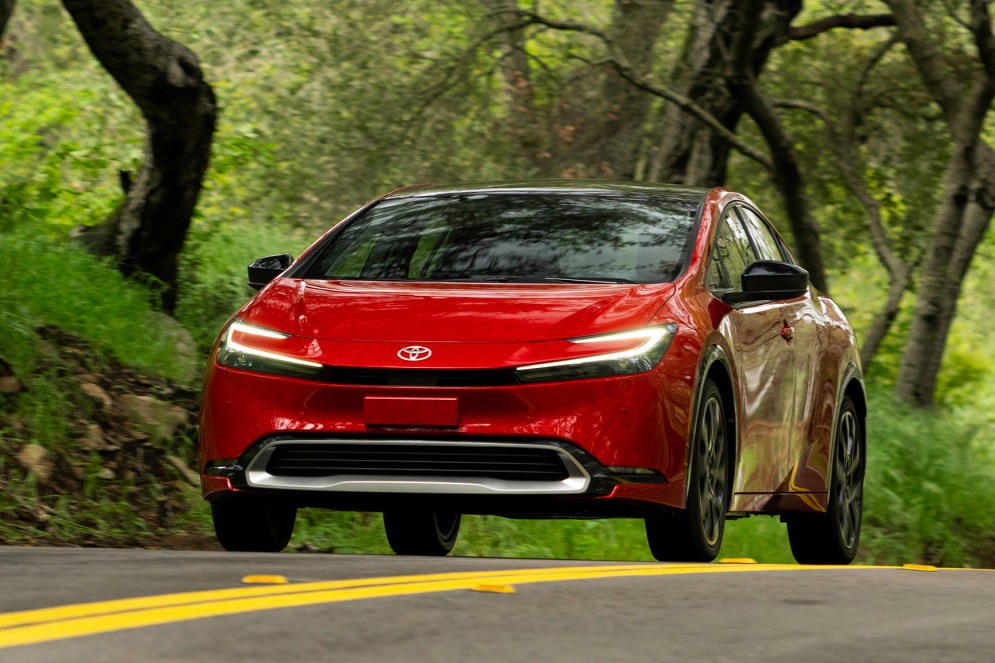
2023-Present Toyota Prius
It’s hard to talk about great fuel economy rankings without bringing up the Toyota Prius. Though not the first hybrid on the market, it’s easily the most popular of all time. That means there are plenty of used Priuses out there to choose from, but we recommend the latest version, which was introduced for the 2023 model year and is the most fuel-efficient car on our list.
The 2023-and-newer Prius looks sharp and is more powerful than the model it replaced. Yet despite its added grunt, this Prius is actually more fuel-efficient than the last generation, seeing a combined EPA figure of 57 mpg with front-wheel drive (FWD) and 54 mpg with all-wheel drive (AWD); the last model had ratings of 52 and 49 mpg, respectively.
2019-22 Honda Insight
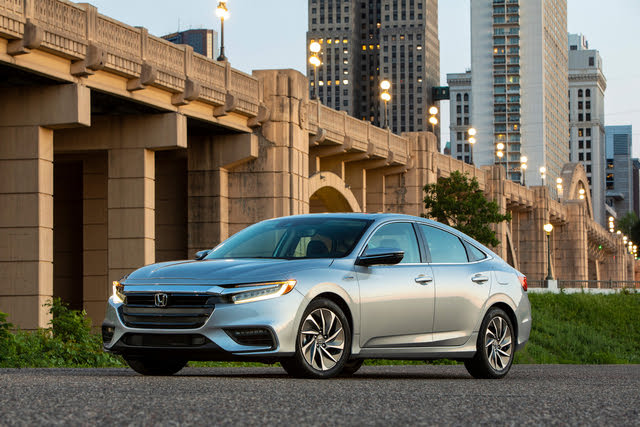
Instead of offering a Civic Hybrid from 2019 to 2022, Honda just used the third-gen Insight to fill that gap in its lineup because, to all intents and purposes, it’s the same vehicle. The Insight shared the Honda Civic’s platform along with its comfortable cabin and pleasing driving dynamics. Heck, the two cars were even built at the same plant in Indiana.
Honda was also able to package the Insight’s batteries under the floor without sacrificing cargo room; that means it has the same cargo volume as the gas-powered Civic. Of course the main draw of the Insight is its outstanding fuel economy, which is 52 mpg combined.
2017-24 Toyota Camry and Toyota Camry Hybrid
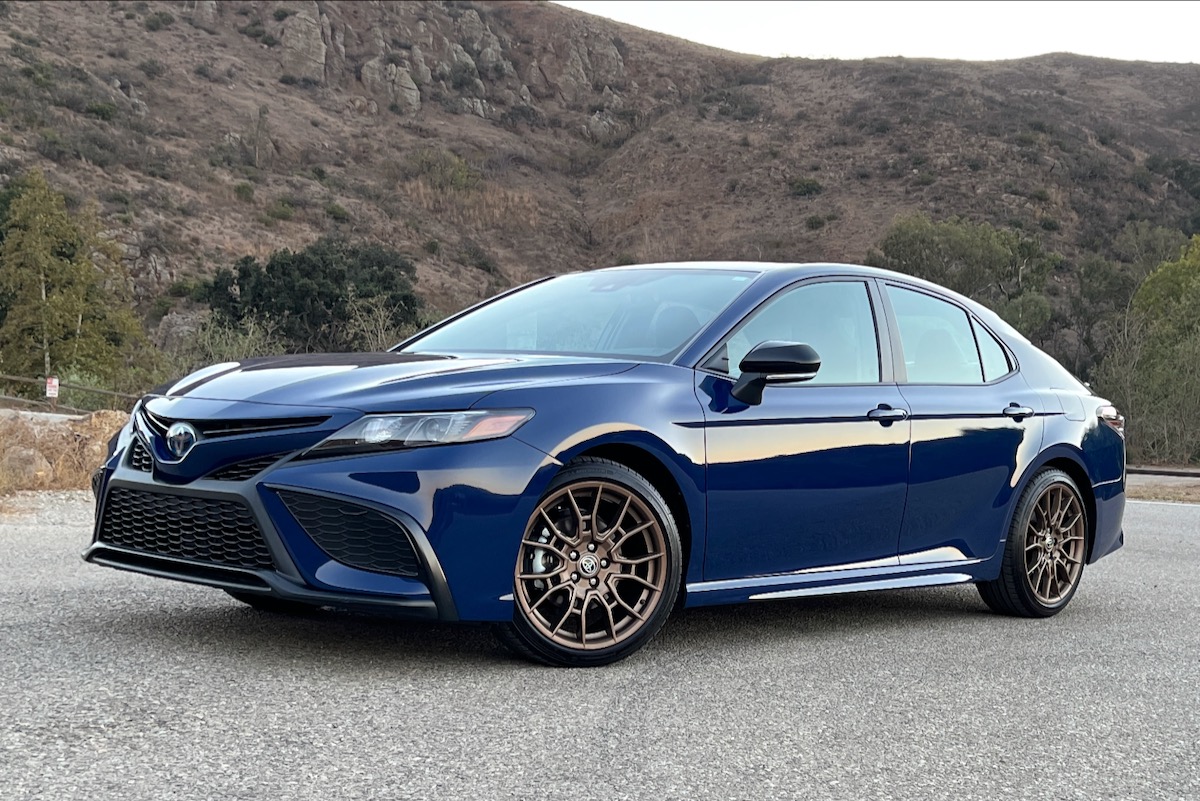
The Toyota Camry has been a staple of suburban driveways for years, and it remains one of the top contenders in the midsize sedan category. The previous-generation Camry, which was sold between 2017 and 2024, is our pick for its mix of value, features, comfort, and, of course, excellent fuel economy.
The hybrid version of the Camry returns a stellar 52 mpg in mixed driving, while the gas-only model is capable of delivering up to 32 mpg combined. Moreover, you can find versions of this Camry with AWD for better all-weather traction, and there’s even a high-performance TRD model with a powerful V6 engine and a more engaging. driving experience. However, the TRD isn’t the Camry to target if you’re concerned with economy: it sees a lackluster 25 mpg in mixed driving. If you’re after something similar but a little more compact, then consider the Toyota Corolla Hybrid.

2021-2024 Kia Sorento Hybrid
The Kia Sorento Hybrid straddles the line between compact and midsize crossover, making it ideally suited for families who want the usability of an available third row but not a gargantuan SUV. With the help of an electric motor, the Sorento Hybrid crossover achieves great fuel economy in combined driving: 37 mpg for the FWD version and 35 mpg for the AWD model. We recommend the current model, which was introduced for 2021 and has plenty of safety features, even with the base trim. If you can live with a little less space, then the subcompact Kia Niro SUV is also worth a look.
2017-22 Honda Accord Hybrid
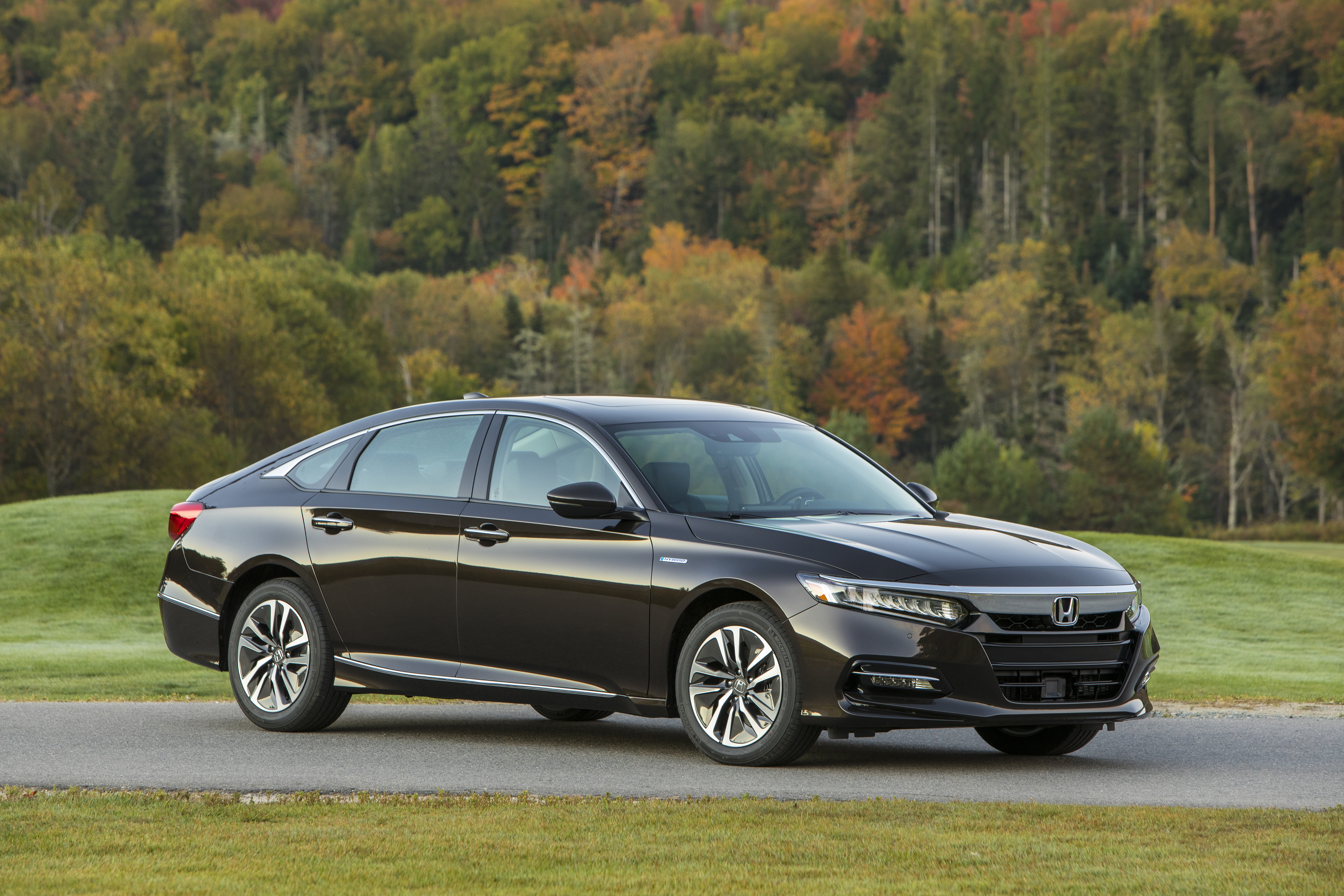
The Honda Accord Hybrid, which competes in the midsize sedan segment alongside the Toyota Camry, earns our pick for this list based on its athletic driving dynamics and propensity to sip fuel. We’d aim for the Accord Hybrid that was produced from 2017 through 2022, as it boasts modern features and a reasonable price. Examples with market-average mileage are readily available in the mid-$20,000 range. The Accord Hybrid returns 47 mpg on the combined cycle, which is good enough to give the midsize sedan a cruising range in excess of 600 miles, or roughly the distance from Indianapolis to Washington, D.C.

2021-24 Hyundai Elantra Hybrid
If you’re looking for an eco-friendly compact car, the Hyundai Elantra Hybrid might just be the ticket. Released for the 2021 model year, the Hyundai Elantra Hybrid makes a great commuter car thanks to its refined ride, and its avant-garde styling helps it stand out in the small sedan segment. Sadly, the even sleeker Elantra coupe was discontinued before it could receive a hybrid powertrain.
Hyundai actually sold a few different trim levels of the Elantra Hybrid, with the most efficient being the Blue model. It’s rated at 54 mpg in combined driving.
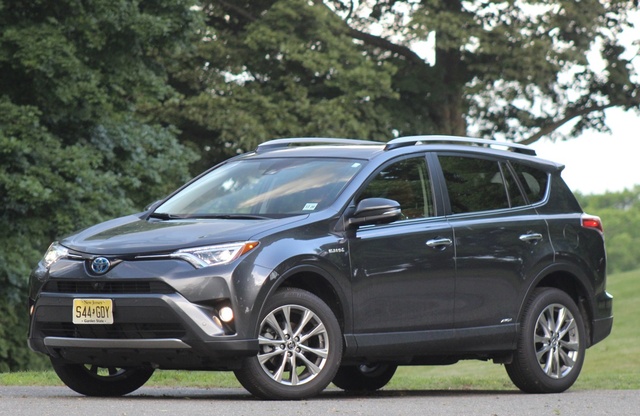
2021-24 Toyota RAV4 Prime
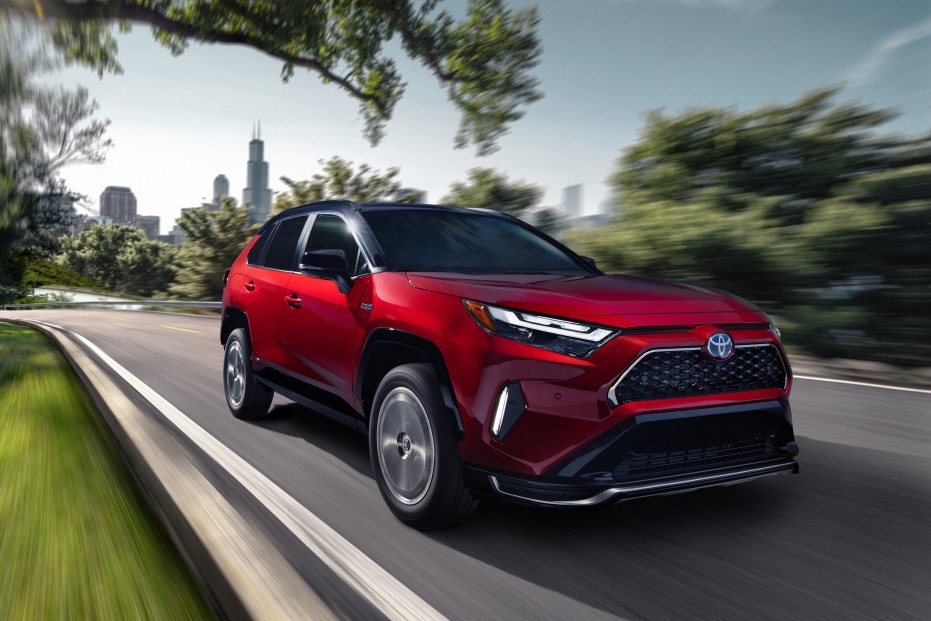
The current-generation RAV4 Prime, introduced in 2020 as a 2021 model, is one of the few plug-in hybrids (PHEVs) in the compact crossover class. The Toyota expertly blends fuel economy with snappy acceleration, courtesy of its 302-horsepower electric-motor-enhanced 2.5-liter four-cylinder powertrain. The dash to 60 mph takes about 5.5 seconds, which is better than the gas-only RAV4’s time of just over eight seconds.
When using battery power, the AWD-only RAV4 Prime crossover can cruise for up to 42 miles on electricity alone and see 94 MPGe in combined driving. On gas, it achieves 38 mpg.

2017-22 Honda CR-V Hybrid
If you want a compact SUV but not a plug-in, the fifth-generation Honda CR-V crossover, which was available as a hybrid from 2020 through 2022 model years, is a great option with practicality in mind. It has loads of cargo space and well-appointed cabin, and there’s loads of cargo room. The CR-V Hybrid crossover comes with standard AWD and boasts more power than its gas-only counterpart but still manages 38 mpg in combined driving, making it one of the most fuel-efficient vehicles in the class.
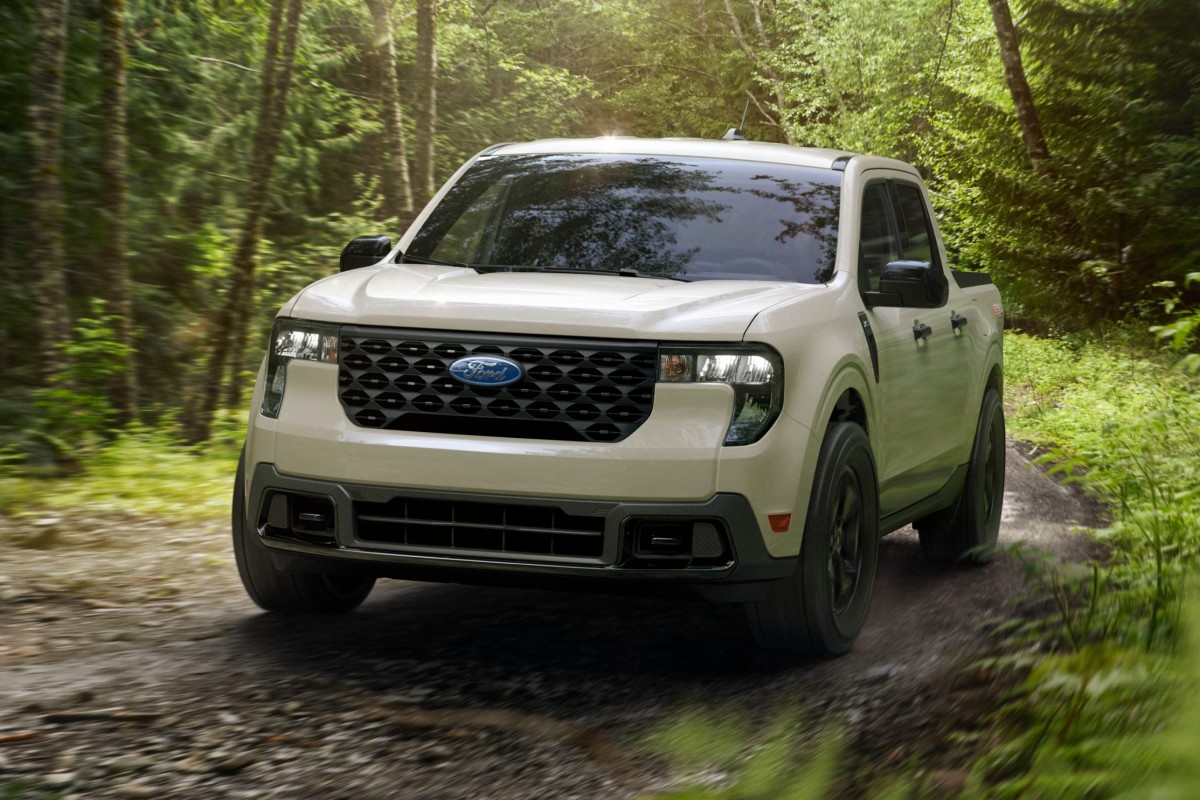
2022-Present Ford Maverick Hybrid
Introduced for the 2022 model year, the Ford Maverick Hybrid is proof that a pickup doesn’t have to be big and inefficient. The FWD version of this compact truck returns 37 mpg in combined driving, which makes it far and away the most gas-efficient used pickup you can buy today.
It’s pretty capable, too, with a tow rating of 2,000 pounds and a payload capacity of 1,500 pounds. The latter is not that far off from what the larger and much less efficient Ford Ranger pickup can haul. The Maverick’s bed isn’t huge, but it measures 4.5 feet in length, which is big enough to accommodate a 40-by-48-inch pallet. There are also a number of bed accessories available, including a bed extender that gives you an additional two feet of usable space.

2019-2023 Volkswagen Jetta
If you have champagne tastes but only a beer budget, the Volkswagen Jetta may suffice. The Jetta punches well above its weight with a luxury-car-like ride and a well-appointed interior that has plenty of space and an accessible infotainment system. Most importantly for this list, it’s great on gas, returning a combined 35 mpg — that’s the same EPA rating as the much smaller and less powerful Nissan Versa subcompact gets.
Factors to Consider When Buying a Fuel-Efficient Used Car
Many factors contribute to a car’s overall fuel economy, but the powertrain is the most crucial, particularly with hybrid cars. After all, it’s the part of the car that’s actually burning the fuel to make it go.
When it comes to engines, size matters; generally speaking, the bigger the engine, the lower the fuel economy. But how can a shopper determine how big a car’s engine is? It’s pretty easy, actually. The size — or more accurately, the amount of air it displaces (known as the displacement) — of an engine should be listed in the powertrain specs. It’s almost universally displayed in terms of liters, making it easy to do an apples-to-apples comparison between two cars. There are certainly exceptions to the rule, but you can typically expect a car with a 2.0-liter engine to be more fuel-efficient than a comparable vehicle with a 3.0-liter engine.

What Makes a Car More Fuel-Efficient?
A good portion of modern cars use a forced-induction device like a turbocharger or supercharger to enhance fuel efficiency. Turbos are more common. They use the flow of exhaust gases to push more air into the engine, which helps it to generate more power. While originally designed for high-performance applications, turbos are now being installed in mainstream vehicles, as they’re essentially a replacement for displacement. For instance, it’s possible for a turbocharged 1.5-liter engine to make the same power as a 2.0-liter while using less fuel.
Cylinder count also comes into play. If you’re shopping with gas mileage in mind, odds are you’ll be looking at cars equipped with four-cylinder engines. The inline-four, which means the engine has four cylinders lined up in a single row, is the most popular engine in the U.S. and, in most applications, offers a good blend of performance and efficiency. If you’re after a gas car with a bit more passing power, you might consider a vehicle with a V6 or even a V8 engine, but you’ll likely have to give up some efficiency.

Are Manual or Automatic Cars More Fuel-Efficient?
A car’s transmission, which sends the engine’s torque to the drive wheels, is another factor affecting fuel efficiency. The vast majority of modern cars have a single transmission option, so you likely won’t have a choice to make. But if you do, know that an automatic — particularly one with eight or more gears — can be more fuel-efficient than a manual gearbox. Also, in recent years, automakers have been moving away from traditional manuals and automatics and toward the continuously variable transmission (aka a CVT), as the latter has an infinite number of gear ratios and therefore can operate at a peak efficiency no matter the engine speed. The CVT is common in hybrid-powered vehicles, though some gas-only cars use them too.
Lastly, a vehicle’s weight and shape are important considerations. Though not exactly scientific, it’s fairly safe to assume that a vehicle that’s big and blocky will return lower gas mileage than something small and sleek. That being said, few of today’s cars are lightweight, and automakers have devised wind-cheating ways to make even chunky SUVs somewhat aerodynamic.

Tips for Maximizing Fuel Efficiency
The most effective way to maximize your vehicle’s fuel economy is through driving style. The smoother you drive (i.e., avoiding jackrabbit starts and slamming on the brakes), the better fuel economy your vehicle will return.
Keeping up on maintenance is another great way to ensure you’re getting the most from a gallon of gas. Confirm that your tires are inflated to the recommended pressure, and be sure to replace your engine’s air filter at regular intervals. Underinflated tires result in increased rolling resistance, which hurts fuel economy, and a clogged air filter can reduce the efficiency of your engine.
Lastly, don’t carry around unnecessary weight or things that could reduce your car’s aerodynamics. Weight is the enemy of efficiency, so clearing out your trunk could result in savings at the pump. Likewise, driving around with a cargo box on the roof increases drag, which lowers your fuel efficiency.