Nissan's flagship model is the Armada—a full-size, three-row SUV that serves as its largest and most luxurious vehicle. As a body-on-frame vehicle, the Armada is heavier and has more towing capacity than a typical SUV. It seats between seven and eight people, offers four-wheel drive with a low-range gearbox, and powerful V8 or turbocharged V6 engines.
Nissan Armada Buying Guide: Cost, Reliability, and the Best Years to Buy
Search for Nissan Armada
See all


Overseas, the current Armada is sold as the Nissan Patrol. The Infiniti QX80 and QX56, which we review separately, are sold as the luxury versions of the Armada across various generations. On the used market, upper Nissan Armada trim levels compete with the Infiniti models as they are mechanically identical to their three respective generations. The Nissan Armada competes with other full-size, body-on-frame SUVs such as the Ford Expedition, the Chevrolet Tahoe, the GMC Yukon, and depending on the year, the Dodge Durango, the Toyota Land Cruiser, and the Jeep Wagoneer. When properly equipped, it also competes with luxury SUVs such as the Lincoln Navigator, the Land Rover LR4, and the Land Rover Discovery.
Nissan Armada Buying Guide: Cost, Reliability, and the Best Years to Buy
- Frequently Asked Questions
- Pros and Cons
- Nissan Armada Generations
- Nissan Armada Third Generation (2025-Present)
- Nissan Armada Second Generation (2017-2024)
- Nissan Armada First Generation (2004-2015)
Frequently Asked Questions
Which Nissan Armada years are the best?
The third generation is the best Armada, and in reality, one of the best full-size SUVs period. The 2025 model was that good in our testing, though reliability is still unknown. If a used 2025 or 2026 Armada is too dear, then get the second generation from the 2021-2024 model years. Starting in 2021, Nissan refreshed the styling and updated the electronics. The V8 engine is excellent.
Which Nissan Armada years are the worst?
Avoid the first generation from any model year (2004-2015). They’re too outdated to be competitive in any metric and very thirsty.
Is a used Nissan Armada a good deal?
Yes. Averaged among all model years for which we have sufficient data, the Armada lists on CarGurus for $29,000. For a vehicle that starts at $59,000 new without options, there is great value in buying a used Armada.
Pros and Cons
Pros:
- Powerful engines
- Body-on-frame design for towing and longevity
- Spacious and comfortable
Cons:
- Poor fuel economy
- Outdated technology (first and second generation)
- Cargo space lower compared to American SUVs
Nissan Armada Generations
Nissan Armada Third Generation (2025-Present)
The newest Armada is an impressive SUV not just among older Armada generations, but among the Expedition, the Tahoe, and other competitors where it truly outclasses them in design, quality, and performance. While the exterior dimensions were largely unchanged for 2025 versus the previous generation, the interior saw significant increases. Front seat legroom was up 4.2 inches, while third-row legroom was up 5.7 inches. Cargo space was also up, with 20.4 cubic feet behind the third row, 56.3 behind the second row, and 97.1 with both rows folded. The exterior sported new headlamps with combination turn signals and daytime running lamps, new vertical taillamps, and nearly the same profile down to the shape of the doors and glass. Air suspension, an off-road Pro-4X trim, and dramatically improved interior design and technology were all welcomed.
Replacing the 5.6-liter V8 engine was a 3.5-liter twin-turbo V6 engine with 425 horsepower and 516 lb-ft torque, paired to a nine-speed automatic transmission versus the older seven-speed unit. Acceleration and noise levels were significantly better. Fuel economy was marginally better, at an EPA-estimated 16 mpg city and 19 mpg highway for four-wheel drive (4WD) models. Towing remained the same at 8500 pounds. The SV, SL, Platinum, and Platinum Reserve trims carried over, with the new Pro-4X slotted between the Platinum trims. Base prices before options ranged from around $57,500 to $77,000.
The 2025 Armada models offered more choices of second-row seating across the lineup, with only the base SV and upper-range Pro-4X coming strictly with a bench seat. The three other trims could be ordered with the bench or captain's chairs. The Armada SV came standard with 18-inch wheels, leatherette upholstery, an eight-way power driver's seat, a four-way power passenger's seat, a six-speaker stereo, two 12.3-inch displays, wireless Apple CarPlay and Android Auto, tri-zone climate control, front knee airbags, front and rear parking sensors, remote start, rear emergency braking, and ProPilot Assist which included adaptive cruise (Intelligent Cruise Control), lane keep assist (Intelligent Lane Intervention), blind spot intervention, and more. There were no options for the SV.
The Armada SL added 20-inch wheels, a leather-wrapped, heated steering wheel with power tilt/telescope, heated front seats, 10-way power driver's seat with two-way lumbar, six-way power passenger's seat with two-way lumbar, EZ Flex second-row seats for one-touch access to the third row, power-folding third-row seats, Google built-in including Maps, Assistant, and Play store, Amazon Alexa, WiFi, wireless charging pad, a 120-volt outlet in the cargo hold, 360-degree cameras (Nissan’s Intelligent Around View Monitor), Invisible Hood View (to show underneath the vehicle), Trailer Back Up Assist, and ProPilot Assist 1.1 (automatic speed guidance when using navigation).
The Nissan Armada Platinum came with upgrades such as fog lights, lighting in the door pockets, ambient lighting with 64 colors, power-folding mirrors with integrated turn signals, panoramic moonroof, power motion-activated liftgate, leather, 12-way power front seats with four-way lumbar and cooling, heated second-row seats, 12-speaker Klipsch premium audio system, two 14.3-inch infotainment touch-screen displays, a dash cam with an in-car camera, biometric cooling (using infrared sensors to automatically adjust the climate in the rear), heated wiper park, 3D renderings for the 360-degree cameras (3D Around View Monitor), and Intelligent Rear View Mirror (using a combination mirror/camera display).
The Armada Pro-4X introduced an air suspension for up to 9.6 inches of clearance and auto-height adjustment at speed and when parked, a rear locking differential, exposed tow hooks, all-terrain tires, skid plates, and a resculpted front bumper. It removed the dash cam, in-car camera, biometric cooling, moonroof, heated rear seats, and 12-way cooled front seats. Instead, they were optional. It added a rear LED light bar and puddle lights. A power liftgate was unavailable.
The Platinum Reserve had a unique leather interior with double-colored stitching and wood-like accents, massaging front seats, two more USB-C ports for the second row, and an additional side airbag positioned between the two front seats. ProPilot Assist 2.1, which allowed for hands-free driving, was optional as it was on the Platinum and SL. A head-up display was optional on all trims except the SV.
For 2026, Nissan gave the Armada the NISMO treatment, with 35 extra horsepower (for a total of 460), a sport exhaust, spoilers, a retuned suspension, and a special grille, red accents, black trim, and 22-inch aluminum-alloy wheels.
At the time of writing, base MSRPs for the 2026 Armada started at $58,840 for the SV, $63,530 for the SL, $70,490 for the Platinum, $74,300 for the Pro-4X, $79,520 for the NISMO, and $80,550 for the Platinum Reserve.
The average used list price on CarGurus for the 2025 Nissan Armada was $67,000 at the time of writing. There were no data for the 2026 model.
Nissan Armada Second Generation (2017-2024)
After 12 years—double the lifecycle of a typical vehicle in one generation—Nissan debuted the second-generation Armada as an all-new SUV based off the Patrol sold in the Middle East and Africa, not the Titan pickup truck of the first generation. Since the Patrol was a specialty vehicle for global markets instead of the U.S.-only Titan, production moved from Mississippi to Japan, while the engine continued to be made in Tennessee.
Nissan skipped the 2016 model year and went straight to 2017, befitting its introduction in early 2016 at the Chicago Auto Show. In addition to a sleeker, more handsome body with Nissan's "V-Motion" grille, smoother sheet metal and a cleaner silhouette (no more hidden rear door handles and chunky fenders), the 2017 Armada was both shorter and longer than its predecessor. Compared to the previous generation, this Armada was 1.2 inches longer and 0.6 inches wider, yet it was 2.2 inches shorter in height and 2.1 inches shorter in the wheelbase. Cargo space was 16.5 cubic feet behind the third row, 49.9 behind the second row, and 95.4 with both rows folded.
The 2017 Armada greatly improved power and safety, and it offered more luxury. The SV, SL, and Platinum trim levels continued with the Nissan Endurance V8, but now the 5.6-liter engine made 390 horsepower and 394 pound-feet of torque due to the switch from port to direct fuel injection and enhancements to valve timing and lift on the intake and exhaust. New pistons allowed for higher compression. A seven-speed automatic transmission, with rev matching on downshifts, replaced the five-speed unit. Full-time four-wheel drive (4WD) with a low-range transfer case was optional, with rear-wheel drive as standard. Towing capacity was reduced from 9,000 to 8,500 pounds. Fuel economy, at an estimated 13 mpg city and 18 mpg highway on 4WD models, was unchanged.
The SV came standard with LED taillamps, LED low-beam headlamps, and LED daytime running lamps, along with navigation, SiriusXM traffic, an eight-inch non-touch display, a 13-speaker Bose stereo, heated eight-way power front seats, cloth upholstery, dual-zone climate, acoustic-laminated windshield and front side glass, push-button start, backup camera, and 18-inch wheels. The SL added a power liftgate, fog lights, power-folding third row, leather, remote start, 360-degree cameras (Around View Monitor), and 20-inch wheels, some of which were optional with the SV. The Platinum came with driver assistance features that were optional on the SL, including adaptive cruise control, forward collision warning with automatic emergency braking that could detect speed differences ahead of the car in front, lane keep assist, blind spot monitoring, and blind spot intervention. Also included were a moonroof, cooled front seats, and a DVD rear entertainment with two seven-inch screens and wireless headphones. Captain's chairs were optional with the Platinum. Base prices ranged from around $45,000 to $60,500 before options and destination.
For 2018, Nissan introduced the Intelligent Rear View Mirror, a combination mirror and LCD monitor that used a separate rear camera to project a live feed over the mirror at the flick of the usual day/night switch. The Armada was the first Nissan to offer this key feature and was standard on the Platinum. The Platinum Reserve returned with two-tone brown seats with checker-pattern stitching, matte wood trim, and dark chrome exterior trim.
For 2019, Nissan made as standard forward automatic emergency braking, forward collision alert, adaptive cruise, and rear door alert (a new feature that reminded the driver to check the back seat before leaving). Heated exterior mirrors became standard for 2020, while 22-inch wheels were optional.
The Armada received a substantial refresh for 2021 with thinner, crisper all-LED headlamps with a new bracket-shaped DRL pattern, new grilles, new bumpers, new taillamps connected by black trim, increased engine output on premium fuel (400 hp and 413 lb-ft of torque), and more standard driver assist features (including blind spot intervention) rebranded as Nissan Safety Shield 360. A Midnight Edition package was available with darker exterior and interior trim, as was a trailer brake controller with trailer sway control. The small dash display was replaced with a 12.3-inch touchscreen with wireless Apple CarPlay and WiFi, along with a redesigned center stack and a new seven-inch color display in the instrument panel.
For 2022, the Platinum added a one-touch function for the power-folding third row. For 2023, the Armada came with standard remote engine start, LED fog lights, auto-dimming rearview mirror, a garage door opener, and Amazon Alexa. Android Auto continued to be offered from a wired connection. A heated steering wheel became standard on the SL. There were no changes for 2024.
Average list prices on CarGurus for the 2017-2024 Nissan Armada ranged between $16,000 to $46,000 at the time of writing.
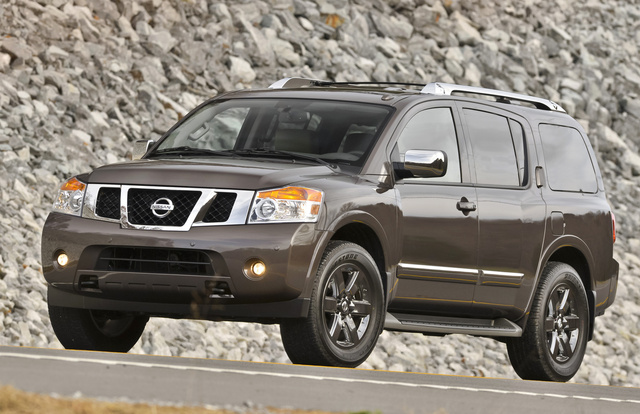
Nissan Armada First Generation (2004-2015)
Launched as the Pathfinder Armada, Nissan's entry into the full-size SUV market was meant to sway buyers who already liked the Pathfinder but wanted it to be bigger. The Armada's biggest advantage was not in physical size. Unlike the Ford, Chevy, Dodge, GMC, and Toyota models that dominated this segment, the Armada had an independent double-wishbone rear suspension that allowed for a lower and flatter floor, which improved passenger space, cargo capacity, and handling. At its debut, the Armada had the most legroom in the second row, while all rear seats could fold down into one continuous, flat floor for up to 97.1 cubic feet of cargo. In that way, the Armada was more like a Nissan Quest minivan than a truck.
Based on the Titan pickup, the first Armada came in three trims (SE, SE Off-Road, LE) with either rear-wheel drive (RWD) or full-time four-wheel drive (4WD). Nissan's Endurance V8 was standard and would be the Armada's only powertrain through the 2024 model year. The reason was simple: At 5.6 liters, it was a tough, throaty, and reliable engine that made 305 horsepower and 385 pound-feet of torque. A five-speed automatic transmission shifted smoothly and quickly, with the ability to tow up to 9,100 pounds. However, fuel economy was rated at 13 mpg city and 18 mpg highway, disappointingly and equally low as it was among all full-size SUVs of this era.
Standard equipment was generous with the base SE, including: Automatic headlights, a roof rack with cross rails, running boards, rear parking sensors, a six-CD stereo, power windows with one-touch up/down in the front, HomeLink garage door opener, auto-dimming rearview mirror, power heated exterior mirrors, power adjustable pedals, keyless entry, manual flip-out rear windows for the third row, and an eight-way power driver's seat. In addition, there were 14 cupholders and the front passenger seat could fold flat like the second and third rows. Safety features included dual front airbags and side curtain airbags (front side airbags were optional on the SE and standard on other trims) plus anti-lock brakes and stability control (Vehicle Dynamic Control). Ground clearance was either 9.9 inches for 4x2 models or 10.6 inches for 4x4 models.
The SE Off-Road came with 17-inch all-terrain tires instead of 18-inch all-season tires, fog lights, a lower final gear ratio, three skid plates, and Rancho shocks. Additionally, a 10-speaker Bose stereo, six-way power passenger seat, and leather were standard and optional on the SE. Options on the SE and SE Off-Road included second-row captain's chairs with a center console, sunroof, and a tow package with a hitch, trailer wiring, an auto-leveling rear air suspension, heavy-duty battery, and a temperature gauge for the transmission. The LE came with the tow package, captain's chairs, power flip-out third row windows, puddle lights, footwell lights, driver's seat memory with easy exit/entry, and heated front seats. Optional were a sunroof, power liftgate, and navigation with a seven-inch screen. A DVD rear entertainment system was optional for all trims. Base prices ranged from around $33,000 to $41,000.
For 2005, Nissan added Red Brawn to the list of paints and made active head restraints and seat belt pretensioners standard for the driver and front passenger. The “Pathfinder” name was dropped. A backup camera was newly optional with the LE, while the power liftgate was now optional with the SE and the SE Off-Road. For 2006, Nissan made dual-zone climate control, a 60/40 split folding third row, and MP3 CD compatibility as standard. The LE gained power-folding and dimming mirrors with exterior turn signals. Majestic Blue and Granite were new colors.
For 2007, the V8 received an enhanced air intake that resulted in 317 horsepower (up 12). Changes to the fuel system allowed the engine to run as a Flexible Fuel Vehicle on E85 (a blend of 85 percent ethanol and 15 percent gasoline). The SE Off-Road trim was discontinued. The 2008 Armada was a mild refresh with revised grilles, new bumpers, new roof racks, restyled headlamps and taillamps, more interior colors and fabrics, a new shifter gate, illuminated controls on the steering wheel, a recolored instrument panel, and a lockable glove compartment. Exclusive to the LE were a heated steering wheel, faux wood trim, an Intelligent Key (which twisted in an ignition but was not metal) and Bluetooth. Optional and only on the LE were a power-folding third row, navigation with XM traffic, a 9.3-gigabyte hard drive for music, and 20-inch wheels. Desert Stone and Timberline were two new colors.
For 2009, some LE equipment such as heated seats and the tow package, which were standard in earlier years and had become optional, once again became standard. New chrome 20-inch wheels were optional. The LE was dropped for 2010 and replaced by two new trims, the Titanium Edition and Platinum Edition, which had varying levels of equipment offered previously. The DVD entertainment system was now standard with the Platinum. Side front airbags became standard, while three exterior colors were added along with body-color side moldings with chrome accents. The interior received a new wood-like trim pattern and contrasting stitching. Nissan switched the trims again for 2011 by replacing the SE with the SV and the Titanium Edition with the SL. The top trim became Platinum. Max towing capacity dropped by 100 pounds to 9,000. Else there were no other major changes.
For 2012, a power liftgate became newly optional on the SV and SL, while the SL came with standard heated front seats. The Platinum had a new padded center console, heated second row seats, and a padded armrest in the second row for the captain's chairs. Brilliant Silver was a new color.
For 2013, the base SV now came with SiriusXM, Bluetooth, and a four-way power passenger seat as standard. A USB port and illuminated vanity mirrors with sliding extendable sun visors were added to all trims. The DVD entertainment system switched from a single eight-inch screen to two seven-inch screens in the back of each front headrest. The Platinum Reserve Package on Platinum established what would become the best Armada trim for years to come, with two-tone brown leather seating, real wood trim, dark chrome accents, and dark chrome body trim with 20-inch chrome wheels. New to the color palette were Midnight Garnet, Graphite Blue, Gun Metallic, Java Metallic and Pearl White. There were no major changes for 2014.
In its final year of the first generation, the 2015 Armada came with new trim designs on the inside door panels, standard driver's seat lumbar, new 20-inch wheels on the SL and Platinum, and two new exterior colors.
Average list prices on CarGurus for the 2010-2015 Nissan Armada (the only model years with sufficient data) were between $8,000 and $11,500 at the time of writing.
Related Topics


by Clifford Atiyeh
Clifford Atiyeh has hosted, directed, and produced more than 300 series-length videos for CarGurus since 2016. He has reported and photographed for dozens of websites, magazines, and newspapers over 20 years, including The Boston Globe, Car and Driver, and Road & Track. Clifford runs CHA Creative, which provides industry analysis and brand marketing to automotive clients.
The content above is for informational purposes only and should be independently verified. Please see our Terms of Use for more details.


