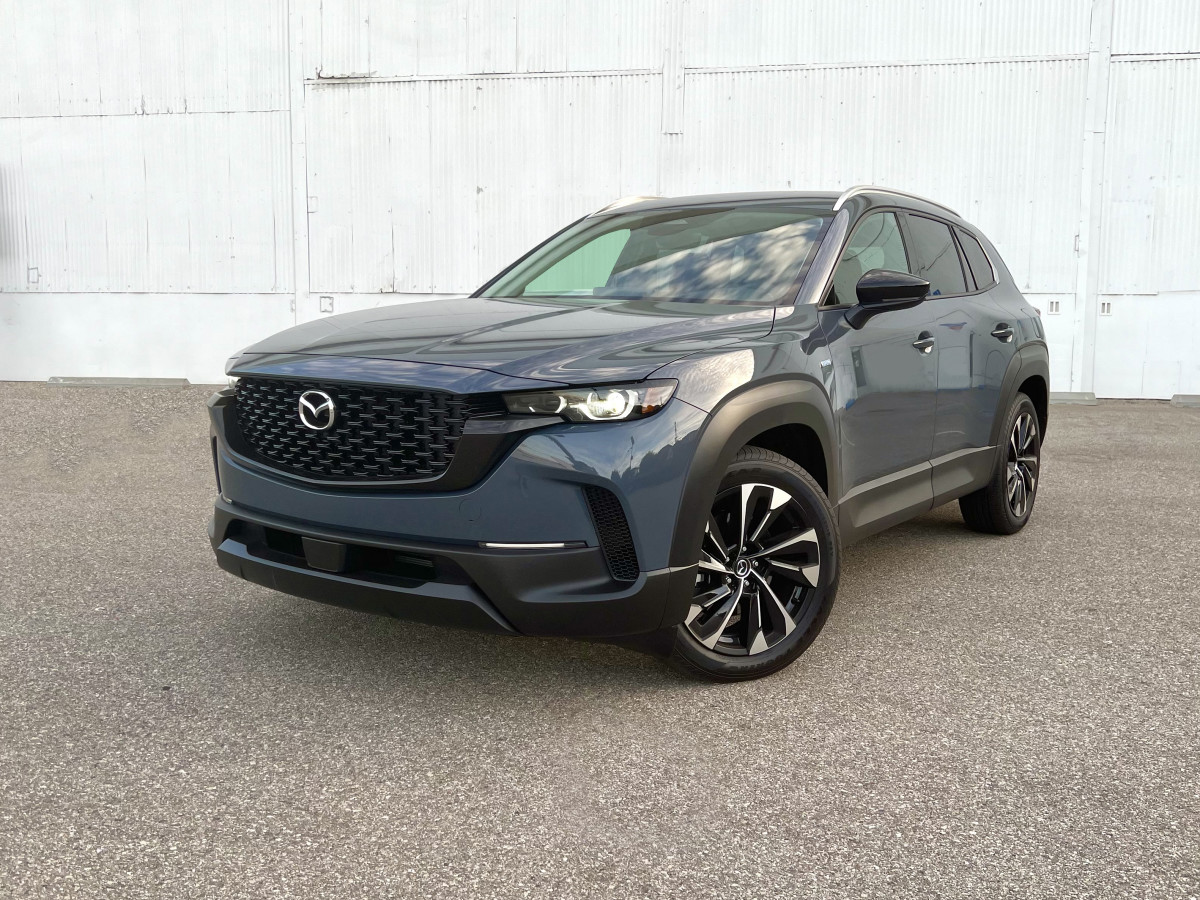
The Mazda CX-30 is a compact crossover SUV that debuted for the 2020 model year. It was briefly sold alongside the slightly smaller Mazda CX-3, which was introduced in 2016 and discontinued from the 2021 model year. The CX-30 was an improvement on the CX-3 in nearly every meaningful way, with more space inside, a premium-quality interior, and a larger, more powerful engine. The 2026 Mazda CX-30 remains a good option for buyers who like small cars but prefer crossovers to sedans or hatchbacks.
The CX-30 is the smallest crossover Mazda currently sells, sitting below the CX-5, CX-50, CX-70, and CX-90 models. Unlike the rest of Mazda’s lineup of crossover SUVs, the CX-30 is not offered with a hybrid powertrain. Instead, the 2026 Mazda CX-30 is equipped with either a base naturally aspirated 2.5-liter four-cylinder engine with 191 horsepower, or an optional Skyactiv-G turbocharged engine with up to 250 hp. Mazda’s i-Activ all-wheel-drive (AWD) system and G-Vectoring Control Plus are standard.
Mazda CX-30 Buying Guide: Cost, Reliability, and the Best Years to Buy
- Frequently Asked Questions
- Mazda CX-30 Pros and Cons
- Mazda CX-30 Generations
- Mazda CX-30 First Generation (2020-Present)
Frequently Asked Questions
Which Mazda CX-30 years are the best?
There haven’t been any significant changes to the CX-30 since it went on sale in the United States. It’s proven a reliable car over the years, so buyers are advised to pick a trim level and a powertrain, then choose a model that falls into their price bracket.
If you’re considering a CX-30 with the base 2.5-liter four-cylinder engine, 2023 and newer versions have a bit more power and improved fuel economy over previous versions.
What are the worst Mazda CX-30 years?
Technically, CarComplaints.com shows more owner complaints from 2021 than any other year, but the actual number of issues has been small regardless of model year. If you’re looking for the turbocharged engine, you’ll have to skip 2020, since Mazda offered only the base 2.5-liter four-cylinder engine for that model year.
Is a used Mazda CX-30 a good deal?
Yes, the Mazda CX-30 can be an excellent deal. Prices for used Mazda CX-30 models fall roughly in line with similarly sized competitors such as the Honda HR-V and the Subaru Crosstrek, so buyers who prefer the premium interior and sporty driving experience that Mazda vehicles offer and don’t mind the CX-30’s cramped rear seats (a test drive should provide both of those answers) shouldn’t have any reason to look elsewhere.
It’s also worth mentioning that the Mazda CX-30 comes with a solid list of driver-assist safety features and has received top safety ratings from the National Highway Traffic Safety Administration and Insurance Institute for Highway Safety.
Mazda CX-30 Pros and Cons
Pros
- Stylish design
- Fun to drive
- Great safety ratings
Cons
- Cramped back seat
- Not much cargo space
- Hasn’t been refreshed in six years
Mazda CX-30 Generations
Mazda CX-30 First Generation (2020-Present)
The new Mazda CX-30 hit dealerships in the United States for the 2020 model year. It was Mazda’s second subcompact SUV, and didn't immediately replace the smaller CX-3 that had been around since 2016. The CX-3 would eventually end production following the 2021 model year. The CX-30 launched Mazda’s updated crossover naming scheme—the existence of the CX-3 and the larger CX-5 compact crossover seemed to suggest the CX-30 should have been a CX-4, but that’s because the next generation of Mazda crossovers hadn't yet debuted—coming before the CX-50, the CX-70, and the CX-90.
When it launched, the CX-30 was offered in four separate trim levels: a base trim, Select, Premium, and Preferred. Standard equipment for the base trim level included 16-inch alloy wheels, LED headlights, keyless entry and an 8.8-inch infotainment screen running Mazda Connect software. Mazda Connected Services were available through the MyMazda app on an owner’s smartphone. Mazda’s i-Activsense driver assistance safety equipment came standard and included driver attention alert, Mazda's radar cruise control (adaptive cruise control) with a stop and go function, lane-departure warning with lane-keep assist, smart brake support (commonly known as automatic emergency braking), and high-beam control, which automatically dips the headlights for oncoming traffic.
Stepping up to the Select trim level brought 18-inch alloy wheels, Apple CarPlay and Android Auto, keyless entry, and blind spot monitors with rear cross-traffic alert. Interior upgrades for Select trim included leatherette seating surfaces, a leather-wrapped steering wheel and shift knob, dual-zone automatic climate control, rear air conditioning vents, and a rear armrest with built-in cupholders.
Stepping up to Preferred trim added features such as a Bose 12-speaker premium audio system with SiriusXM satellite radio, heated front seats, an eight-way power-adjustable driver’s seat with lumbar support, and memory position door mirrors. Outside, the Preferred trim level got a gloss-black front grille.
The top-spec Premium model came with a windshield-projected Active Driving Display (otherwise known as a head-up display), leather seats, a power liftgate, power sliding-glass moonroof, adaptive front lighting system, roof rails, paddle shifters, cylinder deactivation, and LED Signature illumination headlights and taillights.
From launch, the CX-30 came standard with a 2.5-liter four-cylinder engine that sent 186 hp and 186 pound-feet of torque to the front wheels through a six-speed automatic transmission. Mazda’s predictive i-Activ AWD was optional. Fuel economy figures for the 2020 Mazda CX-30 were as high as 25 miles per gallon in the city, 33 mpg on the highway, and 28 mpg combined. Adding i-Activ AWD dropped highway and combined figures by one mile per gallon.
A turbocharged engine with up to 250 hp and 320 lb-ft on premium fuel (the engine runs fine on regular unleaded but power is lowered to 227 hp and 310 lb-ft) became optional for the 2021 model year. All-wheel drive came standard on turbo models, and fuel economy dropped a bit to 22 mpg city, 30 mpg highway, and 25 mpg combined.
Trim levels for 2021, the CX-30’s second year on the market, were updated. The base trim was called 2.5 S, and the S Select and S Preferred were joined by an S Premium trim level. The turbo engine was offered in 2.5 Turbo, 2.5 Turbo Premium, and 2.5 Turbo Premium Plus trim levels. Android Auto and Apple CarPlay functionality became standard across the board, and, as the top trim, only the Premium model got such desirable features as leather seats, navigation, a Bose 12-speaker audio system, a power liftgate, paddle shifters, and a head-up display. The new 2.5 Turbo Premium Plus trim level added parking sensors, rear cross-traffic alert with automatic braking, a surround-view camera system, and traffic jam assist.
All-wheel drive became standard on all Mazda CX-30 models for the 2022 model year. A new Carbon Edition trim level was added, with standard features including blacked-out 18-inch alloy wheels, heated side mirrors with black caps, a unique gray paint color, and red leather seats. The 2023 Mazda CX-30’s base 2.5-liter four-cylinder engine was bumped to 191 hp, and fuel economy rose to 26 mpg in the city, 33 on the highway, and 29 mpg combined (up 3 mpg over the previous year).
The 2024 Mazda CX-30 gained an S Select Sport trim level with the base engine, and a Carbon Turbo trim level with the turbocharged engine. While the regular S Carbon Edition wore Polymetal Gray Metallic paint and had a red leather interior, the 2.5 Carbon Turbo got an exclusive Terracotta leatherette/black suede interior and was available with Zircon Sand paintwork.
There weren’t any major changes for the 2025 model year, but the 2026 Mazda CX-30 trim levels include a 2.5 S Aire Edition and a 2.5 Turbo Aire Edition with white leatherette/gray suede trim. Aire Edition exterior colors include Aero Gray, Snowflake White, Ceramic Metallic, Deep Crystal Blue, and Jet Black Mica. A new limited-slip differential was added for 2026. The 2026 S Select Sport gains wireless Apple CarPlay and Android Auto connectivity, and, starting with the 2.5 S Preferred trim level, a larger 10.25-inch touchscreen infotainment system is standard.
The 2026 Mazda CX-30 2.5S carries an MSRP of $27,470 (price including destination). The least expensive 2026 CX-30 with a turbo engine is the $35,905 2.5 Turbo Aire Edition.
Used models start at about $12,000, but budget for $13,500 or more if you want a car with less than 100,000 miles on the odometer.