In 2003, Infiniti decided to entirely remake the G line, redesigning around the bones of the Japanese-market V35-series Nissan Skyline. All through the late 1990s, the Skyline had become world-famous for its blistering performance via starring roles in video games like Gran Turismo, and it didn’t hurt that the V35 was as stylish and as quick as the BMW 3 Series. For the U.S., it became the Infiniti G35, and sales more than doubled from the G20’s levels, partly helped by a strong aftermarket tuning base.
Available in sedan and coupe body styles, the G35 was just the kick the brand needed to compete head-to-head with the 3 Series, the C-Class, and a new challenger: the Lexus IS 300. Like the Nissan 350Z and the Skyline, the G35 was built on the OEM’s FM rear-wheel drive platform—FM signifying “front midship.” This means the engine’s centerline is placed behind the front axle, so technically in the "middle" of the car. The platform was developed for rear-wheel drive, with all-wheel drive optional.
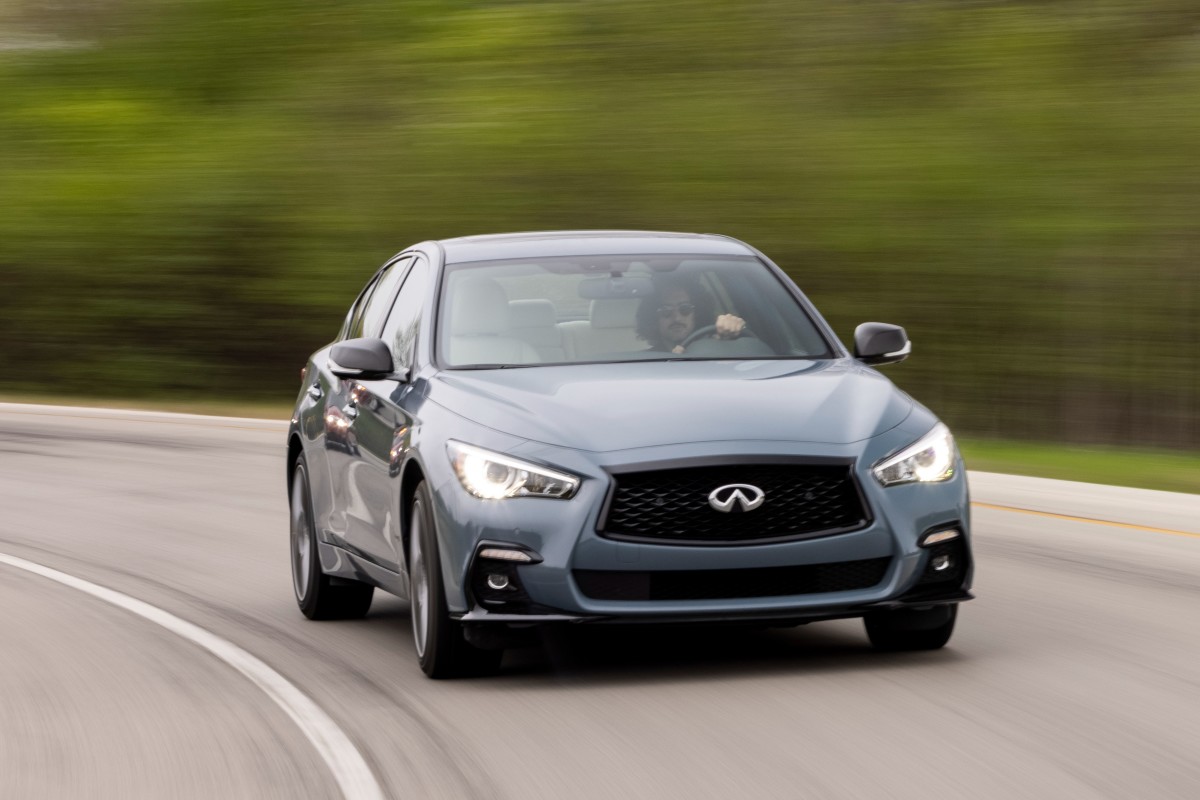
The G35 was Infiniti’s best-selling model for much of its time on sale, and in 2009 its engine was enlarged, and the name changed to G37. This did not blunt the model’s momentum, and Infiniti even launched lower-end (G25) and higher-performance (IPL) versions during the G37 era. But in 2014, the brand decided to rename all of its vehicles with Q prefix alphanumerics, and many consumers were just plain confused as to why all the Infinitis now had the same name. The G37 was renamed the Q40/Q50 (sedan) and Q60 (Coupe), but sales never entirely recovered.
Because it was so popular and a good performer, the G35 is still a popular used vehicle, though many have been used hard. Our buyer’s guide outlines the two G35 and G37 generations and provided some insight into what to watch out for and how much you can expect to pay when buying one.
INFINITI G35 Buying Guide: Cost, Reliability, and the Best Years to Buy
Frequently Asked Questions
Which INFINITI G35 years are the best?
Overall, the G35 and its G37 successor are solidly reliable cars, but it seems like later years in each generation are more sorted out in terms of reliability and quality. Among G35s, that means roughly 2005 to 2007 versions are the best ones to go for. In the G37 years, it’s 2010 and newer.
What are the worst INFINITI G35 years?
The 2003 and 2004 models have more owner complaints on crowd-sourced sites like CarComplaints.com, and many G35 forums (the car has a big fan base) also find more electrical and trim issues in these early years. However, those same years made a desirable Brembo brake upgrade available, and some fans see that as outweighing any potential issues. 2009 models also generate complaints, but the issues center on trim and electrical issues again, not major mechanical hiccups.
Is a used INFINITI G35 a good deal?
Yes. The G35 is generally more reliable and cheaper to maintain than its German rivals from the same era, and it performs just as well as they do. It’s also cheaper to buy, though it doesn’t have the same brand cachet as its rivals. That doesn’t really matter all that much if you’re buying a car more than ten years old anyway, and so long as you inspect carefully, the G35 (and G37) should prove a good experience.
INFINITI G35 Pros and Cons
Pros:
- Sports car performance
- Less pricey than rivals from BMW or Mercedes, to buy and maintain
- Roomy interior, plenty of tech for its era
Cons:
- Can’t get AWD with the manual
- Sub-par interior materials, dated cabin design
- Harsh ride
INFINITI G35 Generations
Infiniti G35 (and G37) Second generation (2007-2013)
The G35’s second generation kicked off in 2007, with the sedan version entirely remade on a redesigned platform shared with the V36-series Nissan Skyline. The Infiniti G35 coupe, however, remained in its first-generation form, and it would not be redesigned until 2008, when it became the G37 coupe. The two different nameplates on the same new chassis ran concurrently that year, before being changed over entirely to the Infiniti G37 (sedan and coupe) for 2009, when they were joined by a new body style: the G37 Convertible.
The style changes over the first-generation models were modest and evolutionary. The G37-era cars look more rounded and have softer exterior details, but they still have the same muscular looks as the original and largely the same proportions. The layout remained unchanged, rear-wheel drive by default, with all-wheel drive optional, though manual transmissions could only be had in rear-drive (they also featured a sport package).
This is also true inside, where materials were improved and the seven-inch nav screen better integrated, but the visual personality remained much the same. The car’s in-cabin tech won high praise at the time, and in the late 2000s, the screen looked great. By today’s standards, it feels a little old, but not as old as some of its contemporaries from this era. These cars don’t have a modern infotainment system, so there are lots of buttons, but they do have Bluetooth and the ability to connect to some devices, such as iPods. They also soon got backup cameras and USB ports, and models after the 2010 refresh have more standard tech features that are still usable today.
The car’s stellar performance remained a main selling point, with its taut chassis and standard rear-wheel drive layout proving excellent feedback through the steering wheel. G35 sedans in this era were powered by a 3.5-liter V6 making 306 horsepower and 268 pound-feet of torque, mated to a five-speed automatic transmission, with a six-speed manual optional. In 2009, the G37 sedan arrived, with the engine enlarged to 3.7 liters and power up to 328 horsepower and 269 pound-feet of torque. The five-speed automatic gave way to a new seven-speed unit, while the six-speed manual remained.
G coupes and convertibles—all G37s after 2009—used the same powerplants and transmissions, but for the 2011 model year, they added the Infiniti Performance Line (IPL) trim, which upped power to 348 horsepower and 276 pound-feet of torque. All G37s were vigorous performers at the time, but the IPL model had only a modest advantage over the regular versions, so buyers rarely chose it. The sport coupe can do zero-to-60 in just over five seconds, but the weightier Convertible (a retractable hardtop design) is a little slower.
In 2011, Infiniti also added the lower-tier G25, with a 2.5-liter V6 making 218 horsepower and 187 pound-feet of torque and aimed at the BMW 328i and Lexus IS250. This model came only with the automatic transmission and didn’t have as many luxury options. Like the other models, all-wheel drive (signified with an x at the end of the name, e.g., G25x or G37x) could be ordered. It cost about $5,000 less than the G37, but it found fewer buyers and only lasted two model years.
Buyers liked the G35 and G37 just as they had in the first generation, and it was a performance bargain, offering handling and power similar to a BMW 3 Series for almost $10,000 less to start. There were three basic trims, the base grade, the better-equipped Journey, and the manual versions, which counted as a separate trim (6MT). The IPL and IPL 6MT also worked this way.
Beyond good performance, the G35 and G37 also have a solid reliability record, with relatively few owner complaints and generally average or above average ratings from outlets like J.D. Power, Consumer Reports, and the Dashboard-Light index. The only caveat is that some examples, particularly IPL models, may have been driven pretty hard or fitted with performance mods, so a pre-purchase inspection is advisable.
Happily, these cars are still affordable, though they aren’t as easy to find used as they once were. A G35 or G37 of this era, in good condition with fewer than 100,000 miles on the odometer, should cost anywhere from about $9,000 to $15,000, and maintenance costs are much lower than those of contemporary rivals from Audi or BMW. The earlier G35 sedans will be at the low end of the spectrum, while Convertible and IPL models can sometimes sell for a little more. Manual versions are rare, but don’t seem to command much of a price premium.
Infiniti replaced the G series with the Q40 (sedan, later the Q50) and Q60 (coupe) in late 2013, but those cars are essentially the next generation of this same basic car.
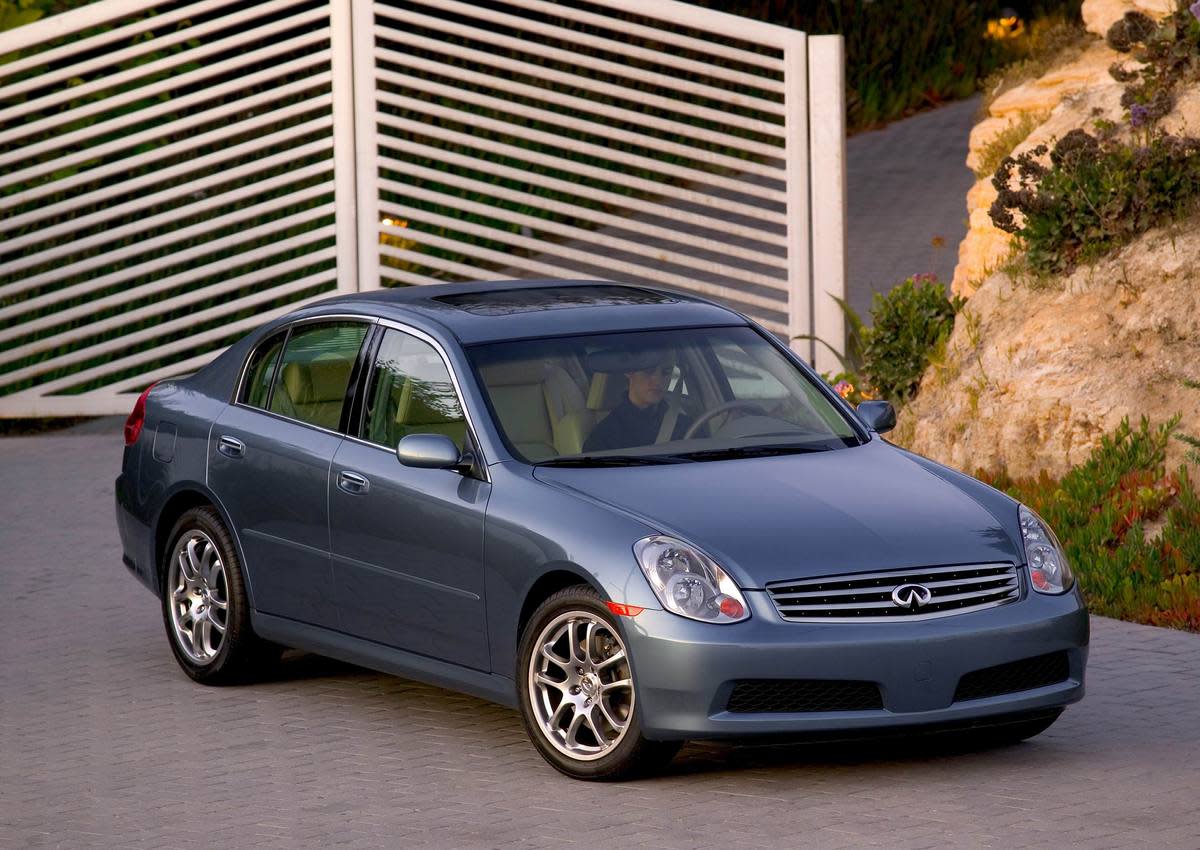
Infiniti G35 First generation (2003-2007)
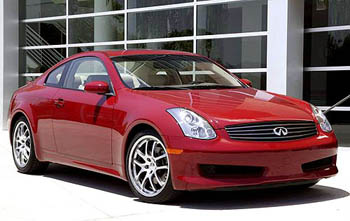
The G35 stormed onto the market in 2003 in coupe and sedan form, wowing reviewers and buyers alike with its luxury styling and impressive performance. Descended from the Nissan Skyline, a model mainly offered only in Japan up to that point; the G35 was a luxury ride with instant enthusiast bona fides and grin-inducing handling. It was an instant success and banished memories of some of Infiniti’s less remarkable previous efforts, like the Nissan Maxima-based i30/i35, which used the same VQ-series engine as the G35 but which wasn’t nearly as interesting.
At first, in calendar year 2002 (2003 model year cars began arriving that summer) only the G35 sedan was available and only in the lower trims, but the models greatly expanded in early 2003. Infiniti’s trim lineup reads weirdly today, as the automaker liked to call out specific options as separate trims. The sedan was available in three models: G35 Sedan, G35 Sedan Leather (which obviously means leather seats—heated seats were optional), and G35 Sedan Sport 6MT. The coupe got the same treatment as the G35 Coupe 5A/T, G35 5A/T Coupe w/Leather, and G35 6M/T Coupe. A Premium package was available with Leather models, which added a Bose sound system. The trim was eventually replaced with the “Journey” grade, which had similar equipment. Individual options included Xenon High Intensity Discharge (HID) headlights, a sunroof, and an Aero package with upgraded alloy wheels a rear spoiler.
Both cars featured a 3.5-liter V6 engine (internally referred to by Nissan as the VQ35DE engine) but with varying performance. The sedan pushed out 260 horsepower and 260 pound-feet of torque and was mated to a five-speed automatic or six-speed manual transmission. The coupe, however, went a bit harder with 280 ponies and 270 pound-feet of twist. Again, that can be mated to a five-speed automatic or six-speed manual transmission, but only with rear-wheel drive.
Nissan’s ATTESA E-TS all-wheel drive system became optional on the G35 in 2004, with all-wheel drive models getting the G35x label. This system adds grip and works well, and it remained in the later G35 and G37 generation, but it only came with the automatic and added a little weight. It can split torque 50/50 front and rear, but in most normal situations it biases the power to the back wheels, and it earned positive comparisons to the Audi Quattro and BMW xDrive systems. Infiniti added a standard viscous limited-slip rear differential to the rear-drive Leather 6MT model that same year.
The coupe and sedan had virtually the same interior, including a cool optional navigation system with a 6.5-inch retractable monitor and plenty of leather in the higher trim. When new, both undercut their nearest Audi, BMW, and Mercedes-Benz rivals by thousands of dollars.
The 2005 model year brought a slight refresh to the G35 sedan, with revamped front and rear fasciae and wheels. The V6 mated to the five-speed automatic got a bump to 280 horsepower and 270 pound-feet of torque. Drivers who chose the six-speed manual transmission (in the coupe or the sedan) were rewarded with 298 ponies courtesy of variable valve timing on the exhaust side, known as “revup”—but the same 260 pound-feet of torque. The sedan also got larger brakes in 2005, as well as the option of a rear limited-slip differential on all trims, while 2006 brought a mild refresh, which included new headlights and taillights and a fresh front bumper, among other styling tweaks.
There were no changes to the sedan, but the coupe improved with available rear active steering. In 2007, the sedan was redesigned into its second generation, but the coupe remained largely unchanged, so the two generations briefly ran concurrently.
The G35 earned great marks for initial quality when it was new from outlets such as J.D. Power, and it continued to rank well for reliability long after it left the showroom. Early models, built from mid-2002 to 2004, have a higher-than-average number of common issues, but they generally center on aging electrical problems, such as malfunctioning window motors and door locks. Some cars of this generation reportedly have high oil consumption, with some owners suggesting a replacement valve cover could solve the issue. Keep an eye out for all the above at the dealership and during a test drive. Once they became affordable used cars, however, many early G35 coupes were modified or used hard, so they may not be the best choices. As a result, we’d recommend only looking for stock examples.
Finding a low-mileage G35 isn’t easy these days, as they’ve been well-known as reliable, good-performing used cars for a long time now and the earliest examples are more than 20 years old.
G35s are priced reasonably for what they are, and you can expect to pay roughly $6,000 to $11,000 for a clean, stock automatic example with under 120,000 miles. Coupes tend to sell for more than sedans, but all-wheel drive doesn’t command much of a premium in either body style. Manual transmission models are much rarer and sell for about 20% more than their automatic siblings.
Related Topics