Fourth generation (2022-Present)
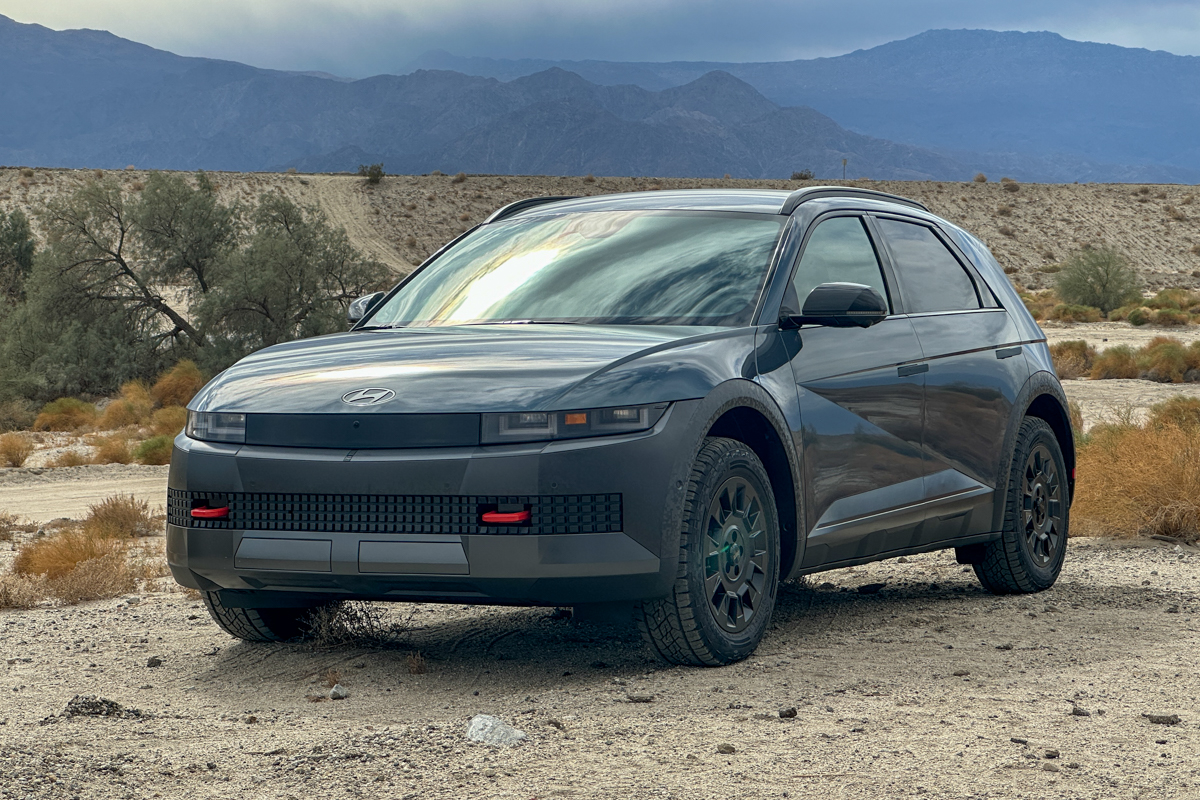
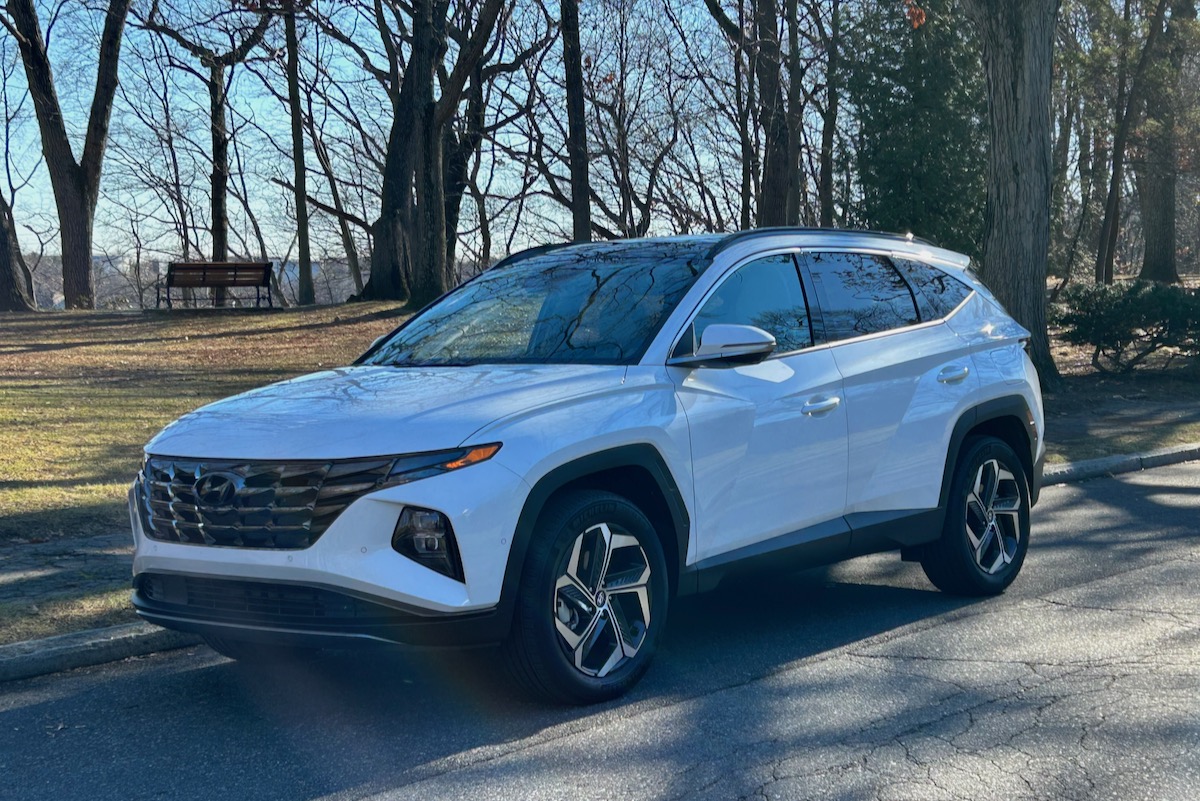
The current, fourth-generation Hyundai Tucson debuted in the 2022 model year and is easily distinguishable from its predecessor. There’s a more high-tech look, with a wide grille that cleverly integrates LED accent lights in its outer edges with the actual headlights positioned where the fog lights typically reside. The side bodywork features the sharp creases that have been incorporated into other Hyundai vehicles, while the taillights have two downward spikes at the corners, with a single illuminated bar tying them together at the top.
Compared with the previous Tucson, this newer model has grown by almost six inches in length, with the wheelbase (the distance between the front and rear axles) accounting for about half of that. This results in an additional three inches in rear-passenger legroom and a 25% increase in cargo capacity behind those seats. As with every Tucson, it shares many parts with the concurrent Kia Sportage.
The fourth-generation Hyundai Tucson is powered by a 2.5-liter four-cylinder engine that produces 187 horsepower and 178 pound-feet of torque. An eight-speed automatic transmission sends power to the front wheels (FWD), with all-wheel drive (AWD) available as an option. There’s also a Tucson Hybrid with 227 horsepower and a 261-hp plug-in hybrid (PHEV) version, both of which are classed as separate models.
The standard Tucson is one of the slower SUVs in its class, requiring 10 seconds to accelerate to 60 mph—lethargic enough to make even conservative drivers wish for more power. The suspension is also tuned for comfort, which makes for a smooth ride but not a particularly exciting drive.
The latest Tucson was introduced in five trim levels: SE, SEL, N Line, XRT, and Limited. Standard feature highlights for the base SE trim include LED headlights, 17-inch alloy wheels, an 8-inch infotainment touchscreen, rear-view monitor, and wireless Apple CarPlay/Android Auto connectivity. Safety highlights include a forward collision-avoidance system with pedestrian detection, lane-keeping assist, a rear passenger reminder, and driver attention warnings.
Tucson SEL models have roof rails, keyless entry and ignition, a power-adjustable driver seat, heated front seats, adaptive cruise control, and a blind-spot monitor with rear cross-traffic alert and steering intervention. An available Convenience package upgraded to 19-inch wheels, a hands-free powered liftgate, sunroof, digital instrument cluster, dual-zone climate control, a wireless charging pad, ambient interior lighting, and a leather-wrapped steering wheel and shift knob. The Premium package could be added to that, bringing leather seating surfaces, ventilated front seats, and a Bose premium audio system.
The sporty N Line model includes the contents of the Convenience package and spruces things up with unique styling accents inside and out, sport seats, and the Bose audio upgrade. The XRT is more outdoorsy, but without any additional off-road hardware or capabilities. Instead, it represents a cosmetic package that adds different bumpers, dark exterior trim elements, side steps, a roof rail, and a tow hitch receiver.
The Limited trim tops off the features list with a panoramic sunroof, upgraded LED lighting, paddle shifters, a power-adjustable front passenger seat, a heated steering wheel, heated rear seats, a 10.2-inch infotainment touchscreen, a navigation system, a blind-spot camera, lane centering, and a surround-view camera system. It also features Hyundai’s Highway Driving Assist semi-autonomous driving feature.
For the 2023 model year, the Premium package was discontinued, with its features split into other trim levels. A few other features were also made available on more models, including adding the panoramic sunroof to the N-Line trim and upgrading the XRT trim to the larger infotainment touchscreen. Adaptive cruise control was also added to the base SE trim. In the following year, the N Line switched to the more powerful hybrid powertrain and was dropped from the standard Tucson lineup.
In 2025, the Hyundai Tucson received a minor styling update, with a subtly revised grille and bumpers. More significant changes happened inside, with a new-look dashboard featuring a single rectangular panel that houses both a 12.3-inch digital instrument panel and a touchscreen side by side. To get it, you have to upgrade to at least the SEL trim with the Convenience package, otherwise, it comes with an analog instrument panel. All models also gained a new climate control layout. The 2026 model year lineup carries over largely unchanged, but with revised trim levels of SE, SEL (formerly Blue), XRT, SEL Premium (formerly SEL Convenience), and Limited.
The EPA initially estimated the Tucson would return up to 29 mpg in combined driving (26/33 mpg city/highway) in front-wheel drive. The AWD model was estimated at 26 mpg combined (24/29 mpg city/highway). These figures were later reduced by one mpg in some metrics.
The 2022 Tucson initially received a four-star rating in overall, frontal, and rollover tests, and five stars in side impact evaluations from the National Highway Traffic Safety Administration (NHTSA). Later in the year, the frontal crash test score was upgraded to five stars, increasing the FWD overall rating to five stars, but the AWD model remained at four. By the 2024 model year, the AWD Tucson increased to five stars. The Insurance Institute for Highway Safety (IIHS) awarded the 2022 Tucson its highest score of "Good" in all crashworthiness tests, and named it a Top Safety Pick+, the Institute's highest honor.
As of early 2026, the MSRP for a new Hyundai Tucson ranges from $29,200 (excluding destination fee and taxes) to $41,825 for the top-spec Tucson Hybrid model. Warranty cover is hard to beat, with a five-year/60,000-mile bumper-to-bumper warranty and a 10-year/100,000-mile powertrain warranty.
Recalls have been fairly light for this Tucson and, in its inaugural year, they were issued for the hitch wiring harness, roof moldings, and headlights/taillights. For 2023 and 2024, a problem with the oil pump emerged, while the hitch wiring problem persisted. They were addressed that year, but for 2025, unrelated issues included the airbags, engine bolts, and a transmission that could slip out of park.
The relative lack of mechanical gremlins likely helped the Hyundai Tucson to retain its value over time. While data is still rather limited, initial reports have it depreciating at a slower rate than many other SUVs in the class.
Third generation (2016-2021)
The third-generation Hyundai Tucson was introduced for the 2016 model year, sporting a far more refined look than its predecessor. It also grew by 2.6 inches in length and just over an inch in its width and wheelbase. This translated to a larger cargo capacity, though passenger space remained about the same.
This Tucson generation's initial engine offerings included a 2.0-liter four-cylinder that produced 164 horsepower and 151 pound-feet of torque, which was only available for the base model and paired with a six-speed automatic transmission. All other trim levels upgraded to a 1.6-liter turbocharged four-cylinder good for 175 hp and 195 lb-ft of torque, paired with a seven-speed automated dual-clutch transmission. Front-wheel drive (FWD) was standard, with all-wheel drive (AWD) available as an option.
With the turbocharged engine, the Tucson could accelerate to 60 mph in about eight seconds, which was an average performance among its peers. Points were deducted for the dual-clutch transmission's occasional stumbles and hesitation, though this was typically only a problem at low speeds. The base engine's specs weren't significantly lower, but it was noticeably slower to get up to highway speeds.
The 2016 Hyundai Tucson was available in four trim levels: SE, Eco, Sport, and Limited. The Tucson SE started you off with the non-turbo engine, 17-inch alloy wheels, heated mirrors, cloth upholstery, a 5-inch infotainment touchscreen display, a satellite radio, Bluetooth, and an auxiliary audio input jack. The Eco was the least expensive way to get the turbocharged engine, and added fog lights, roof rails, and a power-adjustable driver seat.
The Tucson Sport upgraded to 19-inch wheels, a hands-free power liftgate, a leather-wrapped steering wheel and shifter, and a blind-spot monitor with rear cross-traffic alert. The top Limited trim added a smarter interior with additional soft-touch surfaces, leather seats, a power front passenger seat, dual-zone automatic climate control, rear-passenger air vents, an 8-inch touchscreen, a navigation system, and two more speakers. This trim was eligible for the optional Ultimate package that included adaptive xenon headlights, a panoramic sunroof, ventilated front seats, heated rear seats, lane-departure warning, forward collision warnings with automatic emergency braking, and rear parking proximity sensors.
For 2017, the Tucson added Apple CarPlay and Android Auto, but only for the top Limited trim. Meanwhile, the Sport model received the smarter interior materials and, along with the Eco trim, gained the rear air vents. The Limited trim also added an Infinity premium audio system option.
The lineup was rearranged in 2018 with a new SEL trim level that was essentially the SE with a few options from the previous year. These included Apple CarPlay/Android Auto and a 7-inch touchscreen. The new SEL Plus trim followed the same game plan by adding otherwise unavailable features. Elsewhere, the Sport trim received a unique 181-hp 2.4-liter engine, and yet another new model called the Value trim replaced the Eco trim as the most affordable turbocharged choice.
The 2019 Tucson underwent a minor styling refresh that updated the front end to Hyundai's cascading grille with a curving lower section. Inside, the infotainment touchscreen was moved from within the dash to its own enclosure. There was also a push for increased safety, with all models coming standard with frontal collision mitigation, lane-keep assist, and a driver attention monitor. This year also killed off the turbocharged engine. The following year, 2020, was a mostly carryover year for the Tucson, with only the leather-wrapped steering wheel standard on the Sport trim and above. In its final 2021 model year, the third-gen Tucson only had some paint color changes.
The EPA estimated the 2016 Hyundai Tucson would return up to 28 mpg combined (26/32 mpg city/highway) with the front-drive Eco trim. The Turbo engine was surprisingly efficient by comparison, dropping to only 27 mpg combined (25/30 mpg city/highway), regardless of FWD or AWD. At the bottom was the base-engined Tucson with AWD, which registered only 23 mpg combined. By the end of third-generation production, the FWD models were rated at 25 mpg combined and AWD at 23 mpg.
The National Highway Traffic Safety Administration (NHTSA) awarded the third-generation Hyundai Tucson five out of five stars in overall, frontal, and side collisions, and four stars in rollover tests. Likewise, the Insurance Institute for Highway Safety (IIHS) gave the Tucson its highest score of "Good" in all crash tests except for an updated side impact evaluation, where it scored a second-best "Moderate". It was named a Top Safety Pick+, the Institute's highest honor until the 2018 calendar year, when it was downgraded to a second-best Top Safety Pick. It regained the Top Safety Pick+, but only for 2019.
The few recalls issued for this generation were somewhat concerning and included a possible fire caused by the antilock brake controller, which persisted throughout this production run. Other problems included stalling engines and the wired trailer brakes/signals that continued into 2017. Thanks to its relatively trouble-free nature, longer-than-average new-car warranty, and Hyundai's quick action to address any issues, the third-generation Tucson holds its value about as well as any other SUV in its class. Like its rivals, it's dependent on the trim level, with the top trims retaining more of their value over time than the base models.
Second generation (2010-2015)
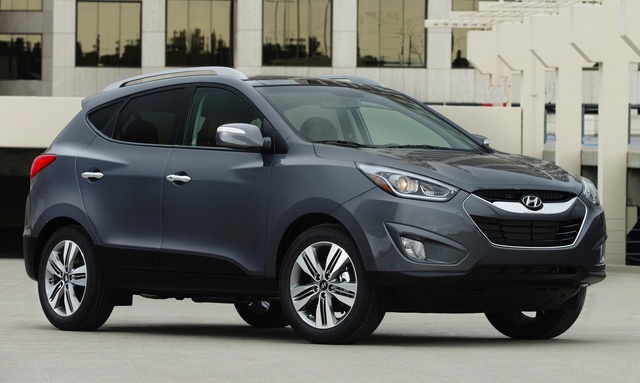
The debut of the second-generation Tucson coincided with Hyundai's transformation from a budget brand to a legitimate alternative to Japanese rivals. Across the entire stable of vehicles, the design switched from depressingly anonymous to distinctive and attractive, inside and out. The redesigned Tucson showcased the new trapezoidal corporate grille with sculpted headlights that bridged the span to the fenders, marking a significant improvement over the previous generation's bugeye headlights and plain rectangular grille.
The Tucson's interior also left a more favorable impression, with elements bespoke to the vehicle, rather than pulled from a common parts bin. Even the air vents were shaped to mimic the curves of the dash, and the rows of buttons were tapered to look more purposeful and intentional. Material quality also saw big improvements, with more soft-touch surfaces and fewer hard plastics.
In terms of size, the 2010 Tucson grew about three inches in length and one inch in width, though it lost almost two inches in height. Despite this, the rear passengers gained a fraction of an inch in headroom, but legroom increased 1.5 inches.
The second-generation Tucson was initially limited to only one engine: a 2.4-liter four-cylinder unit producing 176 horsepower and 168 pound-feet of torque, though in California, it was reduced to 170 hp and 163 lb-ft. A six-speed manual transmission was standard on the base model, while the other trim was equipped with a six-speed automatic. Front-wheel drive (FWD) was standard, with all-wheel drive (AWD) available as an option. The automatic transmission was mandatory for all AWD models. Engine power was about average for the time, but the Tucson distinguished itself from most rivals with its sharper handling.
The 2010 Hyundai Tucson was offered in two trim levels: GLS and Limited. Standard feature highlights for the GLS included 17-inch steel wheels with plastic wheel covers, remote keyless entry, cloth upholstery, air conditioning, power windows and locks, a six-speaker audio system, satellite radio, a USB port with an iPod/iPhone interface, and an auxiliary audio input jack.
An optional Popular Equipment package added roof rails, body-colored exterior trim elements, cruise control, heated mirrors, a leather-wrapped steering wheel with audio and cruise control buttons, synthetic leather seat trim, and Bluetooth. If you wanted navigation, you'd have to add it onto the Popular Equipment package, along with a rearview camera and a subwoofer.
The Limited trim included the Popular Equipment package and upgraded to 18-inch alloy wheels, chrome exterior elements, fog lights, leather seats, heated front seats, a power-adjustable driver seat, and dual-zone automatic climate control. This trim was eligible for the Premium package that eliminated the roof rails but added a panoramic sunroof and the Navigation package.
For 2011, the Tucson lineup grew to include a new base GL trim that came with a 165-hp 2.0-liter four-cylinder engine. It was paired with either a five-speed manual or an optional six-speed automatic transmission, but AWD was not available. This new GL trim essentially took the previous GLS trim's features list, while the GLS now included the Popular Equipment package. In 2012, the suspension was adjusted for a more comfortable ride quality, while fuel economy improvements were made thanks to the inclusion of low-rolling-resistance tires and engine/transmission tunings.
The 2013 Tucson added the heated front seats and foglights to the GLS trim, and keyless entry/ignition to the Limited. In 2014, the GL trim and the manual transmission were both discontinued, but a new midrange SE trim debuted. The GLS trim adopted the 2.0-liter engine and made AWD available, while the SE upgraded to the 2.4-liter engine, which increased output to 182 hp thanks to direct fuel injection. In its final 2015 model year, the second-generation Tucson carried over without any notable changes as Hyundai prepared for the next big redesign.
The 2010 Tucson was estimated to return up to 26 mpg combined (23/31 mpg city/highway) with FWD, and 24 combined (21/28 mpg city/highway) with AWD. If you opted for the manual transmission, that dropped estimates by about one or two mpg. In the following years, these figures dropped by another one or two mpg. The 2.0-liter engine was initially rated at 25 mpg combined (23/30 mpg city/highway) in FWD, and 23 mpg combined (20/27 mpg city/highway) with AWD.
Crash tests from the National Highway Traffic Safety Administration (NHTSA) were not available for the first few years of production, but the 2012 Tucson received four out of five stars for overall, frontal, and rollover protection, and five stars in side impact tests. The Insurance Institute for Highway Safety (IIHS) awarded the 2010 Tucson its highest score of "Good" in all crashworthiness tests except for the newer driver-side small overlap frontal collision, where it received the lowest score of "Poor". Despite this, the Tucson was named a Top Safety Pick through 2013, the Institute's highest honor until the Top Safety Pick+ debuted that same year.
The 2010 Hyundai Tucson received recalls for a possible fire caused by the antilock brake controller, malfunctioning brake lights, and an airbag passenger sensor. The brake lights and airbag sensor were fixed by the next year, but a transmission cooler hose problem appeared in 2011. The ABS controller issue persisted throughout the production run and was joined by a steering wheel airbag problem that wasn't fixed until 2014, and an oil leak that wasn't addressed until 2013.
Tucsons of this vintage have held their value better than most equivalent SUVs. They've even managed to appreciate slightly in recent years from their lowest resale point in 2024.

First generation (2005-2009)
The original Hyundai Tucson went on sale as a 2005 model, with the base version powered by a 2.0-liter four-cylinder engine that produced 140 horsepower and 136 pound-feet of torque. It was paired with either a five-speed manual or a four-speed automatic transmission, with front-wheel drive (FWD) as standard. All-wheel drive (AWD) was available, but only with the manual transmission. All other Tucson trims were upgraded to a 2.7-liter V6, good for 173 hp and 178 lb-ft, and it was exclusively mated to the four-speed automatic.
The 2005 Tucson was available in three trim levels: GL, GLS, and LX. The entry-level GL's standard feature highlights included 16-inch alloy wheels, roof rails, heated side mirrors, power windows and locks, cruise control, air conditioning, cloth upholstery, and a six-speaker audio system with a CD player. This was well before the adoption of advanced safety features, so the most notable items included anti-lock disc brakes, traction and stability control, and airbags.
The midrange GLS trim was the most affordable model with the V6 engine and only added minor features such as a leather-wrapped steering wheel and a subwoofer. The LX was the more luxurious alternative, adding fog lights, a six-CD changer, leather seats, heated front seats, and remote keyless entry. A sunroof was available as an option.
The LX trim was renamed Limited for 2006 and added body-colored exterior trim and an auto-dimming rearview mirror. For 2007, the GL trim was eliminated, but a new midrange SE trim made up for it and, as such, the GLS was downgraded to the four-cylinder engine. The following year, satellite radio and an auxiliary audio input jack became standard equipment. In its final year before the second-generation redesign, the 2009 Tucson made some driveline upgrades to improve fuel economy and introduced a navigation system as an option, among other minor feature shifts.
The EPA estimated that the 2005 Hyundai Tucson would return up to 22 mpg combined (20/25 mpg city/highway) with the manual transmission and FWD. The automatic was nearly identical, while opting for AWD dropped those figures by one mpg. The V6 was rated at 20 combined (18/24 mpg city/highway) with FWD and 1 mpg lower with AWD. Over the years, these estimates only varied by one or two mpg.
Crash test results from the National Highway Traffic Safety Administration (NHTSA) were not available for the first-generation Tucson, but the Insurance Institute for Highway Safety (IIHS) gave it the second-best score of "Acceptable" for frontal and side protection, and the lowest score of "Poor" in Rollover evaluations.
The 2005 Tucson was issued recalls for its brake lights, airbags, parking brake, and stability control. The brake light problem persisted throughout production, while the airbag issues were finally addressed in 2007. Given that the earliest examples are now more than 20 years old, and that a Tucson of this era isn’t likely to be anyone’s prized possession, it’s worth giving any potential purchase a good test drive to check for any obvious issues. The first-generation Tucson retains its value about as well as any other SUV of the era, with the cheapest examples available for less than $3,000.
Related Topics