Those old enough to have thumbed through inky classified ads will remember how much easier car shopping became when it moved online. Buyers could search for an exact make, model, year, spec and more, no longer hoping to find a vaguely suitable used car for sale alongside want ads in the local newspaper—it was revolutionary stuff.
Time, tech, and the car market have since moved on, and the drop-down filters have become as laborious as the old, printed ads. New models, body styles, brands, and fuel types have all added complexity, so many shoppers feel overwhelmed by information and just don’t know where to start searching for their used car.
AI car search is the next and latest step—and it does away with all the above. Intuitive prompts can help consumers turn vague ideas into a sharply honed shortlist and make informed decisions about the car they eventually buy. CarGurus Discover does exactly that, and its AI-first approach to car shopping has access to the country’s largest used car marketplace, heaps of data, and decades of experience designing better ways to search and shop for cars.
This article explains how AI car search works and how shoppers can use it effectively.
How AI Car Search Engines Work (and How to Use One to Find Your Next Car)
- The Old Way of Car Shopping is Ending
- CarGurus Discover: AI Search That Shows Real Cars
- How AI Changes Car Shopping
- How to Use AI to Search for a Car
- The Bottom Line
Quick Answer: How Does AI Car Search Work?
AI car search lets you describe what you're looking for in plain language instead of filling out filters—and matches you with real, available listings in seconds. Here's what to know:
- How it works: Say or type what you need in your own words—no makes, models, or specs required
- Real results: Unlike ChatGPT or Copilot, CarGurus Discover connects directly to live used car inventory
- Refine as you go: Follow-up prompts like "under $25K" or "lower mileage" narrow results conversationally
- Deal transparency: Every listing includes CarGurus' Instant Market Value so you know if you're getting a good deal
- Save your search: Each session gets a unique URL—log in and pick up where you left off anytime
The Old Way of Car Shopping is Ending
Information Overload
A buyer in the market for a used mid-size SUV—and that’s a lot of people—has their work cut out for them, because there’s a staggering amount of choice. Sure, there are reviews, comparisons, and umpteen other sources to help whittle down the options, but the sheer volume of choice from all angles can be paralyzing. And that’s just for one type of car.
The Filter Frustration
Filters are great for buyers who know what they’re looking for, but they can be more of a hindrance than a help when the start point is information overload. They require exact makes, models, specs, years, and price brackets, among other elements, none of which help buyers who are scratching their heads. They also don’t capture the “feels right” factor of a more sophisticated search, because it isn’t possible to filter for a “reliable SUV that feels fun to drive”.
Defining Needs vs. Wants
Lots of buyers have a vague idea of the type of car they want but struggle to articulate it beyond an initial concept. They might know they require something similar to their existing car and have an idea of the things they want to change, but that’s still ambiguous. This is where using AI to search for cars kicks in, because there’s a big difference between searching for “SUV” and “SUV with good cargo space, AWD for winters, fuel efficiency for commute”.
Lack of Expertise
Many shoppers are unsure which car is right for them. Not everyone knows a six-cylinder engine from a hybrid drivetrain or subcompact—and that’s nothing to be ashamed of. Most buyers aren’t automotive experts, which makes it all the more difficult when they kick off their research, because they may not be aware of how different specs translate into real-world benefits.
Time Consumption and Decision Fatigue
It can take buyers a really long time to find a used car when they don’t know what they’re looking for and there’s information coming at them from all angles. As beneficial as choice can be, whittling it down is laborious, and it’s easy to lose hours browsing listings. Then there’s the need to evaluate potential options against rivals to make sure a car actually fits the bill.
In short, the traditional way of searching for a used car online assumes that the shopper is an expert who knows exactly what they want. The reality is that most people know the feeling they want but not the technical specifications, and that’s where AI car searches come into their own.
CarGurus Discover: AI Search That Shows Real Cars
CarGurus Discover: At a Glance
- Conversational search using natural language
- Connected to the largest used car inventory in the U.S.
- Instant results showing real, available listings
- Persistent sessions—save your search and continue later
- No filters or forms required
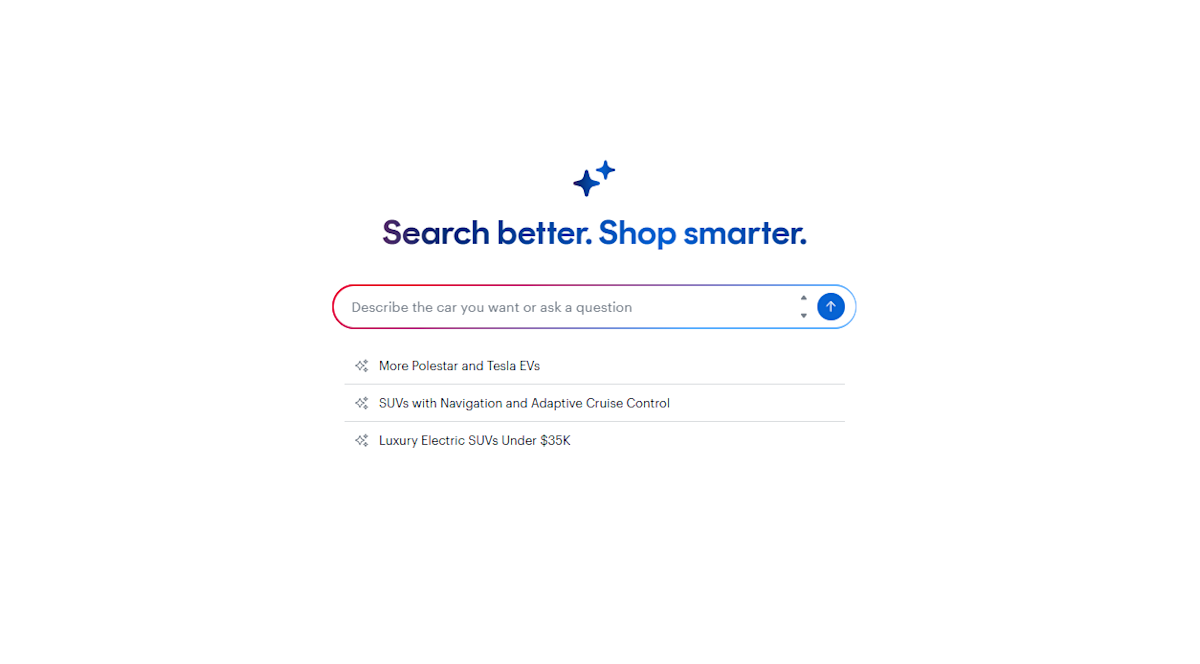
Search the Way You Talk
Buyers can use AI to search for cars by describing what they’re looking for in their own words and in as much or as little detail as they want. Think of it as replacing the filters with a chat.
Shoppers might use prompts such as “I’m a new parent looking for a safe, reliable SUV under $30K,” “Help me find a car with good tech features for my commute," or “I’d like a truck that can tow my boat but still gets decent gas mileage”.
Connected to Real Inventory
Discover is not like using large language AI platforms that provide text-based summaries or directions. The big difference is that it provides shoppers with actual listings of cars for sale on CarGurus. There are no generic suggestions, and every result is a real car for sale at a dealer right now, drawn from CarGurus’ comprehensive database, which has more inventory than Autotrader, Cars.com, TrueCar, or CarFax.
Instant, Tailored Results
The “out with the old, in with the new” search format means there is no fiddling with filters or any form of multi-step process to narrow down options. Buyers can find cars with AI in seconds, and the listings they see match whatever they’ve described.
Refine Through Conversation
Simple though Discover is, it’s not a case of one and done. Shoppers can ask follow-up questions to narrow down the results with prompts such as “show me options under $25K,” or “what about with lower mileage?”. The listings are refined by keeping the conversation rolling, instead of scrolling back to adjust a heap of filters.
Continue Where You Left Off
Discover generates a unique URL for each search, so buyers can always tap out and come back later to pick up the conversation where they left off without having to start from scratch. Shoppers must be logged into their CarGurus account to use this feature, but it’s otherwise automatic.
Deal Intelligence Built In
CarGurus core features form part of Discover, and listings to which it directs shoppers include our Instant Market Values to illustrate whether a car is a great deal, a good deal, or a fair deal. As always, pricing transparency is built into everything we do, so buyers can see exactly what they’re getting at every stage of the process—and generic AI tools don’t do that.
How AI Changes Car Shopping
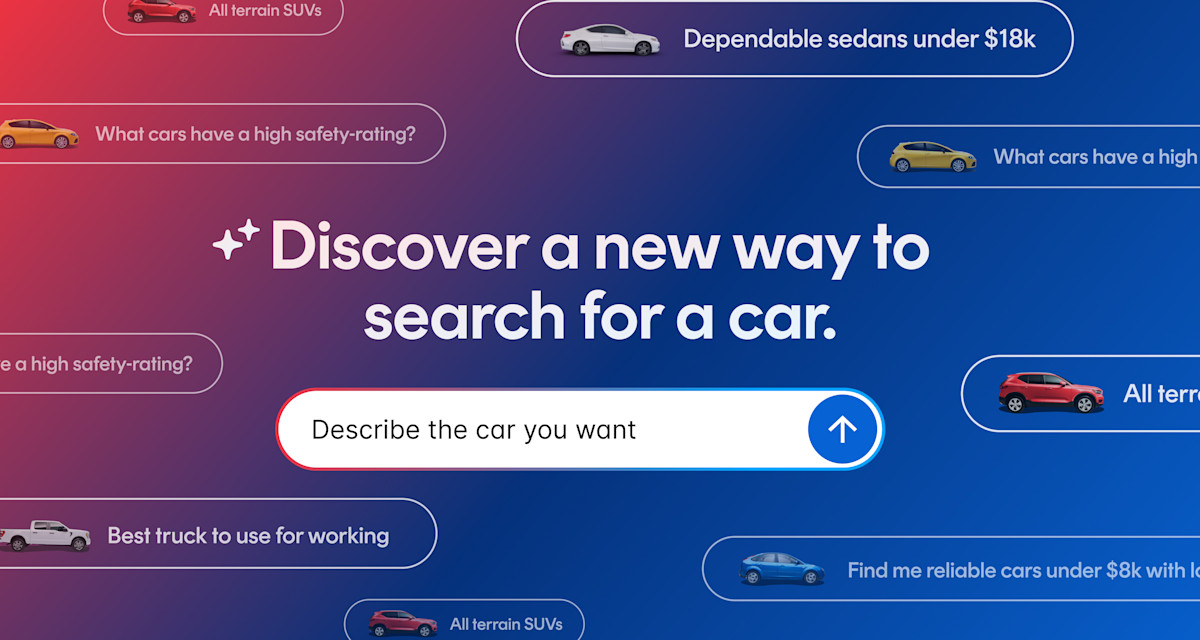
An AI-powered car search engine differs from a traditional filter-based tool in one fundamental way: it interprets what you mean, not just what you type. Where conventional car search engines require shoppers to input exact makes, models, and specs, an AI car search engine parses natural language to match shoppers' intent—so a search like "find my perfect family SUV under $30K" yields real, relevant results rather than a prompt to refine your filters.
Conversational Understanding
AI’s most revolutionary impact on car shopping is its ability to understand and respond to natural language, which shifts the process from being mechanical to conversational. It can process and interpret how a buyer actually talks, and understand context, preferences, and priorities. That means consumers don’t need to start their buying journey with technical jargon, exact specifications, or even a firm idea of what they want—they can just ask.
Personalized Matching
A natural language car search translates those conversations into relevant criteria to match shoppers with listings that align with what they’re looking for. It considers multiple factors simultaneously and, throughout the course of a chat, learns what matters most to buyers based on how shoppers describe their needs.
In practice, that might change a traditional, filter-based search from the following:
- Make: Honda
- Model: CR-V
- Year: 2020-2023
- Price: $20,000-$25,000
- Mileage Limit: 60,000
- Distance: 50 miles
to something like this:
"I need a reliable family SUV with good safety ratings, space for kids' sports gear, decent gas mileage, and average miles for under $25,000. Keep it local if you can."
Real-Time Results
AI car shopping tools, such as Discover, only match buyers with used cars that are available right now. There are no generic summaries or recommendations, which are typically what the major large language models such as ChatGPT and Microsoft Copilot produce. While those platforms can be useful for conversational advice, they aren’t connected to real-world used car inventories, so they’re more like research assistants.
That’s the big difference with a car shopping platform such as Discover, which blends conversational car searches with the country’s largest used car inventory and draws on CarGurus’ wealth of expertise and longstanding history as a transformative car-shopping marketplace.
How to Use AI to Search for a Car
Be Specific About What Matters Most
There’s a temptation to think that AI will do everything for us, but the reality is we get out what we put in. The more information buyers provide, the more accurate the results, so buyers shouldn’t just say “SUV”—they should explain why they need one and what they’ll use it for. Provide enough detail, and AI can find the perfect car.
It’s like talking to someone who knows about cars—the go-to gearhead we always ask for advice. A good way to start with an AI search might be, “I need an SUV because I have three kids, and we do a lot of camping trips”. An even better way is, “I need a three-row SUV with good cargo space for camping gear, that’s reliable in snow, and costs less than $35,000”.
Describe Your Lifestyle, Not Just Specs
Filter-based searches rely on specs and specifics—AI doesn’t, and it’s actually more effective when shoppers describe their real-life circumstances in context. For example, instead of “200+ horsepower,” say, “I want something that feels quick when merging onto highways”. If economy is a priority, instead of “30+ mpg,” say, “I have a 50-mile daily commute and want to keep fuel costs down”.
Search by Features
Unlike filter-based search, which requires shoppers to select specific makes, models, and trim levels, AI lets buyers search cars by features and real-world priorities. Rather than knowing that a Honda CR-V or Toyota RAV4 comes standard with all-wheel drive, a shopper can simply say "I need something reliable in snow with good cargo space," and the search engine does the feature-matching work for them.
Include Your Constraints
Buyers will get the most out of AI searches when they include their limitations as well as what they want. A budget is the most important factor, followed by location—and the more context, the better, as a phrase such as “good in Chicago winters” will go a long way. It also helps to include priorities and lifestyle needs, such as “reliability matters more than fancy features,” and “fits two car seats comfortably”.
Ask Follow-Up Questions, Then Narrow it Down
There’s no obligation to go with the first results from an AI search, because they can simply be a start point for refinement, and it’s a good idea to view the initial search as casting a wide net. Buyers who throw it more pointed questions, such as “what about with better gas mileage?” or “show me similar cars under $28,000 instead,” or “which of these has the best safety rating?” will quickly narrow their search to a rock-solid option.
Example Conversation Flow:
You: "I need a reliable family car with good safety features under $25K"
AI: [Shows results]
You: "What about options with third-row seating?"
AI: [Shows results]
You: "Which of these gets the best gas mileage?"
The Bottom Line
Old-school online car shopping requires buyers to come armed with at least a certain amount of information before they start, while those who lack expertise (which is most people) and/or a clear idea of what they want are going to have to put the hours in. As a rule, only car nuts who love scrolling the classifieds enjoy any of that, and it can be a frustrating time-sink for the average Joe.
AI car buying tools, such as CarGurus’ Discover, change the game. They remove all the traditional barriers and provide shoppers with a natural way to search from scratch without any prior knowledge. They differ from the big, generic AI platforms by serving up links to real cars for sale now as part of their results, which buyers can tweak and refine by continuing the conversation—and they can leave and return to a search at any time.
Ready to give AI car shopping a shot? Try CarGurus Discover. Describe your ideal car in your own words, and get real, available listings in seconds.