The Honda Civic Type R turns everything you thought you knew about the Civic on its head. Solid, reliable, economical. These are the sorts of things that spring to mind when you think Honda Civic, not a high-performance driver's car. But Honda has worked its magic on successive Civic Type R models, making it a contender for one of the best front-wheel drive hot hatchbacks of the past 30 years.
Honda Civic Type R Buying Guide: Cost, Reliability, and the Best Years to Buy
Search for Honda Civic Type R
See all


It has been around since 1997 and spanned six generations, although only the final two have officially been sold in the U.S. The current sixth-generation model is one of a dwindling number of new cars available with a manual transmission, which continues Type-R tradition and only boosts its appeal in enthusiasts' eyes.
As of late 2025, the future of the Civic Type R is unclear. In European markets the Type R will be discontinued in 2026 due to new emissions regulations, and although 2025 model year examples can still be bought new in the US, there's no news on the 2026 model.
Our buyer's guide takes an in-depth look at each generation of Civic Type R that has been sold in the US, exploring the model's history and the best and worst versions to buy.
Honda Civic Type R Buying Guide: Cost, Reliability, and the Best Years to Buy
- Frequently Asked Questions
- Honda Civic Type R Pros and Cons
- Honda Civic Type R generations
- Sixth Generation (2023-present)
- Fifth Generation (2017-2021)
- Previous Generations (1997-2017)
Frequently Asked Questions
Which Honda Civic Type R years are the best?
The latest sixth-generation model, built from 2023, is not only the most complete Type R to date, but also had five recalls listed on NHTSA.gov at the time of writing, compared with 20 for its predecessor (that's been around for longer, so its foibles have had more time to come to the surface). That doesn't mean either is unreliable, because Honda has a legendary reputation for building extremely durable vehicles—and that applies just as much to its superbly engineered sports cars and hot hatches.
What are the worst Honda Civic Type R years?
The main thing to watch out for with any Civic Type R is how it's been driven. It's built to be thrashed, so we'd advise buying based on a car's condition and its history rather than cherry picking by model year. If we were to be pedantic about it, NHTSA.gov reports five recalls each for the 2017 and 2018 model years—the most of any model year—so they are arguably the worst. However, if the corrective work has been carried out and the car is otherwise in good condition, then the recalls are no biggie.
Is a used Honda Civic Type R a good deal?
Benchmark it against a conventional used Civic, and the Type R is a pricey thing. Frame it in the context of desirability, likely future value, and the amount of performance and kit you get for your money, and it looks like a good investment. At the time of writing the average price for a used Civic Type R was $41,388 according to CarGurus pricing trends. That was up 0.94% over the previous 30 days and up 2.6% year over year. Again, at the time of writing, new Civic Type Rs had a starting MSRP of $47,090 (including destination and handling fees), and our pricing trends showed 2024 and 2025 models (likely in more than base spec form) were selling for $45,629 and $48,943 respectively. The previous generation was more affordable, with average prices spanning $33,356 to $39,031.
The Civic Type R was the most expensive used car among its peers when we checked, although the latest version was also among the most recently refreshed of the same group. Yet again at the time of writing, the closest match was the Toyota GR Corolla, the average used price for which was $38,524, followed by the Volkswagen Golf R, the Hyundai Elantra N, and the Subaru WRX. We'd stress that, in its current form, the Honda is more powerful than all of the above except the Golf R—which has an identical 315 hp—and arguably the best to drive.
Honda Civic Type R Pros and Cons
Pros:
- Spectacular handling for a front-wheel-drive car
- Powerful, engaging, and well-built engine
- Crisp six-speed manual transmission
Cons:
- Civics do not generally come more expensive
- Some interior trim shows budget roots
- Bright red seats aren't for everyone
Honda Civic Type R generations
Sixth Generation (2023-present)
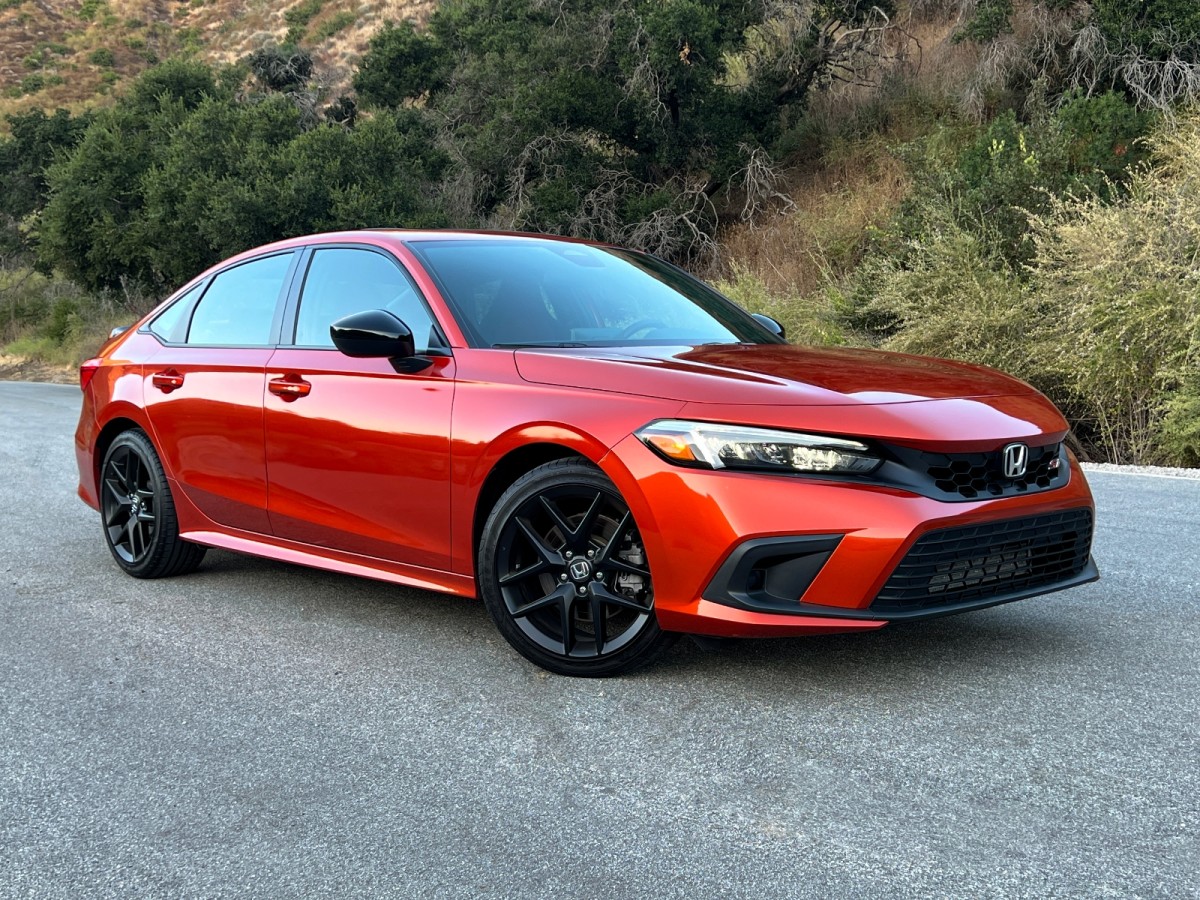
It may be the sixth-generation Civic Type R—also known as the FL5—but this version is only the second to be sold in the U.S. market. Widely regarded as the most accomplished version to date, Honda's hot hatch had more than 25 years of development under its belt by this point, so the formula was well-honed, and the current model is very much a polished and refined version of its predecessor. The styling is softer and the lines are cleaner, but the big rear wing, the deep meshed grille, and the 19-inch alloy wheels (down from 20s in the last model) leave you in no doubt that it's a Honda Type R—and it looks great in the optional Championship White paintwork.
The new Honda skipped a model year (there was no 2022 model), and when it arrived the manufacturer lauded it as its most powerful production vehicle ever sold in the United States. It also won a series of high-profile accolades overseas, including the front-wheel-drive production car track record at the Japanese manufacturer's home racing circuit of Suzuka and the lap time record for a front-wheel-drive car at Germany's Nürburgring Nordschleife.
The 2.0-liter turbocharged inline four-cylinder VTEC powertrain from the fifth-generation Civic Type R remains, but with relatively mild tweaks to add nine horsepower and 15 pound-feet of torque, bringing the respective totals to 315 hp and 310 lb ft. That makes it good for 0-60 mph in 5.4 seconds and a top speed of 170 mph.
The trademark drivetrain and transmission combo remained—front-wheel drive with a wonderfully snappy six-speed manual gearbox, complete with aluminum shift knob—while stopping power was aided by hefty Brembo four-piston aluminum front brake calipers. Four driving modes allowed you to prioritize a more comfortable or sportier driving experience via its adaptive dampers.
A limited-slip differential helped to rein in the torque steer (when the steering wheel wiggles under hard acceleration and handling is compromised) common to powerful front-wheel-drive cars, while Honda's rev-matching function and Michelin Pilot Sport 4S tires made for crisp downshifts and sharp turn-in. Given the level of performance, even fuel economy was reasonable at 22 mpg city, 28 mpg highway, and 24 mpg combined.
The sixth-generation Civic Type R's interior is an improvement on its predecessor's—cleaner, more modern, and with a nine-inch touchscreen infotainment system mounted atop the dash, rather than integrated into the center. And you can't miss the bright red sports seats. Wireless Android Auto and Apple CarPlay, a wireless charging pad, and cruise control are standard, as are a 12-speaker Bose premium audio system. There's even a new version of Honda's "Log R" datalogger, designed to monitor driving performance.
While the future of the Civic Type R hasn't been confirmed, many of its chassis components (although not its engine) are shared with the new Honda Prelude coupe.
Honda is widely known for being one of the most reliable car manufacturers, and that extends to the Type R models. The 2.0-liter turbocharged engine was refined over a long period of time, and is extremely durable, rendering the Civic one of the most usable performance cars around. The five recalls issued to this generation relate to fitment of the driver's seat frame (this also applied to the Accord, the standard Civic, the Pilot, the HR-V, the Acura Integra and the Acura Integra Type S of the same era) and a faulty steering box (this one also roped in the CR-V). Assuming those were sorted and documented at the dealership, the only real things to watch out for during a test drive are signs of a hard life, such as worn tires and brake pads, and damaged bodywork. Honda's new cars come with a 3-year/36,000-mile bumper-to-bumper warranty and a 5-year/60,000-mile powertrain warranty.

Fifth Generation (2017-2021)
If there was ever an example of Japan's artwork in automotive form, it's the fifth-generation Honda Civic Type R. The sliced and diced styling looks straight out the pages of a manga comic, while the triple-exit tailpipes and the jagged rear spoiler would not look out of place in the country's legendary drifting scene (the front-wheel drive drivetrain probably would, though).
The fifth-gen Civic Type R was the first one to be officially sold in the U.S. and, like its successor, it held the title of fastest front-wheel-drive production car at the Nürburgring. Known internally at Honda as the FK8, it uses the same 2.0-liter turbo engine as the current model, producing 306 hp and 295 lb ft of torque. It was the second turbocharged Civic Type R, with previous versions having high-revving, naturally aspirated engines. At the time, that bagged it the title of Honda's most powerful production car ever sold in the States, and the performance lived up to the hype: 0-60 mph in 5.7 seconds and a 169 mph top speed.
The usual mechanical Civic Type R hallmarks were in play: front-wheel drive and a short-throw, six-speed manual transmission—backed up by a beefy Brembo braking system. The front suspension continued with the Type-R's usual MacPherson strut setup, but the rear suspension changed from the previous torsion beam to a multi-link arrangement, which was a little controversial among enthusiasts who loved the handling of previous incarnations.
There were some minor upgrades for the 2019 model year, in the form of a new Sonic Gray Pearl paint scheme, Honda Sensing safety features, and an upgraded audio system, while the 2020 model year added Boost Blue paint, tweaked suspension and brakes, standard Honda Sensing, and heralded the debut of the "Log R" performance monitoring system.
The biggest change of this generation came in 2021, when Honda launched the Civic Type R Limited Edition. Billed as the 'ultimate track-focused Type R', it was 28 pounds lighter than the standard model and only 600 examples were sold, each featuring motorsport-influenced mods such as lightweight forged aluminum wheels by BBS, tuned dampers, and recalibrated steering, as well as Phoenix Yellow paint.
The fifth-generation Civic Type R has held its value well and isn't what you'd call an absolute steal given its age, but its $30-40,000 price range renders it more accessible than the current sixth-generation model. Earlier, more affordable examples are more likely to have been modified, which is fine if it's quality work and well-documented, but anything that deviates from the manufacturer's standard is always worth a buyer's attention. As always with a Type R, signs of regular hard driving and slipshod maintenance are the biggest worries.
Recalls for this generation related to the fuel pump, the steering system, the airbags, and the brake master cylinder, so it's worth finding out if they were addressed.

Previous Generations (1997-2017)
Only the fifth- and sixth-generation Civic Type Rs have officially been sold in the U.S., but the model has been around for much longer, and some Japanese domestic market (JDM) versions were imported on a more informal basis.
The first Civic Type R, known as the EK9, appeared in 1997, and set the tone for everything to come with what was then a punchy 182 hp 1.6-liter VTEC engine, while the second, known as EP3, arrived in 2001, upped that to a 198 hp 2.0-liter VTEC, and was sold in Europe as well as Japan. The 2.0-liter engine was a constant from then on, and the third generation (FN2) brought radically different styling but no change in power output. The fourth (FK2) really upped the power ante, though; it was the first turbocharged version, with 306 hp, and the most powerful of any Type R model Honda had built at that point.
Related Topics


by Jack Carfrae
Jack has been writing about cars since 2007 and covered everything from the new and used markets, to classics and commercial vehicles. His work has won a basket of awards and he specialises in the business side of the industry.
The content above is for informational purposes only and should be independently verified. Please see our Terms of Use for more details.


