The GMC Sierra 3500HD can trace its roots all the way back to the 1900s and the General Motors Truck Company. GMC was known for its commercial trucks until after WWII, when it began making the GMC 100 pickup truck for consumers. More capable heavy-duty trucks sprang forth in the 1960s and 70s, leading to the creation of the Sierra 3500 in the late 1980s.
GMC Sierra 3500HD Buying Guide: Cost, Reliability, and the Best Years to Buy
Search for GMC Sierra 3500HD
See all


The Sierra 3500 kept a lot of its work truck sensibilities and was marketed to shoppers as a "commercial grade" workhorse, with stronger towing and hauling abilities than the supporting GMC Sierra 2500HD and Sierra 1500. Shoppers evolved over time, and more recently, the GMC Sierra found a niche in the market as a more refined and luxurious alternative. This is especially true for the top-end Denali trims. Historically, its rivals have been limited to heavy-duty offerings that included the Ford F-350 Super Duty and the Ram/Dodge 3500.
GMC Sierra 3500HD Buying Guide: Cost, Reliability, and the Best Years to Buy
- Frequently Asked Questions
- GMC Sierra 3500 HD Pros and Cons
- GMC Sierra 3500 HD generations
- Fifth Generation (2020-Present)
- Fourth Generation (2015-2019)
- Third Generation (2007-2013)
- Second Generation (2001-2006)
- First Generation (1988-1998)
Frequently Asked Questions
Which GMC Sierra 3500HD years are the best?
The current fifth-generation Sierra 3500HD is your best bet. As is customary with almost any modern vehicle, it's more technologically advanced than any of its predecessors, as well as more powerful, comfortable, efficient, and safer.
Which GMC Sierra 3500HD years are the worst?
Of all the Sierra 3500 iterations, we're more likely to avoid the fourth generation, which had a short run between 2015 and 2019. It had more recalls than normal, and some of those tended to persist for several model years.
Is the GMC Sierra 3500HD a good deal?
The current GMC Sierra 3500HD's MSRP varies wildly between the $50,000 base model and over $100,000 for the top Denali trims. They tend to hold their value a little better than their Ford and Ram rivals, but savvy shoppers would do well to seek out a truck that’s at least two years old to avoid the steep initial depreciation that affects all new vehicles.
GMC Sierra 3500 HD Pros and Cons
Pros:
- Impressive hauling and towing capabilities
- Luxurious higher trim levels
- Smart tech features for towing and off-roading
Cons:
- Later years are unwieldy in parking lots
- Top trims can be prohibitively expensive
- Rivals typically can tow more
GMC Sierra 3500 HD generations
Fifth Generation (2020-Present)
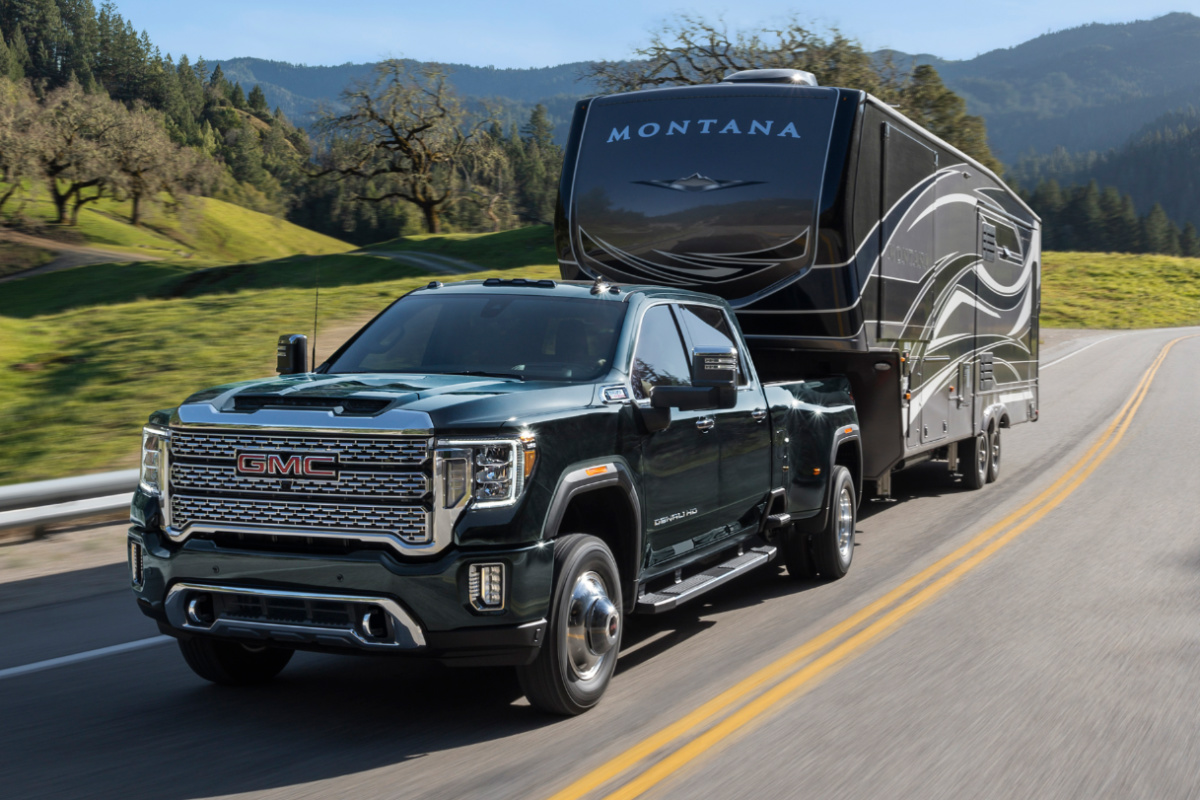
The fifth-generation GMC Sierra 3500HD debuted as a 2020 model. Compared to the previous generation, this new truck grew as much as 10 inches in length and 2.5 inches in height. The revised styling accentuated the larger footprint with a slightly larger and blockier grille, but you'd have to be a truck aficionado to tell the old and new Sierras apart, and the changes were equally minor on the inside. More importantly, this new model made significant improvements to increase its maximum towing capacity which, in its most extreme case, increased by 53 percent.
As with all heavy-duty pickup trucks, the new GMC Sierra 3500HD was offered in a dizzying array of trim levels and body style configurations. Shoppers could choose between a regular cab, an extended cab, or a crew cab, which could be paired with either a 6’10” short bed or an 8’2” long bed. Then they were able to select either a single- or dual-wheel (dualies) rear axle.
Two engine options were offered—a 6.6-liter V8 that produced 401 horsepower and 464 pound-feet of torque, or a 6.6-liter Duramax turbodiesel V8 engine that was good for 445 hp and a whopping 910 lb-ft of torque. The V8 gas engine was paired with a six-speed automatic, while the diesel was upgraded to a 10-speed automatic transmission. Rear-wheel drive was standard, with four-wheel drive (4WD) available as an option.
At its maximum, the Sierra 3500HD could haul as much as 7,442 pounds of cargo, and tow up to 35,500 pounds. These loads require the diesel engine, a single cab body, rear-wheel drive, a gooseneck hitch, and the dual rear wheels. Not surprisingly, the Chevy Silverado 3500HD matches these specs, and to put it into perspective, the supporting Sierra 2500 HD maxes out at 3,979 lbs of payload and 18,500 for towing. Meanwhile, the competing Ford F-350 Super Duty of the time could pull as much as 37,000 lbs, while the Ram 3500 was rated at 35,100 lbs.
The fifth-generation Sierra 3500HD was available in five trim levels: base, SLE, SLT, AT4, and Denali. The base model was a work truck with minimal features that made it look and feel like something you'd rent from U-Haul. Standard feature highlights included 18-inch steel wheels, vinyl upholstery, manual crank windows, a trailer hitch receiver, a seven-inch infotainment touchscreen, and Apple CarPlay and Android Auto functionality. The SLE trim upgraded to 18-inch aluminum wheels, power-adjustable tow mirrors, power windows, remote keyless entry, jet black cloth upholstery, satellite radio, a wifi hotspot, and cruise control.
The SLT was only available as a crew cab (as were higher trims) and added the MultiPro tailgate that could be configured for a number of uses, remote and keyless ignition, trailering assist features, household power outlets, leather upholstery, heated front seats, and dual-zone automatic climate control.
The AT4 was the off-road model, with a specific suspension, all-terrain tires, underbody skid plates, a locking rear differential, unique off-road drive modes, a head-up display, surround-view cameras, and additional off-road instrumentation. The top Denali was the luxury choice in the lineup, with premium leather, heated front seats, a native navigation system, a wireless phone charger, a larger eight-inch touchscreen, a Bose premium audio system, and parking proximity sensors.
Available safety features included forward collision alert with automatic emergency braking, a blind-spot monitor with rear cross-traffic alert, lane departure warning, and a teen driver mode.
For 2021, a new jack-knife alert system debuted, while the SLE trim gained the MultiPro tailgate, the Denali added the surround-view camera and a bed-view camera, and the AT4 added optional mud tires and a side step with extra ground clearance. The following year, the base Sierra trim was renamed the Pro trim.
More significant changes occurred in 2024, with a slight styling refresh that updated the front fascia and headlights, but there were also numerous other enhancements. The turbodiesel received a power bump to 470 hp and 975 lb-ft of torque, while a new Denali Ultimate trim took over as the top model. It came with the diesel engine, 20-inch wheels, power-retracting running boards, adaptive cruise control, cooled and massaging front seats, a digital rearview mirror, and a sunroof. A larger 13.4-inch infotainment touchscreen and a digital instrument panel were also added to the SLE trim and above. For trailering, an enhanced adaptive cruise control debuted, along with a weight limit monitor, and a transparent trailer camera view.
In 2025, the adaptive cruise control with trailering assist and parking sensors were available with more models, and the trailer brake controller was made standard on all Sierra 3500HDs. The MultiPro tailgate was also available with more models in 2026.
Heavy-duty trucks such as the Sierra 3500HD are exempt from reporting fuel economy estimates, but you should expect some of the lowest numbers of any non-commercial vehicle. With the gasoline V8, you should only expect between 10 and 15 mpg, while the turbodiesel should improve those figures by two or three mpg. Towing and hauling large loads will dramatically decrease mileage.
Heavy duty trucks are also exempt from standardized crash testing, so there are no results to report from either the National Highway Traffic Safety Administration (NHTSA) or the Insurance Institute for Highway Safety (IIHS).
In its inaugural year, the GMC Sierra 3500HD was issued recalls for a transmission valve that could lock-up the rear wheels, a faulty hood and tailgate latch, seatbelt anchors, side curtain airbags, and a possible fire caused by the emergency seatbelt tensioners. The hood latch, airbag, and tensioner fire issues were addressed before the 2021 model year, but a recall for a possible brake system fire was also issued, and persisted into 2022, along with the transmission valve. The tailgate latch issues also carried into 2024, when a possible steering arm failure recall was added.
While some of those recalls could be considered serious, the Sierra 3500HD received fewer recalls than its rivals from Ford and Ram. This likely helped the fifth-generation models retain more of their value by comparison.
Fourth Generation (2015-2019)
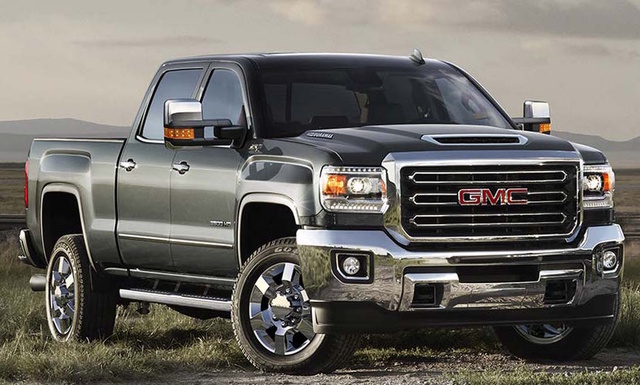
The fourth-generation GMC Sierra 3500HD debuted in 2015 with a completely new style. Blocky, hard-edged elements replaced the previous model's rounded corners and smoother design. While its exterior dimensions remained almost identical to its predecessor’s, the new Sierra 3500HD appeared significantly larger.
The interior was also completely revamped and represented a significant upgrade from the last generation. A lot of the cheap, hard plastic pieces were replaced with noticeably smarter soft-touch materials, while the dashboard added a central pod that housed the infotainment touchscreen, climate controls, and air vents. In-car technology also saw several upgrades, bringing it into line with other vehicle types, and the top Denali trim was more luxurious than ever.
Two engines were offered with the 2015 Sierra 3500HD. The standard powertrain had a 6.0-liter gasoline V8 engine that produced 360 horsepower and 380 pound-feet of torque. A turbocharged 6.6-liter diesel V8 increased output to 397 hp and 765 lb-ft of torque, and both were paired with a six-speed automatic transmission, with the diesel receiving a more durable Allison gearbox. Rear-wheel drive was standard for all models, and four-wheel drive (4WD) was optional. Properly equipped, it could haul as much as 7,374 pounds of payload, tow up to 19,600 lbs with a standard ball hitch, and with a fifth-wheel hitch, up to 23,200 lbs.
Shoppers could choose between a regular cab, a double cab, or a crew cab body style, with either a single- or a dual-wheel rear axle. A choice of short or long bed lengths was available, and there were four trim levels: Work Truck, SLE, SLT, and Denali. The Work Truck was nothing fancy and came with only the bare essentials, including steel wheels, a front bench seat, vinyl upholstery and floor coverings, cruise control, a 4.2-inch infotainment display, and USB/iPod integration.
The SLE upgraded to alloy wheels, keyless entry and power locks/windows, an automatic locking rear differential, an integrated trailer brake controller, cloth seats, carpeting, an eight-inch infotainment touchscreen, a wifi hotspot, Bluetooth, OnStar telematics, an improved audio system with satellite radio, bed lighting, and a rearview camera. Stepping up to the SLT netted you larger wheels, a MultiPro tailgate, foglights, power-folding mirrors, remote start, dual-zone automatic climate control, power-adjustable pedals, leather-upholstered heated front seats, and a household power outlet.
The top Denali trim dressed up the Sierra 3500HD with chrome running boards, a spray-on bedliner, a sliding rear window, a locking tailgate, a navigation system, a Bose premium audio system, ventilated front bucket seats, a heated steering wheel, and parking proximity sensors. Additional safety features included lane-departure warning, frontal collision alerts, and a safety alert seat that buzzed when warnings were triggered.
For 2016, the headlamps were upgraded to Xenon bulbs with LED accent lights, while the infotainment system received a new operating system with Apple CarPlay and Android Auto capability. A new seven-inch touchscreen also debuted, along with an available wireless charging pad. In 2017, the turbodiesel engine's output increased to 445 hp and 910 lb-ft of torque and its hood added an air intake for improved cooling. A teen driver mode was also added.
All models came standard with a rearview camera for the 2018 model year, while the infotainment system update trickled down to supporting trims, and a more stylish grille came with the Denali trim. In preparation for the 2020 redesign, the Sierra 3500HD lineup was pared down a bit. The regular cab was discontinued, as was the double cab model with the short bed.
The 2015 GMC Sierra 3500HD was hit with 18 separate recalls related to its airbags, brake pedal, front fuel tank, fuel tank vent hose, ignition lock, rear axle, power steering, front seat anchors, transfer case, warning chimes, fuse box, and exhaust. All but the airbag and the brake pedal problems were addressed for 2016, but new fuel tank and warning chime issues arose. Problems with the engine block heater, the rear fuel tank, the seatbelt retractors, and the front airbag recall persisted until the final production year in 2019. These recalls likely contributed to the Sierra 3500HD's slightly accelerated depreciation for this generation, along with mounting pressure from Ford and Ram.

Third Generation (2007-2013)
When the third-generation GMC Sierra 3500HD debuted in 2007, it represented more of an evolution of past themes, rather than a complete redesign. A larger grille, revised headlights, and a taller hood rounded out the biggest visual changes, though more significant upgrades took place underneath. A reinforced frame, stronger suspension components, and standard antilock brakes made the Sierra 3500HD more competent at towing.
The interior had one of the most noteworthy changes, moving away from the previous blocky and modular dashboard that was plagued by cheap and hard plastics. The new cockpit was more streamlined, better integrated, and made use of noticeably improved materials.
The standard engine was a 6.0-liter V8 that produced 353-horsepower and 373 pound-feet of torque. It was paired with a six-speed automatic transmission that sent power to the rear wheels, with four-wheel drive (4WD) available as an option. An optional Duramax 6.6-liter V8 turbodiesel made 365 hp and 660 lb-ft of torque and it was mated to a heavy-duty Allison six-speed automatic. The diesel was the best for towing and hauling, with a maximum rating of 16,500 pounds in fifth-wheel configuration, 13,000 with a conventional hitch, and 5,307 lbs of payload capacity.
The third-gen Sierra 3500HD was available as regular, extended, or crew cabs, but only with the 8’2” bed. Dual rear wheels were available on all but the rear-drive single cab. The bare-bones Work Truck trim came with steel wheels, air-conditioning, a vinyl-covered front bench, and OnStar telematics. The SLE1 model dressed up the Sierra with chrome trim, alloy wheels, power windows and locks, cloth upholstery, cruise control, and a CD player. The SLE2 upgraded to front bucket seats and dual-zone climate control. The top SLT trim added keyless entry/ignition, leather seats, a Bose multi-CD player, smarter interior materials, and heated front seats.
Option packages included the Z71 Off-Road package (off-road suspension, underbody skid plates, and a locking rear differential) and the Safety package (power-adjustable pedals and parking sensors), while standalone options included a power-sliding rear window, remote start, a navigation system, satellite radio, rear parking sensors, and a sunroof.
In its sophomore year, the Sierra 3500HD gained standard satellite radio, and in 2009, a new OnStar system, Bluetooth, a rearview camera, and real-time traffic debuted. For 2010, the gas engine's output was increased to 360 hp and 380 lb-ft of torque, and in 2011, the diesel was upgraded to 397 hp and 765 lb-ft. As a result, payload capacity increased to 6,635 lbs, standard towing to 17,000 lbs, and fifth-wheel to 21,700 lbs. That year also brought a new frame and suspension, an exhaust brake, stability control, hill-start control, and trailer sway control. Ventilated seats became available in 2012.
Recalls issued for this generation included problems with airbags, electrical fires, fire extinguishers, fuel tanks, ignition locks, steering shafts, fuel pumps, and gear selectors. Some of these issues persisted throughout the seven-year production run. Depreciation for these trucks depend heavily on trim levels and body types, but overall, GMC Sierra 3500HDs of this era held their value about as well as other pickups.
Second Generation (2001-2006)
The redesigned second-generation GMC Sierra 3500HD debuted in 2001, following the switchover to the Chevrolet Silverado-based Sierra 1500 that went on sale in 1999. In the interim, the last-generation Sierra 3500 continued to be sold as the Sierra Classic. Note that this was the first generation to add the "HD" to its name.
Compared to the previous Sierra, this new model was more rounded and aerodynamic-looking, losing much of the square-shouldered brawn. The interior had a subtle makeover by comparison, representing more of an evolution of the last generation, but passenger space nonetheless increased. More importantly, the new Sierra benefited from a stronger frame, suspension, and axles, along with upgraded brakes and cooling.
Under the hood was GM's Vortec 6000 base engine, a 6.0-liter V8 producing 300 horsepower and 360 pound-feet of torque. It was paired with either a four-speed automatic transmission or a five-speed manual. A new Vortec 8100 8.1-liter big-block V8 was also available and made 340 hp and 455 lb-ft of torque. Also noteworthy was a new Duramax 6.6-liter turbodiesel with 300 hp and 520 lb-ft of torque. Both the big-block and the diesel were available with either a six-speed manual, or a five-speed Allison heavy-duty transmission. Properly equipped, the Sierra 3500HD could tow up to 15,300 pounds or haul as much as 5,753 lbs in its bed.
The 2001 Sierra 3500HD was offered in regular, extended, or crew cab configurations, with either single- or dual-rear wheels, depending on which body style was chosen. Shoppers could pick between the SL, SLE, and SLT trim levels, with the SLT having the nicest cabin. In 2003, it received a minor exterior styling update as well as a new instrument panel, seats, and available dual-zone climate control. The following year, all body types were eligible for the single rear-wheel axle, and a new Work Truck trim replaced the SL as the base model. The SLE trim also gained foglights and leather upholstery.
The 2006 Sierra 3500HD's turbodiesel output increased to 360 hp and 650 lb-ft of torque, and the heavy-duty Allison transmission upgraded to six speeds. As with its predecessor, when the next-generation Sierra debuted in late 2007, this second-gen version continued to fill the time gap as the "Classic" model.
Recalls were notably few in the first few years of production, with only a minor one issued in 2001 for body pressure relief valves. There were more serious recalls in 2003 for brakes and tailgate support cables, but 2004 had the most, involving the rear seatbelts, the parking brake, child seat anchors, the bedliner, and the tailgate hinge. The rear seatbelts and parking brake problems continued into 2005, with another added for a power steering issue.
Second-generation Sierra 3500HD trucks held their value about as well as other heavy-duty pickup trucks of the time, though body styles and powertrain greatly influence how well it retains its value.
First Generation (1988-1998)
There was a turning point for GM's truck division in 1988, with the switch from the old C/K series to the new GMT400 and GMT480 platforms. That year also marked the beginning of the Sierra model name which, in previous years, was a trim level. This new generation made a big splash with its debut, and helping matters was GM's "Like a Rock" ad campaign that burned these trucks into the public's consciousness. A co-starring role in 1989's Lethal Weapon 2, where it was used to tear down the antagonist's stilt house in the Hollywood Hills, also helped.
In addition to the fictional ground, the GMC Sierra 3500 broke figurative ground. It was the first GMC to offer an extended cab—called the Club Coupe—and included huge improvements throughout. It was noticeably more comfortable, with an upgraded cabin and smoother ride, thanks to a new independent front suspension. Durability also improved, with a fully welded, galvanized frame.
The base engine was a 5.7-liter V8 that produced 190 horsepower and 300 pound-feet of torque. A big-block 7.4-liter V8 increased output to 230 hp and 385 lb-ft, while the 6.2-liter V8 diesel was good for 143 hp and 257 lb-ft of torque. Depending on the rest of the powertrain, several transmissions were available, including a four- or five-speed manual, and a three- or a four-speed automatic. Rear-wheel drive was standard and four-wheel drive was optional.
The 1988 GMC Sierra 3500 was available in standard, extended (Club Coupe), or crew cab configurations, with either a 6’5” short bed, or an 8’ bed. A dual rear wheel was also offered. Properly equipped, the Sierra 3500 could fifth-wheel tow as much as 19,000 pounds (gross combination weight including the truck itself) or haul up to 5,382 in payload.
Trim levels were limited to the base SL, the midsize SLX, or the top SLE. A new turbocharged diesel engine was added in 1992, producing 190 hp and 385 lb-ft of torque. In 1995, the Sierra 3500 received some of the most significant updates, with an improved interior and four-wheel antilock brakes (previous models had only rear-wheel ABS). For 1996, the Vortec engines were introduced, with the 5.7-liter V8 now making 250 hp and 355 lb-ft of torque, the 7.4 increasing to 290 hp and 410 lb-ft.
One notable recall for this Sierra 3500 generation included a transmission vent tube that persisted from its 1988 debut until the 1992 model year. Throughout its production run, recalls were also issued for seatbelt anchors, brake pedal linkage, brake lights, oil and fuel filter leaks, and the power steering system. In the first decade, the GMC Sierra 3500 held its value as well as other heavy-duty trucks, and stabilized in more recent years, just like its rivals.
Related Topics

by Mark Takahashi
Mark Takahashi's automotive career began in art direction working on car and motorcycle publications, and he honed his craft as an amateur open-wheel racer. Those experiences opened the way into automotive journalism, where he built a reputation writing for outlets including Edmunds, Car and Driver, Autoblog, and TrueCar, reviewing thousands of vehicles during a decades-long career and earning a seat on the jury of the North American Car and Truck of the Year Awards.
The content above is for informational purposes only and should be independently verified. Please see our Terms of Use for more details.


