The Ford F-150 Lightning has been the talk of the truck world for three years now, the first series-production full-size electric pickup to hit the market. But the Lightning name goes back much further than that, to 1992. That December, the Blue Oval introduced the 1993 Ford SVT Lightning, a white-hot street truck aimed at the Chevrolet 454SS pickup. “SVT” refers to Ford’s Special Vehicle Team, which in those days came up with its highest-performance machinery.
A version of the F-150, the Lightning looked a whole lot like a regular short-bed F-Series, but it was genuinely quick for its day, but truck standards anyway, and packed a 5.8-liter, 240-horsepower V8 and handling finessed by none other than former F1 champion Jackie Stewart. 11,563 were built from 1992 to 1995 before Ford redesigned the entire F-Series lineup, but the project was successful enough to warrant a second generation.
Built from 1999 to 2004, the second SVT Lightning had fewer celebrities in its design process, but it was considerably faster. Under the hood lay a supercharged 360-horsepower V8, good for zero-to-sixty in 5.2 seconds.
Both generations of the SVT Lightning were regular cab, short bed (“Styleside” in the second generation), rear-wheel drive (RWD) only pickups with exclusive V8 engines. While the electric F-150 Lightning is expected to introduce Ford customers to EVs, the original F-150 SVT Lightning introduced the Ford Motor Company’s clientele to high-performance pickups, and they were unique in the marketplace among competitors.
Today both of these trucks are collector’s items, and they can fetch between $30,000 and $60,000. There are also a few celebrity owners, including Lady Gaga. Here, we’ve broken down both generations and included some advice about what to look for and what to pay if you’re looking to saddle up with one of these street trucks.
Ford F-150 SVT Lightning Buying Guide: Cost, Reliability, and the Best Years to Buy
Frequently Asked Questions
Which Ford F-150 SVT Lightning years are the best?
The original 1993 to 1995 F-150 SVT Lightnings are more or less bulletproof if kept in stock condition and properly maintained. Because they’re the original version, they also have more collector appeal. They use many proven, heavy-duty components including the old 351 Windsor V8, and they’re not hard to fix or work on. The very late second-generation SVT Lightning, from 2003 to 2004, is also fairly reliable, having had all the bugs of the second-generation design worked out. As with the original, lots of modifications are possible, and pushing the engine too far increases the likelihood of problems later down the line.
What are the worst Ford F-150 SVT Lightning years?
The 1999 to 2001 SVT Lightnings seem to have the most problems. Early models are known for intercooler issues and for “launching” spark plugs, as the plugs don’t sit very deep in the cylinder head. Some owners also feel that the 1999-2000 transmissions aren’t as robust as those in 2001 and newer trucks. Generally speaking, even in these more problematic years, a well-maintained Lightning is going to be fairly reliable.
Is a used Ford Ford F-150 SVT Lightning a good deal?
Only if you’re after a collector truck, as these are now much more expensive than the regular Ford F-150s they were based on. The F-150 SVT Lightning was created to be a niche performance truck and it still is, so they're generally much pricier than regular F-150s. On the other hand, they’re not insanely expensive as collector trucks go, and they do have investment potential, especially the first-generation model. They’re also a fun classic you can use without too much worry about mechanical breakdowns or unobtainable parts.
Ford F-150 SVT Lightning Pros and Cons
Pros:
- Old-school muscle-truck performance
- Supercharged V8 in second-gen model
- A guaranteed classic
Cons:
- Grim fuel economy
- Not so useful as a working truck
- Relatively tall rear axle ratio (2nd Generation)
Ford F-150 SVT Lightning Generations
Second Generation (1999-2004)
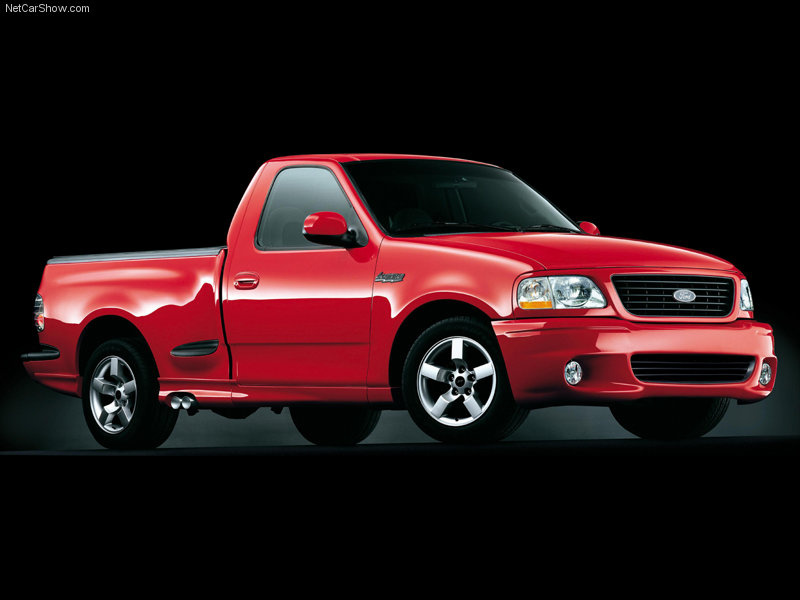
The second-generation Ford F-150 SVT Lightning was based on the SN96 chassis F-150, which was first introduced for 1997. Unlike the previous model, this second-gen Lightning was essentially unmodified from any of the zillion standard, step-side F-150s you’d see swarming the streets in the late 1990s. However, while not as specialized as the original, this second Lightning was still a product of the SVT group, along with the SVT Focus, Contour, and Mustang of the same era.
We’ll get to the driveline in a minute, but there was a lot of cost-savings going on with the development of the second generation. As before, Lightnings came only as regular cab, short-bed models, though now they used the flareside bed, whcih was rare on standard F-150s, but not any different.
In addition to its pedestrian chassis. The front suspension was largely the same short-/long-arm front suspension found in a conventional F-150, though the front setup was an inch lower than standard and had a fat 31-mm stabilizer bar. At the rear, you got the same solid axle with a leaf-spring suspension, albeit lowered two inches and also including a 21-mm stabilizer. For the first three model years, Monroe provided the shocks, but between 2002 and 2004, Bilstein provided the dampers. The SVT Lightning also featured 18-inch alloy wheels specific to this truck, wrapped in bespoke, directional Goodyear Eagle F1 tires.
The big draw, of course, was the engine, which boasted impressive specs: the 5.4-liter Triton SOHC V-8 you could purchase in lesser F-150 models was capped with an Eaton M112 blower, producing 360 horsepower and 440 pound-feet of torque in the 1999 and 2000 model years. In 2001, horsepower increased to 380, and torque went up to 450 pound-feet. The truck was genuinely fast for its time too, with zero-to-60 times in the low five-second range.
The transmission was the same fairly conventional 4R100 four-speed automatic transmission that you’d get in any 5.4-liter or better V8-powered F-Series. Along with the lesser horsepower and torque of the first two years, the early SN96 SVT Lightning was also hamstrung slightly by a tall 3.55 rear axle ratio. The 2001 and later trucks not only got a boost of 20 horsepower, but they also got the hole shot advantage of a 3.73:1 rear diff, plus a sewer pipe 4.5-inch aluminum driveshaft to replace the 3.5-inch steel unit in the earlier trucks.
In general, the feedback was positive from the get-go, except for payload. Not that anybody was hauling 2,000 pounds of potatoes in the back of a $29,335 shortbed pickup, but the first two years only had an 800-pound payload capacity, half of what you’d see in a 1999 Ranger and 42 percent of what you can get out of a current Hyundai Santa Cruz. The later SN96 SVT Lightning had a more reasonable 1,350 pounds.
These second-generation Lightnings aren’t as bulletproof or as sought-after as the first-gen models. The early years have the same “plug throwing” problem that many 5.4-liter Triton V8s do, the plug threads aren’t deep enough into the block. They also had intercooler and transmission issues in the first couple of years, while the final years have a beefier rear suspension that gives them a 1960s-style street racer rake, which some folks like and some folks don’t.
Ford produced nearly three times as many second-generation SVT Lightnings as it did first-gen, building 28,124 in total over six model years. Today it’s possible to find worn-out examples for under $20,000, but most of these trucks will cost you $30,000 to $45,000 depending on condition, and a few extremely low-mileage examples have gone even higher than that.
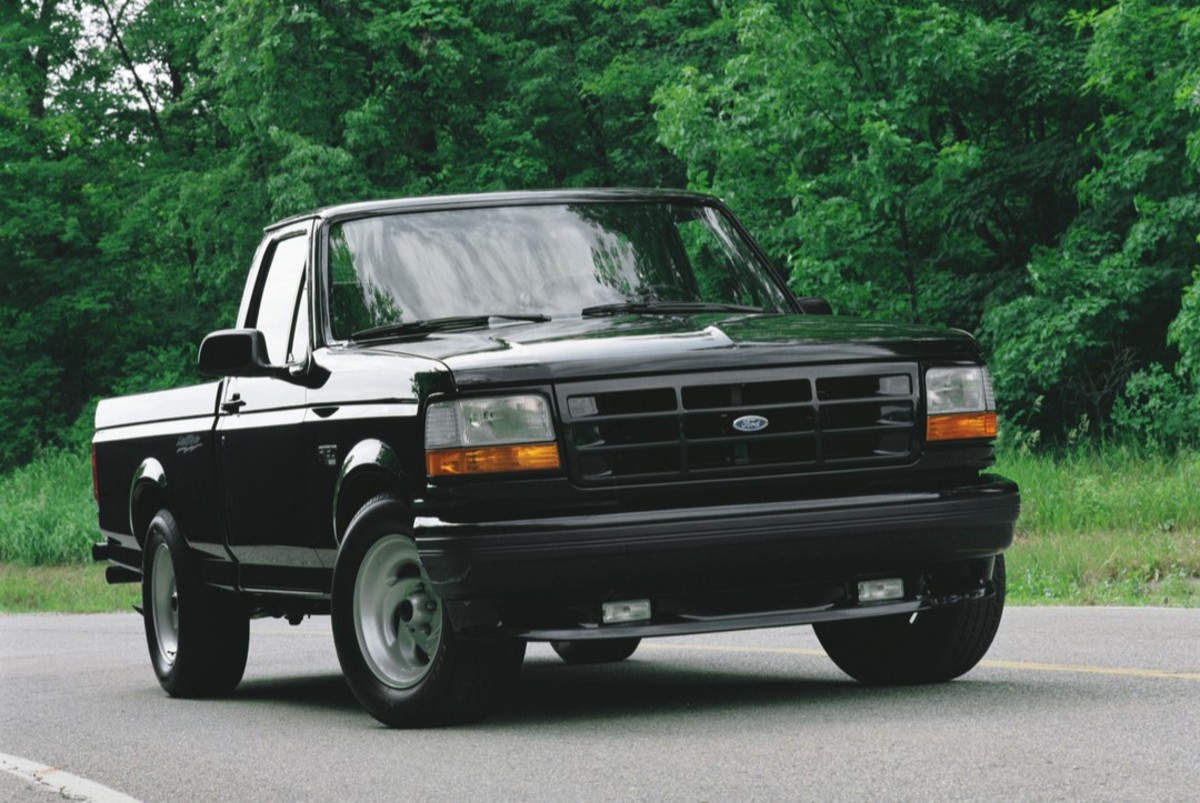
First Generation (1993-1995)
The later second-generation model is faster, but there’s no substitute for the original. The boxy simplicity of the 1993 to 1995 SVT Lightning belies the engineering that went into it, and the huge power outputs of modern trucks obscure what a performer it really was back when it was new. This famous Ford truck, however, wouldn’t have happened without a Chevy.
Detroit’s automakers had largely abandoned big-engine, full-size sport trucks in the early 1980s, but in 1990 Chevrolet brought the idea back with the 454 SS, powered by the massive 7.4-liter (formerly 454 cubic-inch) V8 that gave it its name. With big fat performance tires, 230 horsepower, and mean styling, it was a genuinely exciting truck even if it only did zero-to-60 in 7.7 seconds and didn’t drive any better than a regular C1500 pickup. Ford decided to respond in kind, developing a truck that was not only faster, but also handled better, and that’s how the SVT Lightning came to be.
The Special Vehicles Team at Ford took an entirely different tack with the SVT Lightning’s drivetrain. Instead of shoehorning a giant V8 under the hood, it used the 351-cubic-inch Windsor V8, modified with GT40 intake and heads to offer 240 horsepower and 340 pound-feet of torque. To more effectively utilize the Windsor’s lower torque, the SVT Lightning had a 4.10:1 rear differential, which the 454 SS only got after 1991.
What was even more impressive about the first-generation SVT Lightning was the chassis. First, it wasn’t just any conventional light-duty pickup frame. It had the beefier frame rails of the four-wheel drive F-250, with unique gusseting that provided much greater chassis stiffness to start with.
The suspension featured uniquely calibrated Monroe Formula GP performance shocks, front and rear stabilizer bars, and modified leaf springs in the rear with a rubber snubber. These worked to eliminate wheel hop under hard acceleration, the way a set of traction bars would on a drag car. Thanks to input from F1 legend Jackie Stewart, the first-generation SVT Lightning could pull .88 g on a skid pad, something no SS454 was ever going to accomplish.
Rounding out the package were the unique 17x8-inch alloy wheels, which were a major upgrade from the SS454’s 15-inch chrome steel wheels. They were equipped with 275/60HR17 Firestone Firehawk GTA tires. Unlike the second-gen pickup trucks, the first-generation SVT Lightning had the same payload and towing capacity as a shortbed F-150.
Much like its electric truck namesake, the SVT Lightning didn’t look much different from a regular F-150 XL on the outside, which was kind of its appeal. It had a painted grille and a chin spoiler, plus a few decals thrown on the bed sides, but other than the big wheels, there wasn’t much to visually distinguish an SVT Lightning from any other pickup in the lineup.
Over three model years, the Ford Motor Company produced 11,563 SVT Lightnings in just three colors. Most were black, while the lowest percentage of total pickups sold were the red 1995 models, which totaled just 695 units. Today, they sell for about $30,000 to $45,000 just like the later models, but they’re more reliable and harder to find. Chances are good their prices will only go up with time, especially as the electric F-150 Lightning has rekindled interest in them.
Related Topics