Charging an electric car is a very different experience than refueling a gas car. Pricing can vary widely, based on factors like your location (charging at home will always be cheaper), your source of electricty, the time of day, and others.
On average, it typically costs about $56 per month to charge an EV or around $0.05 per mile to charge an EV; that compares to around $0.13 per mile to refuel a gas-powered car.
Whether you’re experienced in charging an EV and just want to learn about how and why pricing varies, or you’re considering buying or driving an EV for the first time, read on to learn electric car charging basics.
Electric Car Charging Basics
- How Much Does It Cost to Charge an Electric Car?
- Understanding the Cost Factors
- Comparing Charging Options
- Calculating Charging Costs
- Charging Efficiency and Battery Health
- Tips to Reduce Charging Costs
- How Long Does It Take to Charge an Electric Car?
- Factors That Affect EV Charging Time
- Understanding EV Charging Levels
- Types of Power Sources
- How to Optimize Charging Times
Understanding the Cost Factors:
Electricity rates and tariffs. Obviously, electricity rates will be among the most significant factors in the cost of charging an EV. Though the actual cost of electricity is dynamic (meaning it’s constantly changing because of other factors), the price itself doesn’t change constantly in response to the cost.
According to the U.S. Energy Information Administration, electricity prices generally change seasonally, based on things like fuel costs, power plant and infrastructure costs, weather, and local pricing regulations. Tariffs or taxes on electricity rates can significantly raise the cost of electricity and depend on where you live.
Charging time and speed. Generally, faster public chargers, like DC fast chargers, cost more than slower chargers, like Level 2 chargers. In some areas, depending on local regulations, the cost of charging is based on the amount of time your car is plugged in, instead of how much electricity is added during the session.
In those cases, it’s especially important to bear in mind that the rate of charging slows down dramatically once a car achieves an 80% charge, because any charge beyond that will be drastically more expensive.
Battery capacity and range. Bigger batteries and vehicles with higher ranges will cost more to charge, but will need to be charged less frequently.
Comparing Charging Options
Different types of electric vehicle charging connectors are on the market, so it's helpful to get familiar with what your EV uses.
-
Level 1 & Level 2: These basic levels of EV charging use what’s called a J1772 connector and can be plugged into household outlets like a 120-volt — the standard wall outlet — and 240-volt (the outlet your dryer plugs into).
If your car has one of these J1772 connectors, you can only use a Level 1 or Level 2 EV charger (not a DC fast charger, unless you have an adaptor, though your car must also be rated to handle a faster charge). A J1772 connector can handle a typical power output of up to 19 kW, and about 10 to 20 miles of range per hour with a Level 2 charger.
-
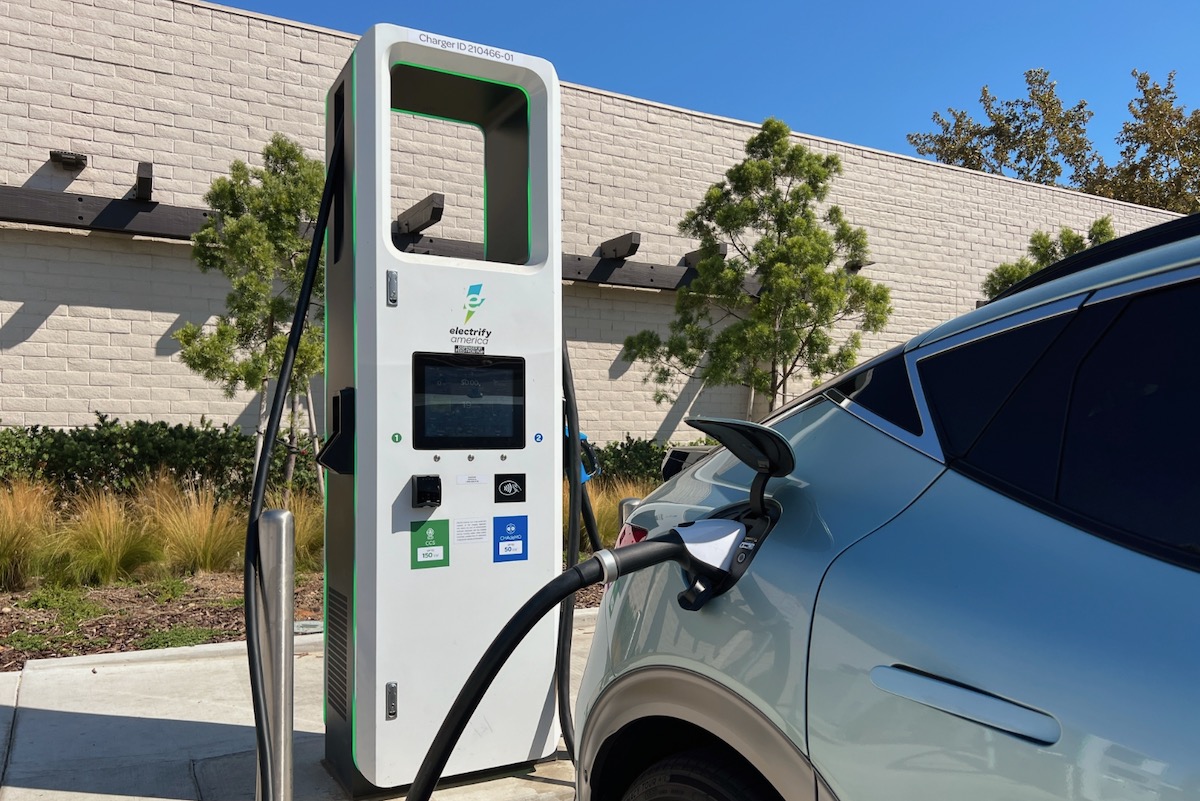
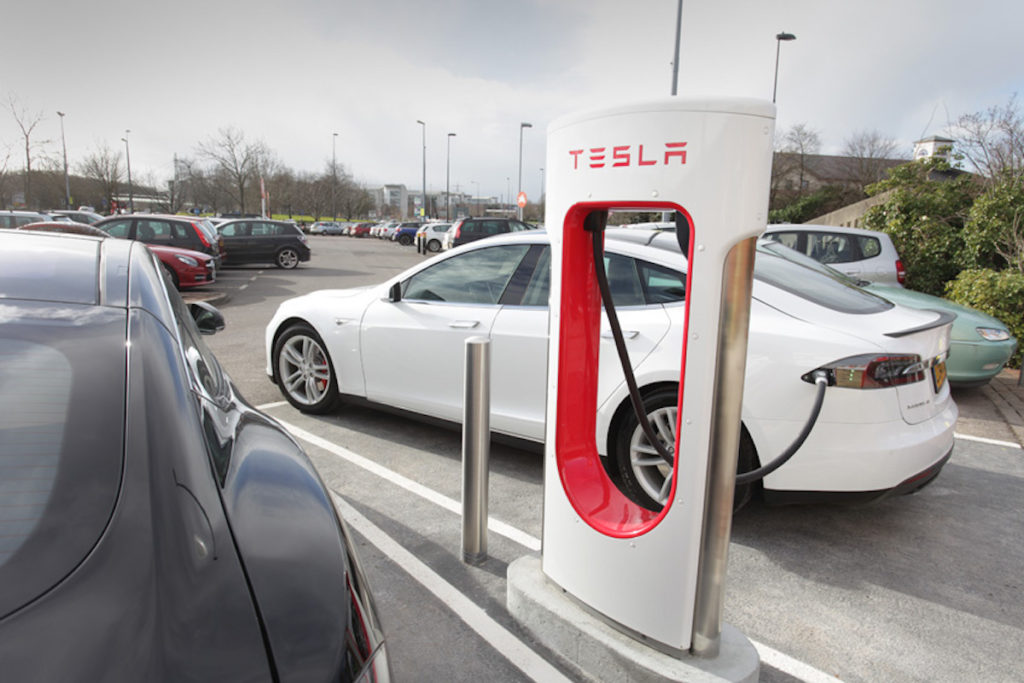
DC Fast Charging: The three types of DC fast charging connectors are CCS, CHAdeMO, and Tesla (known as North American Charging Standard, or NACS). Tesla’s NACS connectors are compatible only with Tesla Superchargers and Tesla’s own wall connectors, though adaptors are widely available so drivers of every Tesla model can use other brands of DC fast chargers. Similarly, many other vehicles rated for DC fast charging can use Tesla Superchargers. Check your owner’s manual to see if yours is compatible.
-
Charging non-Teslas with Tesla stations: It’s worth noting that nearly all automakers have recently announced that their EVs will soon use Tesla’s NACS connections. This means owners of non-Tesla EVs will be able to use Tesla Supercharging stations and Tesla home chargers to recharge their EVs. Thus, if you have now or are interested in an EV that’s from the 2024 model year or newer, be sure to check whether it uses the NACS.
Pros and cons of Level 1, Level 2, and DC fast charging:
All charging types have their own pros and cons.
- Level 1 is slow, but it can work with any household outlet.
- Level 2 is available both at home and at public chargers.
- It can be expensive to install a Level 2 charger at home, but there are often federal and local incentives to help defray costs, and Level 2 charging at home is convenient and affordable.
- Level 2 public chargers are widely available in most parts of the country, though costs vary.
- DC fast charging is available at public charging stations. It’s fast and convenient, but the most expensive option.
- Excessive DC fast charging can cause premature degradation of the car’s battery.

Calculating Charging Costs
-
How to estimate charging costs: Figuring out the cost to charge an EV can be complicated, especially at public chargers. That’s because public chargers don’t have consistent pricing, much the way rival gas stations across the street from each other, and even the same brand in different areas, have different gas prices. However, public chargers show the price at the charger as well as online on charging network maps or using apps.
-
Factors that affect cost per mile: Energy costs at a public charger vary based on factors such as location, charging network, and type and capability of charger. Home charging may vary, too, based on energy costs from the local utility. It’s not free charging, but it’s the most affordable, especially if you need a full charge. Call your utility company if you have questions about your electricity bill.
-
Understanding kilowatt-hour (kWh) pricing: Kilowatt-hours per 100 miles are the unit of measure for an EV’s energy efficiency (comparable to the fuel efficiency rating of a gas car). The U.S. Department of Energy’s Alternative Fuels Data Center has an online calculator to show energy costs for different types of vehicles. Note that most, but not all chargers use kWh pricing. In some areas, depending on local laws or regulations, public chargers are priced by the minute.
Charging Efficiency and Battery Health
Efficiency losses during charging: EV batteries charge less efficiently in extreme temperatures, so EVs have settings to “precondition” the battery, which means bringing it to the proper temperature to charge. These settings can be managed in your car’s control panel or app.
Effect of temperature on charging efficiency: Not only do extreme temperatures matter when your EV is actually charging, regular exposure to harsh conditions affects battery health and lifespan. If you live in a very hot or very cold climate, park your EV inside whenever possible, and if it’s cold, use your battery preconditioning system before charging, particularly DC fast charging.
If you’re storing your vehicle for a long time, plug it in, if possible, and monitor its state of charge remotely via smartphone app.
Tips to Maintain Optimal Battery Health:
-
Though your EV’s battery will eventually degrade, there are steps you can take to slow down that degradation.
-
Experts advise regular battery and electrical system checks, about every 7,500 miles or according to to your car’s owner’s manual, to address issues promptly.
-
It’s also wise to avoid DC fast charging whenever possible, since it’s hard on the battery.
-
Other charging best practices for EV owners include maintaining at least a 20% charge whenever possible, and to avoid charging to 100% unless maximum range is absolutely necessary. Generally, 80% is the maximum recommended charge.
-
Finally, avoid harsh acceleration whenever possible, since it accelerates battery wear.
Tips to Reduce Charging Costs:
-
Optimizing your charging schedules for cheaper rates: Most EVs and home chargers have built-in features that enable you to set times to start charging so you charge at the cheapest time of day or night. To make the most of these features, contact your local utility.
Many have programs that provide reduced electricity rates to EV owners who agree to charge only during off-peak hours, when energy demand is at its lowest. When you park for the night, plug in your EV as usual, and it’ll automatically begin charging at the correct, preset time for off-peak rates.
-
Utilizing renewable energy sources: Using a public charging station that charges with renewable energy may not be any cheaper than charging elsewhere, but there are other benefits.
For example, Electrify America uses large solar arrays to offer public charging in rural areas that are far off the grid, making EV ownership possible for more consumers. Solar arrays and other forms of renewable energy can also store electricity so it’s readily available even during peak hours, when chargers connected to the grid may suffer slow service and, likely, charge higher rates.
To truly realize the benefits of saving money with renewable energy, look into federal and local incentives to reduce the cost of installing a home charger and a home solar array to power it. If home solar isn’t an option where you live, contact your local utility to see if there are incentives pr rebates for charging with renewable energy. In some areas, solar energy may be supplemented with other renewable sources, such as wind or hydroelectric power.
-
Maximize regenerative braking and energy recovery: A simple method to reduce charging costs is to charge less, by maximizing how many miles you travel on a charge. Learn about your EV’s regenerative braking system and its settings, and practice using it for more efficient driving. This feature uses the car’s electric motor to slow the vehicle when you stop accelerating, and recaptures lost energy to maximize range.
Though all EVs, as well as plug-in hybrids, feature regenerative braking, each make and model’s system works a little differently, and it’s a good way to drive more efficiently and reduce your average cost per mile.