This completely new era of Dodge trucks helped reinvigorate the brand, and all three versions of the truck (including the half-ton 1500) became a serious market force as a result. Dodge gradually added more features and configurations, including a crew cab in 1998, before redesigning the trucks in 2002. The 2500 and 3500 models were new for model year 2003, though the 1500 had appeared in 2002, and they now came with the turbodiesel six or Chrysler’s new 5.7-liter Hemi V8, though the V10 was now restricted to the 3500 model.
In 2009, Dodge redesigned the Ram pickup family, but it delayed introducing the 2500 and 3500 heavy-duty models until 2010. That same year, parent company Fiat Chrysler Automobiles (now known as Stellantis) spun Ram trucks off into their own brand. The trucks were marketed only as the “Ram 2500” soon after, with the brand changeover complete by 2013.
For this guide, we’re focusing on the pre-2011 models. We’ve outlined each generation of the Ram 2500 and included a little advice about what to watch out for and what to pay.
Dodge Ram 2500 Buying Guide: Cost, Reliability, and the Best Years to Buy
Frequently Asked Questions
Which Dodge Ram 2500 years are the best?
The earliest and the latest. The first-generation Dodge Ram 2500, built from 1994 to 2001, has a very good reputation for reliability and longevity. Unusually, the 2001 model comes in for much more criticism than the others, mainly for interior quality and suspension issues. Normally, a vehicle nearing the end of its life has the bugs worked out, but not in this case. The 2010 and newer Dodge Ram 2500 and Ram 2500 models also have a better reliability record (and better resale value) than the 2002 to 2009 models.
What are the worst Dodge Ram 2500 years?
As on the lighter-duty 1500, the Dodge Ram 2500’s early 2000s redesign seemed to cause many issues, and the worst years for reliability, and the ones that generate the most owner complaints about quality, are 2003 to 2005. Unlike the 1500, the 2500’s issues don’t really involve its engines. The Cummins turbodiesel six can have problems if maintenance is neglected, but in general, the 2500’s problems revolve around poor-quality interior fittings and worn-out suspension components, which aren’t abnormal for 20-year-old pickup trucks used for hauling heavy things. Both the first- and second-generation Dodge Ram 2500s are also vulnerable to rust.
Is a used Dodge Ram 2500 a good deal?
Yes and no. The 2500 offers a meaningful increase in payload and towing capacity over the Ram 1500 but almost the same driving experience and amenities. It does cost more to buy and fuel, but it also has superior powertrains, most notably the long-running Cummins turbodiesels that weren’t offered in the 1500. The Dodge Ram 2500 can’t match the Ford F-250 Super Duty on raw brawn, but it’s nicer to drive, particularly in later years after Dodge refined the steering and front suspension. However, it doesn’t cost much less than the Ford, as the Dodge holds its value pretty well. Early diesel models are also brutally expensive, putting them in competition with newer, better-equipped trucks.
Dodge Ram 2500 Pros and Cons
Pros:
- Standout styling
- Powerful, reliable engine offerings
- Holds its value
Cons:
- Club Cab and Quad Cab don’t offer much rear-seat space
- Fewer configurations than rivals from Chevy and Ford
- Basic, poor-quality interiors in some years
Dodge Ram 2500 Generations
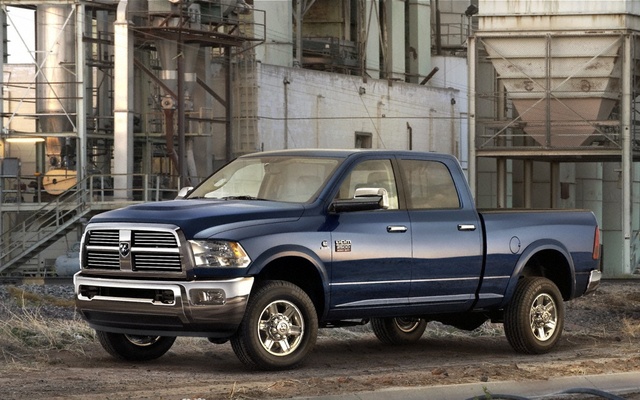
Third Generation (2010)
One year after the fourth-generation Dodge Ram 1500 was redesigned, the third-generation 2500 underwent a similar overhaul. It received significant interior and exterior styling updates, resulting in a more sophisticated and comfortable work site powerhouse with a massive, functional cabin.
There were three cab configurations: Regular Cab, Crew Cab, and the palatial Mega Cab. The Regular Cab came with an 8-foot bed while the Mega Cab (at first) came only with a 6.5-foot bed. The Crew Cab could have either. The Ram 2500 offered five trim levels: ST, SLT, the off-road-capable TRX, the off-road monster Power Wagon, and the upscale Laramie. Those last three were not available on regular cab models, which were mainly sold to work customers and fleets.
The standard engine for all these trims was the 5.7-liter Hemi V8 which made 383 horsepower and 400 pound-feet of torque. It routed power through a five-speed automatic transmission. Rear-wheel drive (RWD) was standard on most models with four-wheel drive (4WD) optional, but TRXs and Power Wagons. The other engine option, was the long-running turbodiesel Cummins inline-six, makes 350 horsepower and 650 pound-feet of torque. This engine is available on all but the Ram 2500 Power Wagon.
The gas V8 can tow up to 13,450 pounds when properly equipped, and it can haul up to 3,160 pounds of payload in the bed. The Cummins diesel helps the Ram 2500 pull up to an impressive 17,600 pounds. An five-speed automatic transmission was standard on V8s, but turbodiesel models could be had with a six-speed manual or a six-speed automatic. Payload and towing limits are lower on the manuals, and they were not a popular option.
The ST was a basic vynil-interior work truck, but the SLT added things like cloth seats, floor mats, Satellite radio, and cruise control. The TRX offers premium cloth upholstery, a digital driver display, keyless entry, and forged aluminum wheels. The range-topping Ram 2500 Laramie features 17-inch aluminum alloy wheels, dual-zone climate control, power-adjustable front seats, driver memory settings, simulated woodgrain interior accents, and a leather-wrapped steering wheel. It also includes USB and Bluetooth connectivity.
The Power Wagon comes standard with four-wheel drive and is aimed at off-road fans. Other trail-ready features include a beefed-up suspension, front-mounted winch, and locking front and rear differentials. Options on the Ram 2500 include skid plates, voice-activated navigation, a limited-slip rear differential, and various axle ratios. This truck came out before the advent of loaded touchscreen infotainment systems with Apple CarPlay and Android Auto, but Crew Cab and Mega Cab versions of the SLT, TRX, and Laramie trims were available with other passenger-friendly options like a sunroof and a rear-seat DVD entertainment system.
Owners generally liked the 2010 Ram 2500 for improved features and styling, but the 2500 did not enjoy the same comfortable ride as its 1500 counterpart. 2500 and 3500 models kept their old-school leaf spring rear suspension for heavy loads, while the new-generation 1500 got a coil-spring rear suspension for much-improved ride quality and handling. Since towing and hauling are the priority, the ride is rough, as is maneuverability. Overall, the 2010 Dodge Ram 2500 is an incredibly capable workhorse designed for whatever you throw at it. The Cummins is also one of the most economical engine choices in the heavy-duty truck class.
These 2500s have a good reliability record and offer both increased capacity and nicer interiors than their predecessors. Most of these trucks are labeled as Rams only, and the 2500 has continued as a Ram ever since 2011, with its latest redesign happening in 2020. These trucks hold their value well too, and even a basic 2010 Ram 2500 work truck in good condition with under 100,000 miles costs more than $20,000. Mega cabs and high trim models can venture well above $30,000 despite their age.
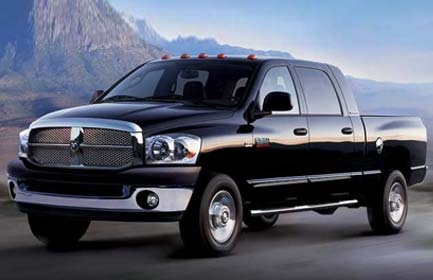
Second Generation (2003-2009)
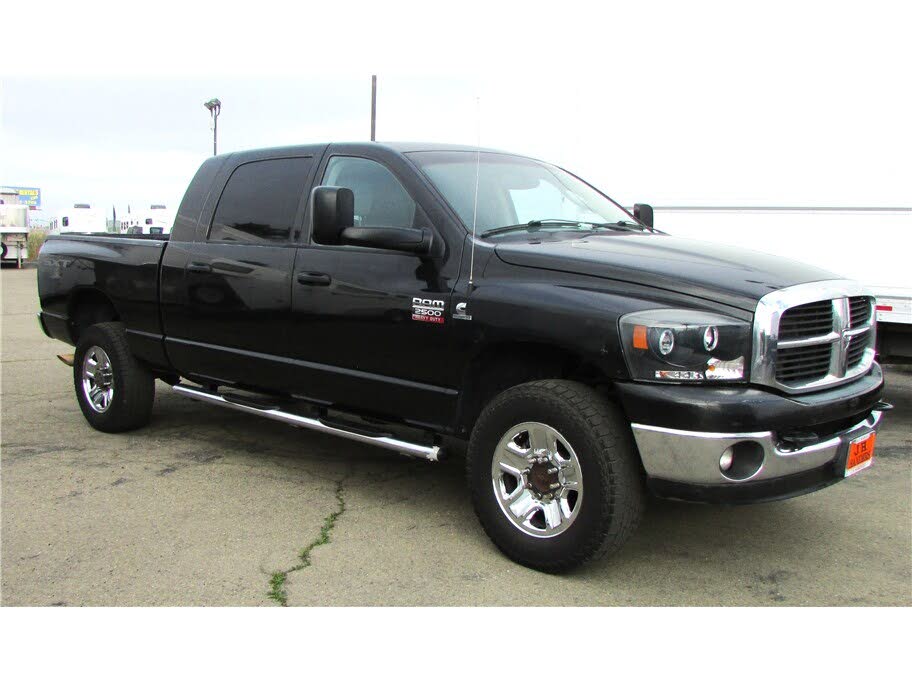
The Dodge Ram 2500 was redesigned for the 2003 model year, but it retained its predecessor's big-rig design philosophy. At first, it was offered in Quad Cab and Regular Cab styles and ST, SLT, and Laramie trims. The V10 was now restricted to the beefier 3500 model, but Dodge made up for this with a brand new base engine, the revived 5.7-liter “Hemi” V8. The 5.9-liter Cummins turbodiesel inline-six carried over from the tail end of the first-generation model. As before, rear-wheel drive was standard with four-wheel drive optional.
Early on, the Hemi V8 made 345 horsepower and 375 pound-feet of torque, while the turbodiesel six offered multiple levels of tune. The standard output was 250 horsepower and 460 pound-feet of torque, but the high output (HO) model pumped out 305 horsepower and 555 pound-feet. Some 2500s sold in California and a few other states made less power due to emissions regulations, but they still had plenty of grunt. A five-speed manual or four-speed automatic were offered at first but later gave way to beefier six-speed units.
These trucks also featured an all-new interior, though the plastic pieces didn’t hold up very well over time, and broken interior bits are the number one complaint owners have about these trucks today. As before, there were three basic trims at first: ST (the workhorse), SLT (the mid-range), and Laramie (the luxury model). Bluetooth connectivity and a navigation system were offered for the first time. For 2004, the Laramie package offered some new styling tweaks, and there was a newly available Off-Road package.
A Power Wagon trim was introduced for the 2005 model year. It boasted electronically locking front and rear differentials, ensuring enhanced capability in more settings. It also boasts a lifted suspension and 33-inch off-road tires. A power sunroof and satellite radio were available options.
2006 saw major updates for the whole lineup, most notably the addition of the “Mega Cab,” a stretched crew cab with more room than any other crew cab pickup and lots of neat storage features within. It’s still one of the largest pickup interiors ever and is truly superior to rival crew cabs from Ford and GM, even if Dodge’s other cabs from this era lag their rivals on room, particularly the Quad cab. Depending on configuration, this model year's top-end towing performers ranged between 12,000 and 14,000 pounds.
For 2007, the Ram 2500 receives a new 6.7-liter turbodiesel inline six-cylinder engine. It makes 350 horsepower and 650 pound-feet of torque. This new diesel engine replaces the 5.9 Cummins diesel engine of prior years and also integrates an exhaust brake. Because of the late availability of this engine, some 2007 Ram 2500 examples come equipped with the older 5.9 High-Output Cummins. If you find the 6.7, it comes with a six-speed automatic transmission, replacing the older four-speed automatic. A six-speed manual remained available on the diesel.
The Hemi engine continued, but by the end of the run, it was making 390 horsepower and 410 pound-feet of torque. By 2009, the 2500’s maximum payload capacity had reached 3,600 pounds, and it could to up to 13,400 pounds on a conventional hitch (and more than 15,000 with a gooseneck). That’s notably lower than some earlier versions but still a solid number for a 2500-level truck of this era.
Towing and payload limits were lower with the diesel, but according to crowdsourced data from apps like Fuelly, the turbodiesel returns between 14.5 and 16 mpg, which is more than any other HD truck of this time. The EPA does not officially rate heavy-duty models, but real-world results can be found. Towards the end of the run, the Cummins was also the only heavy-duty truck engine to meet future (2010) emissions guidelines, so it was cleaner than other diesels.
Owners generally love these trucks' towing power and durability, but they don’t like the interior in the early years. 2006 and newer versions, especially the Mega cab, are much preferred. Poor fuel economy from the Hemi is the most notable complaint, with some mention of a bumpy ride and a tendency for rear-wheel skidding. These trucks have held their value well too, though we’d probably recommend going newer than 2004 to get past the years with the most complaints.
Second-generation Dodge Ram 2500s in good condition with fewer than 120,000 miles on the odometer generally start at around $20,000. Gas versions cost less than diesel, in part because of the oil burner’s extra torque and reputation for reliability. The higher-trim diesel can run into the low $30,000 range, and virtually all Mega Cabs run more than $30,000 because of the desirability of that configuration.
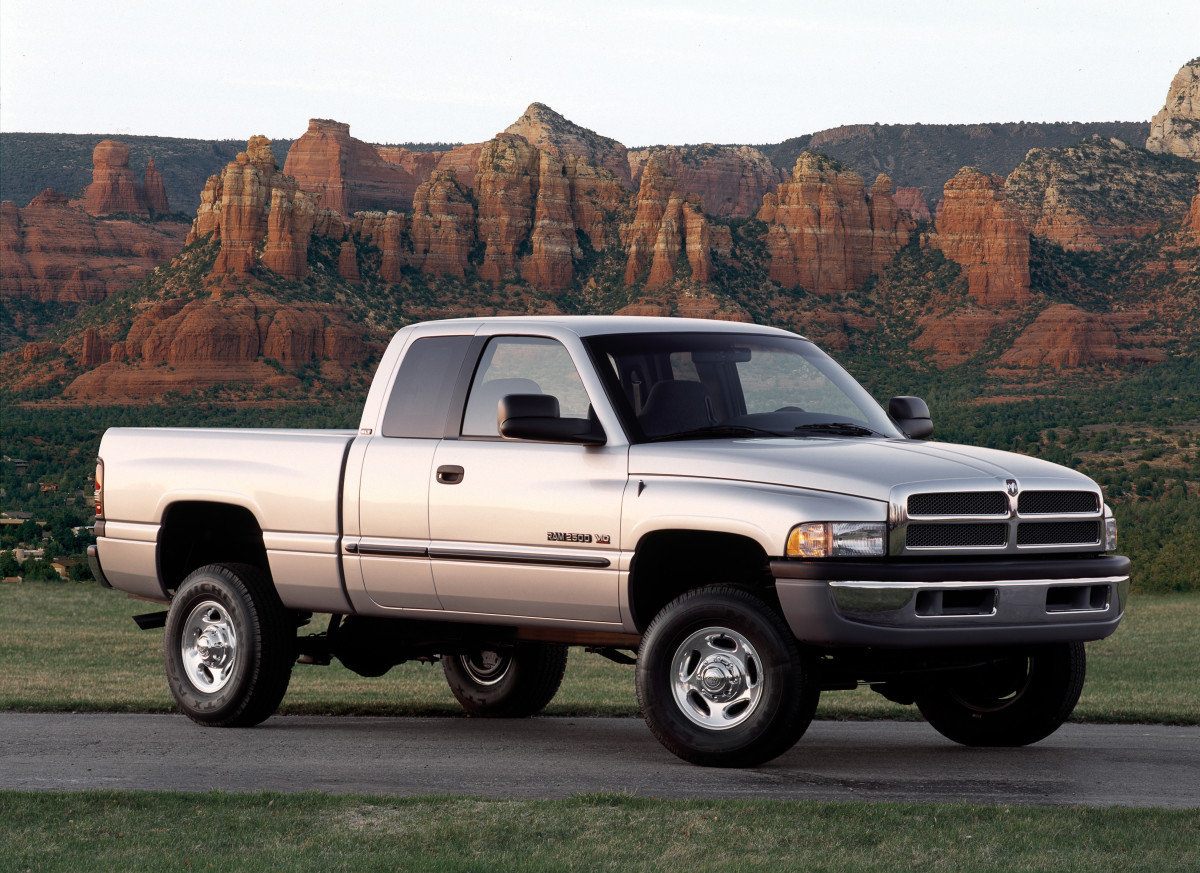
First Generation (1993-2002)
The Dodge Ram name dates back to 1980, but before 1994 the heavy-duty models were simply labeled as the Dodge W250 or W350. In that era, the automaker added its first Cummins turbodiesel engines, which would later come to define the Dodge Ram 2500, but the actual model name and truck did not arrive until 1994’s new “big-rig” family of trucks. Dodge also split these years into a standard 2500 and a heavy-duty one, each with their own engine lineup.
Buyers could select ST, LT, SLT, and Laramie trims, all in the regular-cab configuration, with either short or long beds. The standard 2500 came equipped with a 5.2-liter V8 making 220 horsepower and 300 pound-feet of torque, but most standard-grade 2500s were built with the optional 5.9-liter V8, with 235 or 245 horsepower depending on the year, and up to 335 pound-feet of torque. Both of these engines were long-running and durable Chrysler motors that had been around for decades, and they could tow 7,700 or 9,100 pounds, respectively.
The “2500HD,” which is the ancestor of the subsequent Dodge Ram 2500s, came standard with the 5.9-liter V8. Above that, it offered the 5.9-liter Cummins turbodiesel straight six, which went through many improvements over the years and gained power and torque almost every year. It started at 160 horsepower and 400 pound-feet of torque (with an automatic) and ended the run at up to 245 horsepower and 505 pound-feet in high output form (a standard output model was also offered).
There are many different versions, so you may need to check out old spec charts for exact tow ratings. In 1995, it was rated for a 12,300-pound towing maximum, but by 2002, the high-output diesel could tow 14,100 pounds. Several different four-speed automatic transmissions were offered, as were two different five-speed manuals and one six-speed unit. Rear-wheel drive (which you’ll need for the highest tow ratings) was standard, and four-wheel drive was optional.
At the top of the engine lineup was the 8.0-liter V10, a cousin of the engine in the Dodge Viper sports car. Depending on the year, this gas-powered behemoth made 300 or 310 horsepower, and 450 pound-feet of torque. It could tow 13,600 pounds early on, but never really bettered that figure. As the turbodiesel became more powerful, it gradually made the fuel-thirsty V10 redundant, and these are the only 2500 models on which it was offered.
For 1994, the single-cab configuration remained, but buyers could not opt for a Sport trim with unique styling. In 1995, the Club cab debuted, an extended cab model with a rear-hinged back door. Though this provided more room for tools and tiny occasional seats for uncomfortable rear passengers, the 2500 did not offer a proper crew cab (labeled quad cab by Dodge) until 1998, when the lineup got its first refresh.
There were four trims in the early years, WS, ST, SLT, and Laramie SLT, in ascending order of plushness, but all but the most loaded Laramies would seem basic inside to today’s audiences. In its day, this was a futuristic-feeling interior, full of round plastic and convenient features, but the plastic doesn’t always age well, and it just seems basic and dated now, and the belated crew cab did not have as much interior room as rivals from Chevy, GMC, and Ford. Nonetheless, it was comfy up front.
These 2500s have held up well over time, and despite a vulnerability to rust, they’re generally dependable. Owner complaints tend to center on worn-out suspension parts and broken or low-quality interior components, especially on 2001 and 2002 models, but these aren’t things that will break a used truck buyer’s budget. V8 models are pretty cheap, ranging from about $9,000 to $15,000 in good condition with low mileage, but make sure to check the door label for capacities if you really need towing power.
Good V10s generally cost more, about $11,000 to $18,000, and they’re fairly rare. The turbodiesels, just starting to be collector trucks and famously reliable, cost much more, typically over $30,000 on average. They’re nice trucks with collector potential, but at that price there are more modern offerings if you’re just looking to haul.
Related Topics