In 1983, four years after President Jimmy Carter approved a $1.5 billion bailout to save Chrysler from collapsing, the greatest automotive comeback appeared in Dodge showrooms: the Caravan. By taking the utility of a truck-based commercial van and marrying it with the comfortable suspension, low ride height, and efficient powertrains of a car, Chrysler created a new vehicle segment and killed the station wagon. Millions of American families would pile into minivans—and decades later, the sportier but less practical crossovers and SUVs they inspired (see Dodge’s own Durango for details)—all because of the Caravan.
Dodge Grand Caravan Buying Guide: Cost, Reliability, and the Best Years to Buy
Search for Dodge Grand-Caravan
See all


The Dodge Grand Caravan, along with the Plymouth Grand Voyager and the Chrysler Town & Country, were extended length versions, introduced in 1987, offering double the cargo space behind the third row of seats and extra passenger space thanks to more than 14 inches of added length and seven extra inches of wheelbase. The Grand Caravan was a separate, more expensive model until the fifth and final generation in 2008, when Dodge dropped the shorter Caravan. While the Grand Caravan continues in spirit as the Chrysler Pacifica, which competes with the Kia Carnival, the Honda Odyssey, and the Toyota Sienna, it was officially discontinued after the 2020 model year.
Dodge Grand Caravan: Cost, Reliability, and the Best Years to Buy
- Frequently Asked Questions
- Pros and Cons
- Dodge Grand Caravan Generations
- Dodge Grand Caravan Fifth Generation (2008-2020)
- Dodge Grand Caravan Fourth Generation (2001-2007)
- Dodge Grand Caravan Third Generation (1996-2000)
- Dodge Grand Caravan Second Generation (1991-1995)
- Dodge Grand Caravan First Generation (1987-1990)
Frequently Asked Questions
Which Dodge Grand Caravan years are the best?
Late-model Grand Caravans are the best, mainly to avoid the four-speed transmission failures and creaking, rattling bodies that tend to plague these vans as they age.
Which Dodge Grand Caravan years are the worst?
Avoid any Grand Caravan with more than 80,000 miles. Think about what a minivan has to go through, and what kinds of things happen in the back of minivans, and you will understand why a high-mileage Grand Caravan is might not be a great move. With that in mind, ensure you carry out a thorough test drive when you visit the dealership, and note that all used examples are now out of warranty.
Is a used Dodge Grand Caravan a good deal?
Yes, they are all very affordable.
Pros and Cons
Pros:
- Incredibly spacious and well laid-out
- Comfortable for adults in all rows
- Easy entry and exit
Cons:
- Drab styling in final generation
- Unreliable four-speed automatic transmissions
- Prone to chassis flex and vibrations as they age
Dodge Grand Caravan Generations
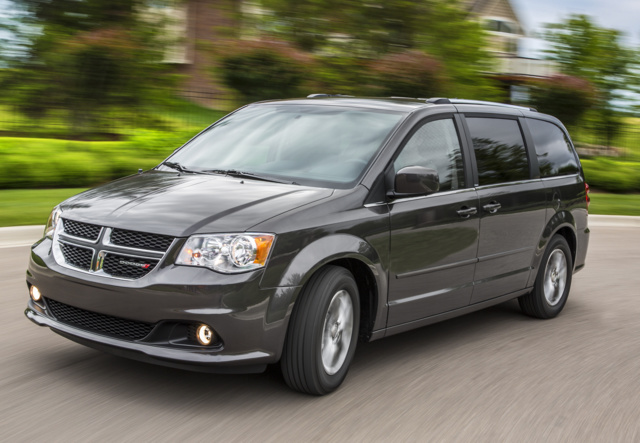
Dodge Grand Caravan Fifth Generation (2008-2020)
This was the longest-running Grand Caravan generation, because it coincided with Chrysler switching ownership four times and upper management were hired and fired on a regular basis. Chrysler was bankrupt again by 2009, bailed out again, and never quite stabilized its business. This led to total stagnation in the Grand Caravan's development and little incentive to push the technological envelope. Toward the end of its life, the Grand Caravan was primarily sold to fleets and marketed to retail consumers as a leftover, cheaper alternative to its true sixth-generation replacement, the Chrysler Pacifica.
To begin with, the fifth-generation Grand Caravan was off to the races against the Toyota Sienna, the Honda Odyssey, the Hyundai Entourage, and the Nissan Quest. In addition to the Stow 'n Go seats, Dodge added Swivel 'n Go, which allowed the second-row captain's chairs to tilt in the opposite direction to face the third row, and included a fold-out table and a flip-around entertainment screen in the third row. Specs included a hard drive connected to the stereo, called MyGIG, which could store and record music as part of the Uconnect infotainment system, which also had a voice-command function, and it was available with remote start. Power windows for the sliding doors were added, along with standard side curtain airbags and electronic stability control. The exterior styling was much boxier and more upright—more like the second-generation Grand Caravan than the third or the fourth. The 3.3-liter V6 (175 hp/205 lb-ft) continued with a four-speed automatic transmission, but a new six-speed automatic was paired to the 3.8-liter V6 (197 hp/230 lb-ft) and also a new 4.0-liter V6 (251 hp/259 lb-ft) with the Dodge Grand Caravan SXT. All-wheel drive (AWD) was discontinued.
Blind-spot monitoring with rear cross traffic alert and a sport suspension were optional for 2009, while the Stow 'n Go seating was made standard on all trim levels. Active headrests were added for 2010, along with manual three-zone climate control on SE trims and a lower final drive ratio for the 4.0-liter V6 for improved mpg. The Swivel 'n Go seats were discontinued.
A significant refresh for 2011 dropped all three V6 engines and replaced them with a new 3.6-liter Pentastar V6 (283 hp/260 lb-ft). Additional tweaks to the brakes, tires, ride height, and a rear spoiler helped to improve efficiency. The interior quality was a big step up, with a one-piece dash, softer materials, larger gauges, a heated steering wheel, and better fit and finish across all trim levels. A new roof rack, Stow 'n Place, allowed the cross rails to fold and hide into the side rails when they weren’t in use. The Stow 'n Go seats were advertised as being more comfortable, and now included a one-touch operation when folding. An R/T trim was added for a sportier look, as were optional LED taillights.
For 2012, Dodge dropped the base MSRP by $4,000 and called the base model the American Value Package (AVP). Blue ambient lighting and captain's chairs with leather upholstery on the R/T were new. Dodge dropped the MSRP another $1,000 for 2013, added a Blu-Ray player, and made a second-row bench standard on the base AVP. A 30th Anniversary trim was added for 2014 along with Blacktop appearance packages. For 2015, Dodge added Plus packages to the SE and SXT trims, which added power second- and third-row windows, an auto-dimming mirror, and other conveniences. There were no major changes for 2016. During that time, Dodge said it would discontinue the Grand Caravan but later decided against it. For 2017, Dodge reduced the number of trims from six to four (SE, SE Plus, SXT, and a new Grand Caravan trim, the GT). Standard on all trims were a 6.5-inch touchscreen and a backup camera. The GT was dropped for the 2018 Dodge Grand Caravan and there were no major changes aside from a new blue paint. The 2019 Dodge Grand Caravan added a 35th Anniversary trim with red interior accents, 17-inch wheels, and a chrome grille. The last 2020 model year made the Stow 'n Go bucket seats standard on SE Plus along with extra features, such as a power driver's seat. The 2020 Dodge Grand Caravan was the final model, ceding its place to the Chrysler Pacifica which continues to push the minivan's technological innovations (such as being the only plug-in hybrid minivan on sale).
Used pricing for 2020 Dodge Grand Caravan models and earlier through 2010 averaged $11,000 on CarGurus when we looked.

Dodge Grand Caravan Fourth Generation (2001-2007)
A subtle evolution of the third generation, this Grand Caravan brought notable improvements to the engine output, suspension, safety features, and added convenience, with remote power-sliding doors, power liftgate, and an in-dash four-CD changer. Air conditioning became standard, with three-zone climate on Sport and ES trims. A removable center console, with a power outlet, could be installed either between the two front seats or between the captain's chairs in the second row. Dual-stage front airbags, which were designed to detect a smaller adult or child in the front passenger seat, were standard features and front side airbags were optional. Front-seat pre-tensioners were new, and could cinch the slack in the belt by four inches during a crash. The power-sliding doors came with optional sensors that could detect an obstruction and reverse the door's direction. Dodge made the headlights brighter, quieted the cabin with new insulation, re-sculpted the side mirrors, re-geared the steering rack, and made a host of small but meaningful changes to the front suspension geometry. The Grand Caravan's two V6 engines received more power and torque due to a larger air induction system. The 3.3-liter (180 hp/210 lb-ft) and 3.8-liter (215 hp/245 lb-ft) units were both paired to a four-speed automatic. Owing to the ethanol push of the time, the 3.3-liter could run on E85 or any mix up to that rating. The 3.0-liter V6 was discontinued, front-wheel drive (FWD) was standard, and all-wheel drive (AWD) remained an option.
A cargo organizer was added for 2002, along with a new front fascia for the Grand Caravan ES and optional rear seat audio controls. New paint colors and a DVD rear entertainment system were added for 2003. For 2004, a Grand Caravan cargo van, the CV, was available without rear seats for commercial buyers. A Grand Caravan Anniversary Edition marked 20 years of production.
There were no notable changes in any other year except in 2005, when Dodge unveiled Stow 'n Go seating. It was, and still is, an incredible feat of mechanics and precision: The second and third row seats could collapse and slide below the minivan's floor, leaving a completely flat loading area without any need to roll out, unclamp, and store the big seats in a garage. Doing so meant the integrated child booster seats had to be discontinued, but the system—still patented—is only on Chrysler minivans. Dodge estimated an owner could, in less than 30 seconds, change the number of seats from seven to two. The seats had to be thinner and less supportive than previous generations’ for them to perform these acrobatics, but Dodge compensated by using high-density foam originally developed for NASA. The underfloor seat compartments offered an additional 12 cubic feet of hidden storage when all the seats were up. The Grand Caravan could also swivel its third-row seats to face the rear, such as for tailgating. Dodge also added a movable rail system on the interior's roof for 2005, so extra storage bins could be installed overhead. A driver's knee airbag became standard. Optional side curtain airbags extended to all rows. Bluetooth and Sirius radio were also new options. For 2007, Dodge added two new paint colors.

Dodge Grand Caravan Third Generation (1996-2000)
Chrysler's "cab-forward" designs were revolutionary in the mid-1990s, which this futuristic Grand Caravan employed to maximize interior volume and create a futuristic look. Chrysler modernized its minivan for a new era—against not only established competition from General Motors and Ford, but to distance the Grand Caravan from the aged 1980s platform of the previous two generations. Every exterior shape was rounded and elongated. The windshield was 32-percent larger and necessitated bigger wipers that stacked on top of each other and swept in opposite directions. The body was seven inches longer to increase cargo space by 27 percent and five inches wider to improve shoulder room and widen the space between seats. The taller roof added headroom for the second row, a new driver-side sliding door allowed access on both sides, the liftgate handle was redesigned to open without a key, the door sills were dropped to make getting in and out easier, and the second and third row seats were on rollers to make them easier to remove and reinstall.
Side-impact door beams, headrests for the outboard second and third rows, anti-lock brakes, adjustable height seat belts for the front and second rows, dual front airbags, a power brake booster first used in the Dodge Viper, and a steering wheel lock were all newly standard safety features. More sound insulation, seals, welds, and a stiffer chassis helped ride comfort and quietness. The number of wiring circuits was reduced for greater reliability, while several environmental and health issues were addressed, such as using asbestos-free brake linings, water-based paint, and non-CFC air conditioning. Keyless entry, 16-inch alloy wheels, up to a dozen cupholders, and interior grab handles on the B-pillars were welcome features, as were the second-row seats that could slide longitudinally to make accessing the third row even easier.
A 2.4-liter inline-four (150 hp/167 lb-ft) was standard on the base and Grand Caravan SE, with the return to the three-speed automatic on the base versus the four-speed automatic on the SE. The 3.0-liter V6 also returned as an option, barely making any more output than the inline-four (150 hp/176 lb-ft), paired with the three-speed. The 3.3-liter V6 (150 hp/203 lb-ft) was optional with the SE and standard with the LE, both with a four-speed transmission. A new 3.8-liter V6 (166 hp/227 lb-ft) was optional only with the SE with a four-speed. Choosing the V6 engines with the towing package allowed up to 3,500 pounds of towing with only two people aboard and 2,700 pounds with seven people. A self-leveling rear suspension was also included. In 1997, low-speed traction control was a new option. In 1998, Dodge added hooks to the third row seatback for hanging grocery bags and other light items.
The AutoStick transmission debuted for 1999 on the ES trim, allowing manual gear control for the first time on an automatic transmission. Heated front seats, along with leather, were added as options for the ES, while mild styling tweaks, plus a standard driver-side sliding door and a Sport model, rounded out the changes. A Millennium styling package was offered for 2000.

Dodge Grand Caravan Second Generation (1991-1995)
While plastic wood-grain body paneling was still in vogue in 1991, the rest of the Grand Caravan's order sheet was thoroughly modernized. A driver's airbag, three-point seat belts in all outboard positions, speed-sensitive auto door locks, center high-mounted stop light, and a child lock for the sliding door were major standard safety upgrades, while anti-lock brakes and all-wheel drive (AWD) were optional. Dimensions remained nearly unchanged and the exterior design, even down to the vertical sliding door handle, was a softer and slightly more aerodynamic evolution of the first generation. The steering and suspension were extensively modified to provide greater balance and control, though the chassis was derived from the early-80s Aries and Plymouth Reliant.
Captain's chairs in the second row (Quad Command Seating) were a new option, along with a enlarged overhead console that extended to the second row with lighting and additional switches. The Converta-Bed could now be ordered on Grand Caravan SE trims. In the front, Dodge added a glove box in addition to the first generation's storage drawer under the passenger seat, a tachometer (despite dropping the manual transmission), and tinted windows. Every trim had a 3.3-liter V-6 (150 hp/185 lb-ft) and a four-speed automatic transmission.
For 1992, integrated child booster seats were an innovative option—and something that only automakers such as Volvo had sold in station wagons. There were no major changes for 1993. By 1994, Dodge added a front passenger airbag and reinforced the body to meet tougher federal crash standards. It also deleted the wood grain paneling and offered a 10th Anniversary Edition with two-tone paint. There were no changes for 1995.

Dodge Grand Caravan First Generation (1987-1990)
The original standard-length Caravan was a master of packaging. According to Allpar—a forum dedicated to Dodge, Jeep, Ram, Chrysler, and AMC owners and fans—it was the same length as a Dodge Aries sedan, shorter than the Aries wagon, and yet had the interior volume to rival a cargo van. But unlike a cargo van, the Grand Caravan had a low, flat loading floor, seating for up to seven, and seats that could be removed or swapped between the second and third rows. It handled like a taller car, not a truck, consumed less fuel than a larger van, could fit in a normal-sized garage, had a high seating position to look over traffic at a time when everyone drove cars, such as the Dodge Charger, and introduced the first built-in cupholders.
When the Grand Caravan came out for 1987, it featured a seven-inch increase in wheelbase, 14.6-inch increase in overall length, and cargo capacity of up to 150 cubic feet (versus 125 in the Caravan). Dodge switched from carburetors to fuel injection for 1987, which improved performance for the base 2.5-liter inline-four (100 horsepower/135 pound-feet of torque). A turbocharged version (150 hp/180 lb-ft) was newly available. Both engines came with a five-speed manual or a three-speed automatic. A 3.0-liter V6 supplied by Mitsubishi, under a joint manufacturing venture with Chrysler that began in 1985, produced 142 hp and 173 lb-ft, available only with a three-speed transmission or, starting in 1989, a four-speed automatic. There were no major changes for 1988. In 1990, Dodge replaced the Mitsubishi engine with an in-house 3.3-liter V6 (150 hp/185 lb-ft). This became the standard engine for the Grand Caravan.
Air conditioning for the rear seats, power vented rear windows, an Infinity stereo, a front bench seat that expanded seating to eight passengers, a tilt steering column, cruise control, and a towing package were among the many options. Standard-length Caravan models had one unique feature the Grand Caravan did not: The Converta-Bed, available on five-passenger models without the third row, allowed the rear seat to fold into a flat bed.
Related Topics

by Clifford Atiyeh
Clifford Atiyeh has hosted, directed, and produced more than 300 series-length videos for CarGurus since 2016. He has reported and photographed for dozens of websites, magazines, and newspapers over 20 years, including The Boston Globe, Car and Driver, and Road & Track. Clifford runs CHA Creative, which provides industry analysis and brand marketing to automotive clients.
The content above is for informational purposes only and should be independently verified. Please see our Terms of Use for more details.


