The SS badge has been around on production cars since 1961, when the Super Sport option package was made available on the full-size and extraordinarily popular Impala. There weren’t many Chevrolet Impala SS models sold in that first year, but the SS nameplate would go on to be extremely influential on machines as varied as the Camaro, the Malibu, and even the Silverado pickup truck. In fact, the SS badge continues to appear on Chevy vehicles to this day, currently on the Blazer SS electric crossover SUV. One of the most interesting cars to carry the name was the Chevrolet SS sedan, built from 2014 through 2017.
In true muscle car fashion, Chevy took the powerplant from the previous version of its Corvette, which at the time was a 6.2-liter LS3 V8 engine with 415 horsepower and 415 pound-feet of torque, and nestled it under the hood of what casual observers may otherwise have seen as a mainstream family car. Of course, with all that horsepower on tap, while the Chevy SS sedan was perfectly capable of family duties, it was also able to rip from 0-60 miles per hour in less than five seconds. It could cover the quarter-mile in under 12 seconds and carry on to a limited top speed of 160 mph. Think of the Chevy SS as a modern-day version of a big-block Chevrolet Chevelle SS, and you’re on the right track. But unlike some old coupes from the 1960s that carried the revered name—think the Nova SS or Camaro SS, or more recent oddballs such as the Chevrolet Cobalt SS, the Chevrolet SSR pseudo truck (a retro-styled machine that wasn’t as useful as something like a Chevrolet El Camino SS) or a Trailblazer SS—the SS sedan was world-class in every sense.
The Chevy SS came to American dealerships courtesy of Australia, where the Holden Commodore stood out as one of General Motors’ most interesting sedans. An earlier version of the four-door Commodore was previously sold in the United States in 2008 and 2009 as the Pontiac G8. With a fully modern rear-wheel drive, four-door sedan platform available from Adelaide, South Australia, and a long history of building some of the best V8 engines in the world, the Chevrolet SS was a match made in heaven for fans of four-door performance cars. Buyers who may otherwise have considered a Chevrolet Camaro SS now had a more practical option.
Chevrolet SS: Cost, Reliability, and the Best Years to Buy
- Frequently Asked Questions
- Chevrolet SS Pros and Cons
- Chevrolet SS Generations
- Chevrolet SS First Generation (2014-2017)
Frequently Asked Questions
Which Chevrolet SS years are the best?
While there’s very little wrong with a 2014 Chevy SS sedan, the 2015 version was upgraded with standard and desirable Magnetic Ride Control suspension. Just as importantly to some buyers, a six-speed manual transmission was added to the options sheet, alongside the more popular six-speed automatic transmission that was the only unit available in the SS sedan’s first model year.
The 2016 Chevy SS sedan was again updated for 2016 with a mild exterior refresh, a new set of 19-inch alloy wheels, and an upgraded exhaust system. So if you’re looking for the ultimate Chevrolet SS, the 2015 through 2017 models are your best bet.
What are the worst Chevrolet SS years?
While there are no truly awful Chevy SS model years, the first year of 2014 was the only one in which there was no manual transmission option, and it lacked the high-tech suspension components of the 2015-2017 SS models. The SS sedan got enough upgrades in its later model years to make those ones more desirable overall.
Is a used Chevrolet SS a good deal?
If you’re considering a used Chevrolet SS, you’re going to have to ask yourself why it’s on your radar. If it’s because you grew up on high-octane muscle cars and classic cars and think the SS is the perfect four-door performance sedan for your needs, or if you think it’s going to appreciate in value over time, then it’s probably a good deal. But if you just want something with plenty of V8 power, options such as the Ford Mustang, the Chevy Camaro, or even the Chevrolet Corvette sports car are much easier to find, probably less expensive, and just as fast. And if you need four doors, the newer Dodge Charger sedan offered a range of powerful (nearly 800 horsepower in some cases) Hemi V8 engines.
If you fall into the ‘this-is-my-dream-car’ camp and are looking for a rear-wheel-drive daily driver powered by a V8 engine, expect to pay more than $35,000 for a decent Chevy SS with less than 100,000 miles on its odometer. SS models with the six-speed manual generally sell for more than those with the automatic.
If you happen to believe the Chevrolet SS sedan is a future classic that’s worth preserving in a climate-controlled garage, you’re probably going to want a low-mileage example from one of its final model years, which means you’ll pay more than $50,000 for the right car.
Chevrolet SS Pros and Cons
Pros
- Great handling
- Powerful engine
- Spacious interior
Cons
- Poor fuel economy
- Outdated technology
- Few modern-day safety features
Chevrolet SS Generations
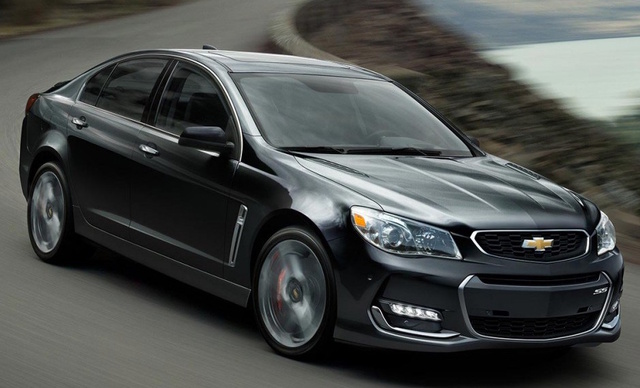
Chevrolet SS First Generation (2014-2017)
There is only one generation of the Chevrolet SS sedan. It was introduced to the public in Daytona Beach, Florida, in 2013 and went on sale wearing a 2014 model year designation. While it was a totally new vehicle for American buyers, the Chevy SS shared its chassis with a range of Australian Holden sedans. It was preceded by the seventh-generation rear-wheel-drive Chevrolet Impala SS—itself powered by the legendary Chevy small-block engine and produced from 1994 through 1996—the unloved Pontiac GTO coupe from 2004 through 2006, and the Pontiac G8 sedan from 2008 and 2009. Another rear-wheel-drive, Holden-based product called the Chevrolet Caprice was sold primarily to law enforcement agencies.
As a new-world take on the classic muscle car, the 2014 Chevrolet SS sedan stood out from other SS performance cars by virtue of its stiff chassis. Handling was excellent, and it was benchmarked against the legendary BMW M5 sedans of the early 2000s, and it was backed up by strong Brembo brakes, high-quality interior furnishings with standard leather upholstery, and a few doses of modern-day technology. It offered Bluetooth connectivity, automated parking assist, a head-up display, Forward Collision Alert, Lane Departure Warning and more. The SS sedan started right around the $45,000 mark in 2014, its first year on the market.
For 2015, Chevrolet upgraded the SS sedan with adjustable and adaptive magnetorheological dampers that improved ride quality while still maintaining excellent handling when the road got twisty. A six-speed manual transmission was also added for 2015 that further separated the SS from the automatic-only Dodge Charger. With a manual transmission, the Chevy SS was estimated to get 15 miles per gallon in the city, 21 mpg on the highway and 17 mpg combined. SS models with an automatic transmission dropped one mile per gallon in the city but the other fuel economy ratings remained the same.
The 2016 model year brought slightly revised styling to the Chevy SS sedan that made it look a little less like the contemporary and mundane Chevrolet Malibu due to its more identifiable SS badge, functional hood vents, and new 19-inch wheels. A dual-mode exhaust system was also added for 2016, so nobody was going to mistake it for a Malibu once the burly V8 engine was fired up.
There weren’t any meaningful changes to the Chevy SS high-performance sedan for the 2017 model year. Sales increased every year it was on sale in the United States, but General Motors’ Australian Holden Commodore sedan ceased production, which meant the bones that built the Chevrolet SS were no longer available for import. Fewer than 13,000 Chevy SS sedans were sold over its four-year run in America, so there’s a reasonable chance that well-preserved examples could become collectible.