2021 Jeep Wrangler 4xe Reviews, Pricing & Specs




Pros & cons
What we like
Fuel-efficient
Powerful engine
Easy-to-use technology
What to consider
Unimpressive electric range
Noisy
Poor handling
The CarGurus verdict
Your dream of running the Rubicon in silence with pure and instant electric-motor torque to overcome obstacles is now a reality thanks to the 2021 Jeep Wrangler 4xe plug-in hybrid.
In the history of automobiles, perhaps none captures the go-anywhere and do-anything American spirit quite like the Jeep Wrangler (and its CJ and Willys ancestors). Now, the 2021 Jeep Wrangler lineup offers two new ways to conquer whatever obstacles lay in your path. The first is the V8-powered Wrangler Rubicon 392. The second is the subject of this review, the clean, green, plug-in hybrid electric machine called the Wrangler 4xe.
out of 10 expert review
Look & feel
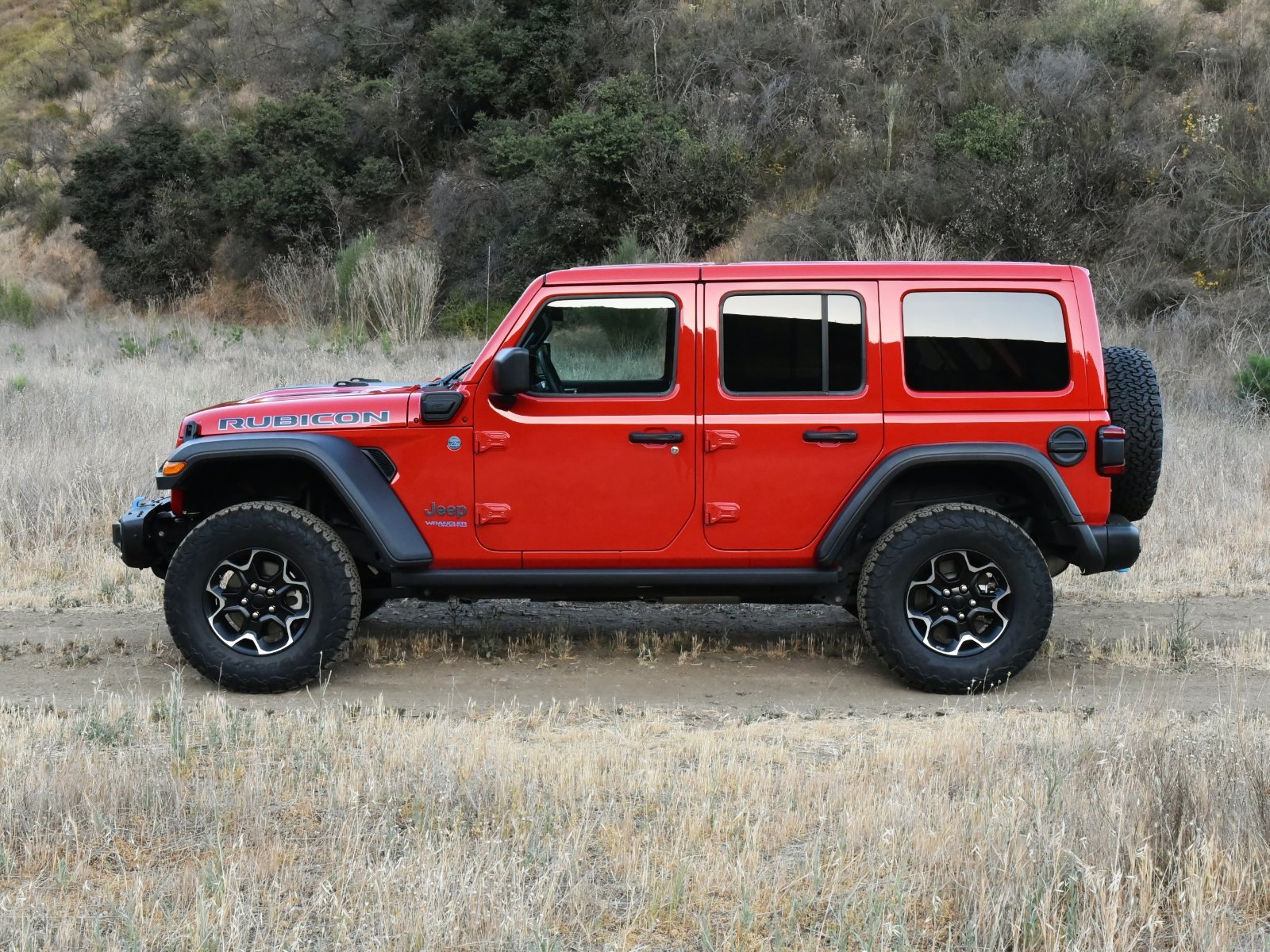
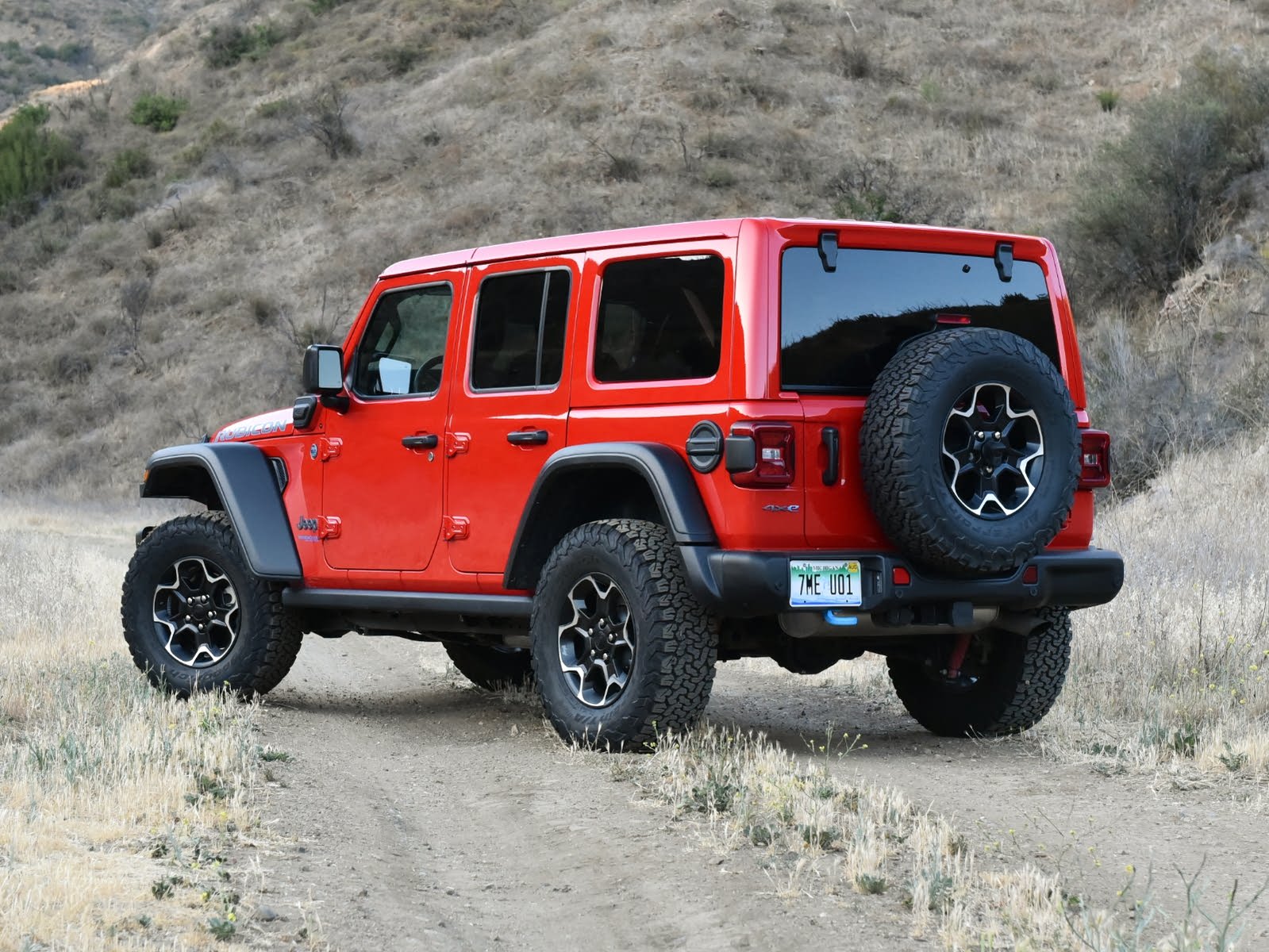
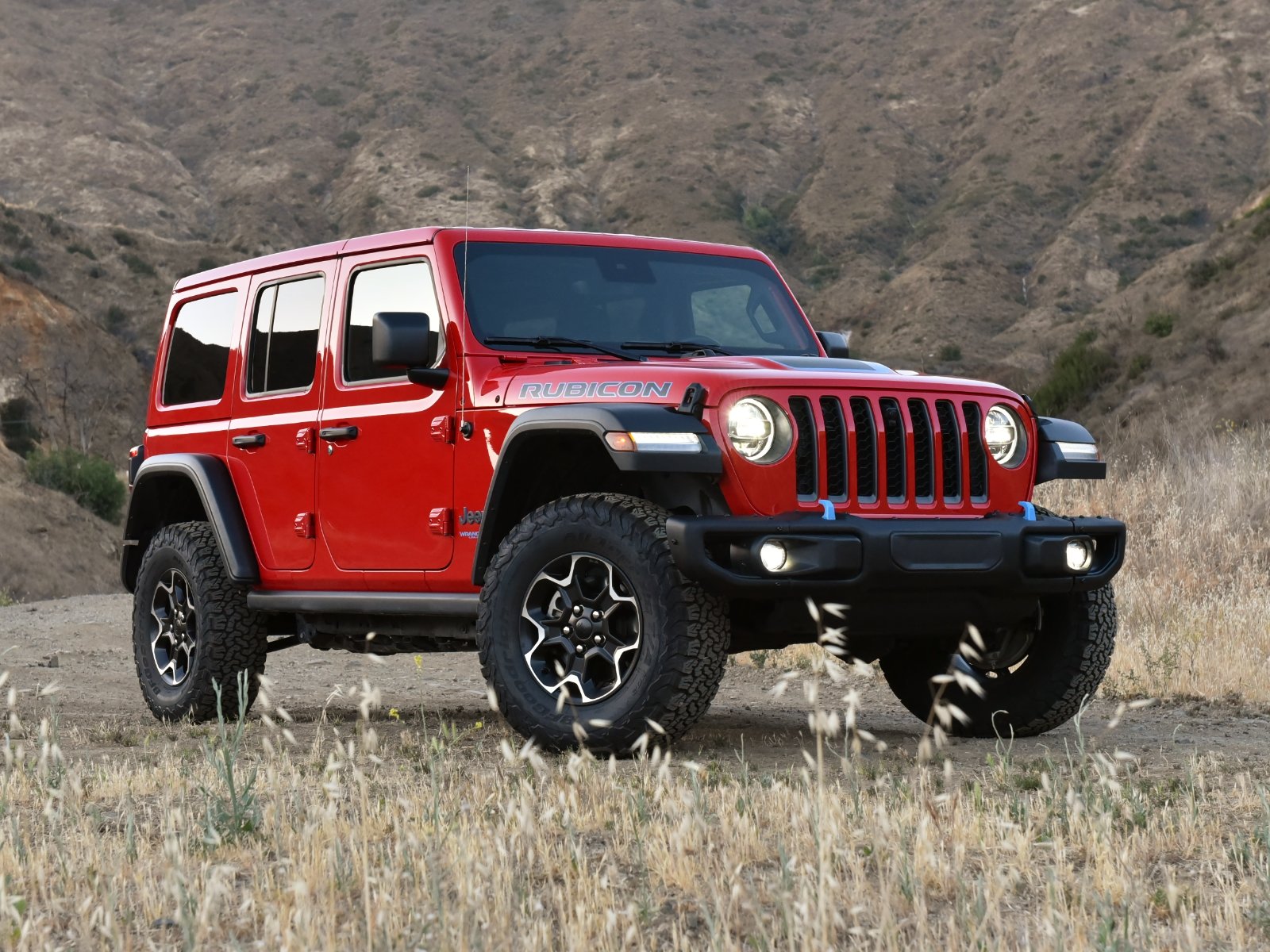
The 2021 Jeep Wrangler 4xe announces its presence as much by how it sounds as how it looks. Aside from a single “4xe” badge and sky blue tow hooks and accents, the only difference between the Wrangler plug-in hybrid electric vehicle (PHEV) and a regular Wrangler is the power port located at the left base of the windshield.
However, when the battery pack has enough juice to move the Jeep without assistance from the turbocharged four-cylinder gasoline engine, the SUV is silent except for the whine of its pedestrian notification system. This sound, more than anything, turned plenty of heads in the Wrangler 4xe’s direction as we puttered around Yosemite National Park in Jeep’s first PHEV.
Painted a bright Firecracker Red, our well-equipped test vehicle had Rubicon trim and more than $13,000 in options. It wore a price tag of $66,690, including the $1,495 destination charge. You can also get the 4xe in Wrangler Sahara or High Altitude trim levels, and the Sahara starts at less than $50,000 (not including destination and before applying the federal income tax credit and any state or local incentives in your region).
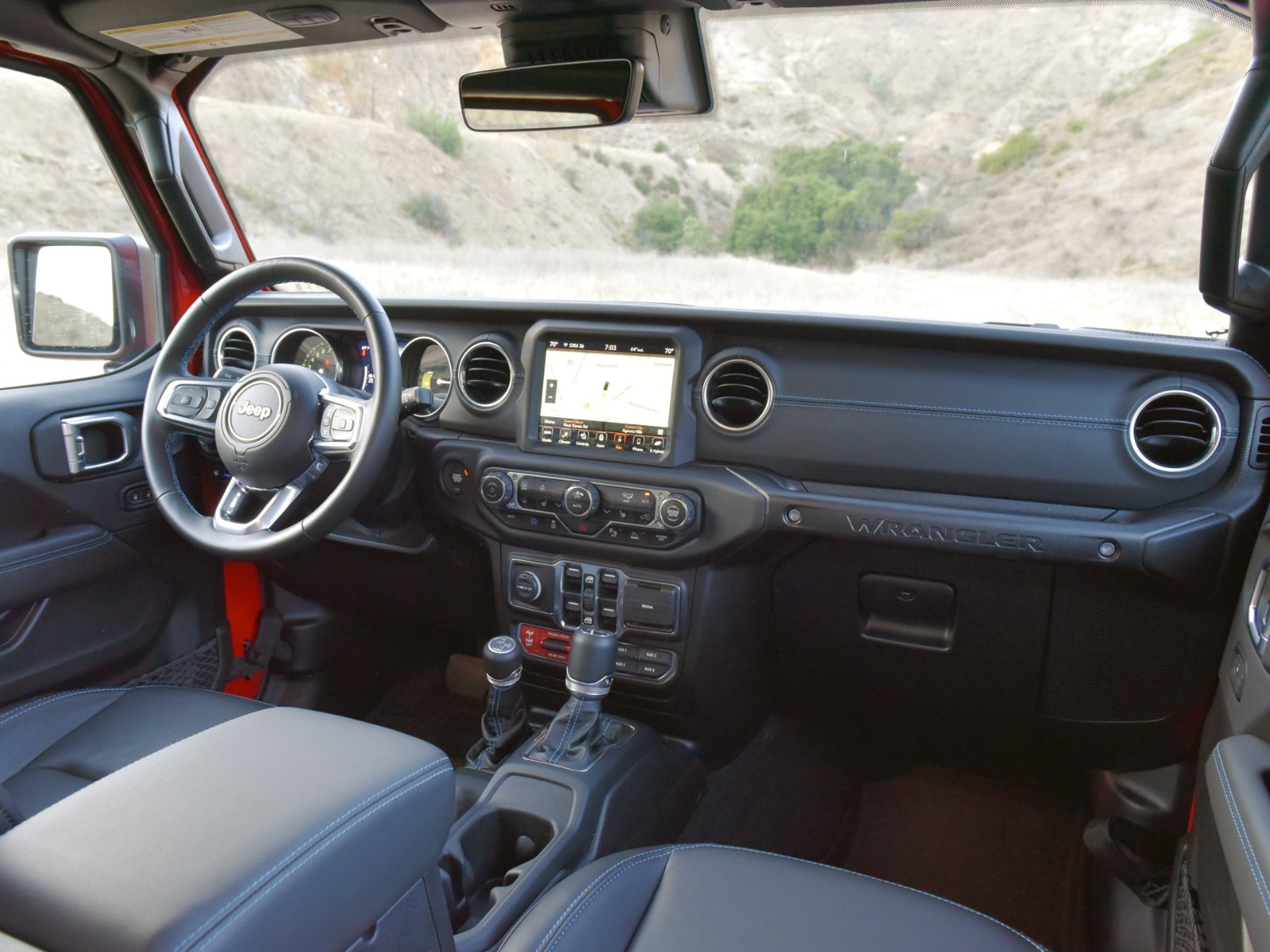
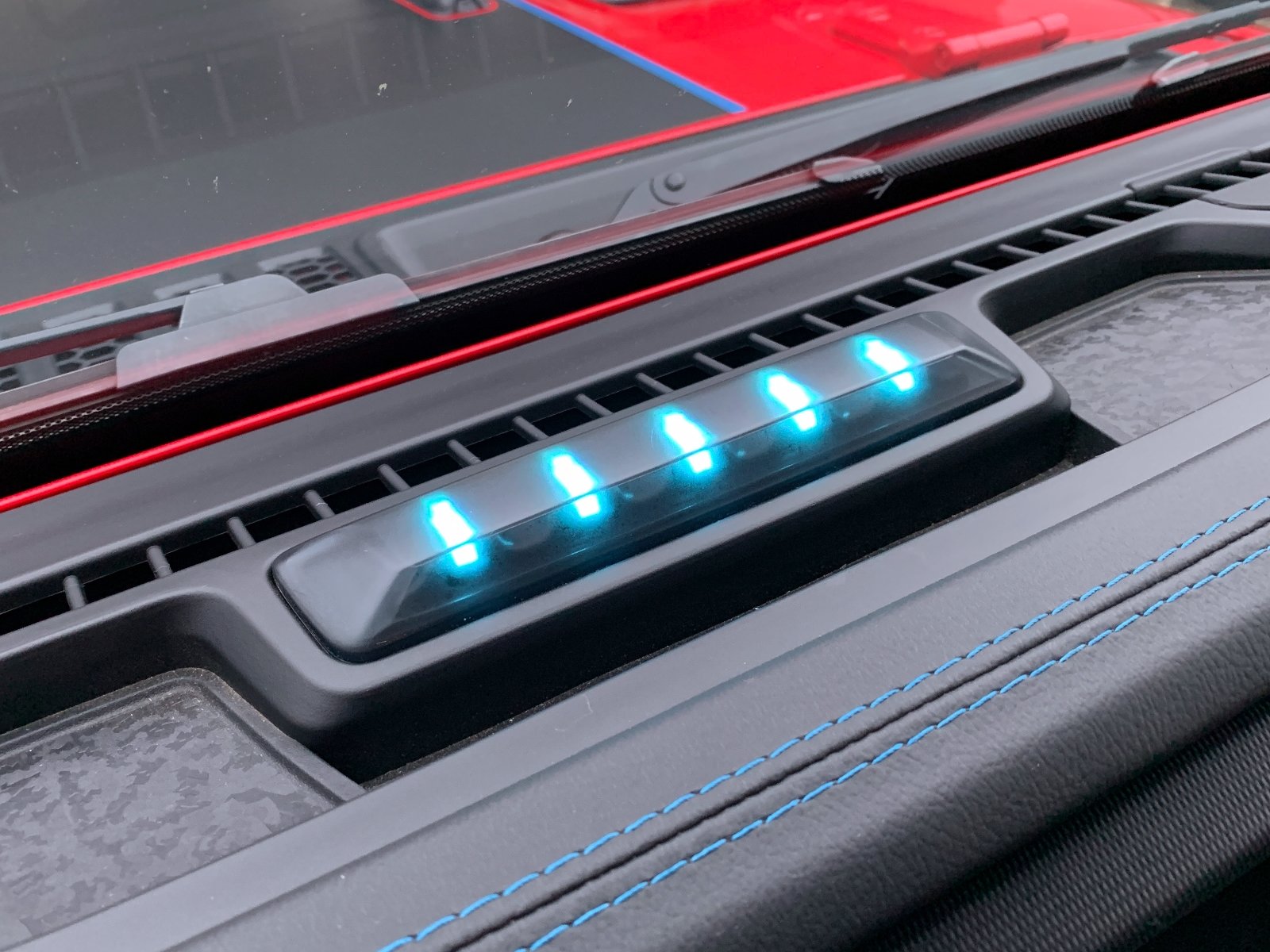
Inside, the Wrangler 4xe is essentially the same as every other four-door Wrangler. Aside from the blue seat stitching, the row of charging indicator lights at the top of the dashboard, and special gauges and displays related to the PHEV powertrain, it has the same hose-me-out look and feel to it. There is more soft-touch material than you might expect, though, from the leather on the seats to the padded upper door panels.
Controls are laid out in a form-follows-function format, and the center console houses a transmission shifter, a hand-operated emergency brake, and a manual transfer-case lever. Under the power window switches on the lower portion of the dashboard, you’ll also find the Rubicon 4xe’s front and rear locking differential controls and sway bar disconnect button, along with auxiliary upfitter switches. Robust grab handles mounted to the windshield pillars, and one for the front passenger on the dashboard, hint at the eventual need to brace yourself.
Overall, the Wrangler 4xe’s interior retains its legendary purposeful simplicity yet is better outfitted than any Wrangler to come before it. But, of course, your perspective might be different. Just don’t expect luxury or refinement because no version of a Wrangler, regardless of its price, can deliver that.
Performance
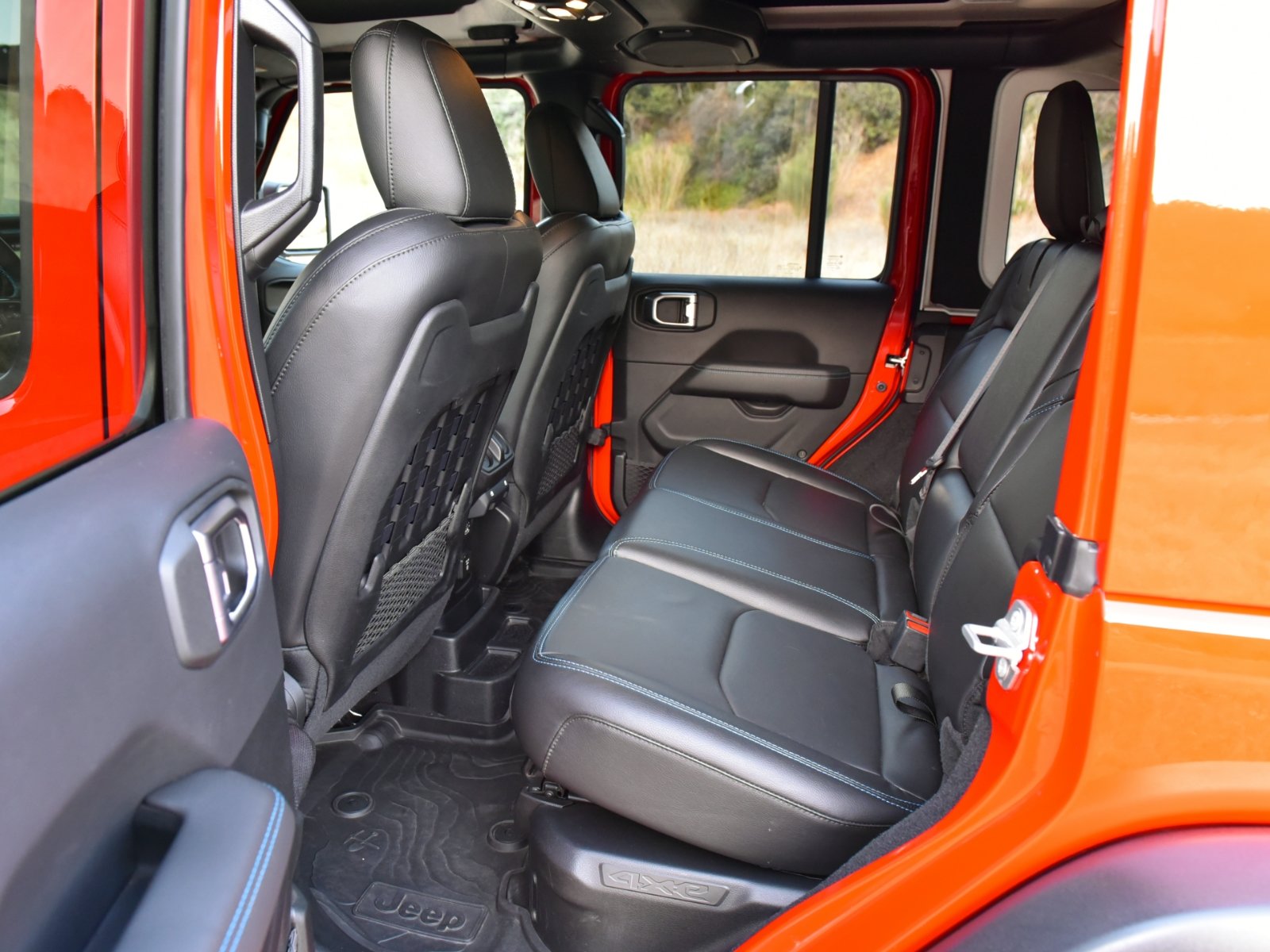
Jeep bases the Wrangler 4xe’s powertrain on its turbocharged 2.0-liter four-cylinder gasoline engine, matched to an eight-speed automatic transmission. To this, Jeep adds two electric motors and a 17-kilowatt-hour lithium-ion battery pack that lives underneath the back seat. All trim levels feature skid plates, low range, and Dana 44 axles, but the Rubicon gets an upgraded four-wheel drive system with electronic front and rear lockers.
The battery provides enough electricity to supply an estimated 21 miles of pure electric driving, with an efficiency rating of 49 MPGe combined. When used as a hybrid, the Environmental Protection Agency (EPA) rates fuel economy at 20 mpg combined. All-in, the Wrangler 4xe offers a total of 370 miles of driving range, according to Jeep.
Three powertrain modes govern how these components work together. Hybrid is the default mode, and it leverages electrification to maximize power or efficiency, depending on situational requirements. For example, if you’re accelerating onto a freeway in Hybrid mode, you’ll have the Wrangler 4xe’s total 375 horsepower and 470 pound-feet of torque at your disposal. Jeep says this scoots the 4xe to 60 mph in six seconds flat.
If you want to run the Jeep solely on electric power, choose Electric mode from the panel on the lower-left portion of the dashboard. This mode keeps the gas engine turned off unless the Wrangler 4xe encounters a situation where the turbo 2.0-liter’s extra oomph is necessary. For instance, during my range testing, the Jeep struggled to maintain freeway speed on a hill in my city. As a result, the gas engine automatically engaged to ensure the 4xe didn’t continue to lose velocity.
A third mode is called e-Save. Activate this setting, and you can save the battery power for use in a specific situation, using only the gas engine until you’re ready to run the Wrangler on electricity. This mode is helpful to Jeep’s owners in other parts of the world, where some urban areas are open only to electric vehicles. It also helps you to get from downtown Moab to the trailhead without using up all of your battery power, preserving the 470 pound-feet of instant electric torque for when the going gets really tough.
We borrowed the Wrangler 4xe for a weekend road trip to Yosemite. Before leaving, we conducted an electric driving-range test on local roads in a Los Angeles suburb. Departing home, the full-charged Jeep showed 23 miles of electric range. Driving a mix of residential and city streets, country roads, and freeways, we traveled 20 miles before the gas engine started up. The final few miles included freeway driving, and the Wrangler’s utter lack of aerodynamic efficiency undoubtedly contributed to rapid battery depletion toward the end.
After an overnight charging session using a standard household power outlet (it actually took about 16 hours), we left on a Friday afternoon, heading north on Interstate 5 with the Jeep in Hybrid mode. After chowing down some In-N-Out in Fresno, it was time to fuel up. The trip computer said we’d traveled 259.1 miles, with 47.9 of those miles electric and 211.2 of them using fuel. The Jeep had averaged 20.8 mpg.
You might wonder how the Wrangler 4xe more than doubled its typical electric driving range. When descending grades, such as when cresting California’s Tejon Pass and dropping into the San Joaquin Valley, the Jeep’s gas engine shuts off. As the Wrangler 4xe coasts and brakes downhill, the battery captures regenerative energy to recharge a bit to improve overall efficiency.
Night fell as we continued our journey north, Google Maps directing us down narrow two-lane highways that brought into sharp focus just how much on-center slop the Wrangler’s steering suffers. When you’re barreling along at 60 mph, on a stretch of blacktop without a discernible shoulder, the faintest traces of light fading from the western horizon, and an 18-wheeler is coming at you, the Jeep’s slow steering with plenty of on-center play definitely gets the adrenaline flowing.
The next day, at Yosemite, the electrified Wrangler drew plenty of attention as it whirred through parking areas whenever it had recouped enough charge to do so. Off-roading was not on the menu, but the Wrangler’s clearances assisted us in executing some creative parking solutions. And aside from some difficulty with entry and exit, the whole family enjoyed comfortable accommodations and clear views out, relieved that the Jeep’s all-season floor mats collected whatever they dragged in from the outdoors.
Our hotel was in El Portal, near the western entrance to Yosemite. After a day of exploring trails, viewing waterfalls, and drinking in nature’s beauty, the Jeep’s battery was depleted of charge. However, simply by driving from the Yosemite Village store to El Portal alongside the raging Merced River, the battery recharged to 7 percent.
Our trip back to Los Angeles was uneventful. It’s undeniably strange yet satisfying to drive a Wrangler without the sound of a gasoline-fueled engine, but on freeways, the Wrangler 4xe is a noisy thing mainly due to wind roar. Its slab-sided bodywork is also susceptible to strong cross-winds, as we discovered coming back over a windy Grapevine region.
During our short four-day loan, and starting with a fully charged battery, the Wrangler 4xe covered 757 miles (120.9 of them on electricity) and averaged 19.1 mpg. We fully recharged the Jeep once.
Form & function
The longer your legs are, the easier you’ll find it to climb into and out of the Wrangler 4xe. All four door sills are high, the rears are narrow, and the Rubicon has no side steps to preserve off-roading capability. Shorter members of your family will make use of the front windshield pillar and rear roof pillar grab handles as they hoist themselves aboard.
Once everyone is in, though, they’re likely to find this Jeep to be comfortable. The driving position is classic Wrangler. You sit high, and you sit close to the steering wheel, dashboard, and windshield. As a result, the view out and over the hood and front fenders is clear.
Manual front seat height adjusters help you find the best position, but over time, as you repeatedly slide out to exit the Wrangler, the seats tend to lower themselves. Heated front seats and a heated steering wheel are a part of the optional Cold Weather Group.
Due to the hand-brake and transfer case lever, the center console doesn’t offer much practical storage, especially for a road trip. The bin under the armrest is small, the glovebox isn’t particularly useful, and the storage netting on the lower door panels is suitable only for items that won’t slip through them.
Though our lanky teenage passenger groused about rear-seat space, it’s not a problem if you don’t mind sitting up straight rather than slouching. She had air conditioning vents, USB charging ports, a 115-volt power outlet, and MOLLE-style storage straps at her disposal. In addition, the seat cushion is high off the floor, providing excellent visibility.
Loading cargo can be a pain in the you-know-what. The Wrangler has a lower swing-out tailgate with a full-size spare wheel and tire mounted to it, and a flip-up rear glass window. Unfortunately, after creatively parking near Yosemite Falls, there was no room to access backpacks, so we had to reach over the back seat to retrieve them. Still, this design is a part of the Wrangler’s charm and personality, so if you don’t like it, get yourself a Toyota Highlander or something.
Cargo volume measures 27.7 cubic feet behind the back seat, four cubes less than a standard Wrangler. There is a storage bin under the load floor, but that’s where you store the 4xe’s charging cord. The Alpine sound system’s subwoofer also takes up some space, and the storage bag for the hardtop’s removable roof panels also makes a nuisance of itself. As a result, our four roll-aboard suitcases and an equal number of backpacks took up all available room below the seat and window line. Fold the back seat down, and the maximum volume measures 72.4 cubic feet.
Technology
Generally speaking, the Wrangler 4xe Rubicon’s technological advancements are related to its plug-in hybrid powertrain and 4WD system, including the data displays for each. But it does offer a comprehensively-equipped Uconnect infotainment system.
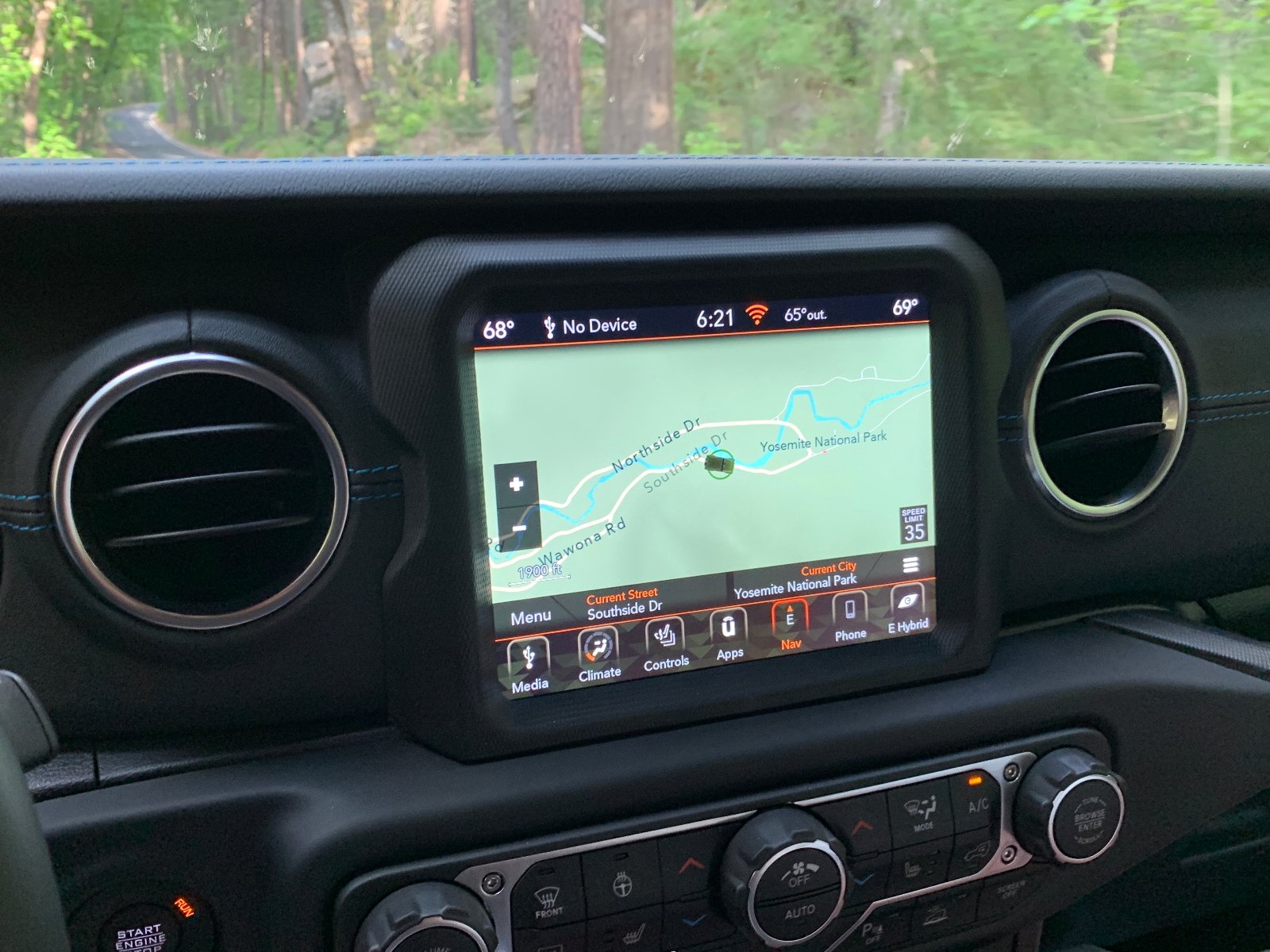
Featuring an 8.4-inch touchscreen display encased in a waterproof rubber surround, the Uconnect system provides Bluetooth connectivity, Apple CarPlay, Android Auto, a navigation system, and SiriusXM Guardian connected services with a free one-year subscription. A WiFi connection is also available and came in handy during our road trip. Our test vehicle’s Alpine sound system could overcome the wind noise on the freeway, but turning it up that loud made conversation almost impossible.
Overall, the Uconnect system is intuitive to use, but it is starting to reveal its age regarding load time, responsiveness, voice recognition accuracy, and graphics. As a result, it is time for Jeep to upgrade the Wrangler to Stellantis’s latest Uconnect 5 technology.
It is worth noting that the Trip Summary data panel on the screen between the gauges provides a charging time estimate using 120-volt Level 1 or 240-volt Level 2 charging. That’s helpfully informative.
Also, the five blue charging indicator lights on the top of the dashboard are helpful to view charging status at a glance. For example, looking out of our dining room window at the Jeep in the driveway, it was easy to tell how much further the battery had to go before reaching full-charged status.
Safety
Jeep offers several advanced driving assistance systems for the Wrangler 4xe and bundles them in the Safety Group (blind-spot warning, rear cross-traffic warning, rear parking sensors) and the Advanced Safety Group (adaptive cruise control with full-stop capability, full-speed forward-collision warning with automatic emergency braking, automatic high-beam headlights).
We used these features, and though they are basic in nature, they function as expected. We highly recommend the blind-spot warning system because the Wrangler’s side mirrors are somewhat narrow. The last thing you want to do in a vehicle with a tall center of gravity and tires meant for driving on dirt instead of pavement is take any kind of sudden corrective steering action that can unsettle the SUV.
On unlit California 140, the LED headlights with automatic high beams were effective, though they rate no better than Marginal according to the Insurance Institute for Highway Safety (IIHS). However, that’s a better rating than the standard headlights receive, which is Poor.
Otherwise, IIHS testing reveals the Wrangler to be a safe SUV except for when it comes to small-overlap, frontal-impact protection for the driver, which earns a Marginal rating. In two different tests, the Wrangler tipped over onto its side during this evaluation. The IIHS has not assessed the SUV’s front passenger protection in this type of impact on that side of the Jeep.
The National Highway Traffic Safety Administration (NHTSA) gives the Wrangler Unlimited a four-star frontal-impact crash-test rating and a three-star rating for its ability to resist a rollover in a collision.
Cost-effectiveness
Few authentic sport/utility vehicles exist anymore. We’re talking about the kind that can go places and do things most other vehicles can’t. And that makes the Jeep Wrangler a rare breed, with only the Toyota 4Runner and Ford Bronco serving as direct competitors. And neither the Ford nor the Toyota is available with a PHEV powertrain.
When you’re one of the only games in town, cost-effectiveness is a moot point. You either want what Jeep is selling, or you don’t.
But the new 2021 Wrangler 4xe isn’t devoid of value. Look around, and it’s clear many people can afford a new $50,000 SUV. And while it’s a small thing, the Jeep Wave customer care program provides complimentary scheduled maintenance for three years along with half a decade of 24-hour roadside assistance, owner support, trip interruption insurance, and access to exclusive events.
Plus, as long as you plug it in every night, you’ll find the Wrangler 4xe to be less costly to operate than a standard model. That’s especially true if you have a relatively short commute, and you can plug it in once you arrive at your office.
Also, don’t forget that the Wrangler 4xe is also eligible for up to a $7,500 federal income tax credit as well as any state or local incentives for buying electrified vehicles. In Southern California, the Wrangler 4xe is eligible for an additional $1,500 rebate. However, watch out for “market adjustment” fees, which can effectively eliminate those two incentives and then some.
If you’re finding the same situation at dealerships where you live, you should wait until dealers are having trouble selling the 4xe or just buy yourself a regular Wrangler. There is almost always a deal to be made on Jeep’s legendary rock-crawler.
What owners say
"Overall, owners of the 2021 Jeep Wrangler 4xe express strong enthusiasm for its blend of power and comfort, particularly enjoying the electric and turbo features which enhance performance. However, some drivers are disappointed with the fuel economy compared to the traditional gas model, especially given the higher price tag. The interior is praised for being family-friendly and well-equipped."
I love this car. It’s definitely pretty fairly priced. My only hesitation is the discontinuation of the the 4XE models or Wrangler and Geand Cherokee.
January 26, 2026Love this car, great speed,, quiet and comfortable with great gas mileage!
August 7, 2022Absolutely love everything about this vehicle except waiting on the recall parts to come in. Even with a month wait at this point, I’m still able to enjoy all the features and LOVE the electric component!
February 27, 2023What owners say
I love this car. It’s definitely pretty fairly priced. My only hesitation is the discontinuation of the the 4XE models or Wrangler and Geand Cherokee.
January 26, 2026Love this car, great speed,, quiet and comfortable with great gas mileage!
August 7, 2022Absolutely love everything about this vehicle except waiting on the recall parts to come in. Even with a month wait at this point, I’m still able to enjoy all the features and LOVE the electric component!
February 27, 2023I love this Jeep High Altitude 4xe… for my family purposes, it’s both refined- and rough-enough. Has seats for 5 that I need. Has great power with the electric plus turbo-4. The all electric mode is super quiet and fine for most of our daily driving, including 27 mile range (need to use hybrid if you want to hustle a bit more). Highly recommend the car…
August 13, 2021It helps save on gas. Very comfortable. Many details. Only issue is that mine did not come with the cold weather package. The heated seats, steering wheel and mirrors are in the cold weather package.
March 22, 2024Love the jeep! Had all the features I wanted.
October 4, 2021Jeep 4xe is great, but MPG is not there when this model is 20k more than the regular gas model. Gas mileage needs to go up or technology price needs to come down.
August 18, 2021Good value. Affordable. Sahara model was perfect for us. Snazzberry color is the snazz!
July 25, 2022Trims & specs
Base MSRP $67,795 | Seating 5 |
Engine 2.0L 375 hp I4 Hybrid | Cargo Capacity 27.7 cu ft |
Combined MPG 49 | Drivetrain 4X4 |
Base MSRP $61,395 | Seating 5 |
Engine 2.0L 375 hp I4 Hybrid | Cargo Capacity 27.7 cu ft |
Combined MPG 49 | Drivetrain 4X4 |
Base MSRP $57,695 | Seating 5 |
Engine 2.0L 375 hp I4 Hybrid | Cargo Capacity 27.7 cu ft |
Combined MPG 20 | Drivetrain 4X4 |


Pricing trends
MSRP range
$51,225 - $56,800
Current avg. market price
$24,830
Trending down by 2.0% this month
May 2026 - November 2026


