2025 Jeep Wrangler 4xe Reviews, Pricing & Specs


Pros & cons
What we like
Fun to drive
Plug-in hybrid powertrain
Easy-to-use technology
What to consider
Noisy
Interior materials feel cheap
Advanced safety features are not standard
Expert review
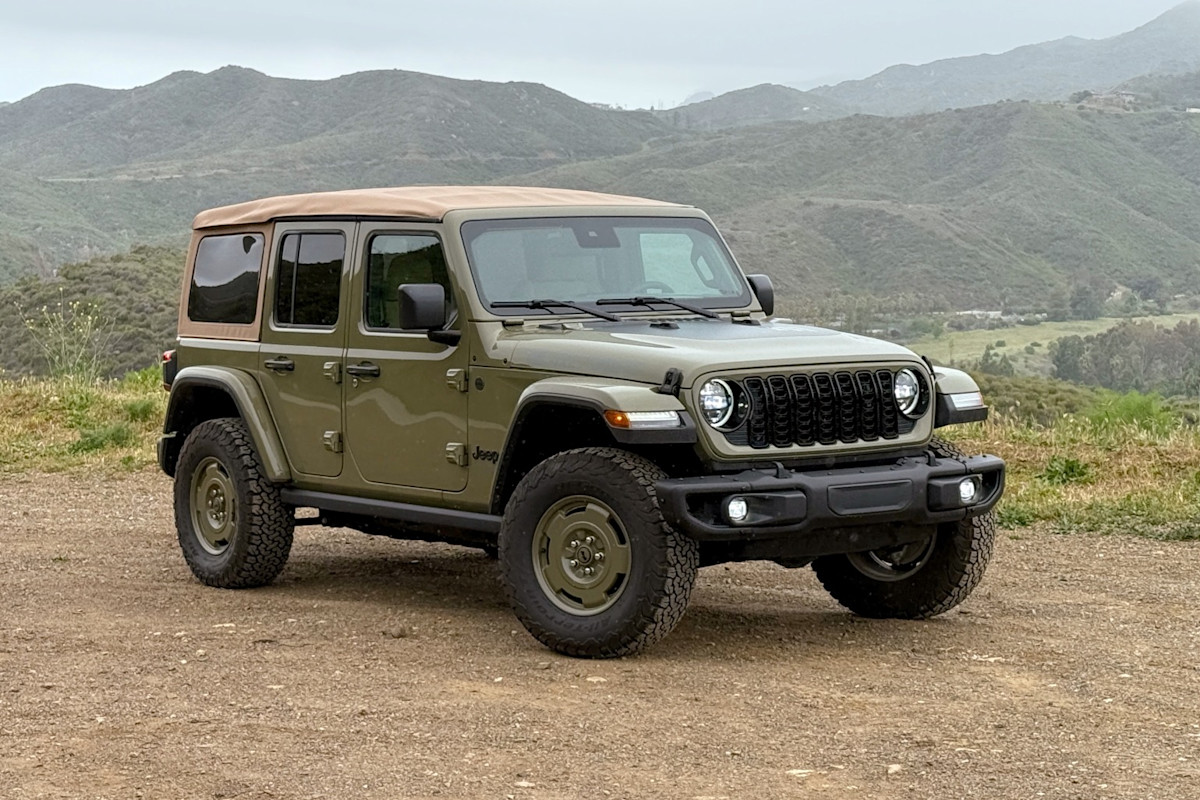
The 2025 Jeep Wrangler 4xe Willys ‘41 Special Edition commemorates the Willys MB World War II military vehicle.
You can’t miss the Willys ’41 Special Edition. It has exclusive ’41 paint (drab olive green), 17-inch aluminum wheels styled like steelies and dipped in the same color, and a tan soft-top roof. Steel front and rear bumpers, along with 33-inch all-terrain tires, are also standard. Inside, exclusive Heritage Tan cloth seats and an Olive Drab cloth dashboard insert set the 2025 Wrangler 4xe Willys ’41 edition apart. All in, it looks ready to serve.
Verdict: We like the 2025 Wrangler 4xe (and the Wrangler in general), but if you buy one with a conventional mindset regarding comfort, convenience, refinement, and sophistication, this Jeep isn’t right for you. Raw, rugged, and objectively flawed, the Wrangler is about a lifestyle and image, not convenient commuting.
out of 10 expert review
Look & feel
Uncharacteristically gloomy weather descended on Southern California during our week testing the 2025 Wrangler 4xe Willys ’41 Special Edition. Still, even when buttoned up to ward off the chill, this Jeep drew plenty of attention in a region awash in Wranglers. That’s because the Willys ‘41 is distinctly different. The unusual color. The terrific wheel design. The tan fabric top. There’s nothing else like it on L.A. highways. The overall look did feel a little too much like World War II cosplay, but we love those wheels. Jeep can make them an accessory upgrade at any time. Offer them in black, gray, and white, and we’re certain they’d be a hit.
In addition to the standard tan soft top, you can get the Willys ’41 with a body-color hardtop or the more expensive but convenient Sky One-Touch power-operated top. If you plan to regularly drive fully open to the elements in a dry climate, the soft top is easy enough to live with, even if it makes loading the cargo area a bit of a hassle. Otherwise, we recommend the hard top with its removable front roof panels, or the Sky One-Touch top if you can stretch your budget.
Inside, the Willys ’41 has Heritage Tan cloth seats that match the soft top. Jeep offered this color in the past, but for the 2025 model year, it’s only available on this WWII-inspired special edition. It looks great, although it does show dirt and stains. Jeep pairs the upholstery with an Olive Drab cloth dashboard insert and an exclusive ’41 shifter knob.
Otherwise, the cabin is standard-issue Wrangler, which means it looks and feels ready to hose out. Hard plastic is the rule, and while Jeep has improved the Wrangler’s infotainment system and added a decorative cloth insert to the dashboard in recent years, the interior remains as raw and unrefined as ever.
That’s not a criticism. Wrangler interiors are exposed to plenty of dirt, grit, and moisture, so durable materials that are easy to clean are essential. But when you’re spending this kind of cash on a mainstream-brand SUV, it would be easy to expect something more than this Jeep can deliver.
Performance
If you’re wondering what the best-selling plug-in hybrid (PHEV) in America is, you’re looking at it. Jeep has built over 250,000 examples of the Wrangler 4xe at its Toledo, Ohio, assembly plant since it debuted for the 2021 model year.
Jeep bases the Wrangler 4xe’s powertrain on a turbocharged 2.0-liter four-cylinder engine. Two electric motors, one a 33-kilowatt generator motor and the other a 100-kW traction motor integrated into the eight-speed automatic transmission, provide an estimated 21 miles of electric-only driving range. They draw energy from a 17.3-kilowatt-hour (kWh) battery pack.
When the battery reaches its minimum state of charge, the gas-fueled turbo-four fires up to provide 20 mpg in combined driving. That’s your best-case scenario if you never plug the Wrangler 4xe in to recharge the battery. Comparatively, the standard Wrangler’s gas-only turbocharged four-cylinder is rated at 21 mpg. Therefore, spending more to get the 4xe makes sense only if you plan to plug it in on a regular basis. Jeep says you can recharge the battery in 12 hours when using a standard household wall outlet. That aligns with our experience. Alternatively, you can get a Level 2 home charging station and recharge the Wrangler 4xe in 2.5 hours.
On the lower left portion of the dashboard, three driving modes are available: Hybrid, Electric, and E-Save. Drive the Wrangler 4xe in Hybrid mode, and it automatically adjusts to maximize power or efficiency, depending on the situation.
Select Electric mode, and it runs only on battery power and the electric traction motor, unless a situation requires the gasoline engine. Examples include accelerating hard to reach freeway speed or climbing a mountain grade, when the gasoline engine may provide the electric traction motor with temporary assistance.
Choose E-Save mode, and only the turbocharged gasoline engine motivates the Wrangler, conserving the battery for a specific purpose. Situations calling for this mode include using battery power for quieter travel and smoother drivetrain response when driving off-road, or, for Jeep’s overseas customers, traveling into urban zones restricted to electric vehicles.
In theory, this powertrain is just what a fuel-inefficient lifestyle vehicle like the Jeep Wrangler needs. And if you recharge the battery each night, it can dramatically improve overall efficiency, especially for owners who do not commute and use their Wranglers mainly for short local trips. That’s how we lived with the Willys ’41 edition for a week, and we had plenty of gas left over at the end of the evaluation period.
In Hybrid mode, with the gas engine and electric motors working in tandem, Jeep claims the Wrangler 4xe produces 375 horsepower and 470 pound-feet of torque. That represents a 105-hp and 175 lb-ft bump over the gas-only turbo four, and a 90-hp/210 lb-ft increase over the Wrangler’s available 3.6-liter V6 engine (a 470-hp 6.4-liter V8 is also available in the Wrangler Rubicon 392). This makes for a pretty quick SUV with fuel economy that’s close to the turbo-four Wrangler.
We performed a range test, starting with a full battery that indicated 22 miles of electric range. A couple of hard acceleration situations and an ascent into the local mountains netted 18 miles of travel on electricity and 4.6 miles on gas, equivalent to 30.8 mpg for the overall distance. For a Wrangler, that’s impressive. Of course, as you continue to drive, that average falls. At the end of our 72.1-mile Southern California testing loop, the Willys ’41 had averaged only 20.1 mpg, factoring in the 18 miles covered solely on electricity.
Subsequently, we spent nearly a week in a Wrangler Sport S with the gas-only turbo four, and it got 19.1 mpg over more than 275 miles. So, the more miles you put on the PHEV without recharging the battery, the less efficient it becomes compared to a standard Wrangler, and the less financially sensible it may be.
Putting the powertrain aside, the Wrangler 4xe Willys ’41 Special Edition boasts all of the same off-road capability and suffers from all of the same on-road flaws as other Wranglers. Need to forge rather than follow a path through the wilderness? A Wrangler 4xe can do that, seemingly without effort. But in daily driving, you’ll pay for it with a noisy interior, a rudimentary ride, modest handling, and vague steering.
Form & function
A 2025 Wrangler 4xe has room for four adults, and when necessary, you can squeeze a fifth person into the middle of the back seat. Most versions of the 4xe have manual front seat adjusters and cloth upholstery, but the top-shelf Jeep Wrangler Rubicon X includes 12-way power-adjustable front chairs wrapped in premium Nappa leather. Heated front seats and a heated steering wheel are available, extending the open-top driving season.
Our test vehicle had those upgrades, and they proved worthwhile during L.A.’s “May Gray” weather. The manual driver’s seat height adjuster also improved comfort. But we found that entering and exiting the vehicle meant sliding over the height-adjustment lever, meaning we unintentionally lowered the seat over time.
Tall people may find the Wrangler uncomfortable due to its cramped legroom in both the front and rear seats. Fortunately, the test vehicle’s softly padded front seatback proved kind to knees and shins. Teenagers report that Wranglers are terrible for napping, though, unless they fold down the rear center armrest and lean toward the middle instead of the doors.
Storage space is lacking, forcing creativity. For example, the key tucks neatly into the small armrest cubby on the driver’s door, while a 32-ounce water bottle can lie on the hand brake lever between the seats. A slot between the two cupholders can secure a smartphone, but that doesn’t work very well when drinks are also kept there. That leaves the small cubby under the center armrest, the narrow glove compartment, and the netting on the door panels.
The Willys ’41 was the first Wrangler with a soft top we’d driven in a long time. The benefits of opting for a fabric roof include how quickly and easily it opens both rows of seats to the sky, compared to the hard top’s removable roof panels, which offer a sun-drenched drive only to the driver and front passenger. Also, thanks to the zippered and tabbed top design, it is comparatively easy to remove and store the plastic windows and the top itself.
However, loading cargo is more of a hassle. With the hard top, the rear window flips up after you swing the tailgate to the right. With the soft top, you must perform some disassembly to load larger items into the four-door Wrangler’s 27.7 cubic-foot cargo area. Fold the back seat down, and the Wrangler 4xe provides 67.4 cubic feet of cargo space.
Technology
Every Wrangler 4xe comes standard with a 12.3-inch touchscreen infotainment system featuring Jeep’s latest Uconnect 5 technology. Wireless Apple CarPlay and Android Auto smartphone integration is standard, and with active subscriptions, you can access connected services, a Wi-Fi hotspot, and SiriusXM satellite radio. Upgrades include a navigation system, an Alpine premium sound system, and access to Trails Offroad trail guides.
Oddly, Jeep does not offer navigation on the Willys ’41, so we relied on Apple CarPlay during our week with the Wrangler 4xe. It worked well, and the touchscreen successfully resisted glare when driving with the roof open. Uconnect 5’s Bluetooth connection can support two devices simultaneously, and switching between them is easy. Just remember to bring a USB cable for charging your smartphone, as a wireless charger is not available.
While the touchscreen is intuitive and responsive, and Siri quickly executed verbal commands, Jeep provides large stereo volume and radio tuning knobs with rubber grips for old-school analog control. They reside on the dashboard with the climate controls and a smattering of other buttons. Initially, we kept mistaking the center fan speed knob for the volume control, but we soon acclimated.
The test vehicle’s optional nine-speaker Alpine sound system effectively mitigated the significant ambient noise within the Jeep, whether the top was latched tightly or peeled open. It includes speakers in the overhead sound bar, which rear passengers need to watch their heads on when off-roading or traveling over humps or through dips at speed. The rear axle tends to bounce in those situations, which means your passengers will, too.
Safety
The 2025 Wrangler 4xe doesn’t offer many safety technologies. Forward-collision warning and adaptive cruise control are standard on all trim levels, but otherwise, you’ll need to upgrade to the optional Active Safety Group. That package contains automatic high-beam headlights, a blind-spot monitoring system, rear cross-traffic alert, and rear parking sensors. Unfortunately, Jeep won’t add the Active Safety Group unless you also buy the Convenience Group. That means you’ll pay $3,590 just to get what is arguably one of the most important safety features on a Wrangler: blind-spot monitoring.
Why do we say that? Well, the Wrangler’s side mirrors are relatively small, the steering is sloppy, and this Jeep earns a mediocre three-star rating for rollover resistance from the National Highway Traffic Safety Administration (NHTSA). You don’t want to swerve for any reason while driving a Wrangler, especially if it’s wet or snowing. Get one of these sliding sideways, and it can tip and tumble pretty easily.
Fortunately, the Jeep Wrangler 4xe comes standard with side-curtain airbags. Those arrived with a 2024 model-year refresh, and are likely why the NHTSA doesn’t have a side-impact crash-test rating for this model. In a frontal impact, the NHTSA says the Wrangler 4xe provides its driver no better than three-star protection.
The Insurance Institute for Highway Safety (IIHS) isn’t impressed with the Wrangler’s safety, either. As with the NHTSA, testing is incomplete, especially for the 4xe. However, in the evaluations performed, the Wrangler 4xe yields unimpressive scores.
If there are areas in which Jeep must improve the Wrangler as soon as possible, it is safety technology and occupant protection. If safety is important to you, avoid the Wrangler.
Cost-effectiveness
The Willys ’41 is one of seven 2025 Wrangler 4xe models. It sits smack in the middle of a lineup that includes the more affordable Sport S, Willys, and Sahara, as well as the more expensive Rubicon, Backcountry, and Rubicon X trim levels. Pricing ranges from $52,690 to $72,340, including the $1,995 destination charge. You can get into the Willys ’41 for $62,520, but our test vehicle came equipped with the optional Convenience Group, Technology Group, and Active Safety Group. Those upgrades increased the manufacturer’s suggested retail price (MSRP) to $67,705 with destination.
Arguably, the primary reason for choosing a Wrangler 4xe over non-hybrid versions is to drive more frequently using electricity and less often using gasoline. Sure, there might be other reasons, such as the 4xe’s appealing blend of power, performance, and efficiency. Ultimately, though, using electrons instead of fossil fuels is the goal. And that goal is rooted in environmentalism, saving money, or both.
If you want an electric Wrangler, the 4xe is as close as you can get. Plug it in every night, use it for local commuting and running errands, and you’ll reduce your carbon footprint. But if your goal is to save money, a Wrangler 4xe isn’t the right choice if you’re buying instead of leasing. Using the Willys trim level to compare the Wrangler and Wrangler 4xe, you’ll pay $8,740 more to buy the PHEV, and if you don’t plug it in every night, it will return lower fuel economy than the turbocharged four-cylinder in the standard Wrangler.
If you lease a new Jeep Wrangler, the value equation flips in favor of the 4xe. That’s because, as of this writing, Jeep offers an EV Lease Incentive amounting to $7,500 to help reduce the monthly payment. Not only that, but other incentives are more substantial for the 4xe, so the payment is significantly lower for the PHEV than the gas-only version.
Every deal is different, and the incentives landscape shifts more often than the Portuguese Bend landslide in Rancho Palos Verdes, California. So at any given moment, and depending on whether you’re buying or leasing, either the 4xe or the standard Wrangler might prove to be the better value.
Still, there isn’t another PHEV in the segment. You won’t find one in the Ford Bronco lineup, and you can’t get a plug-in Toyota Land Cruiser or 4Runner (they do offer hybrid powertrains without plugs, though). If you want to live the off-road lifestyle, and can make use of a PHEV, the Wrangler 4xe is a unique option.

What owners say
Great Jeep for an incredible price. All because folks are worried about defects. There have been recalls on 4xe’s, but all under warranty, and most are CPO’s—this warranties are extended. You’re getting an almost brand new loaded Rubicon for $33k. That’s crazy.
May 10, 2026Trims & specs
Base MSRP $64,290 | Seating 5 |
Engine 2.0L 375 hp I4 Hybrid | Cargo Capacity 27.7 cu ft |
Combined MPG 49 | Drivetrain 4X4 |
Base MSRP $70,345 | Seating 5 |
Engine 2.0L 375 hp I4 Hybrid | Cargo Capacity 27.7 cu ft |
Combined MPG 49 | Drivetrain 4X4 |
Base MSRP $50,695 | Seating 5 |
Engine 2.0L 375 hp I4 Hybrid | Cargo Capacity 27.7 cu ft |
Combined MPG 49 | Drivetrain 4X4 |
Base MSRP $55,435 | Seating 5 |
Engine 2.0L 375 hp I4 Hybrid | Cargo Capacity 27.7 cu ft |
Combined MPG 49 | Drivetrain 4X4 |
Base MSRP $57,695 | Seating 5 |
Engine 2.0L 375 hp I4 Hybrid | Cargo Capacity 27.7 cu ft |
Combined MPG 20 | Drivetrain 4X4 |
Base MSRP $59,930 | Seating 5 |
Engine 2.0L 375 hp I4 Hybrid | Cargo Capacity 27.7 cu ft |
Combined MPG 20 | Drivetrain 4X4 |
Base MSRP $61,395 | Seating 5 |
Engine 2.0L 375 hp I4 Hybrid | Cargo Capacity 27.7 cu ft |
Combined MPG 49 | Drivetrain 4X4 |


Pricing trends
MSRP range
$50,695 - $70,345
Current avg. market price
$31,831
Trending down by 2.6% this month
May 2026 - October 2026


