2015 Ford Mustang Reviews, Pricing & Specs
Write a review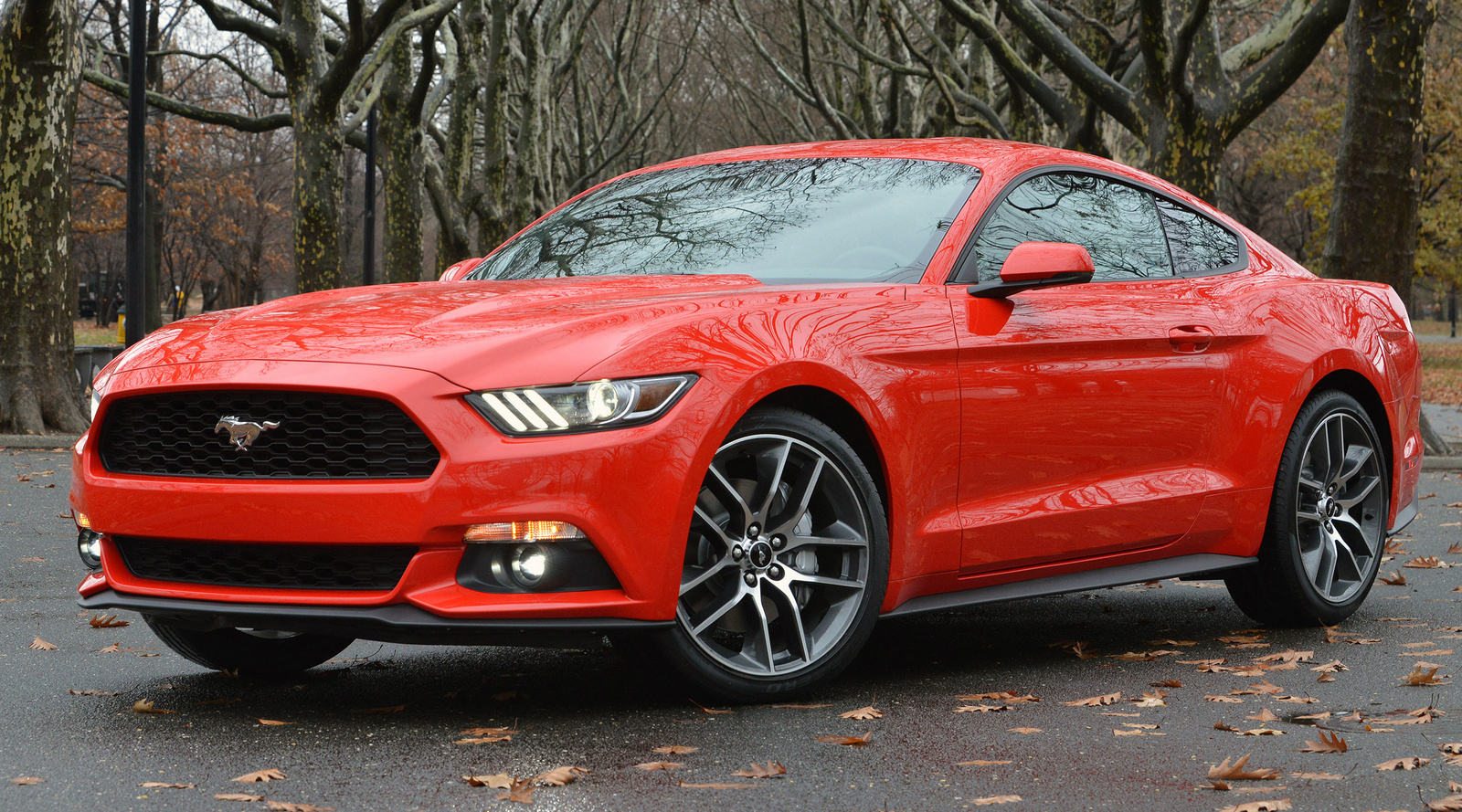
Want to ruin a neighborhood’s peaceful evening? Get off your Harley, rev the hell out of the Mustang GT’s V8, drop the clutch, and lay smoking stripes of rubber on the pavement.

Thomas Hobbes famously said that the lives of medieval Europeans were “nasty, brutish, and short.” Parts of that description also applied to American sports coupes until this past decade.
Until the previous-generation Ford Mustang arrived in 2005, the so-called “pony car” was indeed nasty, the best version of it idiotically loud, brutish, and short-lived. Sure, the SVT Cobra was thrilling to drive, especially in Cobra R form, but from the poor quality of the interior materials to the patchwork of engineering compromises, at the turn of the century the Mustang was selling primarily based on image rather than substance.
At least Ford kept building the Mustang. General Motors had killed the Chevy Camaro and Pontiac Firebird by 2003, and the last time Americans had purchased a Dodge Challenger, the name was affixed to the back of an unworthy car sourced from Mitsubishi. Undeniably, the 2005 Mustang marked a significant turning point not only for pony-car enthusiasts, but also for all three automakers, because it inspired a muscle-car revival that continues to this day.
Now, Ford celebrates the Mustang’s 50th anniversary by introducing the sixth-generation version of the car, the most refined and capable one yet. Design-wise, Ford nudges the 2015 Mustang into the future, retaining the retro 1960s styling elements that made the previous generation car a hit, but sharpening them for a more technical appearance.
Homages to the past remain evident within the cabin, too, but with this car Ford has added what it claims is aircraft-inspired detailing. Although my test car, a Ruby Red Mustang GT equipped with nothing more than a set of optional Recaro performance seats, was sparsely equipped, it didn’t necessarily look or feel that way aside from the fact that it was missing Ford’s MyFord Touch infotainment system.
Skip the extra-cost paint and seats, and my test car’s price tag would’ve totaled $33,125, including a destination charge of $825. That’s right in line with what Americans are spending on a new car, on average, in 2015. And while there are more affordable ways to get your Mustang fix, they don’t include the GT model’s gorgeous V8 engine.

You do not need to be a driving enthusiast to appreciate a Mustang GT’s 5.0-liter V8 engine. From the sonorous rumble of its dual exhaust to the shattering crescendo of thrust it supplies when you mash your right foot to the floor, this 435-hp motor is a visceral thrill. Want to ruin a neighborhood’s peaceful evening? Get off your Harley, rev the hell out of the Mustang GT’s V8, drop the clutch, and lay smoking stripes of rubber on the pavement.
How fast is a Mustang GT? Glad you asked. Independent publications that have measured acceleration indicate that it takes just 4.5 seconds to get to this version of the car to 60 mph, making it quick enough to induce grins from even the most grizzled of curmudgeons.
My test vehicle had six row-‘em-yourself gears, and this new manual transmission is far more refined than in previous Mustangs. With short throws, precise engagement, and easy clutch take-up, the latest Mustang is a genuine joy to drive. A 6-speed automatic is optional and includes paddle shifters.
Get the Mustang on a tangled piece of pavement, and the difference between the rear beam axle suspension of yore and the new, relatively sophisticated independent rear suspension is readily apparent. The 2015 Mustang is a far superior handler, demonstrating more talent than ever through corners combined with a more composed ride quality.
My test vehicle had the GT’s standard wheel, tire, and suspension package, which made the car almost glide down a freeway, but also produced plenty of squish and push while exercising the car on mountain roads. If you intend to take corners with gusto, upgrade from the standard 18-inch wheels and 235/50 tires to the available 19- or 20-inch rolling stock.
Testing weather was cool and comfortable, and the Mustang’s brakes didn’t fade during a long downhill set of twisties. In fact, during an entire week of driving the Mustang, the brake pedal drew no undue attention from its driver, a sign of excellent calibration.
Ford’s approach to the Mustang’s electric steering, however, cannot be described as one-size-fits-all. Normal, Sport, and Comfort modes are desirable for specific types of driving. Comfort is best for driving in cities and parking lots. Sport is best when taking the long way home. Normal is preferable on highways and freeways. Good thing Ford makes it easy to toggle between these different settings by placing a button for them right on the dashboard.
Mustang buyers on a budget should rejoice over the addition of a turbocharged 4-cylinder engine to the lineup. New for 2015, this 2.3-liter EcoBoost engine makes 310 hp, and if you’ve got a $30,000 budget, you can get it, a manual gearbox, a Performance Package, and Recaro performance seats for less than $30,000.
My husband has tested a Mustang similar to this, and told me that with less weight over the front end, suspension modifications, and more aggressive rubber, this version of the car resolves the mushy handling displayed by my GT test car. Plus, he got 23.2 mpg out of the Mustang EcoBoost.
Granted, that is better than the 18.6 mpg my Mustang GT produced. (The EPA says my test car should have returned 15 mpg in the city and 25 mpg on the open road.) But that buzzy little EcoBoost engine simply could not match the GT’s magnificent V8 engine when it came to inspiring a deep emotional connection to this car.

One of my least favorite things about sports coupes is that they’re hard to get into and they’re hard to get out of, especially if you’re attempting to do so with any semblance of ease and grace. Long, heavy doors always pose a challenge, especially in parking lots. And because of my short legs, I usually have the seat positioned fairly close to the steering wheel, which means that it takes a bit of extra finagling to angle myself in.
Aggressively bolstered Recaro sport seats don’t help, but they sure make finding an ideal driving position easy, despite a lack of power adjustment in my test car. The seat faces a dual-cowl dashboard design that pays homage to the pony-car’s heritage with a dash plaque that states: “Mustang since 1964.”
While I like the Mustang’s mix of retro style with modern controls, execution could be improved. Brittle and glossy pieces of plastic, shiny and cheap-looking chrome trim, and obviously fake metallic surfaces are unlikely to inspire pride of ownership. Interior rattles and uneven fits further detract from the experience.
Outward visibility is terrible, and worse than in the previous Mustang. Long and wide, the Mustang’s forward sight lines are compromised by its small windshield, thick roof pillars, and Texas-size hood. The side mirrors are small, too, though they contain individual blind-spot mirrors. A reversing camera is standard equipment and quite necessary.
Perhaps driving a Mustang takes more acclimation than a week and 300 miles. All I can tell you is that when I drove this car into a parking garage with a curving and curbed entrance, I felt sure that I would scrape the lower part of the front fascia or the front wheel. Once inside the garage, navigating the low, wide car remained a challenge. More than anything, the Mustang needs front and rear parking-assist sensors.
The garage was located in Santa Barbara, California, where my family and I took the Mustang for a short trip. This car is not designed for that sort of travel. Rear quarters are tight, and while we successfully installed a forward-facing child safety seat and a booster seat, we had to tell both kids to sit cross-legged for the hour-long jaunt north.
Forget about taking adults anywhere. Legroom is in short supply, but the real problem is headroom. There simply isn’t enough space beneath a Mustang Fastback’s rear glass. Clearly, the Mustang is designed for single people, or young couples without kids, or empty nesters.
For these buyers, the Mustang provides unexpected utility. The trunk measures a surprisingly generous 13.5 cubic feet, which is about the same amount of space that you’d find in a compact sedan. The 50/50-split folding rear seats allow longer items to be carried, too.

If you’re into spending money replacing tires, the Mustang GT with the manual transmission is equipped with a standard electronic line-lock system. Ford’s official claim is that this system allows the car’s owner to warm the rear tires prior to a track event. The reality is that people are likely to use it for creating giant clouds of acrid smoke for awe-struck bystanders to choke upon.
It works like this. Activate the system through the Mustang’s Track Apps technology. Take your foot off the brake pedal, and the technology keeps the car’s front brakes engaged. Release the clutch, and spin the rear wheels to your heart’s content. Then, in theory, pull up to the staging line and use the standard launch control system to smoke your competition. Later, review your performance data via the Track Apps system.
My sparsely equipped test car didn’t have most of the infotainment technology that Ford offers for this model. Instead, it had lots of knobs and buttons for controlling the stereo and climate controls, and while the voice-activated Ford Sync system won’t dazzle tech snobs with its complexity, it was easy to establish a Bluetooth connection, make and receive calls, and stream music. That’s good enough for me.
A MyFord Touch infotainment system with an 8-inch touchscreen display is optional, and though Ford has made numerous improvements to this technology over the years, I still prefer the simpler knobs and buttons found within my test car. Once you’ve installed MyFord Touch, additional upgrades include a navigation system and a premium audio system with HD Radio.

If you’re the parent of a teen driver, use the Mustang’s standard MyKey system to program specific dynamic limitations for when your offspring is in possession of the car. Using MyKey, you can limit vehicle speed and stereo volume while encouraging use of the seat belts, among other features.
A reversing camera is standard for all Mustangs, and options include a blind-spot information system with cross-traffic alert technology and an adaptive cruise control system. Also, keep in mind that the car’s standard Sync Bluetooth system includes 911 Assist technology, which can automatically alert emergency rescue personnel after a collision has occurred, so long as a device is paired to the system and is within the Mustang at the time of the crash.
Ford has also designed the new Mustang to protect occupants in the event of a collision, and available crash-test scores for the Fastback model reflect those efforts. The National Highway Traffic Safety Administration (NHTSA) assigns 5 stars for nearly all assessments, including rollover resistance. The Insurance Institute for Highway Safety (IIHS) has tested the Mustang for protection in the moderate overlap frontal-impact test, and the car got a Good rating.

Buying a performance car is rarely a cost-effective approach to personal mobility. A Mustang is an emotional purchase, one made by a person who has always loved Mustangs and always will, or by someone who thinks it looks terrific, or by someone who wants the power and performance the car provides.
This buyer mentality, combined with the fact that the 2015 Mustang is redesigned and in relatively short supply, would normally mean that good deals are hard to come by. That’s not the case, as your local Ford dealer has lease, finance, and rebate programs available for this car.
Measured by other standards of value, there’s no denying that a Mustang EcoBoost with the Performance package and Recaros represents a terrific deal for an enthusiast who prefers going around corners to accelerating in a straight line. Even a Mustang GT with the same handling hardware costs just a little more than a loaded Honda Accord family sedan.
Historically, Mustangs have proven to be slightly better than average in terms of quality, dependability, and the costs associated with ownership. The 2015 Mustang is a more technologically sophisticated automobile than it used to be, though, so this could change with this year’s redesign. Also, keep in mind that insurance premiums for a Mustang can be ridiculously high depending on your age and driving record.
Impassively assessed, the 2015 Ford Mustang represents an unbeatable deal in some respects, but is a waste of money in others. Ultimately, because buying a Mustang is an emotional rather than a rational decision, whether or not this pony car offers value is up to you and your own values.

User reviews for 2015 Ford Mustang
Write a review2015 Ford Mustang Pricing
Trims & specs
Air Conditioning
Single front air conditioning zones
Airbags
Dual front airbags · Driver knee airbags · Passenger airbag deactivation: occupant sensing deactivation · Front side airbags · Front side curtain airbags
Audio System
Antenna Type: element · Voice recognition audio system · Bluetooth auxiliary audio input · Single disc in-Dash CD · MP3 player: CD MP3 Playback · AM/FM radio · Total Number of Speakers: 6
Brakes
ABS: 4-wheel · Braking assist: hill start assist · Front brake diameter: 12.6 · Front brake width: 1.18 · Front brakes: ventilated disc · Rear brake diameter: 12.6 · Rear brake width: 0.47 · Rear brakes: disc
Comfort Features
Floor Mat Material: carpet · Floor Material: carpet · Floor Mats: front · Foot pedal trim: aluminum · Parking brake trim: leather · Steering wheel trim: leather
Convenience Features
Center console: locking · Cupholders: front · Dimming rearview mirror: auto-dimming · Multi-function remote: proximity entry system · One-touch windows: 2 · Power outlet(s): 12V front · Power steering: electric · Reading lights: front · Steering wheel: tilt-adjustable · Steering wheel mounted controls: audio · Storage: front seatback · Vanity mirrors: dual illuminating
Driver Seat
Manual adjustments: 4
Drivetrain
Axle ratio: 3.15 · Limited slip differential: rear
Exterior Features
Door handle color: body-color · Exhaust: integrated exhaust · Exhaust tip color: metallic · Front bumper color: body-color · Grille color: black · Mirror color: body-color · Rear bumper color: body-color · Window trim: black
Headrests
Front headrests: adjustable · Number of front headrests: 2 · Number of rear headrests: 2
In Car Entertainment
Infotainment: SYNC · Infotainment screen size: 4.2 in.
Instrumentation
Instrument cluster screen size: 4.2 in. · Warnings and reminders: low oil pressure
Lights
Headlights: Auto on/off · Tail and brake lights: LED
Mirrors
Exterior mirrors: power
Passenger Seat
Manual Adjustments: 2
Rear Seats
Type: 50-50 split bench
Safety
Camera system: rearview · Child seat anchors: LATCH system · Impact sensor: post-collision safety system · Programmable safety key: MyKey · Rearview monitor: in mirror
Seatbelts
Front seatbelts: 3-point · Seatbelt force limiters: front · Seatbelt pretensioners: front · Seatbelt warning sensor: driver and passenger · Second row seatbelts: 3-point
Seats
Driver seat manual adjustments: height · Front seat type: bucket · Rear seat folding: split · Upholstery: cloth
Spare Tire
Kit: inflator kit
Steering
Steering ratio: 16.1
Suspension
Front Arm Type: lateral links · Front Shock Type: gas shock absorbers · Front Spring Type: coil springs · Front Suspension Classification: independent · Front Suspension Type: MacPherson struts · Rear Shock Type: gas shock absorbers · Rear Spring Type: coil springs · Rear Suspension Classification: independent · Rear Suspension Type: multi-link · Stabilizer bar(s): front
Telematics
Electronic messaging assistance: with read function · Phone: voice activated · Phone wireless data link: Bluetooth
Tires
Type: all season
Tires and Rims
Wheels: painted aluminum
Windows
Front wipers: variable intermittent
Air Conditioning
Single front air conditioning zones
Airbags
Dual front airbags · Driver knee airbags · Passenger airbag deactivation: occupant sensing deactivation · Front side airbags · Front side curtain airbags
Audio System
Antenna Type: element · Voice recognition audio system · Bluetooth auxiliary audio input · Single disc in-Dash CD · MP3 player: CD MP3 Playback · AM/FM radio · Total Number of Speakers: 6
Brakes
ABS: 4-wheel · Braking assist: hill start assist · Front brake diameter: 12.6 · Front brake width: 1.18 · Front brakes: ventilated disc · Rear brake diameter: 12.6 · Rear brake width: 0.47 · Rear brakes: disc
Comfort Features
Floor Mat Material: carpet · Floor Material: carpet · Floor Mats: front · Foot pedal trim: aluminum · Parking brake trim: leather · Steering wheel trim: leather
Convenience Features
Center console: front console with armrest and storage · Cupholders: front · Dimming rearview mirror: auto-dimming · Multi-function remote: keyless entry with panic alarm · One-touch windows: 2 · Power outlet(s): 12V front · Power steering: electric · Reading lights: front · Steering wheel: tilt-adjustable · Steering wheel mounted controls: cruise controls · Storage: front seatback · Vanity mirrors: dual illuminating
Driver Seat
Adjustable lumbar support: power · Power adjustments: 6
Drivetrain
Axle ratio: 3.31 · Limited slip differential: rear
Exterior Features
Door handle color: body-color · Exhaust: dual exhaust tips · Front bumper color: body-color · Grille color: black · Mirror color: body-color · Rear bumper color: body-color · Rear spoiler: lip · Rear spoiler color: body-color · Window trim: black
Headrests
Front headrests: adjustable · Number of front headrests: 2 · Number of rear headrests: 2
In Car Entertainment
Infotainment: SYNC · Infotainment screen size: 4.2 in.
Instrumentation
Instrument cluster screen size: 4.2 in. · Warnings and reminders: low fuel level
Lights
Headlights: Auto on/off · Tail and brake lights: LED
Mirrors
Exterior mirrors: power
Passenger Seat
Power adjustments: 6
Rear Seats
Type: 50-50 split bench
Safety
Camera system: rearview · Child seat anchors: LATCH system · Impact sensor: post-collision safety system · Programmable safety key: MyKey · Rearview monitor: in mirror
Seatbelts
Front seatbelts: 3-point · Seatbelt force limiters: front · Seatbelt pretensioners: front · Seatbelt warning sensor: driver and passenger · Second row seatbelts: 3-point
Seats
Driver seat manual adjustments: reclining · Driver seat power adjustments: height · Front seat type: bucket · Passenger seat manual adjustments: reclining · Passenger seat power adjustments: height · Rear seat folding: split · Upholstery: cloth
Steering
Steering ratio: 16.1
Suspension
Front Arm Type: lateral links · Front Shock Type: gas shock absorbers · Front Spring Type: coil springs · Front Suspension Classification: independent · Front Suspension Type: MacPherson struts · Rear Shock Type: gas shock absorbers · Rear Spring Type: coil springs · Rear Suspension Classification: independent · Rear Suspension Type: multi-link · Stabilizer bar(s): rear
Telematics
Electronic messaging assistance: with read function · Phone: voice activated · Phone wireless data link: Bluetooth
Tires
Type: all season
Tires and Rims
Wheels: painted aluminum
Windows
Front wipers: variable intermittent
Air Conditioning
Single front air conditioning zones
Airbags
Dual front airbags · Driver knee airbags · Passenger airbag deactivation: occupant sensing deactivation · Side airbags: front with head protection chambers
Audio System
Antenna Type: mast · Voice recognition audio system · Bluetooth auxiliary audio input · Single disc in-Dash CD · MP3 player: CD MP3 Playback · AM/FM radio · Total Number of Speakers: 6
Brakes
ABS: 4-wheel · Braking assist: hill start assist · Front brake diameter: 12.6 · Front brake width: 1.18 · Front brakes: ventilated disc · Rear brake diameter: 12.6 · Rear brake width: 0.47 · Rear brakes: disc
Comfort Features
Floor Mat Material: carpet · Floor Material: carpet · Floor Mats: front · Foot pedal trim: aluminum · Parking brake trim: leather · Steering wheel trim: leather
Convenience Features
Center console: front console with armrest and storage · Cupholders: front · Dimming rearview mirror: auto-dimming · Multi-function remote: keyless entry with panic alarm · One-touch windows: 2 · Power outlet(s): 12V front · Reading lights: front · Steering wheel: tilt-adjustable · Steering wheel mounted controls: audio · Storage: front seatback · Vanity mirrors: dual illuminating
Driver Seat
Manual adjustments: 4
Drivetrain
Axle ratio: 3.15 · Limited slip differential: rear
Exterior Features
Door handle color: body-color · Exhaust: integrated exhaust · Exhaust tip color: metallic · Front bumper color: body-color · Grille color: black · Mirror color: body-color · Rear bumper color: body-color · Window trim: black
Headrests
Front headrests: adjustable · Number of front headrests: 2 · Number of rear headrests: 2
In Car Entertainment
Infotainment: SYNC · Infotainment screen size: 4.2 in.
Instrumentation
Instrument cluster screen size: 4.2 in. · Warnings and reminders: lamp failure
Lights
Headlights: HID · Tail and brake lights: LED
Mirrors
Exterior mirrors: power
Passenger Seat
Manual Adjustments: 2
Rear Seats
Type: bench
Roof
Convertible rear window: glass · Convertible roof: power
Safety
Camera system: rearview · Child seat anchors: LATCH system · Impact sensor: post-collision safety system · Programmable safety key: MyKey · Rearview monitor: in mirror
Seatbelts
Front seatbelts: 3-point · Seatbelt force limiters: front · Seatbelt pretensioners: front · Seatbelt warning sensor: driver and passenger · Second row seatbelts: 3-point
Seats
Driver seat manual adjustments: reclining · Front seat type: bucket · Upholstery: cloth
Spare Tire
Kit: inflator kit
Steering
Steering ratio: 16.1
Suspension
Front Arm Type: lateral links · Front Shock Type: gas shock absorbers · Front Spring Type: coil springs · Front Suspension Classification: independent · Front Suspension Type: MacPherson struts · Rear Shock Type: gas shock absorbers · Rear Spring Type: coil springs · Rear Suspension Classification: independent · Rear Suspension Type: multi-link · Stabilizer bar(s): front
Telematics
Electronic messaging assistance: with read function · Phone: voice activated · Phone wireless data link: Bluetooth
Tires
Type: all season
Tires and Rims
Wheels: painted aluminum
Wheels
Wheel locks: front and rear
Windows
Front wipers: variable intermittent
Air Conditioning
Automatic climate control front air conditioning · Dual front air conditioning zones
Airbags
Dual front airbags · Driver knee airbags · Passenger airbag deactivation: occupant sensing deactivation · Front side airbags · Rear side curtain airbags
Audio System
Antenna Type: diversity · Voice recognition audio system · USB auxiliary audio input · Single disc in-Dash CD · MP3 player: CD MP3 Playback · AM/FM radio · Satellite Radio: SiriusXM · Total Number of Speakers: 9
Brakes
ABS: 4-wheel · Braking assist: hill start assist · Front brake diameter: 12.6 · Front brake width: 1.18 · Front brakes: ventilated disc · Rear brake diameter: 12.6 · Rear brake width: 0.47 · Rear brakes: disc
Comfort Features
Dash trim: aluminum · Door sill trim: illuminated scuff plate · Floor Mat Material: carpet · Floor Material: carpet · Floor Mats: front · Foot pedal trim: aluminum · Parking brake trim: leather · Steering wheel trim: leather
Convenience Features
Center console: locking · Cupholders: front · Dimming rearview mirror: auto-dimming · Multi-function remote: proximity entry system · One-touch windows: 2 · Power outlet(s): 12V front · Power steering: electric · Reading lights: front · Steering wheel: tilt-adjustable · Steering wheel mounted controls: audio · Storage: front seatback · Vanity mirrors: dual illuminating
Driver Seat
Adjustable lumbar support: power · Power adjustments: 6
Drivetrain
Axle ratio: 3.31 · Limited slip differential: rear
Exterior Features
Door handle color: body-color · Exhaust: integrated exhaust · Front bumper color: body-color · Grille color: black · Mirror color: body-color · Rear bumper color: body-color · Rear spoiler: lip · Rear spoiler color: body-color · Window trim: black
Headrests
Front headrests: adjustable · Number of front headrests: 2 · Number of rear headrests: 2
In Car Entertainment
Infotainment: SYNC · Infotainment screen size: 8 in.
Instrumentation
Instrument cluster screen size: 4.2 in. · Warnings and reminders: low oil pressure
Lights
Headlights: HID · Tail and brake lights: LED
Mirrors
Exterior mirrors: integrated turn signals
Passenger Seat
Power adjustments: 6
Rear Seats
Type: 50-50 split bench
Safety
Camera system: rearview · Child seat anchors: LATCH system · Impact sensor: post-collision safety system · Programmable safety key: MyKey · Rearview monitor: in dash
Seatbelts
Front seatbelts: 3-point · Seatbelt force limiters: front · Seatbelt pretensioners: front · Seatbelt warning sensor: driver and passenger · Second row seatbelts: 3-point
Seats
Driver seat manual adjustments: reclining · Driver seat power adjustments: height · Front seat type: bucket · Passenger seat manual adjustments: reclining · Passenger seat power adjustments: height · Rear seat folding: split · Upholstery: leather
Steering
Steering ratio: 16.1
Suspension
Front Arm Type: lateral links · Front Shock Type: gas shock absorbers · Front Spring Type: coil springs · Front Suspension Classification: independent · Front Suspension Type: MacPherson struts · Rear Shock Type: gas shock absorbers · Rear Spring Type: coil springs · Rear Suspension Classification: independent · Rear Suspension Type: multi-link · Stabilizer bar(s): rear
Telematics
Electronic messaging assistance: with read function · Phone: voice activated · Phone wireless data link: Bluetooth
Tires
Type: all season
Tires and Rims
Wheels: painted aluminum
Windows
Front wipers: variable intermittent
Air Conditioning
Single front air conditioning zones
Airbags
Dual front airbags · Driver knee airbags · Passenger airbag deactivation: occupant sensing deactivation · Front side airbags · Rear side curtain airbags
Audio System
Antenna Type: element · Voice recognition audio system · Auxiliary audio input: jack · Single disc in-Dash CD · MP3 player: CD MP3 Playback · AM/FM radio · Total Number of Speakers: 6
Brakes
ABS: 4-wheel · Braking assist: hill start assist · Front brake diameter: 13.9 · Front brake width: 1.3 · Front brakes: ventilated disc · Rear brake diameter: 13.0 · Rear brake width: 1.0 · Rear brakes: ventilated disc
Comfort Features
Floor Mat Material: carpet · Floor Material: carpet · Floor Mats: front · Foot pedal trim: aluminum · Parking brake trim: leather · Steering wheel trim: leather
Convenience Features
Center console: front console with armrest and storage · Cupholders: front · Dimming rearview mirror: auto-dimming · Multi-function remote: keyless entry with panic alarm · One-touch windows: 2 · Power outlet(s): 12V front · Power steering: electric · Reading lights: front · Steering wheel: tilt-adjustable · Steering wheel mounted controls: cruise controls · Storage: front seatback · Vanity mirrors: dual illuminating
Driver Seat
Adjustable lumbar support: power · Power adjustments: 6
Drivetrain
Axle ratio: 3.31 · Limited slip differential: rear
Engine
Oil cooler: auxiliary
Exterior Features
Door handle color: body-color · Exhaust: integrated exhaust · Front bumper color: body-color · Grille color: black · Mirror color: body-color · Rear bumper color: body-color · Rear spoiler: lip · Rear spoiler color: body-color · Window trim: black
Headrests
Front headrests: adjustable · Number of front headrests: 2 · Number of rear headrests: 2
In Car Entertainment
Infotainment: SYNC · Infotainment screen size: 4.2 in.
Instrumentation
Instrument cluster screen size: 4.2 in. · Warnings and reminders: low fuel level
Lights
Headlights: wiper activated · Tail and brake lights: LED
Mirrors
Exterior mirrors: manual folding
Passenger Seat
Power adjustments: 6
Rear Seats
Type: 50-50 split bench
Safety
Camera system: rearview · Child seat anchors: LATCH system · Impact sensor: post-collision safety system · Programmable safety key: MyKey · Rearview monitor: in mirror
Seatbelts
Front seatbelts: 3-point · Seatbelt force limiters: front · Seatbelt pretensioners: front · Seatbelt warning sensor: driver and passenger · Second row seatbelts: 3-point
Seats
Driver seat manual adjustments: reclining · Driver seat power adjustments: height · Front seat type: bucket · Passenger seat manual adjustments: reclining · Passenger seat power adjustments: height · Rear seat folding: split · Upholstery: cloth
Steering
Steering ratio: 16.1
Suspension
Front Arm Type: lateral links · Front Shock Type: gas shock absorbers · Front Spring Type: coil springs · Front Suspension Classification: independent · Front Suspension Type: MacPherson struts · Rear Shock Type: gas shock absorbers · Rear Spring Type: coil springs · Rear Suspension Classification: independent · Rear Suspension Type: multi-link · Stabilizer bar(s): front
Telematics
Electronic messaging assistance: with read function · Phone: voice activated · Phone wireless data link: Bluetooth
Tires
Type: all season
Tires and Rims
Wheels: painted aluminum
Windows
Front wipers: variable intermittent
Air Conditioning
Automatic climate control front air conditioning · Dual front air conditioning zones
Airbags
Dual front airbags · Driver knee airbags · Passenger airbag deactivation: occupant sensing deactivation · Front side airbags
Audio System
Antenna Type: diversity · Voice recognition audio system · Bluetooth auxiliary audio input · Single disc in-Dash CD · MP3 player: CD MP3 Playback · AM/FM radio · Satellite Radio: SiriusXM · Total Number of Speakers: 9
Brakes
ABS: 4-wheel · Braking assist: hill start assist · Front brake diameter: 12.6 · Front brake width: 1.18 · Front brakes: ventilated disc · Rear brake diameter: 12.6 · Rear brake width: 0.47 · Rear brakes: disc
Comfort Features
Dash trim: aluminum · Door sill trim: illuminated scuff plate · Floor Mat Material: carpet · Floor Material: carpet · Floor Mats: front · Foot pedal trim: aluminum · Parking brake trim: leather · Steering wheel trim: leather
Convenience Features
Center console: front console with armrest and storage · Cupholders: front · Dimming rearview mirror: auto-dimming · Multi-function remote: trunk release · One-touch windows: 2 · Power outlet(s): 12V front · Power steering: electric · Reading lights: front · Steering wheel: tilt-adjustable · Steering wheel mounted controls: audio · Storage: front seatback · Vanity mirrors: dual illuminating
Driver Seat
Adjustable lumbar support: power · Power adjustments: 6
Drivetrain
Axle ratio: 3.31 · Limited slip differential: rear
Exterior Features
Door handle color: body-color · Exhaust: integrated exhaust · Front bumper color: body-color · Grille color: black · Mirror color: body-color · Rear bumper color: body-color · Rear spoiler: lip · Rear spoiler color: body-color · Window trim: black
Headrests
Front headrests: adjustable · Number of front headrests: 2 · Number of rear headrests: 2
In Car Entertainment
Infotainment: SYNC · Infotainment screen size: 8 in.
Instrumentation
Instrument cluster screen size: 4.2 in. · Warnings and reminders: lamp failure
Lights
Headlights: HID · Tail and brake lights: LED
Mirrors
Exterior mirrors: heated
Passenger Seat
Power adjustments: 6
Rear Seats
Type: bench
Roof
Convertible rear window: glass · Convertible roof: power
Safety
Camera system: rearview · Child seat anchors: LATCH system · Impact sensor: post-collision safety system · Programmable safety key: MyKey · Rearview monitor: in dash
Seatbelts
Front seatbelts: 3-point · Seatbelt force limiters: front · Seatbelt pretensioners: front · Seatbelt warning sensor: driver and passenger · Second row seatbelts: 3-point
Seats
Driver seat manual adjustments: reclining · Driver seat power adjustments: height · Front seat type: bucket · Passenger seat manual adjustments: reclining · Passenger seat power adjustments: height · Upholstery: leather
Steering
Steering ratio: 16.1
Suspension
Front Arm Type: lateral links · Front Shock Type: gas shock absorbers · Front Spring Type: coil springs · Front Suspension Classification: independent · Front Suspension Type: MacPherson struts · Rear Shock Type: gas shock absorbers · Rear Spring Type: coil springs · Rear Suspension Classification: independent · Rear Suspension Type: multi-link · Stabilizer bar(s): front
Telematics
Electronic messaging assistance: with read function · Phone: voice activated · Phone wireless data link: Bluetooth
Tires
Type: all season
Tires and Rims
Wheels: painted aluminum
Wheels
Wheel locks: front and rear
Windows
Front wipers: variable intermittent
Air Conditioning
Automatic climate control front air conditioning · Dual front air conditioning zones
Airbags
Dual front airbags · Driver knee airbags · Passenger airbag deactivation: occupant sensing deactivation · Front side airbags · Front side curtain airbags
Audio System
Antenna Type: mast · Voice recognition audio system · USB auxiliary audio input · Single disc in-Dash CD · MP3 player: CD MP3 Playback · AM/FM radio · Satellite Radio: SiriusXM · Total Number of Speakers: 9
Brakes
ABS: 4-wheel · Braking assist: hill start assist · Front brake diameter: 13.9 · Front brake width: 1.3 · Front brakes: ventilated disc · Rear brake diameter: 13.0 · Rear brake width: 1.0 · Rear brakes: ventilated disc
Comfort Features
Door sill trim: illuminated scuff plate · Floor Mat Material: carpet · Floor Material: carpet · Floor Mats: front · Foot pedal trim: aluminum · Parking brake trim: leather · Steering wheel trim: leather
Convenience Features
Center console: locking · Cupholders: front · Dimming rearview mirror: auto-dimming · Multi-function remote: trunk release · One-touch windows: 2 · Power outlet(s): 12V front · Reading lights: front · Steering wheel: tilt-adjustable · Steering wheel mounted controls: audio · Storage: door pockets · Vanity mirrors: dual illuminating
Driver Seat
Adjustable lumbar support: power · Power adjustments: 6
Drivetrain
Axle ratio: 3.31 · Limited slip differential: rear
Engine
Oil cooler: auxiliary
Exterior Features
Door handle color: body-color · Exhaust: dual exhaust tips · Front bumper color: body-color · Grille color: black · Mirror color: body-color · Rear bumper color: body-color · Rear spoiler: lip · Rear spoiler color: body-color · Window trim: black
Headrests
Front headrests: adjustable · Number of front headrests: 2 · Number of rear headrests: 2
In Car Entertainment
Infotainment: SYNC · Infotainment screen size: 8 in.
Instrumentation
Instrument cluster screen size: 4.2 in. · Warnings and reminders: maintenance reminder
Lights
Headlights: Auto on/off · Tail and brake lights: LED
Mirrors
Exterior mirrors: heated
Passenger Seat
Power adjustments: 6
Rear Seats
Type: 50-50 split bench
Safety
Camera system: rearview · Child seat anchors: LATCH system · Impact sensor: post-collision safety system · Programmable safety key: MyKey · Rearview monitor: in dash
Seatbelts
Front seatbelts: 3-point · Seatbelt force limiters: front · Seatbelt pretensioners: front · Seatbelt warning sensor: driver and passenger · Second row seatbelts: 3-point
Seats
Driver seat manual adjustments: reclining · Driver seat power adjustments: height · Front seat type: bucket · Passenger seat manual adjustments: reclining · Passenger seat power adjustments: height · Rear seat folding: split · Upholstery: leather
Steering
Steering ratio: 16.1
Suspension
Front Arm Type: lateral links · Front Shock Type: gas shock absorbers · Front Spring Type: coil springs · Front Suspension Classification: independent · Front Suspension Type: MacPherson struts · Rear Shock Type: gas shock absorbers · Rear Spring Type: coil springs · Rear Suspension Classification: independent · Rear Suspension Type: multi-link · Stabilizer bar(s): rear
Telematics
Electronic messaging assistance: with read function · Phone: voice activated · Phone wireless data link: Bluetooth
Tires
Type: all season
Tires and Rims
Wheels: painted aluminum
Windows
Front wipers: variable intermittent
Air Conditioning
Automatic climate control front air conditioning · Dual front air conditioning zones
Airbags
Dual front airbags · Driver knee airbags · Passenger airbag deactivation: occupant sensing deactivation · Side airbags: front with head protection chambers
Audio System
Antenna Type: mast · Voice recognition audio system · Bluetooth auxiliary audio input · Single disc in-Dash CD · MP3 player: CD MP3 Playback · AM/FM radio · Satellite Radio: SiriusXM · Total Number of Speakers: 9
Brakes
ABS: 4-wheel · Braking assist: hill start assist · Front brake diameter: 13.9 · Front brake width: 1.3 · Front brakes: ventilated disc · Rear brake diameter: 13.0 · Rear brake width: 1.0 · Rear brakes: ventilated disc
Comfort Features
Door sill trim: illuminated scuff plate · Floor Mat Material: carpet · Floor Material: carpet · Floor Mats: front · Foot pedal trim: aluminum · Parking brake trim: leather · Steering wheel trim: leather
Convenience Features
Center console: front console with armrest and storage · Cupholders: front · Dimming rearview mirror: auto-dimming · Multi-function remote: keyless entry with panic alarm · One-touch windows: 2 · Power outlet(s): 12V front · Power steering: electric · Reading lights: front · Steering wheel: tilt-adjustable · Steering wheel mounted controls: cruise controls · Storage: front seatback · Vanity mirrors: dual illuminating
Driver Seat
Adjustable lumbar support: power · Power adjustments: 6
Drivetrain
Axle ratio: 3.31 · Limited slip differential: rear
Engine
Oil cooler: auxiliary
Exterior Features
Door handle color: body-color · Exhaust: dual exhaust tips · Front bumper color: body-color · Grille color: black · Mirror color: body-color · Rear bumper color: body-color · Rear spoiler: lip · Rear spoiler color: body-color · Window trim: black
Headrests
Front headrests: adjustable · Number of front headrests: 2 · Number of rear headrests: 2
In Car Entertainment
Infotainment: SYNC · Infotainment screen size: 8 in.
Instrumentation
Instrument cluster screen size: 4.2 in. · Warnings and reminders: lamp failure
Lights
Headlights: HID · Tail and brake lights: LED
Mirrors
Exterior mirrors: integrated turn signals
Passenger Seat
Power adjustments: 6
Rear Seats
Type: bench
Roof
Convertible rear window: glass · Convertible roof: power
Safety
Camera system: rearview · Child seat anchors: LATCH system · Impact sensor: post-collision safety system · Programmable safety key: MyKey · Rearview monitor: in dash
Seatbelts
Front seatbelts: 3-point · Seatbelt force limiters: front · Seatbelt pretensioners: front · Seatbelt warning sensor: driver and passenger · Second row seatbelts: 3-point
Seats
Driver seat manual adjustments: reclining · Driver seat power adjustments: height · Front seat type: bucket · Passenger seat manual adjustments: reclining · Passenger seat power adjustments: height · Upholstery: leather
Steering
Steering ratio: 16.1
Suspension
Front Arm Type: lateral links · Front Shock Type: gas shock absorbers · Front Spring Type: coil springs · Front Suspension Classification: independent · Front Suspension Type: MacPherson struts · Rear Shock Type: gas shock absorbers · Rear Spring Type: coil springs · Rear Suspension Classification: independent · Rear Suspension Type: multi-link · Stabilizer bar(s): rear
Telematics
Electronic messaging assistance: with read function · Phone: voice activated · Phone wireless data link: Bluetooth
Tires
Type: all season
Tires and Rims
Wheels: painted aluminum
Wheels
Wheel locks: front and rear
Windows
Front wipers: variable intermittent
Air Conditioning
Automatic climate control front air conditioning · Dual front air conditioning zones
Airbags
Dual front airbags · Driver knee airbags · Passenger airbag deactivation: occupant sensing deactivation · Front side airbags · Front side curtain airbags
Audio System
Antenna Type: element · Voice recognition audio system · Bluetooth auxiliary audio input · Single disc in-Dash CD · MP3 player: CD MP3 Playback · HD radio · Satellite Radio: SiriusXM · Total Number of Speakers: 12
Brakes
ABS: 4-wheel · Braking assist: hill start assist · Front brake diameter: 13.9 · Front brake width: 1.3 · Front brakes: ventilated disc · Premium brakes: Brembo · Rear brake diameter: 13.0 · Rear brake width: 1.0 · Rear brakes: ventilated disc
Comfort Features
Dash trim: aluminum · Door sill trim: aluminum · Floor Mat Material: carpet · Floor Material: carpet · Floor Mats: front · Foot pedal trim: aluminum · Parking brake trim: leather · Steering wheel trim: leather
Convenience Features
Center console: front console with armrest and storage · Cupholders: front · Dimming rearview mirror: auto-dimming · Memorized settings: side mirrors · Multi-function remote: trunk release · One-touch windows: 2 · Power outlet(s): 12V front · Reading lights: front · Steering wheel: tilt-adjustable · Steering wheel mounted controls: cruise controls · Storage: front seatback · Vanity mirrors: dual illuminating
Driver Seat
Adjustable lumbar support: power · Power adjustments: 6
Drivetrain
Axle ratio: 3.73 · Limited slip differential: rear
Engine
Oil cooler: auxiliary
Exterior Features
Door handle color: body-color · Exhaust: dual exhaust tips · Front bumper color: body-color · Grille color: black · Mirror color: body-color · Rear bumper color: body-color · Window trim: chrome
Headrests
Front headrests: adjustable · Number of front headrests: 2 · Number of rear headrests: 2
In Car Entertainment
Infotainment: SYNC · Infotainment screen size: 8 in.
Instrumentation
Instrument cluster screen size: 4.2 in. · Warnings and reminders: low fuel level
Lights
Headlights: HID · Tail and brake lights: LED
Mirrors
Exterior mirrors: manual folding
Passenger Seat
Power adjustments: 6
Rear Seats
Type: 50-50 split bench
Safety
Camera system: rearview · Child seat anchors: LATCH system · Cross Traffic Alert: rear · Impact sensor: post-collision safety system · Programmable safety key: MyKey · Rearview monitor: in dash
Seatbelts
Front seatbelts: 3-point · Seatbelt force limiters: front · Seatbelt pretensioners: front · Seatbelt warning sensor: driver and passenger · Second row seatbelts: 3-point
Seats
Driver seat manual adjustments: reclining · Driver seat power adjustments: height · Front seat type: bucket · Passenger seat manual adjustments: reclining · Passenger seat power adjustments: height · Rear seat folding: split · Upholstery: leather
Steering
Steering ratio: 16.1
Suspension
Front Arm Type: lateral links · Front Shock Type: gas shock absorbers · Front Spring Type: coil springs · Front Suspension Classification: independent · Front Suspension Type: MacPherson struts · Rear Shock Type: gas shock absorbers · Rear Spring Type: coil springs · Rear Suspension Classification: independent · Rear Suspension Type: multi-link · Stabilizer bar(s): rear
Telematics
Electronic messaging assistance: with read function · Navigation system: with voice recognition · Phone: voice activated · Phone wireless data link: Bluetooth
Tires
Type: summer performance
Tires and Rims
Wheel type: aluminum alloy
Wheels
Wheel locks: front and rear
Windows
Front wipers: variable intermittent

