Ford Escape vs Honda Passport
Overview | |
MSRP$28,000 | MSRP$41,900 |
Listings258 | Listings171 |
Ratings & Reviews | |
User Reviews | User Reviews |
Expert reviews6.2 out of 10 | Expert reviews7.2 out of 10 |
Pros
Cons
| Pros
Cons
|
Reviews SummaryReportedly, Ford will discontinue the Escape at the end of the current fourth-generation run. Once among the most popular vehicles in its class, Ford recently zigged with the Escape’s design and positioning when the market zagged. Boxy, rugged-looking crossovers are what people want, not soft and sophisticated pseudo-cars like the current Escape. Fortunately, Ford has the Bronco Sport in its lineup, which is getting all of the automaker’s attention. Meanwhile, the 2024 Ford Escape receives no major changes following a substantial makeover in 2023, though it appears the Base trim is canceled. | |
Reviews SummaryWhile many automakers resort to daring designs or flashy tech in their efforts to stand out amid a crowded midsize SUV market, Honda takes a different approach. The 2024 Honda Passport has been refreshed for this year, but few would notice. There are no big-screen TVs in this SUV, no futuristic materials or shocking styling choices. Instead, the Passport goes simple: a proven engine, easy-to-use technology, and enough (but not too much) capability to make it appealing in all weather. Verdict: The Honda Passport’s V6 engine makes impressive power, and the TrailSport trim level tested in this review adds extra capability courtesy of some all-terrain tires and an off-road-tuned suspension. Although its 2024 refresh doesn’t make the Honda Passport a segment leader in any specific category, it will still find plenty of buyers who want a practical, spacious, safe, and reliable crossover SUV. | |
No video found | |
Popular Features & Specs | |
Engine1.5L 180 hp I3 | Engine3.5L 280 hp V6 |
Drive TrainFWD | Drive TrainAWD |
Seating Capacity5 | Seating Capacity5 |
Horsepower180 hp @ 6000 rpm | Horsepower280 hp @ 6000 rpm |
MPG City27 | MPG City19 |
MPG Highway34 | MPG Highway24 |
Engine | |
Engine Name1.5L 180 hp I3 | Engine Name3.5L 280 hp V6 |
Torque199 lb-ft @ 3000 rpm | Torque262 lb-ft @ 4700 rpm |
Horsepower180 hp @ 6000 rpm | Horsepower280 hp @ 6000 rpm |
DrivetrainFWD | DrivetrainAWD |
Fuel Economy | |
MPG City27 | MPG City19 |
MPG Highway34 | MPG Highway24 |
Interior | |
Seating Capacity5 | Seating Capacity5 |
Key Features | |
Sunroof/Moonroof | Sunroof/MoonroofStandard |
Safety | |
Front Crash Overall5 | Front Crash Overall4 |
Side Crash Overall5 | Side Crash Overall5 |
Dimensions & Capacity | |
Cargo Space37.5 cu ft | Cargo Space41.2 cu ft |
Curb Weight3291 lbs | Curb Weight4236 lbs |
Height66.0 in | Height72.2 in |
Length180.1 in | Length189.1 in |
Width85.6 in | Width78.6 in |
Wheelbase106.7 in | Wheelbase110.9 in |
Maximum Payload | Maximum Payload948 lbs |
Number of doors4 | Number of doors4 |
Maximum Towing Capacity2000 lbs | Maximum Towing Capacity5000 lbs |
Overview | ||
MSRP | $28,000 | $41,900 |
Listings | ||
Ratings & Reviews | ||
User reviews | ||
Expert reviews | 6.2 out of 10Read full review | 7.2 out of 10Read full review |
Pros & cons | Pros
Cons
| Pros
Cons
|
Summary | Reportedly, Ford will discontinue the Escape at the end of the current fourth-generation run. Once among the most popular vehicles in its class, Ford recently zigged with the Escape’s design and positioning when the market zagged. Boxy, rugged-looking crossovers are what people want, not soft and sophisticated pseudo-cars like the current Escape. Fortunately, Ford has the Bronco Sport in its lineup, which is getting all of the automaker’s attention. Meanwhile, the 2024 Ford Escape receives no major changes following a substantial makeover in 2023, though it appears the Base trim is canceled. | While many automakers resort to daring designs or flashy tech in their efforts to stand out amid a crowded midsize SUV market, Honda takes a different approach. The 2024 Honda Passport has been refreshed for this year, but few would notice. There are no big-screen TVs in this SUV, no futuristic materials or shocking styling choices. Instead, the Passport goes simple: a proven engine, easy-to-use technology, and enough (but not too much) capability to make it appealing in all weather. Verdict: The Honda Passport’s V6 engine makes impressive power, and the TrailSport trim level tested in this review adds extra capability courtesy of some all-terrain tires and an off-road-tuned suspension. Although its 2024 refresh doesn’t make the Honda Passport a segment leader in any specific category, it will still find plenty of buyers who want a practical, spacious, safe, and reliable crossover SUV. |
Video | No video found | |
Popular Features & Specs | ||
Engine | 1.5L 180 hp I3 | 3.5L 280 hp V6 |
Drive Train | FWD | AWD |
Seating Capacity | 5 | 5 |
Horsepower | 180 hp @ 6000 rpm | 280 hp @ 6000 rpm |
MPG City | 27 | 19 |
MPG Highway | 34 | 24 |
Engine | ||
Engine Name | 1.5L 180 hp I3 | 3.5L 280 hp V6 |
Torque | 199 lb-ft @ 3000 rpm | 262 lb-ft @ 4700 rpm |
Horsepower | 180 hp @ 6000 rpm | 280 hp @ 6000 rpm |
Drivetrain | FWD | AWD |
Fuel Economy | ||
MPG City | 27 | 19 |
MPG Highway | 34 | 24 |
Interior | ||
Seating Capacity | 5 | 5 |
Key Features | ||
Sunroof/Moonroof | Standard | |
Safety | ||
Front Crash Overall | 5 | 4 |
Side Crash Overall | 5 | 5 |
Dimensions & Capacity | ||
Cargo Space | 37.5 cu ft | 41.2 cu ft |
Curb Weight | 3291 lbs | 4236 lbs |
Height | 66.0 in | 72.2 in |
Length | 180.1 in | 189.1 in |
Width | 85.6 in | 78.6 in |
Wheelbase | 106.7 in | 110.9 in |
Maximum Payload | 948 lbs | |
Number of doors | 4 | 4 |
Maximum Towing Capacity | 2000 lbs | 5000 lbs |
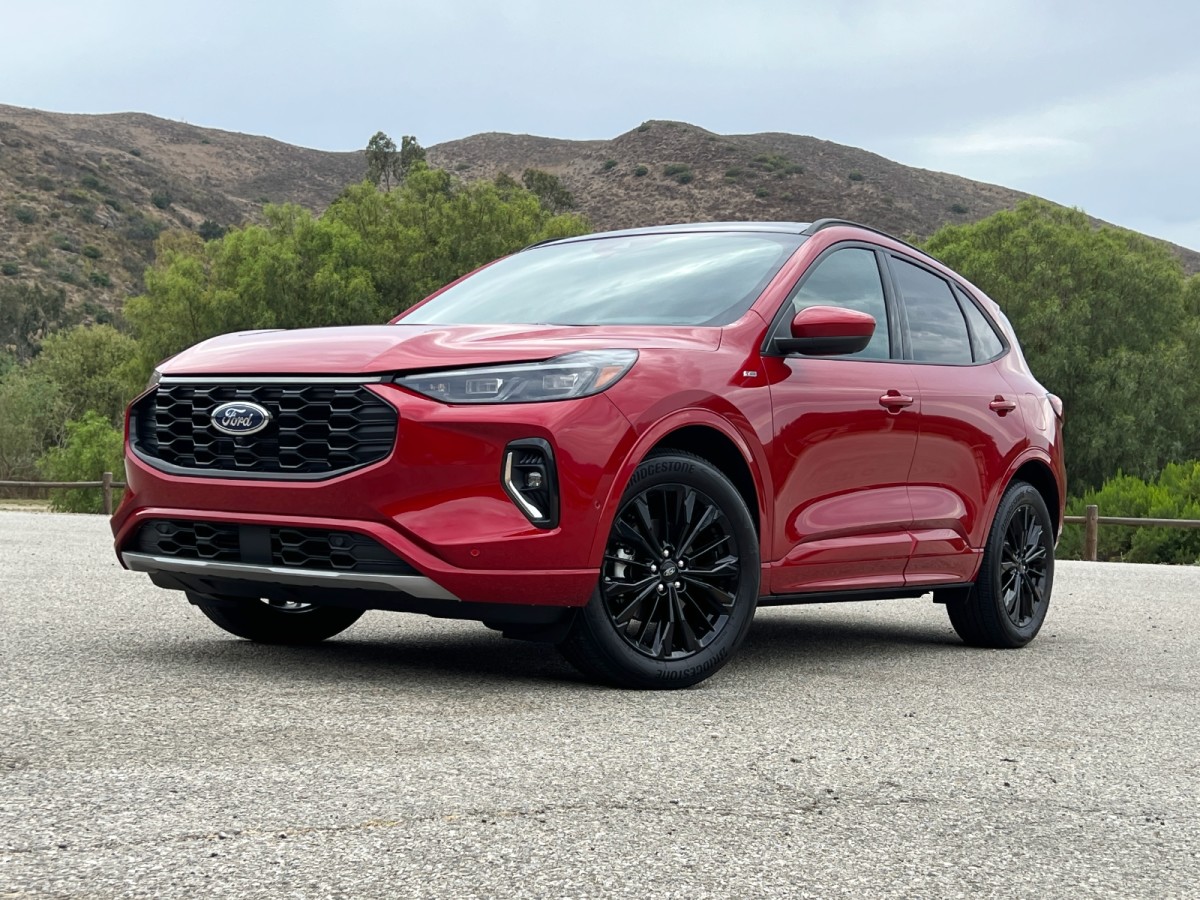
Ford tried to give the Escape a new lease on life in 2023. The company restyled the compact crossover’s front end, added new wheel designs, revamped the trim lineup, and updated the technology with next-generation infotainment and enhanced safety features. These updates carried over into the 2024 Escape, making the SUV dramatically more appealing. The wide-eyed, toothless smile of the previous model was gone, replaced by a more aggressive look. However, the rest of the SUV remained largely the same, retaining a soft and generically appealing overall appearance.
As of this writing, Ford offered the 2024 Escape in Active, ST-Line, ST-Line Select, ST-Line Elite, Platinum, and Plug-in Hybrid trim levels. Ford appeared to have dropped the Base trim, so prices ranged from $29,345 to $40,500, not including the $1,495 destination charge.
Our test vehicle arrived in ST-Line Elite trim, equipped with extra-cost Rapid Red paint, black 19-inch wheels, the Premium Technology Package, and a Panoramic Vista Roof. The price came to $43,650, including the destination charge.
As a fully loaded Escape, our test vehicle’s interior featured diamond-stitched, perforated leather and all of the tech upgrades. At first, the interior looked upscale. But then you noticed the excessively glossy surfaces and felt the unusually stiff and dry upholstery, and you wondered how the Escape ST-Line Elite could cost so much money. Ford could have resolved this with a little bit of added attention to detail, but given the Escape’s rumored upcoming demise, it seemed unlikely.
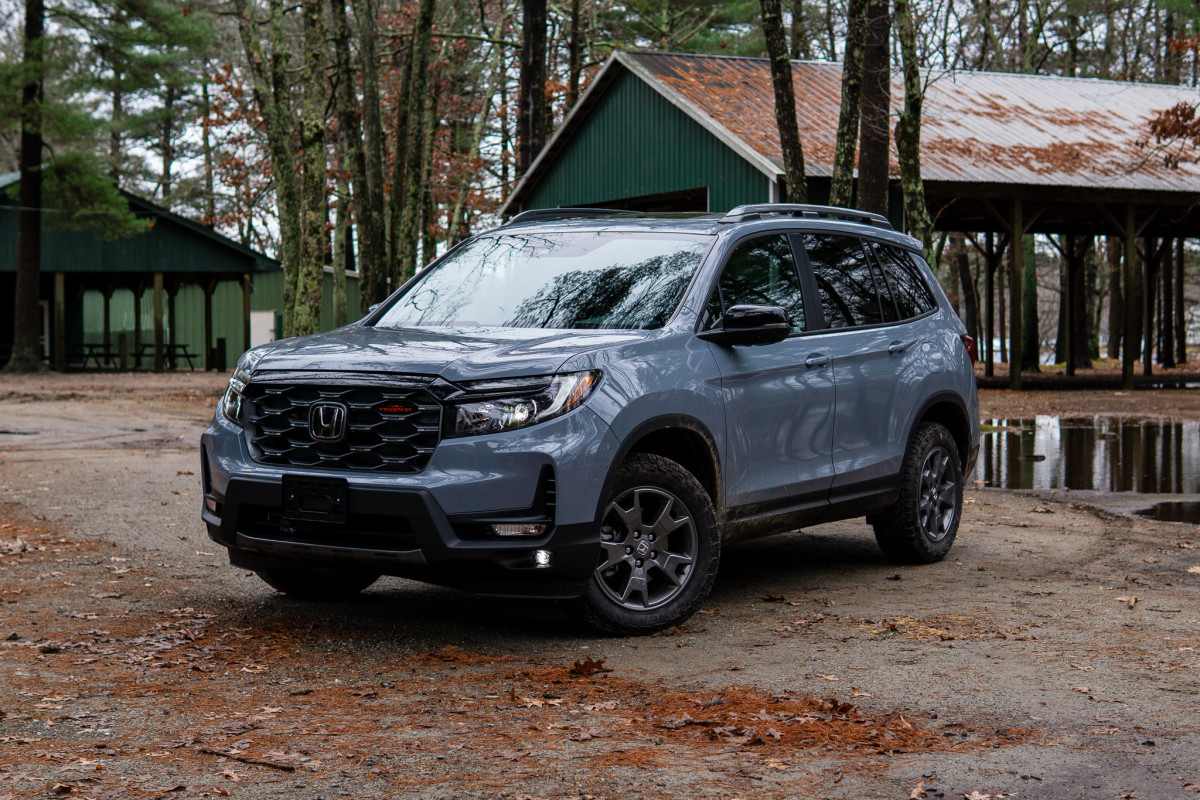
Honda began rolling out an updated design language across its lineup starting with the 2022 Civic redesign and extending to the 2023 Accord, CR-V, and Pilot. The 2024 Passport, however, looked much as it always had. Although the Passport (and the Honda Ridgeline) received some tweaks in 2022, notably a more upright grille and some squared-off corners, the overall look still shared a lot with Honda’s previous-generation designs.
Honda kept things simple with the Passport’s various trim levels. There were three: EX-L, TrailSport, and Black Edition. Some competitors offered a lower-priced, entry-level trim hallmarked by cloth seats, smaller screens, or two-wheel drive. That wasn’t the case with the Passport, which included leather seats, a power moonroof, identical touchscreens, and all-wheel drive (AWD) on every trim level. We tested a mid-level TrailSport trim.
The TrailSport was meant to be the most rugged of the three. It came equipped with genuine all-terrain (A/T) tires, in this case, General Grabber A/T Sport tires, boasting the three-peak mountain snowflake emblem for better snowy surface performance. The TrailSport (like the Black Edition) also came standard with roof rails and LED fog lights, items not included at the base EX-L level.
While it looked rugged, the Passport TrailSport was a bit more "show" than "go." The faux skid plates at the front and rear were plastic rather than metal, there were no recovery points incorporated into the bumpers, and it didn’t have a lift kit. However, at 21.1 degrees and 24.4 degrees, respectively, the Passport’s approach and departure angles were more aggressive than those on a Subaru Outback Wilderness.
On the inside, the Passport sported old-school physical controls and a relatively diminutive, 8-inch touchscreen. There were no honeycomb-style vents like you’d find in a new Accord, Civic, or CR-V. TrailSport trims came equipped with black leather upholstery accentuated by lots of orange contrast stitching and an orange "TrailSport" emblem stitched into the front headrests. Other than those splashes of color, the Passport’s interior was simple and unassuming. Plenty of resilient but inexpensive plastic covered the doors and dash but was well integrated with softer and more upscale materials. Large air vents, simple controls, and plenty of storage space underscored Honda’s utilitarian design direction.

When shopping for a 2024 Escape ST-Line Elite, buyers could choose between a 192-horsepower hybrid powertrain expected to get 39 mpg in combined driving or a turbocharged 2.0-liter four-cylinder cranking out 250 horsepower and 280 pound-feet of torque averaging 26 mpg in combined driving.
Our test vehicle had the turbo paired with an eight-speed automatic transmission and standard all-wheel drive (AWD). The AWD system featured a driveline disconnect feature to help improve fuel economy, and drivers could select between Eco, Normal, Sport, and Slippery driving modes. Notably, there wasn’t an Off-Road mode. With the turbocharged engine, the 2024 Escape could tow up to 3,500 pounds.
The Escape ST-Line Elite (like the ST-Line Select) was the sporty version of the SUV, but that described the appearance more than the driving dynamics. Yes, the turbocharged engine supplied quick acceleration, especially for the class. But otherwise, the driving character didn’t match the promise of the ST badge.
The ST-Line’s ride was soft and compliant when you might expect firm and connected. Handling felt nimble in typical driving situations, but the suspension allowed too much unwanted body motion the majority of the time. The brake pedal was responsive and easy to modulate, but the steering felt sluggish and numb.
For most people, most of the time, the Escape ST-Line provided a sporty look and comfortable, isolated driving dynamics that made commuting, kid shuttling, and errand running bearable. But you could sense that the Escape could be something more to people who liked to drive with more attention to detail.
Since the turbo engine seemed wasted in this application, we suggested skipping the 2.0-liter-powered ST-Line Select, ST-Line Elite, and Platinum, and either paying for the hybrid powertrain or picking a lower-tier Escape. The Escape Active and Escape ST-Line (not to be confused with the ST-Line Select or ST-Line Elite) employed a 1.5-liter turbocharged three-cylinder engine rated for 180 horsepower and 199 pound-feet of torque. Available with either front-wheel drive (FWD) or AWD and paired to the same eight-speed automatic, this powertrain should feel competitive with most of the Escape’s segment, without demonstrating so significant a gap between power and performance.
While the hybrid wouldn’t be as quick as a 250-hp Escape, it could save more money over time. Our turbocharged ST-Line Elite averaged 24.1 on the testing route, coming up short of the official EPA fuel economy rating of 26 mpg.
Conversely, the 2024 Honda Passport did not swap traditional, naturally aspirated engines out of their vehicles in favor of smaller, turbocharged powertrains or hybrid components. Instead, every 2024 Honda Passport came equipped with a naturally aspirated 3.5-liter V6 engine. With 280 horsepower and 262 pound-feet of torque, it matched or surpassed most of the Passport’s competition.
The Passport's 3.5-liter V6 was managed by a nine-speed automatic transmission and provided impressive acceleration for a vehicle of its size. The nine-speed was unobtrusive when shifting, and because it eschewed turbochargers, peak torque didn’t come until 4,700 RPM. This meant drivers needed to get a bit higher in the rev range when sprinting from a standstill than they would in a turbocharged model. Fuel economy suffered a bit, with the EPA rating the Passport at 19 mpg city, 24 highway, and 21 combined.
The TrailSport trim level received a few mechanical changes for off-roading. The front and rear tracks were slightly wider, the A/T tires wrapped around 18-inch wheels (rather than 20 inches on the EX-L and Black Edition), and the suspension was tuned for off-road driving with more articulation.
All Passports came equipped with Honda’s torque-vectoring iVTM4 all-wheel-drive (AWD) system, and a traction-management system with normal, snow, sand, and mud settings. These inclusions were valuable, even though the TrailSport trim wasn’t necessary to get them.
Given its size and all-terrain tires, the Passport had elevated road and wind noise when driving at highway speeds, but it toned down significantly around town. The Passport’s steering was impressively well-balanced and accurate, with very little play off-center, which was unusual for cars of this size.
Towing capacity was another notable aspect. The Passport could tow up to 5,000 pounds, besting the Subaru Outback Wilderness and Hyundai Santa Fe (both at 3,500 pounds) but falling short of the Jeep Grand Cherokee (6,200 pounds).
If you bought a 2024 Ford Escape ST-Line, you had to like black because that was the only interior color available. The standard upholstery featured cloth inserts with artificial leather bolsters, and Ford added red stitching to emphasize the ST-Line’s sportiness. Leather was optional with ST-Line Elite trim, but it was not recommended. Sure, the perforations and diamond-stitched pattern looked fancy, but the feel wasn't great.
In addition to the leather seats, our test model had ambient interior lighting, dual-zone automatic climate control, a 10-way power-adjustable driver’s seat, a six-way power-adjustable front passenger’s seat, heated front seats, and a heated steering wheel. It didn’t feature ventilated front seats, which would have been nice during the Southern California heatwave occurring in our testing week.
The Escape’s front seats felt large and soft for the compact crossover SUV segment and provided good support over time. A height-adjustable front passenger’s seat was somewhat rare in the segment. The back seat was comfortable when slid to its rearmost position, and access was easy through all four of the Escape’s doors.
Interior storage was generous in the front, but rear passengers weren’t as well accommodated. Cargo volume measured 37.5 cubic feet behind the back seat (34.4 cubic feet for the hybrid), and when the rear seat was folded down, you got 65.4 cubic feet (60.8 cubic feet in the hybrid). Our test vehicle offered deep storage areas on either side of the cargo load floor, plus a handy grocery bag hook.
For those needing a vehicle with substantial cargo space but not requiring three rows of seats, the two-row midsize crossover like the Honda Passport was ideal. In this relatively small and overlooked segment, the Honda Passport was the cargo capacity king. With 41.2 cubic feet of cargo space behind the rear seats, plus additional underfloor storage in the trunk, the Passport bested the Outback (32.6 cubic feet), Santa Fe (36.4), Grand Cherokee (37.7), and the Ford Edge (39.2). Cargo space expanded further, to 77.7 cubic feet, thanks to the 60/40-split folding rear seats. Additionally, the folded rear seats sat flush with the trunk-area floor, making it easy to load long items.
The Passport was a big vehicle, comfortable for five fully grown adults. Rear-seat legroom was tighter than in the Hyundai Santa Fe, but it was on par with much of the rest of the segment and a bit better than the Jeep Grand Cherokee. Cupholders abounded, with six available in the back seat alone.
In the front, Honda made one noticeable change for the 2024 model year. The center console bin changed from a long and low storage unit with a retracting top to a taller and deeper one with a comfortably padded, flip-up integrated armrest. As a result, the front-seat environment didn’t feel quite as airy, but there was quite a bit more storage available. Beyond this major change, the position of the cupholders shifted slightly to make room for a larger cubby below the dashboard.
The 2024 Ford Escape featured digital instrumentation as standard, with lower trims sporting an 8-inch display and upper trims featuring a 12.3-inch display. Our ST-Line Elite test vehicle had the larger display with pleasing graphics and plenty of data.
However, the test vehicle’s 13.2-inch Sync 4 infotainment system was more impressive. Ford presented this next-generation technology in a preferable landscape format, which was less distracting than a portrait-mounted screen. The content was also well organized with an intuitive layout.
Unfortunately, the company continued to use a color theme that made the display appear washed out and had thin fonts that were difficult to reference at a glance. Additionally, Ford integrated the dual-zone automatic climate controls into the screen in a narrow strip at the bottom of the display, which was not preferable.
In lower trim levels, Sync 4 employed a smaller 8-inch display and featured wireless Apple CarPlay and Android Auto, SiriusXM 360L satellite radio, and FordPass Connect services, including access to a Wi-Fi hotspot. The larger 13.2-inch touchscreen version added Amazon Alexa and a complimentary three-year subscription to connected navigation. A Bang & Olufsen premium sound system was also available, though our test vehicle's speakers were damaged, preventing us from assessing sound quality.
We observed a lag time between inputs and response when using Sync 4, and the wireless smartphone charger heated an iPhone to an alarming temperature. However, the voice recognition system was excellent, and it was easy to switch between Apple CarPlay and the native environment.
Oddly, Ford placed the engine start/stop button where a stereo volume knob usually was, while the volume knob was where a radio tuning knob usually was. There was no tuning knob, so don’t bother looking for it.
Our test vehicle also had an optional head-up display (HUD). Unlike most examples of this technology, the Escape’s HUD didn’t project data onto the windshield. Instead, a clear piece of plastic rose from the top of the dashboard, showing information to the driver. We didn’t find it dramatically additive to the digital gauges and infotainment system. Still, Ford included it in the optional Premium Technology Package with leather, the Bang & Olufsen sound system, and Active Park Assist 2.0. So, if you wanted that stuff, then you’d get the HUD.
Active Park Assist 2.0 was a semi-autonomous parking assistance technology that took control of the vehicle to place the Escape in parallel or perpendicular parking spaces. In addition, the system could help you exit tight parking situations. The driver remained behind the steering wheel at all times, ready to take control if necessary. We had used this system on other Ford products, and while it worked well, it was impractical on busy streets or in crowded parking lots.
In contrast, the Honda Passport's technology was less advanced. Aside from the Nissan Murano, virtually all of the Passport’s direct competitors could be equipped with touchscreen infotainment system displays measuring greater than 10 inches. The Passport, however, was available only with an 8-inch display. Given the spacious dimensions of the Passport’s cabin, this small screen was underwhelming. Even the compact Honda Civic could be equipped with a larger screen.
Apple CarPlay and Android Auto were included as standard features, as were Bluetooth connectivity and a wireless charging pad. The screen itself had sharp resolution and impressive response speed, but even beyond its diminutive size, the Passport’s tech showed some faults.
For one, when running either the native navigation software (on the TrailSport and Black Edition trims) or Google Maps via Apple CarPlay or Android Auto, the system pushed turn-by-turn directions to the driver’s information display, centered within the gauge cluster. In situations where there was a decent amount of distance between directions, the display would revert to its previous state. However, in city driving, the turn-by-turn directions were effectively always present, preventing the display from reverting to your preferred screen for more than a second. It was a small annoyance that should be easily fixed with software changes, but it was irritating nonetheless.
Further, while Honda offered an upgraded 10-speaker audio system on the Black Edition trim level, we found the seven-speaker unit on our TrailSport test vehicle to be a bit thin. Audiophiles would be better served by a Grand Cherokee equipped with a McIntosh sound system, a Subaru Outback with a Harmon Kardon system, or even a Honda Pilot with a Bose system.
The 2024 Ford Escape included a standard post-collision automatic braking system and the Ford Co-Pilot360 collection of driving assistance systems. Key features were forward-collision warning with pedestrian detection, automatic emergency braking, lane-departure warning, lane-keeping assist, blind-spot monitoring, rear cross-traffic alert, and automatic high-beam headlights.
The ST-Line Elite trim added adaptive cruise control with stop-and-go capability, predictive speed assist, evasive steering assist, lane-centering assist, and a 360-degree surround-view camera system.
While driving, the lane-keeping systems showed inconsistent behavior, and predictive speed assist slowed the SUV excessively for curves, causing frustration. The adaptive cruise control and lane-centering systems also shut down mysteriously at one point.
On freeways, the Co-Pilot360 technology performed better, with more effective lane-keeping and smooth adaptive cruise control in stop-and-go traffic.
The National Highway Traffic Safety Administration (NHTSA) gave the 2024 Escape five-star ratings across the board, except for a four-star rollover resistance rating. The Plug-in Hybrid version also received a four-star rating for driver protection in a frontal-impact collision. As of this writing, the Insurance Institute for Highway Safety (IIHS) had not rated the 2024 Escape, but the 2023 model earned Good ratings except for a Marginal score in a new side-impact safety test.
Honda equipped every Passport with forward collision warning, automatic emergency braking, lane-departure warning, lane-keeping assist, blind-spot monitoring, cross-traffic monitoring, and adaptive cruise control, all under the "Honda Sensing" umbrella.
Despite these features, the Passport did not fare well in crash tests. The Insurance Institute for Highway Safety (IIHS) rated it “Acceptable” in the passenger-side small overlap crash test and “Marginal” in the updated side-impact crash tests, leaving it off the Top Safety Picks list. The National Highway Traffic Safety Administration (NHTSA) awarded the Passport five stars overall, but only four stars in frontal and rollover crash tests.
CarGurus highlights
According to CarGurus experts, the overall rating for the 2024 Ford Escape is 6.2 out of 10, while the 2024 Honda Passport scores 7.2 out of 10. Based on these ratings, the Honda Passport is the recommended choice. It offers more cargo space, a powerful V6 engine, and a robust set of standard safety features, making it a more versatile and practical vehicle for various needs.
Choose the 2024 Ford Escape if:
- You prefer a lower starting price and a range of trim options.
- You value advanced infotainment systems with a larger display.
- You want a hybrid powertrain option for better fuel economy.


Choose the 2024 Honda Passport if:
- You need more cargo space and often carry larger items.
- You prefer a naturally aspirated V6 engine for consistent power.
- You value a comprehensive set of standard safety features.


CarGurus highlights
According to CarGurus experts, the overall rating for the 2024 Ford Escape is 6.2 out of 10, while the 2024 Honda Passport scores 7.2 out of 10. Based on these ratings, the Honda Passport is the recommended choice. It offers more cargo space, a powerful V6 engine, and a robust set of standard safety features, making it a more versatile and practical vehicle for various needs.
Choose the 2024 Ford Escape if:
Shop Now- You prefer a lower starting price and a range of trim options.
- You value advanced infotainment systems with a larger display.
- You want a hybrid powertrain option for better fuel economy.
Choose the 2024 Honda Passport if:
Shop Now- You need more cargo space and often carry larger items.
- You prefer a naturally aspirated V6 engine for consistent power.
- You value a comprehensive set of standard safety features.

By: CarGurus + AI
At CarGurus, our team of experienced automotive writers remain at the heart of our content operation, conducting hands-on car tests and writing insightful guides that are backed by years of industry experience. To complement this, we are harnessing AI to make our content offering more diverse and more helpful to shoppers than ever. To achieve this, our AI systems are based exclusively on CarGurus content, ratings and data, so that what we produce is both unique to CarGurus, and uniquely helpful to car shoppers.

