Dodge Challenger SRT Hellcat RWD vs Dodge Challenger SRT Hellcat Widebody RWD
 Dodge Challenger SRT Hellcat RWD $64,830MSRP | 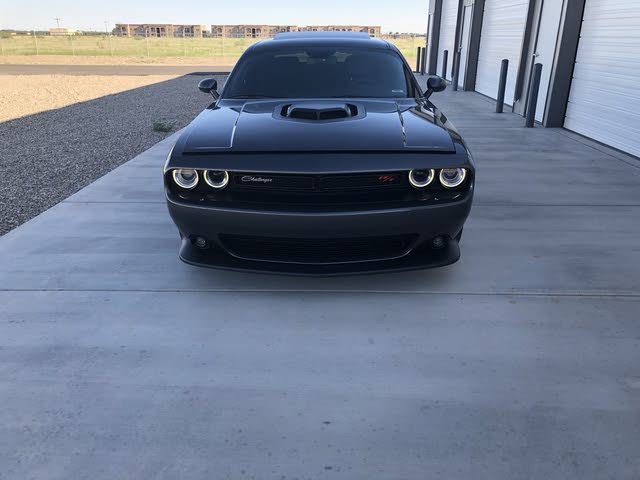 Dodge Challenger SRT Hellcat Widebody RWD $70,830MSRP |
Dodge Challenger SRT Hellcat RWD $64,830MSRP | Dodge Challenger SRT Hellcat Widebody RWD $70,830MSRP |
|---|
Overview | |
Years produced2015-2022 | Years produced2018-2022 |
MSRP$64,830 | MSRP$70,830 |
Average price$53,638 | Average price$62,414 |
Listings250 | Listings43 |
Ratings & Reviews | |
User Reviews | User Reviews |
Popular Features & Specs | |
Engine6.2L 717 hp V8 | Engine6.2L 717 hp V8 |
Drive TrainRWD | Drive TrainRWD |
Seating Capacity5 | Seating Capacity5 |
Horsepower717 hp @ 6000 rpm | Horsepower717 hp @ 6000 rpm |
MPG City13 | MPG City13 |
MPG Highway21 | MPG Highway21 |
Engine | |
Engine Name6.2L 707 hp V8 | Engine Name6.2L 707 hp V8 |
Torque650 lb-ft @ 4000 rpm | Torque650 lb-ft @ 4800 rpm |
Horsepower707 hp @ 6000 rpm | Horsepower707 hp @ 6200 rpm |
DrivetrainRWD | DrivetrainRWD |
Fuel Economy | |
MPG City13 | MPG City |
MPG Highway21 | MPG Highway |
Interior | |
Leather SeatsStandard | Leather SeatsStandard |
Seating Capacity5 | Seating Capacity5 |
Key Features | |
Navigation System | Navigation SystemStandard |
Safety | |
Front Crash Overall | Front Crash Overall4 |
Side Crash Overall | Side Crash Overall5 |
Dimensions & Capacity | |
Cargo Space16.2 cu ft | Cargo Space16.2 cu ft |
Curb Weight5450 lbs | Curb Weight4490 lbs |
Height57.1 in | Height55.7 in |
Length197.7 in | Length197.5 in |
Width75.7 in | Width85.8 in |
Wheelbase116.0 in | Wheelbase116.2 in |
Number of doors2 | Number of doors2 |
Dodge Challenger SRT Hellcat RWD $64,830MSRP | Dodge Challenger SRT Hellcat Widebody RWD $70,830MSRP |
Dodge Challenger SRT Hellcat RWD $64,830MSRP | Dodge Challenger SRT Hellcat Widebody RWD $70,830MSRP |
|---|
Overview | ||
Years produced | 2015-2022 | 2018-2022 |
MSRP | $64,830 | $70,830 |
Average price | $53,638 | $62,414 |
Listings | ||
Ratings & Reviews | ||
User reviews | ||
Popular Features & Specs | ||
Engine | 6.2L 717 hp V8 | 6.2L 717 hp V8 |
Drive Train | RWD | RWD |
Seating Capacity | 5 | 5 |
Horsepower | 717 hp @ 6000 rpm | 717 hp @ 6000 rpm |
MPG City | 13 | 13 |
MPG Highway | 21 | 21 |
Engine | ||
Engine Name | 6.2L 707 hp V8 | 6.2L 707 hp V8 |
Torque | 650 lb-ft @ 4000 rpm | 650 lb-ft @ 4800 rpm |
Horsepower | 707 hp @ 6000 rpm | 707 hp @ 6200 rpm |
Drivetrain | RWD | RWD |
Fuel Economy | ||
MPG City | 13 | |
MPG Highway | 21 | |
Interior | ||
Leather Seats | Standard | Standard |
Seating Capacity | 5 | 5 |
Key Features | ||
Navigation System | Standard | |
Safety | ||
Front Crash Overall | 4 | |
Side Crash Overall | 5 | |
Dimensions & Capacity | ||
Cargo Space | 16.2 cu ft | 16.2 cu ft |
Curb Weight | 5450 lbs | 4490 lbs |
Height | 57.1 in | 55.7 in |
Length | 197.7 in | 197.5 in |
Width | 75.7 in | 85.8 in |
Wheelbase | 116.0 in | 116.2 in |
Number of doors | 2 | 2 |
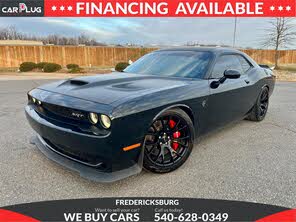
The Dodge Challenger SRT Hellcat RWD epitomizes the zenith of the Stellantis LX platform, representing a powerful culmination of muscle car innovation. Introduced in 2015 after a significant facelift to the Challenger lineup, the SRT Hellcat replaced the SRT-8 trim, quickly becoming a landmark in the muscle car landscape with its jaw-dropping 707 horsepower delivered by a supercharged V-8 engine. This model has spawned various iterations, including the extreme SRT Hellcat Redeye and models equipped with the Widebody Package, each pushing the boundaries of power and performance that this iconic model can deliver.
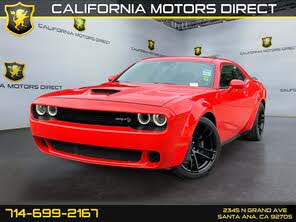
In contrast, the Dodge Challenger SRT Hellcat Widebody RWD is a broader, more assertive version of its sibling, boasting over 700 horsepower from the same legendary supercharged V8 engine. The Widebody variant enhances the Hellcat's already formidable presence and performance, making it a more dominant force on the road. The car’s wide stance not only adds to its aggressive appearance but also contributes to improved stability and cornering prowess, affirming its status as a serious contender in the muscle car arena, capable of challenging even the most elite supercars.
- Standard supercharged V-8
- Six-speed manual transmission
- Brembo six-piston brake system
- Inner driving light removed to increase airflow
- 20x9.5 wheels
- Lip spoiler
- Hood scoop
- Available Alcantara seats with Hellcat logo on heavily bolstered performance seats
- Drive Mode and Performance Pages features on 8.4-inch Uconnect screen with Sport, Track, Custom, and Valet modes
- G-meter, 0-60, and ¼ mile timers
- Supplementary gauges
- Hemi V8 engine
- Insane 0-60 mph and quarter-mile times
- Roomy, grand touring car interior
- Closely related to Chrysler 300 and Dodge Charger
- 425 horsepower
- 4.8-second 0-60 mph
Both variants of the Dodge Challenger SRT Hellcat boast immense power outputs, but with slight distinctions. The standard SRT Hellcat RWD produces 707 horsepower and 650 lb-ft of torque from its 6.2-liter V-8 engine. Meanwhile, the Widebody version slightly ups the ante with 717 horsepower and 656 lb-ft of torque. The slight increase in power and torque in the Widebody may be attributed to tuning adjustments aimed at compensating for its increased mass. Speaking of which, the curb weight of the SRT Hellcat RWD stands at 4,415 pounds, whereas the Widebody weighs in at 4,473 pounds for the automatic version and 4,446 pounds for the manual. This difference in weight slightly affects acceleration and handling dynamics, with the heavier Widebody requiring meticulous engineering to maintain similar performance levels.
The Dodge Challenger SRT Hellcat RWD is equipped with a robust 717 horsepower supercharged 6.2-liter V-8 engine. This powerhouse can be paired with either a traditional six-speed manual or a sophisticated ZF 8HP90 eight-speed automatic transmission. Propelling the car from 0 to 60 mph in an estimated 3.6 seconds, the setup showcases the sheer acceleration capabilities of this rear-wheel drive behemoth.
Similarly, the Dodge Challenger SRT Hellcat Widebody RWD houses a supercharged 6.2-liter V8 engine, offering a choice between an eight-speed automatic and a six-speed manual transmission. Despite its slightly larger frame, the Widebody variant manages a comparable 0-60 mph acceleration time of approximately 3.7 seconds, demonstrating that the additional width does little to hinder its explosive performance.
Dimensionally, both cars share the same length of 197.5 inches and a wheelbase of 116.0 inches, showcasing their shared platform and design philosophy. However, the width and height set them apart: the standard SRT Hellcat RWD measures 75.5 inches in width, while the Widebody stretches out to an imposing 78.3 inches, enhancing its road presence and stability. The height of the standard model is 57.2 inches compared to the Widebody’s slightly taller stance at 57.5 inches, contributing to its more aggressive profile.

















By: CarGurus + AI
At CarGurus, our team of experienced automotive writers remain at the heart of our content operation, conducting hands-on car tests and writing insightful guides that are backed by years of industry experience. To complement this, we are harnessing AI to make our content offering more diverse and more helpful to shoppers than ever. To achieve this, our AI systems are based exclusively on CarGurus content, ratings and data, so that what we produce is both unique to CarGurus, and uniquely helpful to car shoppers.