2020 Kia Telluride vs 2021 Volkswagen Atlas

Overview | |
MSRP$31,890 | MSRP$31,545 |
Listings1041 | Listings1279 |
Ratings & Reviews | |
User Reviews | User Reviews |
Expert reviews8.3 out of 10 | Expert reviews6.5 out of 10 |
Pros
Cons
| Pros
Cons
|
2020 Kia Telluride Reviews SummaryUsually, when I step out of an SUV and feel great, there's a luxury nameplate on the tailgate. Not this time. The Telluride grabbed me from the moment my white-over-grey test car arrived. And after 500 miles, the Telluride proved how impressive it is against every SUV in the $30,000 to $50,000 range. Kia hasn't made a truly big SUV since the 2009 Borrego, which it quickly canceled after bad reviews while a nation reeled from record-high gas prices. The smaller Sorento took over as Kia's 3-row SUV, except it wasn't roomy enough for six or seven people (and still isn't). That's not to say we don't like the Sorento—it's one of our highest-rated cars—but for families who want the most space, technology, and amenities, the 2020 Telluride is Kia's new champ. | |
2021 Volkswagen Atlas Reviews SummaryIntroduced for the 2018 model year, the Atlas is Volkswagen's latest attempt to win over American buyers. Built in Chattanooga, Tennessee, the VW Atlas competes in the three-row crossover SUV segment against well-established nameplates like the Ford Explorer, Honda Pilot, and Toyota Highlander. Changes for 2021 are limited to exterior styling tweaks and a reshuffled option list. VW also offers the two-row Atlas Cross Sport. | |
Popular Features & Specs | |
Engine3.8L 291 hp V6 | Engine2.0L 235 hp I4 |
Drive TrainFWD | Drive TrainFWD |
Seating Capacity8 | Seating Capacity7 |
Horsepower291 hp @ 6000 rpm | Horsepower |
MPG City20 | MPG City21 |
MPG Highway26 | MPG Highway24 |
Engine | |
Engine Name3.8L 291 hp V6 | Engine Name2.0L 235 hp I4 |
Torque262 lb-ft @ 5200 rpm | Torque |
Horsepower291 hp @ 6000 rpm | Horsepower |
DrivetrainFWD | DrivetrainFWD |
Fuel Economy | |
MPG City20 | MPG City21 |
MPG Highway26 | MPG Highway24 |
Interior | |
Seating Capacity8 | Seating Capacity7 |
Safety | |
Front Crash Overall4 | Front Crash Overall4 |
Side Crash Overall5 | Side Crash Overall5 |
Dimensions & Capacity | |
Cargo Space21.0 cu ft | Cargo Space20.6 cu ft |
Curb Weight4112 lbs | Curb Weight4248 lbs |
Height68.9 in | Height70.1 in |
Length196.9 in | Length200.7 in |
Width78.3 in | Width78.4 in |
Wheelbase114.2 in | Wheelbase117.3 in |
Maximum Payload1664 lbs | Maximum Payload1080 lbs |
Number of doors4 | Number of doors4 |
Maximum Towing Capacity5000 lbs | Maximum Towing Capacity2000 lbs |
Overview | ||
MSRP | $31,890 | $31,545 |
Listings | ||
Ratings & Reviews | ||
User reviews | ||
Expert reviews | 8.3 out of 10Read full review | 6.5 out of 10Read full review |
Pros & cons | Pros
Cons
| Pros
Cons
|
Summary | Usually, when I step out of an SUV and feel great, there's a luxury nameplate on the tailgate. Not this time. The Telluride grabbed me from the moment my white-over-grey test car arrived. And after 500 miles, the Telluride proved how impressive it is against every SUV in the $30,000 to $50,000 range. Kia hasn't made a truly big SUV since the 2009 Borrego, which it quickly canceled after bad reviews while a nation reeled from record-high gas prices. The smaller Sorento took over as Kia's 3-row SUV, except it wasn't roomy enough for six or seven people (and still isn't). That's not to say we don't like the Sorento—it's one of our highest-rated cars—but for families who want the most space, technology, and amenities, the 2020 Telluride is Kia's new champ. | Introduced for the 2018 model year, the Atlas is Volkswagen's latest attempt to win over American buyers. Built in Chattanooga, Tennessee, the VW Atlas competes in the three-row crossover SUV segment against well-established nameplates like the Ford Explorer, Honda Pilot, and Toyota Highlander. Changes for 2021 are limited to exterior styling tweaks and a reshuffled option list. VW also offers the two-row Atlas Cross Sport. |
Video | ||
Popular Features & Specs | ||
Engine | 3.8L 291 hp V6 | 2.0L 235 hp I4 |
Drive Train | FWD | FWD |
Seating Capacity | 8 | 7 |
Horsepower | 291 hp @ 6000 rpm | |
MPG City | 20 | 21 |
MPG Highway | 26 | 24 |
Engine | ||
Engine Name | 3.8L 291 hp V6 | 2.0L 235 hp I4 |
Torque | 262 lb-ft @ 5200 rpm | |
Horsepower | 291 hp @ 6000 rpm | |
Drivetrain | FWD | FWD |
Fuel Economy | ||
MPG City | 20 | 21 |
MPG Highway | 26 | 24 |
Interior | ||
Seating Capacity | 8 | 7 |
Safety | ||
Front Crash Overall | 4 | 4 |
Side Crash Overall | 5 | 5 |
Dimensions & Capacity | ||
Cargo Space | 21.0 cu ft | 20.6 cu ft |
Curb Weight | 4112 lbs | 4248 lbs |
Height | 68.9 in | 70.1 in |
Length | 196.9 in | 200.7 in |
Width | 78.3 in | 78.4 in |
Wheelbase | 114.2 in | 117.3 in |
Maximum Payload | 1664 lbs | 1080 lbs |
Number of doors | 4 | 4 |
Maximum Towing Capacity | 5000 lbs | 2000 lbs |
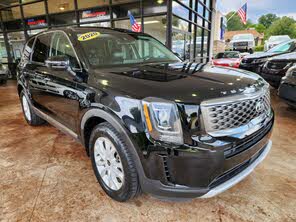
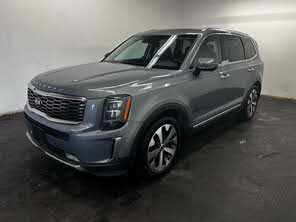
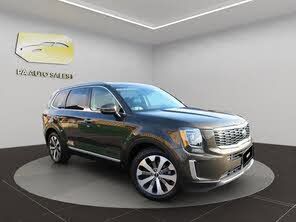
The 2020 Kia Telluride presented itself as an impressive transformation for the Kia brand, shedding its old reputation of being a budget-friendly but lackluster manufacturer. Over the past five years, Kia had worked diligently to elevate its standing, and the Telluride was a testament to this effort. It exuded an upscale appearance that belied its actual cost. The exterior design drew inspiration from luxury SUVs, blending the solid, boxy presence of a large Chevrolet with the refined curves typical of a modern Volvo. Its front featured wide-set vertical headlights above slender air intakes and a robust silver mesh grille. The rear showcased sleek, hockey stick-shaped taillights and bold "TELLURIDE" badging, reminiscent of a certain British luxury SUV. Inside, the Telluride's interior mimicked the aesthetic of high-end vehicles like the Mercedes-Benz GLE-Class, featuring matte wood, silver-painted buttons, and knurled metal knobs. Although some materials, like the wood, turned out to be faux, the overall fit and finish remained top-notch.
In contrast, the 2021 Volkswagen Atlas underwent a refreshing facelift, sporting new front and rear bumpers, standard LED headlights and taillights with fresh designs, and a reconfigured grille. These cosmetic changes gave the Atlas a more assertive look compared to its predecessor, though some elements, like the faux chrome exhaust tips, appeared a bit cheesy. The Atlas shared its MQB platform with several other VW models like the Jetta and Golf, illustrating its flexibility. The remodel added 2.4 inches to the vehicle's length, contributing to its more pronounced exterior stance. Higher trims received sportier enhancements with the R-Line package, including 21-inch wheels and sportier bumpers. Inside, the Atlas adopted a minimalist design philosophy, presenting a functional yet somewhat unembellished interior layout. Simulated leather seating appeared on the SE and SEL trims, while genuine leather was exclusive to the top-tier SEL Premium. However, the material quality in the mid-level SE with Technology model felt below average, with plastics giving a somewhat tinny impression.


The 2020 Kia Telluride featured a single engine option: a robust 3.8-liter V6, delivering 291 horsepower and 262 pound-feet of torque. This engine was paired with an 8-speed automatic transmission, available in both front-wheel drive (FWD) and all-wheel drive (AWD). While the vehicle offered a Sport mode, the transmission response was occasionally inconsistent, particularly during aggressive acceleration. Despite these transmission quirks, the Telluride had sufficient power to move its hefty two-and-a-quarter tons swiftly. Its braking system was responsive with a firm pedal feel, contrasting with its somewhat slow steering and noticeable body lean. While the Telluride didn't offer the agility of luxury SUVs with adaptive dampers, it excelled in providing a smooth ride, aided by double-paned glass and acoustic insulation to minimize wind noise. Off-roaders could benefit from features like the axle-lock mechanism and a snow mode for better traction in slippery conditions. The vehicle’s towing capacity stood at 5,000 pounds, given the additional towing package, while maintaining a respectable fuel economy of 19 mpg city, 24 highway, and 21 combined for AWD models.
The 2021 Volkswagen Atlas offered two engine choices: a 2.0-liter turbocharged inline-four producing 235 horsepower and 258 pound-feet of torque, and a 3.6-liter VR6 engine with 276 horsepower and 266 pound-feet of torque. Both engines were mated to an eight-speed automatic transmission, with FWD standard and optional 4Motion AWD. The base four-cylinder engine provided adequate acceleration but lacked excitement, compounded by rough transmission shifts under acceleration. Despite featuring a multilink independent rear suspension, the Atlas's handling felt more truck-like with a ride that punished occupants over every road imperfection. The AWD system came with various drive modes but focused more on off-road settings rather than improving on-road handling. The 4Motion system also prioritized FWD to save fuel but could transfer power to the rear wheels when needed. The towing capacity was capped at 5,000 pounds for VR6 models, with the four-cylinder versions rated for just 2,000 pounds. Fuel efficiency was modest, with the four-cylinder achieving 22 mpg combined (21 city, 24 highway) in FWD, and VR6 models rated at 19 mpg combined (17 city, 23 highway) with FWD.
The 2020 Kia Telluride offered versatile seating for either seven or eight passengers, depending on the trim. The base LX and EX trims came standard with seating for eight, while the S and SX trims provided optional eight-passenger seating, with reclining second-row captain's chairs available on both trims. The SX trim level stood out with heated and cooled second-row seats, manual side-window shades, and a third climate zone. The third row, although snug, could accommodate a six-foot adult for short durations. Cargo space was ample, with 21 cubic feet available behind the third row and expanding to 87 cubic feet with all seats folded flat. The Telluride’s interior was thoughtfully designed with analog controls that offered a high-quality feel, and higher trims featured larger displays for enhanced functionality.
Meanwhile, the 2021 Volkswagen Atlas focused on practicality with a three-row seating layout designed to accommodate families. With cargo space of 96.8 cubic feet behind the front seats and 20.6 cubic feet with all seats up, the Atlas offered average capacity for the segment but boasted better third-row legroom than many competitors. This advantage came at the expense of second-row legroom, which was less generous. The second-row bench seat, standard on lower trims, lacked comfort with its flat cushions, but third-row access was relatively easy thanks to the sliding second-row bench. The Atlas featured logical control placement and straightforward seat configurations, although its interior didn't match the Telluride’s level of luxury. There were ample USB ports and an optional wireless charging pad for convenience, alongside multiple cupholders distributed throughout the cabin. The driving position provided a commanding view, but forward visibility was somewhat compromised, aided by standard ultrasonic parking sensors and available low-speed automatic braking.
The 2020 Kia Telluride came well-equipped with Apple CarPlay, Android Auto, and Kia's UVO link, allowing remote car access via an app. Higher trims featured a rapid and precise voice-controlled navigation system, although the lack of onboard WiFi was a noticeable shortcoming. Unique to the Telluride, certain trims offered an innovative blind-spot view monitor, displaying live footage of the blind spot within the instrument cluster when signaling. Additionally, the EX and SX trims had Highway Driving Assist, which provided limited self-driving functionality on marked highways. Other technological perks included a quiet mode for front-passenger audio only and an intercom for speaking to rear-seat passengers. The SX trim excelled with bright LED headlights, dual moonroofs, and a high-quality Harman Kardon surround sound system.
The 2021 Volkswagen Atlas featured Bluetooth connectivity and smartphone compatibility through Apple CarPlay and Android Auto. The base S trim had a modest 6.5-inch infotainment display, while higher trims sported an 8-inch screen. An optional Digital Cockpit replaced analog gauges with a 10.3-inch reconfigurable digital display on higher trims. Mid-2021 models expected the MIBIII infotainment system, offering multi-phone pairing, improved voice recognition, and revamped navigation. However, during testing, the standard infotainment system felt plain with text-heavy menus. The standard audio system was average, with a premium 12-speaker Fender system available on upper trims. New for 2021, the Atlas introduced a built-in 4G LTE WiFi hotspot supporting up to four devices, enhancing its family-friendly connectivity.
The 2020 Kia Telluride, although not crash-tested at the time, was expected to achieve top ratings from NHTSA and IIHS. It came standard with a comprehensive suite of active driver assistance features, including forward-collision warning with automatic emergency braking, blind-spot monitoring, rear cross-traffic alert, lane-keep assist, and adaptive cruise control. An innovative Safe Exit Assist used the blind-spot system to alert passengers of potential obstacles when exiting the vehicle, preventing door openings when unsafe. Optional safety features included surround-view cameras and front parking sensors, though the passenger-side knee airbag was notably absent.
The 2021 Volkswagen Atlas received commendable safety ratings, achieving "good" scores in most IIHS crash tests, albeit with "marginal" ratings for child-seat anchors and standard headlights. The 2020 model, similar in structure, earned a five-star overall rating from NHTSA. Standard across all Atlas trims were automatic emergency braking and blind-spot monitoring. Higher trims offered adaptive cruise control, lane-keep assist, and a traffic-jam assist feature for low-speed automation. Later models introduced more advanced aids, including Travel Assist for high-speed lane centering and Emergency Assist for autonomous emergency stops, bringing the Atlas closer to its competitors in safety technology.
CarGurus highlights

According to CarGurus experts, the overall rating for the 2020 Kia Telluride is 8.3 out of 10, while the 2021 Volkswagen Atlas scores 6.5 out of 10. Based on these scores, CarGurus recommends the 2020 Kia Telluride for its superior interior quality, advanced technology, and overall better performance and comfort.
Choose the 2020 Kia Telluride if:
- You seek a vehicle with a luxurious, high-quality interior that mimics high-end SUVs.
- You need ample cargo space and configurable seating options for a large family.
- You appreciate advanced technology features and driver assists for enhanced safety and convenience.




Choose the 2021 Volkswagen Atlas if:
- You prioritize a vehicle with generous third-row legroom and easy access for extended family trips.
- You value straightforward, logically laid-out controls and multiple USB ports for gadget connectivity.
- You prefer a minimalist interior design and are interested in new, advanced driver-assistance features.


CarGurus highlights
According to CarGurus experts, the overall rating for the 2020 Kia Telluride is 8.3 out of 10, while the 2021 Volkswagen Atlas scores 6.5 out of 10. Based on these scores, CarGurus recommends the 2020 Kia Telluride for its superior interior quality, advanced technology, and overall better performance and comfort.
Choose the 2020 Kia Telluride if:
Shop Now- You seek a vehicle with a luxurious, high-quality interior that mimics high-end SUVs.
- You need ample cargo space and configurable seating options for a large family.
- You appreciate advanced technology features and driver assists for enhanced safety and convenience.








Choose the 2021 Volkswagen Atlas if:
Shop Now- You prioritize a vehicle with generous third-row legroom and easy access for extended family trips.
- You value straightforward, logically laid-out controls and multiple USB ports for gadget connectivity.
- You prefer a minimalist interior design and are interested in new, advanced driver-assistance features.



By: CarGurus + AI
At CarGurus, our team of experienced automotive writers remain at the heart of our content operation, conducting hands-on car tests and writing insightful guides that are backed by years of industry experience. To complement this, we are harnessing AI to make our content offering more diverse and more helpful to shoppers than ever. To achieve this, our AI systems are based exclusively on CarGurus content, ratings and data, so that what we produce is both unique to CarGurus, and uniquely helpful to car shoppers.