2020 Audi Q7 vs 2021 Subaru Forester
Overview | |
MSRP$54,800 | MSRP$24,795 |
Listings187 | Listings204 |
Ratings & Reviews | |
User Reviews | User Reviews |
Expert reviews7.7 out of 10 | Expert reviews7.5 out of 10 |
Pros
Cons
| Pros
Cons
|
2020 Audi Q7 Reviews SummaryFrom its styling and interior to its powertrain and technology, the 2020 Audi Q7 gets a thorough update that brings it in line with other high-end cars and SUVs wearing four chrome rings on their grilles. Simultaneously, the changes for the 2020 model year keep this Audi competitive against the BMW X5 and Mercedes-Benz GLE-Class, its primary rivals in the midsize luxury SUV class. We packed a Q7 Prestige full of family and luggage and set off for Lake Tahoe to assess this Audi’s improvements on the open road. | |
2021 Subaru Forester Reviews SummaryThe Subaru Forester was one of the original compact crossover SUVs. Along with the Ford Escape, Honda CR-V, and Toyota RAV4, it helped introduce a vehicular genre that is now displacing traditional sedans from American driveways. That means the Forester has more competition than ever. What was once a small market segment has swelled with the addition of compact SUVs like the Hyundai Tucson, Kia Sportage, Mazda CX-5, Nissan Rogue, Volkswagen Tiguan, and the modern version of the Jeep Cherokee. To keep pace with the competition, the Forester has packed on technology—and pounds. While the first-generation Forester (affectionately nicknamed “toaster” by fans because of its boxy shape) was genuinely compact, the current version has the footprint of a midsize SUV from two decades ago. This version was introduced for the 2019 model year, so it doesn’t change much for 2021. The only news is the addition of three standard safety features—steering-responsive LED headlights, automatic high beams, and a rear seatbelt reminder—standard fog lights and keyless access with push-button start for the Premium trim level, and additional equipment reshuffling on other trim levels. The 2021 Subaru Forester is available in five trim levels—Base, Premium, Sport, Limited, and Touring—all with standard all-wheel drive (AWD). Our test car was the mid-range Sport model. | |
No video found | |
Popular Features & Specs | |
Engine2.0L 248 hp I4 | Engine2.5L 182 hp H4 |
DrivetrainAWD | DrivetrainAWD |
Seating Capacity7 | Seating Capacity5 |
Horsepower248 hp @ 5000 rpm | Horsepower182 hp @ 5800 rpm |
MPG City19 | MPG City26 |
MPG Highway23 | MPG Highway33 |
Engine | |
Engine Name2.0L 248 hp I4 | Engine Name2.5L 182 hp H4 |
Torque273 lb-ft @ 1600 rpm | Torque178 lb-ft @ 4400 rpm |
Horsepower248 hp @ 5000 rpm | Horsepower182 hp @ 5800 rpm |
DrivetrainAWD | DrivetrainAWD |
Fuel Economy | |
MPG City19 | MPG City26 |
MPG Highway23 | MPG Highway33 |
Interior | |
Leather SeatsStandard | Leather Seats |
Seating Capacity7 | Seating Capacity5 |
Key Features | |
Navigation SystemStandard | Navigation System |
Sunroof/MoonroofStandard | Sunroof/Moonroof |
Safety | |
Front Crash Overall | Front Crash Overall5 |
Side Crash Overall5 | Side Crash Overall5 |
Dimensions & Capacity | |
Cargo Space14.2 cu ft | Cargo Space31.1 cu ft |
Curb Weight4784 lbs | Curb Weight3453 lbs |
Height68.5 in | Height67.5 in |
Length199.6 in | Length182.1 in |
Width87.1 in | Width80.9 in |
Wheelbase117.9 in | Wheelbase105.1 in |
Maximum Payload1367 lbs | Maximum Payload1438 lbs |
Number of doors4 | Number of doors4 |
Maximum Towing Capacity4400 lbs | Maximum Towing Capacity1500 lbs |
Overview | ||
MSRP | $54,800 | $24,795 |
Listings | ||
Ratings & Reviews | ||
User reviews | ||
Expert reviews | 7.7 out of 10Read full review | 7.5 out of 10Read full review |
Pros & cons | Pros
Cons
| Pros
Cons
|
Summary | From its styling and interior to its powertrain and technology, the 2020 Audi Q7 gets a thorough update that brings it in line with other high-end cars and SUVs wearing four chrome rings on their grilles. Simultaneously, the changes for the 2020 model year keep this Audi competitive against the BMW X5 and Mercedes-Benz GLE-Class, its primary rivals in the midsize luxury SUV class. We packed a Q7 Prestige full of family and luggage and set off for Lake Tahoe to assess this Audi’s improvements on the open road. | The Subaru Forester was one of the original compact crossover SUVs. Along with the Ford Escape, Honda CR-V, and Toyota RAV4, it helped introduce a vehicular genre that is now displacing traditional sedans from American driveways. That means the Forester has more competition than ever. What was once a small market segment has swelled with the addition of compact SUVs like the Hyundai Tucson, Kia Sportage, Mazda CX-5, Nissan Rogue, Volkswagen Tiguan, and the modern version of the Jeep Cherokee. To keep pace with the competition, the Forester has packed on technology—and pounds. While the first-generation Forester (affectionately nicknamed “toaster” by fans because of its boxy shape) was genuinely compact, the current version has the footprint of a midsize SUV from two decades ago. This version was introduced for the 2019 model year, so it doesn’t change much for 2021. The only news is the addition of three standard safety features—steering-responsive LED headlights, automatic high beams, and a rear seatbelt reminder—standard fog lights and keyless access with push-button start for the Premium trim level, and additional equipment reshuffling on other trim levels. The 2021 Subaru Forester is available in five trim levels—Base, Premium, Sport, Limited, and Touring—all with standard all-wheel drive (AWD). Our test car was the mid-range Sport model. |
Video | No video found | |
Popular Features & Specs | ||
Engine | 2.0L 248 hp I4 | 2.5L 182 hp H4 |
Drivetrain | AWD | AWD |
Seating Capacity | 7 | 5 |
Horsepower | 248 hp @ 5000 rpm | 182 hp @ 5800 rpm |
MPG City | 19 | 26 |
MPG Highway | 23 | 33 |
Engine | ||
Engine Name | 2.0L 248 hp I4 | 2.5L 182 hp H4 |
Torque | 273 lb-ft @ 1600 rpm | 178 lb-ft @ 4400 rpm |
Horsepower | 248 hp @ 5000 rpm | 182 hp @ 5800 rpm |
Drivetrain | AWD | AWD |
Fuel Economy | ||
MPG City | 19 | 26 |
MPG Highway | 23 | 33 |
Interior | ||
Leather Seats | Standard | |
Seating Capacity | 7 | 5 |
Key Features | ||
Navigation System | Standard | |
Sunroof/Moonroof | Standard | |
Safety | ||
Front Crash Overall | 5 | |
Side Crash Overall | 5 | 5 |
Dimensions & Capacity | ||
Cargo Space | 14.2 cu ft | 31.1 cu ft |
Curb Weight | 4784 lbs | 3453 lbs |
Height | 68.5 in | 67.5 in |
Length | 199.6 in | 182.1 in |
Width | 87.1 in | 80.9 in |
Wheelbase | 117.9 in | 105.1 in |
Maximum Payload | 1367 lbs | 1438 lbs |
Number of doors | 4 | 4 |
Maximum Towing Capacity | 4400 lbs | 1500 lbs |
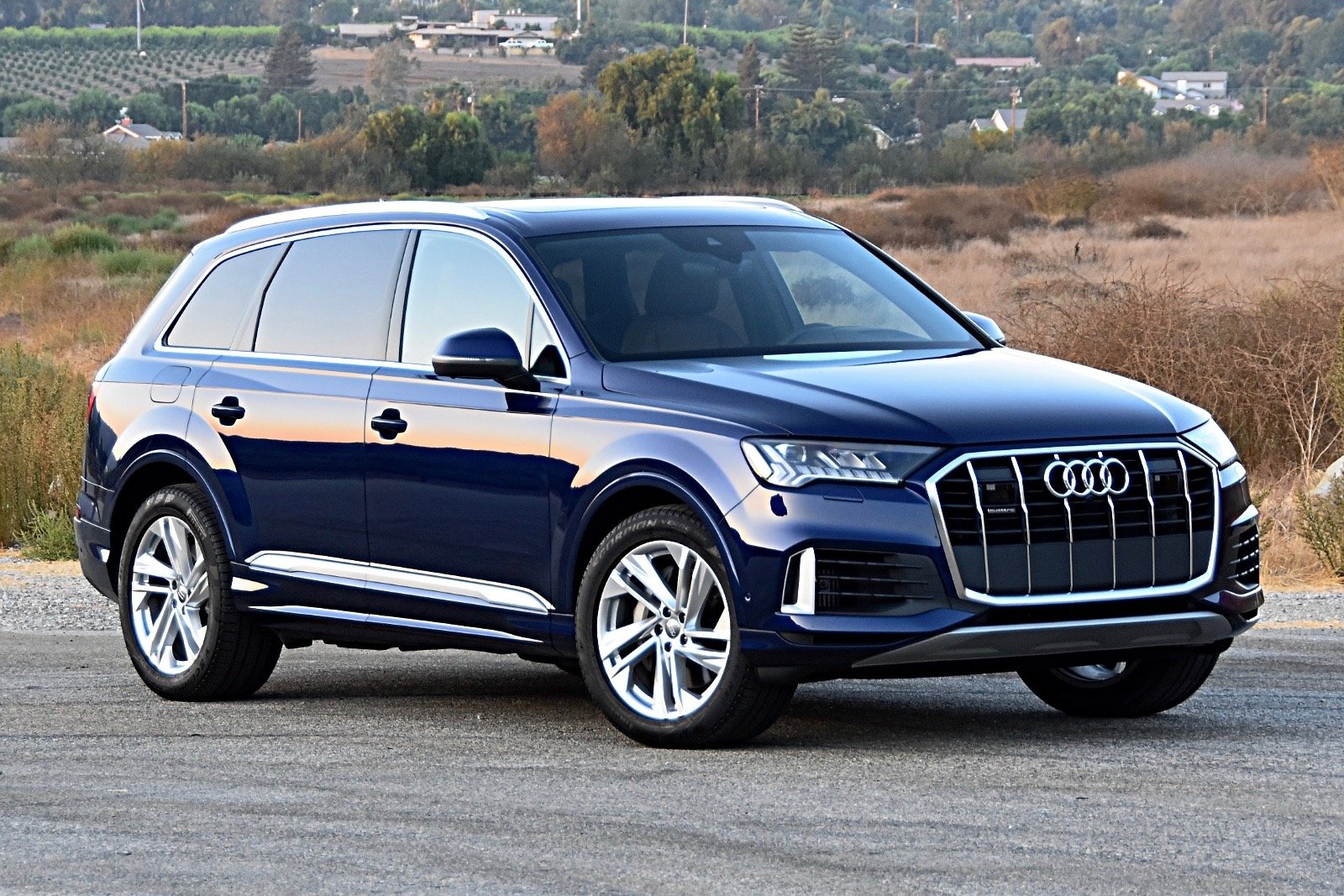
The 2020 Audi Q7 offered multiple variations, including the 45 TFSI with a turbocharged 2.0-liter four-cylinder engine and the 55 TFSI with a mild-hybrid turbocharged 3.0-liter V6. A performance-tuned Audi SQ7 with a twin-turbo 4.0-liter V8 was also new for 2020. The Q7 55 TFSI, starting at $60,800, was available in Premium, Premium Plus, and Prestige trims. The test vehicle, a Prestige trim, featured Navarra Blue metallic paint, a Cold Weather Package, and a Towing Package, totaling $74,290. Design updates included new front and rear styling, wheels, and lighting elements, aligning the Q7 with the flagship Q8 model. The interior adopted the high-tech dashboard and instrumentation from the Q8, featuring three digital displays and Audi’s Virtual Cockpit panel. The cabin, decked out in Okapi Brown leather and Gray/Brown Fine Grain Ash natural wood inlays, exuded an upscale and high-tech vibe, enhanced by multi-color ambient lighting.
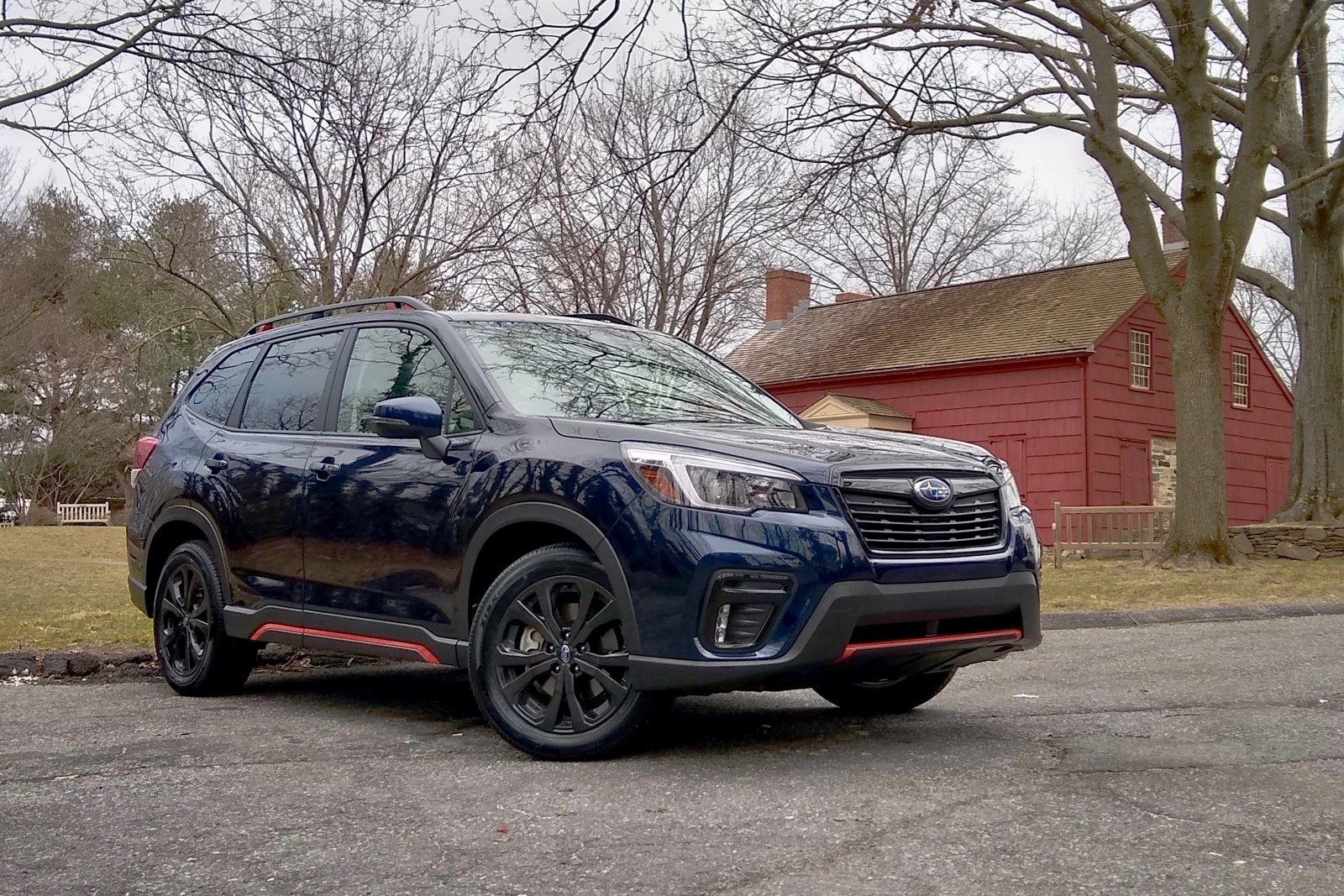
The 2021 Subaru Forester, redesigned for 2019, retained a familiar styling with a boxy, upright shape and distinctive cross-shaped taillights. The Forester Sport model, tested here, featured orange striping, a rear spoiler, and black 18-inch alloy wheels, which made a significant visual impact, especially with the Dark Blue Pearl paint. Riding on the Subaru Global Platform, shared with other Subaru models, the Forester maintained its rugged SUV image. The interior, a no-nonsense mix of durable materials, included orange trim and cross-stitching in the Sport trim. Base, Premium, and Sport models had cloth upholstery, while Limited and Touring trims offered leather. The All-Weather Package, standard on Premium and higher trims, added heated front seats, heated exterior mirrors, and a windshield de-icer.




The 2020 Audi Q7 55 TFSI debuted a new 3.0-liter turbocharged V6 engine, producing 335 horsepower and 369 pound-feet of torque. This engine featured a 48-volt mild-hybrid electrical system, enhancing fuel efficiency. Paired with an eight-speed automatic transmission and Quattro all-wheel-drive, the Q7 offered various driving modes through Audi Drive Select. The 55 TFSI could accelerate from 0 to 60 mph in 5.7 seconds and had a maximum tow rating of 7,700 pounds. The EPA estimated 18 mpg combined, but during testing, it averaged 21 mpg on a road trip and 18.1 mpg locally. The Prestige trim included an adaptive air suspension, adjustable through Audi Drive Select. The Q7 excelled in off-road conditions and provided speedy acceleration on pavement, with the mild-hybrid technology operating seamlessly. The cabin remained quiet, thanks to dual-pane acoustic side window glass, making it a comfortable and enjoyable drive.
The 2021 Subaru Forester featured a 2.5-liter four-cylinder engine, generating 182 horsepower and 176 pound-feet of torque, paired with a continuously variable automatic transmission (CVT). The engine’s boxer configuration provided a lower center of gravity. Subaru quoted a 1,500-pound maximum towing capacity, with Trailer Stability Assist as standard. The Forester lacked a turbocharged engine option, resulting in adequate but not thrilling power. The suspension tuning prioritized comfort, leading to significant body roll in corners and a bouncy ride on uneven pavement. Standard all-wheel drive and X-Mode, with Dual X-Mode on Sport models, enhanced off-road capability. The Forester offered 8.7 inches of ground clearance and standard hill-descent control on Premium and higher trims, making it suitable for light off-roading.
The 2020 Audi Q7, with three rows of seats, was best used as a five-passenger vehicle. The third-row seat, suitable only for young children, required sliding the second-row seats forward, reducing cargo space to 14.2 cubic feet. With the third row folded, cargo capacity increased to 35.7 cubic feet, and with both rows down, it reached 69.6 cubic feet. The Prestige trim’s eight-way power-adjustable, heated, and ventilated front seats were comfortable for long trips. The second-row seats offered ample legroom and thigh support, with four-zone climate control and heated rear cushions ensuring passenger comfort. However, interior storage was limited, with the center console and dashboard screen taking up most of the space.
The 2021 Subaru Forester provided above-average headroom and legroom in both rows, thanks to its tall, flat roofline. This design also enhanced outward visibility and created a roomy feeling. The Forester offered 35.4 cubic feet of cargo space with the rear seats up and 76.1 cubic feet with them folded, surpassing some competitors. However, it lacked a sliding second-row bench. A power liftgate was optional on the Sport trim and standard on Limited and Touring trims. The center console was reasonably sized, but the phone-storage cubby was too small for an average-size phone, and wireless charging was not available. The Forester featured large knobs for audio and climate control, but the numerous buttons on the steering wheel could be confusing.
The 2020 Audi Q7 introduced the Multi-Media Interface (MMI) Touch Response technology, combining a 10.1-inch upper touchscreen with an 8.6-inch lower touchscreen. The system included natural voice recognition, handwriting recognition, wireless Apple CarPlay and Android Auto, navigation with Google Earth imagery, and Audi Connect services with a 4G LTE WiFi hotspot. While the interface was generally intuitive, dry fingertips sometimes made virtual buttons unresponsive. The Prestige trim featured a full-color head-up display, though it was invisible with polarized sunglasses. The test vehicle had a Bose premium sound system, replaced by a 19-speaker Bang & Olufsen system in 2021.
The 2021 Subaru Forester’s standard Starlink infotainment system included a 6.5-inch touchscreen, Apple CarPlay and Android Auto, Bluetooth, SiriusXM satellite radio, and front-row USB ports. Sport models added an 8-inch touchscreen and Harman Kardon audio system, while Limited and Touring trims included navigation and rear USB ports. The system was user-friendly, with well-designed graphics and backup analog controls. However, the screen was slow to boot up. Additional displays in the dashboard and instrument cluster provided secondary information, but the setup seemed overly complex.
The 2020 Audi Q7 featured HD Matrix LED headlights, which performed exceptionally well during night driving but received a "poor" rating from the IIHS due to excessive glare. The Q7 included numerous advanced driving-assistance systems (ADAS), with upgrades available in the Executive Package or Prestige trim. Highlights included Emergency Assist, Turn Assist, and Adaptive Cruise Assist with lane-centering assistance. However, the traffic-sign-recognition technology and Active Lane Assist proved problematic. The IIHS gave the Q7 the highest ratings in collision protection, except for the "poor" headlight assessment.
The 2021 Subaru Forester excelled in safety, earning the highest “Top Safety Pick+” award from the IIHS and a five-star overall rating from the NHTSA. Standard EyeSight technology included adaptive cruise control, automatic emergency braking, lane-departure warning, and lead-vehicle start alert. The Forester also featured a driver-monitoring system, unique among mainstream brands. Optional safety features included blind-spot monitoring, rear-cross traffic alert, lane-keep assist, and reverse automatic braking. The adaptive cruise control and lane-centering functions performed adequately, though the latter’s steering inputs were jerky.
CarGurus highlights
According to CarGurus experts, the overall rating for the 2020 Audi Q7 is 7.7 out of 10, while the 2021 Subaru Forester scores 7.5 out of 10. Based on these ratings, the 2020 Audi Q7 is the recommended choice, offering a more luxurious and enjoyable driving experience with advanced technology and significant towing capacity.
Choose the 2020 Audi Q7 if:
- You prioritize a luxurious and high-tech interior with advanced digital displays.
- You need a vehicle with significant towing capacity and responsive acceleration.
- You value a quiet cabin and comfortable ride for long trips.


Choose the 2021 Subaru Forester if:
- You require a spacious and practical interior with excellent headroom and cargo capacity.
- You want a vehicle with standard all-wheel drive and good off-road capability.
- You prioritize top-tier safety ratings and advanced driver-assistance features.


CarGurus highlights
According to CarGurus experts, the overall rating for the 2020 Audi Q7 is 7.7 out of 10, while the 2021 Subaru Forester scores 7.5 out of 10. Based on these ratings, the 2020 Audi Q7 is the recommended choice, offering a more luxurious and enjoyable driving experience with advanced technology and significant towing capacity.
Choose the 2020 Audi Q7 if:
Shop Now- You prioritize a luxurious and high-tech interior with advanced digital displays.
- You need a vehicle with significant towing capacity and responsive acceleration.
- You value a quiet cabin and comfortable ride for long trips.
Choose the 2021 Subaru Forester if:
Shop Now- You require a spacious and practical interior with excellent headroom and cargo capacity.
- You want a vehicle with standard all-wheel drive and good off-road capability.
- You prioritize top-tier safety ratings and advanced driver-assistance features.

By: CarGurus + AI
At CarGurus, our team of experienced automotive writers remain at the heart of our content operation, conducting hands-on car tests and writing insightful guides that are backed by years of industry experience. To complement this, we are harnessing AI to make our content offering more diverse and more helpful to shoppers than ever. To achieve this, our AI systems are based exclusively on CarGurus content, ratings and data, so that what we produce is both unique to CarGurus, and uniquely helpful to car shoppers.

