2018 Ford F-150 Reviews, Pricing & Specs
Write a review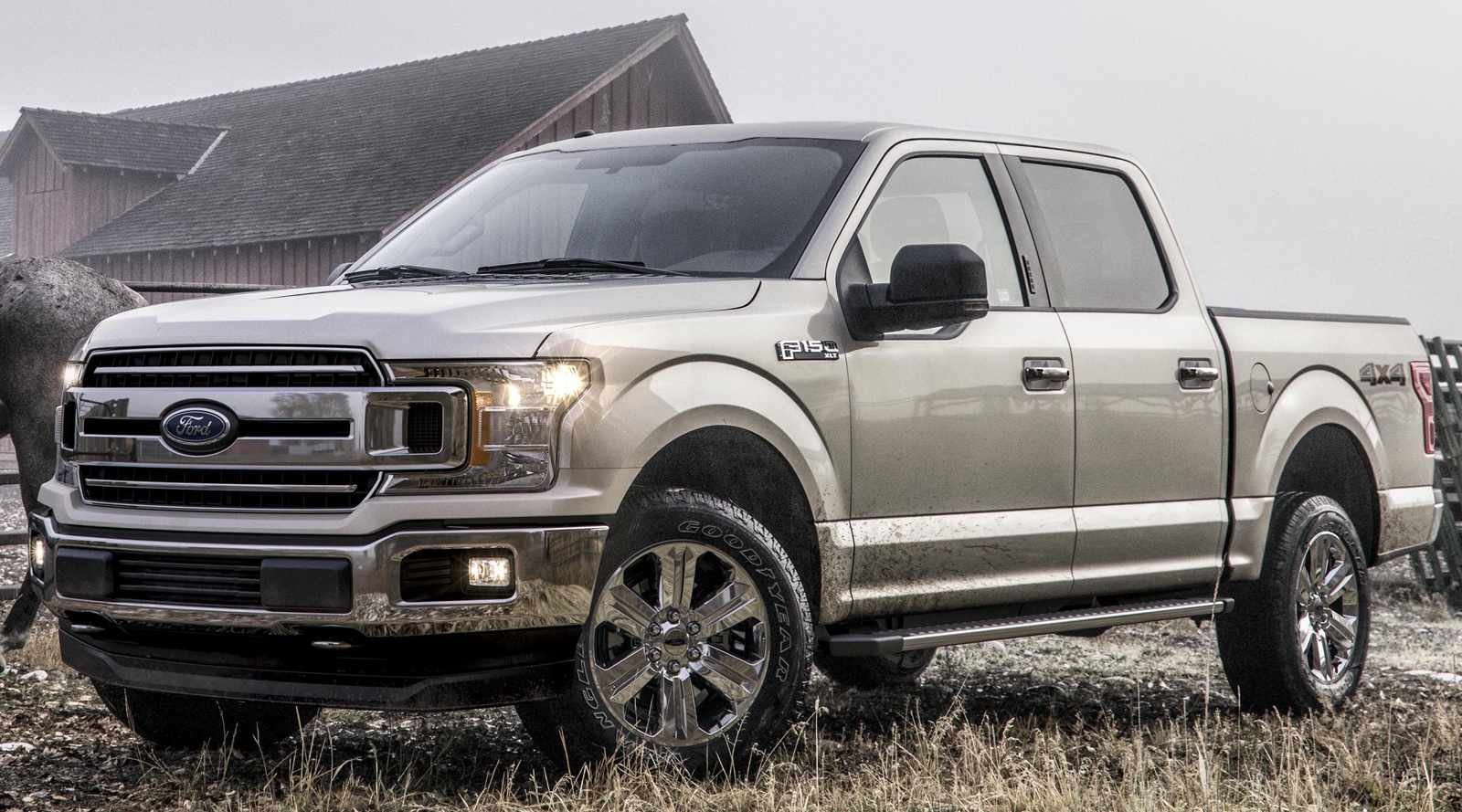
The F-150 is smart, nimble, efficient and sophisticated. Some trucks do a better job owning the luxury niche, but the F-150 is a far more well-rounded pickup for everyday use.
Sometimes being a jack-of-all-trades also means being a master of none. Because it has the best towing capacity and best fuel economy among full-size pickups, you would think the Ford F-150 might lack in other areas—after all, something’s gotta give. But for 2018, Ford’s popular full-size pickup delivers in nearly all areas, making for one of the most well-rounded new pickups available today.
And that’s quite a feat, considering the competition. Every year, automakers cram more capability into their full-size pickups. But trucks have also become more civil and accommodating for people that use their truck to commute. There are plenty of new innovations for the weekend warrior and even the luxury pickup buyer—yes, that’s a thing.
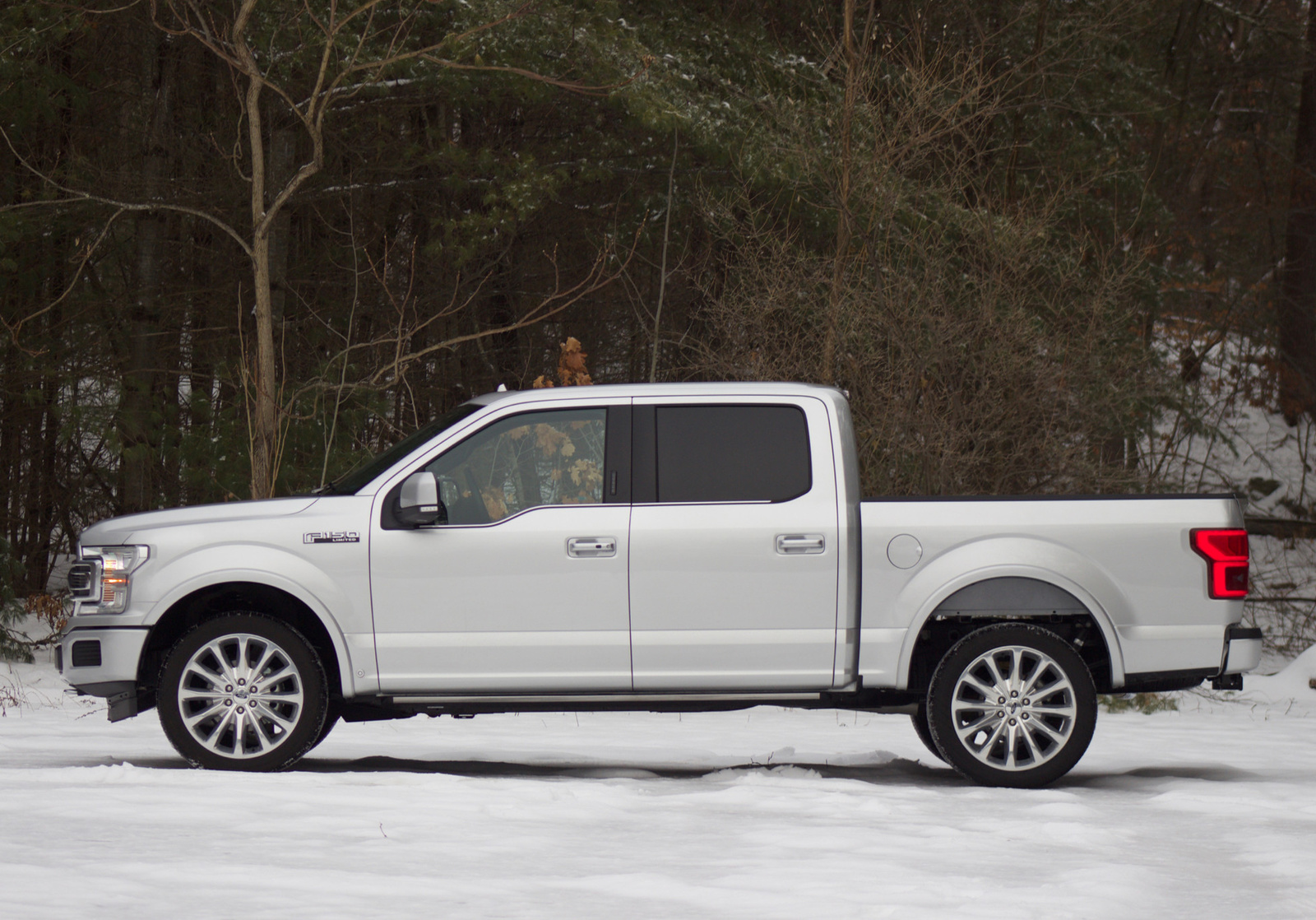
The 2018 Ford F-150 Limited we drove shows just how far the pickup truck has come to address the needs of all these types of truck buyers while showing off some new tricks in the process.

The last decade for large pickups has been characterized by constant one-upmanship. From engine outputs to towing capacity and even sheer size, automakers have been constantly out-doing each other. The result is that most trucks have become comically large.
But thankfully the F-150 actually bucks this trend and feels manageable. It’s still large, but it looks like the bigger-and-bigger trend is finally starting to plateau.
Like most full-size pickups, the F-150 is available with a regular cab, extended SuperCab or a 4-door SuperCrew. Bed-size choices include short, medium, and long. The extended SuperCab has rear-hinged clamshell doors that open to the second row.
More than almost any other modern pickup, the F-150 trim lineup runs the gamut from no-nonsense work trucks to incredible high-end trims. It starts with the base XL and includes XLT, Lariat, King Ranch, Platinum, Raptor, and the Limited that we drove.
The base XL is a true work truck, providing little more than plastic bumpers, cloth seats and steel wheels. On the plus side, it does have a reversing camera and an auxiliary jack for the stereo. Moving up to the XLT adds some basic creature comforts, like power windows and locks, a USB port and Bluetooth connectivity. It also adds 17-inch aluminum wheels and chrome front and rear bumpers.
The Lariat adds 18-inch aluminum wheels, leather-trimmed front seats, a 10-way power driver’s seat, heated and ventilated front seats, dual-zone electronic temperature control, SiriusXM satellite radio, and Ford’s Sync 3 infotainment system. It also comes with an 8-inch advanced trip computer, ambient interior lighting and push-button start.
Moving up to the King Ranch, you get everything from the Lariat, plus unique 18-inch machined aluminum wheels, unique leather bucket seats and a two-tone paint scheme. It also comes with heated rear seats, a Bang & Olufsen premium stereo, and Wi-Fi hotspot capability.
The Platinum delivers plenty of style, including a unique grille and 20-inch polished aluminum wheels, as well as genuine wood interior accents. It also comes with a voice-activated navigation system.
The Raptor is made for conquering trails of all kinds and looks the part. It is actually 6.4 inches wider than the conventional F-150, hence the need for the “trucker” style amber lights integrated into the unique mesh grille. That grille features massive “F-O-R-D” block lettering. The Raptor also features a unique bumper design, larger fender flares and skid plates—all geared for off-roading.
The range-topping Limited comes with a mix of body-colored bumpers and a satin chrome grille and door handles. It also features massive 22-inch polished aluminum wheels.
The Limited comes with basically every major option package selected, including power everything, a massive panoramic sunroof, power sliding rear window, and heated and cooled front seats, with heated rear seats. The front seats also feature a massaging function, which will make any road trip more enjoyable—just don’t doze off!

The F-150 currently offers four engines, including a 3.3-liter V6, a 2.7-liter EcoBoost twin-turbo V6, a 3.5-liter EcoBoost twin-turbo V6, and a 5.0-liter V8.
The base 3.3-liter V6 makes 290 horsepower and 265 pound-feet of torque. The 2.7-liter EcoBoost V6 makes 325 hp and 400 lb-ft of torque, while the 3.5-liter EcoBoost V6 in our test model makes 375 hp and 470 lb-ft of torque. The 5.0-liter V8 makes 395 hp and 400 lb-ft of torque.
Later this spring, the F-150 will be available with a new 3.0-liter Power Stroke turbodiesel V6. It is expected to make 250 hp and 440 lb-ft of torque.
The base 3.3-liter V6 pairs with a 6-speed automatic transmission. All other engines come with a 10-speed automatic. Power gets sent to the rear wheels or available 4-wheel drive (4WD).
The dash-mounted shift-on-the-fly dial in our test truck featured 2-hi, 4-auto, 4-hi, and 4-lo. As a refresher for first-time truck-or-SUV buyers, 2-hi is rear-wheel drive (RWD), and unless you work for a Canadian logging outfit, this is what you will use most of the time.
4-auto is useful when a light covering of snow or ice is on the ground. In older trucks, there's always that big decision on when to put it into 4WD. 4-auto does the thinking for you, deciding when to kick in its extra traction.
When you actually start getting into the dirt and mud is when you'll use 4-hi. Finally, 4-lo is for the serious stuff, such as fording water, crawling over rocks and blasting through deep sand or snow.
On top of even those powertrain modes, the F-150 has a drive-mode selector. It features Tow/Haul, Snow/Wet, Sport, and Eco drive modes. Each has its own unique tuning for the steering feel, throttle response and shift mapping.
The problem is just finding the button. It’s down on the side of the shifter, as are the manual shift controls. It would make a lot more sense for the manual buttons to be paddle shifters on the steering wheel. The drive mode button would also be better located on the center console, in the center stack, or on the steering wheel—pretty much anywhere other than hidden next to the shifter.
There’s been a lot of talk about aluminum in trucks in the last few years, with rivals like Chevrolet attempting to knock Ford for its use of the lightweight material. But the use of aluminum in the F-150 shaves hundreds of pounds. And that weight savings makes the F-150 very nimble. As a result, it drives more like a large SUV than a truck.
Of course, the F-150 Raptor is a completely different beast. It features beefed-up shocks, and its EcoBoost V6 makes an absurd 450 horsepower. All of this is so the Raptor can travel at highway speeds over dirt, sand or gravel.
Of course, if fuel economy is a concern, there are better options than the Raptor, which returns just 15 mpg city, 18 highway, 16 combined.
The most efficient drivetrain configuration in the F-150 is the 2.7-liter EcoBoost V6 with the 10-speed automatic and RWD. It returns 20 mpg city, 26 highway, and 22 combined. Our Limited with the V6 and 4WD returns 17, 23, 19.
The F-150 is capable of fantastic fuel economy, and Ford does not sacrifice power for efficiency, as the 3.5-liter EcoBoost can tow up to 13,200 pounds when properly equipped, which is best-in-class for full-size pickups.
The 5.0-liter V8 tops out at 11,600 pounds, while our 4WD Limited manages a respectable 10,900 pounds. To get the maximum towing capacity, you'll need a very specific equipment setup, hence the old “when properly equipped” disclaimer.

It’s important to note the different types of doors offered with extended-cab pickups—the middle child of cab sizes. A single cab will always have just two doors and maybe a tiny bit of space behind the seats for a small bag. A crew cab will always have four doors and tons of interior space. But different automakers treat the extended cab differently.
The Ford F-150 SuperCab features rear-hinged clamshell doors. And though they provide massive openings, the front doors need to be open all the way in order to open the rear ones. Meanwhile, extended-cab pickups from Ram and Chevrolet feature four conventional doors, which make for smaller openings but are often more practical. If you are using the back seat a lot, those might be better options. Truck owners with kids might want the Chevy or Ram take on the extended cab, but if you are mostly using the front seats and just want some extra space behind them, the SuperCab will get the job done.
The inside of a SuperCrew F-150 is expansive, and frankly, feels like a living room. You can load up the whole family for a weekend trip, and any gear you don’t want exposed to the elements will still fit in one of the many cubbies and compartments or the massive spaces under the rear seats.

The base XL has little more than an AM/FM stereo with four speakers and an auxiliary audio input. Move up to the XLT if you want the most basic version of Sync infotainment, with Bluetooth connectivity.
But all other trims (except the Raptor) come standard with Sync 3. The 8-inch color screen is easy to use and provides large fonts and icons. It also provides support for Apple CarPlay and Android Auto. Sync 3 is optional for the XL, XLT and Raptor trims.
The F-150 can also be had with a Wi-Fi hotspot that can connect up to 10 devices. Sync 3 provides additional features like support for apps like Spotify, Pandora and more. You can also connect to your truck via the FordPass smartphone app. It allows you to find and compare local fuel prices; find, reserve, and pay for parking spots; and you can even get help from a trained team of FordGuides, 24/7!
The available navigation system also features five years of SiriusXM Travel Link. This service provides real-time traffic and weather updates, sports scores and local fuel prices.

Standard safety features for the F-150 include a reversing camera, tire pressure monitoring system, traction control and a full array of front- and side-impact airbags. A 360-degree camera is standard on the Limited and available on the Lariat, King Ranch, Platinum and Raptor. This camera setup provides multiple camera angles, which you can select via a toggle in the dash.
Our Limited also came with features like forward-collision warning and avoidance with pedestrian detection, lane-departure warning, blind-spot monitoring and adaptive cruise control that can stop and go with traffic all on its own. Like the 360-degree camera, these features are standard on the Limited and available on other models.
Safety is more than just airbags and seatbelts—when it comes to trucks, it’s making sure you’re towing safety. To that end, the F-150 comes standard with trailer sway control and is available with an integrated trailer brake controller.
Even beyond that is the Pro Trailer Backup Assist. Backing up a trailer is an acquired skill and can be counterintuitive for beginners. You have to counter-steer in order to position the truck to get the trailer pointed in the right direction, which often means turning the opposite way you think you should. Pro Trailer Backup Assist will execute all the steering inputs needed to back up your trailer.
Base MSRP for the 2018 Ford F-150 is $27,610. The only new truck that starts below that price is the Ram 1500, which comes in at about $500 less.
The XLT trim starts at $33,205, but when you expand to a SuperCab and add 4WD, you'll pay about $40,000 before options. The Lariat starts at $40,920, while the Raptor starts at $50,020.
Above that, you start getting into the true “Lux Trucks,” including the King Ranch, which starts at $51,835. The Platinum trim starts at $54,930, while the range-topping Limited starts at $60,755. The Limited comes so well equipped there are few options to add. You can add 4WD and Pro Trailer Backup Assist, and for that you’ll pay $66,165.
The Limited is absolutely chock-full of features, but luxury is more than the sum of its parts—even for trucks. The Limited doesn’t have the polish of high-end rivals like the Ram 1500 Limited or GMC Sierra Denali.
But as an all-around everyday truck, the Ford F-150 is a fantastic choice. Given its light weight and EcoBoost V6 engines, it’s nimble—nimble and efficient, yet powerful and technologically sophisticated. To that end, few trucks do as many things as well as the 2018 Ford F-150.

User reviews for 2018 Ford F-150
Write a review2018 Ford F-150 Pricing
Trims & specs
Air Conditioning
Single front air conditioning zones
Airbags
Dual front airbags · Passenger airbag deactivation: occupant sensing deactivation · Front side airbags · Front side curtain airbags
Audio System
Antenna Type: mast · Auxiliary audio input: jack · AM/FM radio · Total Number of Speakers: 4
Brakes
ABS: 4-wheel · Braking assist: hill start assist · Front brake diameter: 13.8 · Front brake width: 1.34 · Front brakes: ventilated disc · Rear brake diameter: 13.2 · Rear brake width: 0.87 · Rear brakes: ventilated disc
Comfort Features
Armrests: front center · Door sill trim: scuff plate · Floor Material: rubber · Steering wheel trim: urethane
Convenience Features
Assist handle: front · Cupholders: front · Power outlet(s): 12V front · Steering wheel: tilt and telescopic · Storage: door pockets · Vanity mirrors: passenger
Driver Seat
Manual adjustments: 2
Drivetrain
Axle ratio: 3.55
Exterior Features
Door handle color: black · Front bumper color: black · Grille color: black surround · Mirror color: black · Rear bumper color: black · Tailgate: removable · Window trim: black
Headrests
Front headrests: adjustable · Number of front headrests: 3
In Car Entertainment
Infotainment screen size: 4.2 in.
Instrumentation
Instrument cluster screen size: 2.3 in. · Warnings and reminders: maintenance reminder
Lights
Headlights: Auto on/off
Mirrors
Exterior mirrors: manual · Inside rearview mirror: manual day/night
Passenger Seat
Manual Adjustments: 2
Safety
Camera system: rearview · Crumple zones: front · Impact sensor: post-collision safety system · Rearview monitor: in dash
Seatbelts
Emergency locking retractors: front · Front seatbelts: 3-point · Seatbelt force limiters: front · Seatbelt pretensioners: front · Seatbelt warning sensor: driver and passenger
Seats
Driver seat manual adjustments: reclining · Front seat type: 40-20-40 split bench · Passenger seat manual adjustments: reclining · Upholstery: cloth
Spare Tire
Mount Location: underbody · Size: full-size
Spare Wheel
Rim Type: steel
Stability and Traction
Traction control: with trailer stability control
Steering
Steering ratio: 20
Suspension
Front Shock Type: gas shock absorbers · Front Spring Type: coil springs · Front Suspension Classification: independent · Front Suspension Type: double wishbones · Rear Shock Type: gas shock absorbers · Rear Spring Type: leaf springs · Rear Suspension Classification: solid live axle · Rear Suspension Type: multi-leaf · Stabilizer bar(s): front
Tires
Type: all season
Tires and Rims
Wheels: steel
Towing and Hauling
Trailer wiring: 4-pin
Wheels
Wheel locks: spare only
Windows
Front wipers: intermittent · Solar-tinted glass: rear
Air Conditioning
Single front air conditioning zones
Airbags
Dual front airbags · Passenger airbag deactivation: occupant sensing deactivation · Front side airbags · Front side curtain airbags
Audio System
Antenna Type: mast · Auxiliary audio input: jack · AM/FM radio · Total Number of Speakers: 4
Brakes
ABS: 4-wheel · Braking assist: hill start assist · Front brake diameter: 13.8 · Front brake width: 1.34 · Front brakes: ventilated disc · Rear brake diameter: 13.2 · Rear brake width: 0.87 · Rear brakes: ventilated disc
Comfort Features
Armrests: front center · Door sill trim: scuff plate · Floor Material: rubber · Steering wheel trim: urethane
Convenience Features
Assist handle: front · Cupholders: front · Power outlet(s): 12V front · Power steering: electric · Steering wheel: tilt and telescopic · Storage: door pockets · Vanity mirrors: passenger
Driver Seat
Manual adjustments: 2
Drivetrain
Axle ratio: 3.55
Exterior Features
Door handle color: black · Front bumper color: black · Grille color: black · Mirror color: black · Rear bumper color: black · Tailgate: removable · Window trim: black
Headrests
Front headrests: adjustable · Number of front headrests: 3
In Car Entertainment
Infotainment screen size: 4.2 in.
Instrumentation
Instrument cluster screen size: 2.3 in. · Warnings and reminders: maintenance reminder
Lights
Headlights: auto delay off
Mirrors
Exterior mirrors: manual folding · Inside rearview mirror: manual day/night
Passenger Seat
Manual Adjustments: 2
Safety
Camera system: rearview · Crumple zones: front · Impact sensor: post-collision safety system · Rearview monitor: in dash
Seatbelts
Emergency locking retractors: front · Front seatbelts: 3-point · Seatbelt force limiters: front · Seatbelt pretensioners: front · Seatbelt warning sensor: driver and passenger
Seats
Driver seat manual adjustments: reclining · Front seat type: 40-20-40 split bench · Passenger seat manual adjustments: reclining · Upholstery: cloth
Spare Tire
Mount Location: underbody · Size: full-size
Spare Wheel
Rim Type: steel
Stability and Traction
Traction control: with trailer stability control
Steering
Steering ratio: 20
Suspension
Front Shock Type: gas shock absorbers · Front Spring Type: coil springs · Front Suspension Classification: independent · Front Suspension Type: strut · Rear Shock Type: gas shock absorbers · Rear Spring Type: leaf springs · Rear Suspension Classification: solid live axle · Rear Suspension Type: multi-leaf · Stabilizer bar(s): front
Tires
Type: all season
Tires and Rims
Wheels: steel
Towing and Hauling
Trailer wiring: 4-pin
Wheels
Wheel locks: spare only
Windows
Front wipers: intermittent · Solar-tinted glass: rear
Air Conditioning
Single front air conditioning zones
Airbags
Dual front airbags · Passenger airbag deactivation: occupant sensing deactivation · Front side airbags · Rear side curtain airbags
Audio System
Antenna Type: mast · Auxiliary audio input: jack · AM/FM radio · Total Number of Speakers: 6
Brakes
ABS: 4-wheel · Braking assist: hill start assist · Front brake diameter: 13.8 · Front brake width: 1.34 · Front brakes: ventilated disc · Rear brake diameter: 13.2 · Rear brake width: 0.87 · Rear brakes: ventilated disc
Comfort Features
Armrests: front center · Door sill trim: scuff plate · Floor Material: rubber · Steering wheel trim: urethane
Convenience Features
Assist handle: front · Cupholders: rear · Power outlet(s): 12V front · Power steering: electric · Steering wheel: tilt and telescopic · Storage: door pockets · Vanity mirrors: passenger
Driver Seat
Manual adjustments: 2
Drivetrain
Axle ratio: 3.55
Exterior Features
Door handle color: black · Front bumper color: black · Grille color: black surround · Mirror color: black · Rear bumper color: black · Side door type: dual rear-hinged access · Tailgate: removable · Window trim: black
Headrests
Front headrests: adjustable · Number of front headrests: 3 · Number of rear headrests: 3
In Car Entertainment
Infotainment screen size: 4.2 in.
Instrumentation
Instrument cluster screen size: 2.3 in. · Warnings and reminders: low oil level
Lights
Headlights: Auto on/off
Mirrors
Exterior mirrors: manual · Inside rearview mirror: manual day/night
Passenger Seat
Manual Adjustments: 2
Rear Seats
Type: 60-40 split bench
Safety
Camera system: rearview · Child seat anchors: LATCH system · Crumple zones: front · Impact sensor: post-collision safety system · Rearview monitor: in dash
Seatbelts
Emergency locking retractors: front · Front seatbelts: 3-point · Seatbelt force limiters: front · Seatbelt pretensioners: front · Seatbelt warning sensor: driver and passenger · Second row seatbelts: 3-point
Seats
Driver seat manual adjustments: reclining · Front seat type: 40-20-40 split bench · Passenger seat manual adjustments: reclining · Rear headrests: adjustable · Rear seat folding: folds up · Upholstery: cloth
Spare Tire
Mount Location: underbody · Size: full-size
Spare Wheel
Rim Type: steel
Stability and Traction
Traction control: with trailer stability control
Steering
Steering ratio: 17
Suspension
Front Shock Type: gas shock absorbers · Front Spring Type: coil springs · Front Suspension Classification: independent · Front Suspension Type: double wishbones · Rear Shock Type: gas shock absorbers · Rear Spring Type: leaf springs · Rear Suspension Classification: solid live axle · Rear Suspension Type: multi-leaf · Stabilizer bar(s): front
Tires
Type: all season
Tires and Rims
Wheels: steel
Towing and Hauling
Trailer wiring: 4-pin
Wheels
Wheel locks: spare only
Windows
Front wipers: intermittent · Solar-tinted glass: rear
Air Conditioning
Single front air conditioning zones
Airbags
Dual front airbags · Passenger airbag deactivation: occupant sensing deactivation · Front side airbags · Front side curtain airbags
Audio System
Antenna Type: mast · Auxiliary audio input: jack · AM/FM radio · Total Number of Speakers: 4
Brakes
ABS: 4-wheel · Braking assist: hill start assist · Front brake diameter: 13.8 · Front brake width: 1.34 · Front brakes: ventilated disc · Rear brake diameter: 13.2 · Rear brake width: 0.87 · Rear brakes: ventilated disc
Comfort Features
Armrests: front center · Door sill trim: scuff plate · Floor Material: rubber · Steering wheel trim: urethane
Convenience Features
Assist handle: front · Cupholders: front · Power outlet(s): 12V front · Power steering: electric · Steering wheel: tilt and telescopic · Storage: door pockets · Vanity mirrors: passenger
Driver Seat
Manual adjustments: 2
Drivetrain
4WD Type: part time · Axle ratio: 3.55 · Transfer Case: electronic hi-lo gear selection
Exterior Features
Door handle color: black · Front bumper color: black · Grille color: black surround · Mirror color: black · Rear bumper color: black · Tailgate: removable · Window trim: black
Headrests
Front headrests: adjustable · Number of front headrests: 3
In Car Entertainment
Infotainment screen size: 4.2 in.
Instrumentation
Instrument cluster screen size: 2.3 in. · Warnings and reminders: maintenance reminder
Lights
Headlights: Auto on/off
Mirrors
Exterior mirrors: manual folding · Inside rearview mirror: manual day/night
Passenger Seat
Manual Adjustments: 2
Safety
Camera system: rearview · Crumple zones: front · Impact sensor: post-collision safety system · Rearview monitor: in dash
Seatbelts
Emergency locking retractors: front · Front seatbelts: 3-point · Seatbelt force limiters: front · Seatbelt pretensioners: front · Seatbelt warning sensor: driver and passenger
Seats
Driver seat manual adjustments: reclining · Front seat type: 40-20-40 split bench · Passenger seat manual adjustments: reclining · Upholstery: cloth
Spare Tire
Mount Location: underbody · Size: full-size
Spare Wheel
Rim Type: steel
Stability and Traction
Traction control: with trailer stability control
Steering
Steering ratio: 20
Suspension
Front Shock Type: gas shock absorbers · Front Spring Type: coil springs · Front Suspension Classification: independent · Front Suspension Type: double wishbones · Rear Shock Type: gas shock absorbers · Rear Spring Type: leaf springs · Rear Suspension Classification: solid live axle · Rear Suspension Type: multi-leaf · Stabilizer bar(s): front
Tires
Type: all terrain
Tires and Rims
Wheels: steel
Towing and Hauling
Tow hooks: front · Trailer wiring: 4-pin
Wheels
Wheel locks: spare only
Windows
Front wipers: intermittent · Solar-tinted glass: rear
Air Conditioning
Single front air conditioning zones
Airbags
Dual front airbags · Passenger airbag deactivation: occupant sensing deactivation · Front side airbags · Front side curtain airbags
Audio System
Antenna Type: mast · Auxiliary audio input: jack · AM/FM radio · Total Number of Speakers: 4
Brakes
ABS: 4-wheel · Braking assist: hill start assist · Front brake diameter: 13.8 · Front brake width: 1.34 · Front brakes: ventilated disc · Rear brake diameter: 13.2 · Rear brake width: 0.87 · Rear brakes: ventilated disc
Comfort Features
Armrests: front center · Door sill trim: scuff plate · Floor Material: rubber · Steering wheel trim: urethane
Convenience Features
Assist handle: front · Cupholders: front · Power outlet(s): 12V front · Power steering: electric · Steering wheel: tilt and telescopic · Storage: door pockets · Vanity mirrors: passenger
Driver Seat
Manual adjustments: 2
Drivetrain
4WD Type: part time · Axle ratio: 3.73 · Transfer Case: electronic hi-lo gear selection
Exterior Features
Door handle color: black · Front bumper color: black · Grille color: black · Mirror color: black · Rear bumper color: black · Tailgate: removable · Window trim: black
Headrests
Front headrests: adjustable · Number of front headrests: 3
In Car Entertainment
Infotainment screen size: 4.2 in.
Instrumentation
Instrument cluster screen size: 2.3 in. · Warnings and reminders: low oil level
Lights
Headlights: Auto on/off
Mirrors
Exterior mirrors: manual · Inside rearview mirror: manual day/night
Passenger Seat
Manual Adjustments: 2
Safety
Camera system: rearview · Crumple zones: front · Impact sensor: post-collision safety system · Rearview monitor: in dash
Seatbelts
Emergency locking retractors: front · Front seatbelts: 3-point · Seatbelt force limiters: front · Seatbelt pretensioners: front · Seatbelt warning sensor: driver and passenger
Seats
Driver seat manual adjustments: reclining · Front seat type: 40-20-40 split bench · Passenger seat manual adjustments: reclining · Upholstery: cloth
Spare Tire
Mount Location: underbody · Size: full-size
Spare Wheel
Rim Type: steel
Stability and Traction
Traction control: with trailer stability control
Steering
Steering ratio: 20
Suspension
Front Shock Type: gas shock absorbers · Front Spring Type: coil springs · Front Suspension Classification: independent · Front Suspension Type: strut · Rear Shock Type: gas shock absorbers · Rear Spring Type: leaf springs · Rear Suspension Classification: solid live axle · Rear Suspension Type: multi-leaf · Stabilizer bar(s): front
Tires
Type: all terrain
Tires and Rims
Wheels: steel
Towing and Hauling
Tow hooks: front · Trailer wiring: 4-pin
Wheels
Wheel locks: spare only
Windows
Front wipers: intermittent · Solar-tinted glass: rear
Air Conditioning
Single front air conditioning zones
Airbags
Dual front airbags · Passenger airbag deactivation: occupant sensing deactivation · Front side airbags · Front side curtain airbags
Audio System
Antenna Type: mast · Auxiliary audio input: jack · AM/FM radio · Total Number of Speakers: 6
Brakes
ABS: 4-wheel · Braking assist: hill start assist · Front brake diameter: 13.8 · Front brake width: 1.34 · Front brakes: ventilated disc · Rear brake diameter: 13.2 · Rear brake width: 0.87 · Rear brakes: ventilated disc
Comfort Features
Armrests: front center · Door sill trim: scuff plate · Floor Material: rubber · Steering wheel trim: urethane
Convenience Features
Assist handle: front · Cupholders: front · Power outlet(s): 12V front · Steering wheel: tilt and telescopic · Storage: door pockets · Vanity mirrors: passenger
Driver Seat
Manual adjustments: 2
Drivetrain
Axle ratio: 3.55
Exterior Features
Door handle color: black · Front bumper color: black · Grille color: black · Mirror color: black · Rear bumper color: black · Side door type: dual rear-hinged access · Tailgate: removable · Window trim: black
Headrests
Front headrests: adjustable · Number of front headrests: 3 · Number of rear headrests: 3
In Car Entertainment
Infotainment screen size: 4.2 in.
Instrumentation
Instrument cluster screen size: 2.3 in. · Warnings and reminders: low oil level
Lights
Headlights: Halogen
Mirrors
Exterior mirrors: manual · Inside rearview mirror: manual day/night
Passenger Seat
Manual Adjustments: 2
Rear Seats
Type: 60-40 split bench
Safety
Camera system: rearview · Child seat anchors: LATCH system · Crumple zones: front · Impact sensor: post-collision safety system · Rearview monitor: in dash
Seatbelts
Emergency locking retractors: front · Front seatbelts: 3-point · Seatbelt force limiters: front · Seatbelt pretensioners: front · Seatbelt warning sensor: driver and passenger · Second row seatbelts: 3-point
Seats
Driver seat manual adjustments: reclining · Front seat type: 40-20-40 split bench · Passenger seat manual adjustments: reclining · Rear headrests: adjustable · Rear seat folding: folds up · Upholstery: cloth
Spare Tire
Mount Location: underbody · Size: full-size
Spare Wheel
Rim Type: steel
Stability and Traction
Traction control: with trailer stability control
Steering
Steering ratio: 17
Suspension
Front Shock Type: gas shock absorbers · Front Spring Type: coil springs · Front Suspension Classification: independent · Front Suspension Type: strut · Rear Shock Type: gas shock absorbers · Rear Spring Type: leaf springs · Rear Suspension Classification: solid live axle · Rear Suspension Type: multi-leaf · Stabilizer bar(s): front
Tires
Type: all season
Tires and Rims
Wheels: steel
Towing and Hauling
Trailer wiring: 4-pin
Wheels
Wheel locks: spare only
Windows
Front wipers: intermittent · Solar-tinted glass: rear
Air Conditioning
Single front air conditioning zones
Airbags
Dual front airbags · Passenger airbag deactivation: occupant sensing deactivation · Front side airbags · Front side curtain airbags
Audio System
Antenna Type: mast · Voice recognition audio system · Auxiliary audio input: jack · Single disc in-Dash CD · MP3 player: CD MP3 Playback · AM/FM radio · Total Number of Speakers: 4
Brakes
ABS: 4-wheel · Braking assist: hill start assist · Front brake diameter: 13.8 · Front brake width: 1.34 · Front brakes: ventilated disc · Rear brake diameter: 13.2 · Rear brake width: 0.87 · Rear brakes: ventilated disc
Comfort Features
Armrests: front center · Door sill trim: scuff plate · Floor Mat Material: carpet · Floor Material: carpet · Floor Mats: front · Steering wheel trim: urethane
Convenience Features
Assist handle: front · Cupholders: front · Keyless entry: keypad · Multi-function remote: keyless entry · One-touch windows: 2 · Power outlet(s): 12V front · Power steering: electric · Power windows: lockout button · Steering wheel: tilt and telescopic · Steering wheel mounted controls: phone · Storage: front seatback · Vanity mirrors: dual
Driver Seat
Adjustable lumbar support: manual · Manual adjustments: 4
Drivetrain
Axle ratio: 3.55
Exterior Features
Door handle color: black · Front bumper color: chrome · Grille color: chrome surround · Mirror color: black · Rear bumper color: chrome · Tailgate: power locking · Window trim: black
Headrests
Front headrests: adjustable · Number of front headrests: 3
In Car Entertainment
Connected in-car apps: app marketplace integration · Infotainment: SYNC · Infotainment screen size: 4.2 in.
Instrumentation
Instrument cluster screen size: 4.2 in. · Warnings and reminders: maintenance reminder
Lights
Exterior entry lights: security approach lamps · Headlights: Auto on/off
Mirrors
Exterior mirrors: manual folding · Inside rearview mirror: manual day/night
Passenger Seat
Adjustable lumbar support: manual · Manual Adjustments: 4
Safety
Camera system: rearview · Crumple zones: front · Impact sensor: alert system · Programmable safety key: MyKey · Rearview monitor: in dash
Seatbelts
Emergency locking retractors: front · Front seatbelts: 3-point · Seatbelt force limiters: front · Seatbelt pretensioners: front · Seatbelt warning sensor: driver and passenger
Seats
Driver seat manual adjustments: reclining · Front seat type: 40-20-40 split bench · Passenger seat manual adjustments: reclining · Upholstery: cloth
Spare Tire
Mount Location: underbody · Size: full-size
Spare Wheel
Rim Type: steel
Stability and Traction
Traction control: with trailer stability control
Steering
Steering ratio: 20
Suspension
Front Shock Type: gas shock absorbers · Front Spring Type: coil springs · Front Suspension Classification: independent · Front Suspension Type: strut · Rear Shock Type: gas shock absorbers · Rear Spring Type: leaf springs · Rear Suspension Classification: solid live axle · Rear Suspension Type: multi-leaf · Stabilizer bar(s): front
Telematics
Electronic messaging assistance: with read function · Phone: voice activated · Phone wireless data link: Bluetooth
Tires
Type: all season
Tires and Rims
Wheel type: aluminum alloy
Towing and Hauling
Trailer wiring: 4-pin
Wheels
Wheel locks: spare only
Windows
Front wipers: intermittent · Laminated glass: acoustic · Power windows: front · Solar-tinted glass: rear
Air Conditioning
Single front air conditioning zones
Airbags
Dual front airbags · Passenger airbag deactivation: occupant sensing deactivation · Front side airbags · Front side curtain airbags
Audio System
Antenna Type: mast · Voice recognition audio system · USB auxiliary audio input · Single disc in-Dash CD · MP3 player: CD MP3 Playback · AM/FM radio · Total Number of Speakers: 4
Brakes
ABS: 4-wheel · Braking assist: hill start assist · Front brake diameter: 13.8 · Front brake width: 1.34 · Front brakes: ventilated disc · Rear brake diameter: 13.2 · Rear brake width: 0.87 · Rear brakes: ventilated disc
Comfort Features
Armrests: front center · Door sill trim: scuff plate · Floor Mat Material: carpet · Floor Material: carpet · Floor Mats: front · Steering wheel trim: urethane
Convenience Features
Assist handle: front · Cupholders: front · Keyless entry: keypad · Multi-function remote: keyless entry · One-touch windows: 2 · Power outlet(s): 12V front · Power steering: electric · Power windows: lockout button · Steering wheel: tilt and telescopic · Steering wheel mounted controls: phone · Storage: door pockets · Vanity mirrors: dual
Driver Seat
Adjustable lumbar support: manual · Manual adjustments: 4
Drivetrain
Axle ratio: 3.55
Exterior Features
Door handle color: black · Front bumper color: chrome · Grille color: chrome surround · Mirror color: black · Rear bumper color: chrome · Tailgate: power locking · Window trim: black
Headrests
Front headrests: adjustable · Number of front headrests: 3
In Car Entertainment
Connected in-car apps: app marketplace integration · Infotainment: SYNC · Infotainment screen size: 4.2 in.
Instrumentation
Instrument cluster screen size: 4.2 in. · Warnings and reminders: maintenance reminder
Lights
Exterior entry lights: security approach lamps · Headlights: auto delay off
Mirrors
Exterior mirrors: manual folding · Inside rearview mirror: manual day/night
Passenger Seat
Adjustable lumbar support: manual · Manual Adjustments: 4
Safety
Camera system: rearview · Crumple zones: front · Impact sensor: post-collision safety system · Programmable safety key: MyKey · Rearview monitor: in dash
Seatbelts
Emergency locking retractors: front · Front seatbelts: 3-point · Seatbelt force limiters: front · Seatbelt pretensioners: front · Seatbelt warning sensor: driver and passenger
Seats
Driver seat manual adjustments: reclining · Front seat type: 40-20-40 split bench · Passenger seat manual adjustments: reclining · Upholstery: cloth
Spare Tire
Mount Location: underbody · Size: full-size
Spare Wheel
Rim Type: steel
Stability and Traction
Traction control: with trailer stability control
Steering
Steering ratio: 20
Suspension
Front Shock Type: gas shock absorbers · Front Spring Type: coil springs · Front Suspension Classification: independent · Front Suspension Type: double wishbones · Rear Shock Type: gas shock absorbers · Rear Spring Type: leaf springs · Rear Suspension Classification: solid live axle · Rear Suspension Type: multi-leaf · Stabilizer bar(s): front
Telematics
Electronic messaging assistance: with read function · Phone: voice activated · Phone wireless data link: Bluetooth
Tires
Type: all season
Tires and Rims
Wheel type: aluminum alloy
Towing and Hauling
Trailer wiring: 4-pin
Wheels
Wheel locks: spare only
Windows
Front wipers: intermittent · Laminated glass: acoustic · Power windows: front · Solar-tinted glass: rear
Air Conditioning
Single front air conditioning zones
Airbags
Dual front airbags · Passenger airbag deactivation: occupant sensing deactivation · Front side airbags · Rear side curtain airbags
Audio System
Antenna Type: mast · Auxiliary audio input: jack · AM/FM radio · Total Number of Speakers: 6
Brakes
ABS: 4-wheel · Braking assist: hill start assist · Front brake diameter: 13.8 · Front brake width: 1.34 · Front brakes: ventilated disc · Rear brake diameter: 13.2 · Rear brake width: 0.87 · Rear brakes: ventilated disc
Comfort Features
Armrests: front center · Door sill trim: scuff plate · Floor Material: rubber · Steering wheel trim: urethane
Convenience Features
Assist handle: front · Cupholders: rear · Power outlet(s): 12V front · Steering wheel: tilt and telescopic · Storage: door pockets · Vanity mirrors: passenger
Driver Seat
Manual adjustments: 2
Drivetrain
Axle ratio: 3.55
Exterior Features
Door handle color: black · Front bumper color: black · Grille color: black surround · Mirror color: black · Rear bumper color: black · Tailgate: removable · Window trim: black
Headrests
Front headrests: adjustable · Number of front headrests: 3 · Number of rear headrests: 3
In Car Entertainment
Infotainment screen size: 4.2 in.
Instrumentation
Instrument cluster screen size: 2.3 in. · Warnings and reminders: low fuel level
Lights
Headlights: Auto on/off
Mirrors
Exterior mirrors: manual · Inside rearview mirror: manual day/night
Passenger Seat
Manual Adjustments: 2
Rear Seats
Type: 60-40 split bench
Safety
Camera system: rearview · Child seat anchors: LATCH system · Crumple zones: front · Impact sensor: post-collision safety system · Rearview monitor: in dash
Seatbelts
Emergency locking retractors: front · Front seatbelts: 3-point · Seatbelt force limiters: front · Seatbelt pretensioners: front · Seatbelt warning sensor: driver and passenger · Second row seatbelts: 3-point
Seats
Driver seat manual adjustments: reclining · Front seat type: 40-20-40 split bench · Passenger seat manual adjustments: reclining · Rear headrests: adjustable · Rear seat folding: split · Upholstery: cloth
Spare Tire
Mount Location: underbody · Size: full-size
Spare Wheel
Rim Type: steel
Stability and Traction
Traction control: with trailer stability control
Steering
Steering ratio: 17
Suspension
Front Shock Type: gas shock absorbers · Front Spring Type: coil springs · Front Suspension Classification: independent · Front Suspension Type: strut · Rear Shock Type: gas shock absorbers · Rear Spring Type: leaf springs · Rear Suspension Classification: solid live axle · Rear Suspension Type: multi-leaf · Stabilizer bar(s): front
Tires
Type: all season
Tires and Rims
Wheels: steel
Towing and Hauling
Trailer wiring: 4-pin
Wheels
Wheel locks: spare only
Windows
Front wipers: intermittent · Solar-tinted glass: rear
Air Conditioning
Single front air conditioning zones
Airbags
Dual front airbags · Passenger airbag deactivation: occupant sensing deactivation · Front side airbags · Rear side curtain airbags
Audio System
Antenna Type: mast · Auxiliary audio input: jack · AM/FM radio · Total Number of Speakers: 6
Brakes
ABS: 4-wheel · Braking assist: hill start assist · Front brake diameter: 13.8 · Front brake width: 1.34 · Front brakes: ventilated disc · Rear brake diameter: 13.2 · Rear brake width: 0.87 · Rear brakes: ventilated disc
Comfort Features
Armrests: front center · Door sill trim: scuff plate · Floor Material: rubber · Steering wheel trim: urethane
Convenience Features
Assist handle: front · Cupholders: front · Power outlet(s): 12V front · Power steering: electric · Steering wheel: tilt and telescopic · Storage: door pockets · Vanity mirrors: passenger
Driver Seat
Manual adjustments: 2
Drivetrain
4WD Type: part time · Axle ratio: 3.73 · Transfer Case: electronic hi-lo gear selection
Exterior Features
Door handle color: black · Front bumper color: black · Grille color: black · Mirror color: black · Rear bumper color: black · Side door type: dual rear-hinged access · Tailgate: removable · Window trim: black
Headrests
Front headrests: adjustable · Number of front headrests: 3 · Number of rear headrests: 3
In Car Entertainment
Infotainment screen size: 4.2 in.
Instrumentation
Instrument cluster screen size: 2.3 in. · Warnings and reminders: maintenance reminder
Lights
Headlights: Halogen
Mirrors
Exterior mirrors: manual folding · Inside rearview mirror: manual day/night
Passenger Seat
Manual Adjustments: 2
Rear Seats
Type: 60-40 split bench
Safety
Camera system: rearview · Child seat anchors: LATCH system · Crumple zones: front · Impact sensor: post-collision safety system · Rearview monitor: in dash
Seatbelts
Emergency locking retractors: front · Front seatbelts: 3-point · Seatbelt force limiters: front · Seatbelt pretensioners: front · Seatbelt warning sensor: driver and passenger · Second row seatbelts: 3-point
Seats
Driver seat manual adjustments: reclining · Front seat type: 40-20-40 split bench · Passenger seat manual adjustments: reclining · Rear headrests: adjustable · Rear seat folding: split · Upholstery: cloth
Spare Tire
Mount Location: underbody · Size: full-size
Spare Wheel
Rim Type: steel
Stability and Traction
Traction control: with trailer stability control
Steering
Steering ratio: 17
Suspension
Front Shock Type: gas shock absorbers · Front Spring Type: coil springs · Front Suspension Classification: independent · Front Suspension Type: strut · Rear Shock Type: gas shock absorbers · Rear Spring Type: leaf springs · Rear Suspension Classification: solid live axle · Rear Suspension Type: multi-leaf · Stabilizer bar(s): front
Tires
Type: all terrain
Tires and Rims
Wheels: steel
Towing and Hauling
Tow hooks: front · Trailer wiring: 4-pin
Wheels
Wheel locks: spare only
Windows
Front wipers: intermittent · Solar-tinted glass: rear
Air Conditioning
Single front air conditioning zones
Airbags
Dual front airbags · Passenger airbag deactivation: occupant sensing deactivation · Front side airbags · Front side curtain airbags
Audio System
Antenna Type: mast · Auxiliary audio input: jack · AM/FM radio · Total Number of Speakers: 6
Brakes
ABS: 4-wheel · Braking assist: hill start assist · Front brake diameter: 13.8 · Front brake width: 1.34 · Front brakes: ventilated disc · Rear brake diameter: 13.2 · Rear brake width: 0.87 · Rear brakes: ventilated disc
Comfort Features
Armrests: front center · Door sill trim: scuff plate · Floor Material: rubber · Steering wheel trim: urethane
Convenience Features
Assist handle: rear · Cupholders: front · Power outlet(s): 12V front · Power steering: electric · Steering wheel: tilt and telescopic · Storage: door pockets · Vanity mirrors: passenger
Driver Seat
Manual adjustments: 2
Drivetrain
Axle ratio: 3.55
Exterior Features
Door handle color: black · Front bumper color: black · Grille color: black · Mirror color: black · Rear bumper color: black · Tailgate: removable · Window trim: black
Headrests
Front headrests: adjustable · Number of front headrests: 3 · Number of rear headrests: 3
In Car Entertainment
Infotainment screen size: 4.2 in.
Instrumentation
Instrument cluster screen size: 2.3 in. · Warnings and reminders: low fuel level
Lights
Headlights: Halogen
Mirrors
Exterior mirrors: manual folding · Inside rearview mirror: manual day/night
Passenger Seat
Manual Adjustments: 2
Rear Seats
Type: 60-40 split bench
Safety
Camera system: rearview · Child seat anchors: LATCH system · Crumple zones: front · Impact sensor: post-collision safety system · Rearview monitor: in dash
Seatbelts
Emergency locking retractors: front · Front seatbelts: 3-point · Seatbelt force limiters: front · Seatbelt pretensioners: front · Seatbelt warning sensor: driver and passenger · Second row seatbelts: 3-point
Seats
Driver seat manual adjustments: reclining · Front seat type: 40-20-40 split bench · Passenger seat manual adjustments: reclining · Rear headrests: adjustable · Rear seat folding: folds up · Upholstery: cloth
Spare Tire
Mount Location: underbody · Size: full-size
Spare Wheel
Rim Type: steel
Stability and Traction
Traction control: with trailer stability control
Steering
Steering ratio: 17
Suspension
Front Shock Type: gas shock absorbers · Front Spring Type: coil springs · Front Suspension Classification: independent · Front Suspension Type: double wishbones · Rear Shock Type: gas shock absorbers · Rear Spring Type: leaf springs · Rear Suspension Classification: solid live axle · Rear Suspension Type: multi-leaf · Stabilizer bar(s): front
Tires
Type: all season
Tires and Rims
Wheels: steel
Towing and Hauling
Trailer wiring: 4-pin
Wheels
Wheel locks: spare only
Windows
Front wipers: intermittent · Solar-tinted glass: rear
Air Conditioning
Single front air conditioning zones
Airbags
Dual front airbags · Passenger airbag deactivation: occupant sensing deactivation · Front side airbags · Rear side curtain airbags
Audio System
Antenna Type: mast · Voice recognition audio system · Bluetooth auxiliary audio input · Single disc in-Dash CD · MP3 player: CD MP3 Playback · AM/FM radio · Total Number of Speakers: 6
Brakes
ABS: 4-wheel · Braking assist: hill start assist · Front brake diameter: 13.8 · Front brake width: 1.34 · Front brakes: ventilated disc · Rear brake diameter: 13.2 · Rear brake width: 0.87 · Rear brakes: ventilated disc
Comfort Features
Armrests: front center · Door sill trim: scuff plate · Floor Mat Material: carpet · Floor Material: carpet · Floor Mats: front · Steering wheel trim: urethane
Convenience Features
Assist handle: front · Cupholders: front · Keyless entry: keypad · Multi-function remote: keyless entry · One-touch windows: 2 · Power outlet(s): 12V front · Power steering: electric · Power windows: lockout button · Steering wheel: tilt and telescopic · Steering wheel mounted controls: voice recognition controls · Storage: under front seats · Vanity mirrors: dual
Driver Seat
Adjustable lumbar support: manual · Manual adjustments: 4
Drivetrain
Axle ratio: 3.55
Exterior Features
Door handle color: black · Front bumper color: chrome · Grille color: chrome surround · Mirror color: black · Rear bumper color: chrome · Side door type: dual rear-hinged access · Tailgate: power locking · Window trim: black
Headrests
Front headrests: adjustable · Number of front headrests: 3 · Number of rear headrests: 3
In Car Entertainment
Connected in-car apps: app marketplace integration · Infotainment: SYNC · Infotainment screen size: 4.2 in.
Instrumentation
Instrument cluster screen size: 4.2 in. · Warnings and reminders: maintenance reminder
Lights
Exterior entry lights: security approach lamps · Headlights: Halogen
Mirrors
Exterior mirrors: power · Inside rearview mirror: manual day/night
Passenger Seat
Adjustable lumbar support: manual · Manual Adjustments: 4
Rear Seats
Type: 60-40 split bench
Safety
Camera system: rearview · Child seat anchors: LATCH system · Crumple zones: front · Impact sensor: post-collision safety system · Programmable safety key: MyKey · Rearview monitor: in dash
Seatbelts
Emergency locking retractors: front · Front seatbelts: 3-point · Seatbelt force limiters: front · Seatbelt pretensioners: front · Seatbelt warning sensor: driver and passenger · Second row seatbelts: 3-point
Seats
Driver seat manual adjustments: reclining · Front seat type: 40-20-40 split bench · Passenger seat manual adjustments: reclining · Rear headrests: adjustable · Rear seat folding: folds up · Upholstery: cloth
Spare Tire
Mount Location: underbody · Size: full-size
Spare Wheel
Rim Type: steel
Stability and Traction
Traction control: with trailer stability control
Steering
Steering ratio: 17
Suspension
Front Shock Type: gas shock absorbers · Front Spring Type: coil springs · Front Suspension Classification: independent · Front Suspension Type: strut · Rear Shock Type: gas shock absorbers · Rear Spring Type: leaf springs · Rear Suspension Classification: solid live axle · Rear Suspension Type: multi-leaf · Stabilizer bar(s): front
Telematics
Electronic messaging assistance: with voice recognition · Phone: voice activated · Phone wireless data link: Bluetooth
Tires
Type: all season
Tires and Rims
Wheel type: aluminum alloy
Towing and Hauling
Trailer wiring: 4-pin
Wheels
Wheel locks: spare only
Windows
Front wipers: intermittent · Laminated glass: acoustic · Solar-tinted glass: rear
Air Conditioning
Single front air conditioning zones
Airbags
Dual front airbags · Passenger airbag deactivation: occupant sensing deactivation · Front side airbags · Front side curtain airbags
Audio System
Antenna Type: mast · Voice recognition audio system · Bluetooth auxiliary audio input · Single disc in-Dash CD · MP3 player: CD MP3 Playback · AM/FM radio · Total Number of Speakers: 4
Brakes
ABS: 4-wheel · Braking assist: hill start assist · Front brake diameter: 13.8 · Front brake width: 1.34 · Front brakes: ventilated disc · Rear brake diameter: 13.2 · Rear brake width: 0.87 · Rear brakes: ventilated disc
Comfort Features
Armrests: front center · Door sill trim: scuff plate · Floor Mat Material: carpet · Floor Material: carpet · Floor Mats: front · Steering wheel trim: urethane
Convenience Features
Assist handle: front · Cupholders: front · Keyless entry: keypad · Multi-function remote: keyless entry · One-touch windows: 2 · Power outlet(s): 12V front · Power windows: lockout button · Steering wheel: tilt and telescopic · Steering wheel mounted controls: phone · Storage: door pockets · Vanity mirrors: dual
Driver Seat
Adjustable lumbar support: manual · Manual adjustments: 4
Drivetrain
4WD Type: part time · Axle ratio: 3.55 · Transfer Case: electronic hi-lo gear selection
Exterior Features
Door handle color: black · Front bumper color: chrome · Grille color: chrome surround · Mirror color: black · Rear bumper color: chrome · Tailgate: removable · Window trim: black
Headrests
Front headrests: adjustable · Number of front headrests: 3
In Car Entertainment
Connected in-car apps: app marketplace integration · Infotainment: SYNC · Infotainment screen size: 4.2 in.
Instrumentation
Instrument cluster screen size: 4.2 in. · Warnings and reminders: low oil level
Lights
Exterior entry lights: security approach lamps · Headlights: wiper activated
Mirrors
Exterior mirrors: power · Inside rearview mirror: manual day/night
Passenger Seat
Adjustable lumbar support: manual · Manual Adjustments: 4
Safety
Camera system: rearview · Crumple zones: front · Impact sensor: alert system · Programmable safety key: MyKey · Rearview monitor: in dash
Seatbelts
Emergency locking retractors: front · Front seatbelts: 3-point · Seatbelt force limiters: front · Seatbelt pretensioners: front · Seatbelt warning sensor: driver and passenger
Seats
Driver seat manual adjustments: reclining · Front seat type: 40-20-40 split bench · Passenger seat manual adjustments: reclining · Upholstery: cloth
Spare Tire
Mount Location: underbody · Size: full-size
Spare Wheel
Rim Type: steel
Stability and Traction
Traction control: with trailer stability control
Steering
Steering ratio: 20
Suspension
Front Shock Type: gas shock absorbers · Front Spring Type: coil springs · Front Suspension Classification: independent · Front Suspension Type: double wishbones · Rear Shock Type: gas shock absorbers · Rear Spring Type: leaf springs · Rear Suspension Classification: solid live axle · Rear Suspension Type: multi-leaf · Stabilizer bar(s): front
Telematics
Electronic messaging assistance: with read function · Phone: voice activated · Phone wireless data link: Bluetooth
Tires
Type: all terrain
Tires and Rims
Wheel type: aluminum alloy
Towing and Hauling
Tow hooks: front · Trailer wiring: 4-pin
Wheels
Wheel locks: spare only
Windows
Front wipers: intermittent · Laminated glass: acoustic · Power windows: front · Solar-tinted glass: rear
Air Conditioning
Single front air conditioning zones
Airbags
Dual front airbags · Passenger airbag deactivation: occupant sensing deactivation · Front side airbags · Front side curtain airbags
Audio System
Antenna Type: mast · Voice recognition audio system · Bluetooth auxiliary audio input · Single disc in-Dash CD · MP3 player: CD MP3 Playback · AM/FM radio · Total Number of Speakers: 4
Brakes
ABS: 4-wheel · Braking assist: hill start assist · Front brake diameter: 13.8 · Front brake width: 1.34 · Front brakes: ventilated disc · Rear brake diameter: 13.2 · Rear brake width: 0.87 · Rear brakes: ventilated disc
Comfort Features
Armrests: front center · Door sill trim: scuff plate · Floor Mat Material: carpet · Floor Material: carpet · Floor Mats: front · Steering wheel trim: urethane
Convenience Features
Assist handle: front · Cupholders: front · Keyless entry: keypad · Multi-function remote: keyless entry · One-touch windows: 2 · Power outlet(s): 12V front · Power steering: electric · Power windows: lockout button · Steering wheel: tilt and telescopic · Steering wheel mounted controls: phone · Storage: under front seats · Vanity mirrors: dual
Driver Seat
Adjustable lumbar support: manual · Manual adjustments: 4
Drivetrain
4WD Type: part time · Axle ratio: 3.73 · Transfer Case: electronic hi-lo gear selection
Exterior Features
Door handle color: black · Front bumper color: chrome · Grille color: black · Mirror color: black · Rear bumper color: chrome · Tailgate: power locking · Window trim: black
Headrests
Front headrests: adjustable · Number of front headrests: 3
In Car Entertainment
Connected in-car apps: app marketplace integration · Infotainment: SYNC · Infotainment screen size: 4.2 in.
Instrumentation
Instrument cluster screen size: 4.2 in. · Warnings and reminders: low fuel level
Lights
Exterior entry lights: security approach lamps · Headlights: wiper activated
Mirrors
Exterior mirrors: manual folding · Inside rearview mirror: manual day/night
Passenger Seat
Adjustable lumbar support: manual · Manual Adjustments: 4
Safety
Camera system: rearview · Crumple zones: front · Impact sensor: alert system · Programmable safety key: MyKey · Rearview monitor: in dash
Seatbelts
Emergency locking retractors: front · Front seatbelts: 3-point · Seatbelt force limiters: front · Seatbelt pretensioners: front · Seatbelt warning sensor: driver and passenger
Seats
Driver seat manual adjustments: reclining · Front seat type: 40-20-40 split bench · Passenger seat manual adjustments: reclining · Upholstery: cloth
Spare Tire
Mount Location: underbody · Size: full-size
Spare Wheel
Rim Type: steel
Stability and Traction
Traction control: with trailer stability control
Steering
Steering ratio: 20
Suspension
Front Shock Type: gas shock absorbers · Front Spring Type: coil springs · Front Suspension Classification: independent · Front Suspension Type: strut · Rear Shock Type: gas shock absorbers · Rear Spring Type: leaf springs · Rear Suspension Classification: solid live axle · Rear Suspension Type: multi-leaf · Stabilizer bar(s): front
Telematics
Electronic messaging assistance: with read function · Phone: voice activated · Phone wireless data link: Bluetooth
Tires
Type: all terrain
Tires and Rims
Wheel type: aluminum alloy
Towing and Hauling
Tow hooks: front · Trailer wiring: 4-pin
Wheels
Wheel locks: spare only
Windows
Front wipers: intermittent · Laminated glass: acoustic · Power windows: front · Solar-tinted glass: rear
Air Conditioning
Single front air conditioning zones
Airbags
Dual front airbags · Passenger airbag deactivation: occupant sensing deactivation · Front side airbags · Rear side curtain airbags
Audio System
Antenna Type: mast · Auxiliary audio input: jack · AM/FM radio · Total Number of Speakers: 6
Brakes
ABS: 4-wheel · Braking assist: hill start assist · Front brake diameter: 13.8 · Front brake width: 1.34 · Front brakes: ventilated disc · Rear brake diameter: 13.7 · Rear brake width: .98 · Rear brakes: ventilated disc
Comfort Features
Armrests: front center · Door sill trim: scuff plate · Floor Material: rubber · Steering wheel trim: urethane
Convenience Features
Assist handle: front · Cupholders: rear · Power outlet(s): 12V front · Power steering: electric · Steering wheel: tilt and telescopic · Storage: door pockets · Vanity mirrors: passenger
Driver Seat
Manual adjustments: 2
Drivetrain
4WD Type: part time · Axle ratio: 3.31 · Transfer Case: electronic hi-lo gear selection
Exterior Features
Door handle color: black · Front bumper color: black · Grille color: black surround · Mirror color: black · Rear bumper color: black · Side door type: dual rear-hinged access · Tailgate: removable · Window trim: black
Headrests
Front headrests: adjustable · Number of front headrests: 3 · Number of rear headrests: 3
In Car Entertainment
Infotainment screen size: 4.2 in.
Instrumentation
Instrument cluster screen size: 2.3 in. · Warnings and reminders: low oil level
Lights
Headlights: Auto on/off
Mirrors
Exterior mirrors: manual · Inside rearview mirror: manual day/night
Passenger Seat
Manual Adjustments: 2
Rear Seats
Type: 60-40 split bench
Safety
Camera system: rearview · Child seat anchors: LATCH system · Crumple zones: front · Impact sensor: post-collision safety system · Rearview monitor: in dash
Seatbelts
Emergency locking retractors: front · Front seatbelts: 3-point · Seatbelt force limiters: front · Seatbelt pretensioners: front · Seatbelt warning sensor: driver and passenger · Second row seatbelts: 3-point
Seats
Driver seat manual adjustments: reclining · Front seat type: 40-20-40 split bench · Passenger seat manual adjustments: reclining · Rear headrests: adjustable · Rear seat folding: split · Upholstery: cloth
Spare Tire
Mount Location: underbody · Size: full-size
Spare Wheel
Rim Type: steel
Stability and Traction
Traction control: with trailer stability control
Steering
Steering ratio: 17
Suspension
Front Shock Type: gas shock absorbers · Front Spring Type: coil springs · Front Suspension Classification: independent · Front Suspension Type: double wishbones · Rear Shock Type: gas shock absorbers · Rear Spring Type: leaf springs · Rear Suspension Classification: solid live axle · Rear Suspension Type: multi-leaf · Stabilizer bar(s): front
Tires
Type: all terrain
Tires and Rims
Wheels: steel
Towing and Hauling
Tow hooks: front · Trailer wiring: 4-pin
Wheels
Wheel locks: spare only
Windows
Front wipers: intermittent · Solar-tinted glass: rear
Air Conditioning
Single front air conditioning zones
Airbags
Dual front airbags · Passenger airbag deactivation: occupant sensing deactivation · Front side airbags · Front side curtain airbags
Audio System
Antenna Type: mast · Voice recognition audio system · Bluetooth auxiliary audio input · Single disc in-Dash CD · MP3 player: CD MP3 Playback · AM/FM radio · Total Number of Speakers: 6
Brakes
ABS: 4-wheel · Braking assist: hill start assist · Front brake diameter: 13.8 · Front brake width: 1.34 · Front brakes: ventilated disc · Rear brake diameter: 13.2 · Rear brake width: 0.87 · Rear brakes: ventilated disc
Comfort Features
Armrests: front center · Door sill trim: scuff plate · Floor Mat Material: carpet · Floor Material: carpet · Floor Mats: front · Steering wheel trim: urethane
Convenience Features
Assist handle: front · Cupholders: front · Keyless entry: keypad · Multi-function remote: keyless entry · One-touch windows: 2 · Power outlet(s): 12V front · Power steering: electric · Power windows: lockout button · Steering wheel: tilt and telescopic · Steering wheel mounted controls: phone · Storage: door pockets · Vanity mirrors: dual
Driver Seat
Adjustable lumbar support: manual · Manual adjustments: 4
Drivetrain
Axle ratio: 3.55
Exterior Features
Door handle color: black · Front bumper color: chrome · Grille color: chrome surround · Mirror color: black · Rear bumper color: chrome · Side door type: dual rear-hinged access · Tailgate: removable · Window trim: black
Headrests
Front headrests: adjustable · Number of front headrests: 3 · Number of rear headrests: 3
In Car Entertainment
Connected in-car apps: app marketplace integration · Infotainment: SYNC · Infotainment screen size: 4.2 in.
Instrumentation
Instrument cluster screen size: 4.2 in. · Warnings and reminders: maintenance reminder
Lights
Exterior entry lights: security approach lamps · Headlights: auto delay off
Mirrors
Exterior mirrors: power · Inside rearview mirror: manual day/night
Passenger Seat
Adjustable lumbar support: manual · Manual Adjustments: 4
Rear Seats
Type: 60-40 split bench
Safety
Camera system: rearview · Child seat anchors: LATCH system · Crumple zones: front · Impact sensor: post-collision safety system · Programmable safety key: MyKey · Rearview monitor: in dash
Seatbelts
Emergency locking retractors: front · Front seatbelts: 3-point · Seatbelt force limiters: front · Seatbelt pretensioners: front · Seatbelt warning sensor: driver and passenger · Second row seatbelts: 3-point
Seats
Driver seat manual adjustments: reclining · Front seat type: 40-20-40 split bench · Passenger seat manual adjustments: reclining · Rear headrests: adjustable · Rear seat folding: folds up · Upholstery: cloth
Spare Tire
Mount Location: underbody · Size: full-size
Spare Wheel
Rim Type: steel
Stability and Traction
Traction control: with trailer stability control
Steering
Steering ratio: 17
Suspension
Front Shock Type: gas shock absorbers · Front Spring Type: coil springs · Front Suspension Classification: independent · Front Suspension Type: double wishbones · Rear Shock Type: gas shock absorbers · Rear Spring Type: leaf springs · Rear Suspension Classification: solid live axle · Rear Suspension Type: multi-leaf · Stabilizer bar(s): front
Telematics
Electronic messaging assistance: with voice recognition · Phone: voice activated · Phone wireless data link: Bluetooth
Tires
Type: all season
Tires and Rims
Wheel type: aluminum alloy
Towing and Hauling
Trailer wiring: 4-pin
Wheels
Wheel locks: spare only
Windows
Front wipers: intermittent · Laminated glass: acoustic · Solar-tinted glass: rear
Air Conditioning
Single front air conditioning zones
Airbags
Dual front airbags · Passenger airbag deactivation: occupant sensing deactivation · Front side airbags · Front side curtain airbags
Audio System
Antenna Type: mast · Auxiliary audio input: jack · AM/FM radio · Total Number of Speakers: 6
Brakes
ABS: 4-wheel · Braking assist: hill start assist · Front brake diameter: 13.8 · Front brake width: 1.34 · Front brakes: ventilated disc · Rear brake diameter: 13.2 · Rear brake width: 0.87 · Rear brakes: ventilated disc
Comfort Features
Armrests: front center · Door sill trim: scuff plate · Floor Material: rubber · Steering wheel trim: urethane
Convenience Features
Assist handle: rear · Cupholders: rear · Power outlet(s): 12V front · Power steering: electric · Steering wheel: tilt and telescopic · Storage: door pockets · Vanity mirrors: passenger
Driver Seat
Manual adjustments: 2
Drivetrain
4WD Type: part time · Axle ratio: 3.73 · Transfer Case: electronic hi-lo gear selection
Exterior Features
Door handle color: black · Front bumper color: black · Grille color: black · Mirror color: black · Rear bumper color: black · Tailgate: removable · Window trim: black
Headrests
Front headrests: adjustable · Number of front headrests: 3 · Number of rear headrests: 3
In Car Entertainment
Infotainment screen size: 4.2 in.
Instrumentation
Instrument cluster screen size: 2.3 in. · Warnings and reminders: maintenance reminder
Lights
Headlights: auto delay off
Mirrors
Exterior mirrors: manual · Inside rearview mirror: manual day/night
Passenger Seat
Manual Adjustments: 2
Rear Seats
Type: 60-40 split bench
Safety
Camera system: rearview · Child seat anchors: LATCH system · Crumple zones: front · Impact sensor: post-collision safety system · Rearview monitor: in dash
Seatbelts
Emergency locking retractors: front · Front seatbelts: 3-point · Seatbelt force limiters: front · Seatbelt pretensioners: front · Seatbelt warning sensor: driver and passenger · Second row seatbelts: 3-point
Seats
Driver seat manual adjustments: reclining · Front seat type: 40-20-40 split bench · Passenger seat manual adjustments: reclining · Rear headrests: adjustable · Rear seat folding: folds up · Upholstery: cloth
Spare Tire
Mount Location: underbody · Size: full-size
Spare Wheel
Rim Type: steel
Stability and Traction
Traction control: with trailer stability control
Steering
Steering ratio: 17
Suspension
Front Shock Type: gas shock absorbers · Front Spring Type: coil springs · Front Suspension Classification: independent · Front Suspension Type: double wishbones · Rear Shock Type: gas shock absorbers · Rear Spring Type: leaf springs · Rear Suspension Classification: solid live axle · Rear Suspension Type: multi-leaf · Stabilizer bar(s): front
Tires
Type: all terrain
Tires and Rims
Wheels: steel
Towing and Hauling
Tow hooks: front · Trailer wiring: 4-pin
Wheels
Wheel locks: spare only
Windows
Front wipers: intermittent · Solar-tinted glass: rear
Air Conditioning
Single front air conditioning zones
Airbags
Dual front airbags · Passenger airbag deactivation: occupant sensing deactivation · Front side airbags · Front side curtain airbags
Audio System
Antenna Type: mast · Voice recognition audio system · Auxiliary audio input: jack · Single disc in-Dash CD · MP3 player: CD MP3 Playback · AM/FM radio · Total Number of Speakers: 6
Brakes
ABS: 4-wheel · Braking assist: hill start assist · Front brake diameter: 13.8 · Front brake width: 1.34 · Front brakes: ventilated disc · Rear brake diameter: 13.2 · Rear brake width: 0.87 · Rear brakes: ventilated disc
Comfort Features
Armrests: front center · Door sill trim: scuff plate · Floor Mat Material: carpet · Floor Material: carpet · Floor Mats: front · Steering wheel trim: urethane
Convenience Features
Assist handle: front · Cupholders: rear · Keyless entry: keypad · Multi-function remote: keyless entry · One-touch windows: 2 · Power outlet(s): 12V front · Power steering: electric · Power windows: lockout button · Steering wheel: tilt and telescopic · Steering wheel mounted controls: phone · Storage: front seatback · Vanity mirrors: dual
Driver Seat
Adjustable lumbar support: manual · Manual adjustments: 4
Drivetrain
Axle ratio: 3.55
Exterior Features
Door handle color: black · Front bumper color: chrome · Grille color: black · Mirror color: black · Rear bumper color: chrome · Tailgate: removable · Window trim: black
Headrests
Front headrests: adjustable · Number of front headrests: 3 · Number of rear headrests: 3
In Car Entertainment
Connected in-car apps: app marketplace integration · Infotainment: SYNC · Infotainment screen size: 4.2 in.
Instrumentation
Instrument cluster screen size: 4.2 in. · Warnings and reminders: maintenance reminder
Lights
Exterior entry lights: security approach lamps · Headlights: Auto on/off
Mirrors
Exterior mirrors: manual folding · Inside rearview mirror: manual day/night
Passenger Seat
Adjustable lumbar support: manual · Manual Adjustments: 4
Rear Seats
Type: 60-40 split bench
Safety
Camera system: rearview · Child seat anchors: LATCH system · Crumple zones: front · Impact sensor: alert system · Programmable safety key: MyKey · Rearview monitor: in dash
Seatbelts
Emergency locking retractors: front · Front seatbelts: 3-point · Seatbelt force limiters: front · Seatbelt pretensioners: front · Seatbelt warning sensor: driver and passenger · Second row seatbelts: 3-point
Seats
Driver seat manual adjustments: reclining · Front seat type: 40-20-40 split bench · Passenger seat manual adjustments: reclining · Rear headrests: adjustable · Rear seat folding: folds up · Upholstery: cloth
Spare Tire
Mount Location: underbody · Size: full-size
Spare Wheel
Rim Type: steel
Stability and Traction
Traction control: with trailer stability control
Steering
Steering ratio: 17
Suspension
Front Shock Type: gas shock absorbers · Front Spring Type: coil springs · Front Suspension Classification: independent · Front Suspension Type: double wishbones · Rear Shock Type: gas shock absorbers · Rear Spring Type: leaf springs · Rear Suspension Classification: solid live axle · Rear Suspension Type: multi-leaf · Stabilizer bar(s): front
Telematics
Electronic messaging assistance: with voice recognition · Phone: voice activated · Phone wireless data link: Bluetooth
Tires
Type: all season
Tires and Rims
Wheel type: aluminum alloy
Towing and Hauling
Trailer wiring: 4-pin
Wheels
Wheel locks: spare only
Windows
Front wipers: intermittent · Laminated glass: acoustic · Solar-tinted glass: rear
Air Conditioning
Single front air conditioning zones
Airbags
Dual front airbags · Passenger airbag deactivation: occupant sensing deactivation · Front side airbags · Rear side curtain airbags
Audio System
Antenna Type: mast · Voice recognition audio system · USB auxiliary audio input · Single disc in-Dash CD · MP3 player: CD MP3 Playback · AM/FM radio · Total Number of Speakers: 6
Brakes
ABS: 4-wheel · Braking assist: hill start assist · Front brake diameter: 13.8 · Front brake width: 1.34 · Front brakes: ventilated disc · Rear brake diameter: 13.2 · Rear brake width: 0.87 · Rear brakes: ventilated disc
Comfort Features
Armrests: front center · Door sill trim: scuff plate · Floor Mat Material: carpet · Floor Material: carpet · Floor Mats: front · Steering wheel trim: urethane
Convenience Features
Assist handle: front · Cupholders: front · Keyless entry: keypad · Multi-function remote: keyless entry · One-touch windows: 2 · Power outlet(s): 12V front · Power steering: electric · Power windows: lockout button · Steering wheel: tilt and telescopic · Steering wheel mounted controls: voice recognition controls · Storage: under front seats · Vanity mirrors: dual
Driver Seat
Adjustable lumbar support: manual · Manual adjustments: 4
Drivetrain
4WD Type: part time · Axle ratio: 3.73 · Transfer Case: electronic hi-lo gear selection
Exterior Features
Door handle color: black · Front bumper color: chrome · Grille color: black · Mirror color: black · Rear bumper color: chrome · Side door type: dual rear-hinged access · Tailgate: power locking · Window trim: black
Headrests
Front headrests: adjustable · Number of front headrests: 3 · Number of rear headrests: 3
In Car Entertainment
Connected in-car apps: app marketplace integration · Infotainment: SYNC · Infotainment screen size: 4.2 in.
Instrumentation
Instrument cluster screen size: 4.2 in. · Warnings and reminders: maintenance reminder
Lights
Exterior entry lights: security approach lamps · Headlights: auto delay off
Mirrors
Exterior mirrors: manual folding · Inside rearview mirror: manual day/night
Passenger Seat
Adjustable lumbar support: manual · Manual Adjustments: 4
Rear Seats
Type: 60-40 split bench
Safety
Camera system: rearview · Child seat anchors: LATCH system · Crumple zones: front · Impact sensor: alert system · Programmable safety key: MyKey · Rearview monitor: in dash
Seatbelts
Emergency locking retractors: front · Front seatbelts: 3-point · Seatbelt force limiters: front · Seatbelt pretensioners: front · Seatbelt warning sensor: driver and passenger · Second row seatbelts: 3-point
Seats
Driver seat manual adjustments: reclining · Front seat type: 40-20-40 split bench · Passenger seat manual adjustments: reclining · Rear headrests: adjustable · Rear seat folding: folds up · Upholstery: cloth
Spare Tire
Mount Location: underbody · Size: full-size
Spare Wheel
Rim Type: steel
Stability and Traction
Traction control: with trailer stability control
Steering
Steering ratio: 17
Suspension
Front Shock Type: gas shock absorbers · Front Spring Type: coil springs · Front Suspension Classification: independent · Front Suspension Type: strut · Rear Shock Type: gas shock absorbers · Rear Spring Type: leaf springs · Rear Suspension Classification: solid live axle · Rear Suspension Type: multi-leaf · Stabilizer bar(s): front
Telematics
Electronic messaging assistance: with read function · Phone: voice activated · Phone wireless data link: Bluetooth
Tires
Type: all terrain
Tires and Rims
Wheel type: aluminum alloy
Towing and Hauling
Tow hooks: front · Trailer wiring: 4-pin
Wheels
Wheel locks: spare only
Windows
Front wipers: intermittent · Laminated glass: acoustic · Solar-tinted glass: rear
Air Conditioning
Single front air conditioning zones
Airbags
Dual front airbags · Passenger airbag deactivation: occupant sensing deactivation · Front side airbags · Front side curtain airbags
Audio System
Antenna Type: mast · Voice recognition audio system · Bluetooth auxiliary audio input · Single disc in-Dash CD · MP3 player: CD MP3 Playback · AM/FM radio · Total Number of Speakers: 6
Brakes
ABS: 4-wheel · Braking assist: hill start assist · Front brake diameter: 13.8 · Front brake width: 1.34 · Front brakes: ventilated disc · Rear brake diameter: 13.2 · Rear brake width: 0.87 · Rear brakes: ventilated disc
Comfort Features
Armrests: front center · Door sill trim: scuff plate · Floor Mat Material: carpet · Floor Material: carpet · Floor Mats: front · Steering wheel trim: urethane
Convenience Features
Assist handle: rear · Cupholders: rear · Keyless entry: keypad · Multi-function remote: keyless entry · One-touch windows: 2 · Power outlet(s): 12V front · Power steering: electric · Power windows: lockout button · Steering wheel: tilt and telescopic · Steering wheel mounted controls: cruise controls · Storage: under front seats · Vanity mirrors: dual
Driver Seat
Adjustable lumbar support: manual · Manual adjustments: 4
Drivetrain
Axle ratio: 3.55
Exterior Features
Door handle color: black · Front bumper color: chrome · Grille color: chrome surround · Mirror color: black · Rear bumper color: chrome · Tailgate: removable · Window trim: black
Headrests
Front headrests: adjustable · Number of front headrests: 3 · Number of rear headrests: 3
In Car Entertainment
Connected in-car apps: app marketplace integration · Infotainment: SYNC · Infotainment screen size: 4.2 in.
Instrumentation
Instrument cluster screen size: 4.2 in. · Warnings and reminders: low oil level
Lights
Exterior entry lights: security approach lamps · Headlights: auto delay off
Mirrors
Exterior mirrors: power · Inside rearview mirror: manual day/night
Passenger Seat
Adjustable lumbar support: manual · Manual Adjustments: 4
Rear Seats
Type: 60-40 split bench
Safety
Camera system: rearview · Child seat anchors: LATCH system · Crumple zones: front · Impact sensor: post-collision safety system · Programmable safety key: MyKey · Rearview monitor: in dash
Seatbelts
Emergency locking retractors: front · Front seatbelts: 3-point · Seatbelt force limiters: front · Seatbelt pretensioners: front · Seatbelt warning sensor: driver and passenger · Second row seatbelts: 3-point
Seats
Driver seat manual adjustments: reclining · Front seat type: 40-20-40 split bench · Passenger seat manual adjustments: reclining · Rear headrests: adjustable · Rear seat folding: split · Upholstery: cloth
Spare Tire
Mount Location: underbody · Size: full-size
Spare Wheel
Rim Type: steel
Stability and Traction
Traction control: with trailer stability control
Steering
Steering ratio: 17
Suspension
Front Shock Type: gas shock absorbers · Front Spring Type: coil springs · Front Suspension Classification: independent · Front Suspension Type: double wishbones · Rear Shock Type: gas shock absorbers · Rear Spring Type: leaf springs · Rear Suspension Classification: solid live axle · Rear Suspension Type: multi-leaf · Stabilizer bar(s): front
Telematics
Electronic messaging assistance: with read function · Phone: voice activated · Phone wireless data link: Bluetooth
Tires
Type: all season
Tires and Rims
Wheel type: aluminum alloy
Towing and Hauling
Trailer wiring: 4-pin
Wheels
Wheel locks: spare only
Windows
Front wipers: intermittent · Laminated glass: acoustic · Solar-tinted glass: rear
Air Conditioning
Single front air conditioning zones
Airbags
Dual front airbags · Passenger airbag deactivation: occupant sensing deactivation · Front side airbags · Front side curtain airbags
Audio System
Antenna Type: mast · Auxiliary audio input: jack · AM/FM radio · Total Number of Speakers: 6
Brakes
ABS: 4-wheel · Braking assist: hill start assist · Front brake diameter: 13.8 · Front brake width: 1.34 · Front brakes: ventilated disc · Rear brake diameter: 13.7 · Rear brake width: .98 · Rear brakes: ventilated disc
Comfort Features
Armrests: front center · Door sill trim: scuff plate · Floor Material: rubber · Steering wheel trim: urethane
Convenience Features
Assist handle: rear · Cupholders: rear · Power outlet(s): 12V front · Power steering: electric · Steering wheel: tilt and telescopic · Storage: door pockets · Vanity mirrors: passenger
Driver Seat
Manual adjustments: 2
Drivetrain
4WD Type: part time · Axle ratio: 3.31 · Transfer Case: electronic hi-lo gear selection
Exterior Features
Door handle color: black · Front bumper color: black · Grille color: black surround · Mirror color: black · Rear bumper color: black · Tailgate: removable · Window trim: black
Headrests
Front headrests: adjustable · Number of front headrests: 3 · Number of rear headrests: 3
In Car Entertainment
Infotainment screen size: 4.2 in.
Instrumentation
Instrument cluster screen size: 2.3 in. · Warnings and reminders: low fuel level
Lights
Headlights: Auto on/off
Mirrors
Exterior mirrors: manual · Inside rearview mirror: manual day/night
Passenger Seat
Manual Adjustments: 2
Rear Seats
Type: 60-40 split bench
Safety
Camera system: rearview · Child seat anchors: LATCH system · Crumple zones: front · Impact sensor: post-collision safety system · Rearview monitor: in dash
Seatbelts
Emergency locking retractors: front · Front seatbelts: 3-point · Seatbelt force limiters: front · Seatbelt pretensioners: front · Seatbelt warning sensor: driver and passenger · Second row seatbelts: 3-point
Seats
Driver seat manual adjustments: reclining · Front seat type: 40-20-40 split bench · Passenger seat manual adjustments: reclining · Rear headrests: adjustable · Rear seat folding: folds up · Upholstery: cloth
Spare Tire
Mount Location: underbody · Size: full-size
Spare Wheel
Rim Type: steel
Stability and Traction
Traction control: with trailer stability control
Steering
Steering ratio: 17
Suspension
Front Shock Type: gas shock absorbers · Front Spring Type: coil springs · Front Suspension Classification: independent · Front Suspension Type: double wishbones · Rear Shock Type: gas shock absorbers · Rear Spring Type: leaf springs · Rear Suspension Classification: solid live axle · Rear Suspension Type: multi-leaf · Stabilizer bar(s): front
Tires
Type: all terrain
Tires and Rims
Wheels: steel
Towing and Hauling
Tow hooks: front · Trailer wiring: 4-pin
Wheels
Wheel locks: spare only
Windows
Front wipers: intermittent · Solar-tinted glass: rear
Air Conditioning
Automatic climate control front air conditioning · Dual front air conditioning zones
Airbags
Dual front airbags · Passenger airbag deactivation: occupant sensing deactivation · Front side airbags · Rear side curtain airbags
Audio System
Antenna Type: mast · Voice recognition audio system · Auxiliary audio input: jack · Single disc in-Dash CD · MP3 player: CD MP3 Playback · AM/FM radio · Satellite Radio: SiriusXM · Total Number of Speakers: 7
Brakes
ABS: 4-wheel · Braking assist: hill start assist · Front brake diameter: 13.8 · Front brake width: 1.34 · Front brakes: ventilated disc · Rear brake diameter: 13.2 · Rear brake width: 0.87 · Rear brakes: ventilated disc
Comfort Features
Armrests: front center · Door sill trim: scuff plate · Floor Mat Material: carpet · Floor Material: carpet · Floor Mats: front · Steering wheel trim: leather
Convenience Features
Adjustable pedals: power · Assist handle: front · Cupholders: front · Dimming rearview mirror: auto-dimming · Keyless entry: keypad · Memorized settings: 3 driver · Multi-function remote: keyless entry with panic alarm · One-touch windows: 2 · Power outlet(s): 12V front · Power steering: electric · Power windows: lockout button · Reading lights: front · Steering wheel: tilt and telescopic · Steering wheel mounted controls: audio · Storage: door pockets · Vanity mirrors: dual illuminating
Driver Seat
Adjustable lumbar support: power · Power adjustments: 10
Drivetrain
Axle ratio: 3.55
Exterior Features
Door handle color: body-color · Fender lip moldings: body-color · Front bumper color: chrome · Grille color: chrome surround · Mirror color: body-color · Pickup bed light: LED · Rear bumper color: chrome · Running boards: accent color · Side door type: dual rear-hinged access · Tailgate: power locking · Window trim: black
Headrests
Front headrests: adjustable · Number of front headrests: 3 · Number of rear headrests: 3
In Car Entertainment
Connected in-car apps: app marketplace integration · Infotainment: SYNC · Infotainment screen size: 8 in.
Instrumentation
Fuel economy display: MPG · Instrument cluster screen size: 8 in. · Warnings and reminders: maintenance reminder
Lights
Exterior entry lights: security approach lamps · Headlights: wiper activated
Mirrors
Exterior mirrors: power
Passenger Seat
Adjustable lumbar support: power · Power adjustments: 10
Rear Seats
Type: 60-40 split bench
Safety
Camera system: rearview · Child seat anchors: LATCH system · Crumple zones: front · Impact sensor: post-collision safety system · Programmable safety key: MyKey · Rearview monitor: in dash
Seatbelts
Emergency locking retractors: front · Front seatbelts: 3-point · Seatbelt force limiters: front · Seatbelt pretensioners: front · Seatbelt warning sensor: driver and passenger · Second row seatbelts: 3-point
Seats
Driver seat power adjustments: reclining · Front seat type: 40-20-40 split bench · Passenger seat power adjustments: reclining · Rear headrests: adjustable · Rear seat folding: folds up · Upholstery: leather-trimmed
Spare Tire
Mount Location: underbody · Size: full-size
Spare Wheel
Rim Type: steel
Stability and Traction
Traction control: with trailer stability control
Steering
Steering ratio: 17
Suspension
Front Shock Type: gas shock absorbers · Front Spring Type: coil springs · Front Suspension Classification: independent · Front Suspension Type: strut · Rear Shock Type: gas shock absorbers · Rear Spring Type: leaf springs · Rear Suspension Classification: solid live axle · Rear Suspension Type: multi-leaf · Stabilizer bar(s): front
Telematics
Electronic messaging assistance: with read function · Phone wireless data link: Bluetooth · Wifi: hotspot
Tires
Type: all season
Tires and Rims
Wheel type: aluminum alloy
Towing and Hauling
Trailer hitch: Class IV · Trailer wiring: 4-pin
Truck Features
Pickup truck sliding rear window: power
Wheels
Wheel locks: spare only
Windows
Front wipers: intermittent · Laminated glass: acoustic · Solar-tinted glass: rear
Air Conditioning
Automatic climate control front air conditioning · Dual front air conditioning zones
Airbags
Dual front airbags · Passenger airbag deactivation: occupant sensing deactivation · Front side airbags · Rear side curtain airbags
Audio System
Antenna Type: mast · Voice recognition audio system · Bluetooth auxiliary audio input · Single disc in-Dash CD · MP3 player: CD MP3 Playback · AM/FM radio · Satellite Radio: SiriusXM · Total Number of Speakers: 7
Brakes
ABS: 4-wheel · Braking assist: hill start assist · Front brake diameter: 13.8 · Front brake width: 1.34 · Front brakes: ventilated disc · Rear brake diameter: 13.2 · Rear brake width: 0.87 · Rear brakes: ventilated disc
Comfort Features
Armrests: front center · Door sill trim: scuff plate · Floor Mat Material: carpet · Floor Material: carpet · Floor Mats: front · Steering wheel trim: leather
Convenience Features
Adjustable pedals: power · Assist handle: front · Cupholders: rear · Dimming rearview mirror: auto-dimming · Keyless entry: keypad · Memorized settings: side mirrors · Multi-function remote: proximity entry system · One-touch windows: 2 · Power outlet(s): 12V front · Power steering: electric · Power windows: lockout button · Reading lights: front · Steering wheel: tilt and telescopic · Steering wheel mounted controls: voice recognition controls · Storage: under front seats · Vanity mirrors: dual illuminating
Driver Seat
Adjustable lumbar support: power · Power adjustments: 10
Drivetrain
Axle ratio: 3.55
Exterior Features
Door handle color: body-color · Fender lip moldings: body-color · Front bumper color: chrome · Grille color: chrome surround · Mirror color: body-color · Pickup bed light: LED · Rear bumper color: chrome · Running boards: accent color · Side door type: dual rear-hinged access · Tailgate: removable · Window trim: black
Headrests
Front headrests: adjustable · Number of front headrests: 3 · Number of rear headrests: 3
In Car Entertainment
Connected in-car apps: app marketplace integration · Infotainment: SYNC · Infotainment screen size: 8 in.
Instrumentation
Fuel economy display: MPG · Instrument cluster screen size: 8 in. · Warnings and reminders: low fuel level
Lights
Exterior entry lights: security approach lamps · Headlights: wiper activated
Mirrors
Exterior mirrors: power
Passenger Seat
Adjustable lumbar support: power · Power adjustments: 10
Rear Seats
Type: 60-40 split bench
Safety
Camera system: rearview · Child seat anchors: LATCH system · Crumple zones: front · Impact sensor: post-collision safety system · Programmable safety key: MyKey · Rearview monitor: in dash
Seatbelts
Emergency locking retractors: front · Front seatbelts: 3-point · Seatbelt force limiters: front · Seatbelt pretensioners: front · Seatbelt warning sensor: driver and passenger · Second row seatbelts: 3-point
Seats
Driver seat power adjustments: height · Front seat type: 40-20-40 split bench · Passenger seat power adjustments: height · Rear headrests: adjustable · Rear seat folding: split · Upholstery: leather-trimmed
Spare Tire
Mount Location: underbody · Size: full-size
Spare Wheel
Rim Type: steel
Stability and Traction
Traction control: with trailer stability control
Steering
Steering ratio: 17
Suspension
Front Shock Type: gas shock absorbers · Front Spring Type: coil springs · Front Suspension Classification: independent · Front Suspension Type: double wishbones · Rear Shock Type: gas shock absorbers · Rear Spring Type: leaf springs · Rear Suspension Classification: solid live axle · Rear Suspension Type: multi-leaf · Stabilizer bar(s): front
Telematics
Electronic messaging assistance: with read function · Phone wireless data link: Bluetooth · Wifi: hotspot
Tires
Type: all season
Tires and Rims
Wheel type: aluminum alloy
Towing and Hauling
Trailer hitch: Class IV · Trailer wiring: 4-pin
Truck Features
Pickup truck sliding rear window: power
Wheels
Wheel locks: spare only
Windows
Front wipers: intermittent · Laminated glass: acoustic · Solar-tinted glass: rear
Air Conditioning
Single front air conditioning zones
Airbags
Dual front airbags · Passenger airbag deactivation: occupant sensing deactivation · Front side airbags · Front side curtain airbags
Audio System
Antenna Type: mast · Voice recognition audio system · Bluetooth auxiliary audio input · Single disc in-Dash CD · MP3 player: CD MP3 Playback · AM/FM radio · Total Number of Speakers: 6
Brakes
ABS: 4-wheel · Braking assist: hill start assist · Front brake diameter: 13.8 · Front brake width: 1.34 · Front brakes: ventilated disc · Rear brake diameter: 13.7 · Rear brake width: .98 · Rear brakes: ventilated disc
Comfort Features
Armrests: front center · Door sill trim: scuff plate · Floor Mat Material: carpet · Floor Material: carpet · Floor Mats: front · Steering wheel trim: urethane
Convenience Features
Assist handle: front · Cupholders: front · Keyless entry: keypad · Multi-function remote: keyless entry · One-touch windows: 2 · Power outlet(s): 12V front · Power steering: electric · Power windows: lockout button · Steering wheel: tilt and telescopic · Steering wheel mounted controls: cruise controls · Storage: door pockets · Vanity mirrors: dual
Driver Seat
Adjustable lumbar support: manual · Manual adjustments: 4
Drivetrain
4WD Type: part time · Axle ratio: 3.31 · Transfer Case: electronic hi-lo gear selection
Exterior Features
Door handle color: black · Front bumper color: chrome · Grille color: black · Mirror color: black · Rear bumper color: chrome · Side door type: dual rear-hinged access · Tailgate: removable · Window trim: black
Headrests
Front headrests: adjustable · Number of front headrests: 3 · Number of rear headrests: 3
In Car Entertainment
Connected in-car apps: app marketplace integration · Infotainment: SYNC · Infotainment screen size: 4.2 in.
Instrumentation
Instrument cluster screen size: 4.2 in. · Warnings and reminders: low fuel level
Lights
Exterior entry lights: security approach lamps · Headlights: wiper activated
Mirrors
Exterior mirrors: power · Inside rearview mirror: manual day/night
Passenger Seat
Adjustable lumbar support: manual · Manual Adjustments: 4
Rear Seats
Type: 60-40 split bench
Safety
Camera system: rearview · Child seat anchors: LATCH system · Crumple zones: front · Impact sensor: post-collision safety system · Programmable safety key: MyKey · Rearview monitor: in dash
Seatbelts
Emergency locking retractors: front · Front seatbelts: 3-point · Seatbelt force limiters: front · Seatbelt pretensioners: front · Seatbelt warning sensor: driver and passenger · Second row seatbelts: 3-point
Seats
Driver seat manual adjustments: reclining · Front seat type: 40-20-40 split bench · Passenger seat manual adjustments: reclining · Rear headrests: adjustable · Rear seat folding: folds up · Upholstery: cloth
Spare Tire
Mount Location: underbody · Size: full-size
Spare Wheel
Rim Type: steel
Stability and Traction
Traction control: with trailer stability control
Steering
Steering ratio: 17
Suspension
Front Shock Type: gas shock absorbers · Front Spring Type: coil springs · Front Suspension Classification: independent · Front Suspension Type: strut · Rear Shock Type: gas shock absorbers · Rear Spring Type: leaf springs · Rear Suspension Classification: solid live axle · Rear Suspension Type: multi-leaf · Stabilizer bar(s): front
Telematics
Electronic messaging assistance: with read function · Phone: voice activated · Phone wireless data link: Bluetooth
Tires
Type: all terrain
Tires and Rims
Wheel type: aluminum alloy
Towing and Hauling
Tow hooks: front · Trailer wiring: 4-pin
Wheels
Wheel locks: spare only
Windows
Front wipers: intermittent · Laminated glass: acoustic · Solar-tinted glass: rear
Air Conditioning
Single front air conditioning zones
Airbags
Dual front airbags · Passenger airbag deactivation: occupant sensing deactivation · Front side airbags · Front side curtain airbags
Audio System
Antenna Type: mast · Voice recognition audio system · USB auxiliary audio input · Single disc in-Dash CD · MP3 player: CD MP3 Playback · AM/FM radio · Total Number of Speakers: 6
Brakes
ABS: 4-wheel · Braking assist: hill start assist · Front brake diameter: 13.8 · Front brake width: 1.34 · Front brakes: ventilated disc · Rear brake diameter: 13.2 · Rear brake width: 0.87 · Rear brakes: ventilated disc
Comfort Features
Armrests: front center · Door sill trim: scuff plate · Floor Mat Material: carpet · Floor Material: carpet · Floor Mats: front · Steering wheel trim: urethane
Convenience Features
Assist handle: front · Cupholders: front · Keyless entry: keypad · Multi-function remote: keyless entry · One-touch windows: 2 · Power outlet(s): 12V front · Power steering: electric · Power windows: lockout button · Steering wheel: tilt and telescopic · Steering wheel mounted controls: voice recognition controls · Storage: under front seats · Vanity mirrors: dual
Driver Seat
Adjustable lumbar support: manual · Manual adjustments: 4
Drivetrain
4WD Type: part time · Axle ratio: 3.73 · Transfer Case: electronic hi-lo gear selection
Exterior Features
Door handle color: black · Front bumper color: chrome · Grille color: black · Mirror color: black · Rear bumper color: chrome · Tailgate: removable · Window trim: black
Headrests
Front headrests: adjustable · Number of front headrests: 3 · Number of rear headrests: 3
In Car Entertainment
Connected in-car apps: app marketplace integration · Infotainment: SYNC · Infotainment screen size: 4.2 in.
Instrumentation
Instrument cluster screen size: 4.2 in. · Warnings and reminders: low fuel level
Lights
Exterior entry lights: security approach lamps · Headlights: auto delay off
Mirrors
Exterior mirrors: manual folding · Inside rearview mirror: manual day/night
Passenger Seat
Adjustable lumbar support: manual · Manual Adjustments: 4
Rear Seats
Type: 60-40 split bench
Safety
Camera system: rearview · Child seat anchors: LATCH system · Crumple zones: front · Impact sensor: post-collision safety system · Programmable safety key: MyKey · Rearview monitor: in dash
Seatbelts
Emergency locking retractors: front · Front seatbelts: 3-point · Seatbelt force limiters: front · Seatbelt pretensioners: front · Seatbelt warning sensor: driver and passenger · Second row seatbelts: 3-point
Seats
Driver seat manual adjustments: reclining · Front seat type: 40-20-40 split bench · Passenger seat manual adjustments: reclining · Rear headrests: adjustable · Rear seat folding: folds up · Upholstery: cloth
Spare Tire
Mount Location: underbody · Size: full-size
Spare Wheel
Rim Type: steel
Stability and Traction
Traction control: with trailer stability control
Steering
Steering ratio: 17
Suspension
Front Shock Type: gas shock absorbers · Front Spring Type: coil springs · Front Suspension Classification: independent · Front Suspension Type: double wishbones · Rear Shock Type: gas shock absorbers · Rear Spring Type: leaf springs · Rear Suspension Classification: solid live axle · Rear Suspension Type: multi-leaf · Stabilizer bar(s): front
Telematics
Electronic messaging assistance: with read function · Phone: voice activated · Phone wireless data link: Bluetooth
Tires
Type: all terrain
Tires and Rims
Wheel type: aluminum alloy
Towing and Hauling
Tow hooks: front · Trailer wiring: 4-pin
Wheels
Wheel locks: spare only
Windows
Front wipers: intermittent · Laminated glass: acoustic · Solar-tinted glass: rear
Air Conditioning
Single front air conditioning zones
Airbags
Dual front airbags · Passenger airbag deactivation: occupant sensing deactivation · Front side airbags · Rear side curtain airbags
Audio System
Antenna Type: mast · Voice recognition audio system · USB auxiliary audio input · Single disc in-Dash CD · MP3 player: CD MP3 Playback · AM/FM radio · Total Number of Speakers: 6
Brakes
ABS: 4-wheel · Braking assist: hill start assist · Front brake diameter: 13.8 · Front brake width: 1.34 · Front brakes: ventilated disc · Rear brake diameter: 13.2 · Rear brake width: 0.87 · Rear brakes: ventilated disc
Comfort Features
Armrests: front center · Floor Material: rubber · Steering wheel trim: urethane
Convenience Features
Assist handle: front · Center console: front console with armrest and storage · Cupholders: front · Multi-function remote: keyless entry · Power outlet(s): 12V front · Power steering: electric · Power windows: lockout button · Reading lights: rear · Steering wheel: tilt and telescopic · Steering wheel mounted controls: voice recognition controls · Storage: door pockets · Vanity mirrors: passenger
Driver Seat
Adjustable lumbar support: power · Power adjustments: 8
Drivetrain
4WD Type: part time w/ on demand setting · Axle ratio: 3.55 · Locking differential: rear · Transfer Case: electronic hi-lo gear selection
Engine
Alternator: 240 amps
Exterior Features
Door handle color: black · Front bumper color: black · Grille color: black · Mirror color: black · Rear bumper color: black · Skid plate(s): front · Tailgate: power locking · Window trim: black
Headrests
Front headrests: adjustable · Number of front headrests: 2 · Number of rear headrests: 3
In Car Entertainment
Infotainment: SYNC · Infotainment screen size: 4.2 in.
Instrumentation
Fuel economy display: range · Instrument cluster screen size: 2.3 in. · Warnings and reminders: low oil level
Lights
Exterior entry lights: security approach lamps · Headlights: Halogen
Mirrors
Exterior mirrors: manual folding · Inside rearview mirror: manual day/night
Passenger Seat
Manual Adjustments: 4
Rear Seats
Type: 60-40 split bench · Upholstery: vinyl
Safety
Camera system: rearview · Child seat anchors: LATCH system · Crumple zones: front · Impact sensor: post-collision safety system · Programmable safety key: MyKey · Rearview monitor: in dash
Seatbelts
Emergency locking retractors: front · Front seatbelts: 3-point · Seatbelt force limiters: front · Seatbelt pretensioners: front · Seatbelt warning sensor: driver and passenger · Second row seatbelts: 3-point
Seats
Driver seat power adjustments: reclining · Front seat type: bucket · Passenger seat manual adjustments: reclining · Rear headrests: adjustable · Rear seat folding: split · Upholstery: cloth
Spare Tire
Mount Location: underbody · Size: full-size
Spare Wheel
Rim Type: steel
Stability and Traction
Traction control: with trailer stability control
Steering
Steering ratio: 17
Suspension
Front Arm Type: upper and lower control arms · Front Shock Type: gas shock absorbers · Front Spring Type: coil springs · Front Suspension Classification: independent · Front Suspension Type: strut · Rear Shock Type: gas shock absorbers · Rear Spring Type: leaf springs · Rear Suspension Classification: solid live axle · Rear Suspension Type: multi-leaf · Stabilizer bar(s): front
Tires
Type: all terrain
Tires and Rims
Wheels: polished aluminum
Towing and Hauling
Tow hooks: front · Trailer hitch: Class IV · Trailer wiring: 7-pin
Wheels
Wheel locks: spare only
Windows
Front wipers: intermittent · Solar-tinted glass: rear
Air Conditioning
Automatic climate control front air conditioning · Dual front air conditioning zones
Airbags
Dual front airbags · Passenger airbag deactivation: occupant sensing deactivation · Front side airbags · Front side curtain airbags
Audio System
Antenna Type: mast · Voice recognition audio system · Bluetooth auxiliary audio input · Single disc in-Dash CD · MP3 player: CD MP3 Playback · Touch screen display radio · Satellite Radio: SiriusXM · Total Number of Speakers: 7
Brakes
ABS: 4-wheel · Braking assist: hill start assist · Front brake diameter: 13.8 · Front brake width: 1.34 · Front brakes: ventilated disc · Rear brake diameter: 13.2 · Rear brake width: 0.87 · Rear brakes: ventilated disc
Comfort Features
Armrests: rear center with cupholders · Door sill trim: scuff plate · Floor Mat Material: carpet · Floor Material: carpet · Floor Mats: front · Steering wheel trim: leather
Convenience Features
Adjustable pedals: power · Assist handle: rear · Cupholders: front · Dimming rearview mirror: auto-dimming · Keyless entry: keypad · Memorized settings: side mirrors · Multi-function remote: keyless entry with panic alarm · One-touch windows: 2 · Power outlet(s): 12V front · Power steering: electric · Power windows: lockout button · Reading lights: rear · Steering wheel: tilt and telescopic · Steering wheel mounted controls: voice recognition controls · Storage: under rear seats · Vanity mirrors: dual illuminating
Driver Seat
Adjustable lumbar support: power · Power adjustments: 10
Drivetrain
Axle ratio: 3.55
Exterior Features
Door handle color: body-color · Fender lip moldings: body-color · Front bumper color: chrome · Grille color: chrome · Mirror color: body-color · Pickup bed light: LED · Rear bumper color: chrome · Running boards: accent color · Tailgate: removable · Window trim: black
Headrests
Front headrests: adjustable · Number of front headrests: 3 · Number of rear headrests: 3
In Car Entertainment
Connected in-car apps: app marketplace integration · Infotainment: SYNC · Infotainment screen size: 8 in.
Instrumentation
Fuel economy display: MPG · Instrument cluster screen size: 8 in. · Warnings and reminders: low oil level
Lights
Exterior entry lights: security approach lamps · Headlights: auto delay off
Mirrors
Exterior mirrors: integrated turn signals
Passenger Seat
Adjustable lumbar support: power · Power adjustments: 10
Rear Seats
Type: 60-40 split bench
Safety
Camera system: rearview · Child seat anchors: LATCH system · Crumple zones: front · Impact sensor: post-collision safety system · Programmable safety key: MyKey · Rearview monitor: in dash
Seatbelts
Emergency locking retractors: front · Front seatbelts: 3-point · Seatbelt force limiters: front · Seatbelt pretensioners: front · Seatbelt warning sensor: driver and passenger · Second row seatbelts: 3-point
Seats
Driver seat power adjustments: height · Front seat type: 40-20-40 split bench · Passenger seat power adjustments: height · Rear headrests: adjustable · Rear seat folding: split · Upholstery: leather-trimmed
Spare Tire
Mount Location: underbody · Size: full-size
Spare Wheel
Rim Type: steel
Stability and Traction
Traction control: with trailer stability control
Steering
Steering ratio: 17
Suspension
Front Shock Type: gas shock absorbers · Front Spring Type: coil springs · Front Suspension Classification: independent · Front Suspension Type: double wishbones · Rear Shock Type: gas shock absorbers · Rear Spring Type: leaf springs · Rear Suspension Classification: solid live axle · Rear Suspension Type: multi-leaf · Stabilizer bar(s): front
Telematics
Electronic messaging assistance: with voice recognition · Phone wireless data link: Bluetooth · Wifi: hotspot
Tires
Type: all season
Tires and Rims
Wheel type: aluminum alloy
Towing and Hauling
Trailer hitch: Class IV · Trailer wiring: 4-pin
Truck Features
Pickup truck sliding rear window: power
Wheels
Wheel locks: spare only
Windows
Front wipers: intermittent · Laminated glass: acoustic · Solar-tinted glass: rear
Air Conditioning
Automatic climate control front air conditioning · Dual front air conditioning zones
Airbags
Dual front airbags · Passenger airbag deactivation: occupant sensing deactivation · Front side airbags · Rear side curtain airbags
Audio System
Antenna Type: diversity · Voice recognition audio system · Auxiliary audio input: jack · Single disc in-Dash CD · MP3 player: CD MP3 Playback · Touch screen display radio · Satellite Radio: SiriusXM · Total Number of Speakers: 7
Brakes
ABS: 4-wheel · Braking assist: hill start assist · Front brake diameter: 13.8 · Front brake width: 1.34 · Front brakes: ventilated disc · Rear brake diameter: 13.2 · Rear brake width: 0.87 · Rear brakes: ventilated disc
Comfort Features
Armrests: rear center with cupholders · Door sill trim: scuff plate · Floor Mat Material: carpet · Floor Material: carpet · Floor Mats: front · Steering wheel trim: leather
Convenience Features
Adjustable pedals: power · Assist handle: rear · Cupholders: front · Dimming rearview mirror: auto-dimming · Keyless entry: keypad · Memorized settings: side mirrors · Multi-function remote: keyless entry with panic alarm · One-touch windows: 2 · Power outlet(s): 12V front · Power steering: electric · Power windows: lockout button · Reading lights: rear · Steering wheel: tilt and telescopic · Steering wheel mounted controls: audio · Storage: door pockets · Vanity mirrors: dual illuminating
Driver Seat
Adjustable lumbar support: power · Power adjustments: 10
Drivetrain
Axle ratio: 3.55
Exterior Features
Door handle color: body-color · Fender lip moldings: body-color · Front bumper color: chrome · Grille color: chrome surround · Mirror color: body-color · Pickup bed light: LED · Rear bumper color: chrome · Running boards: accent color · Tailgate: removable · Window trim: black
Headrests
Front headrests: adjustable · Number of front headrests: 3 · Number of rear headrests: 3
In Car Entertainment
Connected in-car apps: app marketplace integration · Infotainment: Apply CarPlay ready · Infotainment screen size: 8 in.
Instrumentation
Fuel economy display: range · Instrument cluster screen size: 8 in. · Warnings and reminders: low fuel level
Lights
Exterior entry lights: security approach lamps · Headlights: auto delay off
Mirrors
Exterior mirrors: power
Passenger Seat
Adjustable lumbar support: power · Power adjustments: 10
Rear Seats
Type: 60-40 split bench
Safety
Camera system: rearview · Child seat anchors: LATCH system · Crumple zones: front · Impact sensor: post-collision safety system · Programmable safety key: MyKey · Rearview monitor: in dash
Seatbelts
Emergency locking retractors: front · Front seatbelts: 3-point · Seatbelt force limiters: front · Seatbelt pretensioners: front · Seatbelt warning sensor: driver and passenger · Second row seatbelts: 3-point
Seats
Driver seat power adjustments: reclining · Front seat type: 40-20-40 split bench · Passenger seat power adjustments: reclining · Rear headrests: adjustable · Rear seat folding: split · Upholstery: leather-trimmed
Spare Tire
Mount Location: underbody · Size: full-size
Spare Wheel
Rim Type: steel
Stability and Traction
Traction control: with trailer stability control
Steering
Steering ratio: 17
Suspension
Front Shock Type: gas shock absorbers · Front Spring Type: coil springs · Front Suspension Classification: independent · Front Suspension Type: double wishbones · Rear Shock Type: gas shock absorbers · Rear Spring Type: leaf springs · Rear Suspension Classification: solid live axle · Rear Suspension Type: multi-leaf · Stabilizer bar(s): front
Telematics
Electronic messaging assistance: with voice recognition · Phone wireless data link: Bluetooth · Wifi: hotspot
Tires
Type: all season
Tires and Rims
Wheel type: aluminum alloy
Towing and Hauling
Trailer hitch: Class IV · Trailer wiring: 4-pin
Truck Features
Pickup truck sliding rear window: power
Wheels
Wheel locks: spare only
Windows
Front wipers: intermittent · Laminated glass: acoustic · Solar-tinted glass: rear
Air Conditioning
Single front air conditioning zones
Airbags
Dual front airbags · Passenger airbag deactivation: occupant sensing deactivation · Front side airbags · Rear side curtain airbags
Audio System
Antenna Type: mast · Voice recognition audio system · Auxiliary audio input: jack · Single disc in-Dash CD · MP3 player: CD MP3 Playback · AM/FM radio · Total Number of Speakers: 6
Brakes
ABS: 4-wheel · Braking assist: hill start assist · Front brake diameter: 13.8 · Front brake width: 1.34 · Front brakes: ventilated disc · Rear brake diameter: 13.7 · Rear brake width: .98 · Rear brakes: ventilated disc
Comfort Features
Armrests: front center · Door sill trim: scuff plate · Floor Mat Material: carpet · Floor Material: carpet · Floor Mats: front · Steering wheel trim: urethane
Convenience Features
Assist handle: front · Cupholders: front · Keyless entry: keypad · Multi-function remote: keyless entry · One-touch windows: 2 · Power outlet(s): 12V front · Power steering: electric · Power windows: lockout button · Steering wheel: tilt and telescopic · Steering wheel mounted controls: voice recognition controls · Storage: under front seats · Vanity mirrors: dual
Driver Seat
Adjustable lumbar support: manual · Manual adjustments: 4
Drivetrain
4WD Type: part time · Axle ratio: 3.31 · Transfer Case: electronic hi-lo gear selection
Exterior Features
Door handle color: black · Front bumper color: chrome · Grille color: black · Mirror color: black · Rear bumper color: chrome · Tailgate: power locking · Window trim: black
Headrests
Front headrests: adjustable · Number of front headrests: 3 · Number of rear headrests: 3
In Car Entertainment
Connected in-car apps: app marketplace integration · Infotainment: SYNC · Infotainment screen size: 4.2 in.
Instrumentation
Instrument cluster screen size: 4.2 in. · Warnings and reminders: low fuel level
Lights
Exterior entry lights: security approach lamps · Headlights: Halogen
Mirrors
Exterior mirrors: manual folding · Inside rearview mirror: manual day/night
Passenger Seat
Adjustable lumbar support: manual · Manual Adjustments: 4
Rear Seats
Type: 60-40 split bench
Safety
Camera system: rearview · Child seat anchors: LATCH system · Crumple zones: front · Impact sensor: alert system · Programmable safety key: MyKey · Rearview monitor: in dash
Seatbelts
Emergency locking retractors: front · Front seatbelts: 3-point · Seatbelt force limiters: front · Seatbelt pretensioners: front · Seatbelt warning sensor: driver and passenger · Second row seatbelts: 3-point
Seats
Driver seat manual adjustments: reclining · Front seat type: 40-20-40 split bench · Passenger seat manual adjustments: reclining · Rear headrests: adjustable · Rear seat folding: split · Upholstery: cloth
Spare Tire
Mount Location: underbody · Size: full-size
Spare Wheel
Rim Type: steel
Stability and Traction
Traction control: with trailer stability control
Steering
Steering ratio: 17
Suspension
Front Shock Type: gas shock absorbers · Front Spring Type: coil springs · Front Suspension Classification: independent · Front Suspension Type: strut · Rear Shock Type: gas shock absorbers · Rear Spring Type: leaf springs · Rear Suspension Classification: solid live axle · Rear Suspension Type: multi-leaf · Stabilizer bar(s): front
Telematics
Electronic messaging assistance: with read function · Phone: voice activated · Phone wireless data link: Bluetooth
Tires
Type: all terrain
Tires and Rims
Wheel type: aluminum alloy
Towing and Hauling
Tow hooks: front · Trailer wiring: 4-pin
Wheels
Wheel locks: spare only
Windows
Front wipers: intermittent · Laminated glass: acoustic · Solar-tinted glass: rear
Air Conditioning
Automatic climate control front air conditioning · Dual front air conditioning zones
Airbags
Dual front airbags · Passenger airbag deactivation: occupant sensing deactivation · Front side airbags · Rear side curtain airbags
Audio System
Antenna Type: mast · Voice recognition audio system · USB auxiliary audio input · Single disc in-Dash CD · MP3 player: CD MP3 Playback · Touch screen display radio · Satellite Radio: SiriusXM · Total Number of Speakers: 7
Brakes
ABS: 4-wheel · Braking assist: hill start assist · Front brake diameter: 13.8 · Front brake width: 1.34 · Front brakes: ventilated disc · Rear brake diameter: 13.2 · Rear brake width: 0.87 · Rear brakes: ventilated disc
Comfort Features
Armrests: front center · Door sill trim: scuff plate · Floor Mat Material: carpet · Floor Material: carpet · Floor Mats: front · Steering wheel trim: leather
Convenience Features
Adjustable pedals: power · Assist handle: front · Cupholders: front · Dimming rearview mirror: auto-dimming · Keyless entry: keypad · Memorized settings: driver seat · Multi-function remote: keyless entry with panic alarm · One-touch windows: 2 · Power outlet(s): 12V front · Power steering: electric · Power windows: lockout button · Reading lights: front · Steering wheel: tilt and telescopic · Steering wheel mounted controls: voice recognition controls · Storage: door pockets · Vanity mirrors: dual illuminating
Driver Seat
Adjustable lumbar support: power · Power adjustments: 10
Drivetrain
4WD Type: part time w/ on demand setting · Axle ratio: 3.55 · Transfer Case: electronic hi-lo gear selection
Exterior Features
Door handle color: body-color · Fender lip moldings: body-color · Front bumper color: chrome · Grille color: chrome surround · Mirror color: body-color · Pickup bed light: LED · Rear bumper color: chrome · Running boards: accent color · Side door type: dual rear-hinged access · Tailgate: removable · Window trim: black
Headrests
Front headrests: adjustable · Number of front headrests: 3 · Number of rear headrests: 3
In Car Entertainment
Connected in-car apps: app marketplace integration · Infotainment: Apply CarPlay ready · Infotainment screen size: 8 in.
Instrumentation
Fuel economy display: MPG · Instrument cluster screen size: 8 in. · Warnings and reminders: maintenance reminder
Lights
Exterior entry lights: security approach lamps · Headlights: auto delay off
Mirrors
Exterior mirrors: power
Passenger Seat
Adjustable lumbar support: power · Power adjustments: 10
Rear Seats
Type: 60-40 split bench
Safety
Camera system: rearview · Child seat anchors: LATCH system · Crumple zones: front · Impact sensor: post-collision safety system · Programmable safety key: MyKey · Rearview monitor: in dash
Seatbelts
Emergency locking retractors: front · Front seatbelts: 3-point · Seatbelt force limiters: front · Seatbelt pretensioners: front · Seatbelt warning sensor: driver and passenger · Second row seatbelts: 3-point
Seats
Driver seat power adjustments: height · Front seat type: 40-20-40 split bench · Passenger seat power adjustments: height · Rear headrests: adjustable · Rear seat folding: split · Upholstery: leather-trimmed
Spare Tire
Mount Location: underbody · Size: full-size
Spare Wheel
Rim Type: steel
Stability and Traction
Traction control: with trailer stability control
Steering
Steering ratio: 17
Suspension
Front Shock Type: gas shock absorbers · Front Spring Type: coil springs · Front Suspension Classification: independent · Front Suspension Type: strut · Rear Shock Type: gas shock absorbers · Rear Spring Type: leaf springs · Rear Suspension Classification: solid live axle · Rear Suspension Type: multi-leaf · Stabilizer bar(s): front
Telematics
Electronic messaging assistance: with voice recognition · Phone wireless data link: Bluetooth · Wifi: hotspot
Tires
Type: all terrain
Tires and Rims
Wheel type: aluminum alloy
Towing and Hauling
Tow hooks: front · Trailer hitch: Class IV · Trailer wiring: 4-pin
Truck Features
Pickup truck sliding rear window: power
Wheels
Wheel locks: spare only
Windows
Front wipers: intermittent · Laminated glass: acoustic · Solar-tinted glass: rear
Air Conditioning
Automatic climate control front air conditioning · Dual front air conditioning zones
Airbags
Dual front airbags · Passenger airbag deactivation: occupant sensing deactivation · Front side airbags · Front side curtain airbags
Audio System
Antenna Type: mast · Voice recognition audio system · Auxiliary audio input: jack · Single disc in-Dash CD · MP3 player: CD MP3 Playback · Touch screen display radio · Satellite Radio: SiriusXM · Total Number of Speakers: 7
Brakes
ABS: 4-wheel · Braking assist: hill start assist · Front brake diameter: 13.8 · Front brake width: 1.34 · Front brakes: ventilated disc · Rear brake diameter: 13.7 · Rear brake width: .98 · Rear brakes: ventilated disc
Comfort Features
Armrests: front center · Door sill trim: scuff plate · Floor Mat Material: carpet · Floor Material: carpet · Floor Mats: front · Steering wheel trim: leather
Convenience Features
Adjustable pedals: power · Assist handle: front · Cupholders: front · Dimming rearview mirror: auto-dimming · Keyless entry: keypad · Memorized settings: 3 driver · Multi-function remote: keyless entry with panic alarm · One-touch windows: 2 · Power outlet(s): 12V front · Power steering: electric · Power windows: lockout button · Reading lights: front · Steering wheel: tilt and telescopic · Steering wheel mounted controls: cruise controls · Storage: door pockets · Vanity mirrors: dual illuminating
Driver Seat
Adjustable lumbar support: power · Power adjustments: 10
Drivetrain
4WD Type: part time w/ on demand setting · Axle ratio: 3.31 · Transfer Case: electronic hi-lo gear selection
Exterior Features
Door handle color: body-color · Fender lip moldings: body-color · Front bumper color: chrome · Grille color: chrome surround · Mirror color: body-color · Pickup bed light: LED · Rear bumper color: chrome · Running boards: accent color · Side door type: dual rear-hinged access · Tailgate: power locking · Window trim: black
Headrests
Front headrests: adjustable · Number of front headrests: 3 · Number of rear headrests: 3
In Car Entertainment
Connected in-car apps: app marketplace integration · Infotainment: Android Auto ready · Infotainment screen size: 8 in.
Instrumentation
Fuel economy display: range · Instrument cluster screen size: 8 in. · Warnings and reminders: low oil level
Lights
Exterior entry lights: security approach lamps · Headlights: Halogen
Mirrors
Exterior mirrors: power
Passenger Seat
Adjustable lumbar support: power · Power adjustments: 10
Rear Seats
Type: 60-40 split bench
Safety
Camera system: rearview · Child seat anchors: LATCH system · Crumple zones: front · Impact sensor: post-collision safety system · Programmable safety key: MyKey · Rearview monitor: in dash
Seatbelts
Emergency locking retractors: front · Front seatbelts: 3-point · Seatbelt force limiters: front · Seatbelt pretensioners: front · Seatbelt warning sensor: driver and passenger · Second row seatbelts: 3-point
Seats
Driver seat power adjustments: height · Front seat type: 40-20-40 split bench · Passenger seat power adjustments: height · Rear headrests: adjustable · Rear seat folding: folds up · Upholstery: leather-trimmed
Spare Tire
Mount Location: underbody · Size: full-size
Spare Wheel
Rim Type: steel
Stability and Traction
Traction control: with trailer stability control
Steering
Steering ratio: 17
Suspension
Front Shock Type: gas shock absorbers · Front Spring Type: coil springs · Front Suspension Classification: independent · Front Suspension Type: strut · Rear Shock Type: gas shock absorbers · Rear Spring Type: leaf springs · Rear Suspension Classification: solid live axle · Rear Suspension Type: multi-leaf · Stabilizer bar(s): front
Telematics
Electronic messaging assistance: with voice recognition · Phone wireless data link: Bluetooth · Wifi: hotspot
Tires
Type: all terrain
Tires and Rims
Wheel type: aluminum alloy
Towing and Hauling
Tow hooks: front · Trailer hitch: Class IV · Trailer wiring: 4-pin
Truck Features
Pickup truck sliding rear window: power
Wheels
Wheel locks: spare only
Windows
Front wipers: intermittent · Laminated glass: acoustic · Solar-tinted glass: rear
Air Conditioning
Automatic climate control front air conditioning · Dual front air conditioning zones
Airbags
Dual front airbags · Passenger airbag deactivation: occupant sensing deactivation · Front side airbags · Front side curtain airbags
Audio System
Antenna Type: diversity · Voice recognition audio system · USB auxiliary audio input · Single disc in-Dash CD · MP3 player: CD MP3 Playback · AM/FM radio · Satellite Radio: SiriusXM · Total Number of Speakers: 7
Brakes
ABS: 4-wheel · Braking assist: hill start assist · Front brake diameter: 13.8 · Front brake width: 1.34 · Front brakes: ventilated disc · Rear brake diameter: 13.2 · Rear brake width: 0.87 · Rear brakes: ventilated disc
Comfort Features
Armrests: front center · Door sill trim: scuff plate · Floor Mat Material: carpet · Floor Material: carpet · Floor Mats: front · Steering wheel trim: leather
Convenience Features
Adjustable pedals: power · Assist handle: rear · Cupholders: rear · Dimming rearview mirror: auto-dimming · Keyless entry: keypad · Memorized settings: driver seat · Multi-function remote: proximity entry system · One-touch windows: 2 · Power outlet(s): 12V front · Power steering: electric · Power windows: lockout button · Reading lights: front · Steering wheel: tilt and telescopic · Steering wheel mounted controls: audio · Storage: under rear seats · Vanity mirrors: dual illuminating
Driver Seat
Adjustable lumbar support: power · Power adjustments: 10
Drivetrain
4WD Type: part time w/ on demand setting · Axle ratio: 3.55 · Transfer Case: electronic hi-lo gear selection
Exterior Features
Door handle color: body-color · Fender lip moldings: body-color · Front bumper color: chrome · Grille color: chrome surround · Mirror color: body-color · Pickup bed light: LED · Rear bumper color: chrome · Running boards: accent color · Tailgate: power locking · Window trim: black
Headrests
Front headrests: adjustable · Number of front headrests: 3 · Number of rear headrests: 3
In Car Entertainment
Connected in-car apps: app marketplace integration · Infotainment: SYNC · Infotainment screen size: 8 in.
Instrumentation
Fuel economy display: MPG · Instrument cluster screen size: 8 in. · Warnings and reminders: low oil level
Lights
Exterior entry lights: security approach lamps · Headlights: wiper activated
Mirrors
Exterior mirrors: integrated turn signals
Passenger Seat
Adjustable lumbar support: power · Power adjustments: 10
Rear Seats
Type: 60-40 split bench
Safety
Camera system: rearview · Child seat anchors: LATCH system · Crumple zones: front · Impact sensor: post-collision safety system · Programmable safety key: MyKey · Rearview monitor: in dash
Seatbelts
Emergency locking retractors: front · Front seatbelts: 3-point · Seatbelt force limiters: front · Seatbelt pretensioners: front · Seatbelt warning sensor: driver and passenger · Second row seatbelts: 3-point
Seats
Driver seat power adjustments: height · Front seat type: 40-20-40 split bench · Passenger seat power adjustments: height · Rear headrests: adjustable · Rear seat folding: folds up · Upholstery: leather-trimmed
Spare Tire
Mount Location: underbody · Size: full-size
Spare Wheel
Rim Type: steel
Stability and Traction
Traction control: with trailer stability control
Steering
Steering ratio: 17
Suspension
Front Shock Type: gas shock absorbers · Front Spring Type: coil springs · Front Suspension Classification: independent · Front Suspension Type: double wishbones · Rear Shock Type: gas shock absorbers · Rear Spring Type: leaf springs · Rear Suspension Classification: solid live axle · Rear Suspension Type: multi-leaf · Stabilizer bar(s): front
Telematics
Electronic messaging assistance: with read function · Phone wireless data link: Bluetooth · Wifi: hotspot
Tires
Type: all terrain
Tires and Rims
Wheel type: aluminum alloy
Towing and Hauling
Tow hooks: front · Trailer hitch: Class IV · Trailer wiring: 7-pin
Truck Features
Pickup truck sliding rear window: power
Wheels
Wheel locks: spare only
Windows
Front wipers: intermittent · Laminated glass: acoustic · Solar-tinted glass: rear
Air Conditioning
Automatic climate control front air conditioning · Dual front air conditioning zones
Airbags
Dual front airbags · Passenger airbag deactivation: occupant sensing deactivation · Front side airbags · Rear side curtain airbags
Audio System
Antenna Type: diversity · Voice recognition audio system · USB auxiliary audio input · Single disc in-Dash CD · MP3 player: CD MP3 Playback · Touch screen display radio · Satellite Radio: SiriusXM · Total Number of Speakers: 7
Brakes
ABS: 4-wheel · Braking assist: hill start assist · Front brake diameter: 13.8 · Front brake width: 1.34 · Front brakes: ventilated disc · Rear brake diameter: 13.7 · Rear brake width: .98 · Rear brakes: ventilated disc
Comfort Features
Armrests: rear center folding with storage · Door sill trim: scuff plate · Floor Mat Material: carpet · Floor Material: carpet · Floor Mats: front · Steering wheel trim: leather
Convenience Features
Adjustable pedals: power · Assist handle: front · Cupholders: front · Dimming rearview mirror: auto-dimming · Keyless entry: keypad · Memorized settings: adjustable pedals · Multi-function remote: proximity entry system · One-touch windows: 2 · Power outlet(s): 12V front · Power steering: electric · Power windows: lockout button · Reading lights: front · Steering wheel: tilt and telescopic · Steering wheel mounted controls: multi-function screen controls · Storage: under front seats · Vanity mirrors: dual illuminating
Driver Seat
Adjustable lumbar support: power · Power adjustments: 10
Drivetrain
4WD Type: part time w/ on demand setting · Axle ratio: 3.31 · Transfer Case: electronic hi-lo gear selection
Exterior Features
Door handle color: body-color · Fender lip moldings: body-color · Front bumper color: chrome · Grille color: chrome · Mirror color: body-color · Pickup bed light: LED · Rear bumper color: chrome · Running boards: accent color · Tailgate: removable · Window trim: black
Headrests
Front headrests: adjustable · Number of front headrests: 3 · Number of rear headrests: 3
In Car Entertainment
Connected in-car apps: app marketplace integration · Infotainment: Android Auto ready · Infotainment screen size: 8 in.
Instrumentation
Fuel economy display: range · Instrument cluster screen size: 8 in. · Warnings and reminders: low oil level
Lights
Exterior entry lights: security approach lamps · Headlights: Auto on/off
Mirrors
Exterior mirrors: integrated turn signals
Passenger Seat
Adjustable lumbar support: power · Power adjustments: 10
Rear Seats
Type: 60-40 split bench
Safety
Camera system: rearview · Child seat anchors: LATCH system · Crumple zones: front · Impact sensor: post-collision safety system · Programmable safety key: MyKey · Rearview monitor: in dash
Seatbelts
Emergency locking retractors: front · Front seatbelts: 3-point · Seatbelt force limiters: front · Seatbelt pretensioners: front · Seatbelt warning sensor: driver and passenger · Second row seatbelts: 3-point
Seats
Driver seat power adjustments: height · Front seat type: 40-20-40 split bench · Passenger seat power adjustments: height · Rear headrests: adjustable · Rear seat folding: split · Upholstery: leather-trimmed
Spare Tire
Mount Location: underbody · Size: full-size
Spare Wheel
Rim Type: steel
Stability and Traction
Traction control: with trailer stability control
Steering
Steering ratio: 17
Suspension
Front Shock Type: gas shock absorbers · Front Spring Type: coil springs · Front Suspension Classification: independent · Front Suspension Type: strut · Rear Shock Type: gas shock absorbers · Rear Spring Type: leaf springs · Rear Suspension Classification: solid live axle · Rear Suspension Type: multi-leaf · Stabilizer bar(s): front
Telematics
Electronic messaging assistance: with read function · Phone wireless data link: Bluetooth · Wifi: hotspot
Tires
Type: all terrain
Tires and Rims
Wheel type: aluminum alloy
Towing and Hauling
Tow hooks: front · Trailer hitch: Class IV · Trailer wiring: 4-pin
Truck Features
Pickup truck sliding rear window: power
Wheels
Wheel locks: spare only
Windows
Front wipers: intermittent · Laminated glass: acoustic · Solar-tinted glass: rear
Air Conditioning
Single front air conditioning zones
Airbags
Dual front airbags · Passenger airbag deactivation: occupant sensing deactivation · Front side airbags · Front side curtain airbags
Audio System
Antenna Type: diversity · Voice recognition audio system · Bluetooth auxiliary audio input · Single disc in-Dash CD · MP3 player: CD MP3 Playback · AM/FM radio · Satellite Radio: SiriusXM · Total Number of Speakers: 7
Brakes
ABS: 4-wheel · Braking assist: hill start assist · Front brake diameter: 13.8 · Front brake width: 1.34 · Front brakes: ventilated disc · Rear brake diameter: 13.2 · Rear brake width: 0.87 · Rear brakes: ventilated disc
Comfort Features
Center console trim: leather · Door sill trim: scuff plate · Floor Mat Material: vinyl/rubber · Floor Material: carpet · Floor Mats: front · Shift knob trim: leather · Steering wheel trim: leather
Convenience Features
Assist handle: front · Center console: front console with armrest and storage · Cupholders: front · Dimming rearview mirror: auto-dimming · Keyless entry: keypad · Multi-function remote: keyless entry · One-touch windows: 2 · Power outlet(s): 115V · Power steering: electric · Power windows: lockout button · Reading lights: front · Steering wheel: tilt and telescopic · Steering wheel mounted controls: audio · Storage: door pockets · Vanity mirrors: dual
Driver Seat
Adjustable lumbar support: power · Power adjustments: 8
Drivetrain
4WD Type: part time w/ on demand setting · Axle ratio: 4.10 · Locking differential: rear · Transfer Case: electronic hi-lo gear selection
Exterior Features
Door handle color: black · Exhaust: dual exhaust tips · Exhaust tip color: black · Fender lip moldings: accent color · Front bumper color: accent color · Grille color: black · Mirror color: black · Rear bumper color: accent · Running boards: accent color · Side door type: dual rear-hinged access · Skid plate(s): front · Tailgate: power locking · Window trim: black
Headrests
Front headrests: adjustable · Number of front headrests: 2 · Number of rear headrests: 3
In Car Entertainment
Connected in-car apps: app marketplace integration · Infotainment: SYNC · Infotainment screen size: 4.2 in.
Instrumentation
Instrument cluster screen size: 4.2 in. · Warnings and reminders: low oil level
Lights
Exterior entry lights: security approach lamps · Headlights: quad headlights
Mirrors
Exterior mirrors: power
Passenger Seat
Adjustable lumbar support: manual · Manual Adjustments: 2
Rear Seats
Type: 60-40 split bench
Safety
Camera system: rearview · Child seat anchors: LATCH system · Crumple zones: front · Impact sensor: post-collision safety system · Parking sensors: rear · Programmable safety key: MyKey · Rearview monitor: in dash
Seatbelts
Emergency locking retractors: front · Front seatbelts: 3-point · Seatbelt force limiters: front · Seatbelt pretensioners: front · Seatbelt warning sensor: driver and passenger · Second row seatbelts: 3-point
Seats
Driver seat power adjustments: height · Front seat type: bucket · Passenger seat manual adjustments: reclining · Rear headrests: adjustable · Rear seat folding: folds up · Upholstery: leather-trimmed · Upholstery accents: cloth
Spare Tire
Mount Location: underbody · Size: full-size
Spare Wheel
Rim Type: steel
Stability and Traction
Traction control: with trailer stability control
Suspension
Front Arm Type: upper and lower control arms · Front Shock Type: gas shock absorbers · Front Spring Type: coil springs · Front Suspension Classification: independent · Front Suspension Type: strut · Rear Shock Type: gas shock absorbers · Rear Spring Type: leaf springs · Rear Suspension Classification: solid live axle · Rear Suspension Type: multi-leaf · Stabilizer bar(s): front
Telematics
Electronic messaging assistance: with voice recognition · Phone: voice activated · Phone wireless data link: Bluetooth
Tires
Type: all terrain
Tires and Rims
Wheel type: aluminum alloy
Towing and Hauling
Tow hooks: rear · Trailer hitch: Class IV · Trailer wiring: 4-pin
Wheels
Wheel locks: spare only
Windows
Front wipers: intermittent · Laminated glass: acoustic · Solar-tinted glass: rear
Air Conditioning
Automatic climate control front air conditioning · Dual front air conditioning zones
Airbags
Dual front airbags · Passenger airbag deactivation: occupant sensing deactivation · Front side airbags · Rear side curtain airbags
Audio System
Antenna Type: mast · Voice recognition audio system · Bluetooth auxiliary audio input · Single disc in-Dash CD · MP3 player: CD MP3 Playback · Premium brand: B&O PLAY · AM/FM radio · Satellite Radio: SiriusXM · 1 subwoofer · Total Number of Speakers: 10
Brakes
ABS: 4-wheel · Braking assist: hill start assist · Front brake diameter: 13.8 · Front brake width: 1.34 · Front brakes: ventilated disc · Rear brake diameter: 13.2 · Rear brake width: 0.87 · Rear brakes: ventilated disc
Comfort Features
Armrests: rear center folding with storage · Center console trim: leather · Dash trim: leather · Door sill trim: scuff plate · Door trim: leather · Floor Mat Material: carpet · Floor Material: carpet · Floor Mats: front · Shift knob trim: leather · Steering wheel trim: leather
Convenience Features
Adjustable pedals: power · Assist handle: front · Center console: front console with armrest and storage · Cupholders: front · Dimming rearview mirror: auto-dimming · Keyless entry: keypad · Memorized settings: side mirrors · Multi-function remote: proximity entry system · One-touch windows: 2 · Power outlet(s): 115V · Power steering: electric · Power windows: lockout button · Reading lights: front · Steering wheel: power tilt and telescopic · Steering wheel mounted controls: cruise controls · Storage: under front seats · Vanity mirrors: dual illuminating
Driver Seat
Adjustable lumbar support: power · Power adjustments: 10
Drivetrain
Axle ratio: 3.15
Exterior Features
Door handle color: body-color · Exhaust tip color: chrome · Fender lip moldings: accent color · Front bumper color: accent color · Grille color: chrome surround · Mirror color: body-color · Paint: two-tone · Pickup bed light: LED · Rear bumper color: accent · Running boards: black · Tailgate: removable · Window trim: black
Headrests
Front headrests: adjustable · Number of front headrests: 2 · Number of rear headrests: 3
In Car Entertainment
Connected in-car apps: SiriusXM Travel Link · Infotainment: SYNC · Infotainment screen size: 8 in.
Instrumentation
Fuel economy display: MPG · Instrument cluster screen size: 8 in. · Warnings and reminders: low oil level
Lights
Exterior entry lights: security approach lamps · Front fog lights: LED · Headlights: Auto on/off · Tail and brake lights: LED
Mirrors
Exterior mirrors: integrated turn signals
Passenger Seat
Adjustable lumbar support: power · Power adjustments: 10
Rear Seats
Type: 60-40 split bench
Safety
Camera system: rearview · Child seat anchors: LATCH system · Crumple zones: front · Impact sensor: post-collision safety system · Parking sensors: rear · Programmable safety key: MyKey · Rearview monitor: in dash
Seatbelts
Emergency locking retractors: front · Front seatbelts: 3-point · Seatbelt force limiters: front · Seatbelt pretensioners: front · Seatbelt warning sensor: driver and passenger · Second row seatbelts: 3-point
Seats
Driver seat power adjustments: height · Front seat type: bucket · Passenger seat power adjustments: height · Rear headrests: adjustable · Rear seat folding: folds up · Upholstery: leather
Spare Tire
Mount Location: underbody · Size: full-size
Spare Wheel
Rim Type: steel
Stability and Traction
Traction control: with trailer stability control
Steering
Steering ratio: 17
Suspension
Front Shock Type: gas shock absorbers · Front Spring Type: coil springs · Front Suspension Classification: independent · Front Suspension Type: strut · Rear Shock Type: gas shock absorbers · Rear Spring Type: leaf springs · Rear Suspension Classification: solid live axle · Rear Suspension Type: multi-leaf · Stabilizer bar(s): front
Telematics
Electronic messaging assistance: with voice recognition · Navigation system: touch screen display · Phone wireless data link: Bluetooth · Smart device app compatibility: SYNC Connect · Smart device app function: maintenance status · Wifi: hotspot
Tires
Type: all season
Tires and Rims
Wheel type: aluminum alloy
Towing and Hauling
Trailer hitch: Class IV · Trailer wiring: 7-pin
Truck Features
Pickup truck sliding rear window: power
Wheels
Wheel locks: spare only
Windows
Front wipers: intermittent · Laminated glass: acoustic · Solar-tinted glass: rear
Air Conditioning
Automatic climate control front air conditioning · Dual front air conditioning zones
Airbags
Dual front airbags · Passenger airbag deactivation: occupant sensing deactivation · Front side airbags · Front side curtain airbags
Audio System
Antenna Type: diversity · Voice recognition audio system · Bluetooth auxiliary audio input · Single disc in-Dash CD · MP3 player: CD MP3 Playback · Premium brand: B&O PLAY · Touch screen display radio · Satellite Radio: SiriusXM · 1 subwoofer · Total Number of Speakers: 10
Brakes
ABS: 4-wheel · Braking assist: hill start assist · Front brake diameter: 13.8 · Front brake width: 1.34 · Front brakes: ventilated disc · Rear brake diameter: 13.2 · Rear brake width: 0.87 · Rear brakes: ventilated disc
Comfort Features
Armrests: rear center with cupholders · Center console trim: leather · Dash trim: leather · Door sill trim: scuff plate · Door trim: wood · Floor Mat Material: carpet · Floor Material: carpet · Floor Mats: front · Shift knob trim: leather · Steering wheel trim: leather
Convenience Features
Adjustable pedals: power · Assist handle: front · Center console: front console with armrest and storage · Cupholders: front · Dimming rearview mirror: auto-dimming · Keyless entry: keypad · Memorized settings: steering wheel · Multi-function remote: keyless entry with panic alarm · One-touch windows: 2 · Power outlet(s): 115V · Power steering: electric · Power windows: lockout button · Reading lights: rear · Steering wheel: power tilt and telescopic · Steering wheel mounted controls: phone · Storage: under front seats · Vanity mirrors: dual illuminating
Driver Seat
Adjustable lumbar support: power · Power adjustments: 10
Drivetrain
Axle ratio: 3.15
Exterior Features
Door handle color: body-color · Exhaust tip color: chrome · Fender lip moldings: accent color · Front bumper color: accent color · Grille color: chrome surround · Mirror color: body-color · Paint: two-tone · Pickup bed light: LED · Rear bumper color: accent · Running boards: black · Tailgate: removable · Window trim: black
Headrests
Front headrests: adjustable · Number of front headrests: 2 · Number of rear headrests: 3
In Car Entertainment
Connected in-car apps: app marketplace integration · Infotainment: Android Auto ready · Infotainment screen size: 8 in.
Instrumentation
Fuel economy display: MPG · Instrument cluster screen size: 8 in. · Warnings and reminders: maintenance reminder
Lights
Exterior entry lights: security approach lamps · Front fog lights: LED · Headlights: LED · Tail and brake lights: LED
Mirrors
Exterior mirrors: driver side auto-dimming
Passenger Seat
Adjustable lumbar support: power · Power adjustments: 10
Rear Seats
Type: 60-40 split bench
Safety
Camera system: rearview · Child seat anchors: LATCH system · Crumple zones: front · Impact sensor: post-collision safety system · Parking sensors: rear · Programmable safety key: MyKey · Rearview monitor: in dash
Seatbelts
Emergency locking retractors: front · Front seatbelts: 3-point · Seatbelt force limiters: front · Seatbelt pretensioners: front · Seatbelt warning sensor: driver and passenger · Second row seatbelts: 3-point
Seats
Driver seat power adjustments: height · Front seat type: bucket · Passenger seat power adjustments: height · Rear headrests: adjustable · Rear seat folding: folds up · Upholstery: leather
Spare Tire
Mount Location: underbody · Size: full-size
Spare Wheel
Rim Type: steel
Stability and Traction
Traction control: with trailer stability control
Steering
Steering ratio: 17
Suspension
Front Shock Type: gas shock absorbers · Front Spring Type: coil springs · Front Suspension Classification: independent · Front Suspension Type: double wishbones · Rear Shock Type: gas shock absorbers · Rear Spring Type: leaf springs · Rear Suspension Classification: solid live axle · Rear Suspension Type: multi-leaf · Stabilizer bar(s): front
Telematics
Electronic messaging assistance: with voice recognition · Navigation system: touch screen display · Phone wireless data link: Bluetooth · Smart device app compatibility: SYNC Connect · Smart device app function: horn/light operation · Wifi: hotspot
Tires
Type: all season
Tires and Rims
Wheel type: aluminum alloy
Towing and Hauling
Trailer hitch: Class IV · Trailer wiring: 4-pin
Truck Features
Pickup truck sliding rear window: power
Wheels
Wheel locks: spare only
Windows
Front wipers: intermittent · Laminated glass: acoustic · Solar-tinted glass: rear
Air Conditioning
Single front air conditioning zones
Airbags
Dual front airbags · Passenger airbag deactivation: occupant sensing deactivation · Front side airbags · Front side curtain airbags
Audio System
Antenna Type: diversity · Voice recognition audio system · Auxiliary audio input: jack · Single disc in-Dash CD · MP3 player: CD MP3 Playback · AM/FM radio · Satellite Radio: SiriusXM · Total Number of Speakers: 7
Brakes
ABS: 4-wheel · Braking assist: hill start assist · Front brake diameter: 13.8 · Front brake width: 1.34 · Front brakes: ventilated disc · Rear brake diameter: 13.2 · Rear brake width: 0.87 · Rear brakes: ventilated disc
Comfort Features
Center console trim: leather · Door sill trim: scuff plate · Floor Mat Material: vinyl/rubber · Floor Material: carpet · Floor Mats: front · Shift knob trim: leather · Steering wheel trim: leather
Convenience Features
Assist handle: rear · Center console: front console with armrest and storage · Cupholders: rear · Dimming rearview mirror: auto-dimming · Keyless entry: keypad · Multi-function remote: keyless entry · One-touch windows: 2 · Power outlet(s): 12V front · Power steering: speed-proportional · Power windows: lockout button · Reading lights: front · Steering wheel: tilt and telescopic · Steering wheel mounted controls: audio · Storage: door pockets · Vanity mirrors: dual
Driver Seat
Adjustable lumbar support: power · Power adjustments: 8
Drivetrain
4WD Type: part time w/ on demand setting · Axle ratio: 4.10 · Locking differential: center · Transfer Case: electronic hi-lo gear selection
Exterior Features
Door handle color: black · Exhaust: dual exhaust tips · Exhaust tip color: black · Fender lip moldings: accent color · Front bumper color: accent color · Grille color: accent surround · Mirror color: black · Rear bumper color: accent · Running boards: accent color · Skid plate(s): front · Tailgate: power locking · Window trim: black
Headrests
Front headrests: adjustable · Number of front headrests: 2 · Number of rear headrests: 3
In Car Entertainment
Connected in-car apps: app marketplace integration · Infotainment: SYNC · Infotainment screen size: 4.2 in.
Instrumentation
Instrument cluster screen size: 4.2 in. · Warnings and reminders: maintenance reminder
Lights
Exterior entry lights: security approach lamps · Headlights: quad headlights
Mirrors
Exterior mirrors: power
Passenger Seat
Adjustable lumbar support: manual · Manual Adjustments: 2
Rear Seats
Type: 60-40 split bench
Safety
Camera system: rearview · Child seat anchors: LATCH system · Crumple zones: front · Impact sensor: alert system · Parking sensors: rear · Programmable safety key: MyKey · Rearview monitor: in dash
Seatbelts
Emergency locking retractors: front · Front seatbelts: 3-point · Seatbelt force limiters: front · Seatbelt pretensioners: front · Seatbelt warning sensor: driver and passenger · Second row seatbelts: 3-point
Seats
Driver seat power adjustments: reclining · Front seat type: bucket · Passenger seat manual adjustments: reclining · Rear headrests: adjustable · Rear seat folding: folds up · Upholstery: leather-trimmed · Upholstery accents: cloth
Spare Tire
Mount Location: underbody · Size: full-size
Spare Wheel
Rim Type: steel
Stability and Traction
Traction control: with trailer stability control
Suspension
Front Arm Type: upper and lower control arms · Front Shock Type: gas shock absorbers · Front Spring Type: coil springs · Front Suspension Classification: independent · Front Suspension Type: strut · Rear Shock Type: gas shock absorbers · Rear Spring Type: leaf springs · Rear Suspension Classification: solid live axle · Rear Suspension Type: multi-leaf · Stabilizer bar(s): front
Telematics
Electronic messaging assistance: with read function · Phone: voice activated · Phone wireless data link: Bluetooth
Tires
Type: all terrain
Tires and Rims
Wheel type: aluminum alloy
Towing and Hauling
Tow hooks: front · Trailer hitch: Class IV · Trailer wiring: 7-pin
Wheels
Wheel locks: spare only
Windows
Front wipers: intermittent · Laminated glass: acoustic · Solar-tinted glass: rear
Air Conditioning
Automatic climate control front air conditioning · Dual front air conditioning zones
Airbags
Dual front airbags · Passenger airbag deactivation: occupant sensing deactivation · Front side airbags · Rear side curtain airbags
Audio System
Antenna Type: mast · Voice recognition audio system · USB auxiliary audio input · Single disc in-Dash CD · MP3 player: CD MP3 Playback · Premium brand: B&O PLAY · Touch screen display radio · Satellite Radio: SiriusXM · 1 subwoofer · Total Number of Speakers: 10
Brakes
ABS: 4-wheel · Braking assist: hill start assist · Front brake diameter: 13.8 · Front brake width: 1.34 · Front brakes: ventilated disc · Rear brake diameter: 13.2 · Rear brake width: 0.87 · Rear brakes: ventilated disc
Comfort Features
Armrests: rear center folding with storage · Center console trim: alloy · Dash trim: leather · Door sill trim: scuff plate · Door trim: leather · Floor Mat Material: carpet · Floor Material: carpet · Floor Mats: front · Shift knob trim: leather · Steering wheel trim: wood
Convenience Features
Adjustable pedals: power · Assist handle: front · Center console: front console with armrest and storage · Cupholders: rear · Dimming rearview mirror: auto-dimming · Keyless entry: keypad · Memorized settings: adjustable pedals · Multi-function remote: proximity entry system · One-touch windows: 2 · Power outlet(s): 12V front · Power steering: electric · Power windows: lockout button · Reading lights: rear · Steering wheel: power tilt and telescopic · Steering wheel mounted controls: phone · Storage: front seatback · Vanity mirrors: dual illuminating
Driver Seat
Adjustable lumbar support: power · Power adjustments: 10
Drivetrain
Axle ratio: 3.15
Exterior Features
Door handle color: chrome · Exhaust tip color: chrome · Fender lip moldings: body-color · Front bumper color: body-color · Grille color: chrome · Lower body step rails: power-retractable · Mirror color: chrome · Pickup bed light: LED · Rear bumper color: body-color · Running boards: black · Tailgate: power locking · Window trim: chrome
Headrests
Front headrests: adjustable · Number of front headrests: 2 · Number of rear headrests: 3
In Car Entertainment
Connected in-car apps: SiriusXM Travel Link · Infotainment: Android Auto ready · Infotainment screen size: 8 in.
Instrumentation
Fuel economy display: range · Instrument cluster screen size: 8 in. · Warnings and reminders: maintenance reminder
Lights
Exterior entry lights: security approach lamps · Front fog lights: LED · Headlights: Auto on/off · Tail and brake lights: LED
Mirrors
Exterior mirrors: driver side auto-dimming
Passenger Seat
Adjustable lumbar support: power · Power adjustments: 10
Rear Seats
Type: 60-40 split bench
Safety
Blind spot safety: trailer coverage · Camera system: rearview · Child seat anchors: LATCH system · Cross Traffic Alert: rear · Crumple zones: front · Impact sensor: post-collision safety system · Parking sensors: rear · Programmable safety key: MyKey · Rearview monitor: in dash
Seatbelts
Emergency locking retractors: front · Front seatbelts: 3-point · Inflatable seatbelts: rear · Seatbelt force limiters: front · Seatbelt pretensioners: front · Seatbelt warning sensor: driver and passenger · Second row seatbelts: 3-point
Seats
Driver seat power adjustments: reclining · Front seat type: bucket · Passenger seat power adjustments: reclining · Rear headrests: adjustable · Rear seat folding: split · Upholstery: leather
Spare Tire
Mount Location: underbody · Size: full-size
Spare Wheel
Rim Type: steel
Stability and Traction
Traction control: with trailer stability control
Steering
Steering ratio: 17
Suspension
Front Shock Type: gas shock absorbers · Front Spring Type: coil springs · Front Suspension Classification: independent · Front Suspension Type: strut · Rear Shock Type: gas shock absorbers · Rear Spring Type: leaf springs · Rear Suspension Classification: solid live axle · Rear Suspension Type: multi-leaf · Stabilizer bar(s): front
Telematics
Electronic messaging assistance: with voice recognition · Navigation system: with voice recognition · Phone wireless data link: Bluetooth · Smart device app compatibility: SYNC Connect · Smart device app function: maintenance status · Wifi: hotspot
Tires
Type: all season
Tires and Rims
Wheels: polished aluminum
Towing and Hauling
Trailer hitch: Class IV · Trailer wiring: 7-pin
Truck Features
Pickup truck sliding rear window: power
Wheels
Wheel locks: spare only
Windows
Front wipers: rain sensing · Laminated glass: acoustic · Solar-tinted glass: rear
Air Conditioning
Automatic climate control front air conditioning · Dual front air conditioning zones
Airbags
Dual front airbags · Passenger airbag deactivation: occupant sensing deactivation · Front side airbags · Front side curtain airbags
Audio System
Antenna Type: mast · Voice recognition audio system · Auxiliary audio input: jack · Single disc in-Dash CD · MP3 player: CD MP3 Playback · Premium brand: B&O PLAY · AM/FM radio · Satellite Radio: SiriusXM · 1 subwoofer · Total Number of Speakers: 10
Brakes
ABS: 4-wheel · Braking assist: hill start assist · Front brake diameter: 13.8 · Front brake width: 1.34 · Front brakes: ventilated disc · Rear brake diameter: 13.2 · Rear brake width: 0.87 · Rear brakes: ventilated disc
Comfort Features
Armrests: rear center with cupholders · Center console trim: alloy · Dash trim: leather · Door sill trim: scuff plate · Door trim: wood · Floor Mat Material: carpet · Floor Material: carpet · Floor Mats: front · Shift knob trim: leather · Steering wheel trim: wood
Convenience Features
Adjustable pedals: power · Assist handle: rear · Center console: front console with armrest and storage · Cupholders: rear · Dimming rearview mirror: auto-dimming · Keyless entry: keypad · Memorized settings: 3 driver · Multi-function remote: keyless entry with panic alarm · One-touch windows: 2 · Power outlet(s): 12V front · Power steering: electric · Power windows: lockout button · Reading lights: front · Steering wheel: power tilt and telescopic · Steering wheel mounted controls: multi-function screen controls · Storage: door pockets · Vanity mirrors: dual illuminating
Driver Seat
Adjustable lumbar support: power · Power adjustments: 10
Drivetrain
Axle ratio: 3.15
Exterior Features
Door handle color: chrome · Exhaust tip color: chrome · Fender lip moldings: body-color · Front bumper color: body-color · Grille color: chrome surround · Lower body step rails: power-retractable · Mirror color: chrome · Pickup bed light: LED · Rear bumper color: body-color · Running boards: black · Tailgate: power open · Window trim: chrome
Headrests
Front headrests: adjustable · Number of front headrests: 2 · Number of rear headrests: 3
In Car Entertainment
Connected in-car apps: app marketplace integration · Infotainment: Apply CarPlay ready · Infotainment screen size: 8 in.
Instrumentation
Fuel economy display: range · Instrument cluster screen size: 8 in. · Warnings and reminders: maintenance reminder
Lights
Exterior entry lights: puddle lamps · Front fog lights: LED · Headlights: quad headlights · Tail and brake lights: LED
Mirrors
Exterior mirrors: power folding
Passenger Seat
Adjustable lumbar support: power · Power adjustments: 10
Rear Seats
Type: 60-40 split bench
Safety
Blind spot safety: trailer coverage · Camera system: rearview · Child seat anchors: LATCH system · Cross Traffic Alert: rear · Crumple zones: front · Impact sensor: post-collision safety system · Parking sensors: rear · Programmable safety key: MyKey · Rearview monitor: in dash
Seatbelts
Emergency locking retractors: front · Front seatbelts: 3-point · Inflatable seatbelts: rear · Seatbelt force limiters: front · Seatbelt pretensioners: front · Seatbelt warning sensor: driver and passenger · Second row seatbelts: 3-point
Seats
Driver seat power adjustments: reclining · Front seat type: bucket · Passenger seat power adjustments: reclining · Rear headrests: adjustable · Rear seat folding: folds up · Upholstery: leather
Spare Tire
Mount Location: underbody · Size: full-size
Spare Wheel
Rim Type: steel
Stability and Traction
Traction control: with trailer stability control
Steering
Steering ratio: 17
Suspension
Front Shock Type: gas shock absorbers · Front Spring Type: coil springs · Front Suspension Classification: independent · Front Suspension Type: double wishbones · Rear Shock Type: gas shock absorbers · Rear Spring Type: leaf springs · Rear Suspension Classification: solid live axle · Rear Suspension Type: multi-leaf · Stabilizer bar(s): front
Telematics
Electronic messaging assistance: with voice recognition · Navigation system: touch screen display · Phone wireless data link: Bluetooth · Smart device app compatibility: SYNC Connect · Smart device app function: engine start · Wifi: hotspot
Tires
Type: all season
Tires and Rims
Wheels: polished aluminum
Towing and Hauling
Trailer hitch: Class IV · Trailer wiring: 7-pin
Truck Features
Pickup truck sliding rear window: power
Wheels
Wheel locks: spare only
Windows
Front wipers: rain sensing · Laminated glass: acoustic · Solar-tinted glass: rear
Air Conditioning
Automatic climate control front air conditioning · Dual front air conditioning zones
Airbags
Dual front airbags · Passenger airbag deactivation: occupant sensing deactivation · Front side airbags · Front side curtain airbags
Audio System
Antenna Type: diversity · Voice recognition audio system · Bluetooth auxiliary audio input · Single disc in-Dash CD · MP3 player: CD MP3 Playback · Premium brand: B&O PLAY · Touch screen display radio · Satellite Radio: SiriusXM · 1 subwoofer · Total Number of Speakers: 10
Brakes
ABS: 4-wheel · Braking assist: hill start assist · Front brake diameter: 13.8 · Front brake width: 1.34 · Front brakes: ventilated disc · Rear brake diameter: 13.2 · Rear brake width: 0.87 · Rear brakes: ventilated disc
Comfort Features
Armrests: rear center folding with storage · Center console trim: leather · Dash trim: wood · Door sill trim: scuff plate · Door trim: leather · Floor Mat Material: carpet · Floor Material: carpet · Floor Mats: front · Shift knob trim: leather · Steering wheel trim: leather
Convenience Features
Adjustable pedals: power · Assist handle: rear · Center console: front console with armrest and storage · Cupholders: front · Dimming rearview mirror: auto-dimming · Keyless entry: keypad · Memorized settings: steering wheel · Multi-function remote: keyless entry with panic alarm · One-touch windows: 2 · Power outlet(s): 12V front · Power steering: electric · Power windows: lockout button · Reading lights: rear · Steering wheel: power tilt and telescopic · Steering wheel mounted controls: audio · Storage: under front seats · Vanity mirrors: dual illuminating
Driver Seat
Adjustable lumbar support: power · Power adjustments: 10
Drivetrain
4WD Type: part time w/ on demand setting · Axle ratio: 3.31 · Transfer Case: electronic hi-lo gear selection
Exterior Features
Door handle color: body-color · Exhaust tip color: chrome · Fender lip moldings: accent color · Front bumper color: accent color · Grille color: chrome surround · Mirror color: body-color · Paint: two-tone · Pickup bed light: LED · Rear bumper color: accent · Running boards: black · Tailgate: power open · Window trim: black
Headrests
Front headrests: adjustable · Number of front headrests: 2 · Number of rear headrests: 3
In Car Entertainment
Connected in-car apps: app marketplace integration · Infotainment: Android Auto ready · Infotainment screen size: 8 in.
Instrumentation
Fuel economy display: MPG · Instrument cluster screen size: 8 in. · Warnings and reminders: maintenance reminder
Lights
Exterior entry lights: security approach lamps · Front fog lights: LED · Headlights: automatic high beam dimmer · Tail and brake lights: LED
Mirrors
Exterior mirrors: power folding
Passenger Seat
Adjustable lumbar support: power · Power adjustments: 10
Rear Seats
Type: 60-40 split bench
Safety
Camera system: rearview · Child seat anchors: LATCH system · Crumple zones: front · Impact sensor: post-collision safety system · Parking sensors: rear · Programmable safety key: MyKey · Rearview monitor: in dash
Seatbelts
Emergency locking retractors: front · Front seatbelts: 3-point · Seatbelt force limiters: front · Seatbelt pretensioners: front · Seatbelt warning sensor: driver and passenger · Second row seatbelts: 3-point
Seats
Driver seat power adjustments: reclining · Front seat type: bucket · Passenger seat power adjustments: reclining · Rear headrests: adjustable · Rear seat folding: split · Upholstery: leather
Spare Tire
Mount Location: underbody · Size: full-size
Spare Wheel
Rim Type: steel
Stability and Traction
Traction control: with trailer stability control
Steering
Steering ratio: 17
Suspension
Front Shock Type: gas shock absorbers · Front Spring Type: coil springs · Front Suspension Classification: independent · Front Suspension Type: double wishbones · Rear Shock Type: gas shock absorbers · Rear Spring Type: leaf springs · Rear Suspension Classification: solid live axle · Rear Suspension Type: multi-leaf · Stabilizer bar(s): front
Telematics
Electronic messaging assistance: with voice recognition · Navigation system: touch screen display · Phone wireless data link: Bluetooth · Smart device app compatibility: SYNC Connect · Smart device app function: horn/light operation · Wifi: hotspot
Tires
Type: all terrain
Tires and Rims
Wheel type: aluminum alloy
Towing and Hauling
Tow hooks: front · Trailer hitch: Class IV · Trailer wiring: 7-pin
Truck Features
Pickup truck sliding rear window: power
Wheels
Wheel locks: spare only
Windows
Front wipers: intermittent · Laminated glass: acoustic · Solar-tinted glass: rear
Air Conditioning
Automatic climate control front air conditioning · Dual front air conditioning zones
Airbags
Dual front airbags · Passenger airbag deactivation: occupant sensing deactivation · Front side airbags · Rear side curtain airbags
Audio System
Antenna Type: diversity · Voice recognition audio system · Bluetooth auxiliary audio input · Single disc in-Dash CD · MP3 player: CD MP3 Playback · Premium brand: B&O PLAY · HD radio · Satellite Radio: SiriusXM · 1 subwoofer · Total Number of Speakers: 10
Brakes
ABS: 4-wheel · Braking assist: hill start assist · Front brake diameter: 13.8 · Front brake width: 1.34 · Front brakes: ventilated disc · Rear brake diameter: 13.7 · Rear brake width: .98 · Rear brakes: ventilated disc
Comfort Features
Armrests: rear center folding with storage · Center console trim: leather · Dash trim: leather · Door sill trim: scuff plate · Door trim: leather · Floor Mat Material: carpet · Floor Material: carpet · Floor Mats: front · Shift knob trim: leather · Steering wheel trim: leather
Convenience Features
Adjustable pedals: power · Assist handle: front · Center console: front console with armrest and storage · Cupholders: front · Dimming rearview mirror: auto-dimming · Keyless entry: keypad · Memorized settings: side mirrors · Multi-function remote: proximity entry system · One-touch windows: 2 · Power outlet(s): 115V · Power steering: electric · Power windows: lockout button · Reading lights: front · Steering wheel: power tilt and telescopic · Steering wheel mounted controls: voice recognition controls · Storage: under front seats · Vanity mirrors: dual illuminating
Driver Seat
Adjustable lumbar support: power · Power adjustments: 10
Drivetrain
4WD Type: part time w/ on demand setting · Axle ratio: 3.31 · Transfer Case: electronic hi-lo gear selection
Exterior Features
Door handle color: body-color · Exhaust tip color: chrome · Fender lip moldings: accent color · Front bumper color: accent color · Grille color: chrome · Mirror color: body-color · Paint: two-tone · Pickup bed light: LED · Rear bumper color: accent · Running boards: black · Tailgate: removable · Window trim: black
Headrests
Front headrests: adjustable · Number of front headrests: 2 · Number of rear headrests: 3
In Car Entertainment
Connected in-car apps: SiriusXM Travel Link · Infotainment: Android Auto ready · Infotainment screen size: 8 in.
Instrumentation
Fuel economy display: range · Instrument cluster screen size: 8 in. · Warnings and reminders: low oil level
Lights
Exterior entry lights: security approach lamps · Front fog lights: LED · Headlights: Auto on/off · Tail and brake lights: LED
Mirrors
Exterior mirrors: integrated turn signals
Passenger Seat
Adjustable lumbar support: power · Power adjustments: 10
Rear Seats
Type: 60-40 split bench
Safety
Camera system: rearview · Child seat anchors: LATCH system · Crumple zones: front · Impact sensor: post-collision safety system · Parking sensors: rear · Programmable safety key: MyKey · Rearview monitor: in dash
Seatbelts
Emergency locking retractors: front · Front seatbelts: 3-point · Seatbelt force limiters: front · Seatbelt pretensioners: front · Seatbelt warning sensor: driver and passenger · Second row seatbelts: 3-point
Seats
Driver seat power adjustments: height · Front seat type: bucket · Passenger seat power adjustments: height · Rear headrests: adjustable · Rear seat folding: split · Upholstery: leather
Spare Tire
Mount Location: underbody · Size: full-size
Spare Wheel
Rim Type: steel
Stability and Traction
Traction control: with trailer stability control
Steering
Steering ratio: 17
Suspension
Front Shock Type: gas shock absorbers · Front Spring Type: coil springs · Front Suspension Classification: independent · Front Suspension Type: strut · Rear Shock Type: gas shock absorbers · Rear Spring Type: leaf springs · Rear Suspension Classification: solid live axle · Rear Suspension Type: multi-leaf · Stabilizer bar(s): front
Telematics
Electronic messaging assistance: with read function · Navigation system: with voice recognition · Phone wireless data link: Bluetooth · Smart device app compatibility: SYNC Connect · Smart device app function: maintenance status · Wifi: hotspot
Tires
Type: all terrain
Tires and Rims
Wheel type: aluminum alloy
Towing and Hauling
Tow hooks: front · Trailer hitch: Class IV · Trailer wiring: 7-pin
Truck Features
Pickup truck sliding rear window: power
Wheels
Wheel locks: spare only
Windows
Front wipers: intermittent · Laminated glass: acoustic · Solar-tinted glass: rear
Air Conditioning
Automatic climate control front air conditioning · Dual front air conditioning zones
Airbags
Dual front airbags · Passenger airbag deactivation: occupant sensing deactivation · Front side airbags · Front side curtain airbags
Audio System
Antenna Type: diversity · Voice recognition audio system · Auxiliary audio input: jack · Single disc in-Dash CD · MP3 player: CD MP3 Playback · Premium brand: B&O PLAY · Touch screen display radio · Satellite Radio: SiriusXM · 1 subwoofer · Total Number of Speakers: 10
Brakes
ABS: 4-wheel · Braking assist: hill start assist · Front brake diameter: 13.8 · Front brake width: 1.34 · Front brakes: ventilated disc · Rear brake diameter: 13.2 · Rear brake width: 0.87 · Rear brakes: ventilated disc
Comfort Features
Armrests: rear center with cupholders · Center console trim: leather · Dash trim: leather · Door sill trim: scuff plate · Door trim: wood · Floor Mat Material: carpet · Floor Material: carpet · Floor Mats: front · Shift knob trim: leather · Steering wheel trim: wood
Convenience Features
Adjustable pedals: power · Assist handle: rear · Center console: front console with armrest and storage · Cupholders: rear · Dimming rearview mirror: auto-dimming · Keyless entry: keypad · Memorized settings: adjustable pedals · Multi-function remote: keyless entry with panic alarm · One-touch windows: 2 · Power outlet(s): 12V front · Power steering: electric · Power windows: lockout button · Reading lights: front · Steering wheel: power tilt and telescopic · Steering wheel mounted controls: multi-function screen controls · Storage: under rear seats · Vanity mirrors: dual illuminating
Driver Seat
Adjustable lumbar support: power · Power adjustments: 10
Drivetrain
4WD Type: part time w/ on demand setting · Axle ratio: 3.31 · Transfer Case: electronic hi-lo gear selection
Exterior Features
Door handle color: chrome · Exhaust tip color: chrome · Fender lip moldings: body-color · Front bumper color: body-color · Grille color: chrome surround · Lower body step rails: power-retractable · Mirror color: chrome · Pickup bed light: LED · Rear bumper color: body-color · Running boards: black · Tailgate: power open · Window trim: chrome
Headrests
Front headrests: adjustable · Number of front headrests: 2 · Number of rear headrests: 3
In Car Entertainment
Connected in-car apps: app marketplace integration · Infotainment: Android Auto ready · Infotainment screen size: 8 in.
Instrumentation
Fuel economy display: range · Instrument cluster screen size: 8 in. · Warnings and reminders: maintenance reminder
Lights
Exterior entry lights: puddle lamps · Front fog lights: LED · Headlights: LED · Tail and brake lights: LED
Mirrors
Exterior mirrors: power folding
Passenger Seat
Adjustable lumbar support: power · Power adjustments: 10
Rear Seats
Type: 60-40 split bench
Safety
Blind spot safety: trailer coverage · Camera system: rearview · Child seat anchors: LATCH system · Cross Traffic Alert: rear · Crumple zones: front · Impact sensor: post-collision safety system · Parking sensors: rear · Programmable safety key: MyKey · Rearview monitor: in dash
Seatbelts
Emergency locking retractors: front · Front seatbelts: 3-point · Inflatable seatbelts: rear · Seatbelt force limiters: front · Seatbelt pretensioners: front · Seatbelt warning sensor: driver and passenger · Second row seatbelts: 3-point
Seats
Driver seat power adjustments: reclining · Front seat type: bucket · Passenger seat power adjustments: reclining · Rear headrests: adjustable · Rear seat folding: folds up · Upholstery: leather
Spare Tire
Mount Location: underbody · Size: full-size
Spare Wheel
Rim Type: steel
Stability and Traction
Traction control: with trailer stability control
Steering
Steering ratio: 17
Suspension
Front Shock Type: gas shock absorbers · Front Spring Type: coil springs · Front Suspension Classification: independent · Front Suspension Type: double wishbones · Rear Shock Type: gas shock absorbers · Rear Spring Type: leaf springs · Rear Suspension Classification: solid live axle · Rear Suspension Type: multi-leaf · Stabilizer bar(s): front
Telematics
Electronic messaging assistance: with voice recognition · Navigation system: with voice recognition · Phone wireless data link: Bluetooth · Smart device app compatibility: SYNC Connect · Smart device app function: horn/light operation · Wifi: hotspot
Tires
Type: all terrain
Tires and Rims
Wheels: polished aluminum
Towing and Hauling
Tow hooks: front · Trailer hitch: Class IV · Trailer wiring: 4-pin
Truck Features
Pickup truck sliding rear window: power
Wheels
Wheel locks: spare only
Windows
Front wipers: rain sensing · Laminated glass: acoustic · Solar-tinted glass: rear
Air Conditioning
Automatic climate control front air conditioning · Dual front air conditioning zones
Airbags
Dual front airbags · Passenger airbag deactivation: occupant sensing deactivation · Front side airbags · Rear side curtain airbags
Audio System
Antenna Type: diversity · Voice recognition audio system · Bluetooth auxiliary audio input · Single disc in-Dash CD · MP3 player: CD MP3 Playback · Premium brand: B&O PLAY · Touch screen display radio · Satellite Radio: SiriusXM · 1 subwoofer · Total Number of Speakers: 10
Brakes
ABS: 4-wheel · Braking assist: hill start assist · Front brake diameter: 13.8 · Front brake width: 1.34 · Front brakes: ventilated disc · Rear brake diameter: 13.7 · Rear brake width: .98 · Rear brakes: ventilated disc
Comfort Features
Armrests: rear center folding with storage · Center console trim: leather · Dash trim: leather · Door sill trim: scuff plate · Door trim: leather · Floor Mat Material: carpet · Floor Material: carpet · Floor Mats: front · Shift knob trim: leather · Steering wheel trim: leather
Convenience Features
Adjustable pedals: power · Assist handle: front · Center console: front console with armrest and storage · Cupholders: rear · Dimming rearview mirror: auto-dimming · Keyless entry: keypad · Memorized settings: adjustable pedals · Multi-function remote: proximity entry system · One-touch windows: 2 · Power outlet(s): 115V · Power steering: electric · Power windows: lockout button · Reading lights: front · Steering wheel: power tilt and telescopic · Steering wheel mounted controls: multi-function screen controls · Storage: door pockets · Vanity mirrors: dual illuminating
Driver Seat
Adjustable lumbar support: power · Power adjustments: 10
Drivetrain
4WD Type: part time w/ on demand setting · Axle ratio: 3.31 · Transfer Case: electronic hi-lo gear selection
Exterior Features
Door handle color: chrome · Exhaust tip color: chrome · Fender lip moldings: body-color · Front bumper color: body-color · Grille color: chrome · Lower body step rails: power-retractable · Mirror color: chrome · Pickup bed light: LED · Rear bumper color: body-color · Running boards: black · Tailgate: removable · Window trim: chrome
Headrests
Front headrests: adjustable · Number of front headrests: 2 · Number of rear headrests: 3
In Car Entertainment
Connected in-car apps: SiriusXM Travel Link · Infotainment: Android Auto ready · Infotainment screen size: 8 in.
Instrumentation
Fuel economy display: range · Instrument cluster screen size: 8 in. · Warnings and reminders: low oil level
Lights
Exterior entry lights: puddle lamps · Front fog lights: LED · Headlights: Auto on/off · Tail and brake lights: LED
Mirrors
Exterior mirrors: integrated turn signals
Passenger Seat
Adjustable lumbar support: power · Power adjustments: 10
Rear Seats
Type: 60-40 split bench
Safety
Blind spot safety: trailer coverage · Camera system: rearview · Child seat anchors: LATCH system · Cross Traffic Alert: rear · Crumple zones: front · Impact sensor: post-collision safety system · Parking sensors: rear · Programmable safety key: MyKey · Rearview monitor: in dash
Seatbelts
Emergency locking retractors: front · Front seatbelts: 3-point · Inflatable seatbelts: rear · Seatbelt force limiters: front · Seatbelt pretensioners: front · Seatbelt warning sensor: driver and passenger · Second row seatbelts: 3-point
Seats
Driver seat power adjustments: height · Front seat type: bucket · Passenger seat power adjustments: height · Rear headrests: adjustable · Rear seat folding: split · Upholstery: leather
Spare Tire
Mount Location: underbody · Size: full-size
Spare Wheel
Rim Type: steel
Stability and Traction
Traction control: with trailer stability control
Steering
Steering ratio: 17
Suspension
Front Shock Type: gas shock absorbers · Front Spring Type: coil springs · Front Suspension Classification: independent · Front Suspension Type: strut · Rear Shock Type: gas shock absorbers · Rear Spring Type: leaf springs · Rear Suspension Classification: solid live axle · Rear Suspension Type: multi-leaf · Stabilizer bar(s): front
Telematics
Electronic messaging assistance: with voice recognition · Navigation system: with voice recognition · Phone wireless data link: Bluetooth · Smart device app compatibility: SYNC Connect · Smart device app function: maintenance status · Wifi: hotspot
Tires
Type: all terrain
Tires and Rims
Wheels: polished aluminum
Towing and Hauling
Tow hooks: front · Trailer hitch: Class IV · Trailer wiring: 7-pin
Truck Features
Pickup truck sliding rear window: power
Wheels
Wheel locks: spare only
Windows
Front wipers: intermittent · Laminated glass: acoustic · Solar-tinted glass: rear
Air Conditioning
Automatic climate control front air conditioning · Dual front air conditioning zones
Airbags
Dual front airbags · Passenger airbag deactivation: occupant sensing deactivation · Front side airbags · Front side curtain airbags
Audio System
Antenna Type: diversity · Voice recognition audio system · Bluetooth auxiliary audio input · Single disc in-Dash CD · MP3 player: CD MP3 Playback · Premium brand: B&O PLAY · AM/FM radio · Satellite Radio: SiriusXM · 1 subwoofer · Total Number of Speakers: 10
Brakes
ABS: 4-wheel · Braking assist: hill start assist · Front brake diameter: 13.8 · Front brake width: 1.34 · Front brakes: ventilated disc · Rear brake diameter: 13.2 · Rear brake width: 0.87 · Rear brakes: ventilated disc
Comfort Features
Armrests: rear center folding with storage · Center console trim: aluminium · Door sill trim: illuminated scuff plate · Floor Mat Material: carpet · Floor Material: carpet · Floor Mats: front · Shift knob trim: leather · Steering wheel trim: leather
Convenience Features
Active parking system: driver controlled brake, gas and gear selection · Adaptive stop and go cruise control: semi-automatic · Adjustable pedals: power · Assist handle: rear · Center console: front console with armrest and storage · Cruise control: adaptive · Cupholders: rear · Dimming rearview mirror: auto-dimming · Keyless entry: keypad · Memorized settings: driver seat · Multi-function remote: proximity entry system · One-touch windows: 2 · Power outlet(s): 115V · Power steering: electric · Power windows: lockout button · Reading lights: front · Steering wheel: power tilt and telescopic · Steering wheel mounted controls: voice recognition controls · Storage: under rear seats · Vanity mirrors: dual illuminating
Driver Seat
Adjustable lumbar support: power · Power adjustments: 10
Drivetrain
Axle ratio: 3.15
Exterior Features
Door handle color: chrome · Exhaust tip color: polished aluminum · Fender lip moldings: body-color · Front bumper color: body-color · Grille color: chrome surround · Lower body step rails: power-retractable · Mirror color: body-color · Pickup bed light: LED · Rear bumper color: body-color · Running boards: black · Tailgate: power open · Window trim: chrome
Headrests
Front headrests: adjustable · Number of front headrests: 2 · Number of rear headrests: 3
In Car Entertainment
Connected in-car apps: app marketplace integration · Infotainment: SYNC · Infotainment screen size: 8 in.
Instrumentation
Fuel economy display: MPG · Instrument cluster screen size: 8 in. · Warnings and reminders: low oil level
Lights
Exterior entry lights: puddle lamps · Front fog lights: LED · Headlights: Auto on/off · Tail and brake lights: LED
Mirrors
Exterior mirrors: integrated turn signals
Passenger Seat
Adjustable lumbar support: power · Power adjustments: 10
Rear Seats
Type: 60-40 split bench
Safety
Automatic emergency braking: front pedestrian · Blind spot safety: trailer coverage · Camera system: trailer view · Child seat anchors: LATCH system · Cross Traffic Alert: rear · Crumple zones: front · Impact sensor: post-collision safety system · Parking sensors: rear · Pre-Collision Warning System: visual warning · Pre-collision warning system: pedestrian detection · Programmable safety key: MyKey · Rearview monitor: in dash
Seatbelts
Emergency locking retractors: front · Front seatbelts: 3-point · Inflatable seatbelts: rear · Seatbelt force limiters: front · Seatbelt pretensioners: front · Seatbelt warning sensor: driver and passenger · Second row seatbelts: 3-point
Seats
Driver seat power adjustments: height · Front seat type: bucket · Passenger seat power adjustments: height · Rear headrests: adjustable · Rear seat folding: folds up · Upholstery: leather
Spare Tire
Mount Location: underbody · Size: full-size
Spare Wheel
Rim Type: steel
Stability and Traction
Traction control: with trailer stability control
Steering
Steering ratio: 17
Suspension
Front Shock Type: gas shock absorbers · Front Spring Type: coil springs · Front Suspension Classification: independent · Front Suspension Type: strut · Rear Shock Type: gas shock absorbers · Rear Spring Type: leaf springs · Rear Suspension Classification: solid live axle · Rear Suspension Type: multi-leaf · Stabilizer bar(s): front
Telematics
Electronic messaging assistance: with voice recognition · Navigation system: with voice recognition · Phone wireless data link: Bluetooth · Smart device app compatibility: SYNC Connect · Smart device app function: maintenance status · Wifi: hotspot
Tires
Type: all season
Tires and Rims
Wheels: polished aluminum
Towing and Hauling
Trailer hitch: Class IV · Trailer wiring: 4-pin
Truck Features
Pickup truck sliding rear window: power
Wheels
Wheel locks: spare only
Windows
Front wipers: intermittent · Laminated glass: acoustic · Solar-tinted glass: rear
Air Conditioning
Automatic climate control front air conditioning · Dual front air conditioning zones
Airbags
Dual front airbags · Passenger airbag deactivation: occupant sensing deactivation · Front side airbags · Front side curtain airbags
Audio System
Antenna Type: mast · Voice recognition audio system · USB auxiliary audio input · Single disc in-Dash CD · MP3 player: CD MP3 Playback · Premium brand: B&O PLAY · AM/FM radio · Satellite Radio: SiriusXM · 1 subwoofer · Total Number of Speakers: 10
Brakes
ABS: 4-wheel · Braking assist: hill start assist · Front brake diameter: 13.8 · Front brake width: 1.34 · Front brakes: ventilated disc · Rear brake diameter: 13.2 · Rear brake width: 0.87 · Rear brakes: ventilated disc
Comfort Features
Armrests: rear center with cupholders · Center console trim: aluminium · Door sill trim: illuminated scuff plate · Floor Mat Material: carpet · Floor Material: carpet · Floor Mats: front · Shift knob trim: leather · Steering wheel trim: leather
Convenience Features
Active parking system: driver controlled brake, gas and gear selection · Adaptive stop and go cruise control: semi-automatic · Adjustable pedals: power · Assist handle: rear · Center console: front console with armrest and storage · Cruise control: adaptive · Cupholders: rear · Dimming rearview mirror: auto-dimming · Keyless entry: keypad · Memorized settings: driver seat · Multi-function remote: keyless entry with panic alarm · One-touch windows: 2 · Power outlet(s): 12V front · Power steering: electric · Power windows: lockout button · Reading lights: rear · Steering wheel: power tilt and telescopic · Steering wheel mounted controls: audio · Storage: under rear seats · Vanity mirrors: dual illuminating
Driver Seat
Adjustable lumbar support: power · Power adjustments: 10
Drivetrain
4WD Type: part time w/ on demand setting · Axle ratio: 3.31 · Transfer Case: electronic hi-lo gear selection
Exterior Features
Door handle color: chrome · Exhaust tip color: polished aluminum · Fender lip moldings: body-color · Front bumper color: body-color · Grille color: chrome surround · Lower body step rails: power-retractable · Mirror color: body-color · Pickup bed light: LED · Rear bumper color: body-color · Running boards: black · Tailgate: power open · Window trim: chrome
Headrests
Front headrests: adjustable · Number of front headrests: 2 · Number of rear headrests: 3
In Car Entertainment
Connected in-car apps: app marketplace integration · Infotainment: SYNC · Infotainment screen size: 8 in.
Instrumentation
Fuel economy display: range · Instrument cluster screen size: 8 in. · Warnings and reminders: maintenance reminder
Lights
Exterior entry lights: puddle lamps · Front fog lights: LED · Headlights: LED · Tail and brake lights: LED
Mirrors
Exterior mirrors: power folding
Passenger Seat
Adjustable lumbar support: power · Power adjustments: 10
Rear Seats
Type: 60-40 split bench
Safety
Automatic emergency braking: front · Blind spot safety: trailer coverage · Camera system: trailer view · Child seat anchors: LATCH system · Cross Traffic Alert: rear · Crumple zones: front · Impact sensor: post-collision safety system · Parking sensors: rear · Pre-Collision Warning System: audible warning · Pre-collision warning system: pedestrian detection · Programmable safety key: MyKey · Rearview monitor: in dash
Seatbelts
Emergency locking retractors: front · Front seatbelts: 3-point · Inflatable seatbelts: rear · Seatbelt force limiters: front · Seatbelt pretensioners: front · Seatbelt warning sensor: driver and passenger · Second row seatbelts: 3-point
Seats
Driver seat power adjustments: reclining · Front seat type: bucket · Passenger seat power adjustments: reclining · Rear headrests: adjustable · Rear seat folding: split · Upholstery: leather
Spare Tire
Mount Location: underbody · Size: full-size
Spare Wheel
Rim Type: steel
Stability and Traction
Traction control: with trailer stability control
Steering
Steering ratio: 17
Suspension
Front Shock Type: gas shock absorbers · Front Spring Type: coil springs · Front Suspension Classification: independent · Front Suspension Type: double wishbones · Rear Shock Type: gas shock absorbers · Rear Spring Type: leaf springs · Rear Suspension Classification: solid live axle · Rear Suspension Type: multi-leaf · Stabilizer bar(s): front
Telematics
Electronic messaging assistance: with read function · Navigation system: touch screen display · Phone wireless data link: Bluetooth · Smart device app compatibility: SYNC Connect · Smart device app function: lock operation · Wifi: hotspot
Tires
Type: all season
Tires and Rims
Wheels: polished aluminum
Towing and Hauling
Tow hooks: front · Trailer hitch: Class IV · Trailer wiring: 4-pin
Truck Features
Pickup truck sliding rear window: power
Wheels
Wheel locks: spare only
Windows
Front wipers: intermittent · Laminated glass: acoustic · Solar-tinted glass: rear

