2013 Nissan Altima Reviews, Pricing & Specs
Write a review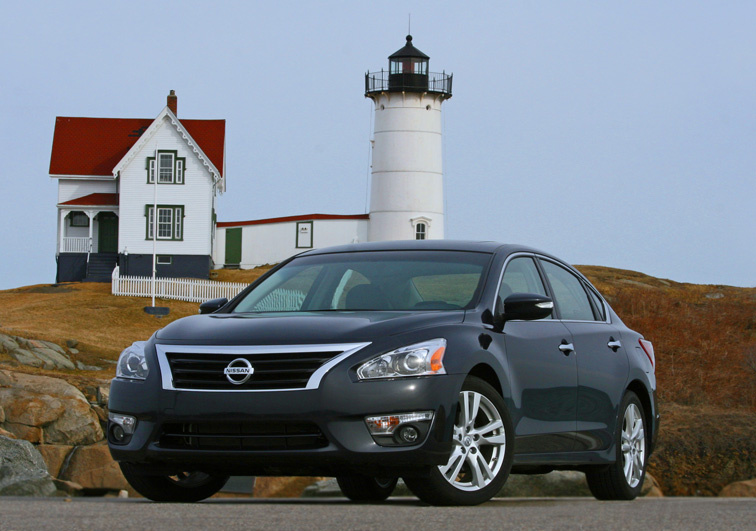
After a week and lots of miles behind the wheel, my inner enthusiast and roadtripper considered the V6-powered Altima to be their new best friend.

In preparation for writing this review, I did a little digging on the all-knowing Interweb to see what the world had to say about epic battles. As a result, I learned that a) my knowledge of history is embarassingly inadequate, b) there are far too many violent video games out there and c) the word epic is overused on an epic scale.
With that in mind, I’ll stop short of referring to the competition among mainstream family sedans as epic. Let’s just say it’s fierce, leading to truly impressive models like the redesigned 2013 Nissan Altima. These are good times for buyers on the hunt for a mainstream family-friendly sedan.
Available in base, S, SV and SL trim levels powered by a 4- or 6-cylinder engine mated to a continuously variable transmission (CVT), the 2013 Altima Sedan debuts with updated styling inside and out, a revised chassis, improved fuel efficiency and new technology, including moving-object detection, blind-spot monitoring and a Nissan Connect infotainment system. I spent a week with a 3.5 SV model fitted with optional floor mats and a Navigation Package. Factoring in a $780 destination charge, the sticker price of my test car came in at $29,335. A base Altima, minus any added equipment, can be had for $22,550.

A new Altima Hybrid is set to debut for the 2014 model year, but, until then, the most efficient powertrain is a 182-hp, 2.5-liter 4-cylinder mated to a revised continuously variable transmission (CVT) and offering an EPA-estimated 38 mpg on the highway. That beats comparable versions of the Ford Fusion, Toyota Camry and Honda Accord.
My 2013 Nissan Altima 3.5 SV model was equipped with an available 3.5-liter V6, delivering 270 hp, 251 lb-ft of torque and EPA ratings of 22 mpg city/31 highway/25 combined. Those specs are on par with the competition’s. (Buyers whose primary concern is fuel efficiency should note that, at the time of this writing, the Honda Accord Plug-In Hybrid, Ford Fusion Hybrid and Toyota Camry Hybrid are already on sale, each offering combined ratings of 41 mpg or better.)
After a week and lots of miles behind the wheel, my inner enthusiast and roadtripper considered the V6-powered Altima to be their new best friend. With a good bit of highway cruising and a fair amount of spirited city driving, I averaged 24.2 mpg. No, that doesn’t rival non-turbo 4-cylinders, yet considering 270 hp coupled with my liberal application of the gas pedal, there isn’t much room for complaint. To the contrary, the abundant output makes the Altima feel like an unassuming sport sedan, one that’s perfectly docile and low-key when tackling the daily point-A-to-B grind, but drop the hammer and the car will literally and gently push you into your seat, without introducing unwelcome torque steer. The accompanying engine noise is noticeable, though not raucous or bothersome.
Interestingly, Nissan has found a way to provide that driving experience while employing a CVT. Unlike others on the market, this unit performs very similarly to a traditional automatic by using simulated shift points to manage the engine’s power delivery. The typical high-revving, rubber-band-like action that makes some CVTs just plain annoying is dialed down significantly in the 2013 Altima. With a clear road ahead and my unrelenting right foot, the CVT held revs at about 7,000, and the car continued to accelerate smoothly. As I discovered when merging into fast-moving highway traffic, this ability to quickly produce ample power is very comforting. For drivers who want to crank the performance factor up another notch or two, the CVT features steering-wheel-mounted paddle shifters and a Sport mode that keeps revs up longer.
Serving as a suitable complement to the 2013 Nissan Altima sedan’s powertrain is an equally impressive chassis. To get a feel for the car’s underpinnings, I found some twisty and seldom-traveled back roads that were obviously not among the Highway Department’s top priorities. It didn’t take long to realize that, rather than suffering the effects of potholes and rough pavement on its own, the firm suspension was intent on sharing that experience with me. The resulting stiff ride will likely alienate buyers who put comfort above all else; others, like myself, will decide such sacrifice is well worth the level of handling offered in return. Electrohydraulic steering, a new introduction for 2013, was somewhat numb on-center and too lightly weighted at times, but body roll was negligible, and the electronic stability and traction control nannies granted a good bit of latitude. In fact, I couldn’t help but smile when pitching the Altima into a corner, where I could lift off the throttle, let the car roll through the center, and then jump back on the gas for a quick and confidently hooked-up exit. That’s fun front-wheel-drive style and can be attributed to what Nissan calls Active Understeer Control. When going through a turn at a good clip, the system applies brake pressure to the inside wheels, effectively helping the car hug the center line and not drift toward the edge of the road.

For those of us who enjoy frequent multi-state treks, and others who can spend hours in commuter traffic, achy or numb body parts often come with the territory. According to Nissan, the 2013 Altima targets that problem with NASA-inspired “zero-gravity” front buckets designed to provide superior comfort and support, even during long drives.
Thankfully, Nissan’s use of this technology is a success. During my test drive, I was able to get in a couple of 3-hour non-stop stretches on the highway, and I felt like I was in my favorite chair the entire time. The cushions are soft and, as promised, there’s plenty of support, meaning body fatigue wasn’t much of an issue when I finally climbed out of the car. Ample head- and legroom contributed to the high degree of comfort in my 3.5 SV tester, too, as did the seat’s multiple power adjustments, wide padded center armrest and leather-wrapped tilt and telescoping steering wheel.
Unfortunately, rear-seat accommodations are less impressive, with a lack of space being the biggest offense. Compared to the competitors listed above, the 2013 Altima offers the least amount of rear legroom (almost 3 inches less than the Toyota Camry) and headroom, though it does provide the most front legroom (about 3.5 inches more than the Camry). That setup is great for the driver and front passenger, yet even people of my short stature find little extra space in back. The cushions are soft but flat, and fixed head restraints sit too low to offer much in terms of comfort.
Storage, on the other hand, is another high point. Look around inside the 5-passenger 2013 Altima and you’ll find a large, deep glovebox, a dual-level front center armrest that includes a power outlet, a felt-lined cubby with a USB port, front and rear door pockets and 8 cupholders. The trunk offers 15.4 cubic feet of space, equal to the Camry but trailing the Fusion and Accord. Rear seatbacks can be lowered to expand cargo area.
When closing the trunk, I noticed there wasn’t a grab handle, a minor nitpick that points to cost-cutting. Inside the cabin, Nissan imparted a sense of quality with padded surfaces on the dash and sills, along with soft cloth fabric on the seats and armrests. There’s also lots of hard plastic used inside the Altima, though all of the pieces in my test car were solidly in place and felt durable.

Technology gets a boost for 2013, with the 2013 Altima’s list of standard gadgetry boasting Bluetooth connectivity and streaming audio, push-button ignition, LED map lights and a 5-inch LCD screen in the gauge cluster, displaying everything from tire pressure to who’s calling you on the phone.
Nissan is also using the redesigned Altima to launch Nissan Connect, the company’s first and appropriately named infotainment system that puts hands-free text messaging and Pandora Internet radio under one roof, so to speak, using your iPhone or Android device. Pairing is quick and easy, and both the steering-wheel-mounted controls and touchscreen tabs were intuitive and well labeled.
My test car also featured an optional navigation system with voice guidance, Google Send-to-Car (allows you to send Google map directions from your computer to the car), and helpful real-time traffic and weather information. I used the system to successfully travel from my home in Maine to a specific subway station outside of Boston, a location I had been unable to find using Bing maps on my laptop.
For car buffs, witnessing a brand-new vehicle being subjected to crash tests is akin to a child using a Picasso as a finger-painting canvas. It’s just not right. Be that as it may, shoppers considering the 2013 Altima Sedan should be pleased to learn that Nissan’s popular 4-door family hauler earned an impressive overall rating of 5 (out of 5) stars from the National Highway Traffic Safety Administration (NHTSA) and was awarded Top Safety Pick Plus recognition by the Insurance Institute for Highway Safety (IIHS).
Nissan is surely proud of those accolades, but more importantly, drivers can enjoy an extra degree of confidence when traveling amongst a population of texting, shaving, eating and sometimes seemingly oblivious motorists. When sharing roadways with those folks, you’ll be glad the 2013 Altima is fitted with 6 airbags, electronic stability and traction control systems, and 4-wheel antilock disc brakes with electronic brakeforce distribution. With the exception of the base 2.5, all Altima Sedans also include Nissan’s Easy-Fill Tire Alert feature, which triggers a chirping sound when proper inflation has been reached, thereby doing away with the need to carry often-inaccurate tire gauges. Top-of-the-line SL models put the icing on the safety cake by offering a Technology Package equipped with a blind-spot monitor, lane-departure warning and a moving-object detection system.

Since the 2013 Nissan Altima has been heavily redesigned, solid reliability data hasn’t been gathered yet. However, if the past several model years are any indication, buyers shouldn’t plan on making too many unexpected trips to their local dealer’s service department.
The same can be said for many of the Altima’s competitors, so I looked elsewhere to see if—and where—Nissan held an advantage. As noted above, power and fuel economy are similar to the Altima’s competitors’, 5-year ownership costs are all within a couple thousand dollars (Altima 3.5 SV vs. competitors’ comparable trims), each offers the same 3-year/36,000-mile basic and 5-year/60,000-mile powertrain warranties, and prices are in the same ballpark. It’s worth noting that Ford and Toyota cover buyers with roadside assistance, while Nissan and Honda do not. Honda and Toyota are expected to continue leading on the resale-value front.
From an objective perspective, the 2013 Nissan Altima may not be at the front of the pack, but from a more subjective look at style, comfort, handling and user-friendliness, it’s a definite podium finisher.

User reviews for 2013 Nissan Altima
Write a review2013 Nissan Altima Pricing
Trims & specs
Air Conditioning
Single front air conditioning zones
Airbags
Dual front airbags · Passenger airbag deactivation: occupant sensing deactivation · Front side airbags · Rear side curtain airbags
Audio System
Antenna Type: element · Bluetooth auxiliary audio input · Single disc in-Dash CD · MP3 player: CD MP3 Playback · AM/FM radio · Total Number of Speakers: 4
Brakes
ABS: 4-wheel · Front brake diameter: 11.7 · Front brake width: 1.02 · Front brakes: ventilated disc · Rear brake diameter: 11.5 · Rear brake width: .35 · Rear brakes: disc
Comfort Features
Armrests: rear center folding with storage · Floor Material: carpet
Convenience Features
Assist handle: rear · Center console: front console with armrest and storage · Cupholders: rear · Multi-function remote: trunk release · One-touch windows: 1 · Power outlet(s): two 12V front · Power steering: electric · Power windows: lockout button · Reading lights: rear · Steering wheel: tilt and telescopic · Steering wheel mounted controls: audio · Storage: door pockets · Vanity mirrors: dual
Driver Seat
Manual adjustments: 6
Exterior Features
Door handle color: chrome · Front bumper color: body-color · Grille color: chrome surround · Mirror color: body-color · Rear bumper color: body-color · Window trim: chrome
Headrests
Front headrests: adjustable · Number of front headrests: 2 · Number of rear headrests: 3
Instrumentation
Fuel economy display: range · Warnings and reminders: maintenance reminder
Lights
Headlights: Auto on/off
Mirrors
Exterior mirrors: power
Passenger Seat
Manual Adjustments: 4
Rear Seats
Type: 60-40 split bench
Safety
Active head restraints: driver · Child seat anchors: LATCH system · Crumple zones: rear
Seatbelts
Front seatbelts: 3-point · Seatbelt force limiters: front · Seatbelt pretensioners: front · Second row seatbelts: 3-point
Seats
Driver seat manual adjustments: height · Front seat type: bucket · Rear seat folding: split · Upholstery: cloth
Spare Tire
Mount Location: inside · Size: temporary
Spare Wheel
Rim Type: steel
Suspension
Front Arm Type: lower control arms · Front Shock Type: gas shock absorbers · Front Spring Type: coil springs · Front Suspension Classification: independent · Front Suspension Type: MacPherson struts · Rear Shock Type: gas shock absorbers · Rear Spring Type: coil springs · Rear Suspension Classification: independent · Rear Suspension Type: multi-link · Stabilizer bar(s): front
Telematics
Phone wireless data link: Bluetooth
Tires
Type: all season
Tires and Rims
Wheels: steel
Wheels
Wheel covers: full
Windows
Front wipers: variable intermittent · Power windows: remote operation
Air Conditioning
Single front air conditioning zones
Airbags
Dual front airbags · Passenger airbag deactivation: occupant sensing deactivation · Front side airbags · Front side curtain airbags
Audio System
Antenna Type: element · Auxiliary audio input: jack · Single disc in-Dash CD · MP3 player: CD MP3 Playback · AM/FM radio · Total Number of Speakers: 6
Brakes
ABS: 4-wheel · Front brake diameter: 11.7 · Front brake width: 1.02 · Front brakes: ventilated disc · Rear brake diameter: 11.5 · Rear brake width: .35 · Rear brakes: disc
Comfort Features
Armrests: rear center folding with storage · Floor Material: carpet
Convenience Features
Assist handle: front · Center console: front console with armrest and storage · Cupholders: front · Multi-function remote: proximity entry system · One-touch windows: 1 · Power outlet(s): two 12V front · Power steering: electric · Power windows: lockout button · Reading lights: front · Steering wheel: tilt and telescopic · Steering wheel mounted controls: audio · Storage: sunglasses holder · Vanity mirrors: dual
Driver Seat
Power adjustments: 6
Exterior Features
Door handle color: chrome · Exhaust: dual exhaust tips · Exhaust tip color: chrome · Front bumper color: body-color · Grille color: black · Mirror color: body-color · Rear bumper color: body-color · Window trim: chrome
Headrests
Front headrests: adjustable · Number of front headrests: 2 · Number of rear headrests: 3
Instrumentation
Fuel economy display: range · Warnings and reminders: low fuel level
Lights
Headlights: auto delay off
Mirrors
Exterior mirrors: power
Passenger Seat
Manual Adjustments: 4
Rear Seats
Type: 60-40 split bench
Safety
Active head restraints: driver · Child seat anchors: LATCH system · Crumple zones: rear
Seatbelts
Front seatbelts: 3-point · Seatbelt force limiters: front · Seatbelt pretensioners: front · Second row seatbelts: 3-point
Seats
Driver seat power adjustments: height · Front seat type: bucket · Rear seat folding: split · Upholstery: cloth
Spare Tire
Mount Location: inside · Size: temporary
Spare Wheel
Rim Type: steel
Suspension
Front Arm Type: lower control arms · Front Shock Type: gas shock absorbers · Front Spring Type: coil springs · Front Suspension Classification: independent · Front Suspension Type: MacPherson struts · Rear Shock Type: gas shock absorbers · Rear Spring Type: coil springs · Rear Suspension Classification: independent · Rear Suspension Type: multi-link · Stabilizer bar(s): front
Telematics
Phone wireless data link: Bluetooth
Tires
Type: all season
Tires and Rims
Wheels: steel
Wheels
Wheel covers: full
Windows
Front wipers: variable intermittent · Power windows: remote operation
Air Conditioning
Automatic climate control front air conditioning · Dual front air conditioning zones
Airbags
Dual front airbags · Passenger airbag deactivation: occupant sensing deactivation · Front side airbags · Front side curtain airbags
Audio System
Antenna Type: diversity · USB auxiliary audio input · Single disc in-Dash CD · MP3 player: CD MP3 Playback · AM/FM radio · Satellite Radio: SiriusXM · Total Number of Speakers: 6
Brakes
ABS: 4-wheel · Front brake diameter: 11.7 · Front brake width: 1.02 · Front brakes: ventilated disc · Rear brake diameter: 11.5 · Rear brake width: .35 · Rear brakes: disc
Comfort Features
Armrests: rear center folding with storage · Floor Material: carpet · Steering wheel trim: leather
Convenience Features
Assist handle: front · Center console: front console with armrest and storage · Cupholders: rear · Multi-function remote: trunk release · One-touch windows: 1 · Power outlet(s): two 12V front · Power steering: electric · Power windows: lockout button · Reading lights: front · Steering wheel: tilt and telescopic · Steering wheel mounted controls: audio · Storage: seatback · Vanity mirrors: dual
Driver Seat
Power adjustments: 6
Exterior Features
Door handle color: chrome · Exhaust: dual exhaust tips · Exhaust tip color: chrome · Front bumper color: body-color · Grille color: black · Mirror color: body-color · Rear bumper color: body-color · Window trim: chrome
Headrests
Front headrests: adjustable · Number of front headrests: 2 · Number of rear headrests: 3
In Car Entertainment
Infotainment screen size: 5 in.
Instrumentation
Fuel economy display: range · Warnings and reminders: maintenance reminder
Lights
Headlights: auto delay off
Mirrors
Exterior mirrors: power
Passenger Seat
Manual Adjustments: 4
Rear Seats
Type: 60-40 split bench
Safety
Active head restraints: driver · Camera system: rearview · Child seat anchors: LATCH system · Crumple zones: rear
Seatbelts
Front seatbelts: 3-point · Seatbelt force limiters: front · Seatbelt pretensioners: front · Second row seatbelts: 3-point
Seats
Driver seat power adjustments: height · Front seat type: bucket · Rear seat folding: split · Upholstery: cloth
Spare Tire
Mount Location: inside · Size: temporary
Spare Wheel
Rim Type: steel
Suspension
Front Arm Type: lower control arms · Front Shock Type: gas shock absorbers · Front Spring Type: coil springs · Front Suspension Classification: independent · Front Suspension Type: MacPherson struts · Rear Shock Type: gas shock absorbers · Rear Spring Type: coil springs · Rear Suspension Classification: independent · Rear Suspension Type: multi-link · Stabilizer bar(s): front
Telematics
Phone wireless data link: Bluetooth
Tires
Type: all season
Tires and Rims
Wheel type: aluminum alloy
Windows
Front wipers: variable intermittent · Power windows: remote operation
Air Conditioning
Single front air conditioning zones
Airbags
Dual front airbags · Passenger airbag deactivation: occupant sensing deactivation · Front side airbags · Rear side curtain airbags
Audio System
Antenna Type: element · Bluetooth auxiliary audio input · Single disc in-Dash CD · MP3 player: CD MP3 Playback · AM/FM radio · Total Number of Speakers: 6
Brakes
ABS: 4-wheel · Front brake diameter: 11.7 · Front brake width: 1.02 · Front brakes: ventilated disc · Rear brake diameter: 11.5 · Rear brake width: .35 · Rear brakes: disc
Comfort Features
Armrests: rear center folding with storage · Floor Material: carpet
Convenience Features
Assist handle: front · Center console: front console with armrest and storage · Cupholders: front · Multi-function remote: trunk release · One-touch windows: 1 · Power outlet(s): two 12V front · Power steering: electric · Power windows: lockout button · Reading lights: front · Steering wheel: tilt and telescopic · Steering wheel mounted controls: paddle shifter · Storage: sunglasses holder · Vanity mirrors: dual
Driver Seat
Power adjustments: 6
Exterior Features
Door handle color: chrome · Exhaust: dual exhaust tips · Exhaust tip color: chrome · Front bumper color: body-color · Grille color: chrome surround · Mirror color: body-color · Rear bumper color: body-color · Window trim: chrome
Headrests
Front headrests: adjustable · Number of front headrests: 2 · Number of rear headrests: 3
Instrumentation
Fuel economy display: range · Warnings and reminders: low fuel level
Lights
Headlights: Halogen
Mirrors
Exterior mirrors: power
Passenger Seat
Manual Adjustments: 4
Rear Seats
Type: 60-40 split bench
Safety
Active head restraints: driver · Child seat anchors: LATCH system · Crumple zones: rear
Seatbelts
Front seatbelts: 3-point · Seatbelt force limiters: front · Seatbelt pretensioners: front · Second row seatbelts: 3-point
Seats
Driver seat power adjustments: height · Front seat type: bucket · Rear seat folding: split · Upholstery: cloth
Spare Tire
Mount Location: inside · Size: temporary
Spare Wheel
Rim Type: steel
Suspension
Front Arm Type: lower control arms · Front Shock Type: gas shock absorbers · Front Spring Type: coil springs · Front Suspension Classification: independent · Front Suspension Type: MacPherson struts · Rear Shock Type: gas shock absorbers · Rear Spring Type: coil springs · Rear Suspension Classification: independent · Rear Suspension Type: multi-link · Stabilizer bar(s): front
Telematics
Phone wireless data link: Bluetooth
Tires
Type: all season
Tires and Rims
Wheel type: aluminum alloy
Windows
Front wipers: variable intermittent · Power windows: remote operation
Air Conditioning
Automatic climate control front air conditioning · Dual front air conditioning zones
Airbags
Dual front airbags · Passenger airbag deactivation: occupant sensing deactivation · Front side airbags · Front side curtain airbags
Audio System
Antenna Type: diversity · Auxiliary audio input: jack · Single disc in-Dash CD · MP3 player: CD MP3 Playback · Premium Brand: Bose · AM/FM radio · Satellite Radio: SiriusXM · 2 subwoofers · Total Number of Speakers: 9
Brakes
ABS: 4-wheel · Front brake diameter: 11.7 · Front brake width: 1.02 · Front brakes: ventilated disc · Rear brake diameter: 11.5 · Rear brake width: .35 · Rear brakes: disc
Comfort Features
Armrests: rear center folding with storage · Floor Material: carpet · Shift knob trim: leather · Steering wheel trim: leather
Convenience Features
Assist handle: front · Center console: front console with armrest and storage · Cupholders: front · Dimming rearview mirror: auto-dimming · Multi-function remote: trunk release · One-touch windows: 2 · Power outlet(s): two 12V front · Power steering: electric · Power windows: lockout button · Reading lights: rear · Steering wheel: tilt and telescopic · Steering wheel mounted controls: cruise controls · Storage: seatback · Universal garage door opener: Homelink · Vanity mirrors: dual illuminating
Driver Seat
Adjustable lumbar support: power · Power adjustments: 8
Exterior Features
Door handle color: chrome · Exhaust: dual exhaust tips · Exhaust tip color: chrome · Front bumper color: body-color · Grille color: black · Mirror color: body-color · Rear bumper color: body-color · Window trim: chrome
Headrests
Front headrests: adjustable · Number of front headrests: 2 · Number of rear headrests: 3
In Car Entertainment
Infotainment screen size: 5 in.
Instrumentation
Fuel economy display: range · Warnings and reminders: low fuel level
Lights
Headlights: Halogen · Tail and brake lights: LED
Mirrors
Exterior mirrors: power
Passenger Seat
Manual Adjustments: 4
Rear Seats
Type: 60-40 split bench
Safety
Active head restraints: driver · Camera system: rearview · Child seat anchors: LATCH system · Crumple zones: rear
Seatbelts
Front seatbelts: 3-point · Seatbelt force limiters: front · Seatbelt pretensioners: front · Second row seatbelts: 3-point
Seats
Driver seat power adjustments: height · Front seat type: bucket · Rear headrests: adjustable · Rear seat folding: split · Upholstery: leather-trimmed
Spare Tire
Mount Location: inside · Size: temporary
Spare Wheel
Rim Type: steel
Suspension
Front Arm Type: lower control arms · Front Shock Type: gas shock absorbers · Front Spring Type: coil springs · Front Suspension Classification: independent · Front Suspension Type: MacPherson struts · Rear Shock Type: gas shock absorbers · Rear Spring Type: coil springs · Rear Suspension Classification: independent · Rear Suspension Type: multi-link · Stabilizer bar(s): rear
Telematics
Phone wireless data link: Bluetooth
Tires
Type: all season
Tires and Rims
Wheel type: aluminum alloy
Windows
Front wipers: variable intermittent · Power windows: remote operation
Air Conditioning
Automatic climate control front air conditioning · Dual front air conditioning zones
Airbags
Dual front airbags · Passenger airbag deactivation: occupant sensing deactivation · Front side airbags · Rear side curtain airbags
Audio System
Antenna Type: diversity · Auxiliary audio input: jack · Single disc in-Dash CD · MP3 player: CD MP3 Playback · AM/FM radio · Satellite Radio: SiriusXM · Total Number of Speakers: 6
Brakes
ABS: 4-wheel · Front brake diameter: 11.7 · Front brake width: 1.02 · Front brakes: ventilated disc · Rear brake diameter: 11.5 · Rear brake width: .35 · Rear brakes: disc
Comfort Features
Armrests: rear center folding with storage · Floor Material: carpet · Steering wheel trim: leather
Convenience Features
Assist handle: rear · Center console: front console with armrest and storage · Cupholders: rear · Dimming rearview mirror: auto-dimming · Multi-function remote: proximity entry system · One-touch windows: 2 · Power outlet(s): two 12V front · Power steering: electric · Power windows: lockout button · Reading lights: rear · Steering wheel: tilt and telescopic · Steering wheel mounted controls: paddle shifter · Storage: cargo net · Universal garage door opener: Homelink · Vanity mirrors: dual illuminating
Driver Seat
Power adjustments: 6
Exterior Features
Door handle color: chrome · Exhaust: dual exhaust tips · Exhaust tip color: chrome · Front bumper color: body-color · Grille color: black · Mirror color: body-color · Rear bumper color: body-color · Window trim: chrome
Headrests
Front headrests: adjustable · Number of front headrests: 2 · Number of rear headrests: 3
In Car Entertainment
Infotainment screen size: 5 in.
Instrumentation
Fuel economy display: range · Warnings and reminders: maintenance reminder
Lights
Headlights: Halogen
Mirrors
Exterior mirrors: integrated turn signals
Passenger Seat
Manual Adjustments: 4
Rear Seats
Type: 60-40 split bench
Roof
Moonroof: one-touch open/close
Safety
Active head restraints: driver · Camera system: rearview · Child seat anchors: LATCH system · Crumple zones: front
Seatbelts
Front seatbelts: 3-point · Seatbelt force limiters: front · Seatbelt pretensioners: front · Second row seatbelts: 3-point
Seats
Driver seat power adjustments: height · Front seat type: bucket · Rear seat folding: split · Upholstery: cloth
Spare Tire
Mount Location: inside · Size: temporary
Spare Wheel
Rim Type: steel
Suspension
Front Arm Type: lower control arms · Front Shock Type: gas shock absorbers · Front Spring Type: coil springs · Front Suspension Classification: independent · Front Suspension Type: MacPherson struts · Rear Shock Type: gas shock absorbers · Rear Spring Type: coil springs · Rear Suspension Classification: independent · Rear Suspension Type: multi-link · Stabilizer bar(s): front
Telematics
Phone wireless data link: Bluetooth
Tires
Type: all season
Tires and Rims
Wheel type: aluminum alloy
Windows
Front wipers: variable intermittent · Power windows: remote operation
Air Conditioning
Automatic climate control front air conditioning · Dual front air conditioning zones
Airbags
Dual front airbags · Passenger airbag deactivation: occupant sensing deactivation · Front side airbags · Front side curtain airbags
Audio System
Antenna Type: diversity · Bluetooth auxiliary audio input · Single disc in-Dash CD · MP3 player: CD MP3 Playback · Premium Brand: Bose · AM/FM radio · Satellite Radio: SiriusXM · 2 subwoofers · Total Number of Speakers: 9
Brakes
ABS: 4-wheel · Front brake diameter: 11.7 · Front brake width: 1.02 · Front brakes: ventilated disc · Rear brake diameter: 11.5 · Rear brake width: .35 · Rear brakes: disc
Comfort Features
Armrests: rear center folding with storage · Floor Material: carpet · Shift knob trim: leather · Steering wheel trim: leather
Convenience Features
Assist handle: front · Center console: front console with armrest and storage · Cupholders: front · Dimming rearview mirror: auto-dimming · Multi-function remote: trunk release · One-touch windows: 2 · Power outlet(s): two 12V front · Power steering: electric · Power windows: lockout button · Reading lights: front · Steering wheel: tilt and telescopic · Steering wheel mounted controls: cruise controls · Storage: seatback · Universal garage door opener: Homelink · Vanity mirrors: dual illuminating
Driver Seat
Adjustable lumbar support: power · Power adjustments: 8
Exterior Features
Door handle color: chrome · Exhaust: dual exhaust tips · Exhaust tip color: chrome · Front bumper color: body-color · Grille color: black · Mirror color: body-color · Rear bumper color: body-color · Window trim: chrome
Headrests
Front headrests: adjustable · Number of front headrests: 2 · Number of rear headrests: 3
In Car Entertainment
Infotainment screen size: 5 in.
Instrumentation
Fuel economy display: range · Warnings and reminders: low fuel level
Lights
Headlights: HID · Tail and brake lights: LED
Mirrors
Exterior mirrors: power
Passenger Seat
Manual Adjustments: 4
Rear Seats
Type: 60-40 split bench
Roof
Moonroof: power glass
Safety
Active head restraints: driver · Camera system: rearview · Child seat anchors: LATCH system · Crumple zones: front
Seatbelts
Front seatbelts: 3-point · Seatbelt force limiters: front · Seatbelt pretensioners: front · Second row seatbelts: 3-point
Seats
Driver seat power adjustments: height · Front seat type: bucket · Rear headrests: adjustable · Rear seat folding: split · Upholstery: leather-trimmed
Spare Tire
Mount Location: inside · Size: temporary
Spare Wheel
Rim Type: steel
Suspension
Front Arm Type: lower control arms · Front Shock Type: gas shock absorbers · Front Spring Type: coil springs · Front Suspension Classification: independent · Front Suspension Type: MacPherson struts · Rear Shock Type: gas shock absorbers · Rear Spring Type: coil springs · Rear Suspension Classification: independent · Rear Suspension Type: multi-link · Stabilizer bar(s): rear
Telematics
Phone wireless data link: Bluetooth
Tires
Type: all season
Tires and Rims
Wheel type: aluminum alloy
Windows
Front wipers: variable intermittent · Power windows: remote operation

