2007 Subaru Impreza Reviews, Pricing & Specs
Write a review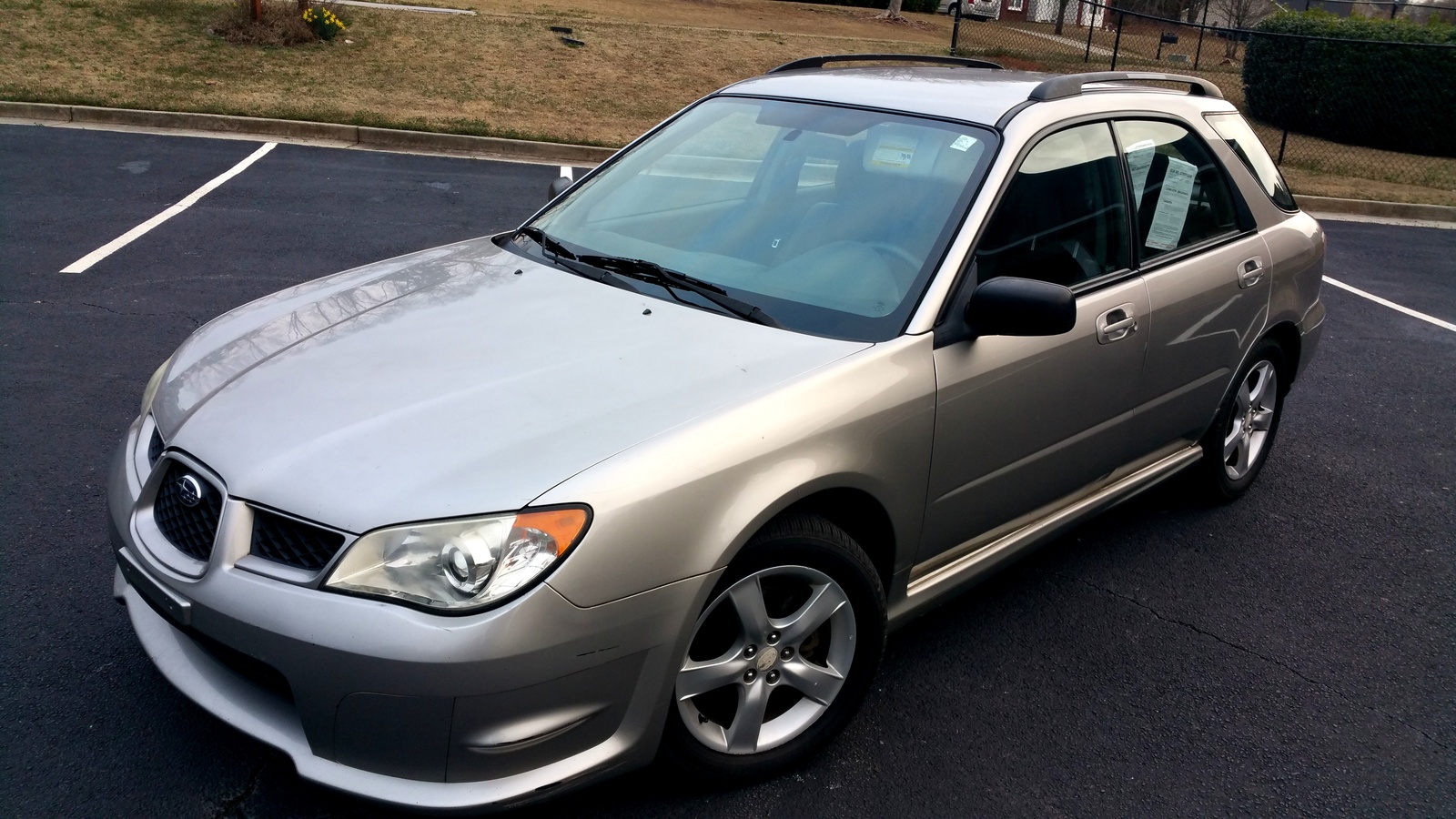
The Subaru Impreza provides nimble, efficient handling and the confidence of standard all-wheel drive.

The Impreza underwent two facelifts during its second generation, the second of which came in 2006 and continues to 2007. It features busy styling, highlighted by angular headlights, and an odd central “snout” in the grille. The Impreza is available in sedan and wagon variants. The wagon can also be had as the Outback Sport, a nod to its larger Legacy-based Outback Wagon. The Outback Sport features roof rails and an adventurous two-tone paint theme with added body cladding.
Inside, the Impreza features a clean and straightforward design. The dial gauges and three-spoke steering wheel provide the Impreza with an almost sports-car-like dash setup. The Impreza uses some plastics and the seats can feel a bit rough, but it is all in service of the Impreza’s active nature. These are seats and dash panels that can take a beating.
Trims are 2.5i and the previously noted Outback Sport. The base 2.5i comes standard with cruise control, remote keyless entry, a CD player, and air conditioning. The Outback Sport adds features like roof rails and a split folding rear seat.

As you might have guessed from the 2.5i trim designation, the Impreza comes standard with a 2.5-liter Boxer 4-cylinder engine. These engines feature two banks of two cylinders set parallel to the ground and pointed at each other. The cylinders “punch” towards one another, with the crankshaft at the center-point, hence the name “Boxer.” This engine provides a low center of gravity, which allows for improved handling dynamics.
In this application, the 2.5-liter Boxer makes 173 horsepower and 166 pound-feet of torque, sent through either a 5-speed manual or available 4-speed automatic transmission. Power is routed to Subaru’s symmetrical all-wheel drive (AWD). This provides enhanced traction in both good and bad road conditions. In all, the Impreza’s acceleration is nothing exciting, but the cornering abilities provided by the car’s unique driveline should impress.

The Impreza sedan provides 11 cubic feet of trunk space. It falls behind the Corolla, which has 13.6 cubic feet, and the Honda Civic, which has 12 cubic feet. This can be expanded by opening the split-fold rear bench.
The Wagon and Outback Sport provide 27.9 cubic feet of cargo space behind the rear seats. Folding down the backseat grows this number to 61.6 cubic feet. This makes the Impreza Wagon and Outback Sport one of the more spacious compact cars on the market.

The Impreza comes standard with a meager 80-watt AM/FM stereo, but it does come with a standard CD player. Subaru offers a Special Edition of the Impreza that upgrades the stereo to a 240-watt sound system with a 6-disc CD changer.
The Impreza also has a helpful trip computer located in the center of the dash. It can provide status updates for fuel economy, distance to empty, and the outside temperature.

Standard safety features include seatbelt pre-tensioners, antilock brakes, and electronic brake-force distribution. The Impreza also provides dual front airbags and front side-impact airbags.
In testing by the National Highway Traffic Safety Administration (NHTSA), the Impreza earns four out of five stars in front driver’s side testing and a perfect 5-star rating for front passenger side testing.

The most efficient version of the Impreza is the 2.5-liter with the 4-speed automatic. It returns 20 mpg city, 25 highway, 22 combined. With the 5-speed manual, this engine returns 19 mpg city, 26 highway, 22 combined.
Base MSRP for the 2006 Subaru Impreza is $17,995 for the 2.5i, in both sedan or wagon form. Adding an automatic transmission brings the price of the 2.5i (sedan or wagon) to $18,795. A Special Edition sedan starts at $18,995. The Outback Sport variant of the wagon starts at $19,195, and an Outback Sport Special Edition starts at $19,695. There are other, less expensive compact cars. But few offer both sedan and wagon body styles. Certainly, none of them offer standard AWD. This makes the Impreza a solid value, any way you cut it.

User reviews for 2007 Subaru Impreza
Write a review2007 Subaru Impreza Pricing
Trims & specs
Air Conditioning
Single front air conditioning zones
Airbags
Dual front airbags · Passenger airbag deactivation: occupant sensing deactivation · Front side airbags
Audio System
Antenna Type: element · 6 disc in-dash CD · AM/FM radio · 1 subwoofer · Total Number of Speakers: 4 · 80 watts
Brakes
ABS: 4-wheel · Front brake diameter: 10.8 · Front brake width: 0.9 · Front brakes: ventilated disc · Rear brake diameter: 10.3 · Rear brake width: 0.4 · Rear brakes: disc
Comfort Features
Armrests: rear center folding with pass-thru · Floor Mat Material: carpet · Floor Mats: front · Foot pedal trim: stainless steel · Shift knob trim: leather
Convenience Features
Center console: front console with storage · Cupholders: rear · Multi-function remote: keyless entry · One-touch windows: 1 · Power outlet(s): 12V front · Power steering: speed-proportional · Steering wheel: tilt-adjustable · Steering wheel mounted controls: cruise controls · Storage: front seatback · Vanity mirrors: dual
Driver Seat
Manual adjustments: 6
Drivetrain
4WD Type: full time · Limited slip differential: center
Exterior Features
Paint: pearl
Headrests
Adjustable rear headrests: integrated headrests · Front headrests: adjustable · Number of front headrests: 2 · Number of rear headrests: 2
Instrumentation
Warnings and reminders: low fuel level
Mirrors
Exterior mirrors: power
Passenger Seat
Manual Adjustments: 4
Rear Seats
Type: bench
Safety
Active head restraints: driver
Seatbelts
Rear center seatbelt: 3-point · Seatbelt force limiters: front · Seatbelt pretensioners: front
Seats
Driver seat manual adjustments: height · Front seat type: sport bucket · Upholstery: cloth
Spare Tire
Mount Location: inside · Size: temporary
Spare Wheel
Rim Type: steel
Suspension
Front Arm Type: lower control arms · Front Shock Type: gas shock absorbers · Front Spring Type: coil springs · Front Suspension Classification: independent · Front Suspension Type: MacPherson struts · Rear Arm Type: upper and lower control arms · Rear Shock Type: gas shock absorbers · Rear Spring Type: coil springs · Rear Suspension Classification: independent · Stabilizer bar(s): front
Tires
Type: all season
Windows
Front wipers: intermittent
Air Conditioning
Single front air conditioning zones
Airbags
Dual front airbags · Passenger airbag deactivation: occupant sensing deactivation · Side airbags: front with head protection chambers
Audio System
Antenna Type: element · Single disc in-Dash CD · AM/FM radio · 1 subwoofer · Total Number of Speakers: 4 · 80 watts
Brakes
ABS: 4-wheel · Front brake diameter: 10.8 · Front brake width: 0.9 · Front brakes: ventilated disc · Rear brake diameter: 10.3 · Rear brake width: 0.4 · Rear brakes: disc
Comfort Features
Armrests: front center · Floor Mat Material: carpet · Floor Mats: front · Foot pedal trim: stainless steel · Shift knob trim: aluminum and leather
Convenience Features
Cargo cover: retractable · Center console: front console with storage · Cupholders: front · Multi-function remote: keyless entry · One-touch windows: 1 · Power outlet(s): 12V front · Power steering: hydraulic variable assist · Steering wheel: tilt-adjustable · Steering wheel mounted controls: cruise controls · Storage: door pockets · Vanity mirrors: dual
Driver Seat
Manual adjustments: 6
Drivetrain
4WD Type: full time · Limited slip differential: center
Exterior Features
Paint: pearl
Headrests
Front headrests: adjustable · Number of front headrests: 2 · Number of rear headrests: 3
Instrumentation
Warnings and reminders: low fuel level
Mirrors
Exterior mirrors: power
Passenger Seat
Manual Adjustments: 4
Rear Seats
Type: bench
Roof
Roof rack: with crossbars · Roof rack color: black
Safety
Active head restraints: driver
Seatbelts
Rear center seatbelt: 3-point · Seatbelt force limiters: front · Seatbelt pretensioners: front
Seats
Driver seat manual adjustments: height · Front seat type: sport bucket · Rear headrests: adjustable · Rear seat folding: split · Upholstery: cloth
Spare Tire
Mount Location: inside · Size: temporary
Spare Wheel
Rim Type: steel
Suspension
Front Arm Type: lower control arms · Front Shock Type: gas shock absorbers · Front Spring Type: coil springs · Front Suspension Classification: independent · Front Suspension Type: MacPherson struts · Rear Arm Type: upper and lower control arms · Rear Shock Type: coil over shock · Rear Spring Type: coil springs · Rear Suspension Classification: independent · Stabilizer bar(s): rear
Tires
Type: all season
Windows
Front wipers: intermittent · Rear wiper: intermittent
Air Conditioning
Automatic climate control front air conditioning · Single front air conditioning zones
Airbags
Dual front airbags · Passenger airbag deactivation: occupant sensing deactivation · Side airbags: front with head protection chambers
Audio System
Antenna Type: element · 6 disc in-dash CD · MP3 player: CD MP3 Playback · AM/FM radio · Satellite Radio: Sirius ready · 1 subwoofer · Total Number of Speakers: 6 · 120 watts
Brakes
ABS: 4-wheel · Front brake diameter: 10.8 · Front brake width: 0.9 · Front brakes: ventilated disc · Rear brake diameter: 10.3 · Rear brake width: 0.4 · Rear brakes: disc
Comfort Features
Armrests: rear center folding with pass-thru · Floor Mat Material: carpet · Floor Mats: front · Foot pedal trim: stainless steel · Shift knob trim: aluminum and leather
Convenience Features
Center console: front console with storage · Cupholders: front · Multi-function remote: trunk release · One-touch windows: 1 · Power outlet(s): 12V front · Power steering: speed-proportional · Reading lights: front · Steering wheel: tilt-adjustable · Steering wheel mounted controls: cruise controls · Storage: door pockets · Vanity mirrors: dual
Driver Seat
Manual adjustments: 6
Drivetrain
4WD Type: full time · Limited slip differential: center
Exterior Features
Paint: pearl
Headrests
Adjustable rear headrests: integrated headrests · Front headrests: adjustable · Number of front headrests: 2 · Number of rear headrests: 2
Instrumentation
Warnings and reminders: low fuel level
Mirrors
Exterior mirrors: power
Passenger Seat
Manual Adjustments: 4
Rear Seats
Type: bench
Roof
Moonroof: power glass
Safety
Active head restraints: driver
Seatbelts
Rear center seatbelt: 3-point · Seatbelt force limiters: front · Seatbelt pretensioners: front
Seats
Driver seat manual adjustments: height · Front seat type: sport bucket · Upholstery: cloth
Spare Tire
Mount Location: inside · Size: temporary
Spare Wheel
Rim Type: steel
Suspension
Front Arm Type: lower control arms · Front Shock Type: gas shock absorbers · Front Spring Type: coil springs · Front Suspension Classification: independent · Front Suspension Type: MacPherson struts · Rear Arm Type: upper and lower control arms · Rear Shock Type: coil over shock · Rear Spring Type: coil springs · Rear Suspension Classification: independent · Stabilizer bar(s): rear
Tires
Type: all season
Windows
Front wipers: intermittent
Air Conditioning
Single front air conditioning zones
Airbags
Dual front airbags · Passenger airbag deactivation: occupant sensing deactivation · Side airbags: front with head protection chambers
Audio System
Antenna Type: element · Single disc in-Dash CD · AM/FM radio · 1 subwoofer · Total Number of Speakers: 4 · 80 watts
Brakes
ABS: 4-wheel · Front brake diameter: 10.8 · Front brake width: 0.9 · Front brakes: ventilated disc · Rear brake diameter: 10.3 · Rear brake width: 0.4 · Rear brakes: disc
Comfort Features
Armrests: front center · Floor Mat Material: carpet · Floor Mats: front · Foot pedal trim: stainless steel · Shift knob trim: aluminum and leather
Convenience Features
Cargo area power outlet: 12V · Cargo cover: retractable · Center console: front console with storage · Cupholders: rear · Dimming rearview mirror: auto-dimming · Multi-function remote: keyless entry · One-touch windows: 1 · Power outlet(s): 12V front · Power steering: speed-proportional · Reading lights: front · Steering wheel: tilt-adjustable · Steering wheel mounted controls: cruise controls · Storage: grocery bag holder · Universal garage door opener: Homelink · Vanity mirrors: dual
Driver Seat
Manual adjustments: 6
Drivetrain
4WD Type: full time · Limited slip differential: center
Exterior Features
Grille color: chrome
Headrests
Front headrests: adjustable · Number of front headrests: 2 · Number of rear headrests: 3
Instrumentation
Warnings and reminders: low fuel level
Mirrors
Exterior mirrors: power
Passenger Seat
Manual Adjustments: 4
Rear Seats
Type: bench
Roof
Roof rack color: black
Safety
Active head restraints: driver
Seatbelts
Rear center seatbelt: 3-point · Seatbelt force limiters: front · Seatbelt pretensioners: front
Seats
Driver seat manual adjustments: height · Front seat type: sport bucket · Rear headrests: adjustable · Rear seat folding: split · Upholstery: cloth
Spare Tire
Mount Location: inside · Size: temporary
Spare Wheel
Rim Type: steel
Suspension
Front Arm Type: lower control arms · Front Shock Type: gas shock absorbers · Front Spring Type: coil springs · Front Suspension Classification: independent · Front Suspension Type: MacPherson struts · Rear Arm Type: upper and lower control arms · Rear Shock Type: gas shock absorbers · Rear Spring Type: coil springs · Rear Suspension Classification: independent · Stabilizer bar(s): front
Tires
Type: all season
Windows
Front wipers: intermittent · Rear wiper: intermittent
Air Conditioning
Automatic climate control front air conditioning · Single front air conditioning zones
Airbags
Dual front airbags · Passenger airbag deactivation: occupant sensing deactivation · Front side airbags
Audio System
Antenna Type: element · 6 disc in-dash CD · MP3 player: CD MP3 Playback · AM/FM radio · Satellite Radio: Sirius ready · 1 subwoofer · Total Number of Speakers: 7 · 240 watts
Brakes
ABS: 4-wheel · Front brake diameter: 10.8 · Front brake width: 0.9 · Front brakes: ventilated disc · Rear brake diameter: 10.3 · Rear brake width: 0.4 · Rear brakes: disc
Comfort Features
Armrests: front center · Floor Mat Material: carpet · Floor Mats: front · Foot pedal trim: stainless steel · Shift knob trim: aluminum and leather
Convenience Features
Cargo area power outlet: 12V · Cargo cover: retractable · Center console: front console with storage · Cupholders: rear · Dimming rearview mirror: auto-dimming · Multi-function remote: keyless entry · One-touch windows: 1 · Power outlet(s): 12V front · Power steering: hydraulic variable assist · Reading lights: front · Steering wheel: tilt-adjustable · Steering wheel mounted controls: cruise controls · Storage: grocery bag holder · Universal garage door opener: Homelink · Vanity mirrors: dual
Driver Seat
Manual adjustments: 6
Drivetrain
4WD Type: full time · Limited slip differential: center
Exterior Features
Grille color: chrome
Headrests
Front headrests: adjustable · Number of front headrests: 2 · Number of rear headrests: 3
Instrumentation
Warnings and reminders: low fuel level
Mirrors
Exterior mirrors: power
Passenger Seat
Manual Adjustments: 4
Rear Seats
Type: bench
Roof
Roof rack color: black
Safety
Active head restraints: driver
Seatbelts
Rear center seatbelt: 3-point · Seatbelt force limiters: front · Seatbelt pretensioners: front
Seats
Driver seat manual adjustments: height · Front seat type: sport bucket · Rear headrests: adjustable · Rear seat folding: split · Upholstery: cloth
Spare Tire
Mount Location: inside · Size: temporary
Spare Wheel
Rim Type: steel
Suspension
Front Arm Type: lower control arms · Front Shock Type: gas shock absorbers · Front Spring Type: coil springs · Front Suspension Classification: independent · Front Suspension Type: MacPherson struts · Rear Arm Type: upper and lower control arms · Rear Shock Type: gas shock absorbers · Rear Spring Type: coil springs · Rear Suspension Classification: independent · Stabilizer bar(s): front
Tires
Type: all season
Windows
Front wipers: intermittent · Rear wiper: intermittent

