2005 Honda Accord Reviews, Pricing & Specs
Write a review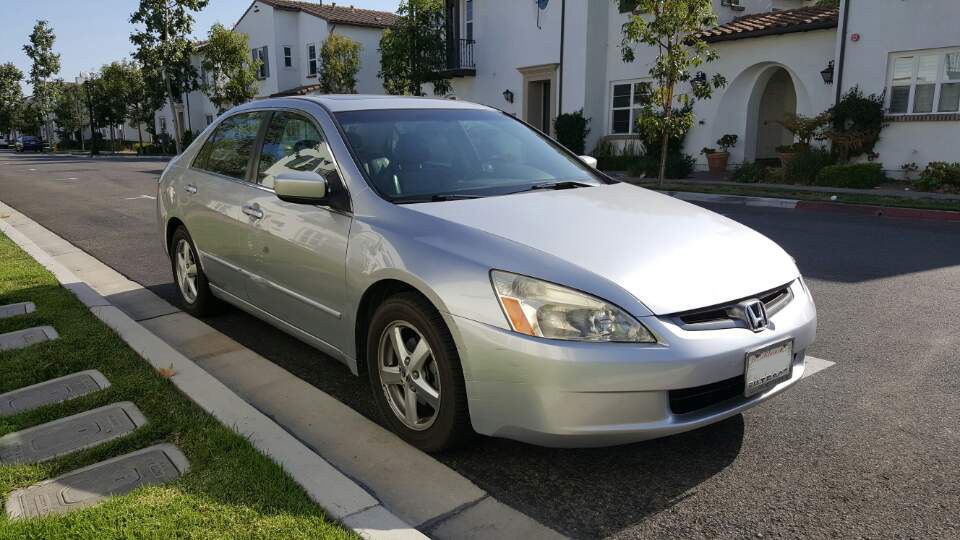
The Honda Accord provides comfortable and reliable daily transportation with styling that sets the bar for the sedan segment.

The Accord’s forward-thinking design serves it well. It has the conventional three-box layout for which sedans are known, but Honda takes the details in a different direction. The headlights are plucky-looking triangles. And while the taillights are a bit more conventional, they still have a futuristically clean design.
Trims for the 2005 Accord are DX, LX, EX, EX-L, LX-V6, and EX-V6. Standard features in the base DX include a two-speaker stereo, 15-inch steel wheels with plastic covers, manually adjustable four-way driver and front-passenger seats, power windows, heated side mirrors, and rear-seating climate-control ducts.
Available features and features found on upper models include alloy wheels, a power sunroof, a power driver’s seat, power side mirrors, remote keyless entry, cruise control, and a multi-function steering wheel with audio and cruise toggles. The EX-L comes with leather upholstery and is available with a GPS navigation system.

There are two engines available on the Accord, a base 2.4-liter 4-cylinder, and a 3.0-liter V6. The 4-cylinder sends 160 horsepower through either a 5-speed manual or 5-speed automatic transmission. The 3.0-liter V6 can be had with only the 5-speed automatic. Both engines route power to front-wheel drive. If you demand a manual with your V6 Accord, look to the Coupe, though it’s a bit less practical than the sedan.
Handling is comfort-oriented, meaning it can also be a bit vague at times. The brakes are not as strong as they could or should be, but overall, the Accord delivers a smooth ride that is optimal for highways, boulevards, and neighborhoods.
Fuel economy estimates for the 2005 Honda Accord are 23 mpg city, 31 highway, 26 combined when the 4-cylinder is paired to the manual transmission. With the automatic transmission, the 4-cylinder returns 21/31/24 combined. The V6 returns a claimed 19/28/22 combined. Your fuel economy may vary.

The cabin of the Accord defies convention, especially compared to contemporary rivals. Honda blends radio and climate controls to the point where temperature and fan speed dials could be confused with the volume dial.
Below those controls is a helpful tray with a retractable cover. The doors and center console have helpful trays and bins, and the trunk has 14 cubic feet of cargo space, which is adequate, but less than the Camry, which has 16.7 cubic feet.
The Accord has a spacious backseat with plenty of legroom and headroom. Even if the front seat passenger slides their seat all the way back, the backseat passenger will have usable space.

The Accord comes standard with a very basic two-speaker stereo and an AM/FM radio receiver… and that’s about it. The LX ups the stereo to 6 speakers, while the EX adds a CD player, and the EX-L adds satellite radio.
The EX V6 and EX-L are available with a navigation system. The system and graphics are quite basic, but they get the job done. Competitive cars have little else in the way of tech features.

The 2005 Accord comes standard with four-wheel antilock brakes (front disc/rear drum), electronic brake-force distribution, an engine immobilizer, and an emergency interior trunk release. It also comes with a full complement of front- and side-impact airbags, including dual-stage front side-mounted airbags, which are new additions for 2005. Moving up to the LX trim adds auto shut-off headlights while selecting the EX adds rear disc brakes as well as a remote anti-theft alarm system.
The Accord earned its best score of Good from the Insurance Institute for Highway Safety (IIHS) in the categories of Moderate Overlap Front and Side Impact crash tests. It scored a Poor for its head restraints. In National Highway Traffic Safety Administration (NHTSA) testing, the Accord earned five out of five stars for Front Drivers Side and Front Passengers Side crash tests. It earns four out of five for side-impact testing and rollover testing.


User reviews for 2005 Honda Accord
Write a review2005 Honda Accord Pricing
Trims & specs
Airbags
Dual front airbags · Front side airbags · Rear side curtain airbags
Audio System
Single disc in-Dash CD · AM/FM radio
Brakes
ABS: 4-wheel · Front brakes: ventilated disc
Comfort Features
Floor Mat Material: carpet
Convenience Features
Center console: front console with storage · Cupholders: front · Power outlet(s): 12V front · Power steering: hydraulic · Steering wheel: tilt and telescopic
Headrests
Number of front headrests: 2
Instrumentation
Warnings and reminders: low fuel level
Lights
Headlights: Auto off
Mirrors
Exterior mirrors: manual
Rear Seats
Type: bench
Safety
Child seat anchors: LATCH system
Seatbelts
Front seatbelts: 3-point · Seatbelt pretensioners: front · Second row seatbelts: 3-point
Seats
Front seat type: bucket · Rear seat folding: split · Upholstery: cloth
Tires and Rims
Wheels: steel
Wheels
Wheel covers: full
Windows
Front wipers: intermittent
Air Conditioning
Single front air conditioning zones
Airbags
Dual front airbags · Front side airbags · Rear side curtain airbags
Audio System
Single disc in-Dash CD · AM/FM radio
Brakes
ABS: 4-wheel · Front brakes: ventilated disc
Comfort Features
Floor Mat Material: carpet
Convenience Features
Center console: front console with storage · Cupholders: front · Power outlet(s): 12V front · Power steering: hydraulic · Steering wheel: tilt and telescopic
Headrests
Number of front headrests: 2
Instrumentation
Warnings and reminders: low fuel level
Lights
Headlights: Halogen
Mirrors
Exterior mirrors: manual
Rear Seats
Type: bench
Safety
Child seat anchors: LATCH system
Seatbelts
Front seatbelts: 3-point · Seatbelt pretensioners: front · Second row seatbelts: 3-point
Seats
Front seat type: bucket · Rear seat folding: split · Upholstery: cloth
Tires and Rims
Wheels: steel
Wheels
Wheel covers: full
Windows
Front wipers: intermittent
Air Conditioning
Single front air conditioning zones
Airbags
Dual front airbags · Front side airbags · Front side curtain airbags
Audio System
Single disc in-Dash CD · AM/FM radio
Brakes
ABS: 4-wheel · Front brakes: ventilated disc
Comfort Features
Floor Mat Material: carpet
Convenience Features
Center console: front console with storage · Cupholders: front · Multi-function remote: trunk release · Power outlet(s): 12V front · Power steering: hydraulic · Steering wheel: tilt and telescopic · Steering wheel mounted controls: audio
Headrests
Number of front headrests: 2
Instrumentation
Warnings and reminders: low fuel level
Lights
Headlights: Auto off
Mirrors
Exterior mirrors: power
Rear Seats
Type: bench
Safety
Child seat anchors: LATCH system
Seatbelts
Front seatbelts: 3-point · Seatbelt pretensioners: front · Second row seatbelts: 3-point
Seats
Front seat type: bucket · Rear seat folding: split · Upholstery: cloth
Tires and Rims
Wheels: steel
Wheels
Wheel covers: full
Windows
Front wipers: intermittent
Air Conditioning
Single front air conditioning zones
Airbags
Dual front airbags · Front side airbags · Rear side curtain airbags
Audio System
6 disc in-dash CD · MP3 player: CD MP3 Playback · AM/FM radio
Brakes
ABS: 4-wheel · Front brakes: ventilated disc
Comfort Features
Floor Mat Material: carpet
Convenience Features
Center console: front console with storage · Cupholders: front · Multi-function remote: trunk release · Power outlet(s): 12V front · Steering wheel: tilt and telescopic · Steering wheel mounted controls: audio
Headrests
Number of front headrests: 2
Instrumentation
Warnings and reminders: low fuel level
Lights
Headlights: Halogen
Mirrors
Exterior mirrors: power
Rear Seats
Type: bench
Roof
Moonroof: power glass
Safety
Child seat anchors: LATCH system
Seatbelts
Front seatbelts: 3-point · Seatbelt pretensioners: front · Second row seatbelts: 3-point
Seats
Front seat type: bucket · Rear seat folding: split · Upholstery: cloth
Tires and Rims
Wheel type: aluminum alloy
Windows
Front wipers: intermittent
Air Conditioning
Automatic climate control front air conditioning · Dual front air conditioning zones
Airbags
Dual front airbags · Front side airbags · Front side curtain airbags
Audio System
6 disc in-dash CD · MP3 player: CD MP3 Playback · AM/FM radio · Satellite Radio: SiriusXM
Brakes
ABS: 4-wheel · Front brakes: ventilated disc
Comfort Features
Door trim: leather · Floor Mat Material: carpet · Steering wheel trim: leather
Convenience Features
Center console: front console with storage · Cupholders: front · Multi-function remote: trunk release · Power outlet(s): 12V front · Power steering: hydraulic · Steering wheel: tilt and telescopic · Steering wheel mounted controls: audio
Headrests
Number of front headrests: 2
Instrumentation
Warnings and reminders: low fuel level
Lights
Headlights: Auto off
Mirrors
Exterior mirrors: power
Rear Seats
Type: bench
Roof
Moonroof: power glass
Safety
Child seat anchors: LATCH system
Seatbelts
Front seatbelts: 3-point · Seatbelt pretensioners: front · Second row seatbelts: 3-point
Seats
Front seat type: bucket · Rear seat folding: split · Upholstery: leather
Tires and Rims
Wheel type: aluminum alloy
Windows
Front wipers: intermittent
Air Conditioning
Single front air conditioning zones
Airbags
Dual front airbags · Front side airbags · Rear side curtain airbags
Audio System
6 disc in-dash CD · MP3 player: CD MP3 Playback · AM/FM radio
Brakes
ABS: 4-wheel · Front brakes: ventilated disc
Comfort Features
Floor Mat Material: carpet
Convenience Features
Center console: front console with storage · Cupholders: front · Multi-function remote: keyless entry · Power outlet(s): 12V front · Power steering: hydraulic · Steering wheel: tilt and telescopic · Steering wheel mounted controls: audio
Headrests
Number of front headrests: 2
Instrumentation
Warnings and reminders: low fuel level
Lights
Headlights: Halogen
Mirrors
Exterior mirrors: power
Rear Seats
Type: bench
Safety
Child seat anchors: LATCH system
Seatbelts
Front seatbelts: 3-point · Seatbelt pretensioners: front · Second row seatbelts: 3-point
Seats
Front seat type: bucket · Rear seat folding: split · Upholstery: cloth
Tires and Rims
Wheels: steel
Wheels
Wheel covers: full
Windows
Front wipers: intermittent
Air Conditioning
Automatic climate control front air conditioning · Dual front air conditioning zones
Airbags
Dual front airbags · Front side airbags · Front side curtain airbags
Audio System
6 disc in-dash CD · MP3 player: CD MP3 Playback · AM/FM radio · Satellite Radio: SiriusXM
Brakes
ABS: 4-wheel · Front brakes: ventilated disc
Comfort Features
Door trim: leather · Floor Mat Material: carpet · Steering wheel trim: leather
Convenience Features
Center console: front console with storage · Cupholders: front · Multi-function remote: trunk release · Power outlet(s): 12V front · Power steering: hydraulic · Steering wheel: tilt and telescopic · Steering wheel mounted controls: audio
Headrests
Number of front headrests: 2
Instrumentation
Warnings and reminders: low fuel level
Lights
Headlights: Halogen
Mirrors
Exterior mirrors: power
Rear Seats
Type: bench
Roof
Moonroof: power glass
Safety
Child seat anchors: LATCH system
Seatbelts
Front seatbelts: 3-point · Seatbelt pretensioners: front · Second row seatbelts: 3-point
Seats
Front seat type: bucket · Rear seat folding: split · Upholstery: leather
Telematics
Navigation system: with voice recognition
Tires and Rims
Wheel type: aluminum alloy
Windows
Front wipers: intermittent
Air Conditioning
Automatic climate control front air conditioning · Dual front air conditioning zones
Airbags
Dual front airbags · Front side airbags · Rear side curtain airbags
Audio System
6 disc in-dash CD · MP3 player: CD MP3 Playback · AM/FM radio · Satellite Radio: SiriusXM
Brakes
ABS: 4-wheel · Front brakes: ventilated disc
Comfort Features
Door trim: leather · Floor Mat Material: carpet · Steering wheel trim: leather
Convenience Features
Center console: front console with storage · Cupholders: front · Multi-function remote: trunk release · Power outlet(s): 12V front · Power steering: hydraulic · Steering wheel: tilt and telescopic · Steering wheel mounted controls: audio
Headrests
Number of front headrests: 2
Instrumentation
Warnings and reminders: low fuel level
Lights
Headlights: Auto off
Mirrors
Exterior mirrors: power
Rear Seats
Type: bench
Roof
Moonroof: power glass
Safety
Child seat anchors: LATCH system
Seatbelts
Front seatbelts: 3-point · Seatbelt pretensioners: front · Second row seatbelts: 3-point
Seats
Front seat type: bucket · Rear seat folding: split · Upholstery: leather
Tires and Rims
Wheel type: aluminum alloy
Windows
Front wipers: intermittent
Air Conditioning
Automatic climate control front air conditioning · Dual front air conditioning zones
Airbags
Dual front airbags · Front side airbags · Rear side curtain airbags
Audio System
6 disc in-dash CD · MP3 player: CD MP3 Playback · AM/FM radio · Satellite Radio: SiriusXM
Brakes
ABS: 4-wheel · Front brakes: ventilated disc
Comfort Features
Door trim: leather · Floor Mat Material: carpet · Steering wheel trim: leather
Convenience Features
Center console: front console with storage · Cupholders: front · Multi-function remote: keyless entry · Power outlet(s): 12V front · Power steering: hydraulic · Steering wheel: tilt and telescopic · Steering wheel mounted controls: audio
Headrests
Number of front headrests: 2
Instrumentation
Warnings and reminders: low fuel level
Lights
Headlights: Halogen
Mirrors
Exterior mirrors: power
Rear Seats
Type: bench
Roof
Moonroof: power glass
Safety
Child seat anchors: LATCH system
Seatbelts
Front seatbelts: 3-point · Seatbelt pretensioners: front · Second row seatbelts: 3-point
Seats
Front seat type: bucket · Rear seat folding: split · Upholstery: leather
Telematics
Navigation system: DVD navigation system
Tires and Rims
Wheel type: aluminum alloy
Windows
Front wipers: intermittent

