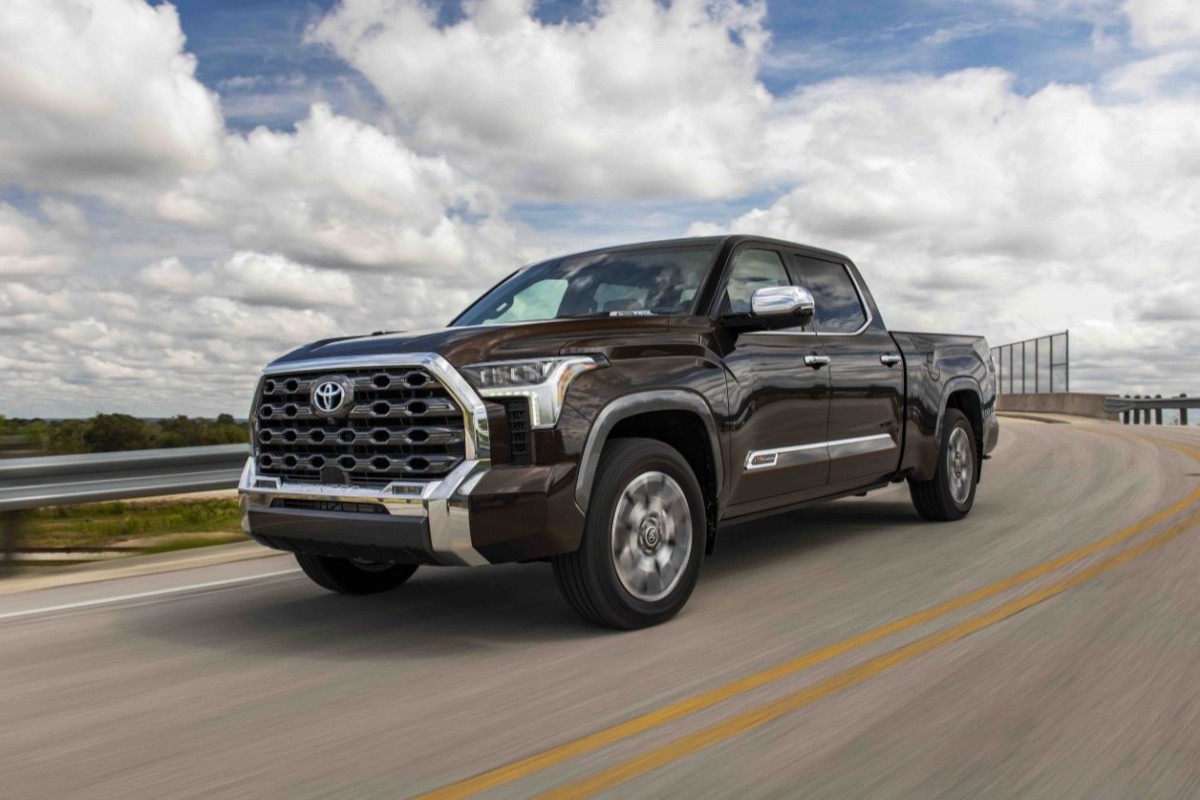
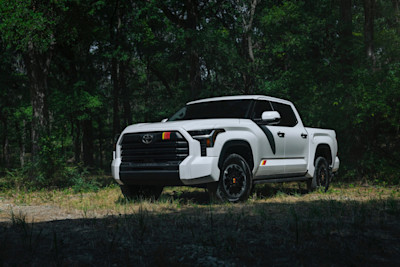
Used Toyota Tundra for Sale near Washington, KS
Toyota Tundra Overview
Available Now
During the 1990s, Toyota's T100 pickup straddled the line between a midsize and a full-size truck. Although officially labeled a full-size vehicle, it didn't quite measure up to the dimensions established by such competitors as the Ford F-150, the Dodge Ram, and the Chevy Silverado, nor did it offer the same towing capacity. Although the T100 delivered good fuel economy with its V6 engine, it lacked the performance required for a true workhorse like the half-ton pickups from the the Big Three. The reaction from buyers was somewhat telling, as they bought hundreds of thousands of F-150s, Rams, and Silverados annually, while Toyota struggled to sell 50,000 T100s.
Enter the Toyota Tundra. Picking up where the T100 left off, the Tundra debuted in 2000 with a muscular exterior design and an optional V8 engine, as well as a comfortable ride and good handling that helped distinguish it from its more rough-edged competitors. While its dimensions and towing capacity still didn't quite live up to the numbers posted by the domestic full-size trucks, the Tundra received positive reviews overall and was named the North American Truck of the Year for 2000, as well as for 2008.
Currently in the midst of its second generation, the Tundra comes in Regular Cab, Double Cab, and CrewMax body styles, at Limited and Tundra-Grade trim levels, with three available bed lengths, as well as available four-wheel drive. In all, nearly 40 trim variations are available. Powerplants include a base 4.0-liter V6, which features variable valve timing (VVT) and churns out 236 hp. It's capable of towing a maximum of 5,200 pounds and gets an EPA-estimated 15/19 mpg. A 4.6-liter VVT V8 puts out 310 hp and raises towing capacity to 9,000 pounds. It manages fuel economy numbers of 15/20. At the top of the line, a 5.7-liter VVT V8 generates 381 hp and pushes the Tundra from 0-60 in just under 7 seconds. Towing capacity tops out at 10,300 pounds, while fuel economy numbers check in at 13/17 mpg.
Overall, the Tundra competes well with domestic trucks, although new generations of the F-150 and the Ram in 2009 raised the stakes in the full-size, half-ton pickup truck market segment. Both the F-150 and the Ram offer key features, such as Ford's Sync system, not available on the Tundra, and the use of some cheap materials in the cabin and the inconvenient placement of some controls on the dashboard top owners' complaints about the Tundra. In addition, the Tundra continues to come with a higher pricetag than some of its competitors (the Tundra starts at about $1,500 more than the F-150, for instance). Still, the Tundra's hunky exterior design, available V8 engines, good towing capacity, and solid ride and handling make it worth a look.
Despite a huge investment in development for the second-generation Tundra, which debuted in 2007, the truck hasn't sold as well as Toyota had hoped or expected. After selling nearly 200,000 units in 2007, fewer than 80,000 Tundras were sold in 2009, which represents a serious drop-off in sales. Toyota has no immediate plans to introduce a hybrid Tundra, although there are some indications a diesel powerplant for the Tundra may be in the works, which would push towing capacity to around 11,000 to 12,000 pounds. In addition, reports indicate the automaker plans to introduce a third-generation Tundra around 2014.
Model History
The Tundra caused some controversy right out of the gate. Since Toyota designed the Tundra to replace the T100 truck in its lineup, the automaker initially designated its new half-ton pickup as the T150, which seemed like a logical step. However, Ford objected, saying the name closely resembled the F-150, and sued the Japanese automaker. As a result, when Toyota's new truck appeared in showrooms for the 2000 model year, it wore the Tundra badge. Despite this minor glitch, the Tundra became Toyota's best-selling new vehicle, moving more than 100,000 units for each of its first two years in production, and doubling sales of the T100.
Production for the Tundra initially took place at Toyota's new plant in Princeton, Ind. The first-generation Tundra sat on a 128.3-inch wheelbase and had an overall length of 217.5 inches. By comparison, the 2000 Ford F-150's wheelbase, which varied by body style, topped out at 157.1 inches, and it had an overall length of up to 239.4 inches.
Power for the Tundra came from two engines, including a 190-hp, 3.4-liter V6, which rolled over from the T100. However, the Tundra's big claim to fame was its 245-hp, 4.7-liter I-Force V8, borrowed from the Land Rover and the Lexus LX 470 SUV. When equipped with the V8 and an optional tow package, the Tundra could tow up to 7,000 pounds.
The Tundra's extended cab, which the automaker referred to as the Access Cab, featured rear-hinged doors and a three-passenger second-row bench seat with limited legroom for taller adults. The regular cab came standard with an 8-foot cargo bed, while the Access Cab came equipped with a 6.5-foot bed. The regular cab was not available with the longer bed, which again limited the Tundra's versatility when compared to some of its competitors.
Initially the Tundra came in V6-powered Base and SR5 trims, as well as V8-powered SR5 and Limited trims. Rear-wheel drive came standard, while an optional 4WD system was designed primarily for handling inclement weather and not for off-roading. While some domestic trucks came standard with rear antilock brakes, Toyota offered four-wheel antilock brakes for the Tundra as an option.
Antilock brakes became standard in 2003, however, and the Tundra received a few minor exterior updates that year, including a new, bolder-looking grille. Also in 2003, Toyota offered a new Stepside cargo bed for V8-powered SR5 and Limited trims with the Access Cab. The Stepside trims featured rounded rear fenders and elongated taillights, giving the Tundra a stylish, sweptback look.
In 2004, Toyota added a new Double Cab body style, equipped with four standard-opening doors. The Double Cab had a wheelbase of 140.5 inches and an overall length of 230.1 inches, which added more than a foot to the Tundra's standard length, and finally made it competitive in size with the domestic trucks. The Double Cab borrowed many of its exterior and interior design features from the Toyota Sequoia SUV. Unique features for the Double Cab included such options as traction control, a sunroof, and a DVD entertainment system.
For 2005, Toyota introduced a new base powerplant for the Tundra. The 4.0-liter V6 produced 236 horsepower, a noticeable improvement over the previous V6's 190 hp. In addition, the optional 4.7-liter V8 engine received variable valve timing, which helped it operate more efficiently while pushing horsepower to 282. A new six-speed manual transmission also debuted for 2005, replacing a five-speed manual from the previous years.
The second-generation Tundra debuted at the 2006 Chicago Auto Show for the 2007 model year. The new Tundra grew up in just about every way imaginable, starting with its wheelbase, which stretched to 126.8 inches for base trims with the regular cab, 145.7 inches for the Double Cab body style (which replaced the Access Cab), and 164.6 inches for a new four-door CrewMax body style. Overall length measured 209.8, 228.7, and 246.7 inches, respectively. The Tundra's interior remained largely unchanged, while the exterior received a more aggressive, muscular look with prominent flared fenders. In addition, the Tundra had a wider stance, which added to its hunky good looks.
Again the Tundra came in Base, SR5, and Limited trim levels, although now it was available with three bed sizes, including a new 8-foot-long bed, expanding the Tundra lineup to a total of 33 available trims.
A new 381-hp, 5.7-liter V8 engine also debuted for 2007. It pushed the Tundra from 0-60 in 6.3 seconds and joined the existing V6 and V8 powerplants in the lineup. Electronic stability control, traction control, and an automatic limited-slip differential all joined the standard feature list, while the standard antilock brakes also included brake assist and electronic brakeforce distribution. Bluetooth and a backup camera were among the new options.
For the second generation, Toyota moved production for some Tundras to a new plant in San Antonio, Texas, with the goal of producing 300,000 Tundras annually. However, when sales started to slip a year or two after the debut of the second generation, the automaker consolidated all production at the San Antonio plant.
By 2008, a total of 44 Tundra trims were available, primarily by expanding cab choices and bed sizes for the entry-level Base trim. The automaker also expanded the standard feature lists across all three trim levels. For 2009, Toyota added a new Tundra-Grade trim level, which slotted below the SR5 and expanded the lineup to 55 trims. In 2010, Toyota added the new 310-hp, 4.6-liter V8, and consolidated the lineup into 38 available trims at Tundra-Grade and Limited trim levels.
Used Versions
The Toyota Tundra maintains the highest resale value of any vehicle in its class, according to recent reports. However, due to problems with Toyota's build quality over the past few years, as well as the surge of interest in trucks from domestic automakers, the resale value for the Toyota Tundra has started slipping a bit in the past few years, which means this could be an excellent time for prospective buyers to look for used Tundras.
Buyers will most likely focus on Tundras built in the early years of the second generation, from 2007 to 2009, which were the peak years of Tundra production. That's reflected in the widening range of trims available during those years, giving buyers a long list of body styles, powerplants, and configurations from which to choose. The second-generation Tundra approached the size of its competitors, thanks to its stretched wheelbase, and came standard with a wide range of safety features, including traction control, electronic stability control, and antilock brakes.
Tundra trims built late in the first generation, from 2004 to 2006, also make good options for prospective buyers. More than 350,000 Tundras were sold over those three years, and while they weren't as well-equipped as the second-generation trims, they included the new Double Cab style, which proved particularly popular with buyers of new Tundras at the time. Base Tundras came with a new 236-hp V6 in 2005, making those trims good options for budget-oriented buyers. In addition, the Sidestep trims from 2003 will appeal to Tundra buyers seeking something a little different.
In early 2010, Toyota recalled 11,000 Tundras built from 2000 to 2003 due to rust problems on the vehicle's undercarriage. In addition, the Tundra was part of the larger Toyota recall due to problems with a sticking gas pedal. It affects Tundras built from 2007 to 2009. Prospective buyers should ensure any problems with these vehicles have been resolved.
4.5 Overall rating
(876 reviews)Customers say
The Toyota Tundra has consistently impressed owners over the years with its powerful engines, spacious interiors, and reputation for reliability. Drivers appreciate the smooth ride and capability of this truck, especially for towing and hauling. Many highlight its durability and strong performance across various conditions. However, some common complaints include less-than-ideal fuel economy and outdated technology compared to competitors. The Tundra's build quality and comfort remain strong selling points, but higher prices and certain features being lacking have caused some hesitation among buyers.
AI generated from the text of customer reviews.
What people say
Great Vehicle reliability is great! I would recommend this truck to anyone who wants to be on a vehicle for the long haul.
Great Truck for a great price. I looked at all the competition and the price/features costs a little more with the competitors. Truck has great acceleration with a comfortable interior. It could use some more features like blind spot monitoring.
It is a full size truck with a good towing ability & a powerful V8 engine. The double cab is roomy & comfortable and the truck has some pleasant amenities for its age.
Bought it for the reliability. Naturally aspirated V8 with no fuel management gimics. Still gets comparable mpg. Good truck
Great truck looks good and powerful base model is what I got
Toyota Tundra FAQs
How much does the Toyota Tundra cost in Washington, KS?
The average Toyota Tundra costs about $35,457.19. The average price has decreased by -5.4% since last year. The 484 for sale near Washington, KS on CarGurus, range from $6,283 to $71,516 in price.
Is the Toyota Tundra a good car?
CarGurus experts gave the 2025 Toyota Tundra an overall rating of 6.7/10 and Toyota Tundra owners have rated the vehicle a 4.4/5 stars on average. If a vehicle has both strong expert and owner reviews, you can feel confident in its quality. If either expert reviews, owner reviews, or both are spotty, you might want to do some research to figure out where the car falls short.
How many Toyota Tundra vehicles in Washington, KS have no reported accidents or damage?
348 out of 484 for sale near Washington, KS have no reported accidents or damage.
Is the Toyota Tundra safe?
CarGurus experts gave the 2025 Toyota Tundra a safety rating of 9/10.
What fuel types are available?
Flex Fuel Vehicle, Gasoline engines are available.
-
Used Toyota Tundra for Sale Under $10,000 Near Washington
-
Used Toyota Tundra for Sale Under $15,000 Near Washington
-
Used Toyota Tundra for Sale Under $20,000 Near Washington
-
Used Toyota Tundra for Sale Under $25,000 Near Washington
-
Used Toyota Tundra for Sale Under $30,000 Near Washington
-
Used Toyota Tundra for Sale Under $40,000 Near Washington
-
Toyota Tundra SR5 in Washington KS
-
Toyota Tundra Limited in Washington KS
-
Toyota Tundra Platinum in Washington KS
-
Toyota Tundra 1794 Edition in Washington KS
-
Toyota Tundra SR in Washington KS
-
Toyota Tundra Grade in Washington KS
-
Toyota Tundra Tundra-Grade in Washington KS
-
Toyota Tundra TRD Pro in Washington KS
-
Toyota Tundra 1794 in Washington KS
-
Toyota Tundra Base in Washington KS
-
Toyota Sedans for Sale in Washington KS
-
Toyota SUVs & Crossovers for Sale in Washington KS
-
Old Toyota Pickups for Sale in Washington KS
-
Work Trucks for Sale in Washington KS
-
Used Toyota Electric Cars for Sale
-
Reliable Cars For Sale in Washington KS
-
Toyota Trucks for Sale in Washington KS
-
Used Toyota Tundra for Sale with Low Mileage
-
Used Pickup Trucks for Sale with Low Mileage
-
All Used Cars
-
Manual Transmission Cars
-
Luxury Cars
-
Cars with Red Interior
-
Cheap Manual Cars
-
Hybrid Cars
-
Sports Cars
-
Electric SUVs
-
Cheap Trucks
-
Small Cars
-
Third Row SUVs
-
Three Quarter Ton Trucks
-
Lifted Trucks
-
Manual Transmission Trucks
-
Diesel Trucks
-
Hybrid SUVs
-
Dually Trucks
-
One Ton Trucks
-
Cheap SUVs
-
Lifted Ford Trucks
-
4x4 Trucks
-
Work Trucks
-
AWD SUVs
-
Ford Trucks
-
Chevrolet Trucks
-
Toyota Trucks
-
Trucks Under $10,000
-
Cars Under $15,000
-
Sports Cars Under $20,000
-
Trucks Under $20,000
-
Used Sedans for Sale with Low Mileage
-
Used SUVs / Crossovers for Sale with Low Mileage
-
Used Hatchbacks for Sale with Low Mileage
-
Used Convertibles for Sale with Low Mileage
-
Used Vans for Sale with Low Mileage
-
Used Minivans for Sale with Low Mileage
-
Used Pickup Trucks for Sale with Low Mileage
-
Used Coupes for Sale with Low Mileage
-
Used Wagons for Sale with Low Mileage