The Nissan Frontier was the follow-up to the company's iconic Hardbody pickup truck that gained fame on the TV show Baywatch. Unlike its blocky predecessor, the compact Frontier was more rounded and generic by comparison. As with almost any vehicle, the Frontier has grown over time, creeping into the midsize truck class in its second generation. That was right around the time when Nissan expanded its lineup to include the full-size Titan truck.
Nissan Frontier Buying Guide: Cost, Reliability, and the Best Years to Buy
Search for Nissan Frontier
See all


Over its 25-year-plus production run, the Nissan Frontier has proven itself a reliable and versatile pickup, though it did so mostly in the shadow of the similarly sized Toyota Tacoma. In general, the Frontier was priced slightly lower than the Tacoma, which kept it popular among budget-minded buyers.
While compact pickup trucks have largely disappeared, there are now more midsize models than we've had for a while. These include the revived Ford Ranger, the on-road Honda Ridgeline, and the Chevrolet Colorado and GMC Canyon twins.
Nissan Frontier Buying Guide: Cost, Reliability, and the Best Years to Buy
- Frequently Asked Questions
- Nissan Frontier Pros and Cons
- Nissan Frontier Generations
- Third Generation (2022 - present)
- Second Generation (2005 - 2021)
- First Generation (1998 - 2004)
Frequently Asked Questions
Which Nissan Frontier years are the best?
The current third-generation Nissan Frontier is the most capable, comfortable, and technologically advanced model in the truck's history. It was introduced for the 2022 model year, with a manufacturer's suggested retail price (MSRP) ranging from $35,000 to more than $45,000. There are few on the used car market, but if you find one, expect to deduct between $3,000 and $4,000 per year in depreciation. Used third-generation models currently average between $27,700 for a 2022 and $36,000 for a 2025.
The last few years of the second-generation Frontier are also worthy of consideration, thanks to a new and more powerful V6 that replaced the previous engine. Those could save you as much as 50 percent off of a new Frontier, and it should remain a strong and dependable workhorse for many more years.
Which Nissan Frontier years are the worst?
While the first-generation Nissan Frontiers weren't a bad choice, they also weren't anything to write home about. Its four-cylinder engine was really only capable of lighter tasks, and the available V6 didn't get a strong injection of power until the 2001 model year. A lack of modern safety features and middling fuel economy also count against it.
How much does a late-model Nissan Frontier cost?
A one-year-old 2025 Nissan Frontier averages around $36,000, while a three-year-old 2023 model averages about $33,000. A five-year-old 2021 Frontier — the final year of the second generation, equipped with the current 3.8-liter V6 — averages roughly $22,500.
Is a used Nissan Frontier a good deal?
The Toyota Tacoma holds its value better than other pickups in its class, but the Nissan Frontier isn't far behind. Frontier prices have risen 6.19% year-over-year, outpacing the broader used car market's 2.93% gain. If you find a 2020 or later second-generation model, you can save a considerable amount of money compared to any of the newer third-generation examples, and it should retain a lot of its value over time.
Nissan Frontier Pros and Cons
Pros:
- Relatively affordable for the class
- Capable as a work truck or off-roader
- Latest model's rugged styling
Cons:
- Not as fuel efficient as some rivals
- Early models weren't very refined or comfortable
- Generic styling
Nissan Frontier Generations
Third Generation (2022 - present)
The second-generation Frontier was in production for so long that it was getting stale in its final years. Thankfully, the new Nissan Frontier was completely redesigned in 2022 and grew about five inches in length, whether you chose the Frontier King Cab or Crew Cab. Styling-wise, it had a blockier and more substantial appearance, and looked particularly rugged in Pro-4X trim, with a wider stance, beefier tires, LED front fog lights, and "lava red'" interior accents. It used the same 3.8-liter V6 and nine-speed transmission as before, but tow capacity increased to 7,150 lbs.
Compared to its predecessor, the third-generation Frontier was more comfortable and handled better, but compared to other midsize trucks, such as the Toyota Tacoma, the Ford Ranger, and the Honda Ridgeline, it lacked rear passenger space, and some models did without a telescopic steering column.
Initially, Nissan Frontier trims comprised S, SV, and Pro-4X trim levels. Again, the S was the basic work truck, with few standard features and steel wheels—although the latest versions do have pedestrian detection and remote keyless entry with push-button start—while the Nissan Frontier SV added features such as power-adjustable seats, larger wheels, and body color front and rear bumpers. The SV was eligible for more options, such as a spray-in bedliner, heated front seats, keyless entry, and dual-zone automatic climate control. The Nissan Frontier Pro-4X kept its off-road credentials with key features such as Bilstein shocks, underbody skid plates, and a locking rear differential. Options included a surround-view camera, wireless device charging, and leather upholstery. There was also a Frontier Pro-X, which was essentially the same as the Pro-4X, but with rear-wheel drive.
Standard safety features included front collision mitigation, lane departure warning, a blind-spot monitor with rear cross-traffic alert, rear automatic braking, and adaptive cruise control. A newer infotainment system was also added, along with Android Auto connectivity and an available wifi hotspot.
For 2023, the Frontier gained a Midnight Edition dark appearance package and wireless Apple CarPlay on Pro-4X models, while 2024 expanded the lineup to include a more refined Frontier SL trim for Crew Cab models, including a moonroof, upgraded exterior lighting, leather upholstery, Nissan's Intelligent Around-View monitor, and a premium audio system, plus some retro-inspired Hardbody Edition appearance packages. In 2025, the Frontier received a minor facelift with a new grille and bumpers. The crew cab long bed was also made available on more trims, and a telescopic steering column was standard on all models.
For 2026, Nissan introduced a Dark Armor package for the SV trim, which included darkened mirror caps, front grille, exterior badging, and tailgate lettering. Inside, the headliner, door handles, HVAC vents, shifter trim, and dashboard accents were darkened. SV trim buyers can also choose the newly available All-Weather package, which bundles a heated leather steering wheel, heated front seats, dual-zone automatic climate control, and remote engine start.
The 2026 Frontier also gets a new drive mode selector, and PRO trims now include standard heated front seats, a heated steering wheel, and remote engine start. SV and PRO trims also get a standard eight-way power-adjustable driver's seat.
Roush Performance offered an exclusive 2026 Frontier PRO-4X R build, which adds a lift kit and the Roush Performance x Ohlins 2.0 Off-Road Suspension System. It adds Roush's "R" badging, Hankook Dynapro AT2 Xtreme all-terrain tires, a titanium-finished skid plate, grille inserts, and lower front fascia, and Lava Red tow hooks.
For 2027, Nissan added a Sport Edition package for the SV trim, which includes a black front fascia, grille, and mirrors, 17-inch off-road-style wheels with all-terrain tires, LED fog lights, and yellow accent stitching inside. An optional aluminum skid plate is also available. PRO-X and PRO-4X trims gained access to a Moonroof package when paired with the Convenience Package, and the PRO Convenience package upgraded to a Qi2 wireless charger with magnetic alignment and a cooling fan. A new Alpine Metallic exterior color also joined the lineup.
Fuel economy estimates remained comparable for this generation, registering 19/24 mpg city/highway for the rear-drive model and 17/21 mpg city/highway with four-wheel drive. The Frontier Pro-4X is rated slightly lower, at 16/20 mpg city/highway.
The National Highway Traffic Safety Administration (NHTSA) gave the third-generation Frontier five stars for overall and frontal crash protection, five stars for side impacts, and three stars in rollover tests. However, the 2026 model earned a four-star overall rating, with a three-star result in frontal crash tests. It also issued recalls for the rearview camera, the transmission, the seat belt bracket, and a fuel tank vulnerability in its first year. Most problems were addressed in that first year, with recalls for the tires, suspension, and airbag following later. In the Insurance Institute for Highway Safety (IIHS) testing, the Frontier earned the highest score of "good" in frontal crash tests, and a second-best rating of "acceptable" for side impact protection.
There isn't quite enough data to report authoritatively on reliability, but owners have so far given the Frontier favorable reviews. Value-wise, you can expect between $3,000 and $4,000 in depreciation per year of ownership. Used models from this generation average around $27,700 for a 2022 to $36,000 for a 2025, depending on the model year.
A 2026 Nissan Frontier starts at $33,895 for a rear-wheel drive King Cab S, and prices climb to $44,115 for a four-wheel drive Crew Cab PRO-4X with the long bed.
Second Generation (2005 - 2021)
The Nissan Frontier received its first full redesign for the 2005 model year, and with a larger footprint that measured nine inches longer and six inches wider than its predecessor, it moved into the midsize pickup class. Styling remained somewhat plain, but a distinct V-shaped grille identified it from a distance. This time around, the regular cab version was discontinued, leaving only the King Cab and the Crew Cab. The long-bed option wasn't available in the first few years.
Under the hood of the King Cab was a 2.5-liter four-cylinder engine that produced 154hp and 173 lb-ft of torque. All other Frontiers came with a 4.0-liter V6 engine that was good for 265hp and 284 lb-ft of torque. Buyers could choose between a six-speed manual transmission or a five-speed automatic. Rear-wheel drive was standard, and four-wheel drive was available with a three-speed electronically controlled transfer case. Towing capacity maxed-out at 6,500 lbs.
The added power was noticeable when compared to the first-generation Frontiers, as was the smoother ride. Inside, the cockpit was more distinctive, with a vertical dash center stack and a thick center steering wheel spoke. For King Cab models, the rear seats were reoriented to face forward, but space was still very limited.
Initial trim levels included the base S model and the SE. The S trim was more akin to sparsely appointed work trucks or something you might rent from U-Haul. The SE added items such as air conditioning, a CD player, power windows, alloy wheels, and cruise control. Leather upholstery and a premium audio system were optional upgrades.
In 2006, the lineup changed to XE, SE, LE, and Nismo trim levels. The SE trim lost a few power controls (locks, windows) that were moved to the LE trim, which also added larger wheels and keyless remote entry. The Nismo trim was aimed at off-roaders, adding a specialized suspension system and all-terrain tires.
The following year, the long bed option was once again available on the Crew Cab, along with a few minor changes. Power output figures were also adjusted to reflect new standards from the Society of Automotive Engineers (SAE). The four-cylinder was adjusted to 152hp and 171 lb-ft, while the V6 came in at 261hp and 281 lb-ft. For 2008, a new Technology package added a premium audio system, auxiliary audio input, Bluetooth, satellite radio, and an alarm system. A slight styling update took place for the 2009 model year, and the Nismo trim was renamed the Pro-4X.
Changes were few and far between for the next few years, with 2010 bringing standard side airbags and stability control. Some minor aerodynamic changes took place in 2013 and added available dual-zone climate control, a rearview camera, and a navigation system. Trim levels were changed to S, SV, Desert Runner, Pro-4X, and SL. There was new tech in 2015, in the form of a five-inch color display for the audio system, remote monitoring and control via the NissanConnect smartphone app, and iPod/iPhone integration.
The base S trim gained a standard rearview camera in 2018, along with air conditioning, and cruise control, while a new Midnight Edition added a dark aesthetic. A seven-inch touch-screen display was added the following year, and a new 3.8-liter V6—paired with a nine-speed transmission—replaced all engines in 2020, offering 310hp and 281 lb-ft of torque.
Fuel economy dropped slightly for the four-cylinder engine, earning an EPA-estimated 19/23 mpg city/highway with the manual transmission and rear-wheel drive. The Automatic was estimated at 17/22 mpg city/highway. The V6 manual with rear-wheel drive was rated at 15/20 mpg city/highway, with four-wheel drive dropping to 15/19 mpg city/highway. The automatic lost only one mpg in city driving. The 3.8-liter V6 that replaced all other engines in 2020 was estimated at 18/24 mpg city/highway or 17/23 mpg city/highway with four-wheel drive. These figures varied by one or two mpg over the production run.
In NHTSA tests, the Frontier earned four stars for driver and front passenger protection and five stars for side impacts. The four-wheel drive models also earned four stars in rollover tests, while the rear-wheel drive models received three stars in 2007. The extended cab model was downgraded to three stars for driver and front passenger protection. These scores fluctuate up and down by a star over the years, and test results were paused between 2011-17.
The IIHS gave the Frontier its highest score of "good" in the moderate frontal overlap crash test, but gave head restraints its lowest score of "poor," although they were later upgraded to the second-best score of "acceptable." In updated small overlap tests that began in 2017, the Frontier scored a second-worst "marginal" rating.
Early second-generation Frontier models had recalls issued for the suspension, the airbag sensor, the trailer brake controller, and stalling engines. There was also a recall for the fuel tank, while the airbag sensor and suspension recalls remained in session through 2007. An overheating Garmin navigation unit necessitated a recall in 2008, while 2012 brought several new recalls. These included the wiring harness, wheel hubs, and the oil cooler connector. Later recalls involved the starter wiring, the rearview camera, the ignition switch, and the transmission. Ask about all the above when you visit the dealership or the private buyer for a test drive.
In general, the second-generation Frontiers have received favorable reliability ratings from owners, although the Toyota Tacoma continues to beat the Nissan by a small margin. On the used vehicle market, a 2005 Frontier Crew Cab should fetch between $6,000 and $7,500, which rings in a few thousand less than a Tacoma of the same vintage. A 2021 Frontier averages around $22,500.
First Generation (1998 - 2004)
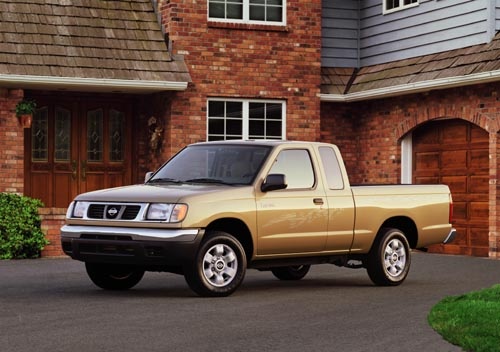
The Nissan Frontier debuted in the 1998 model year, replacing the Hardbody-based pickup truck that preceded it. By comparison, the Frontier was almost 10 inches longer and equipped with a 2.4-liter four-cylinder engine that produced 143 horsepower and 154 lb-ft of torque. A five-speed manual transmission was standard, with a four-speed automatic available as an option. Rear-wheel drive was also standard, with optional four-wheel drive. Despite the increase in size, the Frontier was still classified as a compact truck and, properly equipped, it could tow as much as 3,500 pounds.
The Frontier was offered in single cab and extended cab (called the King Cab) body styles with a six-foot bed. The extended cab featured two unusual fold-down rear seats that face inwards. The interior dimensions didn't change much, but the layout and design were more ergonomic, and the front seats noticeably more comfortable. Styling-wise, it was about as generic as any pickup truck of the era.
The Frontier was available in two trim levels: XE and SE. The XE was the base model with cloth seats, while the SE added features such as power windows, cruise control, and a tilt steering wheel. A power driver seat and leather upholstery were optional.
In its follow-up year, the Frontier added a V6 engine, but only for the King Cab. This 3.3-liter unit was good for 170hp and 200 lb-ft of torque, and towing capacity increased to 5,000 lbs when paired with the automatic transmission. It also gained an optional limited-slip rear differential and standard automatic locking front hubs. The regular cab model also added available front bucket seats that came with a center console.
In 2000, the Frontier expanded further, quite literally. A four-door Crew Cab joined the lineup, significantly increasing rear passenger space and convenience. The bed was shortened by 18 inches, but a bed extender helped to minimize the impact on utility. A Desert Runner model based on the V6-powered King Cab was also added. It was essentially a more affordable rear-wheel drive model that looked the same as the four-wheel drive models.
Styling changes arrived in 2001, including black plastic fender cladding and simulated bolt fasteners for a more substantial and industrial personality. A new supercharged V6 engine was also added, producing 210hp and 245 lb-ft of torque, but it was only available on the Desert Runner, the King Cab, and on Crew Cabs. Trim levels with this engine were named the SVE and the SC, with the SC being the more generously equipped of the two. In 2002, the Crew Cab also gained a full six-foot-plus bed option.
The 2003 Frontier added an "Open Sky" roof, which was a large fabric-topped sunroof that was offered on Crew Cab variants. The standard V6 engine also increased power output to 180hp, while airbags were included with Crew Cabs, and stability control and a tire pressure monitoring system were available as options. Antilock brakes were also added to King Cabs.
Not surprisingly, the four-cylinder powertrain was the most efficient of this generation, with an EPA-estimated 20 mpg city and 24 mpg on the highway with the manual transmission. The automatic dropped those estimates to 17/22 mpg city/highway, while the four-wheel drive model was rated at 16/19 mpg city/highway. The V6 was estimated at 15/17 mpg city/highway for the manual transmission and 14/17 mpg city/highway with the automatic. The supercharged V6 had an estimate of 14/17 mpg city/highway except for the manual four-wheel drive model, which was rated one mpg lower. These estimates varied only by one or two mpg during this generation.
In NHTSA testing, the Frontier had a rather dubious start in regard to safety scores, achieving only three stars for driver protection and four stars for the front passenger and side impacts. Things improved dramatically for 2001, earning four stars for driver protection, five stars for the front passenger and side impacts, and three stars in rollover tests. The King Cab received four stars for front passenger protection and side impacts. The IIHS gave the Frontier its second-worst score of Marginal in moderate overlap frontal collisions for this generation.
The first year of Frontier production brought a handful of recalls for automatic transmissions, seatbelts, and exterior lighting. Other problems that arose in later years included the fuel sending unit, gear selector, fuel filler, axle corrosion, steering column, supercharger, spare tire, and trailer brake connection. The Crew Cab model had a few isolated problems with its electrical and fuel systems, as well as steering.
Despite numerous recalls, the first-generation Frontier was about average for the class when it came to reliability. This helped it to retain some of its value over the years and you can expect to pay between $2,000 and $4,000 for excellent early models and between $5,000 and $6,000 for later models. The Supercharged versions can still go for $6,000 to $7,000.
Related Topics



by Mark Takahashi
Mark Takahashi has been in the automotive world since 2001 and over the years has contributed to Edmunds, Car and Driver, Autoblog, and TrueCar. Prior to being an editor, Mark was an art director on various car and motorcycle publications and has competed in amateur open-wheel racing. He is also a juror on the North American Car and Truck of the Year Awards.
The content above is for informational purposes only and should be independently verified. Please see our Terms of Use for more details.


