General Motors kicked off a new era in the North American pickup truck market when it introduced the Chevrolet S-10 for the 1982 model year. As the first domestically produced compact truck, the Chevy S-10—and its GMC twin that was originally called the S-15 before adopting the GMC Sonoma name—signified that American automakers were taking the small truck segment seriously. Prior to the S-10 pickup, Chevrolet imported Isuzu-built trucks to the United States that wore Chevrolet LUV nameplates.
Chevrolet S-10 Buying Guide: Cost, Reliability, and the Best Years to Buy
Search for Chevrolet S-10
See all


The Chevy S-10 pickup was a traditional body-on-frame truck, similar in design to Chevy’s full-size C/K-badged siblings (later known as the Silverado), but in a smaller compact pickup truck package. The similarly sized Ford Ranger followed a year later, the Jeep Comanche appeared in 1985, and the Dodge Dakota hit the market for the 1987 model year. In place of the V8 engines of larger trucks, compact pickup trucks such as the Chevy S-10 came with a range of four- and six-cylinder engines in the 1980s. It was offered in both regular cab and extended cab (initially called Maxi-Cab from Chevrolet) body styles, and in standard rear-wheel drive or optional four-wheel drive configurations.
As time went on, Chevrolet offered numerous packages to change the S-10’s demeanor. The lowered S-10 Xtreme appealed to drivers looking for a sporty truck while the S-10 ZR2 off-road package was designed for those looking to tackle mud, dirty and rocky terrain. The Chevy S-10 was replaced by the Chevrolet Colorado in 2004, the second-generation of which grew from its original compact pickup truck size to the larger midsize truck segment.
Chevrolet S-10 Buying Guide: Cost, Reliability, and the Best Years to Buy
- Frequently Asked Questions
- Chevrolet S-10 Pros and Cons
- Chevrolet S-10 Generations
- Chevrolet S-10 Second Generation (1994-2004)
- Chevrolet S-10 First Generation (1982-1993)
Frequently Asked Questions
Which Chevrolet S-10 years are the best?
Early Chevy S-10 pickup trucks were simple machines designed primarily to do the kind of light work that casual suburban American truck buyers need. They were a big contrast from the automotive industry of today, because there wasn’t much to go wrong, and General Motors’ 2.0-liter and 2.5-liter four-cylinder engines and 2.8-liter and 4.3-liter V6 engines were durable. A comparatively small number of Isuzu-sourced engines were used in early model years, but those are few and far between in North America.
The best Chevy S-10 pickup trucks were powered by GM’s long-serving 4.3-liter V6 engine that appeared in S-10 order books from 1988. A 1988-1993 first-generation Chevy S-10 with reasonable mileage and a solid service history should be a fine everyday workhorse.
Chevrolet’s second-generation S10 pickup (the truck dropped the hyphen between S and 10 for this generation) received meaningful upgrades such as sturdier suspension and axle assemblies, a revised engine lineup (culminating in the Vortec 4300 in 1998) and a more usable interior with more creature comforts. A third rear access door was added for the 1996 model year, and a four-door crew cab body style arrived in 2001.
A driver’s side airbag wasn’t added until the 1995, so buyers who prioritize safety will want to restrict their search to the 1995-2004 model years. It’s worth noting, however, that much more stringent safety standards apply to the Chevrolet Colorado that replaced the S-10 in North America. If safety is paramount, buyers may want to skip older vehicles such as the S-10 entirely and choose something more modern.
What are the worst Chevrolet S-10 years?
According to CarComplaints.com, the 2001 Chevrolet S-10 has the highest number of reported problems. The 2002 S-10, however, has received a larger number of serious complaints, including the highest instance of transmission failure of any Chevy S-10 model.
Chevy S-10 trucks powered by the Vortec 2200 engine from 1994 through 1997 are the least desirable, with low power and a preponderance of blown head gaskets being the chief complaints. Any S-10 with a four-cylinder engine mated to an automatic transmission is going to be pretty slow.
It’s also worth remembering that the Chevy S-10 first appeared in the early 1980s, and the older the truck, the greater the chance of rust and neglect.
Is a used Chevrolet S-10 a good deal?
At this point, it’s hard to call a truck that was produced between 1982 and 2004 a good deal unless it’s priced very attractively. Some unique Chevy S-10 pickups have reached the point that they are appreciating in value, with special edition models—such as the sporty Xtreme and the off-road-ready ZR2—and low-mileage examples cracking the $20,000 barrier. They’re only good deals if you plan to collect them and believe they may continue to appreciate in value, though.
That said, a cheap first-generation S-10 might be attractive for buyers as a second or third vehicle for occasional hauling. Similarly, a second-generation S-10 powered by a Vortec 4300 4.3-liter V6 engine with good maintenance records could appeal to buyers who prefer old-school usability over today’s modern, tech-filled offerings.
Chevrolet S-10 Pros and Cons
Pros
- Multiple powertrain options
- Generally reliable and durable engines
- Fun and functional Xtreme and ZR2 packages
Cons
- Unimpressive performance by modern standards
- Interior materials feel cheap
- Lacks modern safety equipment
Chevrolet S-10 Generations
Chevrolet S-10 Second Generation (1994-2004)
The second-generation Chevrolet S10 pickup truck (the first-generation’s hyphenated S-10 badge was dropped) debuted for the 1994 model year with more modern and streamlined styling. The front bumper was integrated into the fascia design, the powertrains were upgraded, there were short- and long-bed options, and anti-lock brakes (ABS on the rear only for four-cylinder models or all four wheels on S-10 trucks with a V6 engine).
The second-generation Chevrolet-S10 pickup truck came in base or LS forms. An SS Package received a locking rear differential and a sport suspension package with a lower ride height (the ZQ8 Package could also be ordered with other trim levels) or a ZR2 Package with a wider track, lifted suspension with Bilstein shock absorbers, and chucky off-road tires. Multiple truck beds were available, including a standard Fleetside, in both short and long bed lengths, and a distinctive Sportside box starting in 1996 with pinched corners around sporty fender flares.
Properly equipped with the 4.3-liter Vortec V6 engine and an automatic transmission, the second-generation Chevy S10 could tow up to 6,000 pounds in regular cab form or 5,800 with the extended cab. Opting for a V6 engine and manual transmission dropped the maximum towing rating to 4,500 pounds (or lower depending on the model year), while the 2.2-liter Vortec four-cylinder topped out at 2,000 pounds with either transmission. Multiple versions of the 4.3-liter V6 engine were offered over the years, ranging from 165 horsepower and 235 pound-feet of torque to as much as 195 horsepower and 260 pound-feet.
In its most efficient form, the second-generation Chevy S10 achieved 20 miles per gallon in the city, 26 mpg on the highway, and 23 mpg combined. With the 4.3-liter V6 engine, the second-generation S10 got EPA estimates of between 14 mpg and 17 mpg combined, depending on the year, the drivetrain, whether it had a manual or an automatic transmission, and various other options.
A driver-side airbag was added for 1995 and four-cylinder trucks got four-wheel ABS brakes in 1996. A small, third access door for the rear compartment of extended-cab models was also added that year, but one of the small rear seating perches in the back was ditched. Upgrades for 1997 included some chassis strengthening and improvements to the four-speed automatic transmission. The Chevy S10 got an upgraded interior for the 1998 model year, dual front airbags, and the exterior was also updated with redesigned front and rear bumpers.
A new package called the Chevy S10 Xtreme debuted for 1999, replacing the SS and bringing with it the lowered ZQ8 suspension package and a choice of engines and bed shapes. The S10 Xtreme was only offered with rear-wheel drive. The off-road-ready ZR2 Package remained available and looked like a Chevy truck that was ready to tackle the Baja trail.
A new four-door crew cab configuration was added to the Chevy S10’s options sheet for the 2001 model year, complete with standard four-wheel drive and an upgraded leather interior with seating for five. Opting for four doors meant accepting a short 55-inch truck bed. Only minor changes were made from 2002 until the Chevy S10’s final model year in 2004.
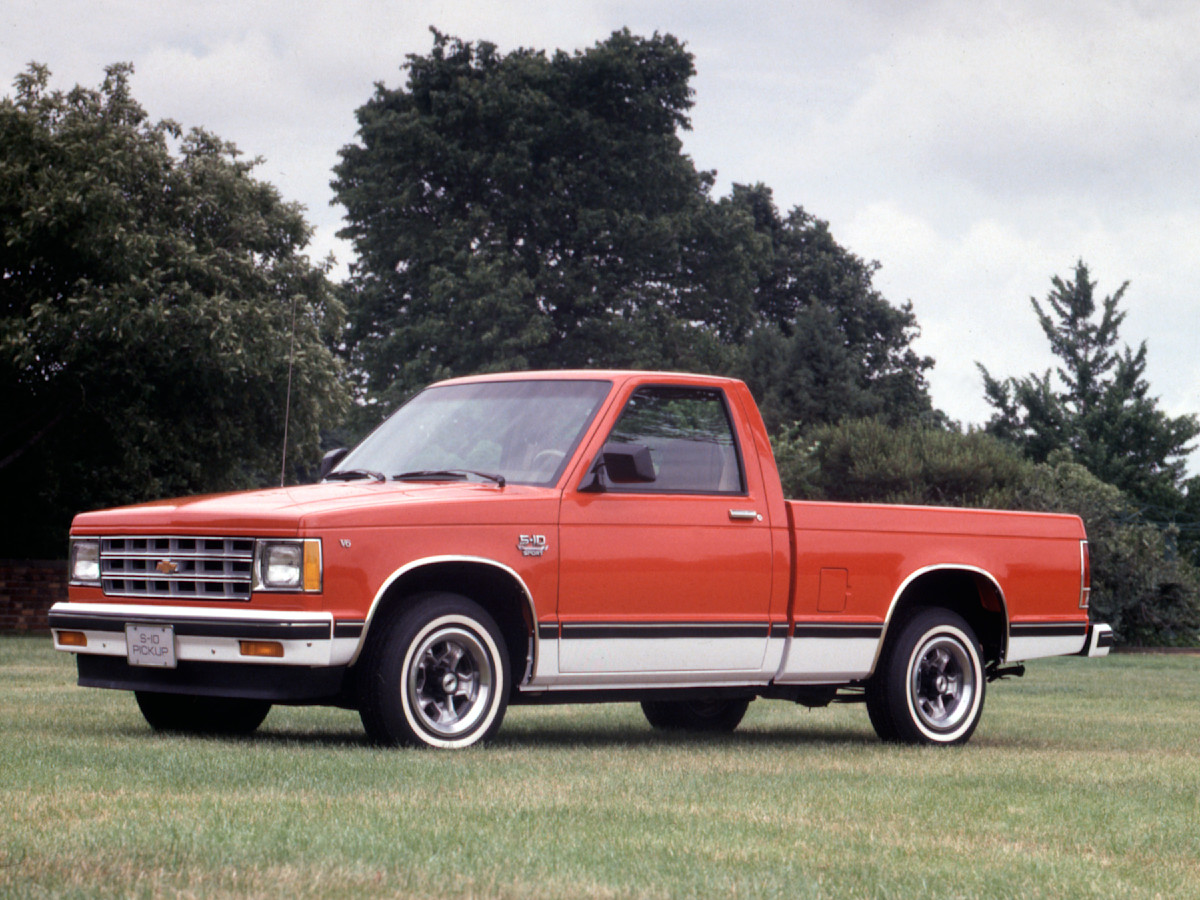
Chevrolet S-10 First Generation (1982-1993)
The first-generation Chevy S10 debuted for the 1982 model year with a standard 1.9-liter four-cylinder engine that offered a meager 82 horsepower. Things improved slightly in 1983 with a 2.0-liter four-cylinder that managed one more horsepower, and again in 1985, when the General Motors so-called Iron Duke 2.5-liter debuted with 92 horsepower (up to 94 in 1990 and 105 from 1991 through 1993).
An optional V6 engine joined the fray in 1982 with 110 horsepower. The 2.8-liter V6 engine jumped to 115 horsepower in 1985 and to 125 horsepower from 1986. Even better, GM’s 4.3-liter V6 engine came to the Chevy S10 for 1988 with 160 horsepower, which jumped to 165 in 1993. A more powerful version of the 4.3-liter V6 engine with more advanced fuel injection produced 195 horsepower and was offered in 1992 and 1993.
An Isuzu-sourced 2.2-liter diesel engine was offered in 1984 and 1985, and while it produced a mere 62 horsepower, it also delivered solid fuel economy with estimates of 26 miles per gallon in the city, 31 mpg on the highway, and 28 mpg combined. That compared favorably to the standard gasoline four-cylinder’s EPA estimates of 21 and 23 mpg combined and the V6’s 18 mpg combined rating.
Chevrolet offered a Baja Package from 1988 through 1991 that came with a roll bar with additional lights, skid plates, and an exterior graphics package. An on-road package for the S-10 pickup truck, called the Cameo, was also offered from 1988 through 1991, and got a sleek front bumper and a plastic ground effects package. Though it looked sporty, the fact that the S-10 Cameo never got the GMC Syclone’s turbocharged V6 engine meant it wasn’t actually any quicker than other S-10 trucks of the era.
Related Topics



by Jeremy Korzeniewski
Jeremy Korzeniewski grew up as the son of an automotive engineer in a family obsessed with cars and trucks and turned that passion into a career in 2006 when he accepted a position with Autoblog. Over the next 18 years, Jeremy published more than 8,000 articles while serving as a Senior Editor and has contributed to respected brands that include Yahoo, Edmunds, Robb Report and AutoGuide. Jeremy is also an avid motorcyclist and spends the majority of his evenings at home with his wife hoping to cook up a delicious meal for dinner.
The content above is for informational purposes only and should be independently verified. Please see our Terms of Use for more details.


