2025 Honda Ridgeline Reviews, Pricing & Specs


Pros & cons
What we like
Comfortable
Great handling
Standard all-wheel drive
What to consider
Limiting towing capacity for a midsize pickup
Outdated technology
Expert review
Honda takes a different approach to midsize pickup trucks.
Honda isn’t known for pickup trucks, but that means it approaches them without any preconceived notions. The 2025 Honda Ridgeline takes a different approach than rivals like the Chevrolet Colorado, Ford Ranger, and Toyota Tacoma with crossover-like unibody construction and clever storage solutions. Having received a few updates for the 2024 model year, the 2025 Ridgeline carries over unchanged.
Verdict: It doesn’t offer the towing capacity or off-road capability of more traditional trucks, but the Ridgeline is much easier to live with.
out of 10 expert review
Look & feel
The Ridgeline remains unique among pickups. Instead of the body-on-frame construction used by rivals like the Chevrolet Colorado, Ford Ranger, Nissan Frontier, and Toyota Tacoma, the Ridgeline is based on a unibody platform similar to most cars and crossover SUVs. The smaller Ford Maverick and Hyundai Santa Cruz are unibody vehicles as well, but the Ridgeline is the only midsize truck built this way.
Exterior styling doesn’t try to hide the fact that the Ridgeline is not like other trucks. Its snub nose hints at a platform designed for a transverse engine and front-wheel drive (FWD) like most other Honda products, although all Ridgeline models have all-wheel drive (AWD). The current-generation Ridgeline also contrasts other midsize pickups with more curvaceous styling similar to the older versions of the Honda Pilot and Passport crossovers with which it’s closely related (along with the Odyssey minivan).
That styling also makes the Ridgeline look a bit dated—even within Honda’s current lineup. While Honda added a blockier grille for the 2021 model year, and stamped “Ridgeline” lettering on the tailgate for 2024, updates haven’t kept pace with the more rugged makeovers the Pilot and Passport have received over the intervening years. But the Ridgeline still has clean lines that contrast the angry snarl of creases that make up most other current midsize pickups.
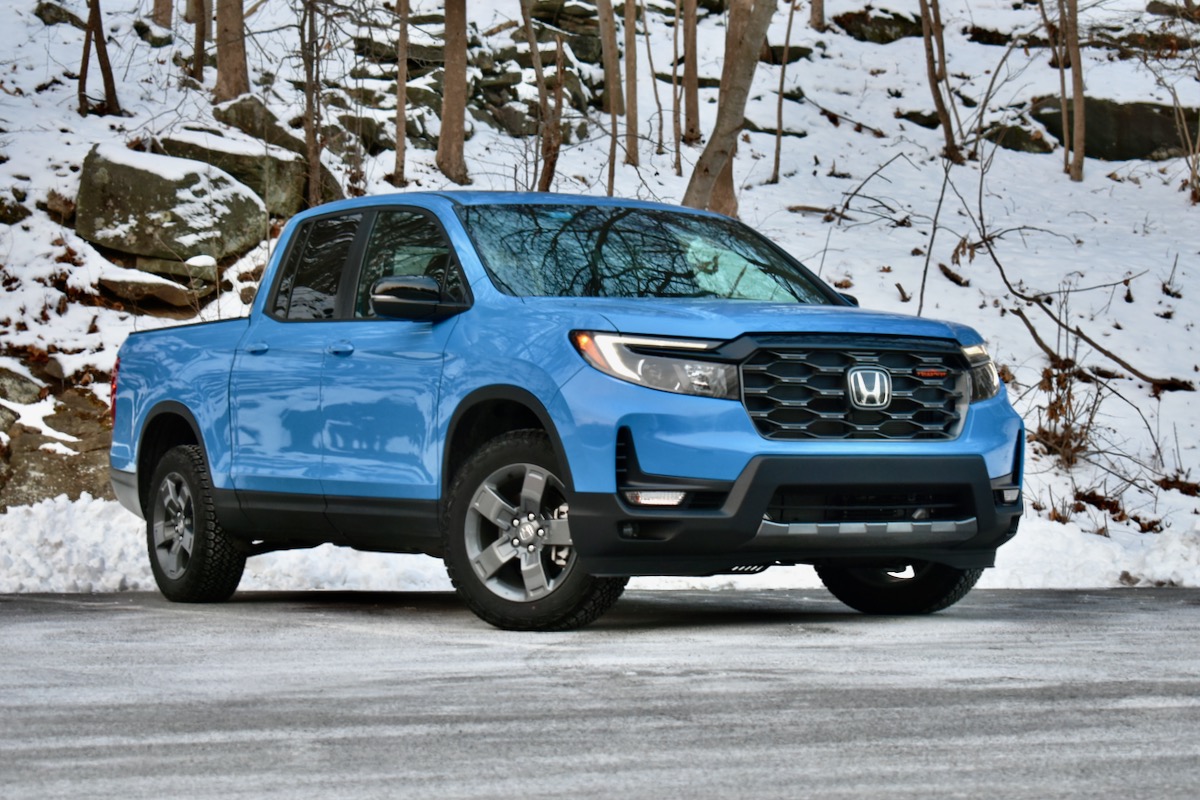
For 2025, Honda continues to offer the Ridgeline in Sport, RTL, TrailSport, and range-topping Black Edition trim levels. Our test vehicle was a TrailSport, an off-road-focused trim introduced for the 2024 model year that includes all-terrain tires, unique suspension tuning, and a front skid plate. You can also get all-terrain tires on other trim levels with the optional HPD (Honda Performance Development) package, but not the TrailSport trim’s Diffused Sky Blue Pearl paint, gunmetal alloy wheels, and orange trim.
The splashes of orange didn’t do much to liven up the interior of our test vehicle though. Everything else was black, and mostly plastic, but with excellent fit and finish, an air of durability, and a decent amount of standard features like tri-zone automatic climate control. This is not a cab we’d be afraid of getting messy, something that can’t be said of certain competitors. Other midsize truck cabs may look nicer, but the Ridgeline’s looks like it was actually designed for work and play. It’s a true truck interior, in other words.

Performance
The Ridgeline continues in a single powertrain spec for 2025. A 3.5-liter V6 generating 280 horsepower and 262 pound-feet of torque sits under the hood. It’s coupled to a nine-speed automatic transmission with the aforementioned standard AWD.
The V6 and nine-speed gearbox remain an excellent combination. The V6 was smooth, responsive, and sounded great, while the transmission made the most of its nine forward ratios by kicking down quickly when extra revs were needed. The transmission also seemed a bit quicker running through the gears from a standing start than we remember. The engine start-stop system’s slowness remained though, so we found ourselves releasing pressure from the brake pedal a bit early to wake the engine up.
Unibody construction also continues to pay dividends in ride quality, handling, and overall refinement. It makes the Ridgeline feel more solid than traditional body-on-frame trucks, and helps damp road noise and vibration. The Ridgeline’s fully independent suspension and torque-vectoring AWD system also gives this truck impressively precise handling despite its size and fairly slow steering. Our Ridgeline TrailSport test vehicle’s all-terrain tires didn’t erode ride or handling, either.
Even in TrailSport guise, though, the Ridgeline offers limited off-road capability compared to rivals. Its car-like construction and lack of a mechanical four-wheel drive (4WD) system are hindrances, and the TrailSport is less extreme than the likes of the Toyota Tacoma Trailhunter or Ford Ranger Raptor. Unless you spend a lot of time at the off-road park, though, the Ridgeline should be more than adequate. And it’s still much nicer to drive where trucks spend most of their time: pavement.
A 5,000-pound maximum towing capacity and 1,583-pound maximum payload capacity aren’t class-leading. The Ridgeline comes close to its more traditional rivals in payload, but most other midsize pickups are available in at least one configuration that can tow up to 7,000 pounds.

Form & function
The Ridgeline is available in only one configuration: a four-door crew cab with a 5-foot, 4-inch bed. A crew cab with a short bed is by far the most popular configuration for pickups today, to the extent that Ford and General Motors dropped other cab styles and bed lengths with recent redesigns of their midsize trucks.
Honda also put a lot of thought into the design of the Ridgeline’s cargo box. Access is via a dual-action tailgate that can open to the side like the rear door of van, or down like a conventional tailgate. At 50 inches wide between the wheel wells, the bed can accommodate the standard 4x8 sheet of plywood laid flat. The box is also made from reinforced sheet molding compound, which makes a bedliner unnecessary, Honda claims. A power-sliding rear window is also standard on all but the base Sport trim level.
Underneath the cargo floor is a 7.3-cubic-foot lockable in-bed trunk that provides precious covered cargo space. A drain plug means it can double as a cooler as well, while four built-in “exciters” that vibrate the bed can turn into a giant speaker to complete the tailgating experience. Honda also packaged the spare tire in a slot beneath the cargo box so you don’t have to climb under the truck to reach it.
Inside the cab, headroom and legroom are close to other midsize pickups. Front-seat occupants benefit from a high-and-wide center console that keeps elbows from bumping and is the perfect height for easily grabbing drinks out of the cupholders. Rear-seat passengers fair less well as, despite a reasonable amount of space, the seats themselves could be more comfortable. That’s perhaps due to the upright angles needed to accommodate under-seat storage.

Technology
All Ridgeline models come standard with a 9-inch touchscreen, Bluetooth, and wireless Apple CarPlay and Android Auto connectivity. SiriusXM satellite radio is also standard on all but the base Ridgeline Sport. Satellite-beamed tunes and podcasts play through a seven-speaker audio system in most models, but the Ridgeline Black Edition gets an eight-speaker system.
Wireless phone charging is standard as well, and the charging pad is ideally placed so that it doesn’t interfere with the rest of the center console. But, in a testament to the Ridgeline’s age, the only data-capable USB port is USB-A, not USB-C (it’s a good thing Apple CarPlay and Android Auto are both wireless). A charging-only front USB-C is standard, while a pair of rear USB-C ports are included on the top Black Edition model.
The USB ports aren’t the only indication of the Ridgeline’s age relative to other midsize pickup trucks. The touchscreen is smaller than those of some rivals like the Chevy Colorado, GMC Canyon, and Toyota Tacoma, and the infotainment system’s default graphics bring to mind accounting software. No of this matters, though, as the low-tech interface is more functional than the screen-heavy interfaces of some of the Honda’s more recently redesigned rivals.
Like the rest of the interior, the Ridgeline’s user interface is no-nonsense. Honda was judicious in what functions were delegated to the touchscreen, and which ones were left to analog controls. The physical “Home” and “Back” buttons are much easier to use than on-screen widgets, and they nicely blend into the screen’s housing. The Ridgeline also features a volume knob and physical buttons and switches for its heated seats, heated steering wheel, and climate controls. Unlike a touchscreen, these can be easily used while wearing gloves—an important feature in a vehicle designed for outdoor work and play.

Safety
The 2025 Honda Ridgeline remains the only midsize pickup truck with a five-star overall safety rating from the National Highway Traffic Safety Administration (NHTSA). It also earned five stars in frontal and side crash tests from the federal safety agency, and four stars in rollover testing.
The Insurance Institute for Highway Safety (IIHS) hadn’t published full results under its updated crash-test regimen at press time. The Ridgeline did earn a top “Good” score in the updated side crash test, along with a “Good” score in the original version of the IIHS’ moderate front overlap test and an “Acceptable” score in the small overlap front test. Headlights received a “Marginal” rating.
Standard safety features include: forward collision warning, automatic emergency braking, lane-departure warning, lane-keep assist, adaptive cruise control, blind-spot monitoring, rear cross-traffic alert, and Road Departure Mitigation. These are typical features one would expect to find on any new vehicle.
The driver aids, branded collectively as Honda Sensing, performed mostly unobtrusively. We appreciated the large signal lights for the blind spot monitoring system mounted on the forward roof pillars, in particular. But the adaptive cruise control system was slow to accelerate when the road ahead was clear, leaving us feeling like sitting ducks in highway traffic. And the lack of a 360-degree camera system seems like a missed opportunity.

Cost-effectiveness
Most Ridgeline models return an EPA-rated 21 mpg combined (18 mpg city, 24 mpg highway), although TrailSport models are slightly less efficient. Fuel economy is not bad in comparison to some of the Honda’s smaller-engine rivals. The turbo-four Ford Ranger and turbo-four hybrid Toyota Tacoma get the same highway fuel economy and only improve in the combined category by two (Ford) to three (Toyota) mpg. The Honda’s V6 is only disadvantaged in city fuel economy, where the four-cylinder Ford and Toyota both top 20 mpg.
When it comes to warranty coverage, Honda’s three-year, 36,000-mile, limited warranty and five-year, 60,000-mile, powertrain warranty align closely with what other brands offer.
Pricing starts at $41,600 for the base Sport model, including the mandatory $1,450 destination charge. The Ridgeline RTL and TrailSport cost $44,430 and $46,830 with destination, respectively, while the top Black Edition has a starting MSRP of $48,200. Standard AWD and a V6 engine make the Ridgeline a decent value compared to other midsize trucks, which still require upgrading to get four driven wheels or the choicest powertrain.
Despite the age of the current generation, and its unorthodox engineering, the Ridgeline is a good, basic truck. Hardcore off-road enthusiasts, overlanders, or those with extensive towing needs should look elsewhere; the Ridgeline is not a hashtag lifestyle vehicle. But its overall refinement, clever design features, and no-nonsense interior make it an excellent truck for real life.


What owners say
I started my truck search looking at full-size trucks, but honestly didn’t want the exterior size to be that big. Just on a side, have you noticed how a lot of the worst drivers on the road are driving the big full-size trucks? I didn’t know the purpose of having a Hemi to actually run people off the road. You know what I mean? That dude is barreling down the interstate doing about 87mph pulling a big @$$ box trailer and he’s like fish tailing all over the place? Back to the review. I drove a Jeep Gladiator, a Tacoma, a Colorado and the Nissan Frontier. The Gladiator was almost scary on the highway. Lots of wind noise and blowing me all over the place even at the lower highway speeds around 55-60mpg. For that reason, it didn’t make sense to me as a daily driver on paved roads. While the new Colorado and Tacoma have that brawny stance, neither of them have a V6. What’s the deal with the 4 banger turbo thing? It’s like Arnold Schwarzenegger in that old Christmas movie, “Jingle All The Way.” “I have to get the “Turbo Man!!” What they are not telling you about the 4 cylinder turbo stuff is that even if a 4 cylinder engine has the power of Ivan Drago in Rocky 4, it is working harder to produce that power compared to the naturally aspirated V6. Multiple mechanics I know personally have said the same thing. Inside, both Tac and Colorado were small and cramped. At first glance, you think they are going to be bigger inside then they are. This was disappointing and strange given how the outside is larger than their prior generations. An odd tech. thing about the Colorado was that you actually turn the headlights on using the touch screen. I also thought that the inside materials in the Colorado felt cheap. That glossy plastic stuff if you know what I mean. I liked the tow rating, but decided to keep shopping. The Frontier was actually my second favorite truck behind the Ridgeline. The naturally aspirated V6 instead of the turbo was already setting it above the other trucks. Then, I drove the Ridgeline and it was like Wow!! This thing rocks!! Honda’s proven reliable V6, smooth driving, yet flexible enough on the dirt or gravel roads, I can fit a 4x8 sheet of plywood flat in the bed because there’s no stupid wheel well hump. I absolutely love the tailgate swing out! It gets my body closer to whatever goods I am lifting out of the back instead of having to lean forward. Honda nailed it with this feature! Plus, let me just say that Ridgeline’s interior almost feels like a full size truck. I have tall teenage boys and the first thing they said when they got in the Ridgeline was “Wow dad!! This is nice and big inside!” Plus, as roomy as it is, I like that Ridgeline fits in a standard garage space too! If you get heavy rains, or it happens to snow, it’s nice to be covered when you want to be. You’ve got drive settings for different terrain and that suits my needs. Another reviewer said the Ridgeline meets the needs of 80% of people driving trucks and he nailed it with that statement. it’s absolutely true. A lot of people are driving big trucks and Jeeps and they never actually use them for the purpose they are intended for. You have those folks that don’t actually need 4 wheel drive. If you’re like me, you want a truck that gives you the utility you need, want to grab some landcape supplies, sheet goods, farm or garden stuff, and rides awesome on both paved and gravel or dirt roads, this is the truck for you. Don’t you love these guys with Jeep fantasies that make stupid videos criticizing Honda trying to create skepticism like…. “Can it do any serious off roading?” You can’t criticize it for something it’s not designed for. If you want a rock crawler you get a Jeep or something similar (locking differential, higher ground clearance, a lift, bigger rubber etc,).
October 31, 2025Trims & specs
Base MSRP $42,050 | Seating 5 |
Engine 3.5L 280 hp V6 | Cargo Capacity 7.3 cu ft |
Combined MPG 21 | Drivetrain AWD |
Base MSRP $42,980 | Seating 5 |
Engine 3.5L 280 hp V6 | Cargo Capacity 7.3 cu ft |
Combined MPG 21 | Drivetrain AWD |
Base MSRP $40,150 | Seating 5 |
Engine 3.5L 280 hp V6 | Cargo Capacity 7.3 cu ft |
Combined MPG 21 | Drivetrain AWD |
Base MSRP $46,750 | Seating 5 |
Engine 3.5L 280 hp V6 | Cargo Capacity 7.3 cu ft |
Combined MPG 21 | Drivetrain AWD |
Base MSRP $47,280 | Seating 5 |
Engine 3.5L 280 hp V6 | Cargo Capacity 7.3 cu ft |
Combined MPG 20 | Drivetrain AWD |
Base MSRP $44,880 | Seating 5 |
Engine 3.5L 280 hp V6 | Cargo Capacity 7.3 cu ft |
Combined MPG 21 | Drivetrain AWD |
Base MSRP $45,380 | Seating 5 |
Engine 3.5L 280 hp V6 | Cargo Capacity 7.3 cu ft |
Combined MPG 20 | Drivetrain AWD |


Pricing trends
MSRP range
$40,150 - $47,280
Current avg. market price
$35,531
Trending down by 2.1% this month
May 2026 - October 2026