2023 Honda Ridgeline Reviews, Pricing & Specs

Pros & cons
What we like
Terrific daily-driver
Exceptional practicality
Great safety ratings
What to consider
Outdated technology
Falls short on towing capacity
Not as capable as some rivals off-road
Expert review
Honda's pickup eschews convention for practicality and purpose.
Trucks are the most popular vehicles in America. We buy them for work, for play, and, let’s be honest, for posing. We slam them down, we jack them up, and we make them loud and imposing. We brag about them, too: how much power they make, how much weight they tow, how far they go off-road, and how reliable they are. Trucks are our pride, our joy, and for some people, our substitution for therapy.
The 2023 Honda Ridgeline is one of several midsize trucks you can buy, but it bucks convention, making it an outlier. For people who need a truck to tackle modest tasks and don’t want to live with the compromises inherent in a traditional pickup, the 2023 Ridgeline is perfect. Just don’t expect to fit in with the crowd described above.
out of 10 expert review
Look & feel
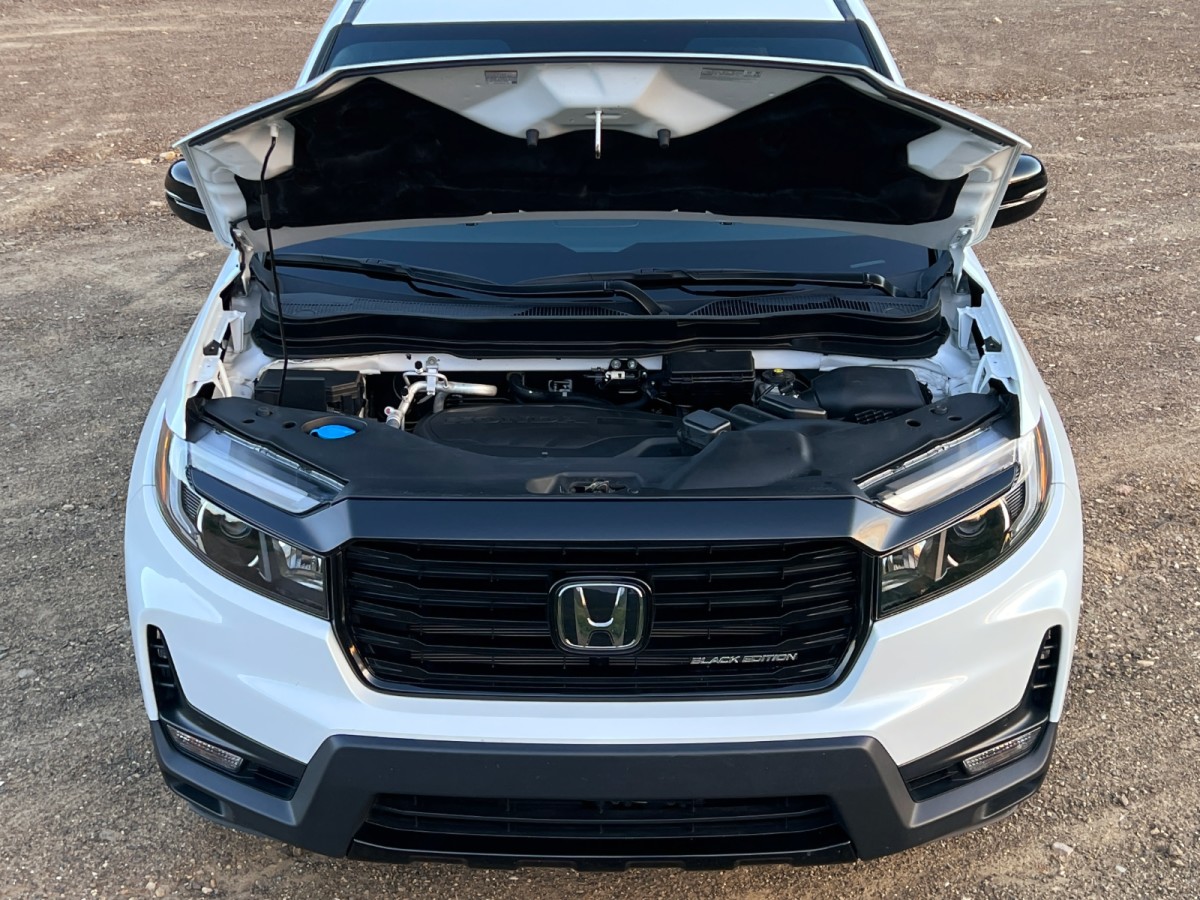
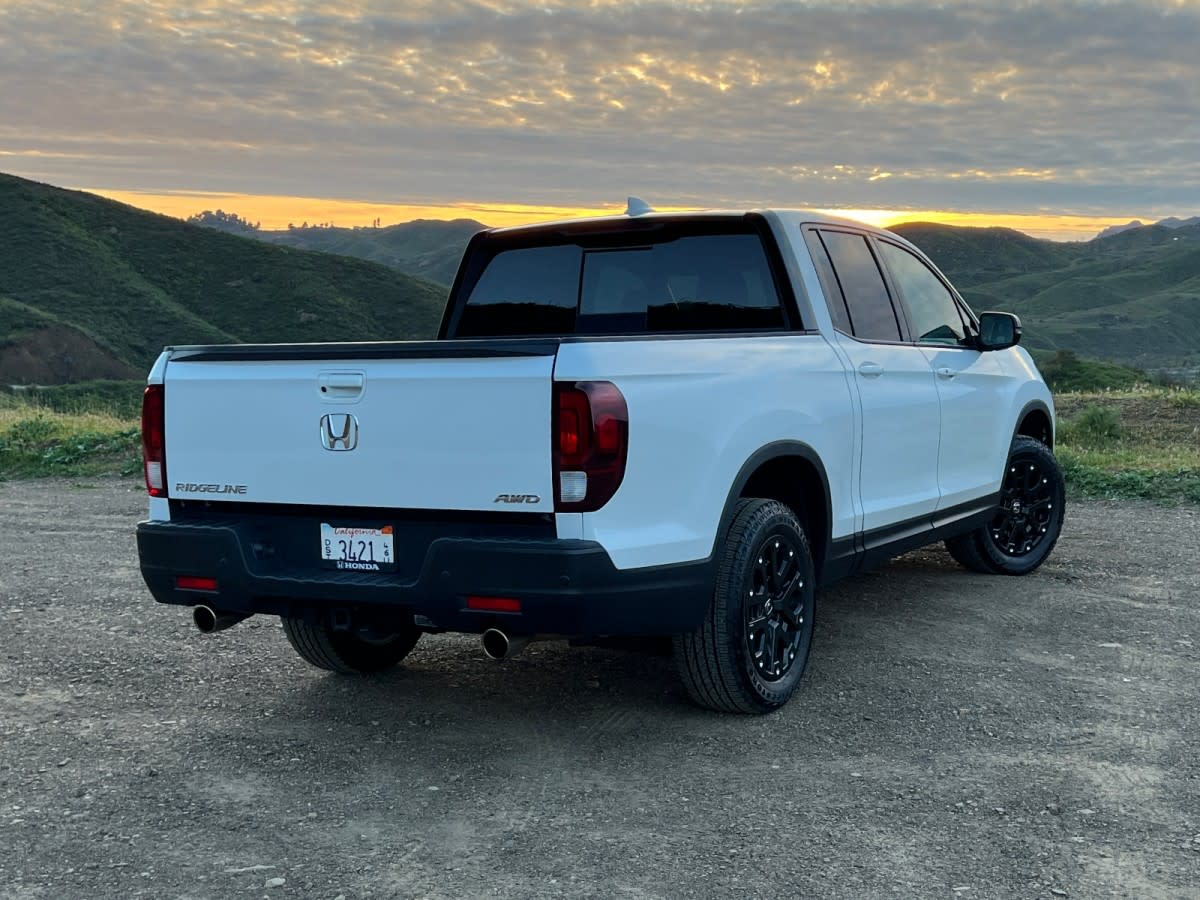
A couple of years ago, Honda updated the Ridgeline’s styling, adding a new front end with bolder details, giving it larger dual exhaust outlets, and bolting on more appealing wheels wearing new tires with an aggressive tread design. The changes resulted in a more rugged appearance, but the optional Honda Performance Development (HPD) packages install comically oversized fender flares, so avoid those.
Four versions of the 2023 Ridgeline are available, each equipped with an excellent V6 engine, a nine-speed automatic transmission, and a torque-vectoring all-wheel-drive (AWD) system. Sport trim is the base model, and from there you can upgrade to RTL, RTL-E, or Black Edition trim. Since some people don’t like black paint, you can also get the Ridgeline Black Edition in white and gray colors.
Prices range from $38,800 to $46,230, not including a destination charge of $1,345. Our Black Edition test vehicle arrived with extra-cost Platinum White Pearl paint and accessory 18-inch black alloy wheels, bringing the manufacturer’s suggested retail price (MSRP) to $49,866, including destination charges.
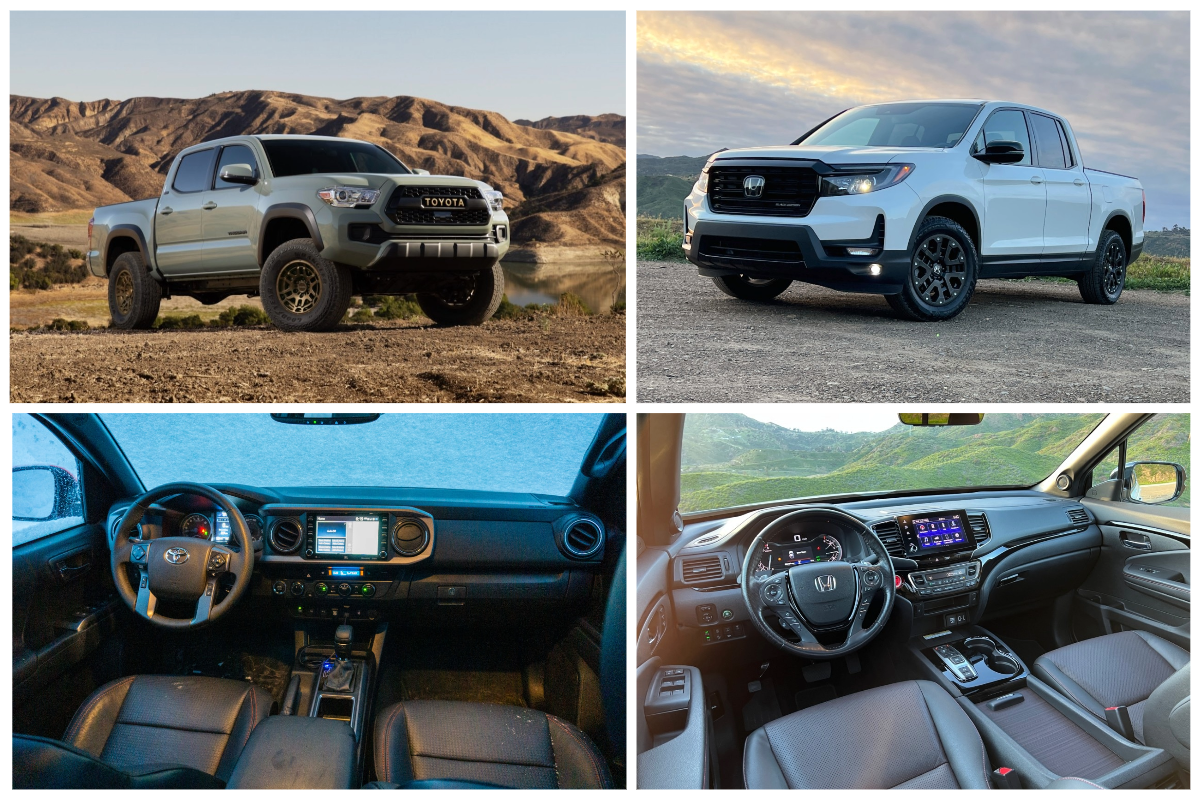
If that sounds high, you’re right. You can get a 2023 Toyota Tacoma Limited with four-wheel drive, the Nightshade Package, and a set of floor mats and save yourself more than three grand. But the Tacoma isn’t the same kind of truck as the Ridgeline. Raw, rough, and unrefined, the Toyota is the poster model for a traditional pickup. The Ridgeline adds several layers of refinement and sophistication compared to the Tacoma and other midsize trucks. And that’s because it shares plenty with the Passport crossover SUV.
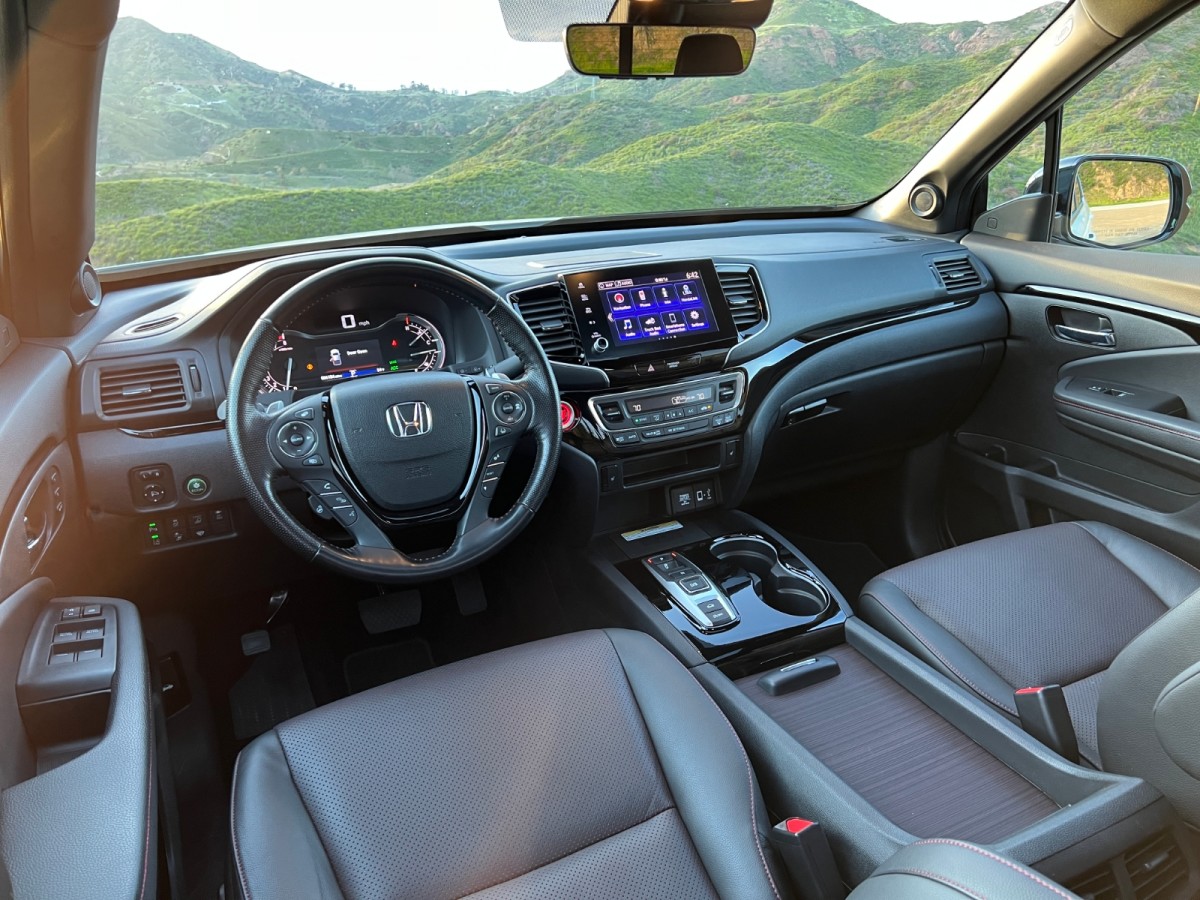
Yank open the Ridgeline’s door, and you’ll immediately spot the resemblance to Honda’s midsize, two-row sport utility vehicle. From the center roof pillars forward, the Ridgeline and Passport are essentially the same vehicles, inside and out.
Before you assume this is a bad thing, we can assure you it is not. The Ridgeline Black Edition’s leather-lined interior exudes quality, offers plenty of storage, provides terrific outward visibility, features a sensible layout with properly marked switchgear, and is quite comfortable for all occupants. And though the interior design dates back to the 2016 Honda Pilot in which it first debuted, it still looks more modern, upscale, and technologically advanced than several of its rivals.
Performance
Wait. What’s the 2016 Pilot got to do with the 2023 Honda Ridgeline? Let us explain.
Car companies often create a platform and component set and then share it across different makes and models. At American Honda, the Ridgeline’s underlying bits and pieces have plenty in common with the third-generation Acura MDX and Honda Pilot SUVs, as well as the current Honda Odyssey minivan and Honda Passport SUV.
For use under the Ridgeline’s sheet metal, Honda fortified the platform for pickup-truck duty. But the 3.5-liter V6 engine (280 horsepower and 262 lb-ft of torque), nine-speed automatic transmission, and torque-vectoring all-wheel-drive system that can put up to 70 percent of the power to a single rear wheel are common to the current Passport.
This isn’t a bad thing because it gives the Ridgeline remarkably sophisticated driving dynamics on pavement, where you’ll spend most of your time anyway. Furthermore, the Ridgeline offers a competitive 1,583-pound payload capacity. However, the Ridgeline’s unibody instead of body-on-frame construction limits it to 5,000 pounds of towing capacity.
That’s one of the only downsides to the 2023 Ridgeline. The other potential issue is its unremarkable 7.6 inches of ground clearance, lack of a traditional four-wheel-drive system with low-range gearing, and somewhat shallow approach, breakover, and departure angles. We’ve done some light off-roading in the Ridgeline, and it can tackle moderately challenging desert terrain. But for serious four-wheeling and rock crawling, you’ll need a different truck.
As it happened, we needed to take a road trip during our time with the Ridgeline, driving round-trip from Los Angeles to San Francisco. Nothing about this truck’s driving character suggests it is a pickup truck. It is quick and refined when accelerating onto a freeway, it is comfortable and reasonably quiet on the highway, and it proves nimble when navigating the traffic and tight parking situations of a city.
In addition, the Ridgeline averaged 22.6 mpg on the trip, landing between its official EPA fuel economy ratings of 21 mpg in combined driving and 24 mpg on the highway. Among midsize pickups with gas-powered V6 engines and four-driven wheels, these numbers are class-leading. However, if you’re willing to go electrified, diesel, or with a turbocharged four-cylinder engine, there are more fuel-efficient powertrain choices in a truck.
On our Southern California test-driving route, the Ridgeline’s unibody construction, four-wheel independent suspension, and torque-vectoring all-wheel drive demonstrated exceptional ride and handling qualities—for a pickup truck.
In the city, the ride is comparatively supple. On the highway, the Ridgeline drives like an SUV instead of a car. And on twisty, lumpy mountain roads, Honda’s pickup demonstrates remarkable athleticism, with none of the shimmy, shake, or skittishness common to a typical truck. Furthermore, it averaged 21.4 mpg on our loop, beating the official EPA rating for combined driving.
If there’s anything here to gripe about, it’s that the steering feels a little too heavy at lower speeds. And that’s more of a nitpick than a complaint.
Form & function
The 2023 Honda Ridgeline is all about function. From the shelves carved into the front door panels and the giant storage console between the front seats to its dual-action tailgate and in-bed trunk, Honda’s truck makes up for its reduced towing and off-roading capability with daily-driving practicality.
From the center roof pillars forward, the Ridgeline and Honda Passport SUV are nearly the same vehicles. So, getting in and out of this truck is easy, the seats are exceptionally comfortable with excellent leg support, and the look and feel of the interior suggest it would be a bad idea to take a hose to it in order to clean it up. In addition, the test truck had heated front seats and a heated steering wheel, perfect for this year’s unseasonably chilly SoCal winter.
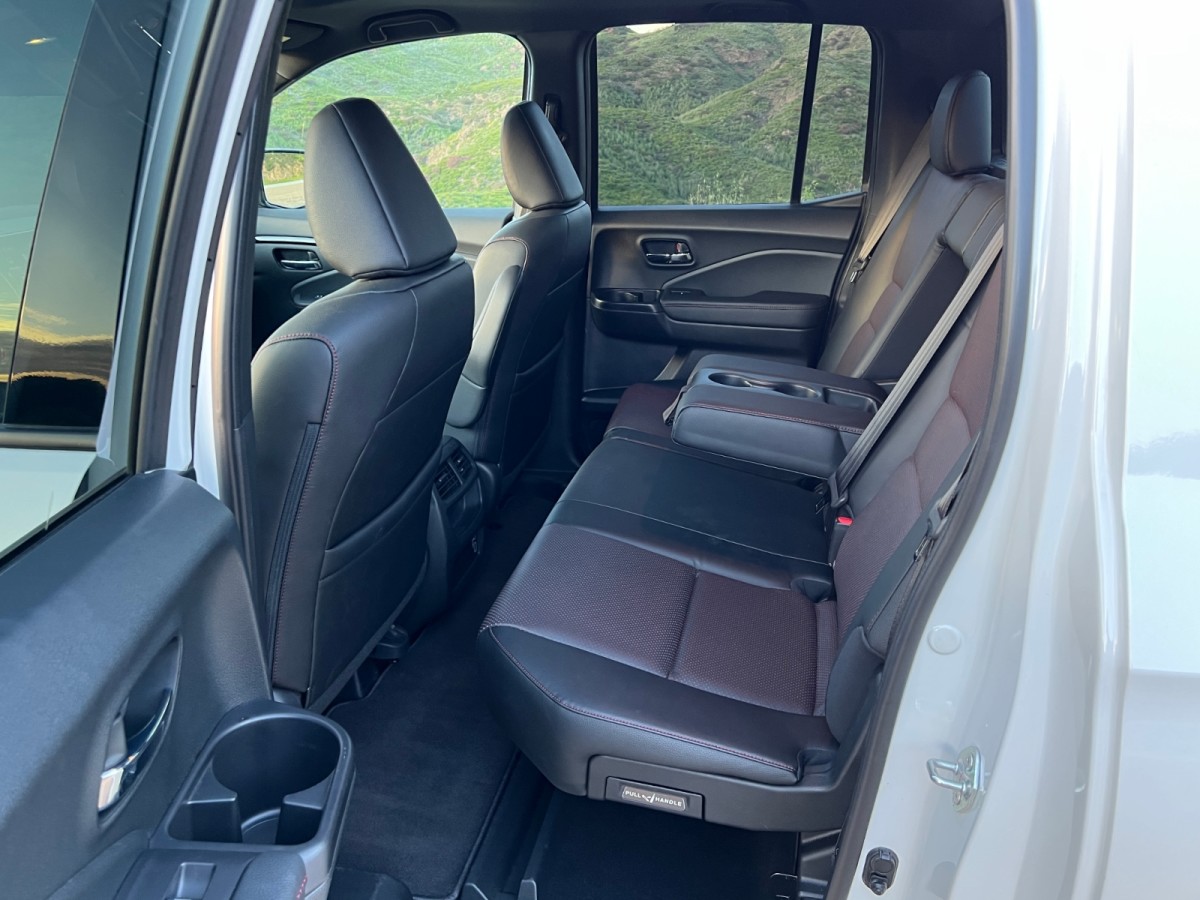
Open a rear door, and you’ll discover that a Ridgeline is not as roomy for rear-seat passengers as a Passport is. However, the three-person bench sits high for an elevated seating position, the front seatbacks are softly padded and kind to knees, and our test truck provided rear air conditioning vents and large cupholders molded into the door panel armrests.
The rear seat cushion flips up to create a sizable load floor behind the front seats, and Honda offers a reasonably priced accessory rear underseat storage system to help contain items within the cab. Up front, our Ridgeline had a dashboard slot perfect for smartphones, a separate wireless charging pad that worked intermittently depending on the position of the device resting upon it, and a huge center console storage bin with a sliding tambour-style cover that doubles as a handy tray.
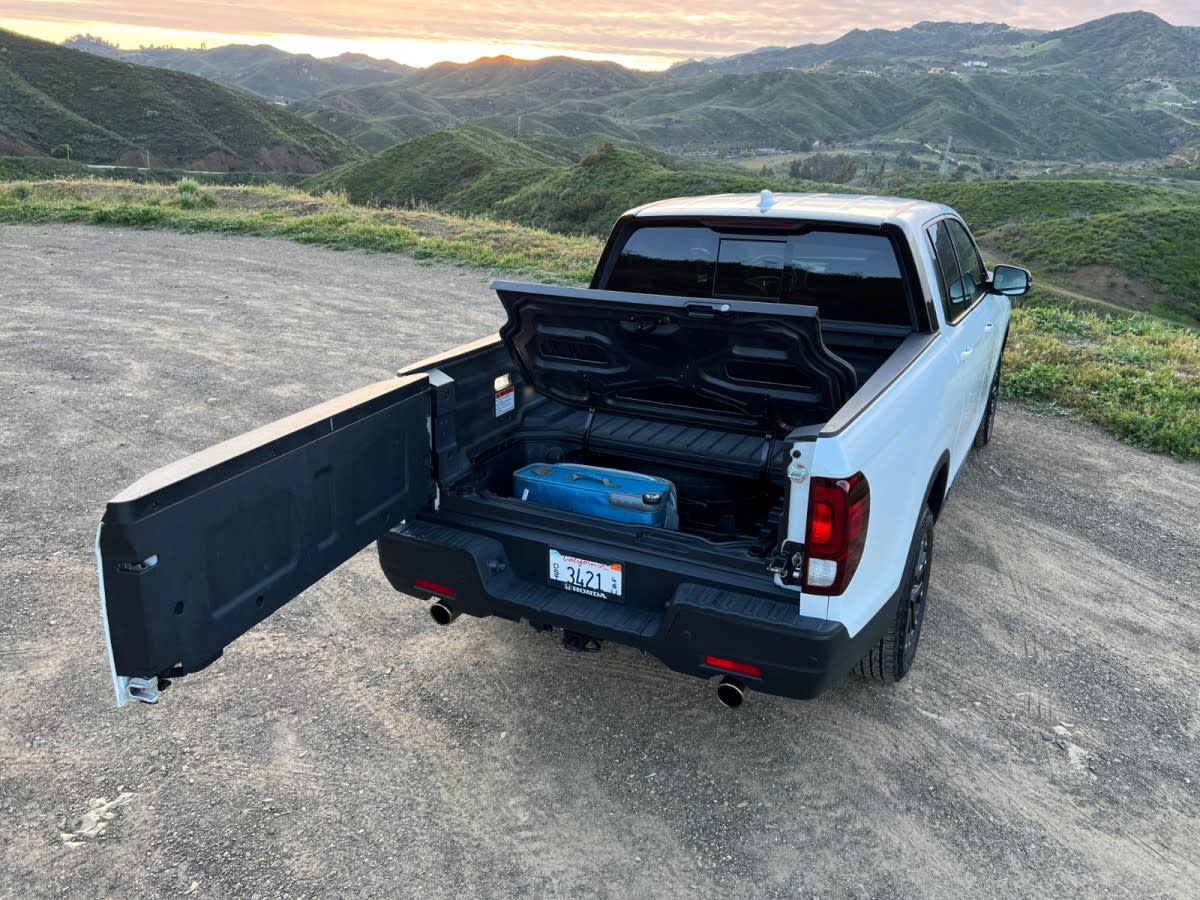
As practical as the interior is, the Ridgeline’s 64-inch cargo bed is even more impressive. The dual-action tailgate drops down or swings open from right to left for loading, and the scratch-resistant composite cargo bed’s floor is flat, measuring a minimum of 50 inches wide at the wheel wells. It is somewhat shallow, though, offering 33.9 cubic feet of volume at the sills. You can use the standard tie-down cleats rated at 350 pounds each to secure larger loads.
Honda offers numerous accessories for the Ridgeline, from a roof rack with crossbars and various attachments to bed extenders, tonneau covers, a bed tent, and more. In addition, some versions of the Ridgeline have a 150-watt/400-watt power outlet and in-bed stereo speakers. But what sets the Ridgeline apart from all trucks except the smaller Hyundai Santa Cruz is its trunk.
Under the load floor, the Ridgeline offers more cargo space with a lockable, weatherproof, 7.3 cubic-foot trunk with a drain plug in the floor, yet another benefit of the truck’s unique unibody platform. You can use it to carry groceries home from the market, luggage home from the airport, wet or muddy gear after surfing or hiking, or items you need to keep dry and secure but that won’t fit inside the cab. And if you’re hosting a tailgate party, you can plug a TV into the truck’s bed-mounted electrical outlet, fill the trunk with ice and beverages, and then easily drain the water out afterward.
Technology
Because the Ridgeline’s engineering dates back to the mid-2010s, it doesn’t have the latest infotainment systems available from Honda. Nevertheless, wired Apple CarPlay and Android Auto are standard, along with basic HondaLink services. Most Ridgelines also have satellite radio, but only the RTL-E and Black Edition include a navigation system, premium sound system, cargo bed speakers, and wireless smartphone charging.
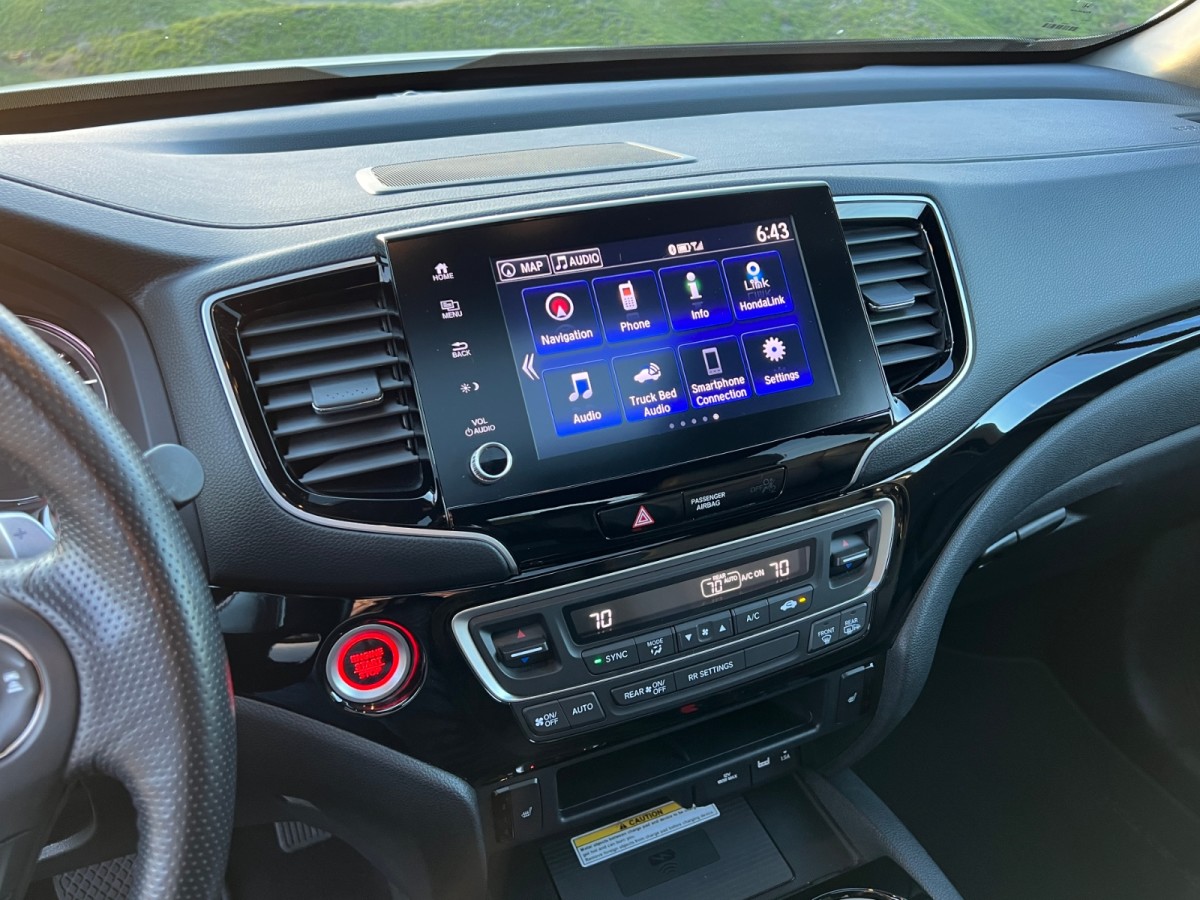
Infotainment content loads slowly when you start the truck, and the voice recognition system exhibits delayed response to voice commands. In addition, the 8-inch touchscreen is smaller than expected, and the on-screen graphics don’t reflect modern design standards. However, as we learned during hours spent behind the truck’s steering wheel, if you lower your expectations it is easy enough to acclimate to the technology.
Fortunately, the user interface is simple enough. The touchscreen display provides touch-sensing Home, Menu, and Back shortcut buttons and a stereo volume knob. You can also swipe between menu panels when necessary.
Frustratingly, there isn’t a way to manually tune between radio stations without tap, tap, tapping on the screen, and the navigation display is cluttered with detail, showing less of the map than is desirable.
Also, Honda does not provide natural or conversational voice recognition, so finding points of interest and programming destinations while driving is distracting because you need to reference the suggested commands shown on the display. However, if you’re willing to follow the step-by-step instructions, you can successfully locate and then navigate to the places you wish to travel, even if the technology regularly seems to be a step or two behind with regard to issuing upcoming directions.
Similarly, if you take the time to program radio station favorites, you can use the steering wheel’s stereo controls to cycle between them. Once you get into the habit of doing so, you won’t miss the Ridgeline’s lack of a tuning knob, and you might not use the volume knob anymore.
As mentioned before, the Ridgeline’s wireless smartphone charger worked haphazardly, seemingly because it is easy for the phone to reposition in a way that is incompatible with the charging pad. We don’t know if vibrations caused a phone to move within the pad or if we imprecisely placed the device on the pad, but using this feature proved dissatisfying.
Overall, the Ridgeline is in desperate need of a technology overhaul, but that likely won’t happen until it gets another refresh or a full redesign.
Safety
Similar to its old-school infotainment system, the Ridgeline relies on aging driver-assistance systems that aren’t as smooth, accurate, and refined as what the latest Hondas offer.
In addition, the standard Honda Sensing collection of tech does not include a blind-spot monitoring or rear cross-traffic alert system. You need to upgrade from Sport to RTL trim for those driver assistance features, and then it looks like an afterthought because Honda embeds the warning lights on pieces of plastic that cover the lower portion of the truck’s front quarter windows. Instead, the warning indicators should be on the mirror glass or the inner side of the mirror caps.
Honda Sensing does equip every version of the Ridgeline with adaptive cruise control, forward-collision warning, automatic emergency braking, lane-departure warning, lane-keeping assist (Road Departure Mitigation in Honda-speak), and lane-centering assist (Lane Keeping Assist). In addition, automatic high-beam headlights are standard.
Our Black Edition test vehicle had all available safety features, and aside from the lane-departure warning system’s irritating steering wheel wobble when you allow the truck to drift over lane markings, the technology is effective. However, the adaptive cruise control system can struggle a bit to maintain a safe following distance, noticeably alternating between braking and acceleration in its quest to find and hold the perfect span.
According to the Insurance Institute for Highway Safety (IIHS), the 2023 Ridgeline earns mostly favorable crash-test and safety ratings. Only the headlights receive a score other than Good or Acceptable. In evaluations performed by the National Highway Traffic Safety Administration (NHTSA), the Ridgeline gets top marks in all crash tests plus a four-star rollover resistance rating, which is good for the segment.
Cost-effectiveness
With a base price of just over $40,000, the 2023 Honda Ridgeline is more expensive than some of its rivals, yet it strikes us as a bargain, and not just because Honda includes two years or 24,000 miles of complimentary scheduled maintenance.
At that price, the 2023 Ridgeline provides a strong V6 engine, standard all-wheel drive with torque vectoring and off-road driving modes, rewarding driving dynamics, a roomy and comfortable interior, practical storage solutions, unique features, and favorable safety ratings. Yes, it needs the next-generation technology Honda provides in several of its other models. And the Ridgeline is undeniably less capable than a typical truck regarding outright towing capacity and off-roading capability.
However, having lived with this Ridgeline Black Edition for a week, adding about 1,000 miles to its odometer reading, we can say the pros far outweigh the cons. So, unless you need maximum towing or off-roading talent from a midsize truck, a Honda Ridgeline is an excellent alternative to a traditional pickup.

What owners say
"Overall, owners of the 2023 Honda Ridgeline express positive feelings, highlighting its comfort, smooth ride, and versatility. They particularly enjoy the useful storage space and modern safety features. However, some drivers are disappointed with the outdated technology and infotainment system compared to competitors."
A great all round vehicle that us reliable and versatile - It drives more like an suv than a truck, so its quite comfortable and quiet, but is also can haul and store quite a bit in its bed and trunk area
December 3, 2024I absolutely love the way this truck handles. It drives so smooth but is rugged like a truck should be. Super comfortable seats and all those little luxurious extras too!
April 23, 2023Only driven for a few days so far but overall impression is that this is a fantastic vehicle. Smooth, quiet and easy to drive. Endless examples of smart engineering in both little things and big things. Super pleased so far and cant wait to add on more miles.
November 22, 2023What owners say
A great all round vehicle that us reliable and versatile - It drives more like an suv than a truck, so its quite comfortable and quiet, but is also can haul and store quite a bit in its bed and trunk area
December 3, 2024I absolutely love the way this truck handles. It drives so smooth but is rugged like a truck should be. Super comfortable seats and all those little luxurious extras too!
April 23, 2023Only driven for a few days so far but overall impression is that this is a fantastic vehicle. Smooth, quiet and easy to drive. Endless examples of smart engineering in both little things and big things. Super pleased so far and cant wait to add on more miles.
November 22, 2023Great truck, has a lot of features that other trucks in this class doesn’t. The storage is phenomenal. Drives and rides more like a automobile than a truck.
March 5, 2023Best mid-size for light hauling and towing. Very nice ride, good gas mileage, plenty of features. Honda quality, longevity and resale.
May 15, 2023Ive been waiting for a Ridgeline hybrid for years, but it isnt coming, so I bought a 2023 RTL-E. A good truck for everyday driving. Very comfortable. Its only drawback is the dated technology. The RAM 1500 I drove 3 years ago had a vastly superior infotainment center: Bigger. Faster. More user friendly. Thing is, I needed more than an infotainment system. I needed a truck maneuverable in small city streets, comfortable on the long haul, useful for carrying everything up to a dogsled team. Its a good truck. Better than the TACO, or the new competition. A slew of modern safety features come standard . Fit and finish is good. I love not having to get a step stool or pull a muscle hoisting myself up into the drivers seat, and dont worry that my geriatric friends might fall out onto the ground trying to get down.
October 31, 2022Great truck! Rides as good as wife’s SUV. Didn’t want a full size vehicle; they’re just too big and bulky. Doesn’t feel/drive like a truck, but has all the features as one. Very smooth ride. Love the “hidden “ compartment in the bed. All around good features.
October 3, 2024Pleased with my Ridgeline and its features. The storage space under the bed is quite useful.
February 16, 2023Very smooth riding and extremely quiet Because its a Pilot Chasis...nice features and love the secret cargo bed area and swing out tailgate.
December 17, 2022The dashboard is lai out perfectly and the vehicle rides like a car not a truck. I am totally impressed overall with the vehicle.. I test drove the Toyota Tacoma and also the Nissan frontier and there’s no comparison.
January 30, 2024Trims & specs
Base MSRP N/A | Seating N/A |
Engine N/A | Cargo Capacity N/A |
Combined MPG N/A | Drivetrain N/A |
Base MSRP N/A | Seating N/A |
Engine N/A | Cargo Capacity N/A |
Combined MPG N/A | Drivetrain N/A |
Base MSRP $46,230 | Seating 5 |
Engine 3.5L 280 hp V6 | Cargo Capacity 7.3 cu ft |
Combined MPG 21 | Drivetrain AWD |
Base MSRP $38,800 | Seating 5 |
Engine 3.5L 280 hp V6 | Cargo Capacity 7.3 cu ft |
Combined MPG 21 | Drivetrain AWD |
Base MSRP $41,780 | Seating 5 |
Engine 3.5L 280 hp V6 | Cargo Capacity 7.3 cu ft |
Combined MPG 21 | Drivetrain AWD |
Base MSRP $44,730 | Seating 5 |
Engine 3.5L 280 hp V6 | Cargo Capacity 7.3 cu ft |
Combined MPG 21 | Drivetrain AWD |


Pricing trends
MSRP range
$38,800 - $46,230
Current avg. market price
$30,905
Trending down by 2.0% this month
May 2026 - October 2026