2024 Toyota RAV4 Reviews, Pricing & Specs


Pros & cons
What we like
Reputation for reliability
Plenty of utility
Generous ownership perks
What to consider
Noisy
Dull to drive
Unimpressive safety ratings
Expert review
The only vehicles more popular with Americans than the Toyota RAV4 are full-size pickup trucks.
That’s not surprising, considering how people have adopted SUVs of every size as their favorite kind of vehicle. Back in the mid-1990s, the original RAV4 (Recreational Activity Vehicle with 4WD) ushered in the era of the crossover. Almost 30 years later, the 2024 Toyota RAV4 helps to set standards in its segment, available with gas, hybrid, and plug-in hybrid drivetrains in trim levels ranging from basic or sporty to rugged or upscale.
Verdict: Last redesigned in 2019, the current-generation RAV4 is nearing the end of its run. But if you’re looking for a dependable, roomy, and practical compact SUV, a 2024 RAV4 will serve you well for a long time to come.
out of 10 expert review
Look & feel
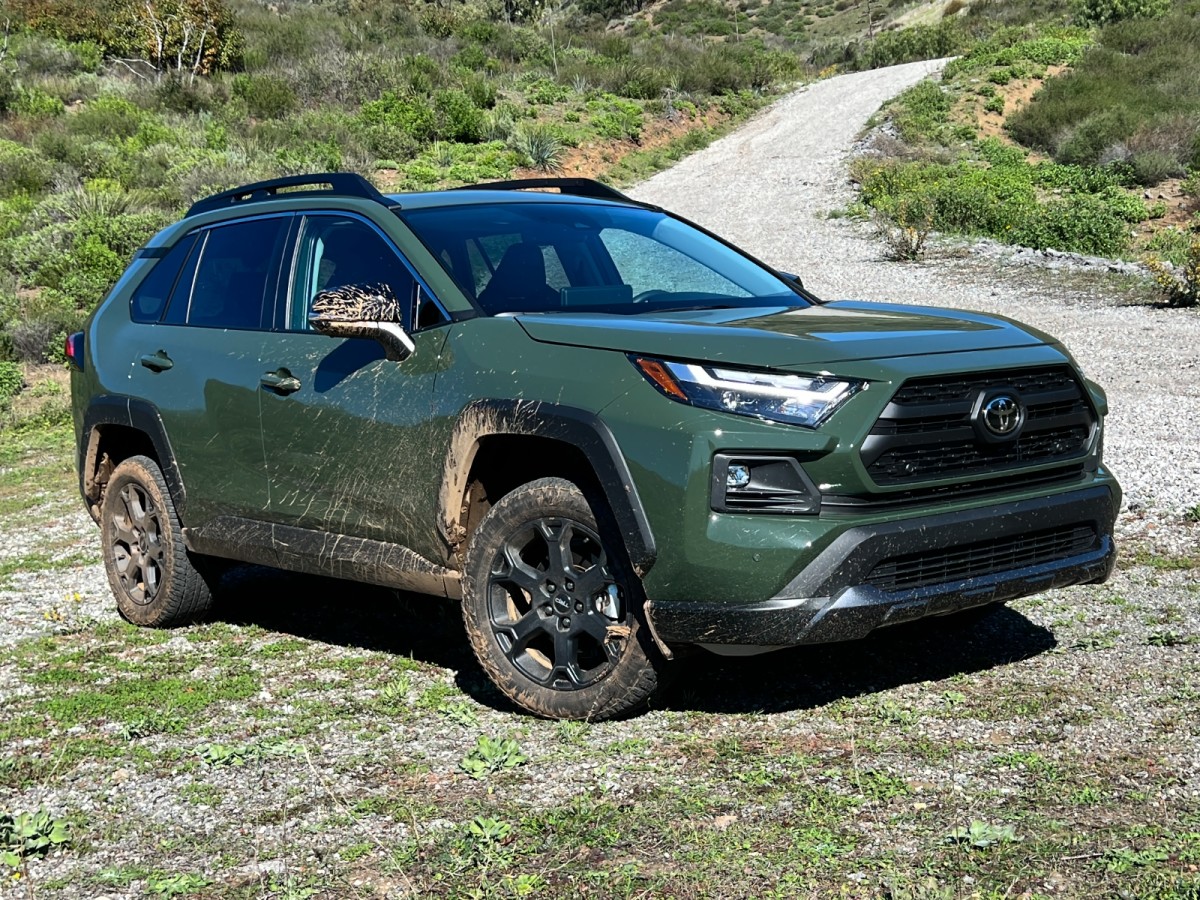
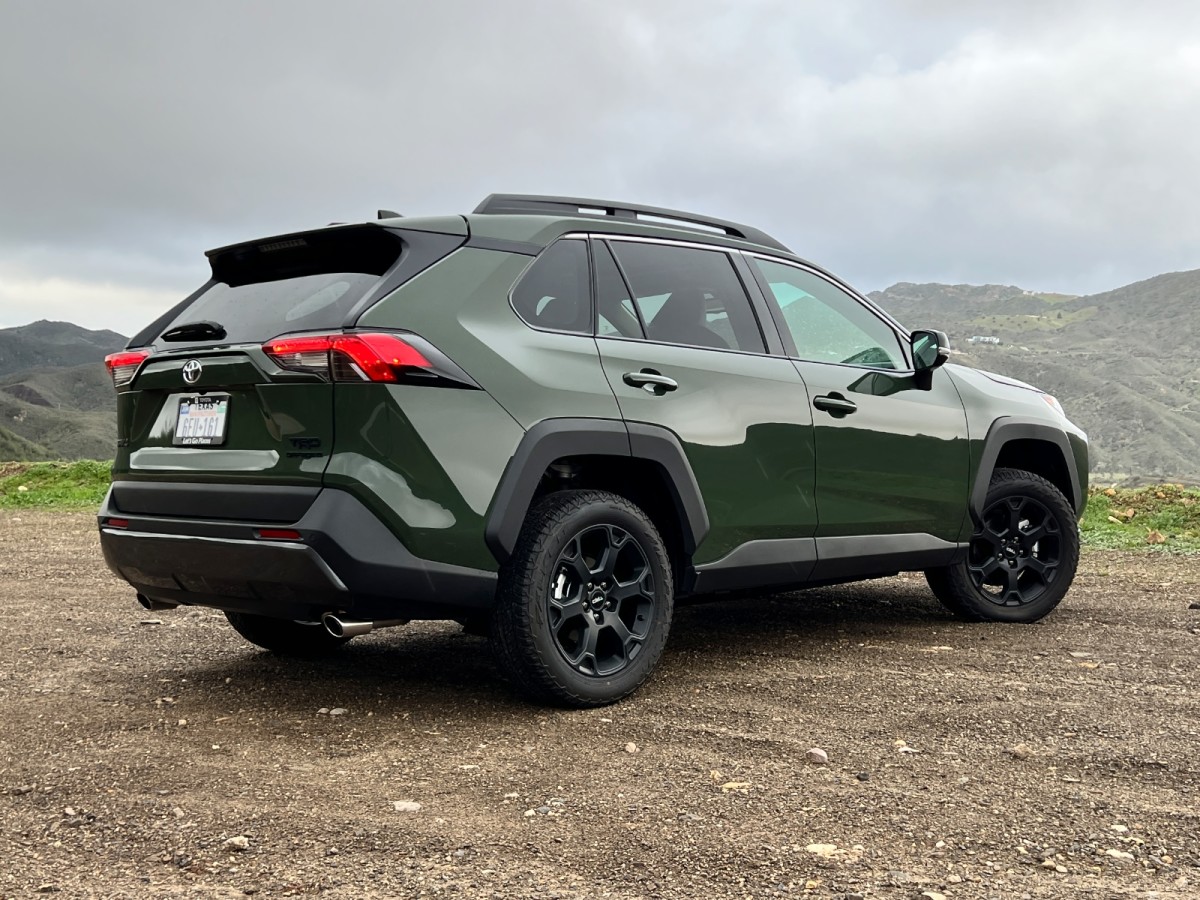
Toyota tries hard to make the RAV4 look tougher than it is. Wearing a frown and grimace, it looks perpetually angry. The lower gray body cladding that’s a part of nearly every SUV recipe displays aggressive angularity, while dual exhaust outlets hint at performance that doesn’t exist. Upper trim levels wear fake front and rear skid plates, and there are two off-road-themed versions with more robust utility-style roof racks.
Our test vehicle was one of those, the TRD Off-Road model that tops the lineup with a base price of $38,295 plus a destination charge of $1,350. Army Green isn’t our favorite RAV4 color, but it doesn’t cost anything extra. The test vehicle did have a digital rearview mirror and the Advanced Technology and Weather option packages, and those brought the manufacturer’s suggested retail price (MSRP) to $41,925, including destination.
You need not spend that kind of money to get a RAV4. Across the gas-engine lineup, prices range from $28,675 for the LE to $38,295 for the TRD Off-Road. Hybrids add two to three grand more, but they’re slightly more powerful and appreciably more fuel-efficient.
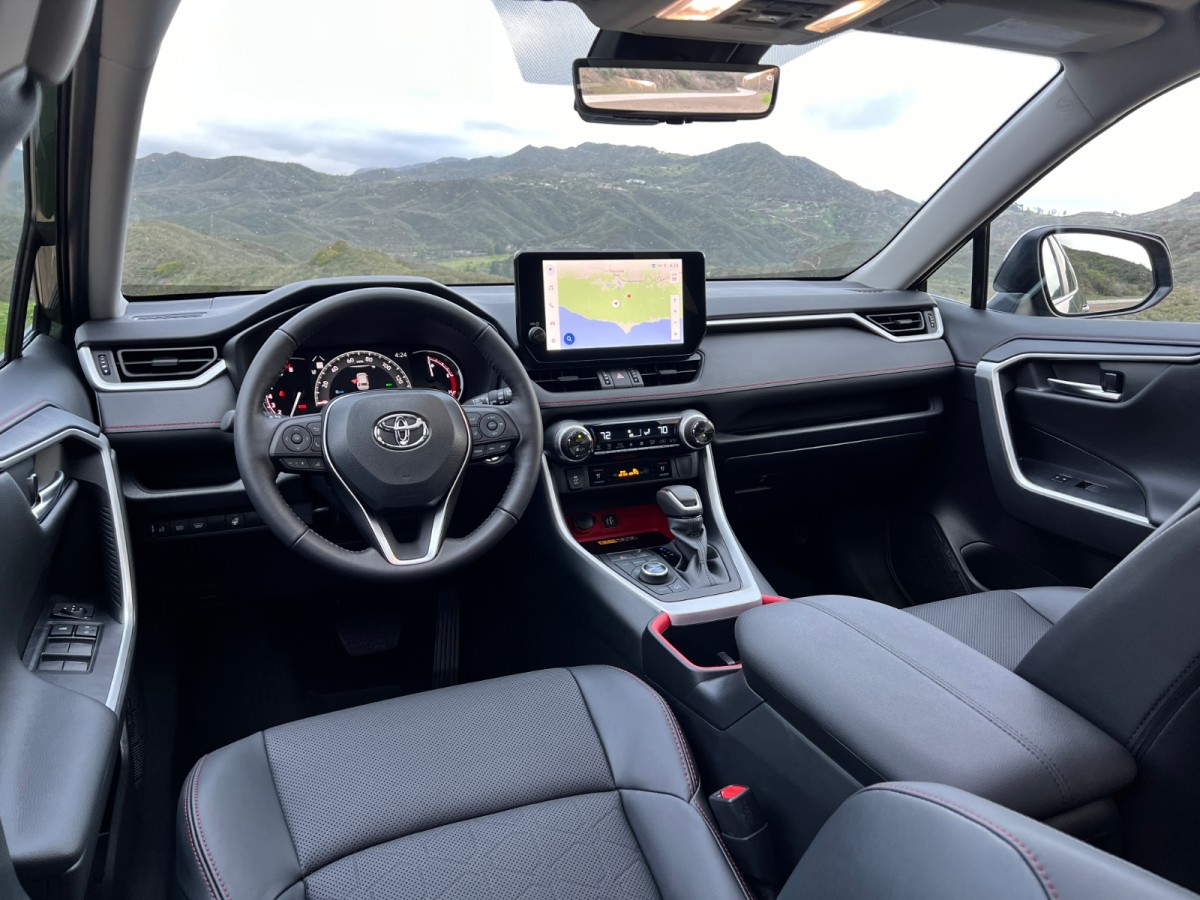
However, the more you budget for a RAV4, the nicer the interior will be. Everything about this SUV’s cabin reflects utility, from the full-width shelf running across the dashboard and robust door handles to the easy-clean surfaces and rubber-lined storage areas. If you want a more upscale look and feel, try one of the contrast-color interior choices in the XLE Premium or Limited trim.
Performance
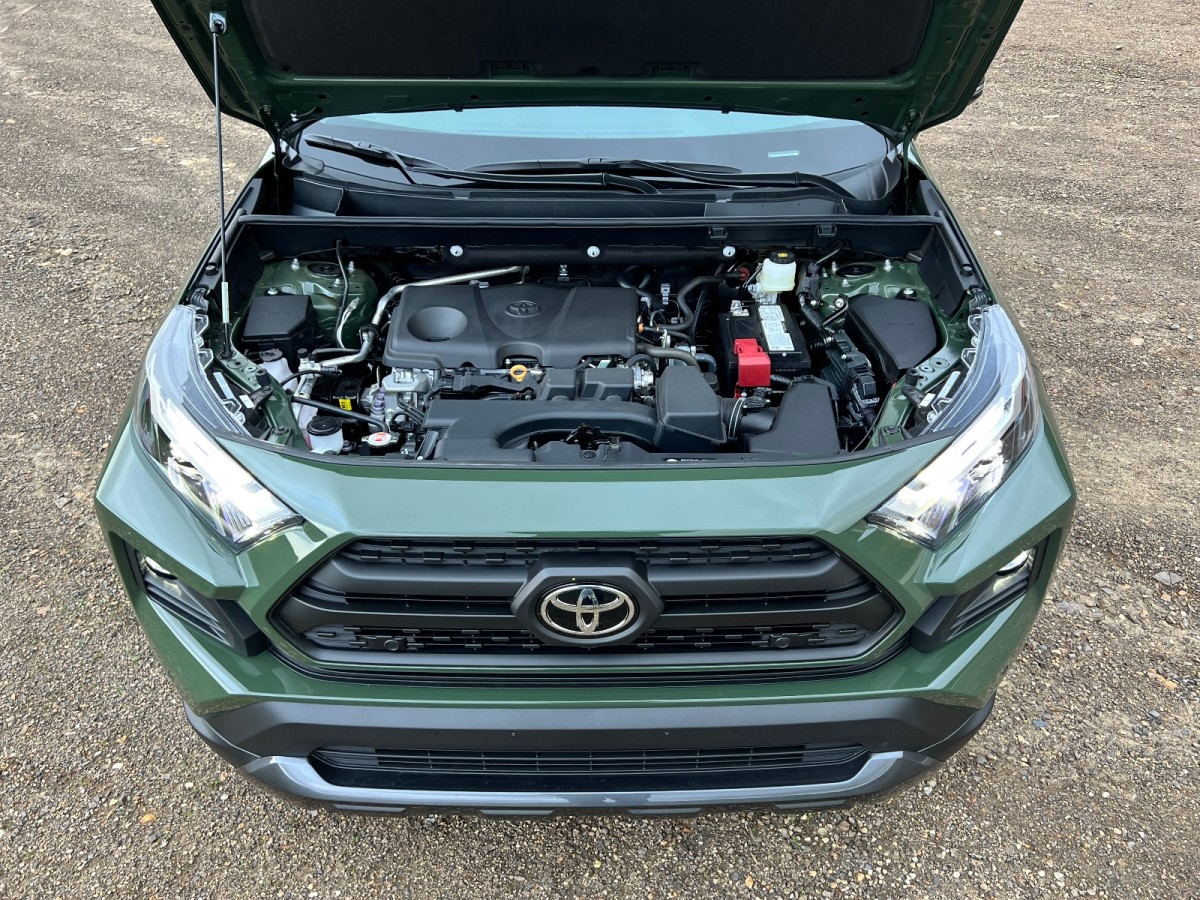
Toyota equips the RAV4 with a 2.5-liter four-cylinder engine making 203 horsepower at 6,300 rpm and 184 pound-feet of torque at 5,000 rpm. Translated, the powertrain’s numbers mean that if you want to access maximum motive force, you need to rev the engine hard.
An eight-speed automatic transmission powers the front wheels unless you choose the torque-vectoring all-wheel drive (AWD) system. Our TRD Off-Road test model had AWD as standard equipment, plus exclusive off-road suspension tuning, an underbody skid plate, and all-terrain tires wrapped around 18-inch matte-black TRD alloy wheels.
Multi-Terrain Select is also standard, equipping the SUV with Normal, Snow, Mud & Sand, and Rock & Dirt driving modes. However, the TRD Off-Road offers the same 8.6 inches of ground clearance as several other RAV4 models. Also, as we would come to discover, the TRD Off-Road does not offer improved approach or departure angles.
After churning the RAV4 through deep mud created by strong Southern California storms fed by atmospheric rivers and zipping along a rutted gravel road, we pulled off Mulholland Highway to snap a few photos. Then, while turning around to exit the location, we scraped the SUV’s lower front fascia on an unseen dirt berm, damaging the plastic and paint. So, while this version of the RAV4 is slightly more capable off the pavement than its siblings, it’s no 4Runner.
That off-road suspension pays dividends during the daily commute, though. It soaks up speed humps and bumps like they’re not even there and shrugs off imperfect pavement without filtering too much information about the surface. Toyota dials in the steering and brakes for the RAV4’s purpose, and the all-terrain tires aren’t a liability on the road. The RAV4 is noisy at freeway speeds, but it’s not the tires causing the racket.
Powerful for the compact crossover class, the RAV4’s normally-aspirated 2.5-liter engine will chirp the front tires and cause a little bit of torque steer while the AWD system’s driveline disconnect gets its act together to transfer some power to the rear wheels. Unfortunately, it sounds loud and unrefined. Nevertheless, the excellent eight-speed automatic and the engine’s reputation for bulletproof dependability take the edge off.
As far as fuel economy goes, the RAV4 TRD Off-Road model’s official EPA fuel economy rating is 28 mpg in combined driving. On the evaluation route, including the light off-roading and mud-churning, the test vehicle averaged 26.6 mpg. By comparison, the similar Toyota RAV4 Hybrid Woodland Edition is rated at 37 mpg, so if you’re sensitive to gas prices, that might be the rugged RAV to get.
Form & function
The point of a RAV4 is recreational activity, so the interior is all about practicality and utility. From the storage shelves, trays, bins, nooks, and crannies to the oversized rubberized control knobs, the RAV4 exudes purpose. But there’s nothing fancy about it.
With TRD Off-Road trim, the seats wear SofTex artificial leather upholstery, and the driver’s seat offers eight-way power adjustment. You’ll need the optional Weather package to get heated and ventilated front seats, a heated steering wheel, and rain-sensing wipers with a de-icer system to complement the standard heated side mirrors. So equipped, it’s ready for just about anything Old Man Winter has planned.
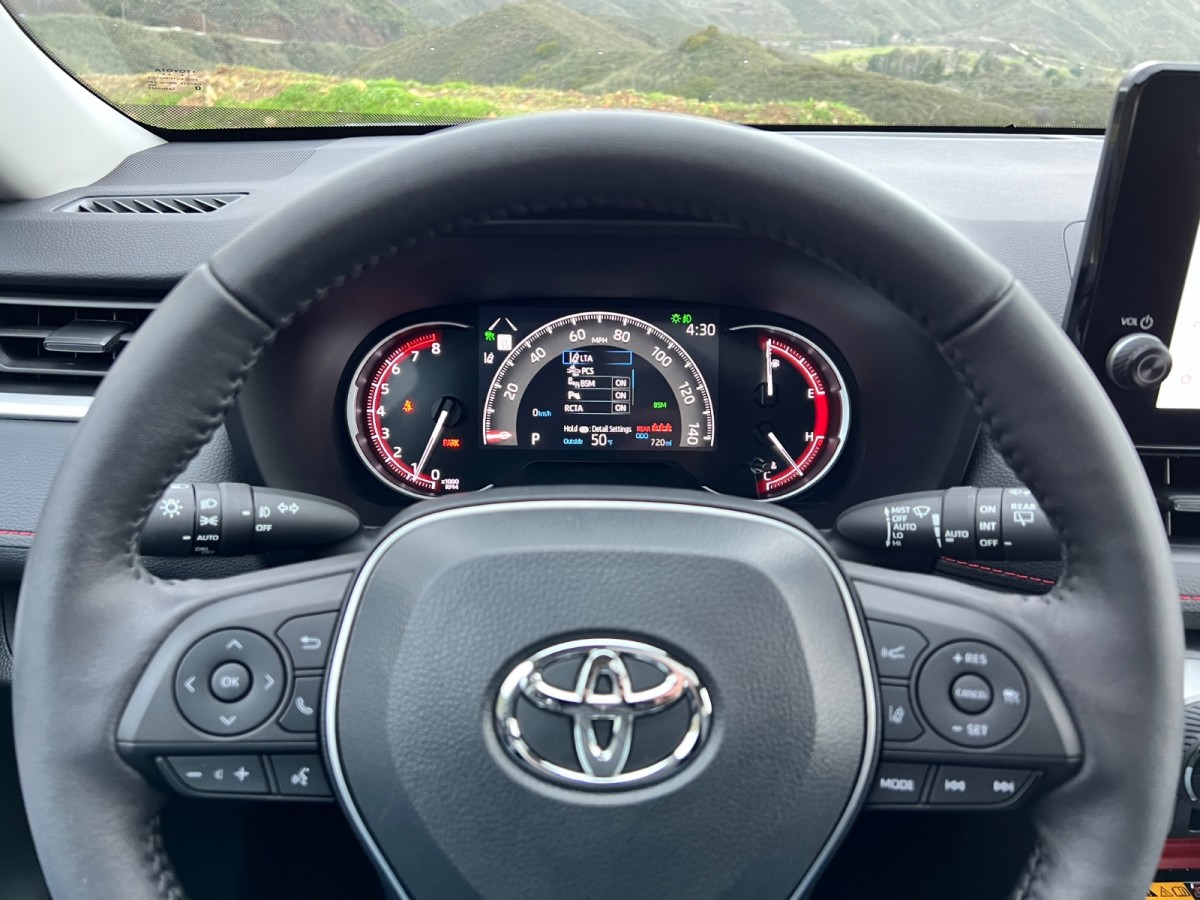
We found the RAV4’s driver’s seat quite comfortable, and the perfectly shaped steering wheel rim is a pleasure to grip. Outward visibility is excellent, too, especially with the optional camera-based digital rearview mirror.
You can easily carry four adults in a RAV4 and five when necessary. The rear seat feels a little too low and lacking in leg support, but the soft front seatbacks and good legroom and footroom boost comfort. The test model also had rear air conditioning vents, USB charging ports, and a fold-down center armrest with cupholders.
Open the power liftgate, and the RAV4 reveals a roomy 37.6 cubic-foot cargo area. Fold the seats down, and that expands to 69.8 cubic feet of cargo space. Both figures are competitive for the segment.

Technology
Though the RAV4 is getting old, the infotainment system features the latest technology in the Toyota arsenal. It’s the Toyota Audio Multimedia system featuring a standard 8-inch and available 10.5-inch touchscreen display, wireless Apple CarPlay and Android Auto, SiriusXM satellite radio, and five different connected services plans.
Service Connect and Safety Connect are included free of charge for ten years, the latter equipping the RAV4 with automatic collision notification and SOS emergency calling. Remote Connect is complimentary for one year, adding remote access to certain vehicle features via smartphone app, such as remote engine starting, door lock/unlock, and others.
Drive Connect is also free for one year. It adds a cloud-based navigation system, a conversational digital voice assistant, and concierge services to the RAV4. Wi-Fi Connect transforms the SUV into an internet hotspot, and comes with a free three-month data plan good for three gigs of data. After that, you’ll need to pay for the service. You can also access your Apple Music and Amazon Music accounts through the Toyota Audio Multimedia interface.
We’ve used this infotainment system in other Toyota and Lexus models, and when all of the connected service plans are active, it is a sophisticated setup.
Generally, our complaints pertain to three things. First, the lack of a multi-panel Home screen where you can reference more than one thing at a time (e.g. navigation map, radio, and phone) causes unnecessary distraction. Second, the only way we found to exit Apple CarPlay in favor of SiriusXM was to use a voice command. Third, the light and delicate font can be hard to read on the white daytime background of the display.
Our test vehicle had an active Drive Connect plan, and the digital voice assistant performed flawlessly except for two problems. First, we could only hear the assistant’s voice when asking for a climate control temperature change. Otherwise, it was silent, and twisting the volume knob did not help. Second, when we said, “I need to go to a hospital!” the system did not parse its data set of medical facilities only for hospitals.
A JBL premium audio system is available for the RAV4, but our test vehicle didn’t have it. The standard speakers are decent, but nothing true audiophiles might find satisfying.
The test vehicle did have the optional digital rear-view mirror, which uses a camera to give you a clear view to the back when the RAV4 is packed to the roof. It did not have the available panoramic surround-view camera with perimeter scanning, which may have prevented us from introducing the test vehicle’s chin to the terrain.
Safety
The 2024 RAV4 has Toyota Safety Sense 2.5 (TSS 2.5), a comprehensive collection of advanced driver-assistance systems (ADAS). However, the base LE trim does not come with a blind-spot monitoring system with rear cross-traffic alert, which is arguably more important to have than some of the standard TSS 2.5 safety features.
In use, TSS 2.5 is adequate. While driving on Pacific Coast Highway near Malibu, California, with the adaptive cruise control and lane-centering assist systems on, the incessant beeping as the latter feature turned off and back on when rounding the road’s curves demonstrated the tech is better when used on straighter highways.
On a section of mostly straight freeway with two lanes running in each direction, these two features performed better. The lane-centering assist was somewhat lazy about keeping the RAV4 exactly centered, but we don’t mind that because the alternative is constant steering inputs that can make the tech too intrusive.
In moderate traffic on one of Los Angeles’s notorious freeways, the adaptive cruise control smoothly managed distances to vehicles ahead. However, in cases where another motorist traveling appreciably slower than the RAV4 cut into the gap ahead, braking erred on the side of caution and, as a result, was typically too excessive for the situation.
Otherwise, aside from a handful of inaccurate lane-departure warnings, the TSS 2.5 system worked well.
Unfortunately, the SUV has lost its Top Safety Pick award from the Insurance Institute for Highway Safety (IIHS). The organization has tightened restrictions again, and the 2024 RAV4 does not qualify. Check its chart, and you’ll spot a Marginal rating in the latest small overlap frontal-impact crash test and an Acceptable instead of Good rating in the latest side-impact test.
Those results are likely due to the current-generation RAV4’s design and engineering age, and they mean it’s time for an all-new version of the SUV ASAP.

Cost-effectiveness
If you’re buying a Toyota RAV4 and you’re planning to drive it for as long as it can last, then the most cost-effective choice is the hybrid model. It costs more upfront, but over the years, you’ll ultimately save money.
Within the standard gas-only RAV4 family, the TRD Off-Road model is the least cost-effective version of the SUV. It has the highest price tag and is one of the least efficient versions of this Toyota. Not only that, but despite its all-terrain tires, underbody skid plate, and Multi-Terrain Select settings, it’s not capable enough off-road to justify its price. The biggest benefit of choosing this version is the TRD-tuned suspension’s on-road ride quality.
All Toyota RAV4s come with free scheduled maintenance for two years or 25,000 miles, a nice perk. Also, the complimentary trial subscriptions to connected services are generous, especially the one for the Safety Connect plan. These added ownership benefits add value to a RAV4 purchase, and the SUV’s longstanding reputation for reliability is also worth some peace of mind.
Overall, the 2024 Toyota RAV4 is a durable, multi-purpose tool for daily living. But it is starting to show its age, and the time has come for a redesigned, next-generation RAV4. If you’d rather not wait for one, consider the Honda CR-V, Hyundai Tucson, Kia Sportage, Nissan Rogue, Mazda CX-50, and Subaru Forester.
Find Out More About Toyota RAV4 Reliability
Ready to take a more detailed look at the Toyota RAV4's reliability record? Check out these resources:

What owners say
"Overall, drivers are impressed with the 2024 Toyota RAV4, praising its comfort and features like the large screen. However, many feel it is overpriced compared to similar models. Owners particularly like the engine's reliability but mention that certain interior elements, like the leather seats, don't meet expectations."
overall, this is an amazing vehicle. It’s unfortunate that Toyota is overpriced for what you get comfort wise, and exterior wise,however, the engine and transmissions are bulletproof.
June 6, 2026Very good model just overpriced compared to equivalent models of same years and kilometers.
October 15, 2026Amazing Car! We have gotten nothing but compliments on it!
April 21, 2025What owners say
overall, this is an amazing vehicle. It’s unfortunate that Toyota is overpriced for what you get comfort wise, and exterior wise,however, the engine and transmissions are bulletproof.
June 6, 2026Very good model just overpriced compared to equivalent models of same years and kilometers.
October 15, 2026Amazing Car! We have gotten nothing but compliments on it!
April 21, 2025I think it has what I need it's definitely a good value ,the seat is a bit to low for short people
November 10, 2025This car is very comfortable but just wish it had remote start.
March 19, 2026Had the car a few days now and Love it. Especially Love the 12.4 Screen and the Blue Print color as its so shinny in the Sun and then turns Black at night. Love it . Heated seats when cold and air seats in the Florida Sun. Very good Sales. Darko Jevtic, and Michael Henkel Jr. Very Good!!
January 2, 2024This RAV4 has all the features I would want in a mid size vehicle!
February 10, 2024Leather seats looked cheap., probably the because it was the first year of the debate. I thought it drove well but preferred another car
September 11, 2024Trims & specs
Base MSRP $38,380 | Seating 5 |
Engine 2.5L 203 hp I4 | Cargo Capacity 37.5 cu ft |
Combined MPG 30 | Drivetrain AWD |
Base MSRP $28,675 | Seating 5 |
Engine 2.5L 203 hp I4 | Cargo Capacity 37.5 cu ft |
Combined MPG 31 | Drivetrain FWD |
Base MSRP $30,075 | Seating 5 |
Engine 2.5L 203 hp I4 | Cargo Capacity 37.5 cu ft |
Combined MPG 30 | Drivetrain AWD |
Base MSRP $38,295 | Seating 5 |
Engine 2.5L 203 hp I4 | Cargo Capacity 37.5 cu ft |
Combined MPG 28 | Drivetrain AWD |
Base MSRP $34,870 | Seating 5 |
Engine 2.5L 203 hp I4 | Cargo Capacity 37.5 cu ft |
Combined MPG 30 | Drivetrain AWD |
Base MSRP $33,075 | Seating 5 |
Engine 2.5L 203 hp I4 | Cargo Capacity 37.5 cu ft |
Combined MPG 31 | Drivetrain FWD |
Base MSRP $34,475 | Seating 5 |
Engine 2.5L 203 hp I4 | Cargo Capacity 37.5 cu ft |
Combined MPG 30 | Drivetrain AWD |
Base MSRP $30,185 | Seating 5 |
Engine 2.5L 203 hp I4 | Cargo Capacity 37.5 cu ft |
Combined MPG 31 | Drivetrain FWD |
Base MSRP $31,585 | Seating 5 |
Engine 2.5L 203 hp I4 | Cargo Capacity 37.5 cu ft |
Combined MPG 30 | Drivetrain AWD |
Base MSRP $36,980 | Seating 5 |
Engine 2.5L 203 hp I4 | Cargo Capacity 37.5 cu ft |
Combined MPG 31 | Drivetrain FWD |


Pricing trends
MSRP range
$28,675 - $38,380
Current avg. market price
$30,546
Trending down by 1.3% this month
May 2026 - October 2026