2024 Hyundai Santa Fe Reviews, Pricing & Specs



Pros & cons
What we like
Stylish design
Multiple powertrain options
Impressive technology
What to consider
Cramped third row
Pedestrian performance
Expensive in top trims
The CarGurus verdict
The redesigned 2024 Hyundai Santa Fe blends brash styling with impressive technology.
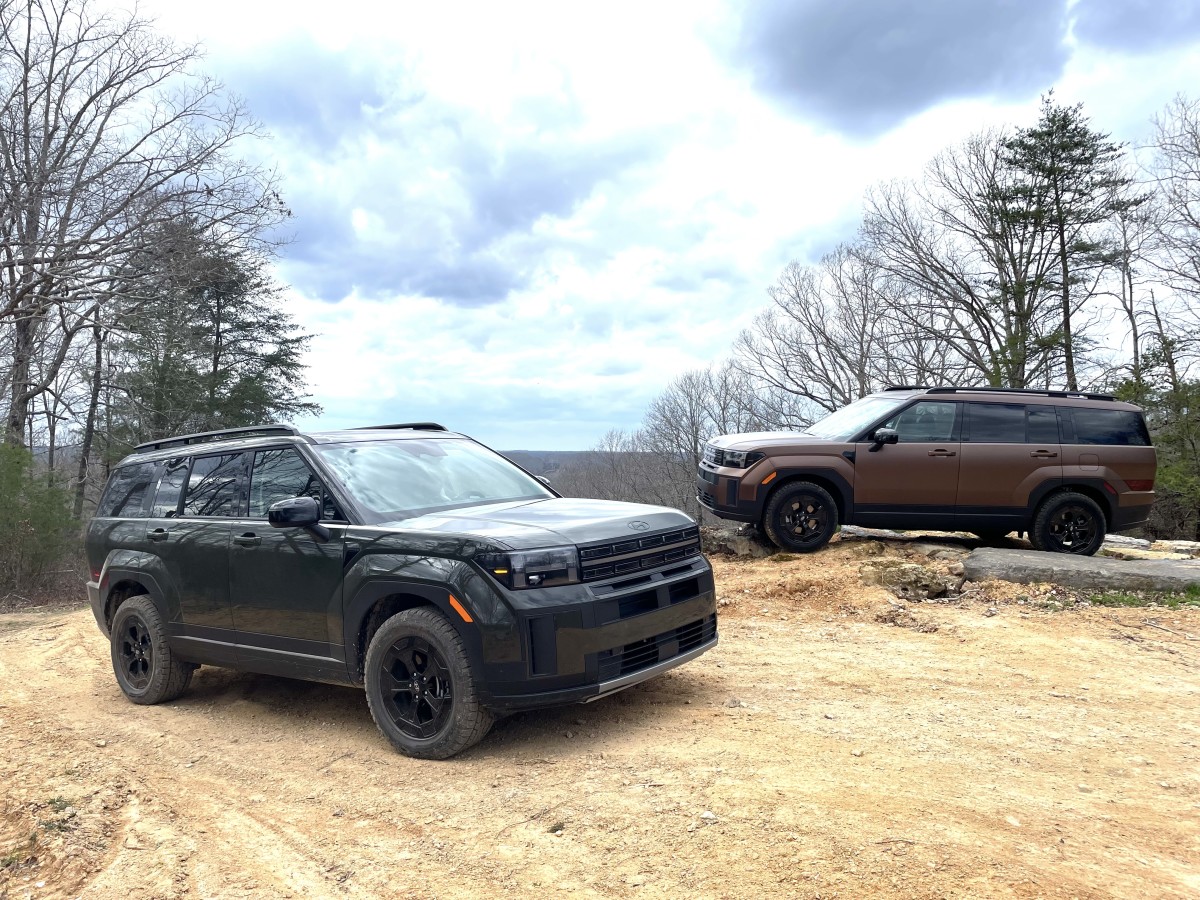
The Hyundai Santa Fe is fully redesigned for 2024. It marks a significant departure for the brand in terms of styling, with a bold and blocky profile and stance reminiscent of, dare we say it, a certain British brand known for its off-road prowess. The Santa Fe’s redesign has as much substance as style, with a longer wheelbase, standard third-row seats, and new premium amenities, including a “terrace” approach to designing passenger and cargo space.
Verdict: According to Hyundai, compact SUVs make up 15% of the brand’s sales, and the company expects the Santa Fe to grow that number. Overall, based on our exploration and time behind the wheel, the 2024 Santa Fe’s redesign is successful, as long as it doesn’t overshadow the rest of Hyundai’s lineup.
out of 10 expert review
Look & feel
While the Hyundai Palisade, Ioniq 5, and Ioniq 6 gave hints of a radical-in-intention yet gradual-in-execution new aesthetic for the Hyundai brand over the past several years, it’s genuinely difficult to discern if the Santa Fe is the culmination of those steps, or something else entirely.
It’s not a bad look, not at all, just entirely different. That’s significant, because the Ioniq design in particular communicates the brand’s embrace of forward-looking technology and efficiency. Instead of the sleek, futuristic, hatchback-styled crossovers we’ve come to appreciate, the Santa Fe goes in the exact opposite direction.
“A box is an optimal shape for storage capacity,” said Hyundai’s design chief SangYup Lee, at our pre-drive press briefing. Mr. Lee explained further that his team’s “job is to make this box elegant-looking and premium-looking.”
Furthermore, the new Santa Fe is more aerodynamically efficient than its predecessor, much more so than any casual observer could expect from a box. It looks upscale. It turns heads. The staff at a hole-in-the-wall general store in rural Tennessee, and some members of the motorcycle gang holding court on the front porch, came outside to admire our fleet.
A palette of sophisticated exterior colors, including several matte options, adds to the overall effect, and Hyundai carries over the new, anodized-finish badging that was recently introduced on the Ioniq 6. It’s elegant overall, and the XRT trim level adds a combination of dark chrome and black cladding and trim. Most trims get standard 18-inch alloy wheels, while Limited and Hybrid Calligraphy versions get 20-inch wheels, and the gas-only Calligraphy gets 21-inch wheels.
Inside, the Santa Fe offers premium styling. Our test drive was limited to the all-terrain XRT and loaded Calligraphy trims, and we found few faults in either. Some out-of-the-way surfaces, like the door panels in the Calligraphy, were made of hard material, but they’re integrated in such a way that we first encountered plenty of softly-padded surfaces, like armrests and windowsills, to soften the effect. Others were positively decadent, like the soothing and cocooning fabric covering the headliner, which we coincidentally think would make for a lovely winter scarf and hat.

Performance
The 2024 Santa Fe’s base powertrain is a 2.5-liter turbocharged four-cylinder engine paired with an eight-speed dual-clutch automatic transmission, rated for 277 horsepower and 311 pound-feet of torque. Front-wheel drive (FWD) is standard across the lineup with all-wheel drive (AWD) optional, with the exception of the soft-off-road-focused XRT trim, which gets AWD standard.
Normal, Sport, and Snow driving modes come standard, with Sport adjusting throttle response and steering for a peppier feel. The XRT adds off-road modes and settings.
Later in the model year, the Santa Fe will be offered with a 1.6-liter turbocharged four-cylinder hybrid engine and six-speed automatic transmission, good for an estimated combined 231 hp and 271 lb-ft of torque.
In terms of projected fuel economy, FWD base versions of the Santa Fe are EPA-rated for 20 mpg city, 29 mpg highway, and 24 mpg combined. Those ratings drop to 20/28/23 with AWD, and 19/26/22 for the XRT model. The Santa Fe Hybrid rates 36 mpg city, 35 mpg highway and 36 mpg combined with FWD and 35/34/34 with AWD.
The drop in XRT EPA ratings is due to its extra ground clearance, almost 1.5 inches, and 30-inch all-terrain tires. On the flip side, while most Santa Fe models max out at 3,500 pounds of towing capacity, the XRT gains extra capacity of 1,000 pounds, thanks to additional cooling with a bigger fan and more air inlets.
On the road, the Santa Fe Calligraphy we tested broadcasted classic Hyundai driving dynamics. The surprises here are in the decadence of the overall package, but not necessarily in the performance. It’s smooth and mostly stable; acceleration, throttle response, and shifting exhibit few misses on straights and through curvy hills. The Santa Fe showcases notable body roll through turns, which may cause passengers to slide back and forth in their seats a bit, but that’s really the only downside of the experience.
Our test drive included an off-road jaunt in the Santa Fe XRT. It’s comparable in capability to SUVs like the Kia Telluride X-Pro, Nissan Pathfinder Rock Creek, and Subaru Forester and Outback Wilderness trims. Like those competitors, the Santa Fe XRT can easily handle a trip to a somewhat remote campsite, thanks in large part to its ground clearance and robust tires. The off-road settings are straightforward and easy to access, and the hill-descent-control feature lends confidence on steep slopes.

Form & function
Let’s take a look at that box. Compared to the previous-generation Santa Fe, it features a wheelbase about two inches longer, with a body that’s two inches longer and taller, as well. Hyundai says that almost all of that extra space was dedicated to the cargo area, since the Santa Fe’s design was inspired by the concept of “chabak,” a combination of “cha” (car) and “sak” (stay) in Korean. Hyundai designed the big cargo area, complete with an extra-wide tailgate, to be comfortable for car camping and tailgating. The design team thought of the area like a terrace, with an inviting floor and plenty of storage to prevent clutter.
That said, the focus on the cargo area doesn’t detract from the rest of the Santa Fe’s design. Though the third row is snug, like any small or midsize SUV that can accommodate six or seven passengers, the first and second rows are spacious and welcoming. Hyundai notes that the Santa Fe is about six inches shorter and three inches narrower than the Palisade (and Kia Telluride, for that matter), and therefore, these two vehicles shouldn’t cannibalize each other’s market. Our advice is, if you really need that third row to be fully functional, go for the Palisade.
Otherwise, if the second row will bear the brunt of the passenger burden, the Santa Fe is a great pick. Depending on trim, it’s available with a choice of a bench or a pair of fully reclining captain’s chairs that tilt back. Stain-resistant cloth upholstery dresses the base SE, while SEL and XRT trim levels get robust synthetic leather. The Limited features real leather and the Calligraphy wears plush quilted Nappa leather. All but the SE feature heated front seats, and Limited and Calligraphy trims add ventilation to the front seats as well. All three rows get storage pockets and bottle holders, another nod to the concept of a calm, well-organized, relaxing space.
The cargo area offers 14.6 cubic feet of cargo space, which expands to 40.5 and 79.6 cubic feet with the third and second rows folded, respectively. The optional roof rails can support 220 pounds, and Hyundai integrated a new grab handle that sits flush in the pillar just behind the rear door and extends to provide support when loading cargo.
Limited and Calligraphy models introduce a new UV sanitization compartment in the glovebox, which was originally conceived during the early days of the Covid-19 pandemic. In other words, Hyundai notes, it was thought up in 2020 and is just now getting rolled out—that’s how long it can take to introduce a cool new feature. Now the Santa Fe can sterilize smartphones, sunglasses, and other small objects in about 10 minutes.

Technology
The centerpiece of the 2024 Hyundai Santa Fe’s cabin is the curved panoramic display that sweeps behind the steering wheel and flows elegantly above the center console, making XRT, Limited, and Calligraphy trims feel extra decadent.
Hyundai claims it’s the first of its kind in the segment. It’s a fine line, incorporating digital real estate like this without making it feel ostentatious, or worse, distracting and overwhelming.
In our experience, the touchscreen display was another one of the Santa Fe’s delights, with easy access to controls, intuitive menus, and super-crisp graphics and camera views. Pairing a phone to wireless Apple CarPlay took seconds, and it comes standard across the lineup along with wireless Android Auto. This system includes a 12-speaker Bose stereo, dynamic voice recognition, and a Wi-Fi hot spot that supports music streaming services. Plus, these trims get a total of six USB ports.
The SE and SEL trims get a simpler 12.3-inch touchscreen infotainment display that we didn’t get the opportunity to see but is still perfectly serviceable with plenty of features, including four USB ports. All but the base SE get wireless charging in the center console, and the Calligraphy even supplies a pair of wireless chargers.
Other features include Hyundai’s BlueLink system for vehicle access and information, which on SEL and above trims has been upgraded to work in lieu of a physical key fob. The system works with Apple and Android devices to automatically detect access. Owners can use the app to grant or revoke levels of access to another person, such as locking and unlocking certain doors of the vehicle or granting permission to drive.
All but the SE and SEL trims include Hyundai Pay, which was introduced in late 2023. This system stores payment information to automatically pay for services at certain vendors, such as fuel stations and parking garages that have partnered with Hyundai so far. The system enhances owners’ safety and security by preventing credit card skimming and reducing the need to open a wallet in public. The Santa Fe also offers Hyundai’s first biometric fingerprint scanner, which can be used to control valet mode.

Safety
The 2024 Hyundai Santa Fe has not yet been crash-tested by the Insurance Institute for Highway Safety (IIHS) or National Highway Traffic Safety Administration (NHTSA), though Hyundai’s vehicles typically fare well in these evaluations.
As is typical for Hyundai, and increasingly in line with shoppers’ expectations for this segment, most advanced safety and driver-assistance features come standard. The base SE trim includes a reversing camera, stop-and-go adaptive cruise control, forward collision-avoidance assist, intersection assist (detects oncoming obstacles while making a left turn), pedestrian and cyclist detection, blind-spot monitors, rear cross-traffic alert with automatic emergency braking, safe-exit assist, lane-keep assist, lane-following assist, driver-attention monitoring with hands-off alert, and a rear-occupant reminder system.
The SEL trim adds an upgraded rear-occupant reminder system, forward-attention warning, and side-view mirrors with turn signals. The XRT trim level adds Hyundai’s highway limited hands-free driving system. With the Limited trim, Hyundai provides a a 360-degree camera system, blind-spot view monitor, rain-sensing windshield wipers, front, rear, and side parking sensors, reverse parking collision assist, remote automatic parking, and a sanitizing compartment in the glovebox.
Finally, the loaded Calligraphy adds a widescreen head-up display (HUD) and upgraded blind-spot and forward collision avoidance systems. On our road test, the traffic-sign recognition system occasionally misread Tennessee’s state route signs as speed limit signs, but otherwise we experienced no flaws in the loaded Santa Fe Calligraphy’s safety tech.
Of note, the 2024 Santa Fe is the first Hyundai vehicle with driver monitoring, included across the lineup. This system combines an infrared camera on the steering column to track alertness and capacitive sensors in the steering wheel that can detect whether or not the driver’s hands are on the wheel. If the system senses the driver is not paying attention or is incapacitated, it issues different levels of warnings before bringing the vehicle to a stop and notifying authorities of a potential emergency.

Cost-effectiveness
The 2024 Hyundai Santa Fe is built in Alabama and is on sale now. Shoppers who might be considering a Santa Fe have more options than ever, so let’s look at how they stack up. The Santa Fe has an extensive trim range, starting at $33,950 for the SE FWD model and topping off at $48,800 for the Calligraphy Hybrid AWD. Across the lineup, AWD is an $1,800 upgrade. As is often the case, the best buys fall somewhere in the middle of the trim range, but it depends what you want from your Santa Fe, and what you’d consider buying instead.
Hyundai calls the Santa Fe a compact SUV, which means it competes with vehicles like the Subaru Forester and Toyota RAV4. Both are very well equipped for their respective price tags of $27,095 and $28,675, and the Forester even comes standard with AWD. Like the Santa Fe, the Volkswagen Tiguan, which starts at $28,880, is notable for its optional third row, which is rare for the class.
The Santa Fe’s pricing structure, as well as its newly standard third row, align with midsize SUV territory as well. Other three-row contenders here include the Kia Sorento for $30,390, Subaru Ascent for $34,395, Volkswagen Atlas for $36,985, Honda Pilot for $37,090, Toyota Highlander for $39,270, and Mazda CX-90 for $39,595. Of this group, the Kia and Subaru provide the best entry-level values with lots of features for the lowest prices; for elevated fit and finish, look to the Mazda lineup.
Regardless of configuration, the Santa Fe’s EPA ratings are in line with its contemporaries. The Santa Fe Hybrid, in particular, keeps pace with the Toyota Highlander Hybrid in terms of fuel economy.
With such an extensive trim lineup, there are a couple options for the best Santa Fe configuration. The well-equipped base SE is a great start, but the SEL is our bet because, for just $2,500 more than the SE, it adds synthetic leather upholstery, heated front seats, a power-adjustable driver’s seat, the curved panoramic display, a wireless smartphone charger, and an upgraded rear occupant alert system that actually senses occupants (instead of just keeping track of whether or not the rear door was opened).
The SEL is the base trim for the Santa Fe Hybrid lineup, and is a compelling choice at $36,950 when the hybrid becomes available. The top-end Calligraphy is likely to be a budget-buster for most customers in this segment ($50,900 for our test vehicle, including $1,000 for Earthy Brass Matte paint and $210 for carpeted floor mats). It’s lovely, but it’s honestly more Santa Fe than most people will need.

What owners say
We bought this car primarily because of the value, in terms of what we get for the money. We looked at many other manufacturers like Honda, Toyota, Subaru, Kia, Nissan and the Hyundai Santa Fe, in the Calligraphy trim level had the most and best features for the price.
October 22, 2024The car is a great upgrade from years before. The third row is very nice and a great size for teenagers. The ride is smooth and quiet.
February 20, 2024It’s so smooth when you drive and all the features are wonderful. Very comfortable and lots of leg room for my 5’10-6’7 family. Great price for an SUV. It’s a 4 cylinder, but the turbo allows it to get up and go while passing or entering a freeway.
June 1, 2024Trims & specs
Base MSRP N/A | Seating N/A |
Engine N/A | Cargo Capacity N/A |
Combined MPG N/A | Drivetrain N/A |
Base MSRP $45,150 | Seating 7 |
Engine 2.5L 277 hp I4 | Cargo Capacity 14.6 cu ft |
Combined MPG 24 | Drivetrain AWD |
Base MSRP $38,250 | Seating 7 |
Engine 2.5L 277 hp I4 | Cargo Capacity 14.6 cu ft |
Combined MPG 24 | Drivetrain AWD |
Base MSRP $43,350 | Seating 7 |
Engine 2.5L 277 hp I4 | Cargo Capacity 14.6 cu ft |
Combined MPG 24 | Drivetrain FWD |
Base MSRP $40,600 | Seating 7 |
Engine 2.5L 277 hp I4 | Cargo Capacity 14.6 cu ft |
Combined MPG 22 | Drivetrain AWD |
Base MSRP $36,450 | Seating 7 |
Engine 2.5L 277 hp I4 | Cargo Capacity 14.6 cu ft |
Combined MPG 24 | Drivetrain FWD |
Base MSRP $48,300 | Seating 6 |
Engine 2.5L 277 hp I4 | Cargo Capacity 14.6 cu ft |
Combined MPG 24 | Drivetrain AWD |
Base MSRP $46,500 | Seating 6 |
Engine 2.5L 277 hp I4 | Cargo Capacity 14.6 cu ft |
Combined MPG 24 | Drivetrain FWD |
Base MSRP $33,950 | Seating 7 |
Engine 2.5L 277 hp I4 | Cargo Capacity 14.6 cu ft |
Combined MPG 24 | Drivetrain FWD |
Base MSRP $35,750 | Seating 7 |
Engine 2.5L 277 hp I4 | Cargo Capacity 14.6 cu ft |
Combined MPG 24 | Drivetrain AWD |


Pricing trends
MSRP range
$33,950 - $48,300
Current avg. market price
$29,969
Trending down by 2.1% this month
May 2026 - November 2026