INFINITI QX80 vs Hyundai IONIQ 9
Overview | |
MSRP$83,750 | MSRP$58,995 |
Listings7223 | Listings204 |
Ratings & Reviews | |
User Reviews | User Reviews |
Expert reviews7.7 out of 10 | Expert reviews7.3 out of 10 |
Pros
Cons
| Pros
Cons
|
Reviews SummaryThe traditional body-on-frame SUV is rarely a wise choice these days. These vehicles are heavy and inefficient, but they can be the right option for buyers who need to carry lots of passengers and either tow trailers or go off-roading. The 2026 Infiniti QX80 carries up to seven people and can tow up to 8,500 pounds, while also adding luxury and some thoughtful features that help it stand out against competitors such as the Cadillac Escalade and the Lincoln Navigator. Redesigned for the 2025 model year, the 2026 QX80 is unchanged except for a new Sport trim level. Verdict: The 2026 Infiniti QX80 appeals for luxury, space, technology, and towing capacity, but poor fuel economy and cumbersome handling mean more nimble crossover SUVs are better for most families. | |
Reviews SummaryAlthough the 2026 Hyundai Ioniq 9 isn’t the first three-row electric SUV through the door, it may be the best choice for most shoppers. With a starting price of $60,555 and qualifying for a $7,500 federal EV tax credit, it’s more affordable than a Tesla Model X or a Rivian R1S, and its standard 110.3-kWh battery pack provides a long range compared to a base-model Kia EV9. Verdict: The Hyundai Ioniq 9 isn’t a perfect vehicle but it offers terrific passenger space, good tech, and family-friendly features. Shoppers may find its design polarizing (you could easily say the same about the Hyundai Ioniq 5 or the Ioniq 6), but families interested in electric vehicles will do well to test drive this new option. | |
No video found | |
Popular Features & Specs | |
Engine | Engine215 hp Electric |
Drivetrain | DrivetrainRWD |
Seating Capacity8 | Seating Capacity7 |
EV Battery Capacity | EV Battery Capacity110 kWh |
Fuel Economy (City) | Fuel Economy (City)103 MPG/MPGe |
Fuel Economy (Highway) | Fuel Economy (Highway)81 MPG/MPGe |
Battery Charge Time (120V) | Battery Charge Time (120V)93 hours |
Battery Charge Time (240V) | Battery Charge Time (240V)9.7 hours |
Engine | |
Engine Name | Engine Name215 hp Electric |
Battery Charge Time (120V) | Battery Charge Time (120V)93 hours |
Battery Charge Time (240V) | Battery Charge Time (240V)9.7 hours |
Drivetrain | DrivetrainRWD |
Fuel Economy | |
EV Battery Capacity | EV Battery Capacity110 kWh |
Fuel Economy (City) | Fuel Economy (City)103 MPG/MPGe |
Fuel Economy (Highway) | Fuel Economy (Highway)81 MPG/MPGe |
Interior | |
Seating Capacity8 | Seating Capacity7 |
Key Features | |
Navigation SystemStandard | Navigation SystemStandard |
Sunroof/MoonroofStandard | Sunroof/Moonroof |
Safety | |
Front Crash Overall | Front Crash Overall5 |
Side Crash Overall | Side Crash Overall5 |
Dimensions & Capacity | |
Cargo Space20.4 cu ft | Cargo Space21.9 cu ft |
Curb Weight5816 lbs | Curb Weight5507 lbs |
Height76.9 in | Height70.5 in |
Length211.2 in | Length199.2 in |
Width92.5 in | Width78.0 in |
Wheelbase121.1 in | Wheelbase123.2 in |
Maximum Payload1455 lbs | Maximum Payload1393 lbs |
Number of doors4 | Number of doors4 |
Maximum Towing Capacity8500 lbs | Maximum Towing Capacity3500 lbs |
Standard Towing Capacity8500 lbs | Standard Towing Capacity |
Overview | ||
MSRP | $83,750 | $58,995 |
Listings | ||
Ratings & Reviews | ||
User reviews | ||
Expert reviews | 7.7 out of 10Read full review | 7.3 out of 10Read full review |
Pros & cons | Pros
Cons
| Pros
Cons
|
Summary | The traditional body-on-frame SUV is rarely a wise choice these days. These vehicles are heavy and inefficient, but they can be the right option for buyers who need to carry lots of passengers and either tow trailers or go off-roading. The 2026 Infiniti QX80 carries up to seven people and can tow up to 8,500 pounds, while also adding luxury and some thoughtful features that help it stand out against competitors such as the Cadillac Escalade and the Lincoln Navigator. Redesigned for the 2025 model year, the 2026 QX80 is unchanged except for a new Sport trim level. Verdict: The 2026 Infiniti QX80 appeals for luxury, space, technology, and towing capacity, but poor fuel economy and cumbersome handling mean more nimble crossover SUVs are better for most families. | Although the 2026 Hyundai Ioniq 9 isn’t the first three-row electric SUV through the door, it may be the best choice for most shoppers. With a starting price of $60,555 and qualifying for a $7,500 federal EV tax credit, it’s more affordable than a Tesla Model X or a Rivian R1S, and its standard 110.3-kWh battery pack provides a long range compared to a base-model Kia EV9. Verdict: The Hyundai Ioniq 9 isn’t a perfect vehicle but it offers terrific passenger space, good tech, and family-friendly features. Shoppers may find its design polarizing (you could easily say the same about the Hyundai Ioniq 5 or the Ioniq 6), but families interested in electric vehicles will do well to test drive this new option. |
Video | No video found | |
Popular Features & Specs | ||
Engine | 215 hp Electric | |
Drivetrain | RWD | |
Seating Capacity | 8 | 7 |
EV Battery Capacity | 110 kWh | |
Fuel Economy (City) | 103 MPG/MPGe | |
Fuel Economy (Highway) | 81 MPG/MPGe | |
Battery Charge Time (120V) | 93 hours | |
Battery Charge Time (240V) | 9.7 hours | |
Engine | ||
Engine Name | 215 hp Electric | |
Battery Charge Time (120V) | 93 hours | |
Battery Charge Time (240V) | 9.7 hours | |
Drivetrain | RWD | |
Fuel Economy | ||
EV Battery Capacity | 110 kWh | |
Fuel Economy (City) | 103 MPG/MPGe | |
Fuel Economy (Highway) | 81 MPG/MPGe | |
Interior | ||
Seating Capacity | 8 | 7 |
Key Features | ||
Navigation System | Standard | Standard |
Sunroof/Moonroof | Standard | |
Safety | ||
Front Crash Overall | 5 | |
Side Crash Overall | 5 | |
Dimensions & Capacity | ||
Cargo Space | 20.4 cu ft | 21.9 cu ft |
Curb Weight | 5816 lbs | 5507 lbs |
Height | 76.9 in | 70.5 in |
Length | 211.2 in | 199.2 in |
Width | 92.5 in | 78.0 in |
Wheelbase | 121.1 in | 123.2 in |
Maximum Payload | 1455 lbs | 1393 lbs |
Number of doors | 4 | 4 |
Maximum Towing Capacity | 8500 lbs | 3500 lbs |
Standard Towing Capacity | 8500 lbs | |
The 2026 Hyundai Ioniq 9 presented a polarizing design that some found appealing while others did not. Its aerodynamic shape, inspired by smooth pebbles and midcentury modern sofas, was crafted to house seven passengers comfortably. Measuring 199.2 inches in length with a 123.2-inch wheelbase, it offered significant interior volume, comparable to a Honda Pilot in length but with a longer wheelbase than a Chevy Tahoe. Despite its size, the Ioniq 9 achieved a 0.27 drag coefficient, making it more aerodynamic than larger SUVs like the Rivian. However, its design, with a swooping roofline and stubby rear end, was not universally considered beautiful. The rear view, with LED taillights wrapping around the tail's circumference, was particularly distinctive.
The Ioniq 9 was available in nine paint colors, with some being trim-specific. The Calligraphy Design trim, for instance, featured Sage Silver Matte paint and unique 21-inch wheels. Inside, the Ioniq 9 offered a spacious and airy environment, with flat floors and minimal clutter. The dashboard had multiple cubbies, and the Limited trim and above included a panoramic sunroof. Upholstery options varied by trim, with the Calligraphy trim offering premium H-Tex and a two-tone dark teal color. While the interior featured high-quality plastic, some elements, like the dashboard insert, felt underwhelming. The seats, though soft, lacked thigh support.
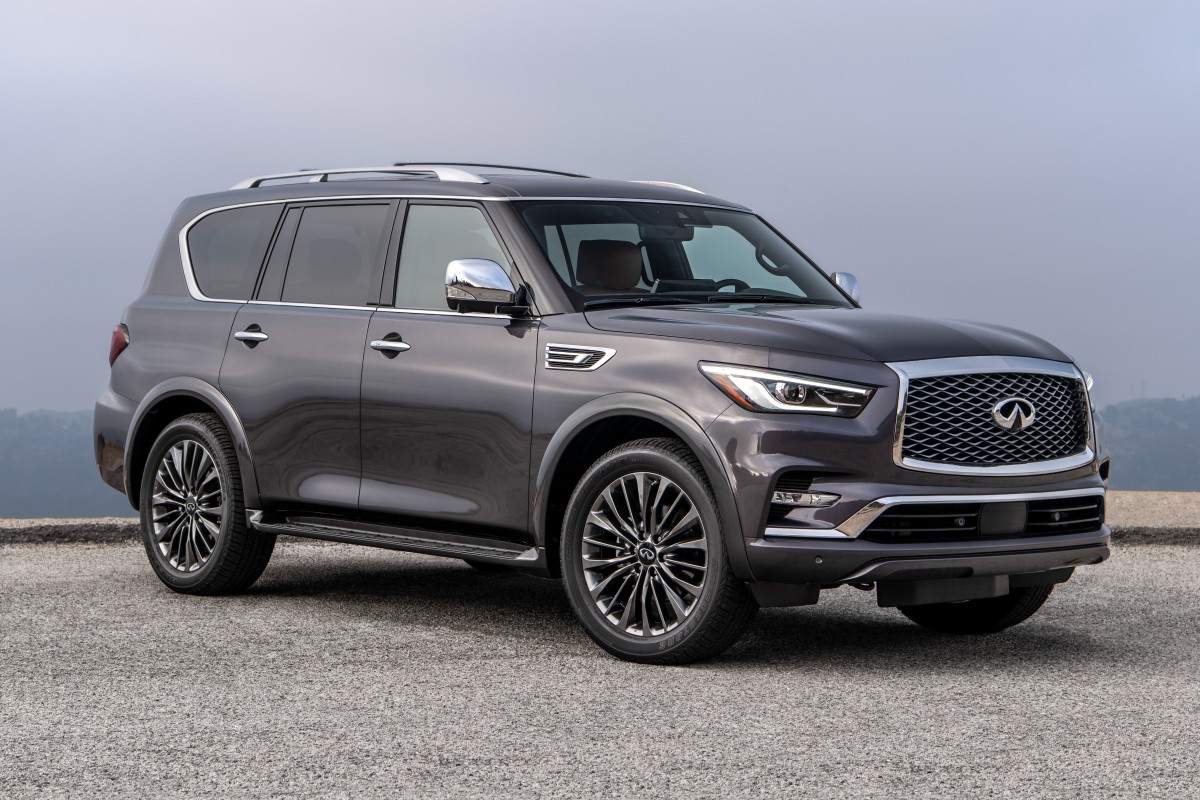
The 2026 Infiniti QX80 embraced a bold, blocky design typical of body-on-frame SUVs. It featured high shoulder lines, a simple two-box profile, and large wheels, with a distinctive grille inspired by a bamboo forest. LED headlights and piano-key daytime running lights added to its striking appearance. At the rear, a taillight light bar echoed the piano key look, sitting above wide Infiniti lettering. The QX80 Sport trim introduced a wider mesh pattern for its frameless grille and dark matte chrome exterior trim.
Inside, the QX80 exuded modern luxury, with four screens, including one for rear passengers, and high-quality materials like aluminum and open-pore wood trim. The Sport models featured a Dusk Blue interior theme. The QX80's interior was spacious, with synthetic or real leather upholstery, and the latter available with a quilted pattern. The technology was complemented by thoughtful design elements, creating a comfortable and luxurious environment.

The 2026 Hyundai Ioniq 9 was equipped with a 110.3-kWh battery pack on the e-GMP platform, offering a larger capacity than similar models like the Kia EV9 and Tesla Model X. The base S trim featured a single rear-mounted 160-kW electric motor, delivering 215 horsepower with rear-wheel drive. Other trims had dual-motor all-wheel-drive systems, with power outputs varying by trim: 303 hp for SE and SEL, and 422 hp for Limited and Calligraphy. The Ioniq 9 demonstrated impressive energy efficiency, with a range estimate of 335 miles for the S trim and 311 miles for the Calligraphy Design. Its chassis provided a smooth ride, though it wasn't adept at cornering due to its weight and soft suspension. The Ioniq 9 offered a towing capacity of 3,500 pounds for RWD and 5,000 pounds for AWD models, with charging options including NACS superchargers and CCS-port Level 2 chargers.
The 2026 Infiniti QX80 transitioned from a 5.6-liter V8 to a twin-turbocharged 3.5-liter V6, producing 450 hp and 516 lb-ft of torque. Paired with a nine-speed automatic transmission, it offered rear-wheel drive as standard, with full-time four-wheel drive optional on base trims and standard on higher trims. The QX80's 4WD system lacked low-range gearing, focusing on Auto and 4H modes. The V6 provided immediate power delivery, achieving a 0-60 mph time of 6.1 seconds. The body-on-frame platform boasted increased torsional rigidity and lateral stiffness, maintaining an 8,500-pound towing capacity. The QX80 featured front and rear double-wishbone suspension, with air springs and adaptive dampers on higher trims, offering adjustable ground clearance for various driving conditions.
The 2026 Hyundai Ioniq 9 prioritized family-SUV practicality with its spacious interior. The S, SE, and SEL trims seated seven with a middle-row bench, while the Limited and Calligraphy trims offered ventilated captain's chairs for six. The Universal Island 2.0, available on higher trims, enhanced accessibility for middle-row passengers. The Ioniq 9 provided 42.8 inches of legroom in the middle row, though the 32 inches in the third row felt tight for adults. The rear doors facilitated easy access, and dual-zone climate control with air vents in all rows ensured comfort. Cargo space was ample, with 21.9 cubic feet behind the third row, expanding to 86.9 cubic feet with seats folded.
The 2026 Infiniti QX80 offered a spacious interior, accommodating up to seven passengers. Synthetic leather and eight-way power-adjustable seats with lumbar adjustment were standard, with leather upholstery and ventilation available on higher trims. The top trims featured massage functions for front and second-row seats. The second-row captain's chairs had power adjustments, and the third-row bench provided ample space for adults or children. Power-folding seats and USB-C ports were standard, though some controls were buried in touchscreen menus. Cargo space was generous, with 22 cubic feet behind the third row, expanding to 101 cubic feet with seats folded.
The 2026 Hyundai Ioniq 9 featured dual 12.3-inch displays for its infotainment system, offering a familiar interface found in other Hyundai models. Standard features included SiriusXM Satellite Radio, over-the-air updates, a Wi-Fi hotspot, wireless Android Auto, and Apple CarPlay. The wireless charging pad struggled to keep up with high-demand devices, but six USB-C ports provided ample charging options. The 14-speaker Bose audio system delivered impressive sound quality, enhancing the driving experience.
The 2026 Infiniti QX80 boasted a pair of 14.3-inch screens for its digital instrument cluster and infotainment system, with Google built-in for app access. Wireless Apple CarPlay, Android Auto, and Amazon Alexa compatibility were standard, along with a 5G connection for a Wi-Fi hotspot. The infotainment screen was user-friendly, though the lower screen's controls were less intuitive. The QX80 excelled with surprise-and-delight features, including a 14-speaker Klipsch audio system, with a 24-speaker system available on higher trims. Additional tech included a head-up display, dashcam, and in-car camera for selfies.
The 2026 Hyundai Ioniq 9 had not yet received crash-test ratings from NHTSA or IIHS. However, it came equipped with a comprehensive suite of advanced driver assistance systems (ADAS) as standard. These included collision avoidance, lane-guidance technologies, driver attention warning, safe-exit assist, and Hyundai's Highway Driving Assist 2, which combined lane-keeping assist with adaptive cruise control for supervised hands-free driving. The SEL trim and above featured a surround-view monitor, parking aids, and a blind-spot view monitor.
The 2026 Infiniti QX80 offered a full range of driver-assistance technology, including automatic emergency braking, high-beam assist, adaptive cruise control, ProPilot Assist 1.1, forward-collision warning, rear cross-traffic alert, active blind-spot monitors, rear automatic braking, parking sensors, lane-departure warning, driver-attention monitor, traffic-sign recognition, and a surround-view camera system. ProPilot Assist 2.1 was optional, allowing for hands-free driving on certain highways. The QX80 earned an IIHS Top Safety Pick+ designation, though NHTSA ratings were not yet available.
CarGurus highlights
According to CarGurus experts, the overall rating for the 2026 Hyundai IONIQ 9 is 7.3 out of 10, while the 2026 INFINITI QX80 scores 7.7 out of 10. Based on these ratings, the Infiniti QX80 is the recommended choice for those seeking a luxurious and technologically advanced SUV with strong performance and safety credentials.
Choose the 2026 INFINITI QX80 if:
- You desire a powerful engine with impressive towing capacity and a luxurious interior.
- You appreciate advanced technology features, including a high-quality audio system and innovative climate control.
- You seek a vehicle with a strong safety rating and hands-free driving capabilities.


Choose the 2026 Hyundai IONIQ 9 if:
- You prioritize a spacious and family-friendly interior with flexible seating options.
- You value energy efficiency and a smooth, quiet ride in an electric vehicle.
- You appreciate a comprehensive suite of standard safety features without a subscription requirement.


CarGurus highlights
According to CarGurus experts, the overall rating for the 2026 Hyundai IONIQ 9 is 7.3 out of 10, while the 2026 INFINITI QX80 scores 7.7 out of 10. Based on these ratings, the Infiniti QX80 is the recommended choice for those seeking a luxurious and technologically advanced SUV with strong performance and safety credentials.
Choose the 2026 INFINITI QX80 if:
Shop Now- You desire a powerful engine with impressive towing capacity and a luxurious interior.
- You appreciate advanced technology features, including a high-quality audio system and innovative climate control.
- You seek a vehicle with a strong safety rating and hands-free driving capabilities.
Choose the 2026 Hyundai IONIQ 9 if:
Shop Now- You prioritize a spacious and family-friendly interior with flexible seating options.
- You value energy efficiency and a smooth, quiet ride in an electric vehicle.
- You appreciate a comprehensive suite of standard safety features without a subscription requirement.

By: CarGurus + AI
At CarGurus, our team of experienced automotive writers remain at the heart of our content operation, conducting hands-on car tests and writing insightful guides that are backed by years of industry experience. To complement this, we are harnessing AI to make our content offering more diverse and more helpful to shoppers than ever. To achieve this, our AI systems are based exclusively on CarGurus content, ratings and data, so that what we produce is both unique to CarGurus, and uniquely helpful to car shoppers.

