2026 INFINITI QX80 Reviews, Pricing & Specs

Pros & cons
What we like
Roomy for seven people and their cargo
A workhorse that can tow 8,500 pounds
Comfortable and luxurious cabin
What to consider
Poor fuel economy as low as 17 mpg combined
Cumbersome handling due to massive size
Prices that can reach six figures
Expert review
The QX80 delivers the power, the towing capacity, the interior space, and the refinement to take on luxury SUV rivals, but it’s too big and too inefficient to work as an everyday family hauler.
The traditional body-on-frame SUV is rarely a wise choice these days. These vehicles are heavy and inefficient, but they can be the right option for buyers who need to carry lots of passengers and either tow trailers or go off-roading. The 2026 Infiniti QX80 carries up to seven people and can tow up to 8,500 pounds, while also adding luxury and some thoughtful features that help it stand out against competitors such as the Cadillac Escalade and the Lincoln Navigator. Redesigned for the 2025 model year, the 2026 QX80 is unchanged except for a new Sport trim level.
Verdict: The 2026 Infiniti QX80 appeals for luxury, space, technology, and towing capacity, but poor fuel economy and cumbersome handling mean more nimble crossover SUVs are better for most families.
out of 10 expert review
Look & feel
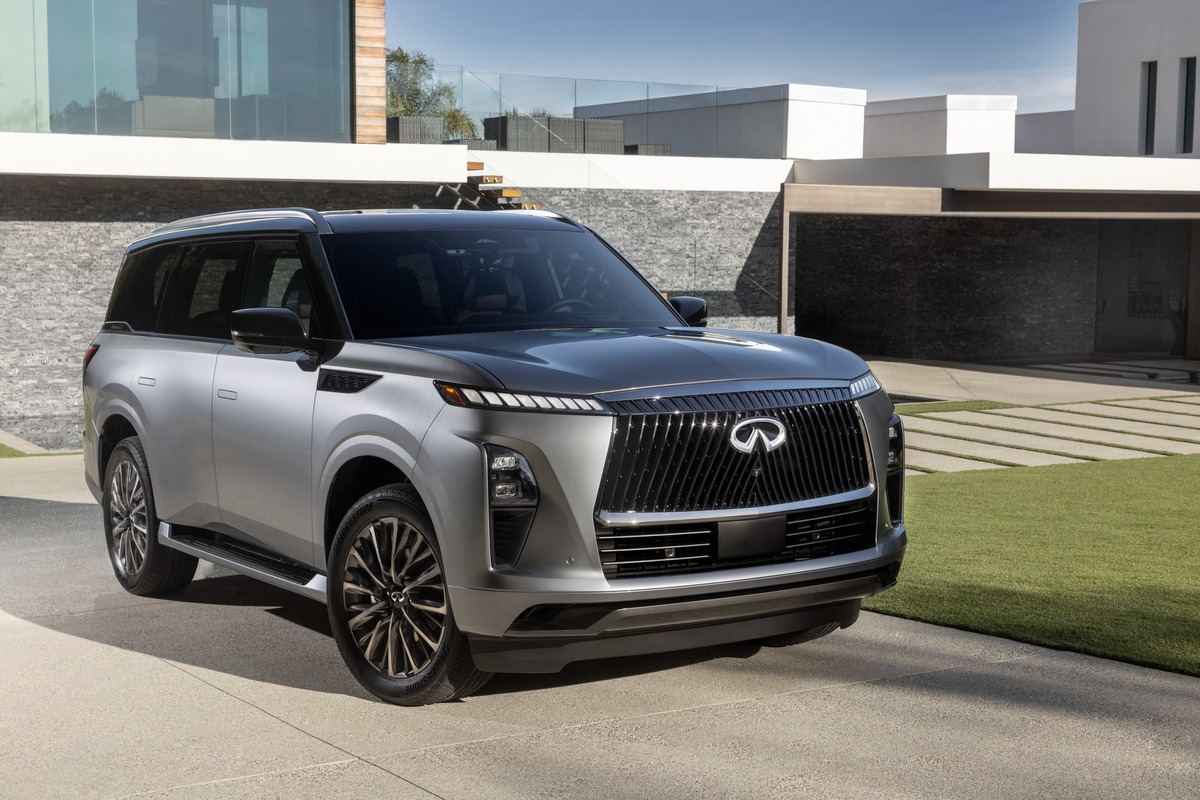
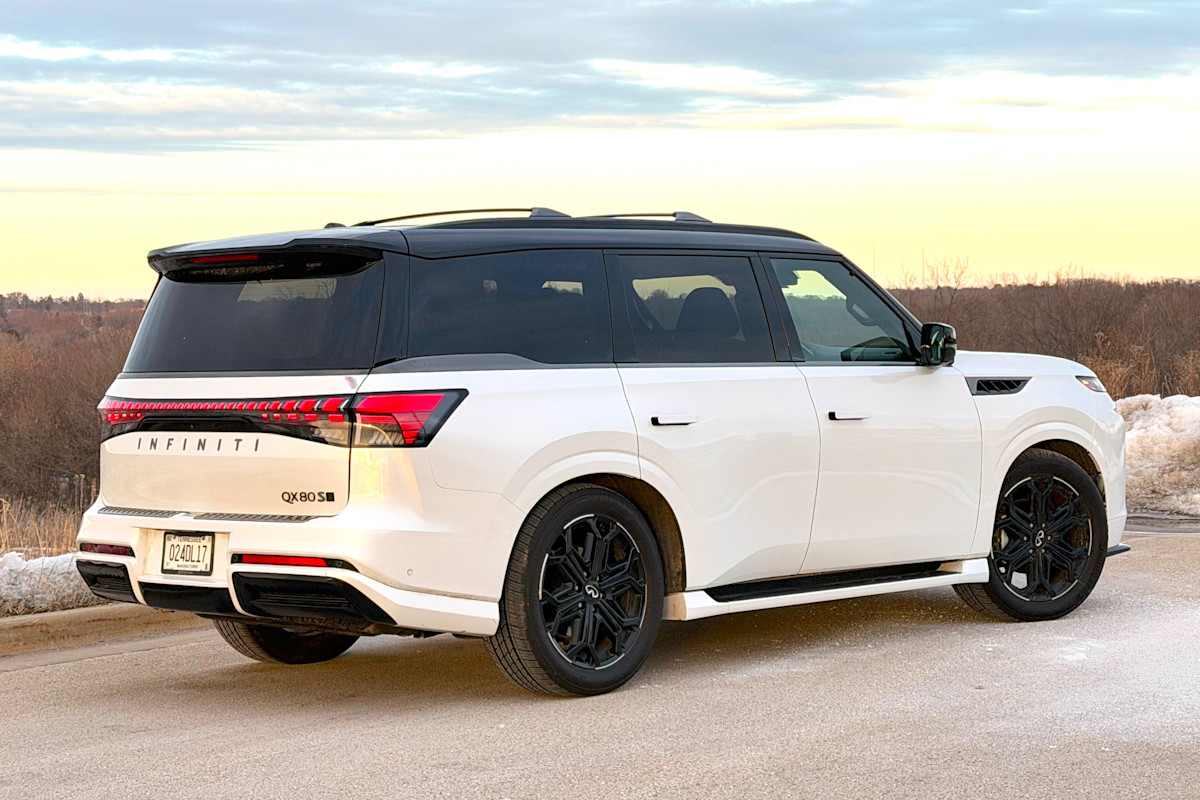
Like many body-on-frame SUVs, the 2026 Infiniti QX80 goes for a big, blocky, macho look. It sits tall and upright, with high shoulder lines, uncluttered and rounded flanks, a simple two-box profile with a standard rear spoiler, and large 20- or 22-inch wheels. The smart nose features a bold, black, two-part grille with a waterfall upper portion with vertical slats that Infiniti says were inspired by a bamboo forest. LED headlights flank the grille and above them sit piano-key daytime running lights. At the rear, a taillight light bar spans the width of the rear end, echoing the piano key look, and sits above wide Infiniti lettering.
A black roof is available, and the new-for-2026 QX80 Sport trim gets a wider mesh pattern for its frameless grille, as well as dark matte chrome exterior trim, and gloss-black roof rails, mirror caps, emblems, and wheels.
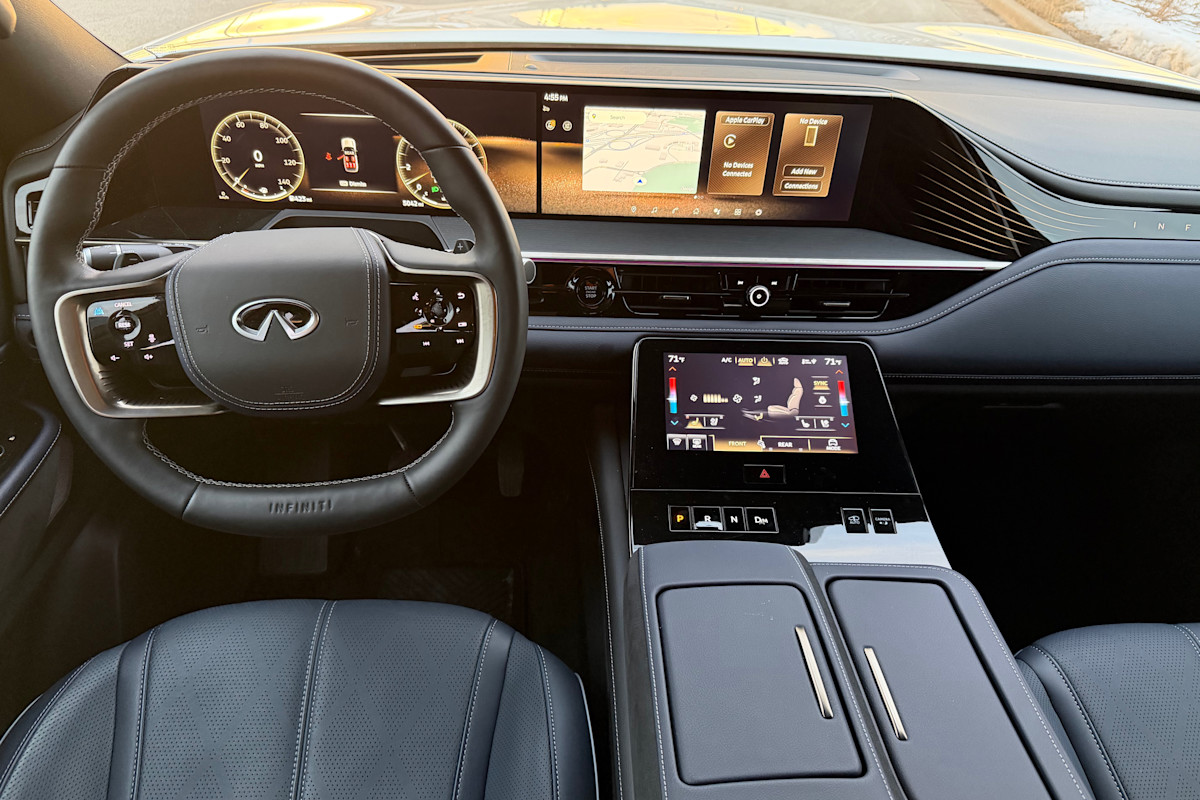
Inside, the QX80 is modern and luxurious. The technology of the four available screens—including one for rear passengers—is softened by synthetic or real leather, and the latter is available with a quilted pattern. High-quality materials include aluminum and open-pore wood trim, while Sport models have a Dusk Blue interior theme with a darkened color palette.
Performance
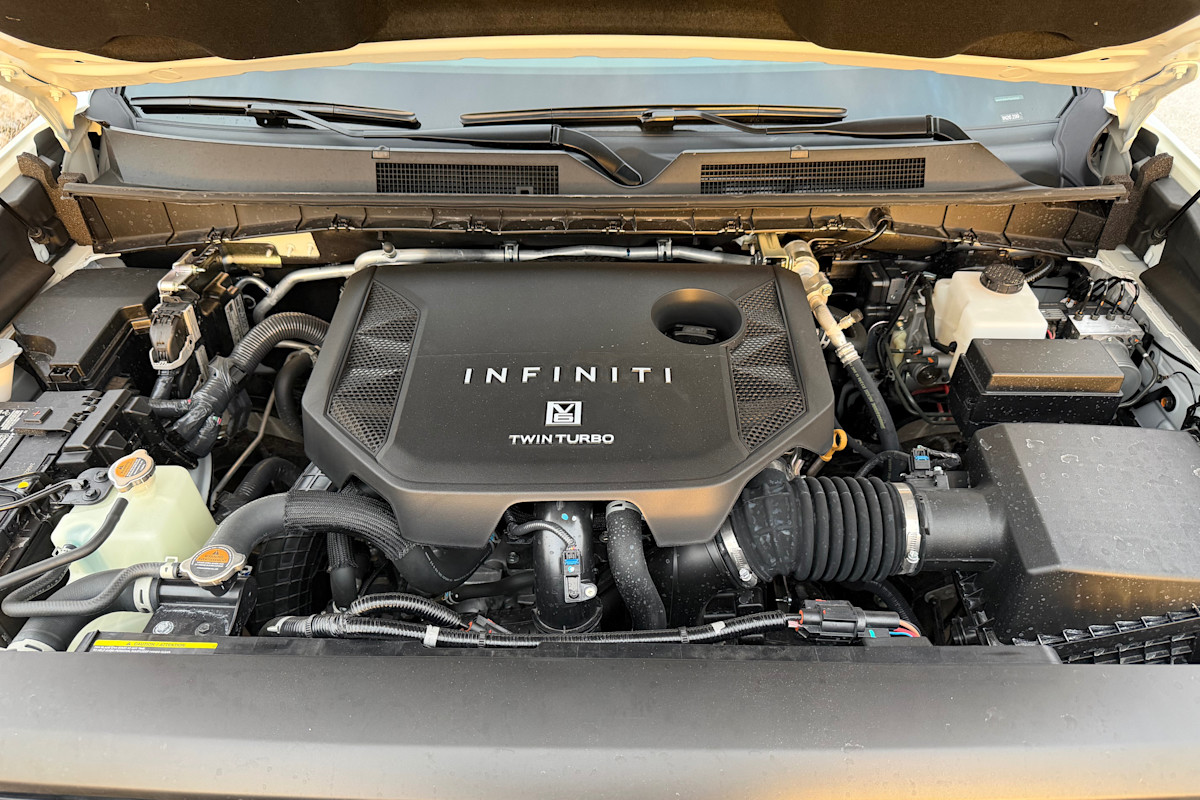
With this generation, the QX80 switches from a 5.6-liter V8 that made 400 horsepower and 413 pound-feet of torque to a twin-turbocharged 3.5-liter V6 that turns up the wick to 450 hp and 516 lb-ft of torque. The engine is mated to a nine-speed automatic transmission, rear-wheel drive (RWD) is standard, and full-time four-wheel drive (4WD) is optional on the two base trims and standard on the top pair. With the redesign, the 4WD system loses low-range gearing and goes with only Auto and 4H modes, dropping some of the QX80’s off-roading pretense.
While the twin-turbo V6 doesn’t offer the rich baritone of a V8, it emits a pleasing subdued howl and power delivery is much more immediate. It’s strong from a stop, has plenty of passing punch, and covered the 0-60 mph sprint in 6.1 seconds in Car and Driver testing. The transmission doesn’t fumble for gears and generally keeps the power on tap, especially in Sport mode.
Infiniti says the body-on-frame platform has 25% more torsional rigidity and 57% more lateral stiffness than the last-generation's ladder frame. Despite more power and a stronger frame, towing capacity remains the same at a robust 8,500 pounds.
Front and rear double-wishbone suspension with coil springs is standard, and all but the base model get air springs and adaptive dampers. We’ve only driven the models equipped with the air suspension, which gives the QX80 a standard ground clearance of 7.9 inches and can raise it to 10 inches to clear off-road obstacles, lower it to 6.7 inches for slightly sharper handling and better fuel economy in Sport mode, and lower it further to just 5.1 inches for entry and exit.
Every QX80 weighs around three tons, and all that size and mass isn’t easy to wrangle. This full-size luxury SUV has notable body lean, even in Sport mode, and the steering, while direct, is slow and heavy. The ride quality is generally comfortable, but the firmer damper settings in Sport mode make it jiggly on broken pavement. The size also makes it hard to park and maneuver in tight spaces.
Form & function
The QX80 is a monstrous SUV with lots of interior space—it's 211.2 inches long on a 121-inch wheelbase that provides plenty of room for up to seven passengers—but it’s smaller than most of its rivals.
Up front, synthetic leather comes standard, as do eight-way power-adjustable seats with two-way lumbar adjustment. Also standard are front-seat heating and a power tilt/telescoping steering column. Moving up one trim level brings leather upholstery (with semi-aniline leather on Sport and Autograph models) and ventilation, and the top two trims get a massage function. Front-seat occupants sit on big, comfy thrones with lots of space and a range of adjustments that will make anyone comfortable.
In all but the base model, the heated second-row captain’s chairs have power tilting and sliding adjustments. Ventilation is standard on the top two trims, and the Infiniti QX80 Autograph trim even gets massaging second-row seats.
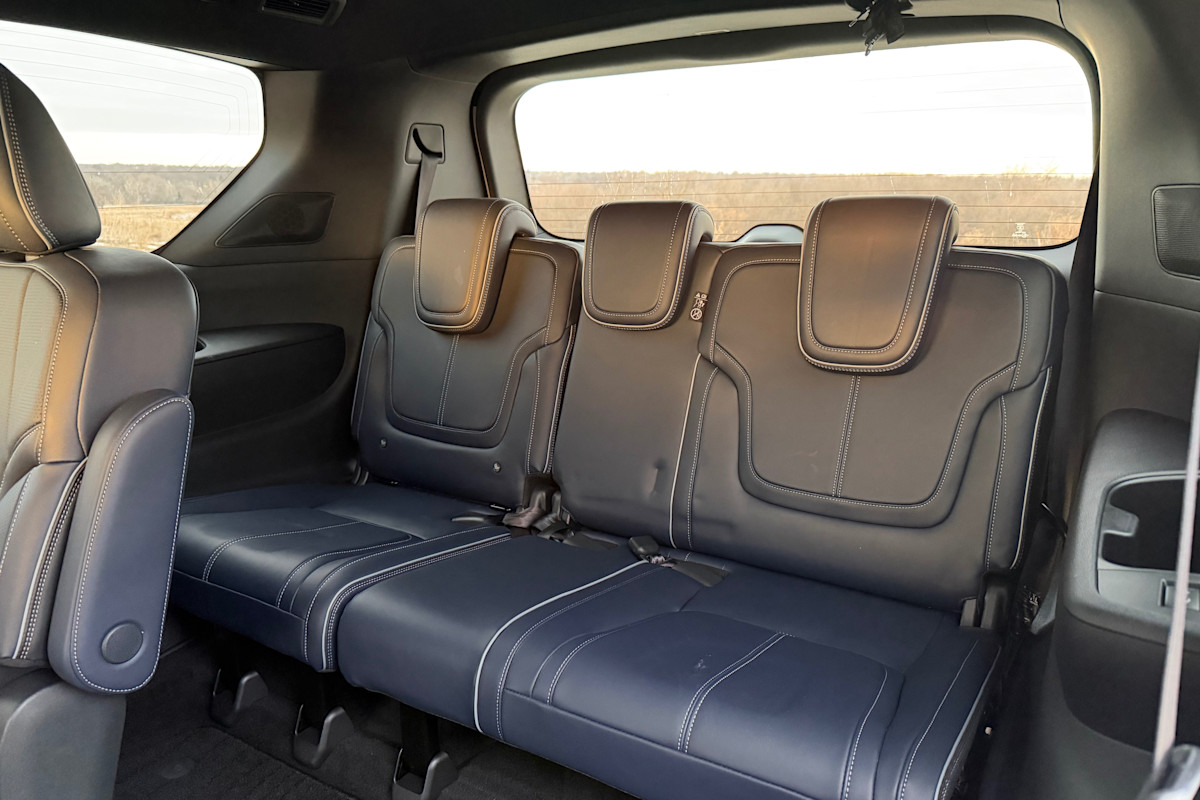
A three-passenger rear bench that reclines is larger than most third rows and has good room for a pair of adults or three kids. It’s heated in the Autograph trim.
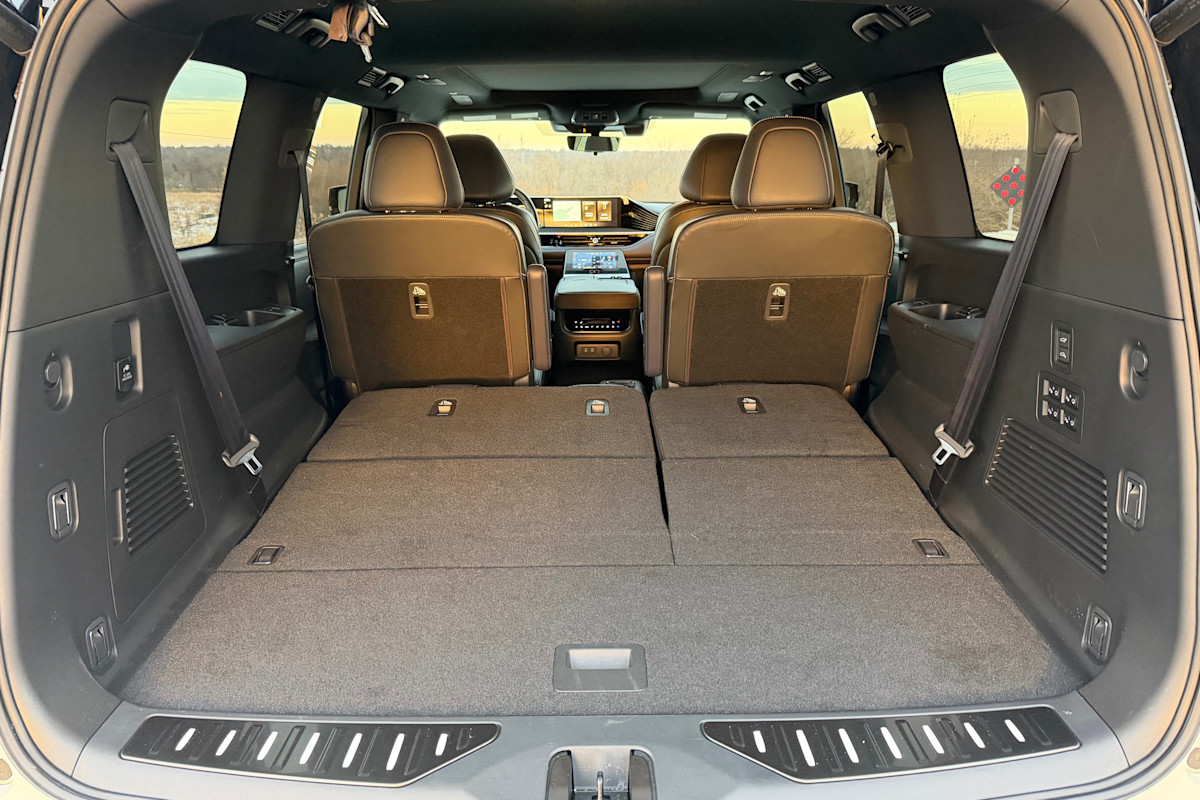
Power-folding third-row seats come standard, controlled from the touchscreen or the rear cargo area, and the second row works the same for all but the base model. Unfortunately, these controls and the controls for the massage settings are buried under layers of menus in the touchscreen. USB-C ports are provided for the second and third rows.
Cargo space is 22 cubic feet behind the third row, 59 cubic feet behind the second row, and a voluminous 101 cubic feet behind the first row. While that’s a lot of space, the Cadillac Escalade tops out at 20 more cubic feet in its standard-wheelbase form.
Technology
Infiniti loads the QX80 with technology, covering all the bases while adding some surprise-and-delight features, but skipping some items buyers can find among the competition.
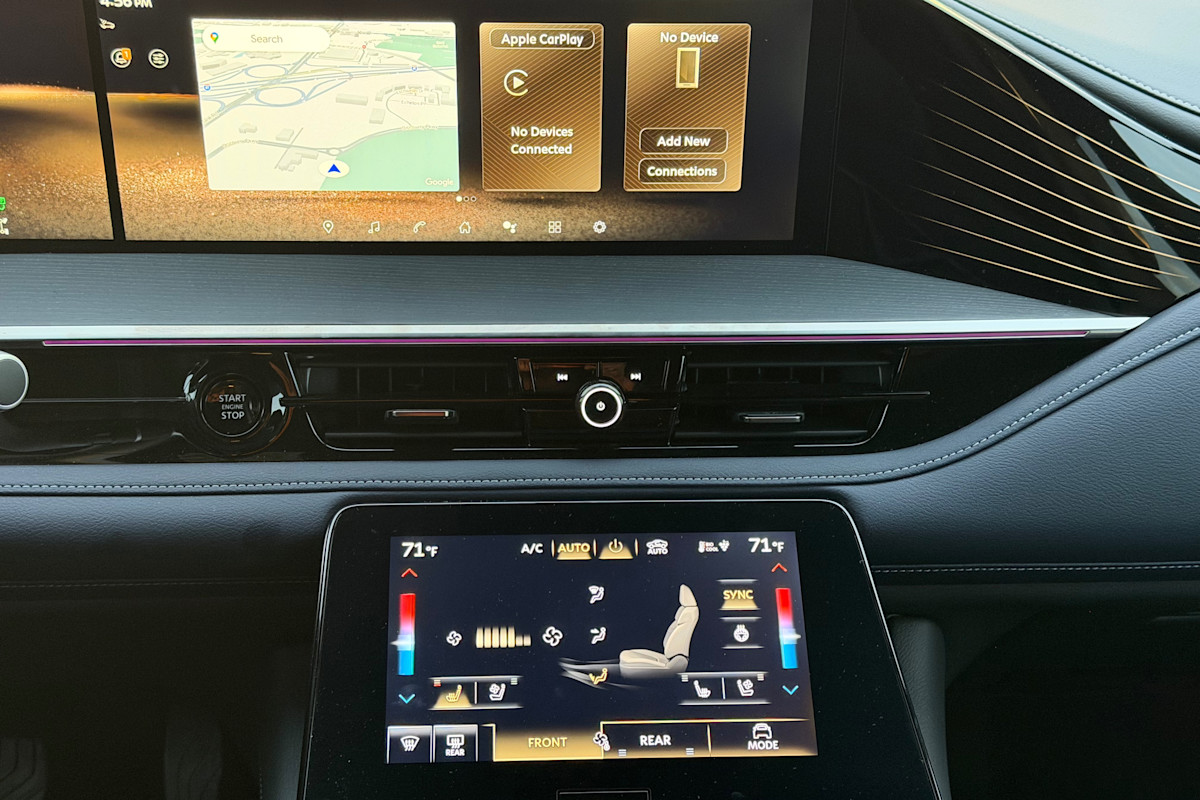
There is a pair of 14.3-inch screens—a digital instrument cluster and an infotainment touchscreen under a single piece of glass. Another touchscreen angles from the center console to the center stack, but Infiniti doesn’t offer a screen for the front passenger, whereas the Cadillac Escalade and the Jeep Grand Wagoneer do.
The infotainment system incorporates Google built-in to make Google apps and services accessible through the screen. It also gets wireless Apple CarPlay and Android Auto, as well as Amazon Alexa compatibility. A 5G connection provides an in-vehicle Wi-Fi hotspot and unlocks remote services with a subscription.
The infotainment screen is easy to reach and use, with quick reactions to control inputs, but the lower screen isn’t so natural. It’s home to the climate controls, which makes sense, but also handles the drive modes, the ride height, the stability control, and the Auto and 4H 4WD settings. They're buried under sub-menus, and difficult to spot at a glance. Drivers will get used to this, but they require a step or two that other systems don’t.
The QX80 excels with its surprise-and-delight features. A 14-speaker Klipsch audio system comes standard, and buyers of the top two trim levels get a 24-speaker Klipsch Reference Premiere system with speakers in the front headrests that let the driver and front passenger hear phone calls and navigation directions while everyone else rocks out to tunes or contemplates podcasts.
Three-zone automatic climate control comes standard, and the top two trims get a biometric cooling system that monitors second-row passengers and directs air over them if it detects that they're getting too hot. According to Infiniti, this cools them down in half the time that a standard climate control system would.
Infiniti offers even more tech features. A head-up display comes standard on all but the base model, a dashcam records crashes in the top two models, and an in-car camera lets occupants take selfies in the top Autograph trim.
A standard surround-view camera system offers nine camera views, including an Invisible Hood view that shows the area normally blocked by the hood. A Front Wide View splashes a wide-angle display across both front screens. It uses cameras located in the front of the vehicle, so it can see around corners before the driver can, and spot potential hazards around objects that would block the driver’s line of sight.
Safety
The 2026 Infiniti QX80 comes standard with a full range of driver-assistance technology, including automatic emergency braking, high-beam assist, adaptive cruise control, ProPilot Assist 1.1, forward-collision warning, rear cross-traffic alert, active blind-spot monitors that cover a trailer, rear automatic braking, front and rear parking sensors, lane-departure warning, a driver-attention monitor, traffic-sign recognition, and the surround-view camera system, which also has moving object detection.
The only option is ProPilot Assist 2.1. The 1.1 version isn’t much more than adaptive cruise control with steering assist, as it requires drivers to keep their hands on the wheel. The 2.1 version is more advanced, allowing for hands-free driving on an undisclosed number of divided highways. We were able to drive hands-free for about 15 miles, though we had to pay attention to the road to keep the system engaged. ProPilot Assist 2.1 can execute lane changes when the driver activates the turn signal, but GM’s Super Cruise can recognize the need for a lane change and proactively execute it. In our experience, the other safety systems worked as intended, though, thankfully, we didn’t need them.
The QX80 earned an Insurance Institute for Highway Safety (IIHS) Top Safety Pick+ designation, the agency’s highest honor. The federal government’s National Highway Traffic Safety Administration (NHTSA) hadn’t released any safety ratings for the 2026 QX80 at the time of publication.
Cost-effectiveness
Infiniti offers the QX80 in Pure, Luxe, Sport, and Autograph trim levels. The Pure has a starting MSRP of $85,940 (including a $2,190 destination fee) while the Luxe runs $93,040, the Sport costs $104,835, and the Autobiography tops the lineup at $114,385. Four-wheel drive adds $3,100 on the Pure and Luxe trims and comes standard on the Sport and the Autograph. All QX80s are backed by a 48-month, 60,000-mile warranty.
We recommend moving up to at least the Luxe trim to get the air suspension and adaptive dampers, as well as leather upholstery, ventilated front seats, and power-folding second- and third-row seats—all useful features. The Sport trim adds no sporty features, but instead amounts to an exterior and interior appearance package. The Autograph has all the goodies, including biometric cooling, massaging seats, heated third-row seats, an in-vehicle camera, a front console coolbox, and the hands-free version of ProPilot Assist.
Fuel economy is improved versus the last-generation QX80, but it’s still a big, thirsty brute. It’s rated at 15 mpg city, 19 highway, and 17 combined with 4WD and 16/20/18 mpg with RWD. Pair that fuel economy with the cumbersome handling, and the QX80 just doesn’t make sense as a family commuter. It does serve a purpose, though, for those who regularly tow horses, race cars, boats, or camping trailers and need to carry lots of people and their stuff.
Those who don’t tow will be much better served by a luxury crossover that rides and handles better and gets better fuel economy. The Mercedes-Benz GLS-Class and BMW X7 come to mind, as do mainstream choices such as the Hyundai Palisade and even the Honda Pilot.

What owners say
Trims & specs
Base MSRP $93,950 | Seating 8 |
Engine 3.5L 450 hp V6 | Cargo Capacity 20.4 cu ft |
Combined MPG 17 | Drivetrain AWD |
Base MSRP $111,500 | Seating 7 |
Engine 3.5L 450 hp V6 | Cargo Capacity 20.4 cu ft |
Combined MPG 17 | Drivetrain AWD |
Base MSRP $86,850 | Seating 8 |
Engine 3.5L 450 hp V6 | Cargo Capacity 20.4 cu ft |
Combined MPG 17 | Drivetrain AWD |
Base MSRP $83,750 | Seating 8 |
Engine 3.5L 450 hp V6 | Cargo Capacity 20.4 cu ft |
Combined MPG 18 | Drivetrain RWD |
Base MSRP $101,950 | Seating 7 |
Engine 3.5L 450 hp V6 | Cargo Capacity 20.4 cu ft |
Combined MPG 17 | Drivetrain AWD |
Base MSRP $90,850 | Seating 8 |
Engine 3.5L 450 hp V6 | Cargo Capacity 20.4 cu ft |
Combined MPG 18 | Drivetrain RWD |


Pricing trends
MSRP range
$83,750 - $111,500
Current avg. market price
$81,881
Trending down by 0.8% this month
May 2026 - October 2026