2024 Volkswagen Atlas vs 2024 Toyota 4Runner
Overview | |
MSRP$37,995 | MSRP$40,705 |
Listings257 | Listings199 |
Ratings & Reviews | |
User Reviews | User Reviews |
Expert reviews7.3 out of 10 | Expert reviews4.5 out of 10 |
Pros
Cons
| Pros
Cons
|
2024 Volkswagen Atlas Reviews SummaryLaunched for the 2018 model year, the Volkswagen Atlas is engineered specifically for the United States market. It's a three-row midsize crossover SUV, big for a VW, but targeting a popular market segment that already includes the Chevrolet Traverse, Ford Explorer, Hyundai Palisade, Kia Telluride, Nissan Pathfinder, Subaru Ascent, and Toyota Highlander. To keep up in such a competitive segment, the Atlas gets a major refresh for the 2024 model year. The 2024 Volkswagen Atlas is essentially the same vehicle as before, but it gets key updates like different styling and more standard features. It also loses its six-cylinder engine option, but the remaining turbocharged four-cylinder engine gets more horsepower and torque. The 2024 Atlas lineup includes SE, SE with Technology, SEL, and SEL Premium R-Line trim levels, plus a new-for-2024 Peak Edition treatment available on the SE with Technology and SEL trim levels. For this review, we tested an Atlas SEL Premium R-Line, representing the top of the range. | |
2024 Toyota 4Runner Reviews SummaryVerdict: The Toyota 4Runner remains an accomplished off-road-capable vehicle with a strong reputation for reliability and durability. A new 4Runner is expected, and the current model's aging platform is in desperate need of a full redesign. It trails newer rivals when it comes to technology, safety features, fuel efficiency, and power. The 2024 Toyota 4Runner would be easier to recommend it if the price were significantly reduced. | |
Popular Features & Specs | |
Engine2.0L 269 hp I4 | Engine4.0L 270 hp V6 |
DrivetrainFWD | Drivetrain4X2 |
Seating Capacity7 | Seating Capacity7 |
Horsepower | Horsepower270 hp @ 5600 rpm |
MPG City20 | MPG City16 |
MPG Highway27 | MPG Highway19 |
Engine | |
Engine Name2.0L 269 hp I4 | Engine Name4.0L 270 hp V6 |
Torque | Torque278 lb-ft @ 4400 rpm |
Horsepower | Horsepower270 hp @ 5600 rpm |
DrivetrainFWD | Drivetrain4X2 |
Fuel Economy | |
MPG City20 | MPG City16 |
MPG Highway27 | MPG Highway19 |
Interior | |
Seating Capacity7 | Seating Capacity7 |
Safety | |
Front Crash Overall4 | Front Crash Overall4 |
Side Crash Overall5 | Side Crash Overall5 |
Dimensions & Capacity | |
Cargo Space20.6 cu ft | Cargo Space47.2 cu ft |
Curb Weight4343 lbs | Curb Weight4400 lbs |
Height70.4 in | Height71.5 in |
Length200.7 in | Length190.2 in |
Width88.5 in | Width75.8 in |
Wheelbase117.3 in | Wheelbase109.8 in |
Maximum Payload1091 lbs | Maximum Payload1700 lbs |
Number of doors4 | Number of doors4 |
Maximum Towing Capacity2000 lbs | Maximum Towing Capacity5000 lbs |
Standard Towing Capacity | Standard Towing Capacity5000 lbs |
Overview | ||
MSRP | $37,995 | $40,705 |
Listings | ||
Ratings & Reviews | ||
User reviews | ||
Expert reviews | 7.3 out of 10Read full review | 4.5 out of 10Read full review |
Pros & cons | Pros
Cons
| Pros
Cons
|
Summary | Launched for the 2018 model year, the Volkswagen Atlas is engineered specifically for the United States market. It's a three-row midsize crossover SUV, big for a VW, but targeting a popular market segment that already includes the Chevrolet Traverse, Ford Explorer, Hyundai Palisade, Kia Telluride, Nissan Pathfinder, Subaru Ascent, and Toyota Highlander. To keep up in such a competitive segment, the Atlas gets a major refresh for the 2024 model year. The 2024 Volkswagen Atlas is essentially the same vehicle as before, but it gets key updates like different styling and more standard features. It also loses its six-cylinder engine option, but the remaining turbocharged four-cylinder engine gets more horsepower and torque. The 2024 Atlas lineup includes SE, SE with Technology, SEL, and SEL Premium R-Line trim levels, plus a new-for-2024 Peak Edition treatment available on the SE with Technology and SEL trim levels. For this review, we tested an Atlas SEL Premium R-Line, representing the top of the range. | Verdict: The Toyota 4Runner remains an accomplished off-road-capable vehicle with a strong reputation for reliability and durability. A new 4Runner is expected, and the current model's aging platform is in desperate need of a full redesign. It trails newer rivals when it comes to technology, safety features, fuel efficiency, and power. The 2024 Toyota 4Runner would be easier to recommend it if the price were significantly reduced. |
Video | ||
Popular Features & Specs | ||
Engine | 2.0L 269 hp I4 | 4.0L 270 hp V6 |
Drivetrain | FWD | 4X2 |
Seating Capacity | 7 | 7 |
Horsepower | 270 hp @ 5600 rpm | |
MPG City | 20 | 16 |
MPG Highway | 27 | 19 |
Engine | ||
Engine Name | 2.0L 269 hp I4 | 4.0L 270 hp V6 |
Torque | 278 lb-ft @ 4400 rpm | |
Horsepower | 270 hp @ 5600 rpm | |
Drivetrain | FWD | 4X2 |
Fuel Economy | ||
MPG City | 20 | 16 |
MPG Highway | 27 | 19 |
Interior | ||
Seating Capacity | 7 | 7 |
Safety | ||
Front Crash Overall | 4 | 4 |
Side Crash Overall | 5 | 5 |
Dimensions & Capacity | ||
Cargo Space | 20.6 cu ft | 47.2 cu ft |
Curb Weight | 4343 lbs | 4400 lbs |
Height | 70.4 in | 71.5 in |
Length | 200.7 in | 190.2 in |
Width | 88.5 in | 75.8 in |
Wheelbase | 117.3 in | 109.8 in |
Maximum Payload | 1091 lbs | 1700 lbs |
Number of doors | 4 | 4 |
Maximum Towing Capacity | 2000 lbs | 5000 lbs |
Standard Towing Capacity | 5000 lbs | |
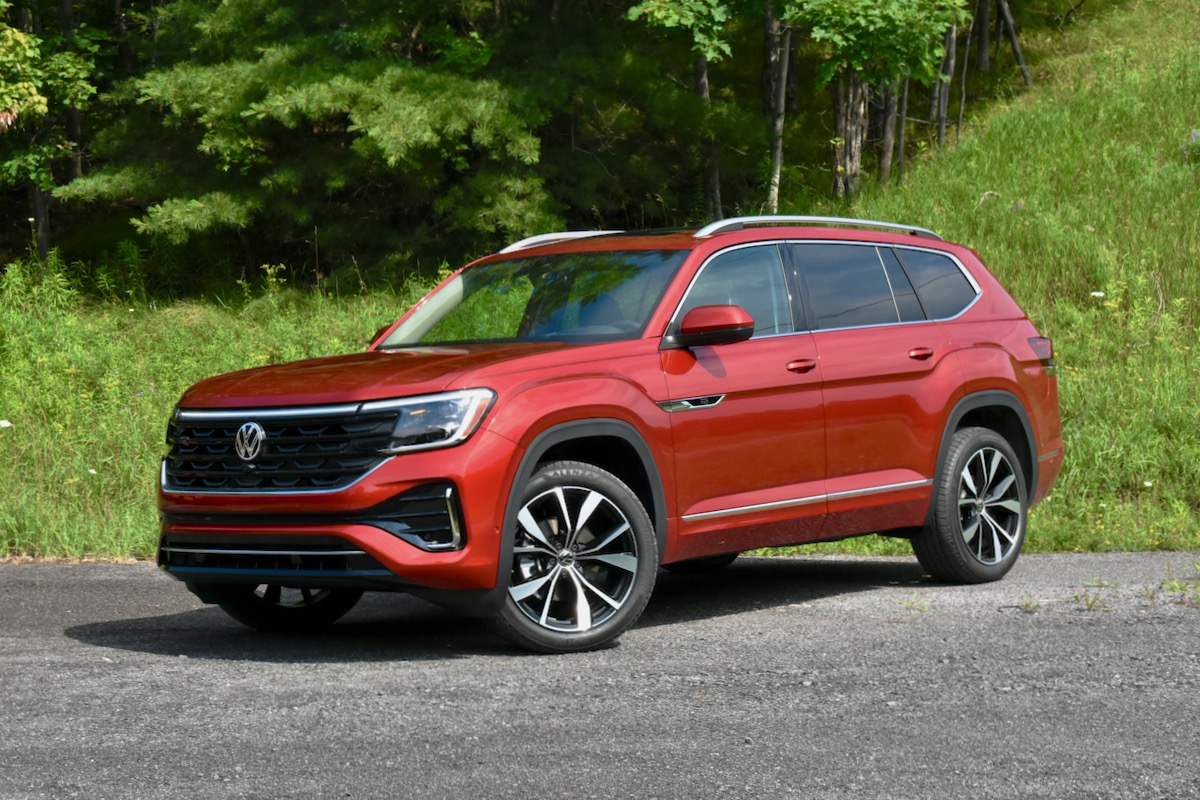
The 2024 Volkswagen Atlas underwent a notable styling refresh, bringing a contemporary twist to its existing design that dated back to the Volkswagen CrossBlue concept of 2013. The most eye-catching feature was the introduction of light-up VW logos. The front emblem shone in white, while the rear logo illuminated in red, similar to updates seen in the ID.4 electric crossover. This gave the Atlas a unique, bright aesthetic that appealed to modern sensibilities.
Additionally, Volkswagen added a front light bar connecting the daytime running lights, integrated into newly designed LED headlights, which seemed inspired by the Ford Expedition. These seemingly minor tweaks dramatically altered the Atlas’ "face," erasing its European subtleties in favor of a bolder, more American look. At the rear, the taillights were merged into a full-width light bar that also featured the illuminated logo, further emphasizing the vehicle’s new back-end design.
All trim levels of the Atlas received new wheel designs for 2024. The base SE model came with 18-inch alloy wheels, while most other trims were equipped with 20-inch wheels. The SEL Premium R-Line went a step further, boasting 21-inch wheels and sportier visual elements.
A fresh addition for 2024 was the Atlas Peak Edition, aimed at consumers with a taste for outdoor adventures. This variant featured black 18-inch wheels paired with all-terrain tires, a redesigned front fascia, silver front and side body cladding, blacked-out exterior trim, and exclusive colors like Avocado Green and Pure Gray. The equipment largely reflected the original trim, but the SE with Technology package added a panoramic sunroof and ambient lighting as standard features.
Inside, the Atlas saw significant changes concentrated around the center console area. The infotainment touchscreen now stood independently from the dashboard, and the gear shifter had been minimized to a small toggle, which freed up considerable space. The console had an upward arch design, creating an additional storage area beneath it. Although this enhanced functionality, the stark contrast between the minimalist interior and the rugged exterior was somewhat disconcerting.
Volkswagen also aimed to elevate the interior's luxury feel. The fake wood trim was upgraded with more grain, and a new weaved plastic trim that mimicked carbon fiber became available. Standard leatherette seats could be upgraded to leather upholstery with contrast stitching on SEL models. The SEL Premium R-Line even offered diamond stitching. Despite these improvements, stitching on some areas like the center console appeared cheaper, making the interior feel more suitable for a base model instead of the top-tier variant.
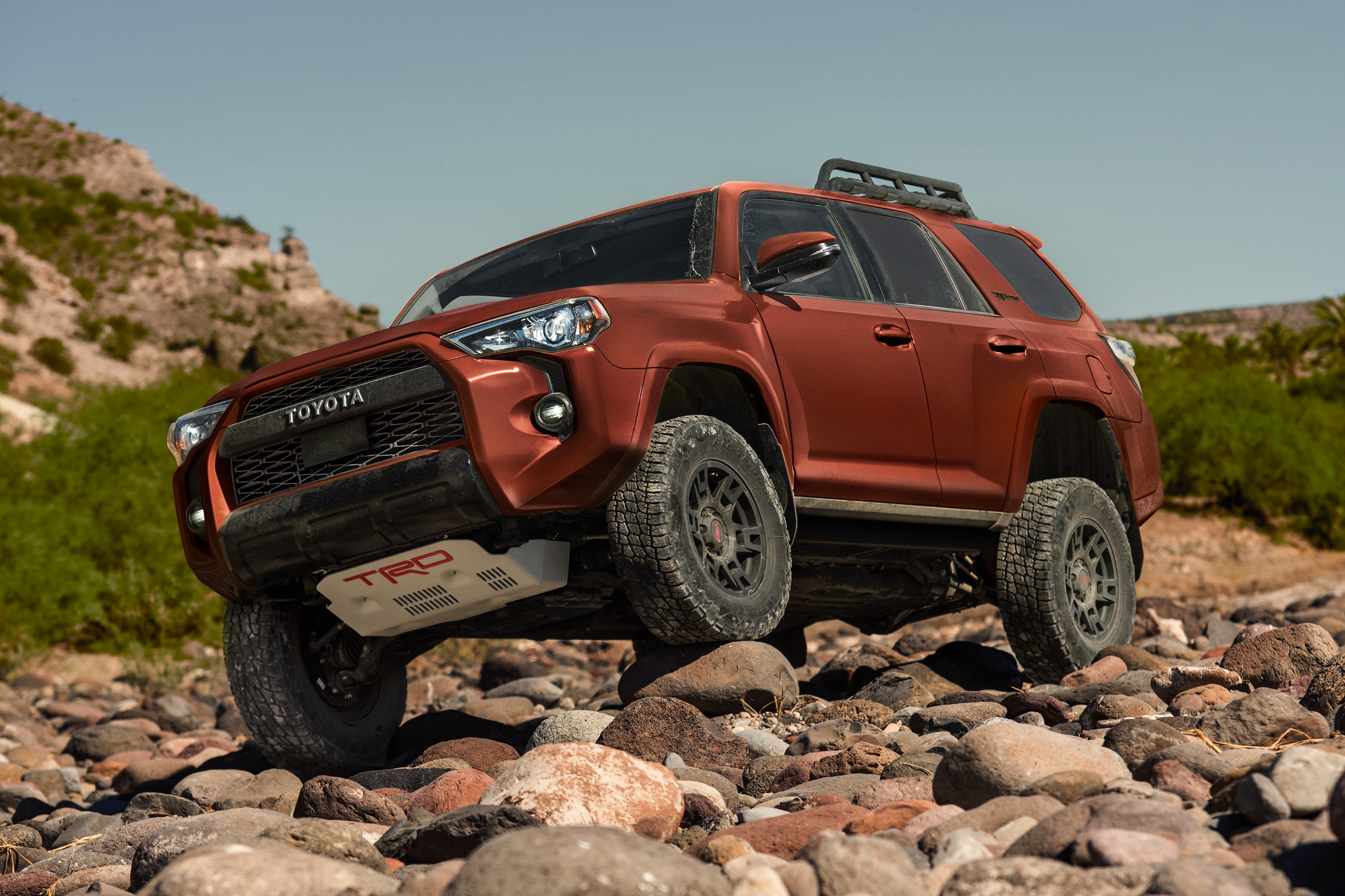
The 2024 Toyota 4Runner retained its classic, almost nostalgic appearance, despite being overdue for a redesign. Having last been updated for the 2010 model year, it was clear that the 4Runner’s boxy shape had endured the test of time. The flared fenders provided a muscular, wide stance that suggested stability—essential for off-road adventures. This ruggedness was accentuated by the pronounced and angular grille and liftgate design. In the TRD Pro model, added features like underbody skid plates and all-terrain tires made it even more prepared for rough terrains. Furthermore, the tubular roof rack added a practical, adventure-ready aesthetic.
Inside, the 4Runner showed its age with outdated styling and last-generation technology features. The analog instrument panel was a conspicuous throwback, especially considering many modern vehicles sported configurable digital displays. The modestly-sized eight-inch infotainment touchscreen also seemed antiquated, along with the classic gear selector and transfer case levers. Nostalgic as it might be for some, it could easily be mistaken for a well-maintained used vehicle by others.
The interior featured a significant amount of hard plastic—a common trait in vehicles catering to off-road enthusiasts—though frequently touched surfaces were padded for comfort. The grained seat upholstery attempted to imitate leather, but instead resembled vinyl, a typical material choice for durability in this vehicle category.
Comparable to the Ford Bronco and Jeep Wrangler, which leaned heavily into retro appeal, the 4Runner also managed to maintain its nostalgic charm. Nevertheless, it could have benefited from integrating more modern touches like its competitors managed to do.


For 2024, the Volkswagen Atlas simplified its powertrain options, eliminating the VR6 engine in favor of a 2.0-liter turbocharged inline four-cylinder engine. This decision marked a significant shift from the previous powertrains. The new turbo-four produced 269 horsepower and 273 pound-feet of torque using regular fuel. This was a noticeable difference from the 276 hp and 266 lb-ft offered by the VR6, and a significant bump from the earlier version of the turbo-four, which delivered 235 hp and 258 lb-ft.
The engine, an advanced version of VW's EA888 found in everything from Jettas to the high-performance Golf R, paired with an eight-speed automatic transmission. The Atlas continued to offer standard front-wheel drive (FWD) and optional all-wheel drive (AWD).
Volkswagen claimed that the Atlas, with its added torque, was quicker than the older V6 models. The FWD models could reportedly accelerate from zero to 60 mph in about eight seconds, while AWD models did so in 8.3 seconds. These were improvements of 0.4 seconds and 0.8 seconds, respectively, over their V6 predecessors. Despite these figures, the driving experience remained focused on comfort for family use rather than performance. The engine performed smoothly, reaching highway speeds without difficulty, though it emitted more noise than power. Ride quality stayed consistent with pre-refresh versions, steering towards a less comfortable experience than its competitors but not poorer than before. If anything, the 21-inch wheels on the test car were a positive consideration.
The Peak Edition emphasized an off-road focus with all-terrain tires and an Offroad driving mode, but Volkswagen's 4Motion AWD system remained mainly pavement-oriented. Capable of transferring a maximum of 50% torque to either the front or rear axles, it also decoupled the rear axle under light loads for better fuel economy. However, it lacked the low-range gearing necessary for serious off-roading or underbody protection for rugged terrain.
In terms of towing, the Atlas maintained a 5,000-pound maximum capacity that now applied to more models, excluding only the base SE, rated for 2,000 pounds. Although most competitors matched this rating, the Nissan Pathfinder stood out with a 6,000-pound towing capacity due to its naturally aspirated V6 engine.
The 2024 Toyota 4Runner came equipped with a 4.0-liter V6 engine delivering 270 horsepower and 278 lb-ft of torque. While these specs were comparable to its off-road-focused peers like the Bronco and Wrangler, the 4Runner lagged in transmission technology, being saddled with a five-speed automatic. In contrast, the Bronco used a ten-speed, and the Wrangler came with an eight-speed transmission, offering better acceleration and fuel efficiency.
The TRD Pro model, reviewed here, included standard four-wheel drive (4WD) and a two-speed transfer case. Other trims typically featured rear-wheel drive (RWD), with 4WD available as an option.
The powertrain’s inadequacies were most evident on paved roads, where the 4Runner felt sluggish, often necessitating full throttle to achieve decent highway merging speeds. The soft suspension, ideal for navigating rocky terrains, resulted in significant rear-end squat during acceleration, lifting the vehicle's front dramatically. This impression was exacerbated by the engine's labored sound and the TRD Pro’s loud exhaust, which sometimes mimicked the noise of a missing catalytic converter.
Hard braking introduced substantial nosedive due to the soft suspension, although the 4Runner remained controllable. On-road handling suffered from pronounced body roll when cornering, and the vehicle exhibited residual bounces over ruts and undulations, especially when unloaded. However, with a cargo load, the ride settled, achieving a more stable experience.
The 4Runner’s tall tire sidewalls and soft suspension effectively absorbed larger road imperfections, but passengers prone to motion sickness should be cautious on winding or rough roads.
The 2024 Volkswagen Atlas upgraded its list of standard features. The base SE model now boasted a heated steering wheel and ventilated front seats. The SE with Technology trim added a power liftgate, while the SEL trim gained leather upholstery and heated second-row seats as standard—previously reserved for higher trims.
The Atlas continued to offer standard seating for seven, with a three-seat second-row bench that could split-fold 60/40, recline up to 14 degrees, and slide fore and aft by 7.7 inches. This bench accommodated three child seats across and could tilt and slide with them installed. Second-row captain's chairs were available from the SE with Technology trim and up, reducing seating capacity to six. A 50/50 split-folding third-row bench remained consistent across all models.
The structure didn't change, but the Atlas impressed with its competitive headroom and legroom across all rows. It topped competitors like the Hyundai Palisade and Kia Telluride in first, second, and third-row headroom, also providing the best third-row legroom in its class. Second-row passengers, however, had slightly less space compared to other mid-sized crossovers.
Cargo space balanced out well with passenger space. With all seats in place, the Atlas held 20.6 cubic feet of cargo. Folding the third row increased capacity to 55.5 cubic feet, while folding both second and third rows maximized it to 96.6 cubic feet. This made the Atlas one of the leaders in cargo capacity, just shy of the Chevy Traverse.
The interior design of the 2024 Toyota 4Runner may have seemed ruggedly fashionable in 2010, but it now appeared undeniably dated. Nevertheless, its straightforward layout and large, easily operable climate control dials and driveline levers persisted, convenient even when wearing gloves. Sturdy handles reassured passengers during intense off-road expeditions, and the expansive front view enhanced by forward-pushed roof pillars was invaluable for navigating challenging terrains.
Front seat passengers enjoyed ample space, although taller drivers might have found the steering wheel’s telescoping range insufficient. The second row offered generous leg and foot space, though headroom was limited for taller occupants due to the elevated rear bench, which also improved outward visibility for passengers. A third-row seat option existed but was only available on certain trims.
The 4Runner provided plenty of storage options for long trips. The dashboard center section had small pockets, the console had medium-sized cupholders and a large armrest bin, and deep door pockets held larger drink bottles.
In terms of cargo capacity, the 4Runner could hold up to 47.2 cubic feet behind the rear seats. Opting for the sliding deck reduced capacity slightly but added convenience. Maximum cargo capacity reached 89.7 cubic feet with the rear seats stowed, although the process required manual effort to tumble the cushions and fold the headrests and seatbacks. The almost flat load floor was an advantage over competitors like the Bronco. However, there was no option for a powered liftgate, and remote seat releases were absent, requiring access from the rear doors. Unique features included the sliding glass rear window and interior hatch party speakers, ideal for tailgating. The 4Runner also featured a hitch receiver with a seven-pin harness, offering a 5,000-pound towing capacity suitable for small campers.
For 2024, the Volkswagen Atlas saw an upgrade in its standard technology offerings. Now equipped with a 12-inch touchscreen and a 10.25-inch digital instrument cluster, the vehicle provided an enhanced tech experience. Standard wireless phone charging, along with wireless Apple CarPlay and Android Auto, made the infotainment system both convenient and modern.
Previously limited to higher trims, wireless phone charging was now available across the board. A total of six USB-C ports were standard, with up to eight ports available, including a dash cam port on SE with Technology and higher trims—eliminating the need for custom wiring. SEL trims and above also featured a head-up display. Volkswagen switched from Fender to a Harman Kardon 12-speaker audio system, adding notable improvement over the basic six-speaker setup.
The infotainment interface itself was user-friendly, particularly the map view integrated into the digital instrument cluster—a boon for long trips. The graphics were clear and straightforward. However, the haptic touchpads for functions like audio volume and headlights reduced usability, lacking the tactile feedback of physical buttons despite the modern aesthetic appeal.
The infotainment system in the 2024 Toyota 4Runner did the basics well, offering standard Apple CarPlay and Android Auto. However, the eight-inch touchscreen felt cramped and could be cumbersome to operate while driving. Absent were off-road-specific apps and gauges, which competitors like the Bronco and Wrangler included, even though they were seldom used.
The TRD Pro model featured a 15-speaker JBL premium audio system, noted for its clear sound and robust bass. Yet, the loud engine and road noise meant that passengers could only fully appreciate the audio quality when the vehicle was stationary.
Additional terrain control switches were located in the headliner console, illustrated with pictograms rather than text descriptions. Thus, consulting the owner’s manual was essential to maximize the vehicle's off-road capabilities. These controls included a Crawl Control dial for low-speed off-roading and a Multi-Terrain Select system for different surfaces. Additional buttons enabled either a braking differential or a locking rear differential for improved traction on challenging terrain.
The 2024 Volkswagen Atlas earned strong safety evaluations. The National Highway Traffic Safety Administration (NHTSA) awarded it a five-star overall rating, including five stars in side-impact tests and four stars in frontal and rollover evaluations.
Though the Insurance Institute for Highway Safety (IIHS) had yet to release ratings for the 2024 model, the structurally similar 2023 version received top "Good" scores in all tests except the updated moderate overlap front crash test, where it scored "Marginal."
For 2024, Volkswagen expanded its driver-assist suite, making the IQ.Drive package standard across all trims. This included forward collision warning, automatic emergency braking, blind-spot monitoring, rear cross-traffic alert, lane-keep assist, and adaptive cruise control. The Travel Assist feature combined adaptive cruise control with lane-keep assist for highway driving. Higher trims like the SEL included predictive adaptive cruise control, while the SEL Premium R-Line added park assist and a surround-view camera system.
Additional safety features included automatic post-collision braking, a crash response system that switched off the fuel pump, unlocked the doors, and activated hazard lights after an incident, and an emergency assist function to stop the car if the driver became incapacitated.
The safety ratings for the 2024 Toyota 4Runner were mixed. NHTSA awarded it four out of five stars for overall and frontal crash protection, five stars for side impacts, and three stars in rollover evaluations. The IIHS also presented inconsistent scores, marking it "Good" on moderate frontal overlap and side protection tests. However, the newer small overlap frontal test yielded "Marginal" and "Poor" ratings.
Comparatively, the Ford Bronco outscored the 4Runner in almost all areas, while the Jeep Wrangler had similar, though incomplete, ratings.
Despite these ratings, the 4Runner came equipped with a comprehensive suite of safety features. Standard systems included adaptive cruise control, forward collision warning with automatic emergency braking, lane-departure warning, and a blind-spot monitor with rear cross-traffic alert. Higher trims like the TRD Pro and Limited also featured a surround-view camera system, although only the Limited trim added front and rear parking proximity sensors.
A downside was the 4Runner's tendency to be overly sensitive with its alerts. Lane-departure warnings triggered by merely nearing a lane marker and forward collision warnings not well-tuned for dense traffic could be sources of ongoing distraction. However, some of these sensitivities could be adjusted through the vehicle’s settings.
CarGurus highlights
According to CarGurus experts, the overall rating for the 2024 Volkswagen Atlas is 7.3 out of 10, while the 2024 Toyota 4Runner scores 4.5 out of 10. Given these ratings, the 2024 Volkswagen Atlas takes the lead, excelling with its comprehensive safety features, modern technological upgrades, and strong performance in terms of cargo capacity and family-friendly options. Although the 2024 Toyota 4Runner remains a reliable and sturdy off-road vehicle, its dated design and lower safety scores suggest it lags behind. For a blend of contemporary style, family utility, and advanced safety, the 2024 Volkswagen Atlas is the better choice.
Choose the 2024 Volkswagen Atlas if:
- You prioritize modern design elements, both exterior and interior, which include light-up logos and a high-tech infotainment system.
- You need ample cargo space and versatile seating arrangements suitable for large families or frequent road trips.
- You're looking for a comprehensive suite of standard safety features and a strong overall safety rating.


Choose the 2024 Toyota 4Runner if:
- You seek a reliable, robust off-road SUV that excels in rugged terrain and offers traditional, hard-wearing interior and exterior designs.
- You need a vehicle with proven, high ground clearance, off-roading capabilities, and ample interior storage for adventure gear.
- You value tried-and-true mechanical simplicity over modern intricacies, appreciating straightforward technology and proven reliability.


CarGurus highlights
According to CarGurus experts, the overall rating for the 2024 Volkswagen Atlas is 7.3 out of 10, while the 2024 Toyota 4Runner scores 4.5 out of 10. Given these ratings, the 2024 Volkswagen Atlas takes the lead, excelling with its comprehensive safety features, modern technological upgrades, and strong performance in terms of cargo capacity and family-friendly options. Although the 2024 Toyota 4Runner remains a reliable and sturdy off-road vehicle, its dated design and lower safety scores suggest it lags behind. For a blend of contemporary style, family utility, and advanced safety, the 2024 Volkswagen Atlas is the better choice.
Choose the 2024 Volkswagen Atlas if:
Shop Now- You prioritize modern design elements, both exterior and interior, which include light-up logos and a high-tech infotainment system.
- You need ample cargo space and versatile seating arrangements suitable for large families or frequent road trips.
- You're looking for a comprehensive suite of standard safety features and a strong overall safety rating.
Choose the 2024 Toyota 4Runner if:
Shop Now- You seek a reliable, robust off-road SUV that excels in rugged terrain and offers traditional, hard-wearing interior and exterior designs.
- You need a vehicle with proven, high ground clearance, off-roading capabilities, and ample interior storage for adventure gear.
- You value tried-and-true mechanical simplicity over modern intricacies, appreciating straightforward technology and proven reliability.

By: CarGurus + AI
At CarGurus, our team of experienced automotive writers remain at the heart of our content operation, conducting hands-on car tests and writing insightful guides that are backed by years of industry experience. To complement this, we are harnessing AI to make our content offering more diverse and more helpful to shoppers than ever. To achieve this, our AI systems are based exclusively on CarGurus content, ratings and data, so that what we produce is both unique to CarGurus, and uniquely helpful to car shoppers.

