2023 Nissan Altima vs 2023 Mazda MAZDA3
Overview | |
MSRP$25,630 | MSRP$22,550 |
Listings396 | Listings80 |
Ratings & Reviews | |
User Reviews | User Reviews |
Expert reviews6.3 out of 10 | Expert reviews8.2 out of 10 |
Pros
Cons
| Pros
Cons
|
2023 Nissan Altima Reviews SummaryThe traditional family sedan segment is taking the brunt of the impact associated with the shift in consumer preferences to SUVs. Nearly all large cars are gone from the marketplace, and the number of midsize sedans is half what it was just a few years ago. In the next 12 to 24 months, it will shrink by another 50 percent, leaving the Honda Accord, Subaru Legacy, Toyota Camry, and the subject of this review, the Nissan Altima, as the last midsize models standing (and the Legacy is likely on life support). | |
2023 Mazda MAZDA3 Reviews SummaryWith the ubiquitous growth of the small SUV, the compact car segment might get overlooked when shopping for your next vehicle. But small cars can do many of the things that are asked of a small SUV—especially if that car is a hatchback. The 2023 Mazda3 is a stark reminder of just how great hatchbacks can be for everyday life. Mazda’s approach with its vehicles has been simple, yet ambitious: to “deliver luxury-level performance and cabin quality without the luxury price,” according to the company. The Mazda3 is no different. It punches well above its weight and raises the bar for what a small car can be. The Mazda3 hatchback even offers SUV-like versatility thanks to added cargo space and a rear liftgate. But does the Mazda3 have the features and attributes that will have you reconsidering cars over crossovers? | |
Popular Features & Specs | |
Engine2.5L 188 hp I4 | Engine2.5L 191 hp I4 |
DrivetrainFWD | DrivetrainFWD |
Seating Capacity5 | Seating Capacity5 |
Horsepower188 hp @ 6000 rpm | Horsepower191 hp @ 6000 rpm |
MPG City27 | MPG City28 |
MPG Highway38 | MPG Highway37 |
Engine | |
Engine Name2.5L 188 hp I4 | Engine Name2.5L 191 hp I4 |
Torque180 lb-ft @ 3600 rpm | Torque186 lb-ft @ 4000 rpm |
Horsepower188 hp @ 6000 rpm | Horsepower191 hp @ 6000 rpm |
DrivetrainFWD | DrivetrainFWD |
Fuel Economy | |
MPG City27 | MPG City28 |
MPG Highway38 | MPG Highway37 |
Interior | |
Seating Capacity5 | Seating Capacity5 |
Safety | |
Front Crash Overall4 | Front Crash Overall5 |
Side Crash Overall5 | Side Crash Overall5 |
Dimensions & Capacity | |
Cargo Space15.4 cu ft | Cargo Space13.2 cu ft |
Curb Weight3253 lbs | Curb Weight3126 lbs |
Height56.7 in | Height56.9 in |
Length192.9 in | Length183.5 in |
Width72.9 in | Width70.7 in |
Wheelbase111.2 in | Wheelbase107.3 in |
Maximum Payload1084 lbs | Maximum Payload953 lbs |
Number of doors4 | Number of doors4 |
Overview | ||
MSRP | $25,630 | $22,550 |
Listings | ||
Ratings & Reviews | ||
User reviews | ||
Expert reviews | 6.3 out of 10Read full review | 8.2 out of 10Read full review |
Pros & cons | Pros
Cons
| Pros
Cons
|
Summary | The traditional family sedan segment is taking the brunt of the impact associated with the shift in consumer preferences to SUVs. Nearly all large cars are gone from the marketplace, and the number of midsize sedans is half what it was just a few years ago. In the next 12 to 24 months, it will shrink by another 50 percent, leaving the Honda Accord, Subaru Legacy, Toyota Camry, and the subject of this review, the Nissan Altima, as the last midsize models standing (and the Legacy is likely on life support). | With the ubiquitous growth of the small SUV, the compact car segment might get overlooked when shopping for your next vehicle. But small cars can do many of the things that are asked of a small SUV—especially if that car is a hatchback. The 2023 Mazda3 is a stark reminder of just how great hatchbacks can be for everyday life. Mazda’s approach with its vehicles has been simple, yet ambitious: to “deliver luxury-level performance and cabin quality without the luxury price,” according to the company. The Mazda3 is no different. It punches well above its weight and raises the bar for what a small car can be. The Mazda3 hatchback even offers SUV-like versatility thanks to added cargo space and a rear liftgate. But does the Mazda3 have the features and attributes that will have you reconsidering cars over crossovers? |
Video | ||
Popular Features & Specs | ||
Engine | 2.5L 188 hp I4 | 2.5L 191 hp I4 |
Drivetrain | FWD | FWD |
Seating Capacity | 5 | 5 |
Horsepower | 188 hp @ 6000 rpm | 191 hp @ 6000 rpm |
MPG City | 27 | 28 |
MPG Highway | 38 | 37 |
Engine | ||
Engine Name | 2.5L 188 hp I4 | 2.5L 191 hp I4 |
Torque | 180 lb-ft @ 3600 rpm | 186 lb-ft @ 4000 rpm |
Horsepower | 188 hp @ 6000 rpm | 191 hp @ 6000 rpm |
Drivetrain | FWD | FWD |
Fuel Economy | ||
MPG City | 27 | 28 |
MPG Highway | 38 | 37 |
Interior | ||
Seating Capacity | 5 | 5 |
Safety | ||
Front Crash Overall | 4 | 5 |
Side Crash Overall | 5 | 5 |
Dimensions & Capacity | ||
Cargo Space | 15.4 cu ft | 13.2 cu ft |
Curb Weight | 3253 lbs | 3126 lbs |
Height | 56.7 in | 56.9 in |
Length | 192.9 in | 183.5 in |
Width | 72.9 in | 70.7 in |
Wheelbase | 111.2 in | 107.3 in |
Maximum Payload | 1084 lbs | 953 lbs |
Number of doors | 4 | 4 |
Nissan had long been a key player in the family car sector, with a lineage that stretched back over 50 years to models like the Datsun 510 and Nissan Stanza. By reworking the Altima for 2023, Nissan clearly aimed to sustain this legacy, even as the more upscale Maxima faced discontinuation.
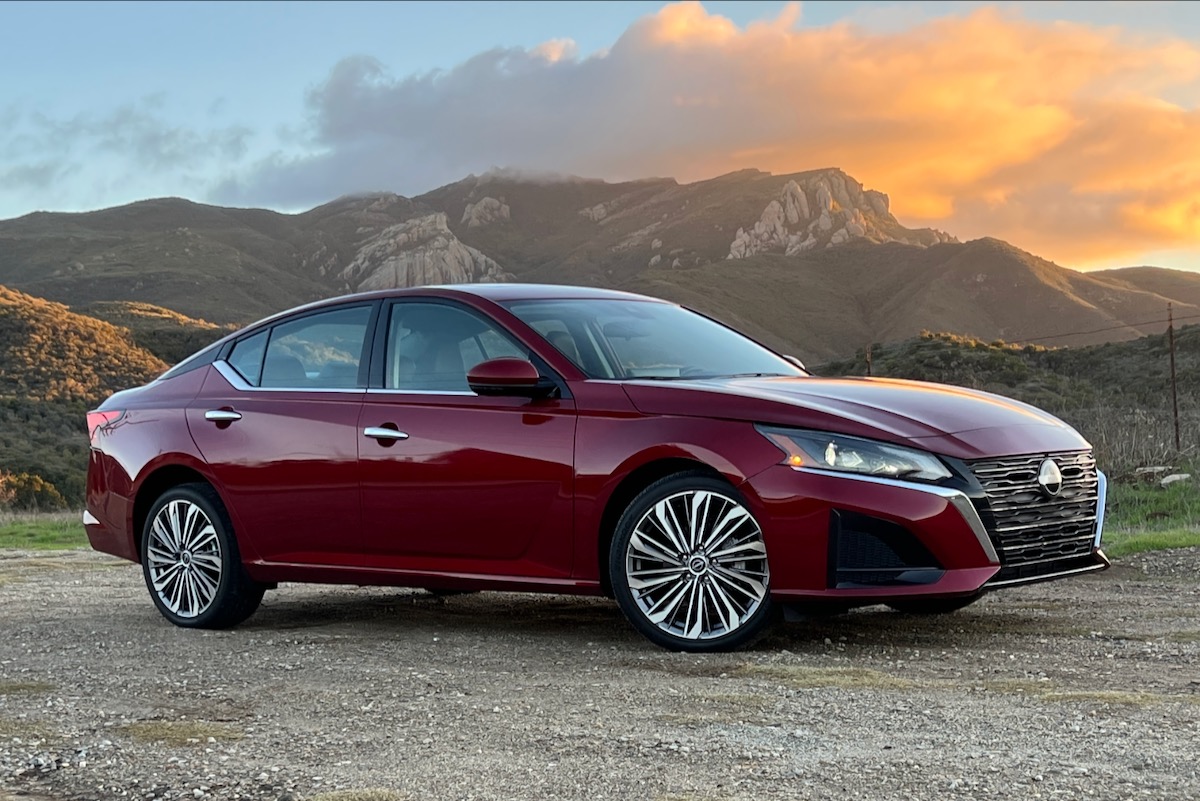
The updates for the 2023 Altima included revamped front styling with a redesigned grille, new wheel designs, and two additional paint colors. With higher trim levels featuring sharp-looking 19-inch wheels, the Altima presented an enhanced visual appeal. However, the Altima SL trim wheels seemed susceptible to curb rash due to their flush design with the tire sidewalls.
Replacing the former Platinum trim, the 2023 Altima SL stood out as one of two new upscale trims. The lineup was composed of the base Altima S, the widely favored Altima SV, the sporty Altima SR, and the luxurious Altima SL. Additionally, there was the Altima SR VC-Turbo variant, combining SL amenities with a more powerful turbocharged engine. Prices ranged from $25,290 to $34,990, plus a $1,095 destination charge.
Our test vehicle was an Altima SL equipped with an optional all-wheel-drive (AWD) system. The MSRP, including the destination charge, was $34,755. Overall, the 2023 Altima SL made a good visual impression, partly due to the sleek but vulnerable wheels. The interior was appealing yet marred by ample hard plastic, reminding buyers of the Altima’s lower starting price. Opting for the Gray leather in SL trim elevated the cabin’s ambiance with a striking two-tone design. Although the new simulated wood dashboard trim didn’t quite convince, the double-stitched seams succeeded in diverting attention from the hard plastic elements.
Mazda always prided itself on sleek designs, and the 2023 Mazda3 was no exception. With striking headlights framing a bold grille, the model came in both sedan and hatchback forms. While the sedan possessed relatively conventional lines, the hatchback broke the mold with its daring design. As one of the cleanest, forward-thinking car designs available, the rear angles of the hatchback curved around the rear window and doors, making for a futuristic appeal that few could match.
Inside, the clean, futuristic philosophy continued. The simplicity of the design, complemented by the seamless way the infotainment system emerged from the dashboard, demonstrated a masterclass in styling that other manufacturers, such as Tesla, could learn from.
Mazda3 maintained a classic shifter design and offered conventional yet easy-to-use climate controls. With elegant steering wheel design and strategically placed controls, the interior felt both refined and functional.
Available trim levels ranged from the 2.5 S, Select, Preferred, and Carbon Edition to the Premium, 2.5 Turbo, and 2.5 Turbo Premium Plus. Standard features on the base 2.5 S included 16-inch wheels, pushbutton start, keyless entry, two USB ports, and an 8.8-inch infotainment display with Apple CarPlay and Android Auto. Advancing through the trims added features like 18-inch wheels, dual-zone climate control, leather-wrapped steering wheels, and even a moonroof and heated seats in upper trims. Our test model was the top-tier 2.5 Turbo AWD Premium Plus hatchback, which also included reverse automatic emergency braking, a surround-view parking monitor, and other advanced driver assistance features.


The 2023 Nissan Altima came with a 2.5-liter four-cylinder engine paired with a continuously variable automatic transmission (CVT) for all variants except the SR VC-Turbo. The engine delivered 188 horsepower (hp) and 180 pound-feet (lb-ft) of torque in front-wheel-drive (FWD) models, and 182 hp and 178 lb-ft with AWD. Available with the SV, SR, and SL trims, the AWD system could distribute up to half of the engine’s output to the rear wheels as required.
While the base engine provided adequate power with peak torque at 3,600 rpm, the SR trim included paddle shifters to boost driver engagement. Nissan’s CVT was designed to emulate a traditional automatic transmission during acceleration, enhancing the driving experience. Fuel economy ratings ranged from 30 to 32 miles per gallon (mpg) combined, but our AWD SL test vehicle averaged a less impressive 27.4 mpg.
For a more spirited drive, the Altima SR VC-Turbo featured an exclusive turbocharged 2.0-liter four-cylinder variable compression engine. Running on regular fuel, it generated 236 hp and 267 lb-ft of torque, which increased to 248 hp and 273 lb-ft with premium fuel. Despite its extra power, the turbo engine’s combined fuel economy was only slightly lower at 29 mpg.
The SR and SR VC-Turbo trims boasted a sport-tuned suspension, while both the Altima SL and SR included brake-based Active Ride Control and Intelligent Trace Control systems. The SR VC-Turbo also offered Active Understeer Control technology.
The SL AWD we tested, despite being the most well-equipped trim, was heavier and featured the least powerful drivetrain, resulting in merely adequate performance and disappointing fuel economy. Nevertheless, Nissan’s CVT performed admirably, maintaining the illusion of a traditional automatic transmission.
While the Altima excelled in grip and maintained a flat cornering attitude, the steering felt lifeless. Additionally, the brakes tended to overheat under demanding conditions, raising concerns.
The base Mazda3 engine was a 2.5-liter naturally aspirated inline-four, producing 191 hp and 186 lb-ft of torque. This engine powered the front wheels through a six-speed automatic transmission, with AWD as an optional upgrade. In some FWD Premium models, a manual transmission was also available.
Our test vehicle, however, came with the optional turbocharged 2.5-liter four-cylinder engine, delivering 227 hp and 310 lb-ft of torque on regular fuel, or 250 hp and 320 lb-ft with premium. The turbo engine was paired with standard AWD and an automatic transmission.
From start-up, the Mazda3’s turbo engine emitted an engaging sound, particularly appealing to fans of high-performance four-cylinder engines. This sensory experience extended to the driving itself, with well-weighted steering providing a perfect blend of feedback and precision.
With substantial torque on hand, the turbocharged Mazda3 accelerated moderately off the line but shone once in second gear. Sport mode kept the transmission in lower gears for extended periods to optimize turbocharger performance, while also increasing steering resistance for a more immersive drive. The braking system was surprising, mimicking a sports car with minimal pedal travel and requiring precise control.
The standout feature of the Mazda3 was its exemplary handling. Agile yet forgiving, the car balanced precision with refinement, effortlessly absorbing road imperfections. An added bonus was the car’s manual tap shift function, mimicking race-car sequential shifters with forward downshifts and backward upshifts—showing Mazda’s commitment to performance drivers.
Beyond its affordable interior materials, the Altima’s cabin was straightforward, comfortable, and user-friendly. With logically-arranged controls and matte black surfaces for easy readability, the analog gauges provided Mazda-like clarity.
Nissan equipped the Altima with its Zero Gravity seats, designed to offer astronaut-like comfort and support. In our SL test car, these leather-wrapped seats remained comfortable despite a somewhat sticky feel.
The Altima’s cabin featured dual-zone climate control, a power sunroof, heated front seats, a heated steering wheel, and a 10-way power-adjustable driver’s seat. However, the front passenger seat lacked a height adjuster, complicating ingress and egress. The snug clearance between the door panel and sill further hampered exit ease.
Rear seat comfort was decent, with sufficient legroom, headroom, and thigh support. Still, lower trims lacked rear air vents, and a rear seatbelt buckle caused discomfort when folding into the cushion. Interior storage was adequate but not overly generous, and removing floor mats could potentially damage the carpets.
The Altima’s trunk offered 15.4 cubic feet of cargo space—roomy yet not as large as some competitors. The trunk design provided a practical shape but lacked a grip or handle to close it sans dirty fingers.
The Mazda3 sedan provided a smaller cargo capacity of 13.1 cubic feet, trailing behind rivals like the Honda Civic and Nissan Sentra. Meanwhile, the hatchback variant offered a more generous 20.1 cubic feet, although still falling short compared to some compact SUVs.
The rear seating area in both sedan and hatchback formats was cramped, with limited legroom when front seats accommodated taller adults. Additionally, the sloping roofline cut into rear headroom. Essentially, the Mazda3 was designed for front-seat-centric use, relegating the back seats for occasional use only.
Front-row storage was mixed. The center console compartment was decently sized but had a sliding lid that only flipped open when fully retracted—an annoying feature. Fortunately, the car's layout included ergonomic amenities and adequately-sized cupholders.
The base Altima S featured a rudimentary infotainment setup with a 5-inch display radio, Bluetooth, and a hands-free text messaging assistant, but nothing further.
Advancing to the SV or SR trims saw the inclusion of an 8-inch touchscreen infotainment system. This package offered wired Apple CarPlay and Android Auto compatibility, along with SiriusXM satellite radio featuring the robust 360L service.
A new offering in 2023 was a 12.3-inch touchscreen infotainment system, standard with SL and SR VC-Turbo trims and optional with SV and SR trims. This upgrade included navigation support, wireless Apple CarPlay, wired Android Auto, a Wi-Fi hotspot, and a conveniently placed wireless smartphone charging pad.
NissanConnect Services, accessible via a required SiriusXM subscription, extended functionality with remote engine starting, Amazon Alexa and Google Assistant integration, and an SOS button.
SL and SR VC-Turbo variants additionally boasted a nine-speaker Bose premium audio system, though its performance was hit-or-miss depending on the music genre. The new 12.3-inch infotainment system, however, was a major enhancement over past NissanConnect setups, featuring an improved interface, superior graphics, and effective voice recognition. Climate controls were not voice-command operable, but physical knobs and buttons offered simple, reliable control.
All Mazda3 variant had an 8.8-inch infotainment display. Unlike many rivals, this system wasn't a touchscreen and was instead controlled via a central console dial. This setup proved to be a weak spot, as navigating menus was often clumsy and less intuitive, making it hard to access basic functions like radio presets efficiently.
The standard system included two USB ports, HD radio, Bluetooth, and voice control. Our test model with additional features such as navigation, satellite radio, and a 12-speaker Bose premium stereo system excelled in sound quality, bolstered by visually appealing aluminum speaker covers throughout the cabin.
The caveat was that integrating Apple CarPlay or Android Auto compounded the system’s ergonomic issues. The interface inconsistently responded to the central dial and buttons, forcing drivers to divert attention from the road more often—a considerable safety concern.
In terms of safety, every 2023 Altima model came equipped with Nissan Safety Shield 360, offering forward-collision warning with pedestrian detection, automatic emergency braking, lane-departure warning, blind-spot monitoring, rear cross-traffic alert, and driver monitoring. The lane-departure warning provided a tactile steering wheel vibration, while blind-spot monitoring used lights located near the windshield pillar.
Higher trims or packages added more safety features: SV trims gained rear automatic braking, SR got automatic high-beam headlights, and SL and SR VC-Turbo included ProPilot Assist. ProPilot Assist combined adaptive cruise control, lane-keeping assist, and lane-centering for better highway driving, though with some abrupt transitions and slower reactions at times.
The SL and SR VC-Turbo also featured a surround-view camera system addressing the car’s visibility challenges. Nonetheless, the reversing camera quality was underwhelming.
Mazda3's safety suite was comprehensive, starting with forward automatic emergency braking, adaptive cruise control, pedestrian and cyclist detection, adaptive headlights, lane-departure warning, and rain-sensing wipers. Select trims added blind-spot monitoring and rear cross-traffic alert. Top-tier models like the Turbo Premium Plus came with advanced features like traffic-sign recognition, traffic jam assist, and a 360-degree camera system.
The traffic-sign recognition even projected stop signs onto the head-up display, aiding driver awareness. Our test model’s side mirrors also tilted down in reverse, minimizing the risk of curb contact while parking.
However, the Mazda3’s problematic design element—a significantly large C-pillar—created considerable blind spots. This issue, combined with the complicated infotainment controls, posed genuine safety risks by distracting drivers prolonging focus away from the road.
CarGurus highlights

According to CarGurus experts, the overall rating for the 2023 Nissan Altima was 6.3 out of 10, while the 2023 Mazda MAZDA3 scored 8.2 out of 10. Given these scores, the Mazda MAZDA3 is the preferable choice, offering a more engaging driving experience, superior technology options, and innovative design. With higher ratings across crucial categories, the Mazda3 makes a stronger case as the ideal vehicle in this comparison.
Choose the 2023 Nissan Altima if:
- You value a car with robust safety features across all trim levels.
- You prefer a spacious and comfortable rear seat area.
- You appreciate the inclusion of AWD in multiple trims, aiding in diverse driving conditions.


Choose the 2023 Mazda MAZDA3 if:
- You prioritize engaging driving experience with well-balanced handling and responsive steering.
- You seek a sleek, futuristically designed vehicle, particularly in its hatchback form.
- You enjoy advanced technology options such as a high-quality Bose sound system and traffic-sign recognition in higher trims.


CarGurus highlights
According to CarGurus experts, the overall rating for the 2023 Nissan Altima was 6.3 out of 10, while the 2023 Mazda MAZDA3 scored 8.2 out of 10. Given these scores, the Mazda MAZDA3 is the preferable choice, offering a more engaging driving experience, superior technology options, and innovative design. With higher ratings across crucial categories, the Mazda3 makes a stronger case as the ideal vehicle in this comparison.
Choose the 2023 Nissan Altima if:
Shop Now- You value a car with robust safety features across all trim levels.
- You prefer a spacious and comfortable rear seat area.
- You appreciate the inclusion of AWD in multiple trims, aiding in diverse driving conditions.
Choose the 2023 Mazda MAZDA3 if:
Shop Now- You prioritize engaging driving experience with well-balanced handling and responsive steering.
- You seek a sleek, futuristically designed vehicle, particularly in its hatchback form.
- You enjoy advanced technology options such as a high-quality Bose sound system and traffic-sign recognition in higher trims.

By: CarGurus + AI
At CarGurus, our team of experienced automotive writers remain at the heart of our content operation, conducting hands-on car tests and writing insightful guides that are backed by years of industry experience. To complement this, we are harnessing AI to make our content offering more diverse and more helpful to shoppers than ever. To achieve this, our AI systems are based exclusively on CarGurus content, ratings and data, so that what we produce is both unique to CarGurus, and uniquely helpful to car shoppers.

