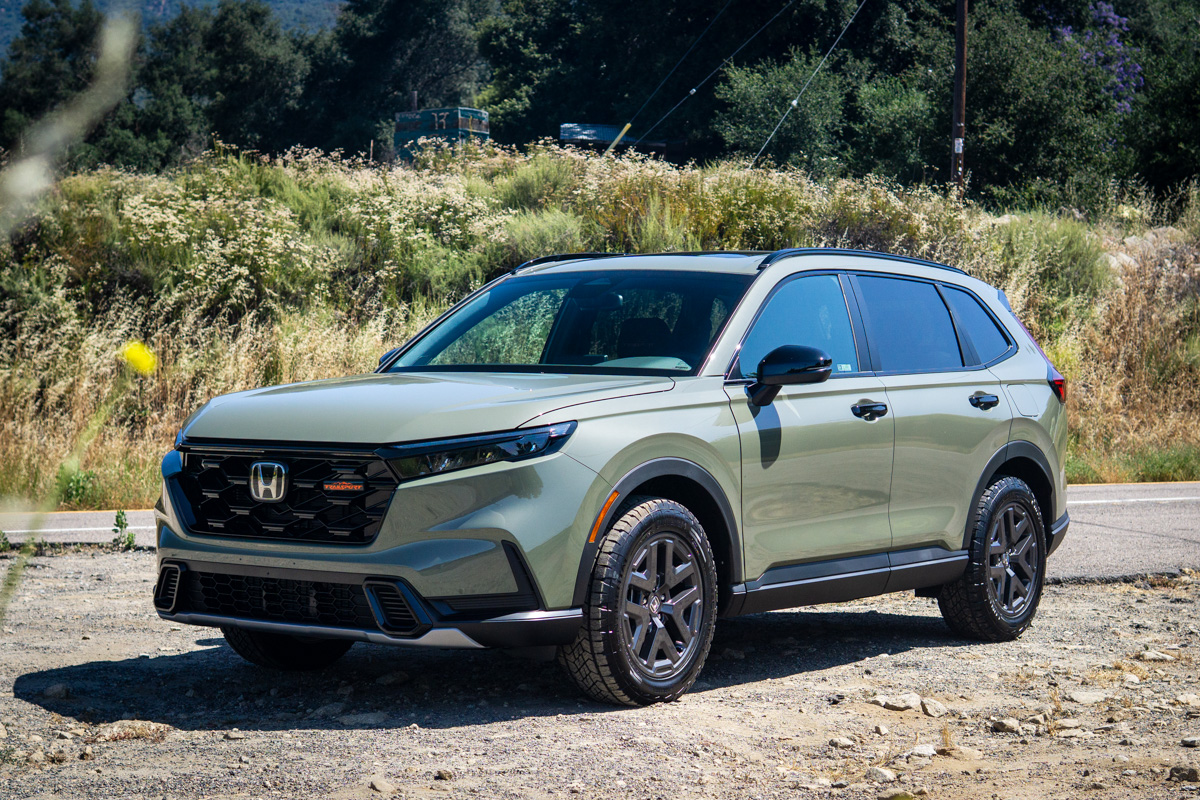
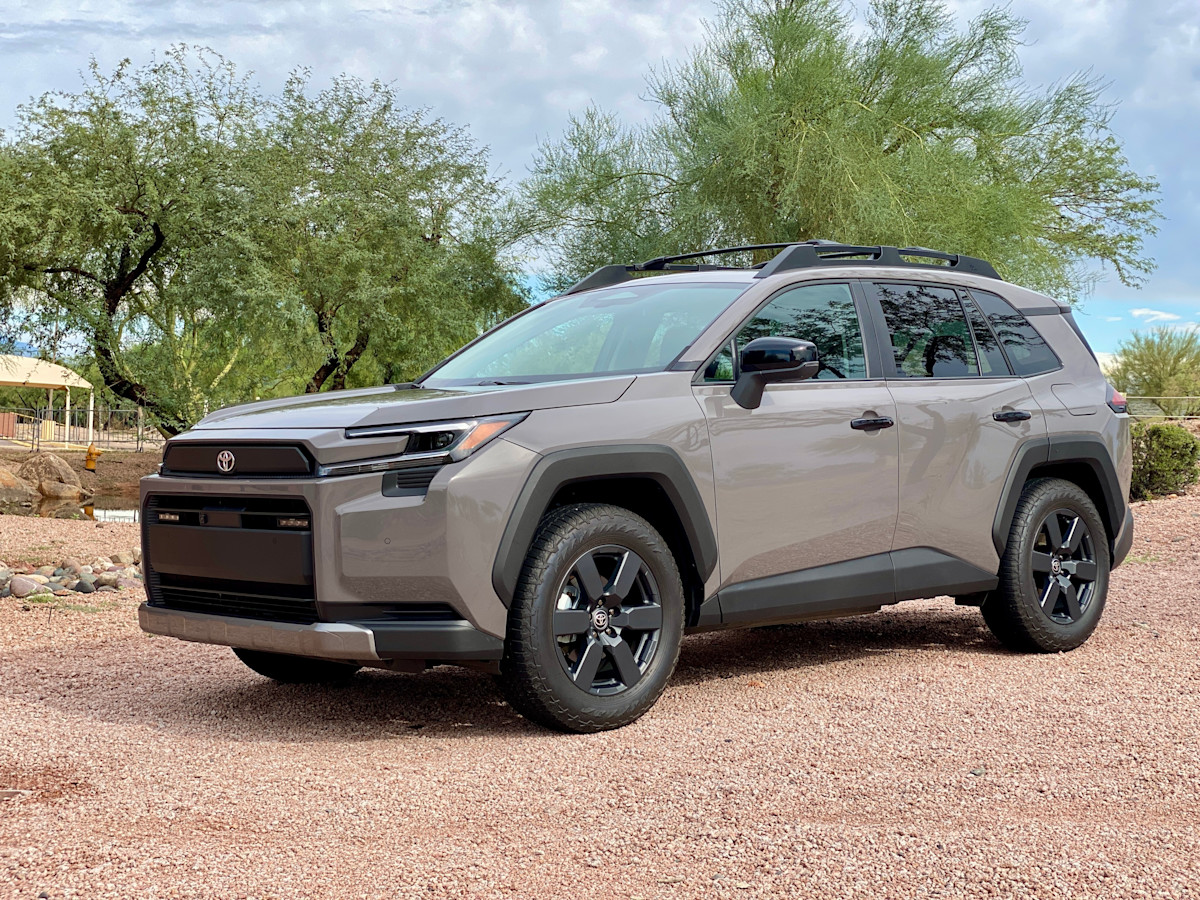
Nissan’s top-selling SUV in the U.S. has been completely redesigned for 2027, and will launch as the Rogue Hybrid initially. It pairs an all-new hybrid powertrain with standard all-wheel drive and bold new styling. Sold in SV, SR, and Platinum trims, it takes on compact crossover heavyweights like the Toyota RAV4 Hybrid, Honda CR-V, Hyundai Tucson, and Chevrolet Equinox.
2027 Nissan Rogue Hybrid Pricing, Specs, and Release Date
- What’s New for the 2027 Nissan Rogue Hybrid
- Design
- Powertrain
- Interior
- Technology
- Safety
- Pricing and Release Date
- Further Research

What’s New for the 2027 Nissan Rogue Hybrid
The 2027 Rogue Hybrid is all-new from the ground up. The most obvious update is the styling, inside and out, while the cabin gains larger available screens, upgraded driver-assistance tech, and, for the first time in a Rogue, available ventilated front seats. Dimensionally, the new model is about the same length as the outgoing Rogue and rides on a similar wheelbase, but it sits a bit taller. It’s also 400 to 500 pounds heavier, and it gives up some rear legroom and cargo space compared to the previous generation.
But arguably the biggest change is under the hood: this is the first vehicle to bring Nissan’s e-POWER hybrid system to the U.S. It’s a series hybrid, meaning the two standard electric motors are what powers the wheels directly, while the gas engine acts solely as a generator. This boosts both refinement and fuel economy.
Design
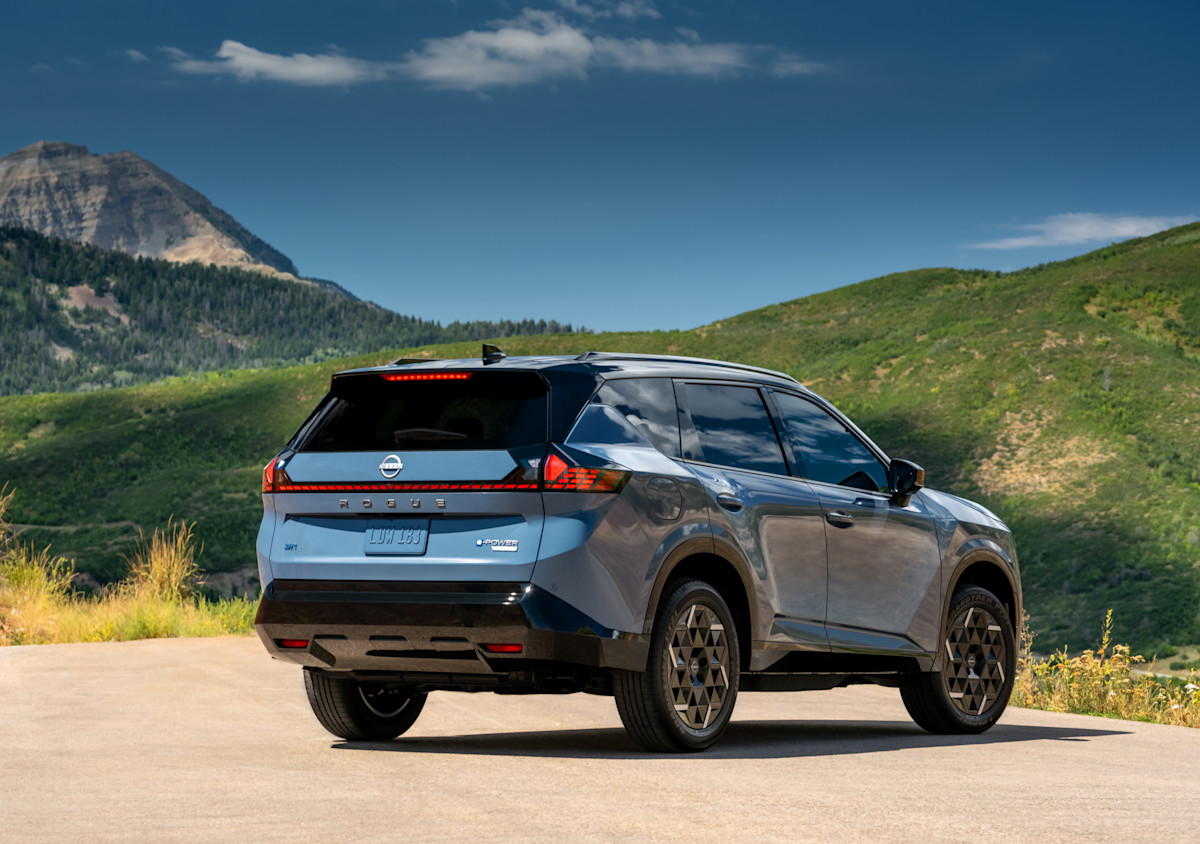
This Rogue marks a new chapter for Nissan design, and it looks unlike any Nissan before it. It’s bold and rugged without tipping into weird or awkward, and its wide, planted stance gives it real presence on the road. Up front, an angular fascia surrounds a hexagonal, honeycomb-pattern grille with integrated LED headlights, while crisp fender edges contrast with smoother, sculpted sides. Some trims also offer a full-width LED taillight stretching across the liftgate.
The SR is the sporty trim, with its own front fascia, unique wheels, and gloss black trim on the grille, mirrors, pillars, and wheel arches. The SV rides on 18-inch dark-painted alloy wheels, while SR and Platinum models get 19-inch alloys with a dark-painted, machine-finished look (the SR also adds aero covers). Black roof rails are standard on SR and Platinum and optional on SV. Buyers can choose from eight exterior colors plus five two-tone combinations with a black roof. Three colors are new to the Rogue: Horizon Blue Pearl Metallic, Alpine Metallic, and Aurora Dune Pearl.
The Rogue measures 183.1 inches long on a 106.5-inch wheelbase, and it’s 72.8 inches wide and 67.7 inches tall. Ground clearance is 8.4 inches on the SV and 8.5 inches on SR and Platinum.
Powertrain
Every 2027 Rogue Hybrid uses Nissan’s e-POWER system, an all-new powertrain for the brand in the U.S. It pairs a turbocharged 1.5-liter three-cylinder engine (148 horsepower and 171 lb-ft of torque) with two electric motors, one at each axle. Total system output is 225 hp, which puts the Rogue about midpack among compact crossovers.
What sets this setup apart is that the gas engine never turns the wheels. It serves only as a generator, feeding a 1.67-kWh lithium-ion battery and the electric motors, and it shuts off when the battery has enough charge. There’s no transmission to shift and no need to plug in; owners just fill up with regular unleaded.
All-wheel drive is standard on every trim. The system continually shifts torque between the front and rear motors for traction and stability, and it can lightly brake the inside wheels to sharpen cornering. Drive modes include Standard, Eco, Sport, Off-Road, Snow, and Personal.
EPA estimates aren’t available yet, but Nissan’s internal testing projects the SR at 40 mpg city, 36 mpg highway, and 38 mpg combined. That would put it near the top of the segment, trailing only the Toyota RAV4 Hybrid and beating models like the Honda CR-V, Hyundai Tucson, and Chevrolet Equinox. The fuel tank holds 14 gallons, and towing capacity is 1,500 pounds when properly equipped.
Interior
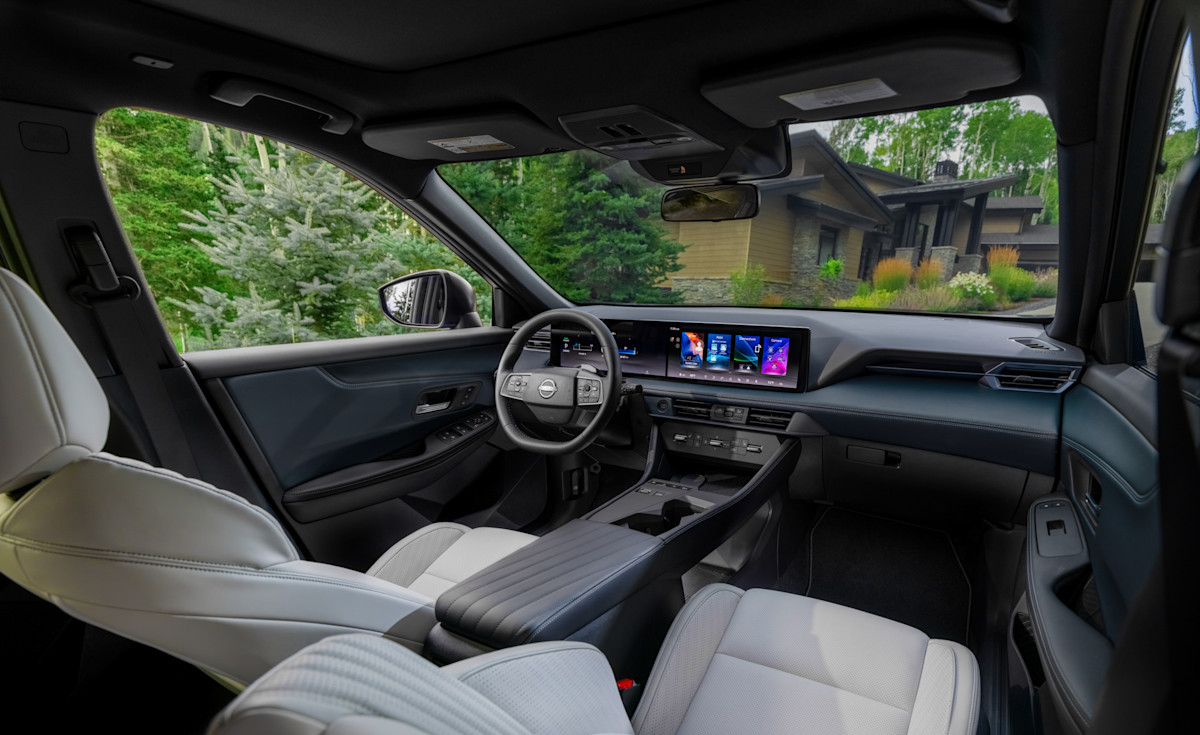
The redesign continues inside, where the materials and fit and finish have a genuinely upscale feel. One standout feature is the physical buttons and switches for the climate control; no touch-sensitive panels or screen-only setup here. SV models come with premium cloth upholstery, with leatherette available as part of a package, while SR and Platinum trims get quilted, perforated, stitched leatherette. Nissan’s Zero Gravity front seats are designed to reduce fatigue on long drives and genuinely live up to their billing.
Heated front seats and an 8-way power driver’s seat are standard across the lineup. The Platinum adds ventilated front seats, heated rear seats, driver’s seat memory, and a power front passenger seat. A panoramic moonroof is optional on SV and SR and standard on Platinum.
Front occupants get 40.9 inches of headroom and 41.5 inches of legroom. In the second row, there’s 40.0 inches of headroom and 36.2 inches of legroom; all headroom numbers drop slightly on models with a moonroof.
While the rear legroom figure is down more than two inches from the outgoing Rogue, there’s still plenty of space back there: our 6-foot-1 reviewer had plenty of space in the rear seats, even with the front seat adjusted for him as well.
Cargo space measures 31.1 cubic feet behind the rear seats and 65.9 cubic feet with them folded, which is about 8 cubic feet less than before with the seats down. Overall, the Rogue now trails most of its competitors for passenger and cargo space. Nissan did slim down the liftgate’s interior trim to add roughly 1.75 inches of load length, and offers a cargo floor board with a lower position for extra height.
Technology
SV and SR trims get a 12.3-inch touchscreen paired with a 12.3-inch digital gauge cluster. The SR Tech Package and Platinum upgrade both displays to 14.3 inches, and the larger touchscreen adds Google built-in, including Google Maps, the Google Play Store, and the Google Gemini assistant. Wireless Apple CarPlay and Android Auto are standard on every trim, and the Platinum also adds a head-up display.
A six-speaker stereo is standard on SV and SR, while the Platinum gets a 10-speaker Bose system with a dual-driver subwoofer. SR and Platinum trims add SiriusXM 360L and NissanConnect Services, which includes a 5G Wi-Fi hotspot and over-the-air software updates, with a one-year complimentary trial. Some connected features require a paid subscription once the trial ends.
Every Rogue Hybrid includes a 15-watt Qi2 magnetic wireless phone charger (the Platinum gets two), two front USB-C ports, and two charge-only USB-C ports for rear passengers.
Also available is a 3D surround-view camera system, which can show a see-through rendering of the Rogue to help you spot curbs or objects in the driveway. This setup is optional on SR and standard on Platinum.
Safety
Every 2027 Rogue Hybrid comes standard with a long list of driver-assistance features, including automatic emergency braking with pedestrian, cyclist, and intersection detection, blind-spot warning and intervention, rear cross-traffic alert, lane departure warning and lane-keeping intervention, traffic sign recognition, automatic high beams, a driver alertness monitor, and adaptive cruise control. A new Lead Car Departure Notification alerts you when the car ahead starts moving, such as at a green light.
SV and SR models also include ProPILOT Assist, Nissan’s hands-on lane-centering system. The latest version uses a new front radar and a front camera with a wider field of view, and Nissan says it offers four following-distance settings instead of three, better low-speed behavior, and earlier detection of slowing or stopped traffic.
The SR Tech Package and Platinum step up to a version of ProPILOT Assist with a driver monitoring system, Hands-off Traffic Jam Support for temporary hands-free driving in slow traffic on divided highways, and Auto Lane Change, which changes lanes after you signal on highways at speeds between 37 and 85 mph. Those models also add front and rear parking sensors and rear automatic braking. SR and Platinum trims get ProPILOT Emergency Stop with emergency calling, and the Platinum adds a front center airbag. ProPILOT Assist requires a NissanConnect Services subscription.
As of this writing, crash-test ratings for the 2027 Rogue Hybrid have not been released.
Pricing and Release Date
Considering its head-turning styling, impressive list of features, and crisp new hybrid powertrain, the 2027 Rogue Hybrid will be plenty competitive when it hits dealerships. Pricing for the 2027 Rogue Hybrid is as follows (including a $1,575 destination charge):
- SV AWD: $37,065
- SV AWD with SV Premium Package: $39,165
- SR AWD: $39,065
- SR AWD with SR Tech Package: $43,065
- Platinum AWD: $45,065
That works out to a starting price of $37,065 with destination. The SV Premium Package adds $2,100 to the SV’s price and brings leatherette upholstery, a panoramic moonroof, two-way power lumbar support for the driver’s seat, and gloss black roof rails.
The SR Tech Package is the bigger upgrade at $4,000 over the base SR. It bundles the 14.3-inch displays with Google built-in, ProPILOT Assist with Hands-off Traffic Jam Support, the 3D surround-view camera system, front and rear parking sensors, rear automatic braking, a panoramic moonroof, a heated steering wheel, driver’s seat and mirror memory, and outside mirrors with integrated turn signals and reverse tilt-down.
The first model to arrive will be the SR with the SR Tech Package, which is scheduled to reach dealerships in fall 2026 at $43,065 with destination. The rest of the lineup, including the SV, standard SR, and Platinum, is expected to go on sale in early 2027. Shoppers who don’t want the hybrid tech and are fine with front-wheel drive can wait for the base, non-hybrid version of the new Rogue, which is expected to arrive in 2027 as a 2028 model.