2026 Mazda CX-90 Reviews, Pricing & Specs

Pros & cons
What we like
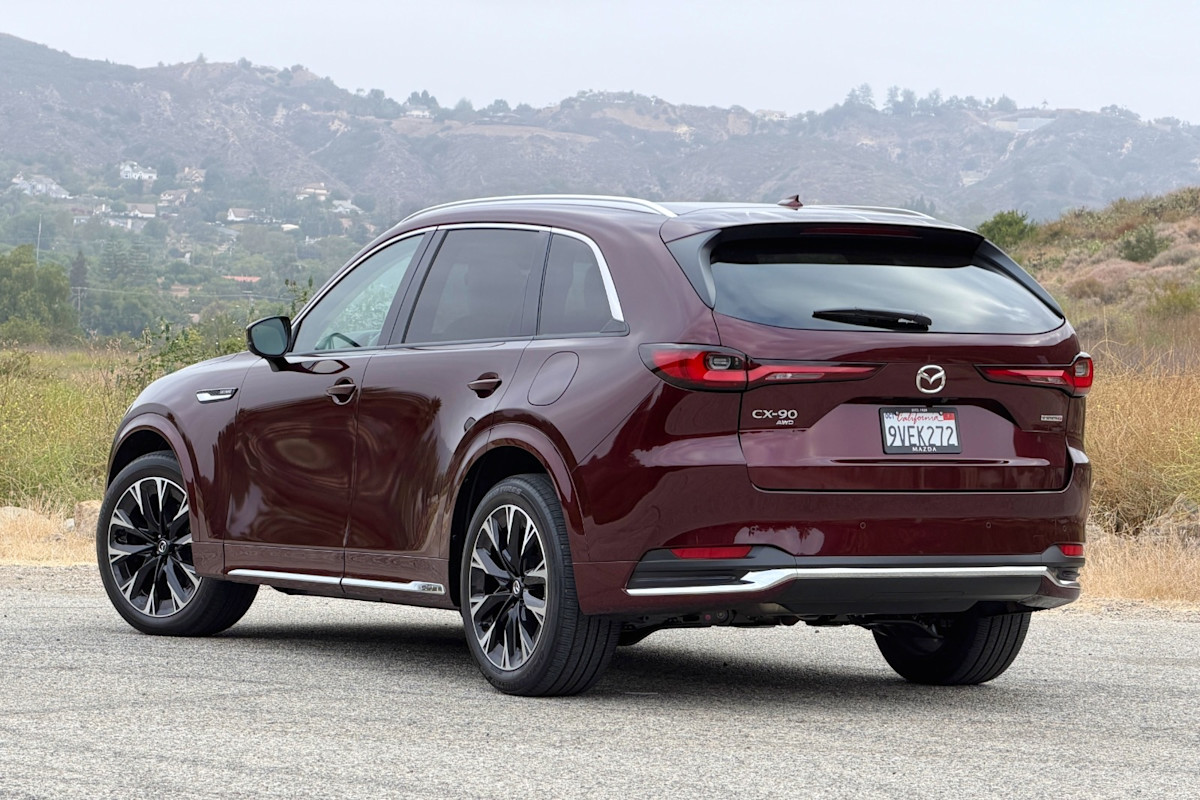
Stylish design
Great handling
Great safety ratings
What to consider
Unrefined powertrain
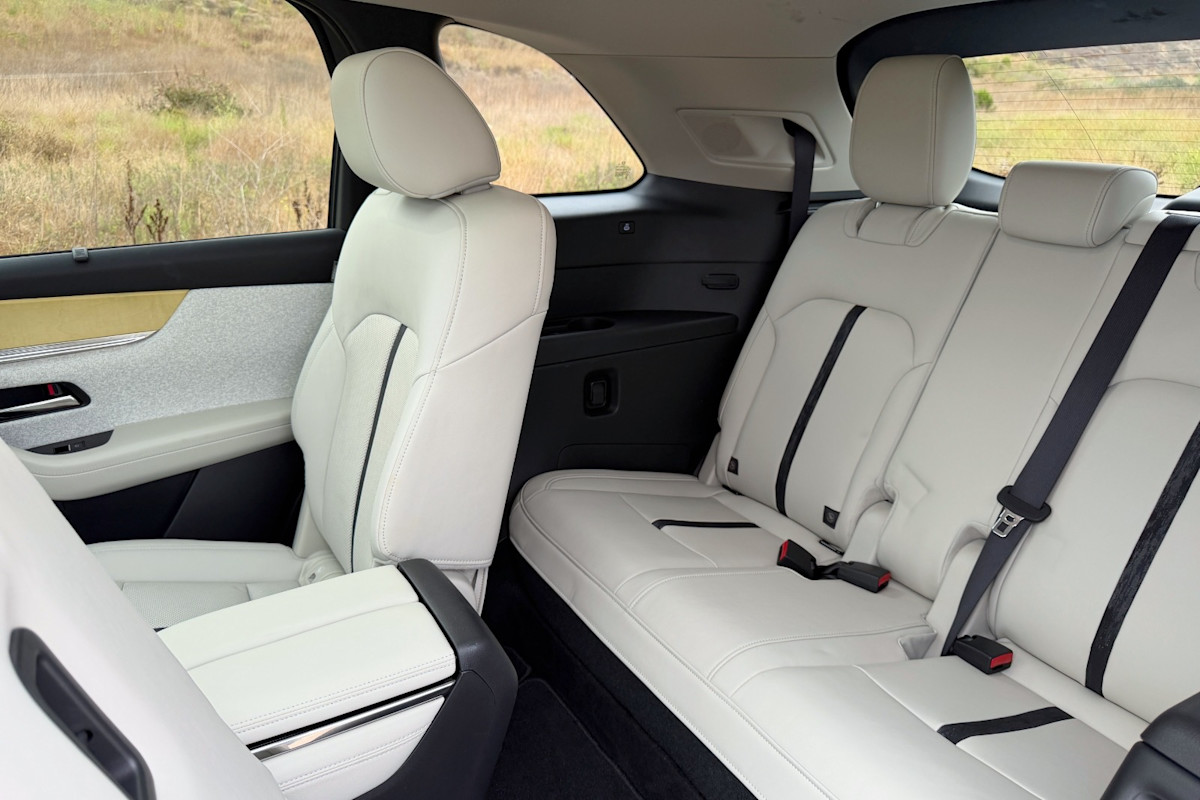
Cramped third row
Unintuitive technology
The CarGurus verdict
Love to drive but need a family SUV? Try the 2026 Mazda CX-90.
The CX-90 is a three-row midsize crossover SUV that offers a great driving experience and solid safety ratings, and has a premium look and feel. The standard gasoline powertrain is fairly fuel efficient and there’s also an available plug-in hybrid powertrain, but those looking for a rugged overlander should check out other options. Updates to the 2026 CX-90 are minor, amounting to wheel, color, and trim changes that unify the lineup.
Verdict: With upscale design, top safety ratings, good fuel economy, and driving dynamics that can put a smile on any face, there’s a lot to like about the 2026 Mazda CX-90. Further fine tuning would make it even better.
out of 10 expert review
Look & feel
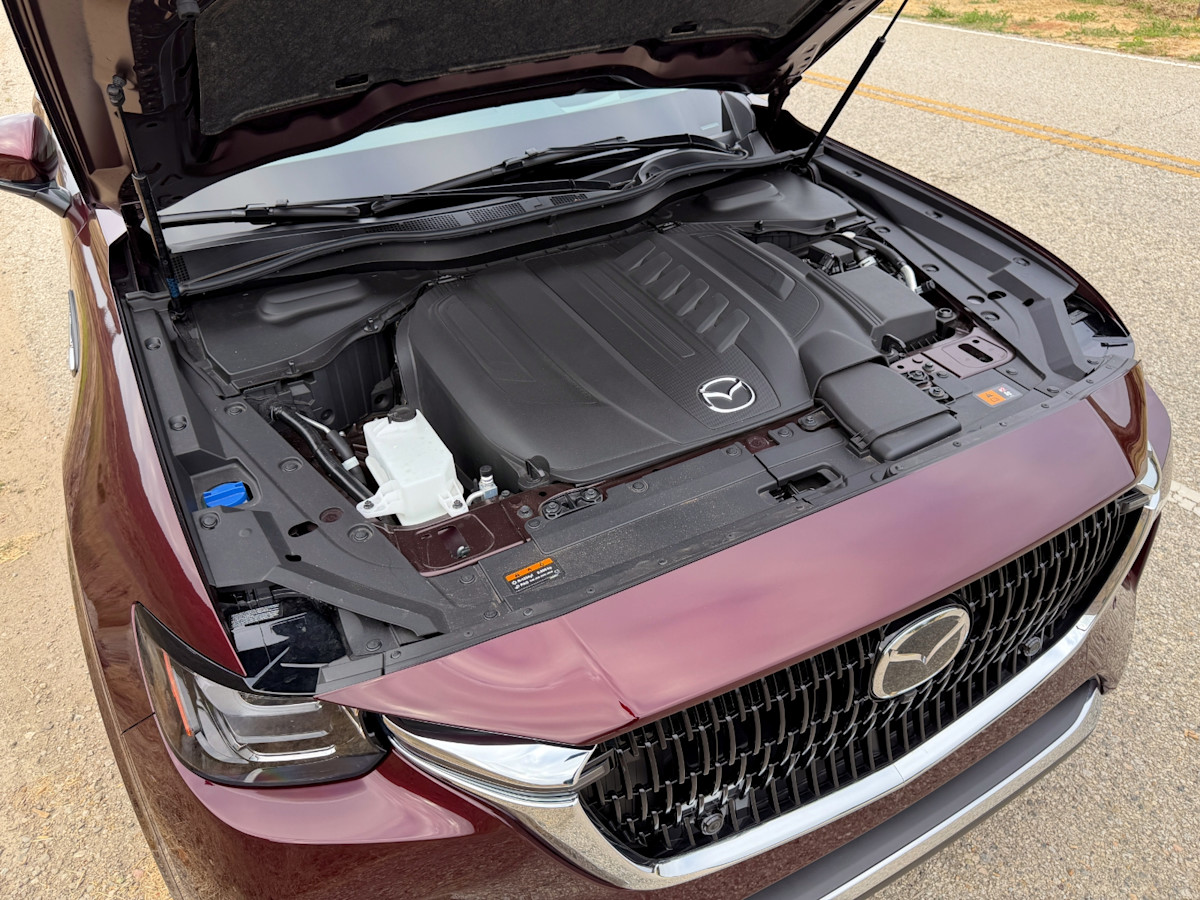
Mazda doesn’t make it easy to sort out the CX-90 lineup. Three model designations are available, aligning with the powertrain. The 3.3 Turbo and 3.3 Turbo S use the same turbocharged 3.3-liter inline-six engine equipped with a 48-volt mild-hybrid system and idle-stop (i-Stop) technology, but the Turbo S makes more power. Separately, there is a plug-in hybrid version called the CX-90 PHEV.
Each model is available with a choice of trim levels. The 3.3 Turbo model range is the most affordable, with Select, Preferred, Premium Sport, and Premium Plus trims ranging from $39,300 to $50,270. The more powerful 3.3 Turbo S lineup includes Premium Sport and Premium Plus trims, priced from $54,140 to $57,570. The PHEVs come in Preferred, Premium Sport, and Premium Plus trims and range from $50,695 to $58,700. Add $1,530 for the destination charge.
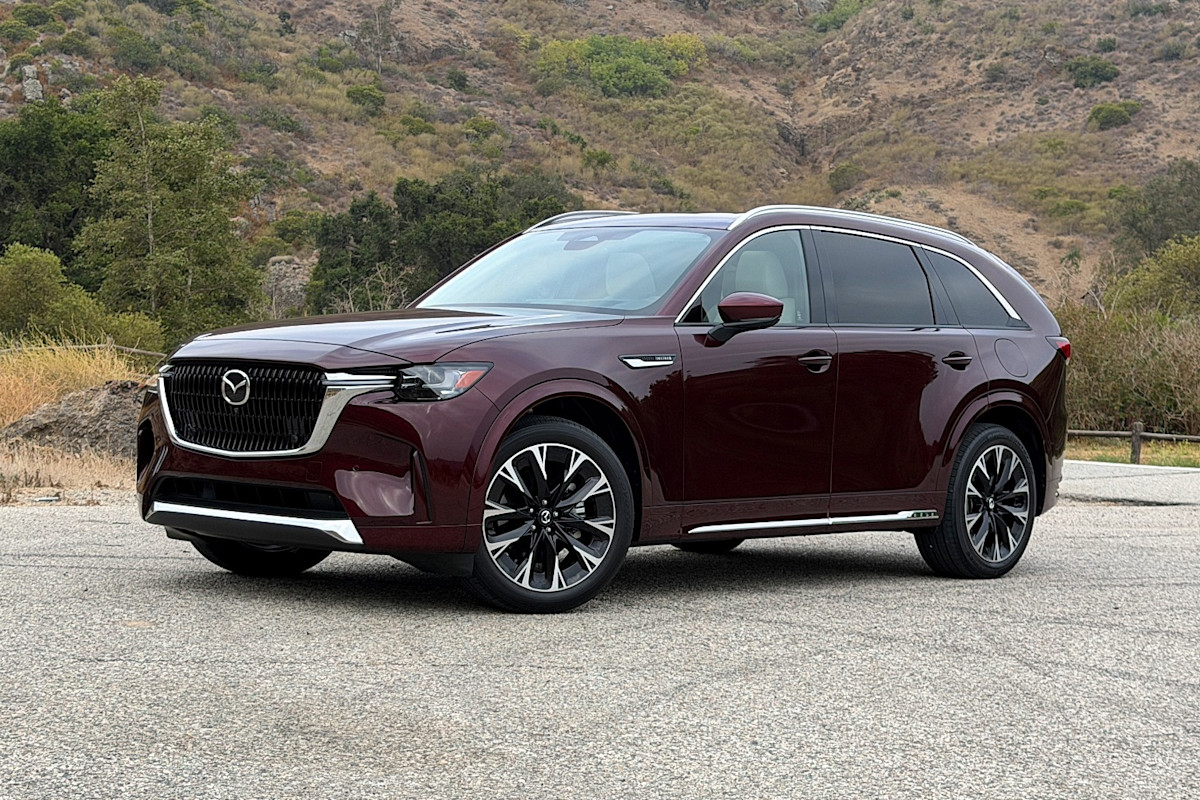
Our 3.3 Turbo S test vehicle arrived with Premium Plus trim, a no-charge option of second-row captain’s chairs, and extra-cost Artisan Red paint. The manufacturer’s suggested retail price (MSRP) came to $59,695, including destination.
The Mazda CX-90 is good looking inside and out. It has a short front overhang, a long hood, and a cabin set back on the underlying platform, lending it the classic sporting proportions of a rear-wheel-drive (RWD) vehicle. Concave door skins create surface interest through the interplay of light, shadow, and reflection, but don’t entirely avoid a slab-sided appearance.
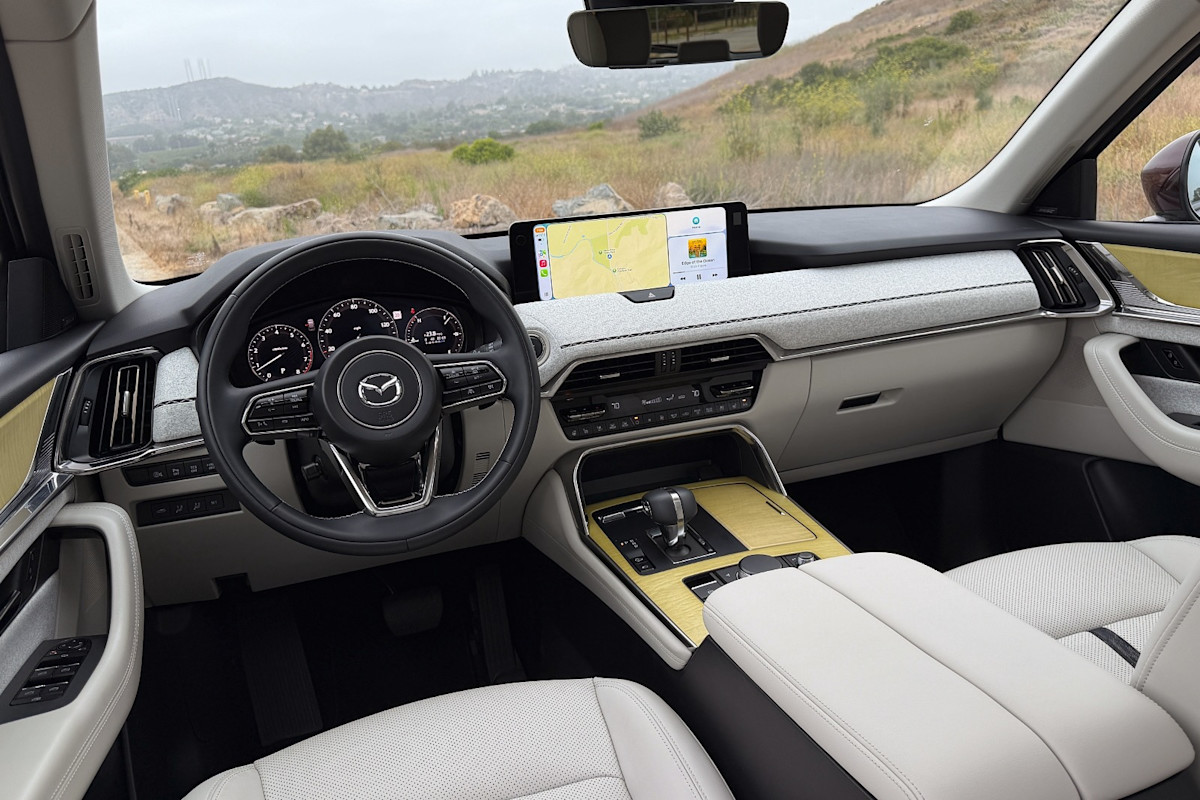
Interior materials quality is top-notch, and everything looks terrific except for the available wood trim in our test vehicle, which has a nauseating olive-colored undertone. That’s a misstep in a cabin that could otherwise pass muster in a significantly more expensive luxury SUV.
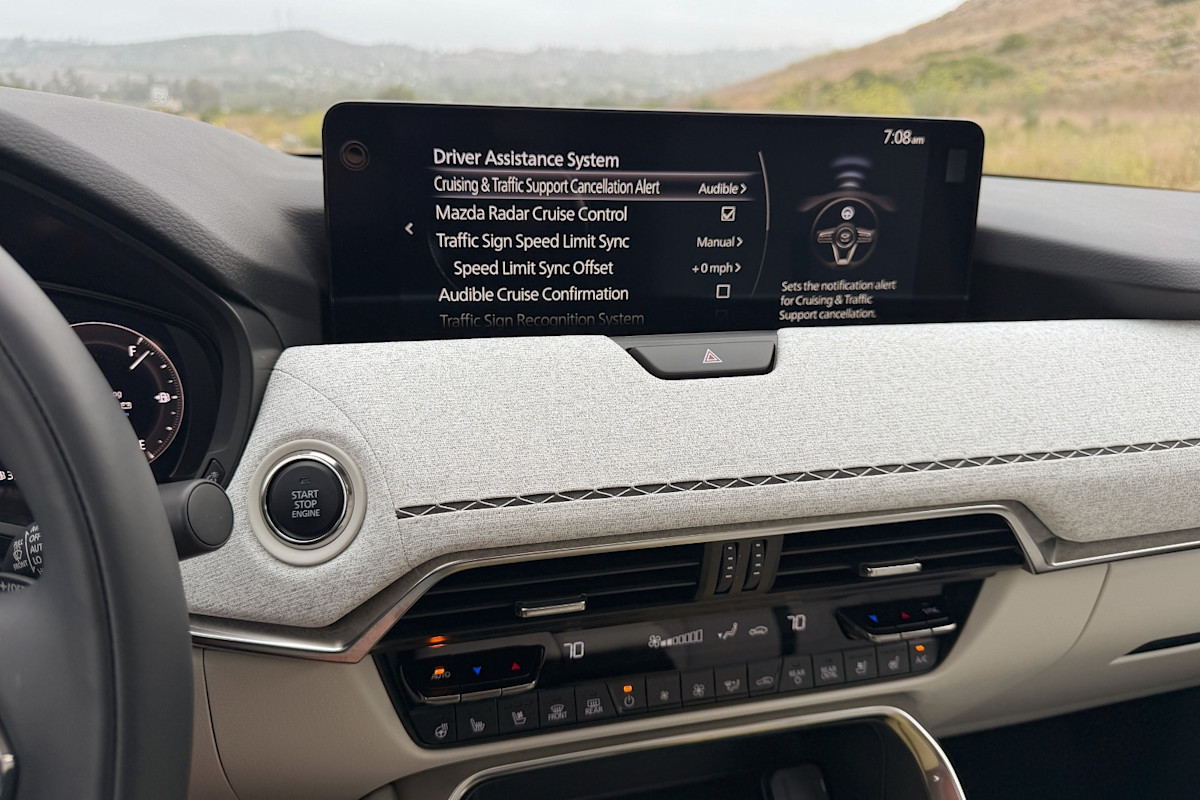
Mazda renders the digital instrumentation as classic analog gauges delivering perfect clarity, and the 12.3-inch infotainment display is artfully nestled into the top of the dashboard. Thankfully, the climate controls are separate from the screen, and the switchgear on the steering wheel and lower left of the dashboard is clearly labeled and easy to see and use.
But the wide center console is a hot mess. There isn’t much storage space for small items in the CX-90, and the controls for the Mazda Connect infotainment system and the Mi-Drive driving mode switch consume a lot of real estate on this surface.
The clunky electronic shifter doesn’t save room, either. It isn't possible to shift out of Park for several seconds after starting the engine, and shifting into Park requires an easily forgettable second step to shove it left. We also found the heat adjusters for the climate control system to be counterintuitive. The toggles are marked with a red up arrow, but the driver must push down on it to turn up the heat.
Performance
In the CX-90 3.3 Turbo, the inline six makes 280 horsepower and 332 pound-feet of torque running on regular gas. Upgrade to the CX-90 3.3 Turbo S, and regular gas produces 319 hp and 369 lb-ft. Run that version on premium fuel, and the horsepower figure jumps to 340.
The CX-90 PHEV has a 2.5-liter four-cylinder engine fortified by a 68-kilowatt electric motor, which draws power from a 17.8-kilowatt-hour battery pack. Together, these components generate 323 hp and 369 lb-ft on premium fuel. The electric-only driving range is 26 miles.
All three powertrains use an eight-speed automatic transmission and a standard all-wheel-drive (AWD) system. Aside from the default normal setting, Sport and Off-Road driving modes are available via the Mi-Drive switch. The PHEV also has an EV mode to maximize electric-only driving.
In our experience, none of these powertrains are particularly smooth, so Mazda might want to recruit some BMW engineers who know how to build world-class turbo-sixes with the occasional PHEV component bolted on.
Not that buyers should expect BMW X5 levels of refinement in a substantially more affordable vehicle, but the CX-90’s powertrain can feel as clunky and uneven as its transmission shifter is unintuitive, especially shortly after starting the engine and particularly in chilly weather. That said, we still like the Turbo S-spec engine for its power and acceleration.
Drivers can easily catch the i-Stop feature flat-footed, because i-Stop may shut off the engine to conserve fuel when coasting up to an intersection with a red light. However, if the light changes to green just as i-Stop shuts things down, and the driver presses the accelerator, there's a moment of delay and brief panic as nothing happens. Then, the engine starts up and off it goes. We found that i-Stop wouldn’t always do this, either, and that unpredictably caused even more irritation.
The good news is that it's possible to turn off the i-Stop function, but there is a real cost to that regarding fuel economy. The official EPA rating for the CX-90 3.3 Turbo and Turbo S in combined city and highway driving is 25 mpg. On our Southern California fuel-economy driving loop, the Turbo S test vehicle averaged 25.5 mpg with i-Stop engaged. Later, on the mountainous evaluation loop, with i-Stop turned off and Sport mode activated for the twisty road driving, we observed 20.3 mpg.
Where the CX-90 shines brightest is its handling prowess. That’s especially true when stacking this Mazda up against its competition; only a Ford Explorer ST comes close to delivering a similar level of driving enjoyment. With its quick and precise steering and a firm suspension that decisively controls unwanted body motions, drivers can experience some joy when driving a CX-90 with enthusiasm.
However, that firm suspension communicates every nuance of the underlying road to the driver and passengers. It will dull the sharper impacts but doesn’t soak up much of anything. Based on this test, conducted on a sunny 85-degree day, the CX-90’s brakes couldn't support enthusiastic driving, because our test vehicle’s stoppers faded significantly after heating up, and took a while to cool down to resume maximum effectiveness.
Form & function
Like the ride, the CX-90’s seats are firm, but they're supportive and comfortable. Our test vehicle had heated and ventilated front and second-row captain’s chairs, and a heated steering wheel, so it was ready for any kind of weather.
We would have liked to see more storage space for common items such as smartphones, keys, and water bottles. Up front there’s only a shallow bin beneath the center armrest. In our test vehicle, second-row captain’s chairs made room for a larger center console between the seats in that row, at least. Passengers sit high in the second row, with a good view out and a climate control panel adding to the comfort level. However, some rivals offer more legroom than the CX-90, so this Mazda could benefit from some additional rearward seat travel.
With the second-row seats slid forward, it's possible to squeeze adults into the third row as long as they have small feet. The second-row center console forced genuinely painful inboard leg and foot placement. Mazda needs to reshape the bottom part of the console so third-row passengers have a place to put their feet.
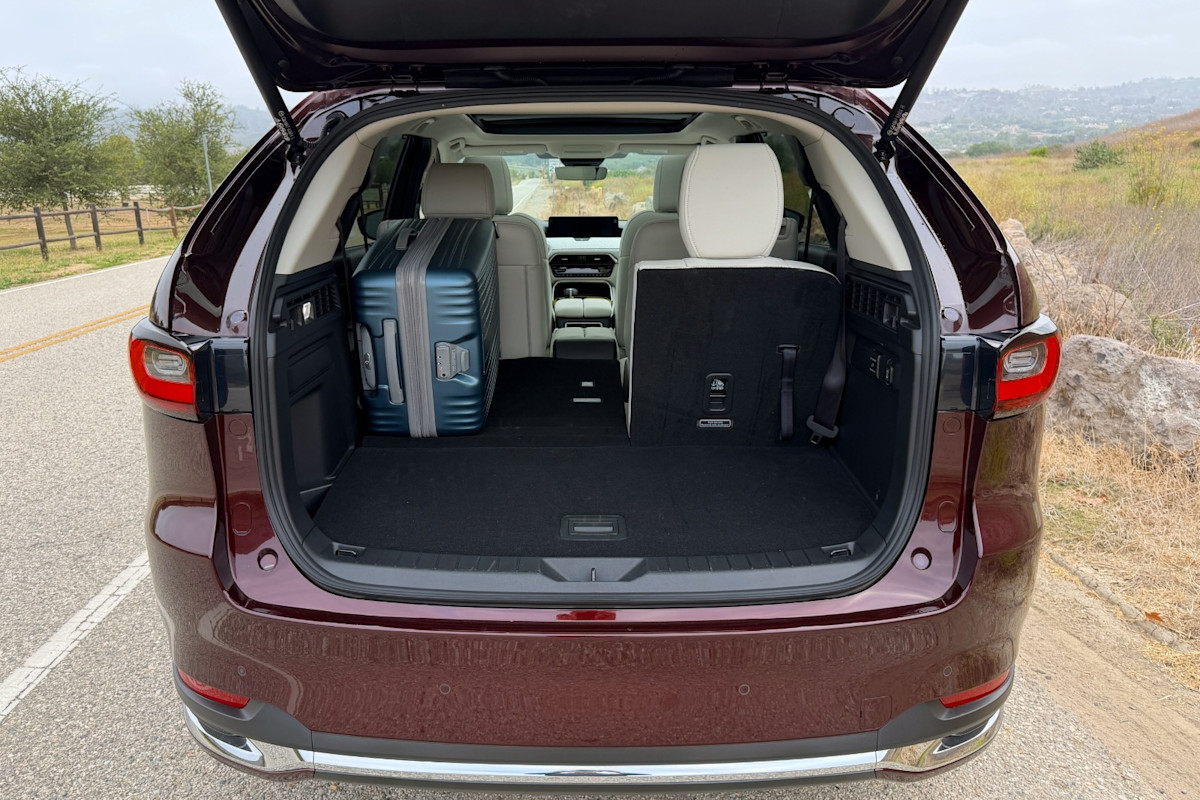
Behind the third row, the CX-90 offers 14.9 cubic feet of cargo space. That’s less than some competitors, partly because the underfloor storage area isn’t as generous as a Honda Pilot's. There is a recessed tray to the left of the load floor, but it doesn't work for small items because they slide out and into the tray underneath the floor.
Manual third-row seat folding means it happens fast, which is preferable. With the third row down, cargo space grows to 40 cubic feet, which proved plenty for a family of four on a two-week vacation. Six rollaboards, four backpacks, and an oversized duffel bag fit into the CX-90 without any issues. However, the 74.2 cubic feet behind the first row is less than what a non-hybrid Honda CR-V offers.
Technology
A 10.25-inch infotainment display, Amazon Alexa compatibility, text-messaging support, and wired Apple CarPlay and Android Auto are standard on the base Select trim level. Other trim levels feature a larger 12.3-inch screen, wireless Apple CarPlay and Android Auto, and wireless smartphone charging. The larger display is also touch-sensing, but only when using smartphone integration. Otherwise, the Mazda Connect infotainment system is controlled via buttons and knobs on the center console.
We found the system to be intuitive sometimes, and otherwise confusing, partly because it's easy to forget which menu or sub-menu contains a certain setting. A digital voice assistant would help, so it's good that Mazda made Amazon Alexa compatibility standard on all 2026 CX-90s. However, it requires an internet connection to work, and wasn’t functional in our test vehicle.
That left us to rely on the native voice recognition system, which doesn’t have the natural-language capability of Alexa, Siri, Google Assistant, or any of the other tools most car buyers are now used to. Still, it's possible to navigate it by carefully following the prompts on the display screen, but that means drivers are looking at the screen and not the road ahead.
Despite closely following the recommendations on the screen, we still couldn't adjust the cabin temperature, turn on the seat heating or ventilation systems, select a radio station, or choose a destination either by address or by name and street. This feature is very basic and not at all aligned with modern expectations. We instead relied on Apple CarPlay (which worked flawlessly) rather than Mazda Connect.
Safety
Standard driver-assist features include forward-collision warning, automatic emergency braking, blind-spot monitors, rear cross-traffic alert, safe-exit warning, lane-departure warning, lane-keep assist, and adaptive cruise control with stop-and-go capability. All but the base Select trim have front and rear parking sensors.
Premium Sport and higher trim levels also have active blind-spot monitors, lane-keep assist, and head-on traffic avoidance steering assist. Mazda’s Cruising & Traffic Support technology—which steps up automation a little from adaptive cruise control but still requires drivers to keep their hands on the wheel—is also standard on these higher trim levels, along with post-collision braking.
Upgrading to the CX-90 Premium Plus adds front cross-traffic alert, automatic intersection braking, automatic rear braking with pedestrian detection, and a surround-view camera system with see-through and trailer-hitch views.
Overall, these features operate in a refined, predictable manner, but the steering assist features are not very sophisticated. They don’t work when traveling through intersections and couldn’t handle a rural two-lane road that usually isn’t a problem for similar tech in other vehicles.
One thing we really like is how Mazda thoughtfully conveys blind-spot monitor warnings via the digital instrumentation and, when equipped, the head-up display. This simple solution reduces distraction and makes it very easy to determine if the coast is clear for a lane change.
The CX-90 earned the highest Top Safety Pick+ award from the Insurance Institute for Highway Safety (IIHS). The National Highway Traffic Safety Administration (NHTSA) gave it a five-star overall rating, but with four stars each for driver and front passenger protection in a frontal-impact collision.
Cost-effectiveness
For those who want a luxury look and feel at a competitive mass-market price, a 2026 Mazda CX-90 delivers value. The turbocharged six-cylinder engine is surprisingly fuel efficient unless drivers are regularly digging into the power, and the availability of a plug-in hybrid powertrain is rare for the segment. In other cost-of-ownership metrics, the CX-90 ranks as average.
We were very impressed by the CX-90’s handling, design, and safety ratings, but Mazda still has some details to sort, such as the poor balance between ride quality and handling, the uneven power delivery, and the dated infotainment tech.
The CX-90 arrived for the 2024 model year, which means a mid-cycle refresh is due in 2027 or 2028. Hopefully, Mazda is keeping a running list of things to improve and will roll out upgrades that resolve our complaints.
What owners say
great driving dynamics, great bang for buck. would be better if there was more 3rd row space. comparable to hyundai santa fe, ford explorer and toyota highlander.
July 7, 2026Trims & specs
Base MSRP N/A | Seating N/A |
Engine N/A | Cargo Capacity N/A |
Combined MPG N/A | Drivetrain N/A |
Base MSRP N/A | Seating N/A |
Engine N/A | Cargo Capacity N/A |
Combined MPG N/A | Drivetrain N/A |
Base MSRP $57,570 | Seating 7 |
Engine N/A | Cargo Capacity 14.9 cu ft |
Combined MPG N/A | Drivetrain N/A |
Base MSRP $39,300 | Seating 8 |
Engine 3.3L 280 hp I6 | Cargo Capacity 14.9 cu ft |
Combined MPG 25 | Drivetrain AWD |
Base MSRP N/A | Seating N/A |
Engine N/A | Cargo Capacity N/A |
Combined MPG N/A | Drivetrain N/A |
Base MSRP $58,500 | Seating 7 |
Engine N/A | Cargo Capacity 15.9 cu ft |
Combined MPG N/A | Drivetrain N/A |
Base MSRP N/A | Seating N/A |
Engine N/A | Cargo Capacity N/A |
Combined MPG N/A | Drivetrain N/A |
Base MSRP $50,495 | Seating 7 |
Engine N/A | Cargo Capacity 15.9 cu ft |
Combined MPG N/A | Drivetrain N/A |
Base MSRP N/A | Seating N/A |
Engine N/A | Cargo Capacity N/A |
Combined MPG N/A | Drivetrain N/A |
Base MSRP $55,300 | Seating 7 |
Engine N/A | Cargo Capacity 15.9 cu ft |
Combined MPG N/A | Drivetrain N/A |
Base MSRP N/A | Seating N/A |
Engine N/A | Cargo Capacity N/A |
Combined MPG N/A | Drivetrain N/A |
Base MSRP $50,270 | Seating 8 |
Engine N/A | Cargo Capacity 14.9 cu ft |
Combined MPG N/A | Drivetrain N/A |
Base MSRP $54,140 | Seating 8 |
Engine N/A | Cargo Capacity 14.9 cu ft |
Combined MPG N/A | Drivetrain N/A |
Base MSRP $43,450 | Seating 8 |
Engine N/A | Cargo Capacity 14.9 cu ft |
Combined MPG N/A | Drivetrain N/A |
Base MSRP N/A | Seating N/A |
Engine N/A | Cargo Capacity N/A |
Combined MPG N/A | Drivetrain N/A |
Base MSRP N/A | Seating N/A |
Engine N/A | Cargo Capacity N/A |
Combined MPG N/A | Drivetrain N/A |
Base MSRP $47,480 | Seating 8 |
Engine N/A | Cargo Capacity 14.9 cu ft |
Combined MPG N/A | Drivetrain N/A |
Base MSRP N/A | Seating N/A |
Engine N/A | Cargo Capacity N/A |
Combined MPG N/A | Drivetrain N/A |


Pricing trends
MSRP range
$39,300 - $58,500
Current avg. market price
$38,696
Trending down by 1.3% this month
May 2026 - November 2026


