2025 Mazda CX-90 Reviews, Pricing & Specs


Pros & cons
What we like
Stylish design
Premium interior materials
Great safety ratings
What to consider
Underwhelming base engine
Noisy
Unintuitive technology
Expert review
With the 2025 CX-90, Mazda doesn’t go with the midsize three-row SUV flow.
Available with a turbocharged inline six-cylinder engine or as a plug-in hybrid, the CX-90’s powertrains are unique in a segment where turbocharged four-cylinder, V6, and hybrid drivetrains are common. Additionally, the 2025 Mazda CX-90 doesn’t have a touchscreen for the native Mazda Connect infotainment functions, a conversational digital voice assistant, or a hands-free driving-assistance system. Mazda also sets the cabin back on the platform, reducing passenger and cargo space. However, the stylish 2025 CX-90 is entertaining to drive.
Verdict: Can the CX-90’s elegant design, premium interior, unusual powertrains, enjoyable driving dynamics, and impressive safety ratings ensure competitiveness in a family-size SUV segment where the Ford Explorer, Honda Pilot, and Kia Telluride dominate? With more attention to detail and better technology, this Mazda SUV could lead instead of follow.
out of 10 expert review
Look & feel
Mazda sells three variants of the 2025 CX-90: the 3.3 Turbo, the 3.3 Turbo S, and the PHEV (plug-in hybrid electric vehicle). Depending on your choice, trim levels can include Select, Preferred, Premium, Premium Sport, and Premium Plus. Pricing ranges from $39,575 to $59,480, including the destination charge. Our 3.3 Turbo test vehicle had Premium Plus trim and extra-cost Soul Red paint, which brought the manufacturer’s suggested retail price (MSRP) to a reasonable $51,450.
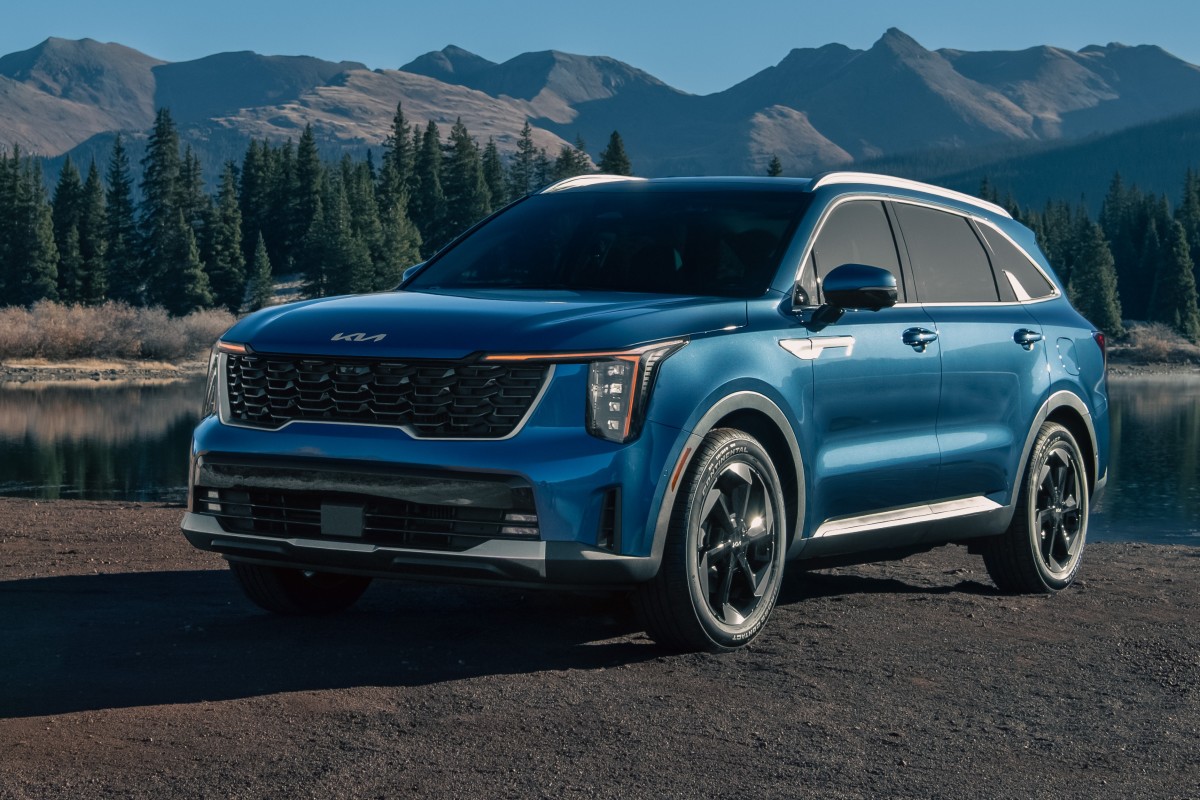
Lustrous paint, polished chrome trim, and intricate 21-inch wheels gave our 2025 Mazda CX-90 a look that resembled that of a luxury SUV. Sculptural sheet metal creates a compelling interplay of light, shadow, and reflection, while a short front overhang, long hood, and a cabin placement that positions most of the visual mass over the rear axle contribute to a low, long, athletic appearance.
That premium look continues within the elegantly rendered interior, where polished metallic trim, Nappa leather with contrast stitching, and clearly marked switchgear await. Some materials reflect the CX-90’s competitive price, but the test vehicle’s cabin proved convincingly upscale.
Design-related complaints revolve around the ergonomics. Examples include a confusing electronic shifter, a hazard flasher button that seems like an afterthought, and Mazda’s continued reluctance to provide touchscreen operation of the native Mazda Connect infotainment functions. Additionally, the climate panel’s temperature-adjustment switchgear is counterintuitive when you want to warm the cabin. Nevertheless, compared to most midsize three-row crossover SUVs from mainstream brands, the 2025 CX-90 oozes sophistication. It looks and feels terrific.

Performance
Unfortunately, the Mazda CX-90 3.3 Turbo’s drivetrain isn’t as refined as the design and materials. That’s particularly disappointing because inline-six engines are typically silky smooth in operation.
Mazda introduced its turbocharged 3.3-liter inline six in the CX-90 and also uses the engine in the five-passenger Mazda CX-70. In the 3.3 Turbo models, it generates 280 horsepower and 332 pound-feet of torque, which are respectable numbers. Choose a CX-90 3.3 Turbo S, and the engine delivers 319 hp and 369 lb-ft (340 hp if you use premium gas).
The power flows through an eight-speed automatic transmission and a standard all-wheel-drive (AWD) system. Mazda says the AWD system biases the power split to the CX-90’s rear wheels for better driving dynamics. Drivers can choose from Normal, Sport, Off-Road, and Towing modes. The CX-90’s maximum towing capacity is 5,000 pounds, and while it’s not a true off-roader, it offers 8.1 inches of ground clearance as well as standard hill descent control.
An i-Stop function that can turn the engine off when the vehicle is coasting or is stopped in traffic aims to improve fuel economy. The official EPA rating for both the 3.3 Turbo and 3.3 Turbo S is 25 mpg combined. We observed 21.3 mpg on our mountainous Southern California testing loop. The available plug-in hybrid powertrain is rated at 25 miles of electric range, and the same 25 mpg combined as other models after that.
As we’ve come to expect from Mazda, the CX-90 provides impressive ride and handling. However, drivetrain refinement is lacking, especially shortly after engine start-up. Get in the CX-90 for the morning commute, and both power delivery and transmission behavior are unpredictable until it’s warmed up. We also experienced unwanted engine surge and acceleration in a situation where we briefly stepped on the accelerator pedal, but then had to immediately brake due to a sudden change in traffic conditions. The CX-90’s delayed reaction to input was unpleasant and resulted in an unnecessary panic stop to override the drivetrain’s behavior.
And while it’s typically possible to sense friction in the drivetrain of a vehicle, the CX-90 suffers from a general lack of isolation from noise and impact harshness. That made it difficult to determine if that was the problem, or if the tuning of the CX-90’s engine, transmission, and AWD system were the overriding issue when it came to refinement.
Those flaws, coupled with the fussy electronic shifter, don’t inspire confidence or support the upscale impression created by the styling and interior. Additionally, on the freeway, vibrations resonate through the second-row captain’s chairs, causing the head restraints to wiggle and jiggle. Every time you look in the rearview mirror, you’ll notice it. So that’s one more thing for Mazda’s engineers to quell.
On the plus side, Mazda delivers one of the most flingable family haulers around. Firm, communicative, and tuned to erase unwanted body motions, the CX-90’s taut suspension is anything but compliant. That means you’re acutely aware of what’s happening where the rubber meets the road. If you’re seeking a softer ride, opting out of the 21-inch wheels fitted to our test car might help.
While driving across the Santa Monica Mountains near Malibu, we got into a satisfying rhythm with the CX-90 after switching from Sport mode back to Normal mode. In Sport mode, the instrumentation goes red, throttle response is more abrupt, the steering is heavier, and the engine note is louder. We preferred Normal mode, which results in smoother driving and more than a hint of the dynamic character for which Mazda is known.

Form & function
California has enjoyed an unseasonably cool and dry summer, but you wouldn’t know it by entering the CX-90’s black interior. Despite the lack of heat and humidity outside, our test vehicle’s interior baked occupants for too long, suggesting the three-zone climate control system is not up to snuff. Eventually, it gets chilly inside, but it seems to take forever. We shudder to think how long it might take in Arizona heat or Florida humidity.
In 3.3 Turbo Premium Plus trim, the CX-90 features Nappa leather upholstery, heated and ventilated front seats, heated second-row captain’s chairs, and a heated steering wheel. The front-seat ventilation seems nearly as ineffective as the air conditioning. However, once the cabin cools off, the eight-way power-adjustable front seats prove comfortable on longer trips.
A panoramic sunroof offers ample natural light, and second-row passengers enjoy elevated seating positions on comfortable chairs. Height-adjustable inboard armrests and side window shades are appreciated, but there isn’t much seat-track travel. Install a rear-facing child safety seat, and it may prove to be a snug fit regarding front seatback clearance. Also, loading children in close quarters could prove challenging due to the CX-90’s unusually long rear doors.
Those rear doors facilitate loading and unloading of the third row, and if you slide the second-row seat forward by an inch or two, two adults can fit comfortably. The rear seats also offer acceptable support. Still, the CX-90’s third row is best reserved for children, especially on longer trips.
Typically, one benefit of an electronic shifter is the added storage space on and under the center console. But that’s not the case in the CX-90, where the emphasis appears to be on style and not practicality. Mazda also declines to add a tray underneath the center console. That leaves you with a smartphone charging tray, a shallow bin under the split center armrest, a sizable glove compartment, and stingy storage in the door panels.
The test vehicle’s hands-free power liftgate rises to reveal 14.9 cubic feet of cargo space behind the third row. Where some rivals offer a sizable compartment underneath the load floor, the Mazda only has small trays. Fold the third row down, and the CX-90 provides 40 cubic feet of cargo room, a practical amount. Maximum cargo volume with the second-row seats flattened measures 74.2 cubic feet, which is small for the segment.

Technology
The CX-90’s dashboard doesn’t have the same high-tech look as some rivals, but the technology is there. It’s just presented in a more traditional manner.
A 12.3-inch digital instrumentation panel pairs with a 12.3-inch infotainment screen, taking the form of a traditional gauge cluster and a display nestled into the top of the dashboard. In a segment where panoramic curved displays are increasingly the norm, Mazda’s old-school approach is refreshing. Unfortunately, the infotainment screen is touch-sensitive only when you’re using wireless Apple CarPlay or Android Auto. The native Mazda Connect platform requires you to fiddle with the knob and buttons on the center console. Eventually, this starts to feel natural, but it takes some time.
A conversational digital voice assistant would be helpful, but Mazda’s voice recognition system does not meet modern expectations. Even when following the specific prompts suggested on the display, the results are hit-and-miss. Fortunately, the automaker is rolling out a new Google Built-in infotainment system, starting with the redesigned 2026 Mazda CX-5. That decision is long overdue, and we expect that tech to arrive in an upcoming refresh of the CX-90.
The test vehicle featured a 12-speaker Bose audio system, which produced a rewarding listening experience. Our CX-90 also featured Mazda’s Active Driving Display, a head-up display with a small but helpful amount of data. One of our favorite things is how it visually alerts you when a vehicle is traveling in one of the CX-90’s blind spots.

Safety
One of the Mazda CX-90’s most appealing traits is safety. It is one of only four midsize, three-row, gas-powered SUVs to receive a Top Safety Pick+ rating from the Insurance Institute for Highway Safety (IIHS). Additionally, the CX-90 PHEV earns five-star ratings in all crash tests conducted by the National Highway Traffic Safety Administration (NHTSA), as well as a four-star rollover resistance rating. (The gas-only CX-90 models get four-star ratings in frontal-impact testing).
Of course, Mazda provides a long list of driver aids as standard equipment. The list of safety features includes: forward collision warning, automatic emergency braking, blind-spot monitoring, rear cross-traffic alert, lane departure warning, and lane keeping assist. Adaptive cruise control, automatic high-beam headlights, and a vehicle exit warning system are also standard.
As you upgrade to more expensive trim levels, Mazda adds steering assist to the blind-spot monitoring system, emergency lane-keeping assist that operates in several different scenarios, front cross-traffic alert, front and rear parking sensors, and a surround-view camera system.
Cruising and Traffic Support is also available on higher trim levels. This system pairs the adaptive cruise control with lane-centering assist to provide a hands-on driving aid intended for highway use. It can also automatically adjust the CX-90’s speed according to posted limits and in curves as well. On freeways with two lanes in each direction, it wavered a little when passing exit and entrance ramps. On a dusty rural two-lane farm road, it had some trouble discerning lane markings. And in the curves of the Pacific Coast Highway, it reduced speed too much, causing irritation in other motorists. In addition, it reactively instead of proactively reduced speed, ignoring the racer’s rule of “slow in, fast out, fast in, spin out.”
Still, aside from the irritating speed reduction feature, the CX-90’s driver aids met expectations. The lane-keeping technologies are particularly effective—without causing aggravation. As with all Mazdas, the blind-spot monitoring system adds an extra layer of safety, continuing to issue warnings when it isn’t technically necessary, but that annoyance pales in comparison to the CX-90’s audible warning systems. So. Many. Warning. Chimes! Generally, the tech is communicative about why it is intruding on your peace and quiet, but can create a cacophony of dings.

Cost-effectiveness
From a styling standpoint, the Mazda CX-90 looks more expensive than it is, which may lead you to expect a higher price. At $51,450, our test vehicle seemed competitive in that respect. You also receive one year of complimentary Mazda Connected Services. Otherwise, though, Mazda doesn’t offer some of the perks you’ll receive from other car companies, aside from typical warranty and roadside assistance plans.
You might decide that the CX-90 plug-in hybrid is the value play, as it offers 25 miles of electric-only driving range. The problem is that a Mazda CX-90 PHEV equipped like our 3.3 Turbo test vehicle would cost just over $60,000.
So, strip cost-effectiveness from the decision-making process. Instead, focus on the CX-90’s safety ratings to convince the left side of your brain, while the Mazda’s design, quality materials, comfortable seats, and driving dynamics satisfy the right side. Those are the primary reasons to get a 2025 Mazda CX-90 over other midsize SUVs. And if you don’t need the CX-90’s third-row seat, consider the nearly identical five-passenger CX-70.


What owners say
Trims & specs
Base MSRP $38,045 | Seating 8 |
Engine 3.3L 280 hp I6 | Cargo Capacity 14.9 cu ft |
Combined MPG 26 | Drivetrain AWD |
Base MSRP N/A | Seating N/A |
Engine N/A | Cargo Capacity N/A |
Combined MPG N/A | Drivetrain N/A |
Base MSRP $53,150 | Seating 8 |
Engine 3.3L 340 hp I6 | Cargo Capacity 14.9 cu ft |
Combined MPG 26 | Drivetrain AWD |
Base MSRP $41,145 | Seating 8 |
Engine 3.3L 280 hp I6 | Cargo Capacity 14.9 cu ft |
Combined MPG 26 | Drivetrain AWD |
Base MSRP N/A | Seating N/A |
Engine N/A | Cargo Capacity N/A |
Combined MPG N/A | Drivetrain N/A |
Base MSRP N/A | Seating N/A |
Engine N/A | Cargo Capacity N/A |
Combined MPG N/A | Drivetrain N/A |
Base MSRP $49,600 | Seating 7 |
Engine 3.3L 280 hp I6 | Cargo Capacity 14.9 cu ft |
Combined MPG 26 | Drivetrain AWD |
Base MSRP $54,900 | Seating 7 |
Engine 2.5L 323 hp I4 Hybrid | Cargo Capacity 15.9 cu ft |
Combined MPG 57 | Drivetrain AWD |
Base MSRP N/A | Seating N/A |
Engine N/A | Cargo Capacity N/A |
Combined MPG N/A | Drivetrain N/A |
Base MSRP $46,600 | Seating 8 |
Engine 3.3L 280 hp I6 | Cargo Capacity 14.9 cu ft |
Combined MPG 26 | Drivetrain AWD |
Base MSRP $56,650 | Seating 6 |
Engine 3.3L 340 hp I6 | Cargo Capacity 15.9 cu ft |
Combined MPG 26 | Drivetrain AWD |
Base MSRP N/A | Seating N/A |
Engine N/A | Cargo Capacity N/A |
Combined MPG N/A | Drivetrain N/A |
Base MSRP $57,950 | Seating 7 |
Engine 2.5L 323 hp I4 Hybrid | Cargo Capacity 14.9 cu ft |
Combined MPG 57 | Drivetrain AWD |
Base MSRP N/A | Seating N/A |
Engine N/A | Cargo Capacity N/A |
Combined MPG N/A | Drivetrain N/A |
Base MSRP N/A | Seating N/A |
Engine N/A | Cargo Capacity N/A |
Combined MPG N/A | Drivetrain N/A |
Base MSRP $49,945 | Seating 8 |
Engine 2.5L 323 hp I4 Hybrid | Cargo Capacity 14.9 cu ft |
Combined MPG 57 | Drivetrain AWD |


Pricing trends
MSRP range
$38,045 - $57,950
Current avg. market price
$32,377
Trending down by 2.5% this month
May 2026 - October 2026