2025 Polestar 3 Reviews, Pricing & Specs


Pros & cons
What we like
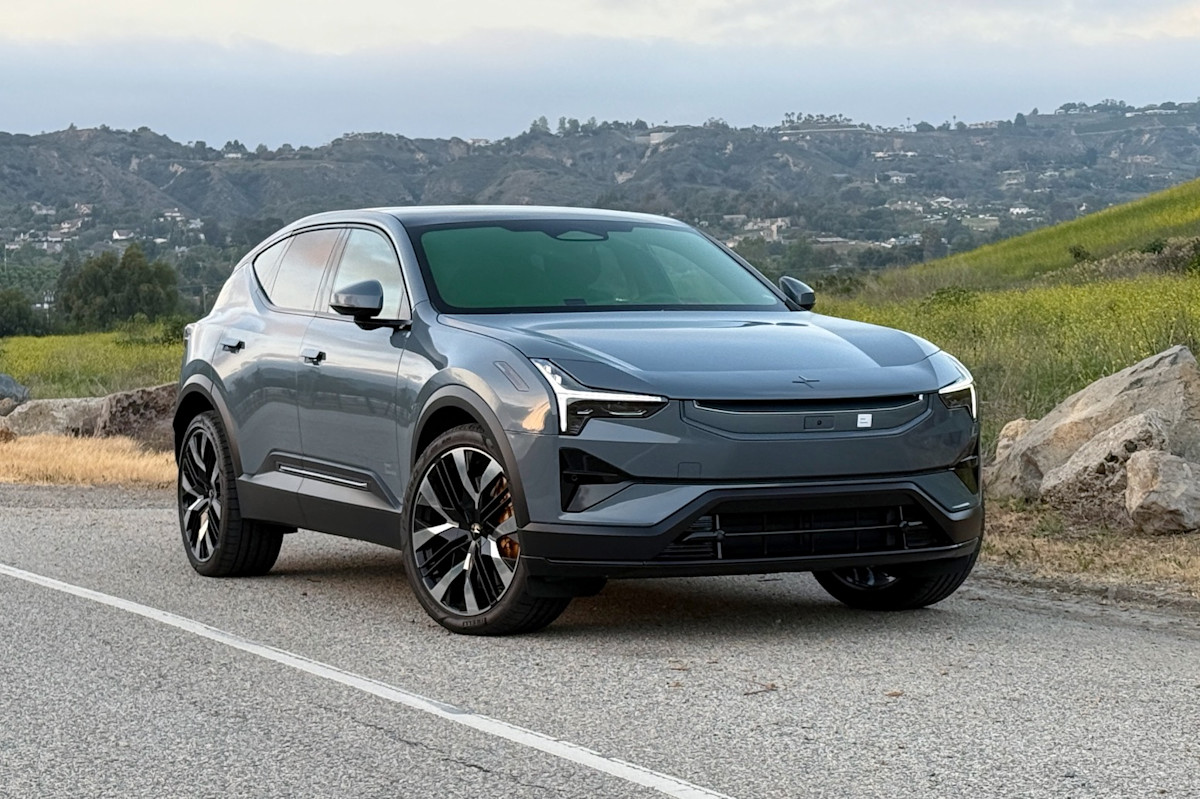
Stylish design
Premium interior materials
Quiet cabin
What to consider
Occasionally confusing interfaces
Sketchy Pilot Assist performance
Nobody knows what it is when they see it
The CarGurus verdict
If its maker can get the word out, the new 2025 Polestar 3 spells success.
During several days of driving the new Polestar 3 electric luxury SUV in Southern California, it swiveled nearly as many heads as a Volkswagen ID. Buzz—which is saying something. People take notice of its crisply tailored design, enigmatic emblems, and swift but silent electric propulsion. But do they know what it is, and where to buy it? Production kicked off in August 2024 in South Carolina. But here in EV-happy Los Angeles, we’ve seen only one other one on the road.
Verdict: The 2025 Polestar 3 is an excellent electric SUV that remains a mystery to luxury EV customers. The only reference to the brand and model is a decal on the door, and because the stylish logo adorning the hood, hatch, and wheels is unknown, it’s the ultimate stealth vehicle. The Polestar 3 deserves recognition, not mystery.
out of 10 expert review
Look & feel
Anybody who casually follows the automotive industry would guess the Polestar 3 is a Volvo. It has the same overall aesthetic, even though it’s something different. And they wouldn’t be completely wrong. Polestar and Volvo are both Swedish, both owned by the same company, and draw from the same wells of design, engineering, and technology.
But your typical American car buyer? They don’t know what the heck this thing is. It needs a “Polestar” badge on the lower left of the liftgate, and a “3” badge on the right, because that stylish Polestar emblem conveys nothing.
The Polestar 3 is a new midsize electric crossover SUV. It seats five people, provides up to 350 miles of range, and is priced from $68,900 to $74,800, including the $1,400 destination charge, before options. They all have a long-range battery pack, and you can select from a single-motor or a dual-motor configuration. Our dual motor test vehicle had the Performance Pack, Plus Pack, Pilot Pack, and metallic paint. The manufacturer’s suggested retail price (MSRP) was $93,100, including the destination charge.
We loved the way the Polestar 3 looks, and based on the attention the test vehicle received, we weren’t alone. This electric vehicle’s primary rivals include the Audi Q8 E-tron, BMW iX, and Mercedes-Benz EQE SUV, and in many ways, the Polestar 3 is more appealing than any of them.
Inside, the cabin boasts a traditional Scandinavian ambience, showcasing minimalism, quality, and technology. Polestar renders the interior in six different themes, with an emphasis on responsibly sourced materials. Vegan, recycled, and repurposed materials are available, while the optional Nappa leather and wool upholstery choices are sourced according to strict animal welfare standards.
Two screens provide access to most features and functions. This leads to numerous small but aggravating quirks, but with time, they’re less frustrating. Still, when it comes to the Polestar 3’s overall design, those quirks cause the love to fade. Nevertheless, we think this Polestar looks great, the materials exude quality, and though it is not traditionally luxurious, it conveys opulence through exquisite attention to detail. It’s a beautiful vehicle, inside and out.

Performance
The most affordable version of the Polestar 3 is the long-range, single-motor, rear-wheel drive (RWD) one. It supplies 299 horsepower, 361 pound-feet of torque, 350 miles of driving range, and acceleration to 60 mph in 7.5 seconds. The efficiency rating is 35 kilowatt-hours per 100 miles.
The pricier Polestar 3 long-range dual-motor has all-wheel drive (AWD) with torque vectoring. Output measures 489 hp and 620 lb-ft, good for acceleration to 60 mph in 4.8 seconds. The range estimate is 315 miles, and it consumes 38 kWh/100 mi. This version offers Range and Performance driving modes, and has an active air suspension that lowers the ride height at higher speeds to improve aerodynamics.
Get the Performance Pack, and the long-range dual-motor delivers 517 hp and 671 lb-ft while accelerating to 60 mph in 4.5 seconds. This version travels 279 miles on a full charge and consumes energy at 44 kWh/100 mi.
A 111-kWh lithium-ion battery is standard, and Polestar says that if you use a 250-kilowatt DC fast charger, you can bring it up from a 10% charge to an 80% charge in 30 minutes. The 11-kW onboard charger means you can fully recharge the battery in 11 hours when using a compatible Level 2 home charging station.
Steering-effort settings include Light, Standard, and Firm, and all Polestar 3 models have performance brakes with vented discs at each corner and Brembo four-piston calipers in front. This is a brake-by-wire system, and Polestar says it offers one-pedal driving capability. The Performance Pack includes 22-inch forged aluminum wheels, Pirelli P Zero tires, and Polestar Engineered chassis tuning with three different suspension settings.
As you approach the Polestar 3, it detects the presence of the key fob, NFC key card, or smartphone digital key and “wakes up.” To drive the test vehicle, we had to tap the key card on a pad on the center console, but then we could stash it somewhere. Reverse or Drive are selected using the right stalk jutting from the steering wheel. Park is activated by pushing the button on the end of the stalk.
With the Performance Pack, the Polestar 3 is really fast and also really quiet. If you’re the type who likes to announce how powerful your car is with a bellowing roar when accelerating, followed by a pop, snap, and crackle every time you lift off the go pedal, this Polestar is not for you. But then, you could have guessed that from its sublime styling and calming cabin.
When departing on our Southern California evaluation loop, the Polestar 3 had a 71% battery charge and 180 miles of indicated range. Just over 72 miles later, it indicated 42% and 100 miles of remaining range. Observed energy consumption was 42.7 kWh/100 mi, better than the official 44 kWh/100 mi rating from the EPA despite the mountainous route.
In the city, likely due in part to its 22-inch wheels and performance tires, the ride was firm and connected. Structurally, the Polestar 3 feels carved out of a single piece of granite, but like granite, it is also relatively unyielding. We wouldn’t call the ride uncomfortable, but if you’re looking for a plush luxury EV, a Polestar 3 Performance Pack isn’t it.
Polestar claims the 3 has one-pedal drive, but with this setting active, the system did not bring the EV to a complete stop. At about 5 mph, the driver must complete the task. That’s the behavior observed in the test car; perhaps we missed a setting somewhere. We elected to turn this off after a while, which felt like cutting an anchor chain. But the test car’s Brembo brakes did feel a little sticky, making smooth stops more challenging.
As in the city, the Polestar 3 suffered some minor lateral body rocking on pavement undulations as we drove into the local mountains. However, as speed increased, the suspension better absorbed small cracks and ripples in the pavement. We guided the Polestar 3 onto the legendary Mulholland Highway, switched into the Performance driving mode, and explored the EV’s effortless power, stout brakes, composed suspension, and extraordinary grip. That lateral body motion didn’t disappear, but the torque-vectoring AWD and flat cornering stance made the Polestar feel like a slot car.
Was it fun to drive in that environment? Yes, but that’s not the same thing as exciting to drive. The Polestar 3’s steering might be fluid, consistently weighted through the range of motion, and predictable, but it is not quick, precise, or communicative. In addition, nothing about the Polestar 3’s driving character is visceral, which is entirely appropriate for what is ultimately a Zen-like luxury SUV. On the Pacific Coast Highway and the 101 freeway, the Polestar was eerily silent, with only a hint of wind noise infringing on the calm. That’s particularly true when the road surface is blacktop instead of concrete.
Overall, the Polestar 3 dual-motor Performance Pack is great to drive, a supremely capable and confidence-inspiring SUV with the emphasis on sport instead of utility. But is it thrilling to drive? No. Then again, except in a straight line, few EVs are.

Form & function
Comfort is king in the 2025 Polestar 3. Our test vehicle had heated, ventilated, and massaging front seats wrapped in supple Nappa premium leather sourced from Bridge of Weir. Polestar says the optional leather is animal-welfare certified, and if you prefer a vegan upholstery, you’ll want the WeaveTech or BioTech material. Wool is also available and is animal-welfare certified.
The back seat is not as satisfying. While the floor is flat, it is also high, making the supportive bottom seat cushion feel like it’s mounted too low. Also, we thought the backrest angle was too reclined, promoting a slouched seating position. One item of note is the high-quality, deployable cupholder design. They eject out of the fold-down rear center armrest, and are typically a prime candidate for cost-cutting, but not in the Polestar.
A standard triple-zone climate control system gives passengers control over the rear environment. With the optional Plus Pack, the EV features PM2.5 air filtration technology. Polestar says it purifies the interior air once every 60 seconds, reducing 95% of particulates, 97% of viruses, and 99.9% of pollen.
Silence is golden, but that’s not why the Polestar 3 has gold seatbelts. This EV features acoustic laminated glass for the windows and the panoramic sunroof, and an active noise cancellation system when you upgrade to the optional Bowers & Wilkins high-end audio system. That sunroof also reduces UV radiation by 99.5%, and an available infrared windshield drops the cabin temperature by up to 5.9 degrees Fahrenheit.
Interior storage is adequate, with large door panel bins, a sizable tray under the center console, and a roomy glove box. Another bin is underneath the front armrest, deep and shaped like it is ready to accept a small, square box of tissues.
The Polestar 3 has a hands-free power liftgate with a Loading Mode that can automatically drop the air suspension by nearly 1.6 inches to make it easier to lift heavy items into the 21.1 cubic-foot cargo area. That measurement includes 3.2 cubic-feet under the cargo floor, which you can configure as a panel to hold grocery bags in place. A ski hatch allows you to carry four people and long items, or you can fold the rear seats down to expand cargo capacity to 49.8 cubic feet. The Polestar 3 also has a 1.1 cubic foot front trunk (frunk), which is where we kept the test vehicle’s charging cord.

Technology
Few traditional analog controls exist inside the Polestar 3’s minimalist cabin. Instead, you’ll interact with a 9-inch digital driver display and a 14.5-inch center touchscreen display, each equipped with an anti-reflective coating that makes them easier to reference and use.
Unmarked, touch-sensing steering wheel controls correspond to functionality shown on the driver display. This is fussy, but is better executed than a similar approach used by Lexus. Polestar 3s equipped with the Plus Pack also have a helpful head-up display.
Most of the action in the cabin happens on the portrait-oriented infotainment screen. The Android-based technology features Google Built-in with a complimentary three-year 5G internet connectivity plan. With that data plan active, you can use Google Maps, Google Assistant, Google Play, and Google Home Integration. Or you can connect an iPhone and run the wireless Apple CarPlay instead.
Stylistically, the displays are outstanding. However, the user experience isn’t as satisfying. For example, we kept forgetting which of the three main menus might provide access to certain features, functions, and settings, which caused distraction while driving.
We also encountered an unusual glitch while using Google Assistant. It worked great for most of our testing queries and commands, but said “I’m sorry, I didn’t understand” to the simplest ones, including “Find a coffee shop.” Usually, voice recognition and digital assistant technology flunks the harder tests, but in the Polestar, the opposite was true.
A 10-speaker, 300-watt sound system is standard, but we salivated over the opportunity to sample the optional Bowers & Wilkins high-end audio system, with 25 speakers, 1,610 watts of power, 3D Surround Sound, and Dolby Atmos technology. Three soundscapes are available, including Studio, Stage, and Room, the latter supposedly recreating what the music would sound like in the Gothenburg Concert Hall.
We liked Studio the best, and the artfully rendered system’s overall performance is downright majestic. We streamed Billie Eilish, Leisure, and Stick Figure, and the speakers issued intense clarity and faithful bass. However, we detected a little bit of brassiness, depending on the artist and song, possibly due to streaming Apple Music. In any case, the gorgeous audio system deserves a standing ovation.

Safety
For now, the Polestar 3 does not offer a hands-off semi-autonomous driving system. The company says it will launch such a system in 2026, making use of the Polestar 3’s built-in lidar sensor, but offers few specifics. For now, the standard Pilot Pack includes hands-on Pilot Assist, pairing the adaptive cruise control with lane-centering assist and lane-change assist systems.
Those build on a comprehensive roster of driver aids, including: forward-collision warning, pedestrian detection, automatic emergency braking, blind-spot monitoring with active steering assist, and rear cross-traffic alert with automatic rear braking. Several lane-assist features are also standard, including lane-departure warning, lane-keep assist, and steering assist to try to prevent collisions with oncoming traffic and running off the road.
Additional safety features include automatic high-beam headlights with cornering illumination and rear lights that initiate a special illumination sequence if the driver brakes suddenly and hard. The Polestar 3 also has a post-collision braking system, an SOS emergency assist button, and automatic collision notification.
During our evaluation, we extensively tested the Polestar 3’s driver-assist features and Pilot Assist. As is common with European vehicles, the lane-keep assist system steps in decisively to prevent a lane or road departure. We found the driver monitoring system to be similarly aggressive, double-chirping to bring attention to the driver display, where a message warns to pay closer attention.
While driving on the Pacific Coast Highway, Pilot Assist expertly managed situations where two lanes merged into one, or one lane broadened into two. Unfortunately, in gentle curves, the lane-centering system allowed the Polestar 3 to waver. And on the sharper curves in the road, the tech couldn’t handle the assignment, allowing the Polestar to drift wide and cross lane markings without any attempt at correction.
Similarly, on the 101 freeway, the steering got a little squirrely when passing exit and entrance ramps. When the freeway began to climb the winding Conejo Grade in Ventura County, the Polestar weaved all over its lane like it had a drunk driver behind the wheel. This behavior—and resistance to manual steering inputs correcting it—made Pilot Assist unpleasant to use.

Cost-effectiveness
Despite our misgivings about the Polestar 3’s buggy technology, this SUV is otherwise impressive. Just running Apple CarPlay and not using Pilot Assist would address most of our complaints, anyway.
Also, while the dual-motor powertrain provides impressive performance, you can keep a Polestar 3’s price beneath $70,000 by choosing the single-motor setup. It’s relatively slow, but it provides an estimated 350 miles of range, is the most efficient version, and with the money you save, you can upgrade with the Plus Pack and all of its appealing goodies.
Whether you choose the single-motor or dual-motor variant, the Polestar 3 is more affordable than its primary rivals from Audi, BMW, and Mercedes. Polestar also includes complimentary scheduled service for three years or 30,000 miles, including valet pick-up and drop-off. And even in a lightly-equipped specification, the Polestar 3 retains the design, quality, aesthetics, and silence that make it so appealing in the first place.

What owners say
Trims & specs
Base MSRP $67,500 | Seating 5 |
Engine N/A | Cargo Capacity 17.1 cu ft |
Combined MPG N/A | Drivetrain N/A |
Base MSRP $78,900 | Seating 5 |
Engine N/A | Cargo Capacity 17.1 cu ft |
Combined MPG N/A | Drivetrain N/A |
Base MSRP N/A | Seating N/A |
Engine N/A | Cargo Capacity 17.1 cu ft |
Combined MPG N/A | Drivetrain N/A |


Pricing trends
MSRP range
$67,500 - $78,900
Current avg. market price
$48,460
Trending down by 2.8% this month
May 2026 - November 2026