2025 Hyundai Kona Electric Reviews, Pricing & Specs



Pros & cons
What we like
Stylish design
Standard advanced safety features
Multiple powertrain options
What to consider
Fairly pedestrian performance
All-wheel drive not available
Expert review
Great value is at the ready with Hyundai’s smallest EV.
If you’re shopping for an electric vehicle, you might think all battery-powered options are priced out of reach. Heck, it’s tough to find a gas-powered vehicle that won’t break the bank, let alone one that is powered by the latest and greatest technology.
That is where the 2025 Hyundai Kona EV comes in. This second-generation subcompact crossover got a redesign for the previous model year and now comes with more features and value than before, all wrapped up in a sleek little package. Sure, there are others that might perform better, but if you’re cost-conscious and are willing to settle for slightly slower acceleration, you’ll be rewarded with a competent and comfortable electric car.
Verdict: The 2025 Hyundai Kona Electric goes big on value with fresh styling, myriad features, and an excellent starting price.
out of 10 expert review
Look & feel
The entry-level Hyundai Kona is available in SE, SEL, the new-for-2025 N-Line, and tippy top Limited trim levels. Although the little SUV is just a year into its second generation, Hyundai added a few features like ambient lighting standard on N Line and above and LED interior lighting on all but the base model. A new Red Metallic paint color is on tap, but our choice is the Neoteric Yellow hue. It adds $500 to the bottom line but you can’t put a price on happiness, and this saturated lime yellow/green makes us very happy. It’s great.
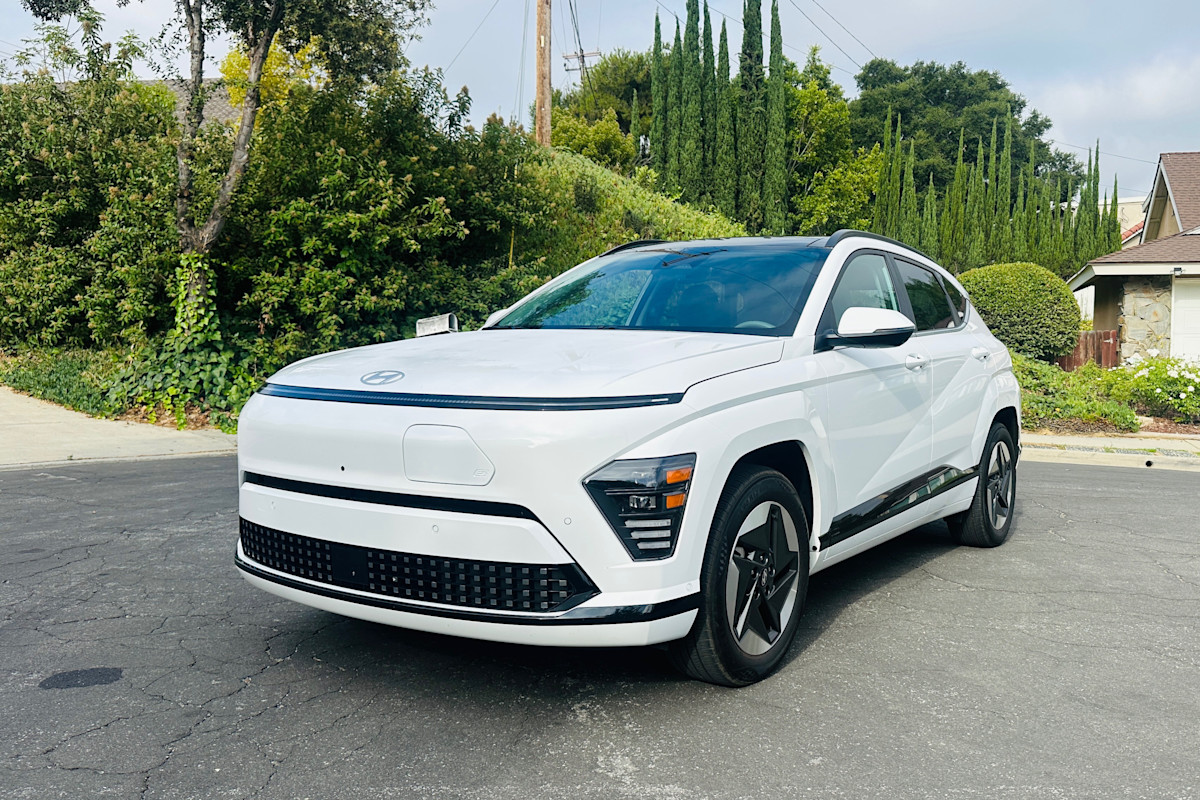
From the outside, the Kona EV looks like a space-age art project, with long, slender pixelated LED lighting front and back, chiseled fenders and strong creases along the silhouette. It’s grown quite a bit from the previous generation, but that just translates to more room inside for a nicely appointed, airy cabin. We like the built-in shelf along the passenger side of the dash and the Sage-Green-with-Lime interior is a great addition to our tester’s more staid Atlas White exterior color.
For a sporty look, choose the N Line with special 19-inch wheels, a rear spoiler, unique front and rear fasciae, and black mirrors.
Cloth seating is standard in the Kona, but the N Line gets its own faux-leather and Alcantara design. Our top Limited tester nixes the Alcantara completely, and the leatherette has a high-quality feel to it. The cabin is finished off with some metallic-looking trim and a stylish three-spoke steering wheel. We appreciate the physical HVAC controls as digging through screen menus to change the temperature a few degrees can be a distracting burden.
Performance
Unfortunately the Kona Electric is available only with front-wheel drive (FWD). If it’s an all-wheel drive (AWD) Kona you want, you’ll need to switch to the traditional ICE powertrain. The base SE Kona EV gets a Standard Range 48.6-kWh battery pack, enough to roll for 200 miles before needing a charge. That’s not great, folks. It’s at the bottom of the class here, beating out only the base-model Nissan Leaf (and the Leaf is due for its own redesign in the fall of 2025).
Adding insult to injury, in this form the single electric motor produces just 133 horsepower and 188 pound-feet of torque. Therefore, we recommend you spend the extra money for the Long Range 64.8-kWh pack. Not only will that get you 261 miles of driving per charge, you’ll also up the power to 201 hp and 291 lb-ft of torque. Note that although the N-Line trim gets the larger of the two batteries, its range is reduced to 230 miles, likely thanks to its larger wheels.
Trust us, you’ll want that extra power out on the road. While the Kona weighs just under 4,000 pounds, it’s still pretty heavy for a small SUV. As a result, it’s not the quickest thing off the line, at right around seven seconds from zero to 60 mph, even in Sport mode. Other EVs do it better, but then again Hyundai has never marketed the Kona as a sporty electric SUV.
Instead it’s a competent commuter. The ride is comfortable and never harsh, the cabin is quiet and the handling is good enough. There are paddle shifters behind the steering wheel, but instead of shifting gears, here they are used for regenerative braking. Drivers can choose anything from coasting to one-pedal driving to get those sweet, sweet free electrons. A pull on the left paddle gives instant max regen regardless of what mode you’re in while pulling on the right paddle switches it to a default mid-level. We spend nearly our entire time in the car using one-pedal mode, hardly ever needing the friction brakes.
The Kona sits on a 400-volt electrical architecture, so DC fast-charging times are merely adequate. You’ll spend more time at public charging stations than with the 800-volt system offered in the Hyundai Ioniq 5. The good news is the Kona has a battery pre-conditioning system to help get everything up to snuff before the charging session starts, but you’ll still wait over 40 minutes to go from a 10-percent to 80-percent state of charge at a DC fast charger. The 11 kW onboard charger means filling up at home should take anywhere from five to six hours. The Kona comes with a CCS port, but a NACS adaptor is available so owners can use the Tesla charging network.
Form & function
While the SE trim level can be a bit bare bones, it still comes standard with dual-zone climate control, proximity key and solar front glass. The SEL trim is where most of the goodies kick in, but for all the bells and whistles, the Limited trim is where it’s at. Heated and ventilated front seats, a heated steering wheel, Bose premium sound system, a sunroof—it’s all here.
The cupholder design is pretty nifty. It allows drivers to rotate them away if you don’t want to use them and would prefer more open space in the console between the seats. Press a button and they circle back around to hold your beverage. Cool! However, the center armrest just reveals a small storage compartment, most of the space beneath the padded surface is open to the center console. If you want to store things out of sight you’ll need to use the glove box.
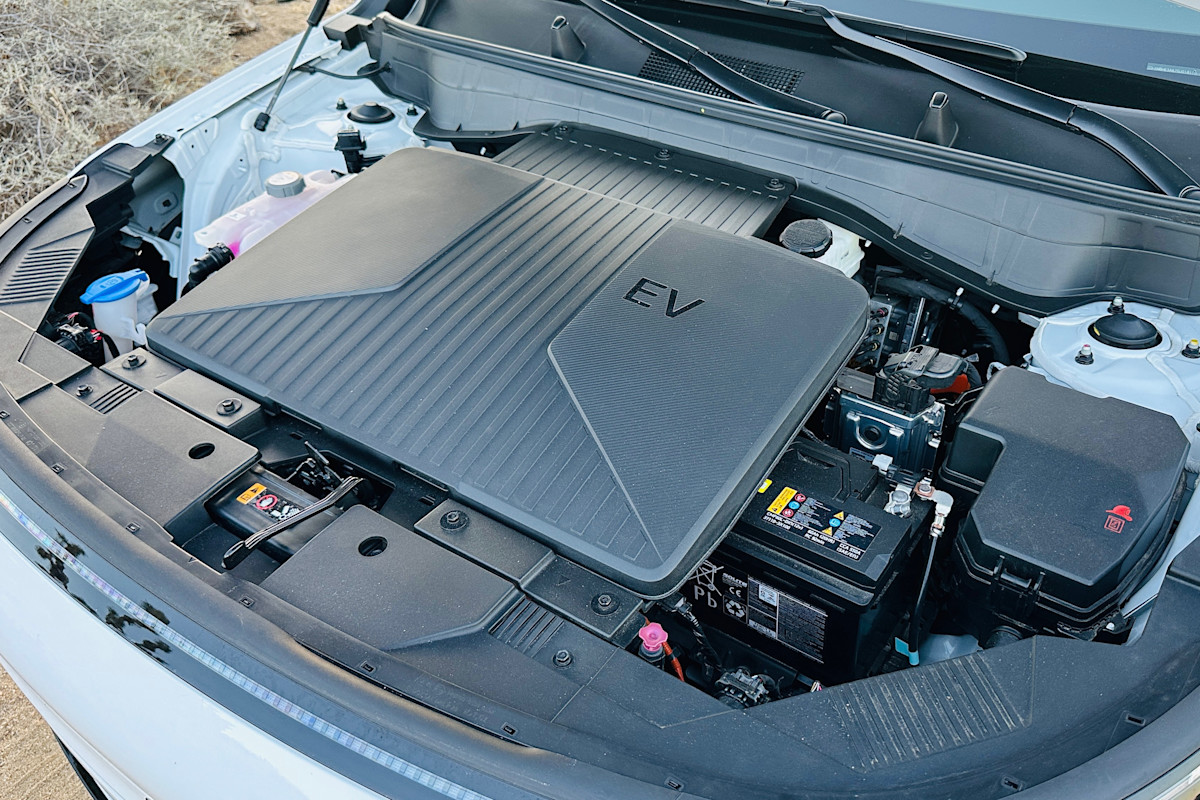
While the Kona EV does have more space than in its previous generation, it’s still a bit smaller than rivals. The small frunk is really only big enough to carry the portable charging cables and the 25.5 cubic feet of space behind the second row of seats—opening up to 63.7 cubic feet with the rear seats folded—is slightly lower than average for the class. While it bests the Mini Countryman SE and Volvo EX30, both the Volkswagen ID.4 and Ford Mustang Mach-E offer more space behind the rear seats.
Technology
Every Kona Electric trim gets dual 12.3-inch displays that are clear and easy to use. The digital gauge cluster sits right behind the steering wheel and offers plenty of information while the infotainment system’s touchscreen sits directly next to it, complete with wireless Apple CarPlay and Android Auto, as well as a WiFi hotspot. We especially like the EV page with a breakdown of both cumulative and instant battery usage. Who knew we used eight percent of our battery on climate control? This information is super-handy to have if you want to nerd out on hypermiling.
The native navigation system can predict your charging needs and suggest places to charge, even giving you the option of an economical route (say, with fewer hills) or a faster route. Again, this is all super-handy to have so you don’t get caught unaware in a charging desert.
The touchscreen itself reacts quickly and the graphics are clean and crisp, but we noticed that during sunset it continuously switched back and forth between daytime and nighttime mode. Just pick a time and stick with it, Hyundai.
Device charging is taken care of by four USB-C ports, two up front and two for rear-seat passengers. N Line trim and above models add wireless device charging. The Kona Electric also gets vehicle-to-load capability to charge items outside the car. Just plug in the $220 adapter to the illuminated charging port at the front of the car and you can add electrons to e-bikes, scooters, Starlinks, or the other geegaws we can’t live without these days. It’s a small load of power, just 1.7 kW, but great to have as an option.
For those who don’t want to mess around with a fob, N Line and Limited trims have Hyundai’s Digital Key 2, which allows owners to unlock their car with their smart phone or smart watch. One less thing to carry around, right?
Safety
Hyundai always goes all-in on driver-assistance tech, and the Kona Electric is no different. Expect each trim to get the manufacturer’s SmartSense suite of features that includes front automatic emergency braking, blind-spot monitoring, rear cross-traffic alert and lane-keeping assist. Even Hyundai’s Highway Driving Assist is standard, where adaptive cruise control and lane-keeping assist work together at higher speeds. It’s a hands-on/eyes-up system but it still takes some of the stress out of longer commutes.
If you really want to go the distance, the Limited trim gets parking aids like a surround-view camera system, parking alerts and Remote Smart Parking Assist, which pulls a car in and out of a perpendicular parking space without the driver onboard. Also appreciated is the Blind-View Monitor that pushes a video feed of your blind spot directly to the gauge cluster when signaling. Sure, you could turn your head and look over your shoulder, but that is so 2000s.
Neither the National Highway Traffic Safety Association (NHTSA) nor the Insurance Institute for Highway Safety (IIHS) had rated the 2025 Hyundai Kona EV at the time of publication.
Cost-effectiveness
You’ll never hear us complaining about Hyundai’s stellar warranty. The powertrain and battery are both covered for 10 years or 100,000 miles and there is a limited warranty for five years or 60,000 miles. Expect complimentary maintenance for three years or 36,000 miles as well.
The 2025 Hyundai Kona Electric starts at just $34,470, including $1,495 for delivery. That’s about $8,000 more than the gas-powered Kona, but it’s still a pretty big discount over the competition. The Kona is about $4,000 less than a Ford Mustang Mach-E, over $10,000 less than a base model Volkswagen ID.4, Mini Countryman SE, and Volvo EX30. Having said that, the Mach-E is offered with rear-wheel drive (RWD) for a sportier driving experience, the rest can be had with AWD, and they all have more power than the Hyundai.
Our Limited tester prices out closer to $43,000, so we think the trim to get is the SEL. Although Hyundai doesn’t offer options beyond some small dealer-installed accessories, the features on this mid-trim balance well with its $38,470 final price.
The 2025 Hyundai Kona EV presents a decent option to those looking for an affordable subcompact, battery-powered SUV. It’s not the quickest in the bunch, nor does it have the most range, but those looking to save a buck or two might just find it worth their while.

What owners say
Trims & specs
Base MSRP $41,050 | Seating 5 |
Engine 201 hp Electric | Cargo Capacity 25.5 cu ft |
Combined MPG 117 | Drivetrain FWD |
Base MSRP $36,875 | Seating 5 |
Engine 201 hp Electric | Cargo Capacity 25.5 cu ft |
Combined MPG 117 | Drivetrain FWD |
Base MSRP $32,875 | Seating 5 |
Engine 133 hp Electric | Cargo Capacity 25.5 cu ft |
Combined MPG 119 | Drivetrain FWD |
Base MSRP $38,275 | Seating 5 |
Engine 201 hp Electric | Cargo Capacity 25.5 cu ft |
Combined MPG 104 | Drivetrain FWD |


