2022 Hyundai Kona Electric Reviews, Pricing & Specs


Pros & cons
What we like
Fun to drive
Great handling
Excellent value for money
What to consider
Cramped back seat
Not much cargo space
Expert review
As Hyundai emerges as a leader in EV production with the Ioniq brand, the Kona Electric’s familiar face soldiers onward.
Whereas the 2022 Hyundai Ioniq 5 broke brains with its futuristic, Tron-like styling, the 2022 Kona Electric appeals to shoppers in search of something more familiar. Hyundai has introduced some tweaks and changes to the 2022 Kona Electric, including some new exterior features and a streamlined trim lineup. The result is an approachable EV that looks great and boasts an affordable price tag.
out of 10 expert review
Look & feel
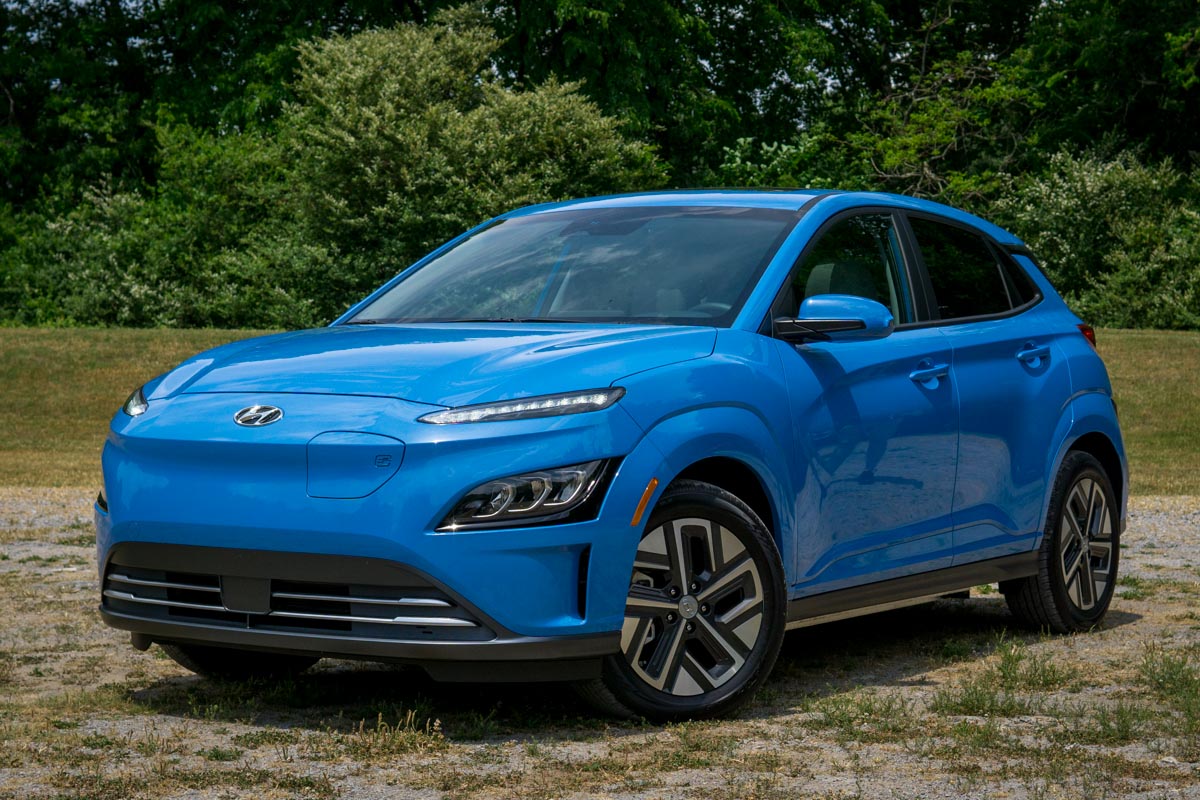
We’ve always appreciated the Hyundai Kona for having a bit of a “bulldog” look to it. Short and stout, the Kona rides low to the ground with hardly any rear overhang. Visually, it manages to look simultaneously tough and friendly.
For 2022, Hyundai has added some new wheels and updated the Kona Electric’s front and rear bumpers. Our test model, a top-tier Limited trim, wore Blue Wave paint to go along with its 17-inch alloy wheels.
Although it was certainly eye-catching, we will say, our blue paint job was a lot of blue. With the Kona Electric’s grille-less front bumper and the painted mirror caps, it was a true wave of color. Again, we found the shade handsome, but we’d be inclined to spec one with the black roof, just to break things up.
After dropping the Ultimate trim for 2022, Hyundai now sells the Kona in two trims: SEL and Limited. There’s also a Convenience Package for $3,500 that can be added to the SEL as a sort of stopgap between the two trim levels. The Kona Electric comes well-equipped, but the Limited does add some nice features. On the exterior, the Limited trim swaps in LED head- and taillights, and it tacks on premium gray body cladding. You also get rain-sensing wipers with the more expensive trim level.
Climb aboard a Hyundai Kona, and you’re greeted with terrific outward visibility. The vehicle’s short, sloping hood and big windows make it easy to stay alert to the happenings around you.
From a usability standpoint, the Kona Electric’s interior is delightfully simple. Physical controls are everywhere. With the exception of the shifter, everything is obvious and instantly familiar. This is the type of vehicle you could rent while on a vacation and feel immediately at home inside.
The shifter is a “+” design with Parking at the top, neutral at the bottom, drive on the left, and reverse on the right. It’s unconventional but self-explanatory. Two big cupholders sit to the right of the shifter.
The rest of the center console is basic and functional. Hyundai fits it with a couple of storage bins, more hard buttons, and knobs for volume and tuning flanking our Limited-trim vehicle’s 10.25-inch touchscreen display—the SEL trim level makes do with an 8-inch screen.
The Kona never feels big—its steering wheel is comically small—but it doesn’t feel cramped in the front. The SEL trim comes equipped with black or gray cloth upholstery, but we enjoyed leather-trimmed seats. Considering its reasonable $3,500 price, the Kona Electric SEL’s Convenience package adds key niceties to the mix. Along with some less-notable features, it delivers a sunroof, LED interior lights, eight-way power adjustment and lumbar adjustment for the driver’s seat, heat for both front seats, wireless device charging, and the battery warmer system.
Performance
Hyundai has quietly become a powerful force in the world of electric and electrified vehicles. Along with the Kona, the company sells PHEV versions of the 2022 Tucson and 2022 Santa Fe, plus it recently debuted the 2022 Hyundai Ioniq 5, the first in an eventual line of all-electric vehicles.
By comparison, the Kona Electric looks well-traveled. While it doesn’t boast top-of-market EV technology like the Ioniq 5, what it does offer is still excellent for regular use.
A 150-kW electric motor paired with a 64-kWh lithium-ion battery makes up the Kona Electric’s powertrain. With 201 horsepower and 291 pound-feet of torque sent to the front wheels, it’s genuinely quick, hitting sixty miles per hour in less than 6.5 seconds. And with all the torque coming on immediately, it’s a hoot to drive around town. Better yet, an EPA-estimated 132 city, 108 highway, and 120 combined MPGe rating makes the Kona Electric an appealing choice for shoppers looking for a highly efficient electric crossover. The total driving range measures 258 miles on a full charge, but as with any EV, that number will fluctuate, and shoppers should expect to see it drop with lower temperatures.
Charging hardware is less impressive: the Kona Electric’s 7.2 kW onboard charger can replenish the battery from 10 to 100 percent on a level 2 home charger in nine hours 15 minutes. Plug into a 100-kW fast charger, and the battery will progress from 10 to 80 percent in 47 minutes. Compared with the new Ioniq 5, this is positively slow.
On the bright side, the battery warmer that comes standard on SEL Convenience and Limited trims helps speed charging in cold weather and, when in winter mode, it minimizes charge loss. Road noise is also impressively quiet in the Kona Electric, measuring only 65 dBA.
Hyundai supplies three drive modes for the Kona Electric: Eco, Comfort, and Sport. Drivers will find that, regardless of mode, the Kona Electric stays composed in corners, with its short, 102.4-inch wheelbase and huge toque making it fun to toss about. The suspension soaks up bumps, but the vehicle is heavy enough (3,715 pounds in SEL trim, 3,836 pounds in Limited) that you’ll feel some weight transfer if you really get into it.
Hyundai has identified range anxiety, slow charging times, and concerns about public charging infrastructure as three key hurdles facing would-be EV adopters. With the Kona’s 258-mile driver range and dual Type 2/CCS charging port, at least two of those concerns are largely alleviated.
Form & function
For such a small vehicle, there’s reasonable headroom in the Kona Electric—39.6 inches up front and 37.7 in the rear. But while the front passengers won’t struggle with legroom (41.5 inches), the folks in the back will. There are only 33.4 inches back there.
Cargo space is also tight: 19.2 cubic feet behind the rear seat, 45.8 with the rear seat folded. While small, it’s actually the same size as the non-EV Kona. That’s because Hyundai designed the Kona to accommodate a large battery pack from the outset, as opposed to other automakers that engineered battery powertrains into existing gas-powered cars.
There’s no getting around the Kona’s compact interior dimensions, but its sensible use of storage cubbies and compartments provides some saving grace. We had no issues loading our test model with water bottles, backpacks, camera equipment, and other road-trip necessities.
For anyone hoping to use a Kona Electric as an uber-efficient hauler, think again. You can’t tow with a Kona Electric, despite it being classified as a crossover.
Technology
Hyundai has developed a terrific infotainment system that manages to be full of features, attractive in design, and simple to understand. The SEL trim’s 8-inch touchscreen supports wireless Apple CarPlay and Android Auto, although the larger, 10.25-inch display on the Kona Electric Limited does not.
Dual USB ports for the front seats are included as standard equipment (the Limited trim also gets a USB outlet for backseat passengers), and shoppers can expect the typical Bluetooth connectivity and SiriusXM satellite radio.
Hyundai also offers the Kona Electric with a digital key, a smartphone app that allows owners to lock, unlock, start, and activate the panic alert on their vehicle.
Step up to the Limited trim, and you’ll also enjoy a Harmon Kardon premium audio system which, despite having only two more speakers than the base system (for a total of eight), sounds crisp and bright with plenty of range.
Finally, Hyundai’s introduced a new 10.25-inch digital driver information display to beautifully pair with the Limited trim’s equal-sized infotainment display.
Safety
The Hyundai brain trust says that “Progress for Humanity” is their north star, the guiding principle behind their current product line. Obviously, electrification ties into this ethos, but the Kona Electric’s impressive array of standard safety features also helps.
The Kona Electric comes equipped with a variety of advanced driver assistance systems (ADAS) included as standard equipment. Labeled under the SmartSense umbrella, these items include forward-collision alert, automatic emergency braking with pedestrian detection, lane-following assist, lane-keeping assist, a driver attention warning, blind-spot warning and collision avoidance, and rear cross-traffic alert.
Shoppers can also add rear parking sensors and cyclist detection for the automatic emergency braking system by moving to the Limited trim. The Kona Electric Limited also benefits from Hyundai’s Highway Driving Assist technology.
Neither the National Highway Traffic Safety Administration (NHTSA) nor the Insurance Institute for Highway Safety (IIHS) has crash-tested a 2022 Hyundai Kona Electric, but the IIHS did award the gas-powered Kona its top score of Good across all crashworthiness evaluations.
Cost-effectiveness
At this point, the market for electric cars is still fairly expensive. The 2022 Kona looks like a decent value, however. Starting at a $34,000 MSRP before a mandatory $1,295 destination fee, the base Kona Electric SEL comes in well below competitors like the Ford Mustang Mach-E, Telsa Model 3, and the Hyundai Ioniq 5 and Kia EV6. Even the Limited trim’s $42,500 price (before destination) looks competitive. Admittedly, the Kona Electric can’t match any of those other options in terms of battery size or interior appointments, but if you’re in the market for an affordable EV, the Kona looks like a Goldilocks of driving range, driving dynamics, and price.
Other vehicles the Kona Electric will need to contend against are the 2022 Nissan Leaf and the 2022 Chevrolet Bolt EUV and Bolt EV, both of which undercut the Kona Electric’s price. However, the Chevrolet is no longer eligible for the federal government’s $7,500 tax credit, and the Nissan Leaf’s time in the sun as a segment-leading EV has long since passed.
For shoppers who are ready to switch to an electric vehicle and want something fun, stylish, and affordable, the Hyundai Kona Electric deserves a test drive.

What owners say
Excellent car, love the features and the ride. Even the rear seat, which I was expecting to be too small is roomy enough for my adult kids.
July 16, 2024Trims & specs
Base MSRP $34,000 | Seating 5 |
Engine 201 hp Electric | Cargo Capacity 19.2 cu ft |
Combined MPG 121 | Drivetrain FWD |
Base MSRP $42,500 | Seating 5 |
Engine 201 hp Electric | Cargo Capacity 19.2 cu ft |
Combined MPG 121 | Drivetrain FWD |