2025 Honda Civic Hybrid Reviews, Pricing & Specs



Pros & cons
What we like
Fuel-efficient
Comfortable
What to consider
All-wheel drive not available
Expert review
The class-leading Honda Civic just got better.
The 2025 Honda Civic lineup gets a big change with the debut of a new Hybrid model that promises more power and significantly improved fuel economy. A slight styling refresh and new features further benefit this affordable and attractive compact car, which is still available in sedan or hatchback body styles.
out of 10 expert review
Look & feel
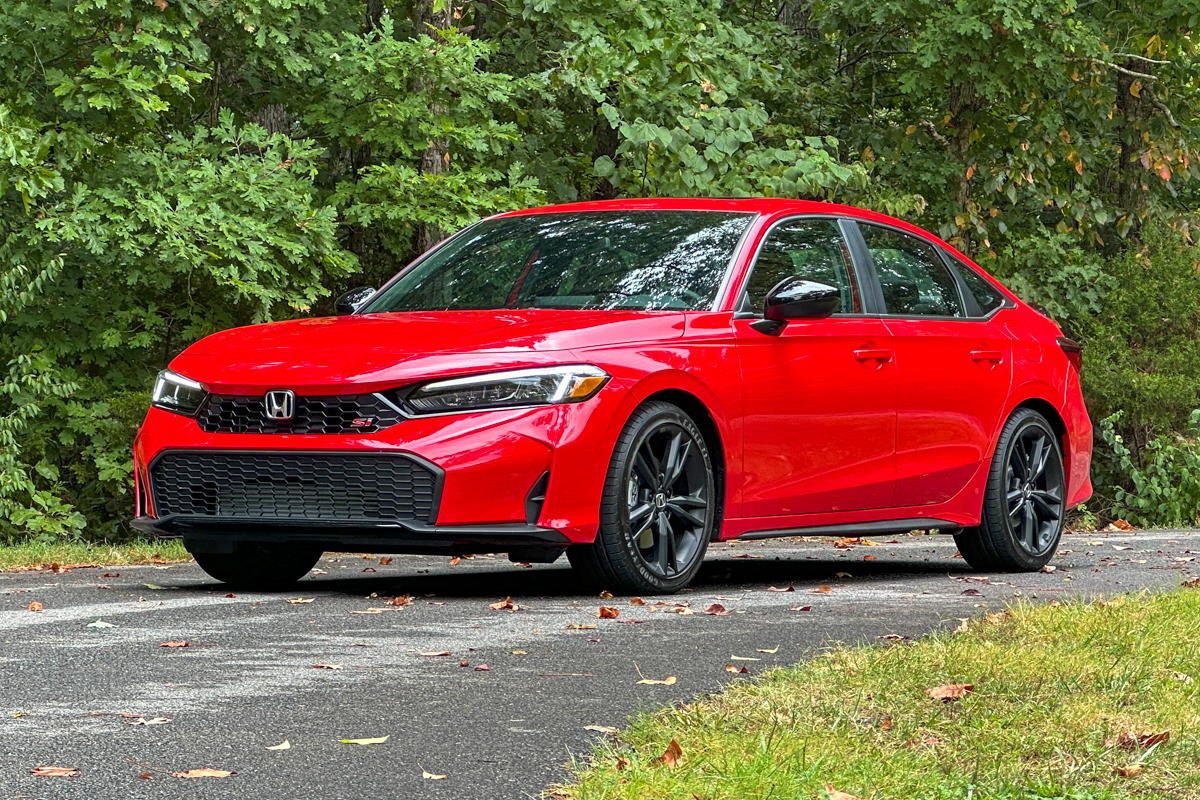
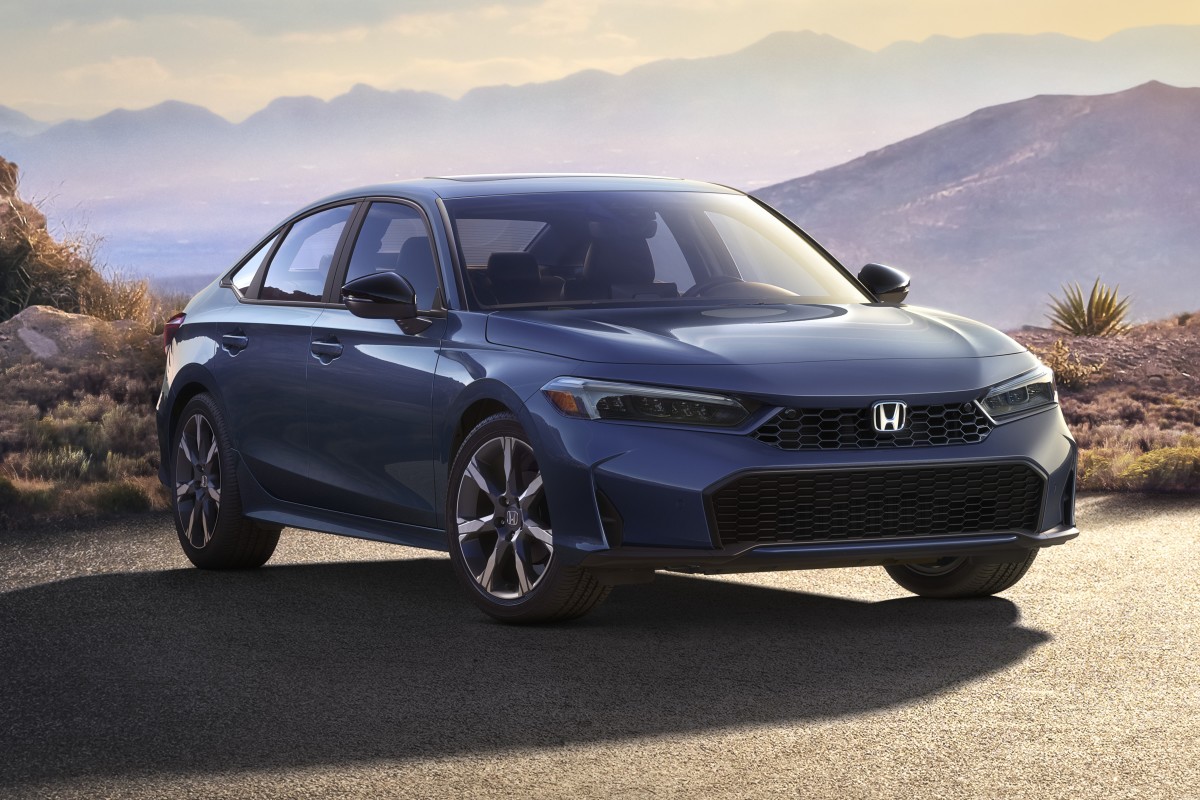
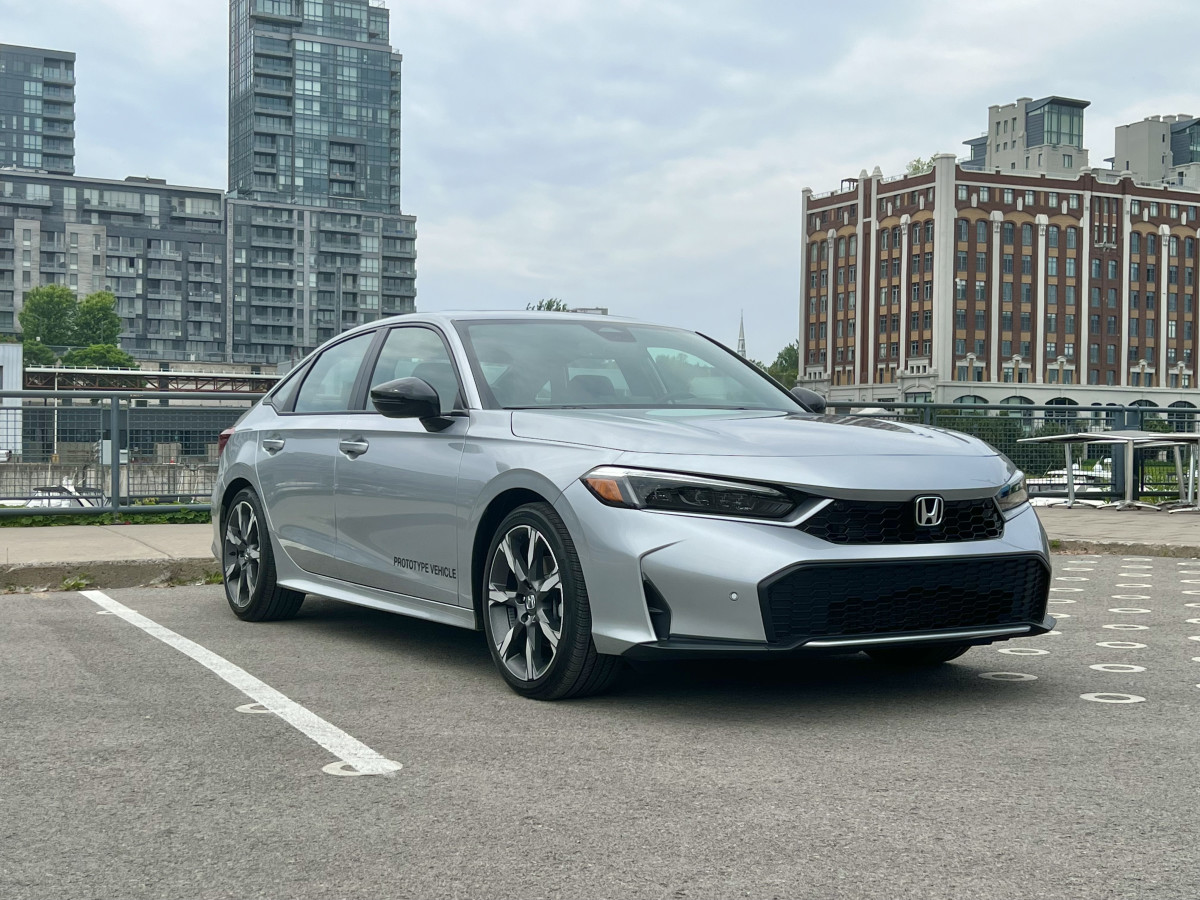
For 2025, the Honda Civic receives a mild styling refresh that is mostly limited to the front fascia. The grilles have been reshaped and the body section between them has been drawn just a bit further forward. This gives the new Civic a sharper and sleeker appearance, as opposed to the more blunted look from a year ago. Though the change is subtle, it adds a slight amount of sporty aggression that was missing before.
From the outside, the Civic is neither too flashy nor bland as it balances classic proportions in a classy package. The Civic hatchback hybrid version will be available later in the summer and turns up the sportiness dial with a sleeker profile and more distinctive tail lights. For non-hybrid shoppers seeking more excitement, the Civic Si and high-performance Civic Type R adopt a racy attitude with aerodynamic wings and styling flourishes to appeal to a more youthful crowd.
On the inside, the Civic returns mostly unchanged, and that's a good thing since it already has one of the nicest interiors in the class. Air vents are hidden behind a distinct mesh grille that spans the dashboard while an infotainment touchscreen sits on top. In higher trim levels, you also get a digital instrument panel that adds a higher-tech feel. On the whole, the cabin is a marked improvement over econoboxes from only a decade ago.
Materials quality is excellent when compared to rivals, with well-grained soft-touch materials where you'd typically touch and harder plastics in areas that are prone to wear. The center console features a herringbone-like texture on a plastic surface that we prefer to the more typical piano-black finish found in many competitors. This pattern keeps annoying fingerprints and dust from being so prominent and should be considered by other carmakers.
The rear seats substitute some of the soft-touch materials for harder plastics to better weather use from children or cargo overflow. The lack of air vents and charge ports back there makes it seem more spartan and basic by comparison. As with the exterior, the Civic Si and Type R interiors are dressed-up with sport seats, red stitching, and several other aesthetic enhancements.
Performance
The base LX and Sport trim are powered by a 2.0-liter four-cylinder engine that produces 150 horsepower and 133 pound-feet of torque. That's down eight hp and five lb-ft from last year's engine, but drivers are unlikely to notice the difference because initial power delivery is more responsive. More importantly, these changes slightly improve fuel economy. A continuously variable transmission (CVT) sends power to the front wheels only and the previously available manual transmission is now exclusive to the Si and Type R.
The biggest change for 2025 comes in the form of the new hybrid powertrain. It also employs a 2.0-liter four-cylinder engine, but it's mated to two electric motors for a combined output of 200 hp and 232 lb-ft of torque. It's the same engine and hybrid system used in Honda's CR-V and Accord hybrids, though the CR-V is notable as the only one that offers all-wheel-drive. This hybrid replaces the previous 1.5-liter turbo engine that was offered on the EX and Touring models which were rated at 180 hp and 177 lb-ft. Despite the increase in power, the new hybrid is expected to return 36% more miles to the gallon. There's no official word from Honda on changes for the Civic Si or Type R yet.
After driving the 2025 Honda Civic Hybrid for ourselves around the Montreal area, we came away with very favorable impressions. On a mix of city streets and highways, our Sport Touring trim vehicle delivered plenty of power to please the vast majority of drivers. While 200 horsepower is a fairly unimpressive figure nowadays, the hybrid electric motors make this Civic feel noticeably more responsive. Much like EVs, power from these motors are instantaneous when compared to internal-combustion engines and also silent.
In most cases, initial acceleration is all-electric, giving you a definite advantage off the line. After a short distance, the gasoline engine springs to life and begins supplying power. The transition between the two is almost seamless and you really hear the low thrum of the engine rather than feel it. When driven conservatively, the continuously variable transmission remains smooth and quiet. With more throttle, the engine will tend to keep the revs high, but it doesn't drone on loudly the way some other CVT-equipped cars do.
Slowing the Civic Hybrid is similarly smooth and seamless, with little to let you know that the system is switching between regenerative braking (using the vehicle's momentum to recharge the hybrid battery) and when the conventional brakes activate. Paddles mounted to the steering wheel allow the driver to adjust the amount of regenerative braking when lifting their foot off the accelerator, much like an EV, but one-pedal driving is not an option.
The suspension is tuned to favor comfort over sporty cornering, yet the Civic remains surefooted and confident in the turns. Honda adjusted the tuning to deliver slightly better handling and thankfully it has no effect on comfort. Overall it's more capable than most drivers will need.
Not surprisingly, the Hybrid is much quieter than its gas-powered siblings, and with active noise cancellation, there's little of the boominess or white noise that is sometimes attributed to EVs and some hybrids. That adds to the already smooth ride quality, which should make longer road trips seem much shorter. The higher-performing Si and Type R are tuned for racetrack-like cornering and make significant sacrifices to ride comfort, but those drawbacks are welcomed by spirited drivers.
Form & function
The Civic's front seats provide plenty of room for larger drivers and there are enough adjustments to ensure you can find your ideal position. Forward visibility is helped by fairly narrow roof pillars and you'll get plenty of situational awareness over your shoulders and through the side mirrors. The rearview is somewhat limited by a tall rear decklid, which may result in more reliance on the rearview camera when backing into a tight parking spot.
Primary controls are placed well within the driver's reach and the conventional climate control knobs are easy to operate without having to take your eyes off the road. Steering wheel buttons are also conventional rather than capacitive touch, and are significantly easier to use.
With a rubberized wireless charging pad (top trim only), larger cup holders, and a deep center armrest bin, there should be adequate space for your personal items, but the door pockets are on the small side and can only hold smaller drink containers.
The rear seats have enough room to comfortably accommodate average-sized adults. There's ample headroom for a five-foot-ten passenger and a wealth of legroom and space under the front seats for your feet. A center armrest is stowed in the middle seatback and has two medium-sized cup holders. Unfortunately, there are no air vents or USB charge ports to keep those passengers as comfy or as charged up as they would in some rivals, and this seems like an uncharacteristic misstep by Honda.
The sedan can hold as much as 14.8 cubic feet of cargo in its trunk, which is big for the class. The space itself is vast without the typical wheel well intrusions and there's added storage underneath the floor. The low liftover height makes loading heavier objects easier, as do the remote rear seatback releases that are conveniently located in the trunk.
Technology
The standard infotainment system on the base LX includes a seven-inch touchscreen, remote control and monitoring through the HondaLink smartphone app, a four-speaker audio system, Apple CarPlay, and Android Auto. Stepping up to the Sport trim doubles the number of speakers, but things really get upgraded once you get to the top Touring trim. It comes with a digital instrument panel, a larger nine-inch touchscreen, a 12-speaker Bose premium audio system, wireless phone integration, and a wireless charging pad.
The big change this year is the switch to a Google Built-in operating system that integrates several online features that could streamline parts of your life. It is only available on the top Sport Touring Hybrid trim, though. This system also enhances voice commands with more natural voice prompts that control more climate, audio, and navigation features.
The infotainment system is easy to use, thanks to logically arranged menus, quick responses, and sharp graphics. Setting up your phone is also simple and we experienced no glitches during our drive. The wireless phone charger's rubberized surface keeps your phone well-secured and can accept larger Max-sized phones with bumper cases.
Safety
In tests conducted by the National Highway Traffic Safety Administration (NHTSA), the 2025 Honda Civic sedan was awarded five-out-of-five stars in overall, side, and rollover protection, and four stars for frontal collisions. The mechanically similar 2024 Civic earned the Insurance Institute for Highway Safety's (IIHS) highest score of "Good" in all evaluations except for the updated frontal moderate overlap and side tests, where it scored a second-best "Acceptable". The Civic is also named a Top Safety Pick, the Institute's second-highest honor. It's possible the 2025 Civic's score could improve as additional frame strengthening has been added to specifically address those new tests.
Standard advanced safety features include forward collision warning with automatic emergency braking, lane-keep assist, adaptive cruise control, a traffic sign reader, and automatic high beams. The Sport trim adds a blind-spot monitor with rear cross-traffic alerts while the top Touring trim extends automatic braking to parking lot speeds and adds parking proximity sensors and rain-sensing wipers. During our time with the Civic, we never encountered any false alarms, which is an improvement over past Honda safety systems.
Cost-effectiveness
The base 2025 Honda Civic LX has a manufacturer's suggested starting price of $25,345 (including $1,095 in destination fees). The Sport model jumps slightly to $27,345 and both of these models are powered by the 2.0-liter non-hybrid engine that is estimated to return 36 mpg in combined city and highway miles for the LX and 35 mpg for the Sport.
The more powerful Hybrid models start at $29,845 for the Sport Hybrid, which adds a sunroof, heated front seats, and dual-zone automatic climate control on top of the supporting non-hybrid Sport trim. The top-of-the-line Sport Touring Hybrid rings in at $32,845 and bolsters the features list with several luxury and technological upgrades. These models are estimated by Honda to achieve an impressive 49 mpg in combined driving.
Crunching the hypothetical numbers with 15,000 miles driven annually with gas at $4 a gallon, it would take 5.7 years to recoup the $2,500 difference between the standard Sport and the Hybrid Sport trims. After that point, you'll be saving $442.18 per year in fuel costs with the Hybrid. That means if you plan on keeping your vehicle for at least six years, you'll end up saving money and that period shortens with higher gas prices and more miles.
Among hybrids in this class, the Toyota Prius remains the leader with an EPA-estimated 57 mpg in combined miles and costs a few hundred dollars less than the Civic Sport Hybrid. It's worth noting that the prius is also offered with all-wheel-drive, which could be a big plus in weather-prone regions. There's also the Toyota Corolla Hybrid at 50 mpg combined, and it's also available with AWD. Another alternative is the Hyundai Elantra Hybrid at 54 mpg and a few hundred dollars more than the Civic Sport Hybrid. You get a few more features with the Hyundai along with a much more generous warranty.
All things considered, it's a fairly even match in this class when it comes to the specs, but the Honda Civic Hybrid gains an advantage over the rest with its more engaging driving manners and more conventional interior. It represents an easier transition from traditional non-hybrids with no discernable drawbacks besides price.

What owners say
Amazing comfort, lots of power and fun to drive. The bose sound system is mind blowing. The quiet hum of the electric motor was a nice break from all the noisy gas motors I was used to. The only issue I have so far is the wireless charger makes my phone run hot and it is not a fast charge.
July 12, 2025Love my 2025 Honda Civic Sports Touring Hybrid. Amazing car that always exceeds expectations
January 21, 2026Trims & specs
Base MSRP $32,695 | Seating 5 |
Engine N/A | Cargo Capacity 14.8 cu ft |
Combined MPG N/A | Drivetrain N/A |
Base MSRP $30,895 | Seating 5 |
Engine N/A | Cargo Capacity 24.5 cu ft |
Combined MPG N/A | Drivetrain N/A |
Base MSRP $29,695 | Seating 5 |
Engine N/A | Cargo Capacity 14.8 cu ft |
Combined MPG N/A | Drivetrain N/A |
Base MSRP $33,895 | Seating 5 |
Engine N/A | Cargo Capacity 24.5 cu ft |
Combined MPG N/A | Drivetrain N/A |


Pricing trends
MSRP range
$28,950 - $33,150
Current avg. market price
$28,205
Trending down by 1.0% this month
May 2026 - October 2026