2023 Toyota Highlander Hybrid Reviews, Pricing & Specs


Pros & cons
What we like
Quiet cabin
Standard advanced safety features
Great safety ratings
What to consider
Fairly pedestrian performance
Interior materials feel cheap
Cramped third row
Expert review
According to Toyota, the hybrid version of the popular Highlander SUV accounts for 25 percent of all sales in the U.S. market.
The Highlander Hybrid's popularity is understandable, given the midsize, three-row crossover's impressive EPA fuel economy rating and accessible base price. However, generally speaking, the 2023 Toyota Highlander is not what it should be, and specifically, the Highlander Hybrid doesn’t meet efficiency expectations. Unfortunately, this Toyota faces few rivals, and only one of them costs less. But the Kia Sorento Hybrid and Plug-in Hybrid models are worthy alternatives.
out of 10 expert review
Look & feel
You can buy a 2023 Toyota Highlander Hybrid for as little as $41,995, including the $1,335 destination charge. That’s for the base LE trim level and front-wheel drive (FWD). From there, you can upgrade to XLE, Bronze Edition, Limited, and Platinum trim, and all-wheel drive (AWD) is optional across the board.
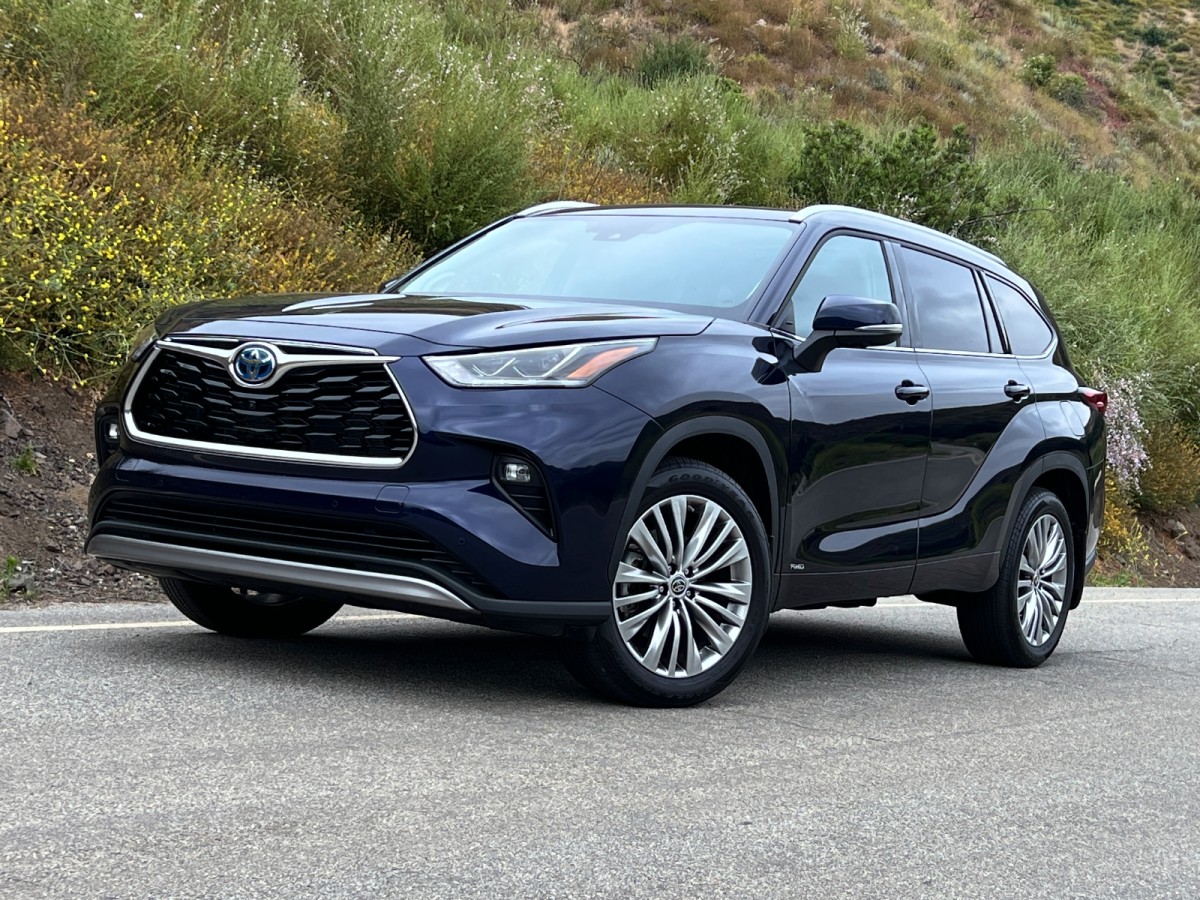
Our 2023 Highlander Hybrid test vehicle arrived in the top Platinum trim with AWD and an All-Weather Floor Liners accessory package. The manufacturer’s suggested retail price (MSRP) was $54,718, including destination.
Appearance changes for 2023 are minimal. There is a new Cypress Green paint color, and power folding exterior mirrors are now standard with Limited and Platinum trim. Otherwise, the Highlander Hybrid is the same as before.
The current-generation Highlander is over-styled. Exaggerated forms wage a visual assault on your retinas, from the scowling headlights and simulated front bumper air intakes to the wildly flared rear fenders and dramatically sculpted rear forms.
Granted, Toyota has taken plenty of criticism for boring design in the past, but the pendulum has swung too far in the other direction. Not only that, but without a set of 20-inch wheels to help fill the swollen wheel arches, most versions of the Highlander look like they need to try Ozempic.
That same philosophy continues inside, where everything looks super-sized. From the large air vents and giant 12.3-inch touchscreen infotainment system to the big climate control knobs and bulging JBL tweeter speaker surrounds, the cabin is anything but subtle or elegant.
Not only that, but the multi-layered dashboard’s mismatched textures and tones, paired with reflections from the display and black plastic trim, make the interior visually obnoxious. Sitting in the driver’s seat, it’s almost as though every element of the dashboard is screaming for your attention.
Perhaps the approach would be less jarring if the Highlander’s cabin reeked of quality. But it doesn’t. Primary controls like the transmission shifter, power door locks, and turn signal stalk sound and feel inexpensive when used, and nearly all storage areas are unlined, virtually guaranteeing scraping and rattling sounds as you drive.
In addition, the door panel pods housing the power window controls flex too much under pressure and the test vehicle’s leather upholstery would not remain tucked into the plastic driver’s side seat base. The front seatback storage pockets appeared warped, matching the edges of the rather flimsy all-weather floor mats at each seating location.
Overall, our test vehicle’s interior looked, felt, and sounded of dubious quality. However, it certainly was quiet on the road. Toyota claims it expended considerable attention to this factor, and with Limited and Platinum trim, the Highlander Hybrid features acoustic front window glass. On the portion of our evaluation loop with the worst pavement, the SUV was remarkably quiet and civil inside.

Performance
The Highlander Hybrid pairs a 2.5-liter Atkinson-cycle four-cylinder engine with two electric motor-generators. One of them helps to propel the SUV, and both serve to keep the battery pack underneath the rear seat charged. Regenerative brakes also contribute charging assistance. Get AWD, and a third electric assist motor powers the rear wheels when necessary.
Toyota says the Highlander Hybrid is good for 243 combined horsepower, charged with motivating 4,430 pounds in Platinum trim. The electric assist motors help the SUV to accelerate and, if you push the EV mode button on the center console, can power the Highlander Hybrid solely on electricity at low speeds, such as when creeping along in traffic or seeking a parking space at a shopping center.
The gas engine offers no more than 175 pound-feet of torque, so high-speed passing power is almost non-existent. Also, though Toyota claims you can tow 3,500 pounds with the Highlander Hybrid, that doesn’t seem like a good idea. There simply isn’t much power to spare, and when driving in the mountains with two people aboard, the test vehicle’s brakes faded, eroding trust in them.
Drivers can choose between Eco, Normal, and Sport driving modes. With AWD, there is an overly optimistic Trail mode button on the center console, but we don’t recommend heading too far off the pavement. Our test vehicle handled light trail work at low speeds, and had no trouble on a washboard gravel surface. Still, the Highlander Hybrid’s 8.0 inches of ground clearance and electric AWD are best suited to helping with traction in winter weather.
The point of the Highlander Hybrid is fuel economy, so a Predictive Efficient Drive system learns your driving habits and considers upcoming road and traffic conditions to maximize efficiency. It’s not very talented, though. According to the EPA, our Platinum test vehicle should have averaged 35 mpg in combined driving. It returned 28.7 mpg on the evaluation loop.
This SUV is soul-crushing to drive. Soft suspension tuning makes it feel like you’re riding around on underinflated tires, the regular groaning of the continuously variable transmission (CVT) will make you sleepier than a noise machine on a hot and muggy day, and the steering is as about as engaging as a high-school physics lesson on a sunny summer afternoon.
Ultimately, the Highlander Hybrid is a tool for tooling around in cities and suburbs, made for people who drive only because they must and simply want a reliable and safe family-sized SUV. The compliant ride soaks up the bumps and cracks in the road, and aside from initial bounce and wallow over undulations, the Highlander remains fairly smooth regardless of the situation. In addition, the SUV is remarkably quiet on the highway. But there isn’t a single thing about driving a Highlander Hybrid that is remotely close to engaging or exciting.
Fortunately, the cupholders in the center console can easily handle the largest size cups from your favorite coffee shop. You’re going to need it.

Form & function
By now, you might be thinking that what’s important about a vehicle like the 2023 Toyota Highlander Hybrid is not how it looks, feels, and drives, but how it handles the demands of daily family life. Fair enough. And to that, we’d point out that there is a reason that Toyota has added the larger 2024 Grand Highlander model to its lineup.
Depending on the trim level and how you outfit the SUV, the Highlander Hybrid carries seven or eight people. However, since most have standard second-row captain’s chairs and the third-row seat is best only for occasional use when no other alternatives for carrying extra people exist, we think this SUV would serve Toyota better as a two-row model.
Standard equipment includes three-zone automatic climate control, and our test vehicle had a heated steering wheel, heated and ventilated front seats, and heated second-row captain’s chairs. So, people should have no problem finding a comfortable temperature.
In addition, both front seats offer power adjustment, including for height. They are large and supportive, but we did wish for added driver’s seat cushion angle adjustment to add more thigh support.
Likewise, the second-row captain’s chairs will make nearly any passenger happy. In our test vehicle, the side window sunshades nearly covered all of the glass, so parents of newborns riding in rear-facing child safety seats can block most of Mr. Sun’s rays. In addition, softly padded front seatbacks allow the second-row passengers to slide forward to make more space for third-row riders without a significant compromise in comfort.
Entering the third row isn’t easy. Clearance between the second-row captain’s chairs and between the door frame and the seat is tight, so adults will grumble about this seating assignment. With the second-row moved forward, we could fit back there, but the third-row cushion and backrest are flatter than the Texas panhandle and as comfortable as an economy-class seat on a trans-Pacific flight. That’s why we think it is best used only when absolutely necessary, like a Kia Sorento’s.
The Highlander has a useful shelf on its dashboard, and this year the center section serves as a wireless smartphone charger. Toyota also places rubber-lined cupholders and a storage tray between the second-row seats. Otherwise, the SUV’s storage areas are unlined with any material, an odd choice considering the effort made to quiet the cabin.
Not only that, but the center armrest storage console design is unnecessarily complex. The armrest doesn’t raise to provide access to the storage bin below. Instead you slide the top open, producing narrower access than you might expect. Then, within the bin, a tray is in the way, making it hard to see and reach for items beneath it. To use the maximum space, you need to remove the tray, which makes little sense to us.
Cargo space behind the third-row seat measures 16 cubic feet, and there is an underfloor storage area. For some reason, we had trouble folding the third-row seats using one hand, but once they were flat, the SUV offered a generous 48.4 cu-ft of cargo area. Unfortunately, the optional all-weather cargo mat looks awful and compromises utility. So, between this observation and the warping of the floor mats, we think you should skip the All-Weather Floor Liners Package.
For maximum volume, fold the second-row seats to create a maximum of 84.3 cu-ft of cargo space.

Technology
For 2023, the most significant change to the Highlander Hybrid is fresh technology. Upper trim levels get a new 12.3-inch digital instrumentation display with Casual, Smart, Tough, and Sporty themes. However, we did not find the controls for the screen to be intuitive, creating an additional source of irritation.
In the middle of the Highlander’s dashboard, new Toyota Audio Multimedia infotainment systems take up residence. An 8.0-inch touchscreen is standard in lower trims while the Bronze Edition, Limited, and Platinum get a larger 12.3-inch display. Both benefit from over-the-air software updates and feature dual-device Bluetooth pairing, wireless Apple CarPlay and Android Auto, HD Radio, and SiriusXM satellite radio.
Several connected service plans are standard, with varying complementary trial subscription lengths. One of them is Wi-Fi Connect, which provides 4G internet connectivity through AT&T and integrated streaming for Apple Music and Amazon Music platforms. Remote Connect is also standard, allowing Highlander owners to remotely access lighting, locks, vehicle status, and engine starting using a smartphone app.
To take full advantage of all the new infotainment system has to offer, the Drive Connect service plan is necessary. It comes with an Intelligent Assistant natural voice recognition system that you can summon by simply saying: “Hey, Toyota.” In addition, this plan equips the Highlander Hybrid with a cloud-based native navigation system, Google-based point-of-interest search, and live human assistance through Destination Assist.
In addition, the test vehicle included a comprehensive head-up display and an 11-speaker, 1,200-watt JBL sound system with Clari-Fi technology. Normally, Toyota’s JBL audio systems fail to impress, but this one produced decent sound quality.
Overall, the Toyota Audio Multimedia platform is easy to understand and use, though we think the graphics should be bolder with sharper contrast. Sometimes, it is hard to see things on the screen. Nevertheless, with an active Drive Connect subscription, the technology works well. And without Drive Connect, simply pair your smartphone and use the wireless Apple CarPlay and Android Auto platforms.

Safety
Typically, safety is high on any midsize SUV shopper’s list, and the 2023 Toyota Highlander Hybrid doesn’t disappoint in this regard.
Every Highlander is equipped with Toyota Safety Sense 2.5+ (TSS 2.5+), a standard collection of advanced driving assistance systems (ADAS). The TSS 2.5+ collection includes adaptive cruise control, forward collision warning with pedestrian detection, automatic emergency braking, lane-departure warning, lane-keeping assist, lane-centering assist, automatic high-beam headlights, and a road sign assist system.
Hybrids also include a standard blind-spot monitoring system with rear cross-traffic alert. Limited and Platinum versions gain front and rear parking sensors with automatic braking, and the Platinum has a standard (and excellent) surround-view camera.
The ADAS works well except for some occasional confusion when lanes converge or broaden from one into two, and on farm roads with partially obscured or worn lane markings. Also, it struggled to navigate around the left turn lanes in the middle of a rural two-lane highway. However, when driving in moderate to heavy freeway traffic, TSS 2.5+ works beautifully and is easy to trust.
Safety Connect is also standard, equipping the Highlander with emergency assistance (SOS button), automatic collision notification, collision assistance, and a vehicle locator. In addition, the Highlander Hybrid gets excellent overall crash-test ratings from both the Insurance Institute for Highway Safety (IIHS) and the National Highway Traffic Safety Administration (NHTSA).

Cost-effectiveness
If you want a midsize three-row SUV with a hybrid powertrain, you have few choices, especially if you’re on a tight budget. The only alternatives to the 2023 Highlander Hybrid are the Ford Explorer Hybrid, Kia Sorento Hybrid and Plug-in Hybrid, and Mazda CX-90 PHEV (Plug-in Hybrid).
When comparing all four models in top-spec trim with AWD, the Toyota is about $2,700 less than a Ford Explorer Platinum Hybrid and saves about $3,600 over a Mazda CX-90 Premium Plus PHEV. Still, the Mazda’s PHEV capability might make it worth settling for less equipment to reduce the CX-90’s price, or paying the surcharge for the top trim.
However, the three-row Kia Sorento Hybrid in SX Prestige trim is nearly $10,000 less than the Toyota. Even the Sorento Plug-in Hybrid model is thousands less than the Highlander Hybrid. Granted, the Kia isn’t quite as roomy inside, but it offers three rows of seats, impressive efficiency, and a terrific warranty. Plus, it uses turbocharging and a traditional automatic transmission, making it more satisfying to drive.
Unfortunately, our Highlander Hybrid test vehicle came nowhere near matching the EPA’s official fuel economy rating. This is common, but the gulf between expectations and reality nevertheless makes it hard to accept the Toyota’s droning powertrain. And, since the Highlander’s third-row seat is almost useless as the one in the Sorento, we think the more stylish, turbocharged Kia looks pretty darn good in comparison.


What owners say
"Overall, drivers of the 2023 Toyota Highlander Hybrid are very positive about their experience. They particularly like its great mileage, comfortable ride, and stylish design. However, some drivers noted that the engine can be a bit loud when starting from a standstill, but it settles down at cruising speeds. A few reviewers mentioned the lack of features like a 360 camera view as a slight downside."
A very good car, economical, budget-friendly, comfortable, reliable, and family-friendly.
May 18, 2026excellent features, great value, comparable to a lexus, great fuel economy and power
April 14, 2023Toyota is synonymous to performance, excellence and durability and comfort. Hybrid keeps more mileage and money to your pocket as you cut down your trip to gas stations. Perfect for my family and everyday use.
June 18, 2023What owners say
A very good car, economical, budget-friendly, comfortable, reliable, and family-friendly.
May 18, 2026excellent features, great value, comparable to a lexus, great fuel economy and power
April 14, 2023Toyota is synonymous to performance, excellence and durability and comfort. Hybrid keeps more mileage and money to your pocket as you cut down your trip to gas stations. Perfect for my family and everyday use.
June 18, 2023Great mileage. Comfortable ride. Nice style and well designed inside and out
March 4, 2023I purchased the Limited trim on this 2023 Toyota Highlander Hybrid. It has everything except the 360 camera view. I love this car it is perfect for long trips, rides smooth and is quiet on the highways. Taking off from a start the engine is a little loud, but settles down at cruising speeds. Great warranty and will last about 250,000 miles. I won’t need to buy another car for the next 15 or so years. When I do need to buy another car it will be a Toyota Highlander Hybrid
September 18, 2023Trims & specs
Base MSRP $46,380 | Seating 7 |
Engine 2.5L 243 hp I4 Hybrid | Cargo Capacity 16.0 cu ft |
Combined MPG 36 | Drivetrain FWD |
Base MSRP $47,980 | Seating 7 |
Engine 2.5L 243 hp I4 Hybrid | Cargo Capacity 16.0 cu ft |
Combined MPG 35 | Drivetrain AWD |
Base MSRP $47,875 | Seating 7 |
Engine 2.5L 243 hp I4 Hybrid | Cargo Capacity 16.0 cu ft |
Combined MPG 36 | Drivetrain FWD |
Base MSRP $49,825 | Seating 7 |
Engine 2.5L 243 hp I4 Hybrid | Cargo Capacity 16.0 cu ft |
Combined MPG 35 | Drivetrain AWD |
Base MSRP $51,075 | Seating 7 |
Engine 2.5L 243 hp I4 Hybrid | Cargo Capacity 16.0 cu ft |
Combined MPG 36 | Drivetrain FWD |
Base MSRP $53,025 | Seating 7 |
Engine 2.5L 243 hp I4 Hybrid | Cargo Capacity 16.0 cu ft |
Combined MPG 35 | Drivetrain AWD |
Base MSRP $40,620 | Seating 8 |
Engine 2.5L 243 hp I4 Hybrid | Cargo Capacity 16.0 cu ft |
Combined MPG 36 | Drivetrain FWD |
Base MSRP $42,220 | Seating 8 |
Engine 2.5L 243 hp I4 Hybrid | Cargo Capacity 16.0 cu ft |
Combined MPG 35 | Drivetrain AWD |
Base MSRP $43,620 | Seating 8 |
Engine 2.5L 243 hp I4 Hybrid | Cargo Capacity 16.0 cu ft |
Combined MPG 36 | Drivetrain FWD |
Base MSRP $45,220 | Seating 8 |
Engine 2.5L 243 hp I4 Hybrid | Cargo Capacity 16.0 cu ft |
Combined MPG 35 | Drivetrain AWD |


Pricing trends
MSRP range
$40,620 - $53,025
Current avg. market price
$38,995
Trending down by 1.1% this month
May 2026 - October 2026


