2023 Lincoln Aviator Reviews, Pricing & Specs

Pros & cons
What we like
Great handling
Comfortable
Impressive stereo
What to consider
Unimpressive electric range
Cramped third row
Outdated technology
Expert review
Let us make something perfectly clear: the 2023 Lincoln Aviator is not an SUV for people who like to drive.
There is a reason that Ford’s Lincoln luxury division emphasizes the ethos of “Quiet Flight” when discussing its products, and our 2023 Aviator Black Label Grand Touring proved itself the epitome of this concept. It quietly glides everywhere you go, swaddling you in comfort, luxury, and high-tech features. And Lincoln hasn’t altered this formula for the new model year. Aside from a new Jet Package (blacked-out trim) and a new Special Edition Luxe Package (black-painted roof), each newly available for Grand Touring models, there are no changes to the 2023 Aviator lineup.
out of 10 expert review
Look & feel
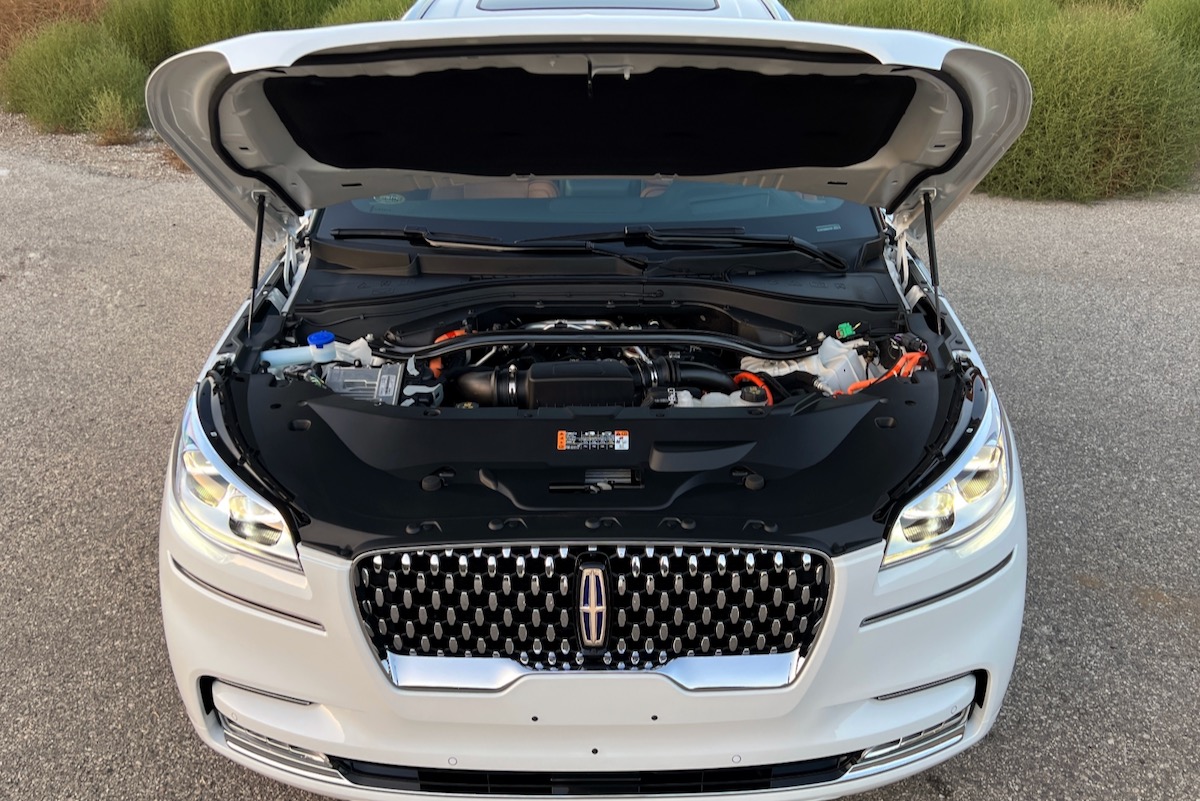
When you go shopping for a new Lincoln Aviator, your first decision relates to the powertrain. A twin-turbocharged 3.0-liter V6 engine is standard with Standard, Reserve, and Black Label trim, and it pairs with a 10-speed automatic transmission and rear-wheel drive (RWD) or all-wheel drive (AWD).
The Aviator Grand Touring and Black Label Grand Touring take that twin-turbo V6, marry it to a 10-speed hybrid automatic transmission with a 75-kilowatt electric motor, and add a 13.6-kilowatt-hour battery pack. The Grand Touring plug-in hybrid versions of the Aviator have standard AWD.
Prices range from $53,340 to $89,280, not including a destination charge of $1,195. Our 2023 Lincoln Aviator Black Label Grand Touring was the top-of-the-line, fully loaded model wearing an optional $750 paint job. Its MSRP tallied up to $91,225, including the destination charge.
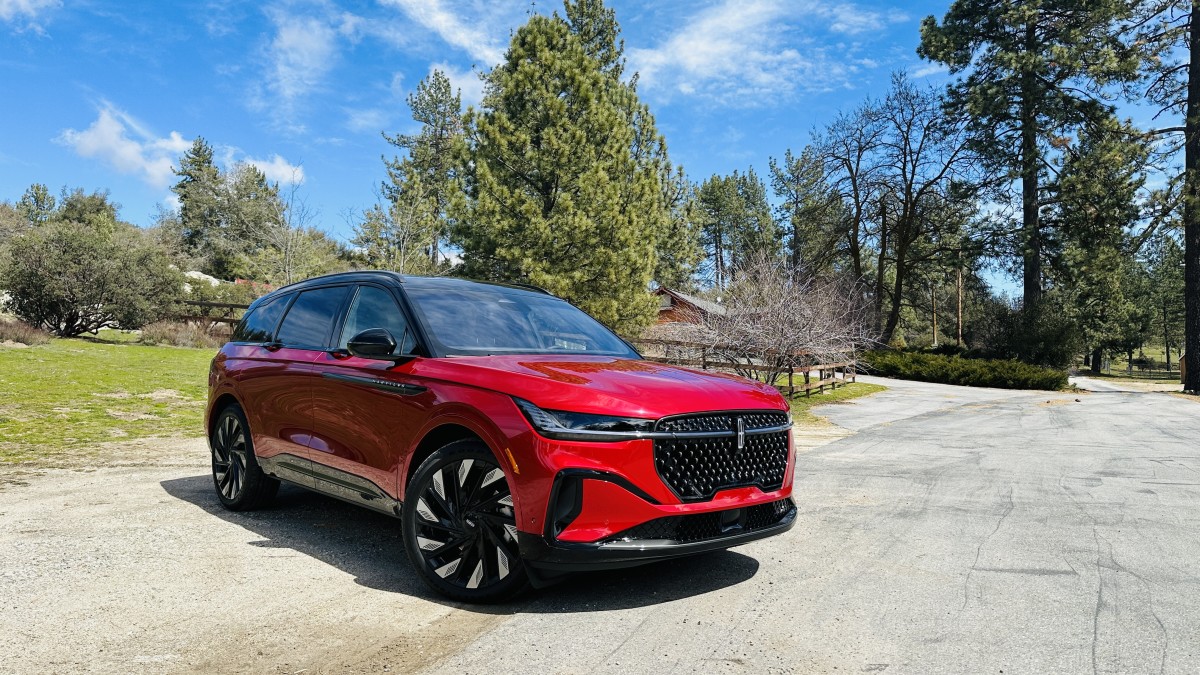
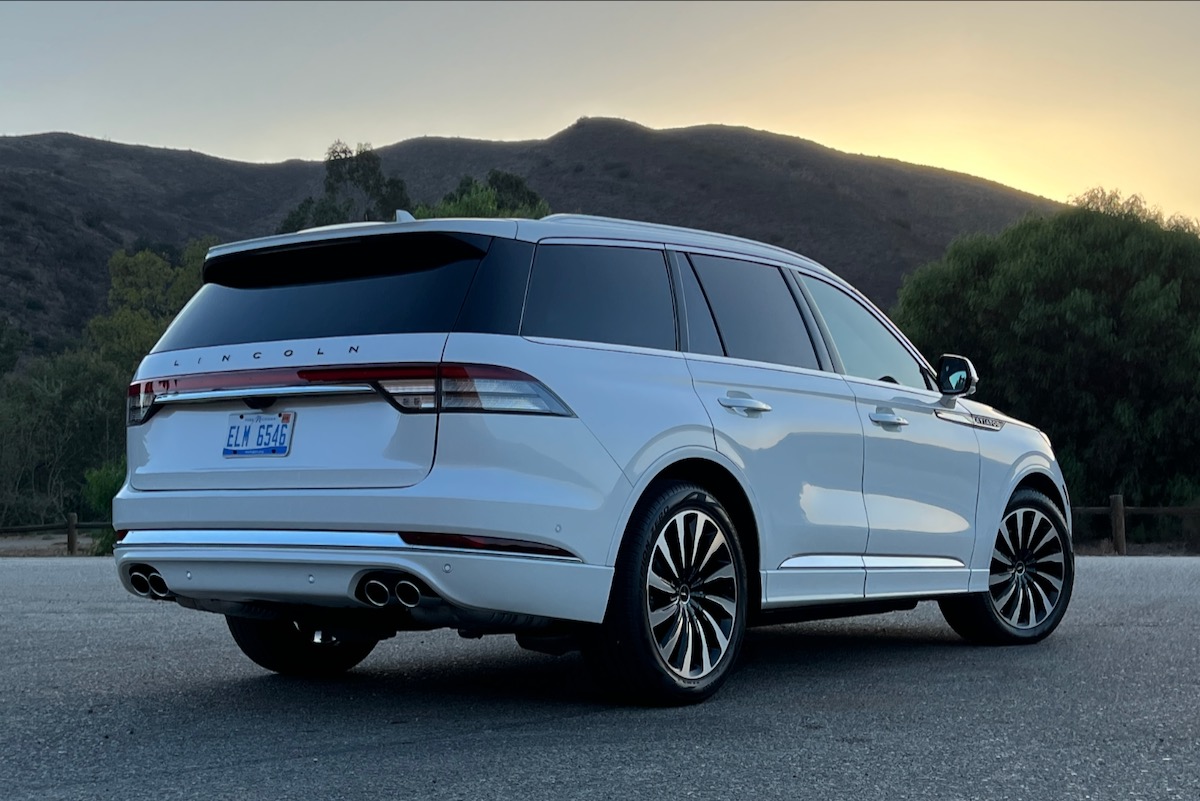
Generally speaking, the Aviator is an appealing three-row, midsize SUV with what we argue is the most successful execution of the modern Lincoln face in the automaker’s four-SUV lineup.
However, wheel designs carry significant impact on any vehicle’s overall look, and the ones on our Black Label Grand Touring were too plain. We prefer the wheels that are standard on both the base Grand Touring and the standard Black Label. Paired with white paint—a nearly ubiquitous color—our test vehicle’s multi-spoke machined-finish rims did not make it look like it ought to cost more than 90 grand.
Walk up to the Aviator Black Label Grand Touring at night, and the Lincoln Embrace lighting sequence acknowledges the presence of the keyfob, illuminating to invite you in. Electric, light-touch door handles and soft-close doors convey the effortlessness Lincoln hopes you’ll associate with the brand, while welcome and ambient cabin lighting cast a glow within the cabin. Just be careful not to accidentally pinch the skin on your fingers while using the electronic door latches, like we did.
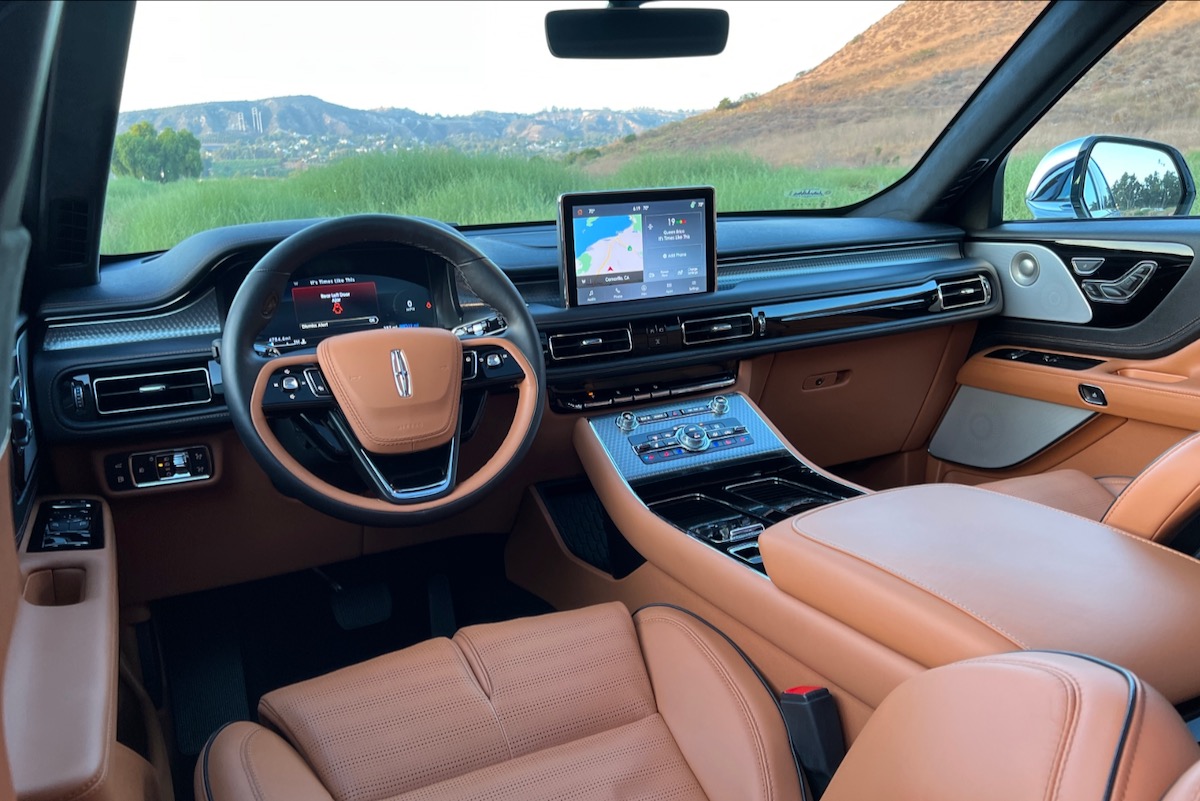
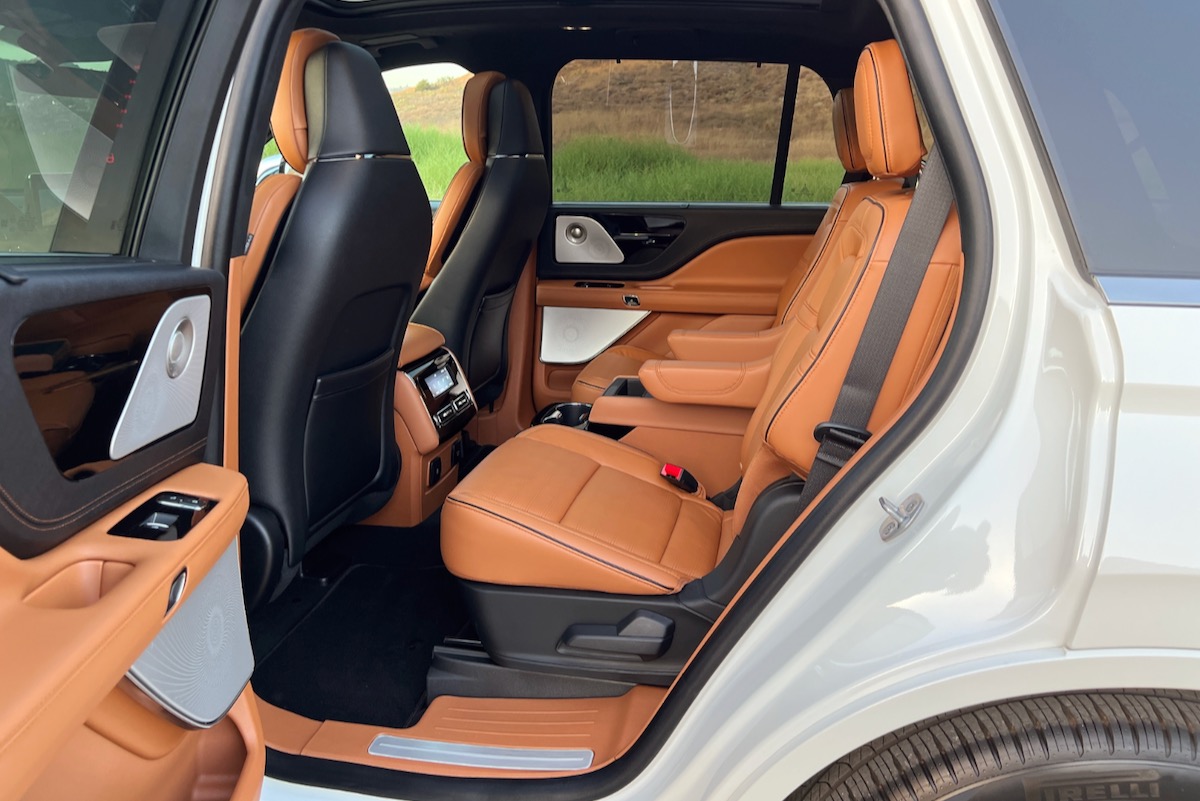
Inside, the Black Label Grand Touring is undeniably fancy. In fact, it might be trying too hard, because there is a lot going on in this cabin. Patterned metal trim, gloss black surfaces, chrome accents, exposed stitching, and the sharp contrast of the Black Label Flight theme’s rich caramel-hued, perforated leather seats against the otherwise black interior are a feast for the eyes. But that’s true only if you lean toward Art Deco instead of Japandi style.
Materials are mostly high-end, with soft and supple leather, softly padded surfaces (including the lower door panels), and a swanky simulated suede headliner wrapped around a panoramic glass sunroof.
However, some of the chrome detailing on the switchgear comes across as cheap rather than decadent. Also, the matching-color stitching on the seats and door panels looks like the fake plastic seams on lower-priced vehicles; black would be better. The Aviator’s key fob is lightweight, plastic, chromed, and too big, looking and feeling too inexpensive for this kind of vehicle. On the other hand, the fob makes a convincing argument for instead using the SUV’s Phone As A Key digital key technology.
Performance
While the Aviator Grand Touring is a plug-in hybrid, don’t take that to mean that its only function is to maximize efficiency. Though its electric motor and battery add a little more than 800 pounds to the curb weight, the drivetrain generates an impressive 494 horsepower at 5,500 rpm and 630 pound-feet of torque at 2,250 rpm.
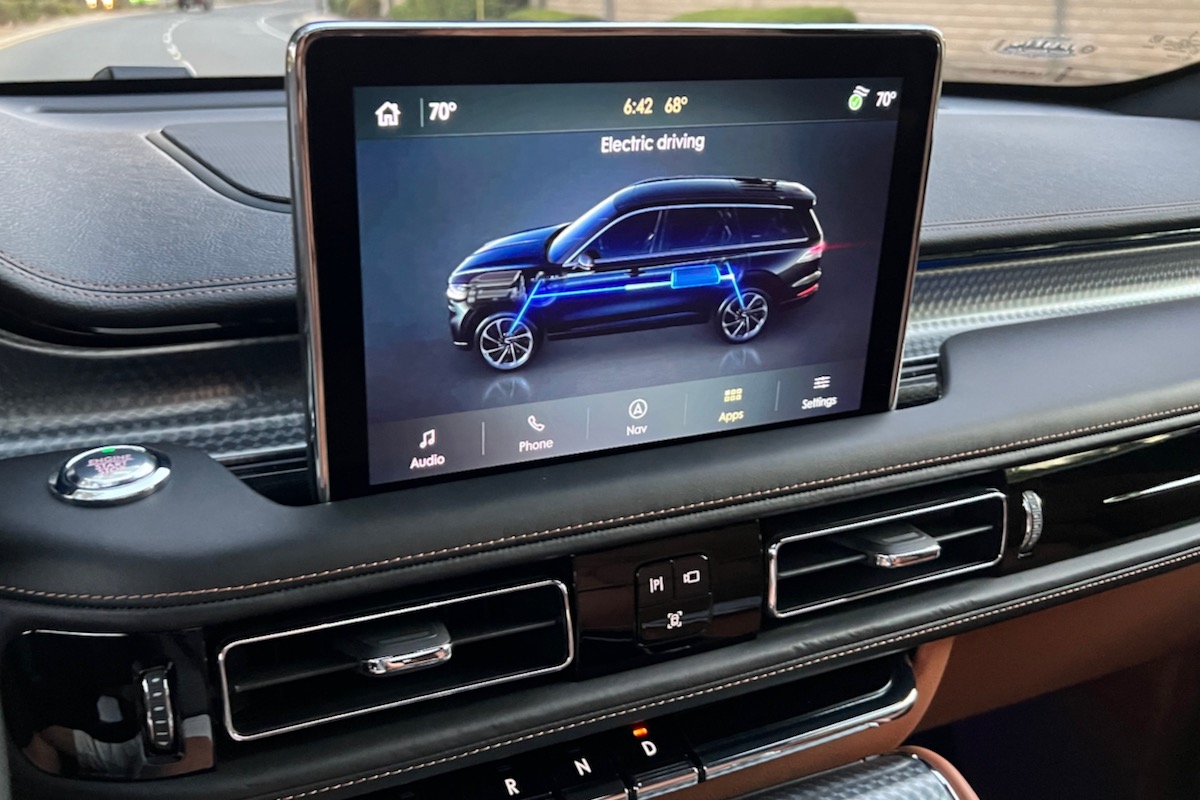
The EPA says the Aviator Grand Touring supplies 21 miles of electric driving range and then will average 23 mpg combined in hybrid mode. To run the SUV solely with electricity, select the Pure EV driving mode. If you’d rather hold the battery charge for use later, choose Preserve EV. Lincoln claims the battery will recharge in under four hours when using a 240-volt Level 2 charging station.
Conserve, Normal, and Excite driving modes allow the powertrain to automatically switch between electricity and gasoline, depending on the driving situation, to maximize efficiency. Lincoln also provides Slippery, Deep Conditions, and Tow/Haul modes.
We departed on an extended evaluation drive with 23 miles of indicated electric driving range with the Normal driving mode selected. When the battery reached its minimum state of charge, we’d traveled 22.3 miles, with 20.8 of those purely on electricity. That means the gas engine started up to assist with acceleration for 1.5 miles. Because we relied so much on electric power, the fuel economy average during this period was equivalent to 163.4 mpg.
For the remainder of the evaluation, the Aviator’s twin-turbo V6 remained on for most, but not all, of the driving. After 94.7 miles of travel, we’d covered 34.8 miles on electricity and the Aviator Grand Touring averaged 24.3 mpg. So, you can see how the technology automatically makes best use of the battery charge to maximize efficiency.
Charge the Aviator Grand Touring at home, at work, and while shopping and, depending on your driving, you might cover most miles on electricity. Then, when the time comes for a road trip, the plug-in hybrid should prove reasonably efficient even if you never plug it in during your travels.
There is plenty of power available, and when you rouse the gas engine under hard acceleration, the Aviator Grand Touring is quite quick. However, the drivetrain is sometimes unpredictable. Sometimes the Aviator would leap forward with more eagerness than anticipated, but other times it responded with delay.
The brake pedal can produce inconsistent behavior as well. This is common with the regenerative braking systems used in electrified vehicles, and by taking deliberate care you can smoothly stop the Aviator Grand Touring. Still, it’s easy to forget that you need to focus to ensure smooth braking.
Thanks to its 800+ pounds of extra weight, the Aviator Black Label Grand Touring has a standard Dynamic Handling Package with an adaptive-damping Active Glide suspension. You can sense the added weight nestled low in the Aviator’s structure, but the suspension successfully erases nearly all unnatural body motions while giving the SUV a flat, predictable cornering stance.
Zooming down Grimes Canyon Road northwest of Moorpark, California, the Aviator Black Label Grand Touring managed the lumps, bumps, dips, whoops, corners, and curves with ease. The P275/45R21 Pirelli tires also got it around tighter turns without howling in pain. Unfortunately, despite its commendable handling traits, the Aviator isn’t much fun to drive, even when you switch it into the more aggressive Excite driving mode.
In addition to its heavy and numb steering, the Aviator Grand Touring is quiet, isolating, and smooth-riding in any situation. You don’t get much in the way of communication from the hardware or the road, and that’s deliberate on Lincoln’s part. If you want a canyon carving SUV, go to the Ford dealership and get yourself an Explorer ST with the Performance Package. If you’d rather glide down highways and byways in silence, check out the Aviator.
Form & function
To go along with the quietude, Lincoln is committed to your comfort. For example, our test vehicle had a four-zone automatic climate control system, a heated power tilt-and-telescopic steering wheel, and automatic heated and ventilated front and second-row seats.
We also loved the massaging, 30-way Perfect Position front seats. While we think you’ll need to fiddle around with them for quite a while before finding perfection, there is no denying they’re mighty comfortable. Similarly, the second-row captain’s chairs are roomy and supportive, and separated by a center console with plenty of storage and rear-passenger controls to open the panoramic sunroof’s shade.
However, if you’re shopping for a three-row luxury SUV that has a third-row seat habitable by adults, you’re going to want to skip the Lincoln Aviator. The power-release second-row captain’s chairs don’t slide forward very much, and the portal through which your passengers must contort is a tight one. Once they squeeze themselves aboard, they’ll find that Lincoln provides some foot room underneath the second-row chairs and the console that separates them. But kneeroom and legroom are in short supply, the third row’s bottom cushion is flat and offers no leg support, and second-row passengers will also lose some of their legroom.
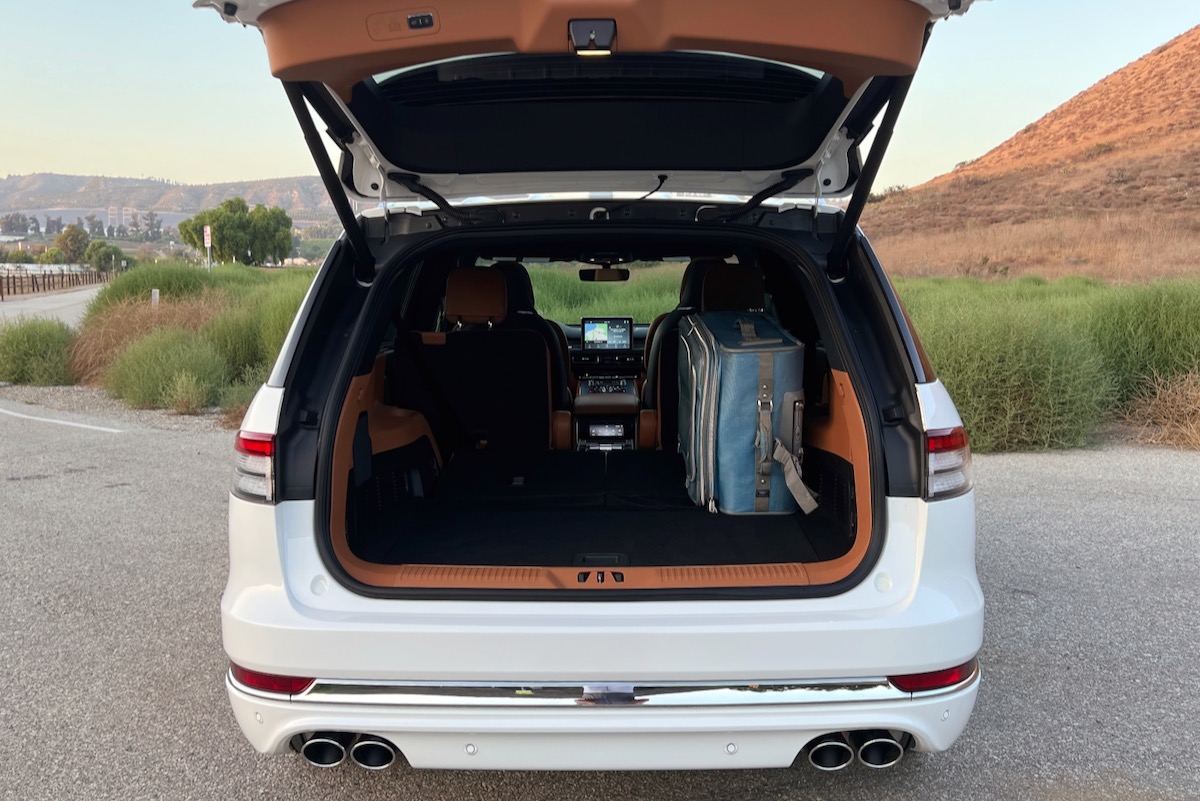
You’ll probably want to power-fold the third-row seats down most of the time anyway, because when they’re in use the Aviator offers just 18.3 cubic feet of cargo room (including the handy underfloor storage area). With the third-row seat folded flat, the Aviator holds 41.8 cubic feet of cargo. Maximum cargo space measures 77.7 cubic feet.
Technology
Lincoln loads the Aviator Black Label Grand Touring with technology, so let’s get right to it.
First up on our list is the 10.1-inch touchscreen infotainment system. It includes Apple CarPlay, Android Auto, Alexa integration, Lincoln Connect connected services (including a WiFi hotspot), SiriusXM satellite radio, and a navigation system. Unfortunately, it runs Lincoln’s old Sync 3 software, and it shows when you use the voice recognition system.
To issue voice commands, you push the talk button that is deftly embedded into the left steering-wheel thumb rest. That’s an innovative approach, however, we did accidentally activate it a couple of times during a week of using the Aviator as a daily driver.
We use a standard set of voice prompts to test voice recognition systems, starting with easy lay-ups and progressing to more complex requests. The Lincoln’s Sync 3 easily found the nearest Starbucks to our location, and then things went downhill from there.
For example, after asking for directions to the closest Chipotle, Sync 3 gave a route to one several miles away instead of the recently opened restaurant just down the street, suggesting that Lincoln isn’t keeping the point-of-interest database current.
Amusingly, when requesting directions to locally-owned Mouthful Eatery on the main drag through Thousand Oaks, California, we got a list of nearby Volvo dealers instead. Maybe the Aviator was suggesting that we test drive a Volvo XC90 Recharge?
Obtaining directions to the White House required jumping through several hoops to find success. First, though we tested this SUV in California, we needed to change the desired search area from West Virginia to the District of Columbia (it did not recognize Washington D.C.). Second, it would not accept “sixteen hundred” or “one-six-zero-zero” Pennsylvania Avenue. Instead, we had to state the name of the street, then the house number. Then, it read the address back as “one-six-oh-oh.”
Telling Sync 3 we needed to go to a hospital resulted in a list of all medical facilities nearby, unfiltered for just the hospitals. If you are in urgent need of care, you don’t want to think about sorting this out on your own. In addition, while enjoying the SiriusXM satellite radio, a request to listen to reggae music resulted in notification that a device wasn’t connected to the USB port. What we hoped for was a recommendation to switch to SiriusXM’s Bob Marley station on channel 19. Sync 3 doesn’t allow for voice control of the climate system, either.
So, our recommendation is to run Apple CarPlay or Android Auto and forget about Sync 3. It is not up to the task of satisfying the spoken queries people commonly use, especially people who can afford to buy a $90,000 SUV.
Moving on, the test vehicle had a thundering 28-speaker Revel Ultima 3D high-end audio system that was spectacular. Lincoln also employs warning and notification chimes recorded by the Detroit Symphony Orchestra, a lovely approach accompanied by a nod to the automaker’s hometown arts and culture scene.
Smartphone-related tech includes wireless charging and the previously mentioned Phone As A Key digital key system. It turns an Apple or Android smartphone into the SUV’s key, making it possible to unlock, start, and drive the Aviator without carrying the plasticky fob around with you.
Digital instrumentation is also standard, and the test vehicle’s comprehensive head-up display remained visible despite our use of polarized sunglasses. It wasn’t as bright, but we could still see it, so other automakers should feel free to take a cue from Lincoln here.
Finally, our test vehicle’s front and rear parking sensors and surround-view camera system came in handy every time we parked the Aviator. We didn’t use the Active Parking Assist 2.0 system, which takes control of steering, acceleration, and braking to park it in parallel and perpendicular spaces. But, we’ve witnessed this technology in action first-hand, and as long as the driver remains behind the steering wheel, it can successfully slot the Lincoln into a space.
Safety
Near as we can tell from the company’s consumer website, Lincoln equips Aviators with its Co-Pilot360 1.5, Co-Pilot360 1.5 Plus, and Co-Pilot360 2.0 collections of driver aids. Availability and features vary depending on the trim level, and things can get confusing, though.
Our fully-loaded test vehicle had every available feature, including automatic high-beam adaptive-pixel headlights, adaptive cruise control with stop-and-go capability, a road-sign recognition system, a pedestrian detection system, and forward-collision warning with automatic emergency braking.
Additionally, our test model had blind-spot monitoring, rear cross-traffic alert with automatic rear braking, lane-departure warning, lane-keeping assist, and lane-centering assist. An evasive steering assist system adds stability when drivers take sudden action to avoid obstacles in the path ahead.
Aside from the unnecessarily fussy driving assistance buttons on the steering wheel, the tech performs well. You’ll be happier with it on straight highways with light traffic, because the lane-keeping system appears to want to hug the inside lane markings in curves, a problem we’ve regularly experienced in other vehicles. Also, the denser the traffic and the wider the freeway, the less dependable the driver aids are. However, when other vehicles cut into the gap ahead, or you change lanes and tuck in behind a closer vehicle, the Aviator doesn’t overreact with too much braking.
Getting back to the steering wheel controls, you must illuminate them in order to see and use them. However, while they look like they’re touch-sensing buttons, they’re not. Instead, the physical buttons are mounted behind the pods on which the illuminated markings live. This is a needless complication that adds more irritation to the user experience than it does satisfaction with the Aviator’s interior appearance.
Neither the Insurance Institute for Highway Safety (IIHS) nor the National Highway Traffic Safety Administration (NHTSA) rates the Aviator Grand Touring for safety. Crash-test ratings for the standard Aviator include a Top Safety Pick from the IIHS and a five-star overall rating from the NHTSA.
Cost-effectiveness
With base prices kicking off in the mid-$50,000 range before you add so much as an interesting paint color, it is easy to see how Lincoln can afford to offer valet pick-up and drop-off for scheduled service and leave you with a loaner vehicle.
The “Lincoln Experience,” from exclusive offers and a rewards program to a complimentary one-year subscription to the Calm smartphone app, certainly underscores the automaker’s cultivation of effortless vehicle ownership. And when you go the Black Label route, Lincoln amps up the perks from easing the purchase process to a custom delivery program. But, as they say, there is no such thing as a free lunch.
The Aviator Grand Touring’s primary rivals include the BMW X5 xDrive45e and the Volvo XC90 Recharge. The BMW is not available with a third-row seat, but it wears a lower starting price tag than the Lincoln and can travel 31 miles on a full battery. Also, the plug-in hybrid BMW costs less when you check every option box, and it has a far superior voice recognition system. However, it gets no better than 20 mpg once the gasoline engine fires up.
The Volvo XC90 Recharge has three rows of seats like the Lincoln, but it also has a base price higher than the Aviator’s. However, the Volvo supplies 32 miles of range, gets 26 mpg when running on its gas engine, offers more cargo space, and is more than $3,000 less than our test vehicle when you load it up with all of the extras. It also has a terrific Google Built-in infotainment system that responds quickly and accurately to voice commands.
Lincoln has some work to do on the Aviator, and a refresh including new technology is expected for the 2024 model year. In the meantime, Lincoln’s ownership benefits, the Black Label’s personalized purchase and delivery experience, and the “Quiet Flight” driving dynamics are the primary draws for the Aviator. Whether Lincoln’s kid-gloves treatment of its customers is worth the price premium is something only you can decide.

What owners say
Our new 2023 Lincoln Aviator combines the top-of-the-line features, including a powerful, responsive 475-HP engine, state-of-the-art technology (still learning it all), a 30-speaker sound system that blows my mind, and signature Lincoln luxury.
July 17, 2026Very happy with this purchase. Aviator is perfect
October 21, 2022Trims & specs
Base MSRP $51,370 | Seating 7 |
Engine 3.0L 400 hp V6 | Cargo Capacity 17.8 cu ft |
Combined MPG 22 | Drivetrain RWD |
Base MSRP $53,870 | Seating 7 |
Engine 3.0L 400 hp V6 | Cargo Capacity 17.8 cu ft |
Combined MPG 20 | Drivetrain AWD |
Base MSRP $53,340 | Seating 7 |
Engine 3.0L 400 hp V6 | Cargo Capacity 17.8 cu ft |
Combined MPG 22 | Drivetrain RWD |
Base MSRP $55,845 | Seating 7 |
Engine 3.0L 400 hp V6 | Cargo Capacity 17.8 cu ft |
Combined MPG 20 | Drivetrain AWD |
Base MSRP $59,005 | Seating 7 |
Engine 3.0L 400 hp V6 | Cargo Capacity 17.8 cu ft |
Combined MPG 22 | Drivetrain RWD |
Base MSRP $80,725 | Seating 7 |
Engine 3.0L 400 hp V6 | Cargo Capacity 17.8 cu ft |
Combined MPG 20 | Drivetrain AWD |
Base MSRP $90,280 | Seating 6 |
Engine 3.0L 494 hp V6 Hybrid | Cargo Capacity 17.8 cu ft |
Combined MPG 56 | Drivetrain AWD |
Base MSRP $61,535 | Seating 7 |
Engine 3.0L 400 hp V6 | Cargo Capacity 17.8 cu ft |
Combined MPG 20 | Drivetrain AWD |
Base MSRP $70,190 | Seating 7 |
Engine 3.0L 494 hp V6 Hybrid | Cargo Capacity 17.8 cu ft |
Combined MPG 56 | Drivetrain AWD |


Pricing trends
MSRP range
$51,370 - $90,280
Current avg. market price
$41,599
Trending down by 1.5% this month
May 2026 - October 2026