2023 Audi e-tron Reviews, Pricing & Specs

Pros & cons
What we like
Stylish design
Quiet cabin
Easy-to-use technology
What to consider
Unimpressive electric range
Not much cargo space
Questionable value for the money
Expert review
The 2023 Audi e-tron Sportback would be easy to recommend if it had more competitive specifications.
Audi’s use of “e-tron” is confusing. First, it’s technically lowercase, like this: e-tron. But that’s just weird. Second, since the name first appeared on a 2010 concept vehicle, both plug-in hybrids and electrics have worn it. Third, Audi has used e-tron interchangeably as a model name and a powertrain designation. This review is about the e-tron SUV model in its Sportback configuration.
out of 10 expert review
Look & feel
Now competing against newer EVs from Mercedes and BMW, the Audi e-tron SUV arrived a few years, when the competition was largely just Tesla. It was Audi’s first long-range electric vehicle, and by that, we mean it could go more than 200 miles on a full battery charge. It has seating for five people and is sized between the Q5 and Q7. Logically, it should be the Q6 e-tron, but we’re content creators, not automotive marketers, so what do we know? Standard and Sportback body styles are available, the latter featuring a faster roofline that makes it a trendy SUV coupe.
That’s the version of the 2023 Audi e-tron we’re reviewing here. To add to the confusion, Audi also now sells a Q4 e-tron, a Q8 e-tron, an e-tron GT, and an RS e-tron. Today’s car is none of those.
The 2023 e-tron Sportback comes in Premium, Premium Plus, and Prestige trim, and prices start at $74,000, plus a $1,195 destination charge. The test vehicle had Prestige trim, and the only option was Glacier White paint for $595. That brought the as-tested Manufacturer’s Suggested Retail Price (MSRP) of this electric SUV to $91,090, including destination.
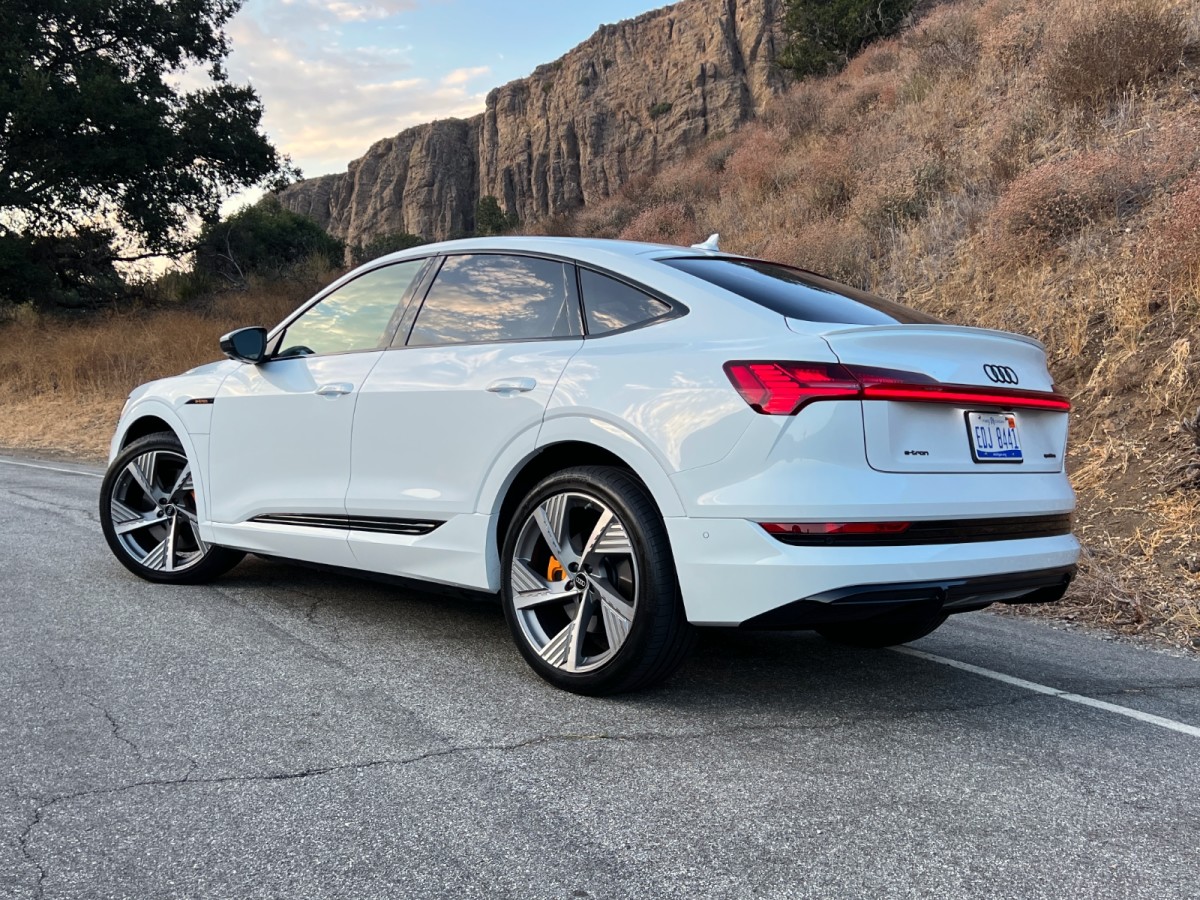
The Audi e-tron Sportback might be the first SUV of its kind that we think looks normal. Appealing, even. Unlike other SUV coupes, the e-tron Sportback’s styling demonstrates balance and grace.
Anchored in front by Audi’s trademark Singleframe grille and standard S-line styling details, the e-tron Sportback displays tautly penned shoulders and subtle fender swells in a nod to the original Quattro model. These elements pair with an artfully curved roofline with thin or hidden pillars and simple, conservative detailing all around. Aerodynamically, the Sportback’s bodywork has a 0.28 coefficient of drag compared to 0.31 cd for the standard e-tron.
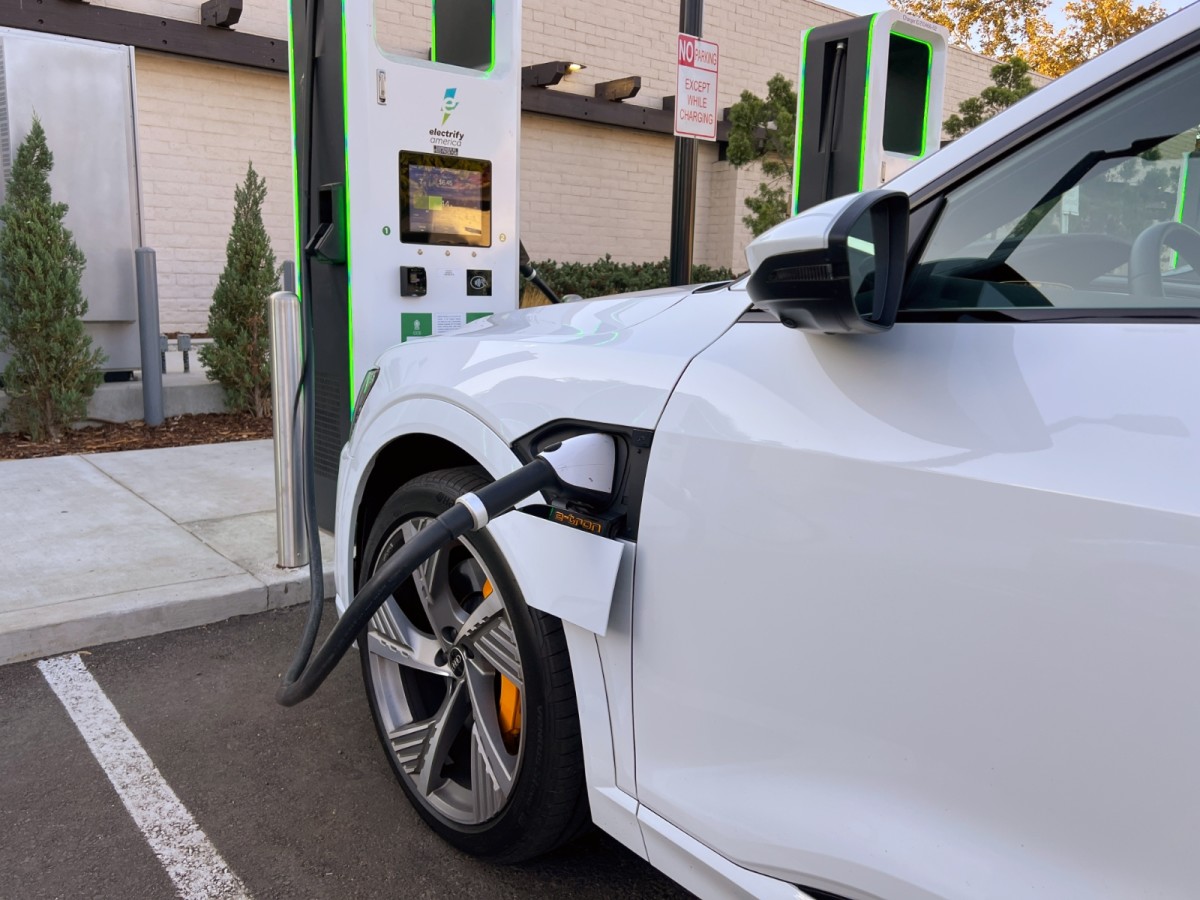
With Prestige trim, the Sportback’s gorgeous Turbine-design 22-inch wheels do all of the talking, along with orange brake calipers that match the e-tron emblem on the charging port door. And while our Glacier White test vehicle looked terrific, we’re suckers for the Plasma Blue color that is also available for the e-tron Sportback. Yummy.
Those 22-inch wheels and orange calipers are newly standard with Prestige trim for the 2023 model year, along with a Black Optic package, digital matrix headlights, and a black interior headliner. Additionally, Audi installs standard rear side-impact airbags with Prestige trim.
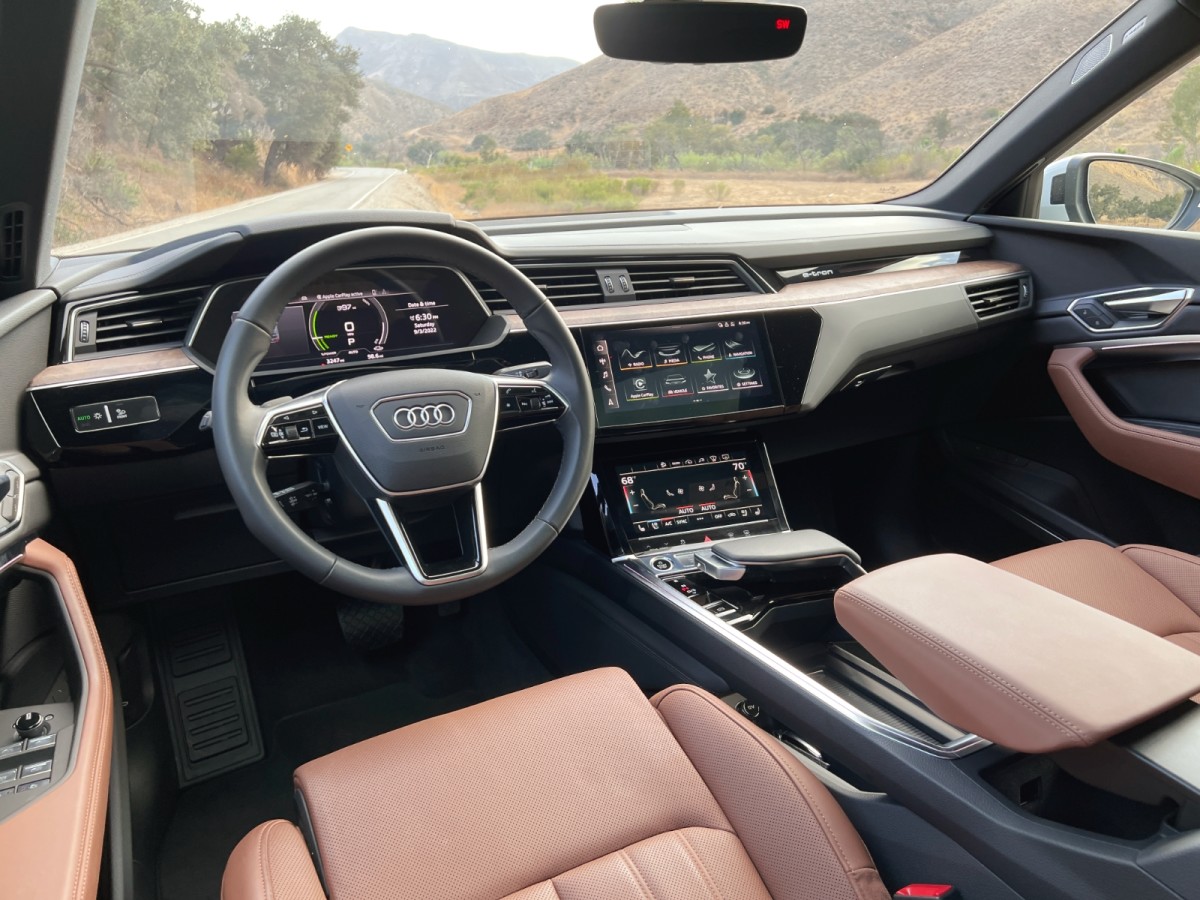
Naturally, the e-tron Sportback offers a Black interior with gray stitching and Volcano Gray Ash wood. For greater visual contrast, any of the three other colors will look terrific: Monaco Gray, Okapi Brown, and Pearl Beige. A panoramic sunroof adds natural light to the interior, but it’s not particularly large.
The interior looks and is high-tech. Drivers face three display screens, and the dashboard has a minimum of physical controls. Overall, the e-tron Sportback Prestige’s cabin boasts beautiful materials, exudes quality, and demonstrates innovation. The transmission selector is a perfect example of all three traits, conveying the heft of quality while proving simple to use and elegantly integrated into a wrist rest on the center console.
Compared to a standard e-tron, the e-tron Sportback loses 1.1 inches of rear-seat headroom, 1.3 cubic feet of cargo room behind the back seat, and 1.9 cu-ft of maximum cargo room. Otherwise, it is just as roomy for five people and their luggage as the standard e-tron.
Performance
Every 2023 Audi e-tron has dual electric motors that create a Quattro all-wheel drive system, single-speed transmissions at each axle, and a 95-kWh battery pack. Together, these components provide 355 horsepower, 414 pound-feet of torque, and 226 miles of driving range (225 miles in the Sportback). Use the Boost mode to access 402 hp and 490 lb-ft of torque for short periods, which helps accelerate the electric SUV to 60 mph in 5.5 seconds, according to Audi. The towing rating is 4,000 pounds, when the e-tron is properly equipped.
Drivers can choose between Efficiency, Comfort, Auto, Dynamic, and Individual driving modes. Additionally, the standard adaptive air suspension offers Efficiency, Dynamic, Standard, Allroad, Off-Road, and Lift settings. The e-tron Sportback also employs progressive-rate electric steering and brake-by-wire regenerative brakes employing robust six-piston front calipers.
Audi says you can recharge the e-tron in about 10 hours using a 240-volt, 9.6 kW, Level 2 home charging station. Use a 150-kW DC fast charger, and Audi claims it takes about half an hour to bring the battery from five percent to 80 percent.
Testing week was an unusually hot and muggy one in Southern California, and on evaluation day local temperatures crested 100 degrees. We set off on our evaluation loop with 161 miles of indicated range, the drivetrain in Auto mode, and the suspension in Standard mode.
At the end of the drive, we’d traveled 70.8 miles, had 85 miles of range remaining, and averaged 2.1 miles per kWh (or 47.6 kWh per 100 miles). That result reflects less efficiency than the official EPA estimate for last year’s e-tron Sportback, which was 44 kWh/100 miles. But the climate control system was working overtime that day.
Though we don’t doubt Audi’s claim that the e-tron accelerates to 60 mph in 5.5 seconds, it is slower compared to other electric luxury SUVs, so don’t bother accepting any stoplight challenges. Also, during a week of driving, the e-tron Sportback consistently overestimated how far it could travel on its remaining range, setting us up for disappointment. However, the SUV’s lack of thrust and range are the only downsides to driving it. Otherwise, this is a fantastic electric luxury SUV.
From its structural integrity over sharp bumps and quick steering that makes parking a snap to its flat cornering attitude and outstanding grip, the e-tron Sportback demonstrates the expected driving dynamics of a German-engineered SUV. Furthermore, on long stretches of highway, the e-tron is smooth, silent, and sumptuous.
However, the brake-by-wire system proves a little tricky at times, making modulation a challenge. This isn’t related to regenerative braking, either. Instead, if you’re braking in advance of a corner or a curve, and you want to release just a little bit of pressure, the system responds with more than you anticipate, causing minor moments of panic. It’s not consistent, either, making it hard to predict and adapt to it.
In braking-related matters, the e-tron has paddles on the steering wheel that activate more aggressive levels of regenerative braking when you lift off of the accelerator pedal. This allows you to proactively attempt to preserve as much battery charge as possible. In the test vehicle, we had to actively manage this during the drive because after each use it returned to a state of little to no regenerative braking. This adds an element of engagement to driving the e-tron, but if you want to set-it-and-forget-it, you might be out of luck.
Additionally, the e-tron appeared to have a proactive driving assist function that automatically slowed the SUV when we too closely followed traffic ahead. It was so subtle that we barely detected it, but the test vehicle appeared to have this functionality.
Overall, this EV is enjoyable to drive. However, we do recommend using the Individual driving mode to set the ride and handling up to personal preferences. That’s because Auto mode can feel too soft and wallowy at times, and Dynamic mode can feel too aggressive at times. With Individual mode you can attempt to find the right balance.
Audi includes 250 kW of complimentary charging at Electrify America stations. Based on our charging history at EA stations, this would be enough for 10 partial DC fast charging events, so while it sounds generous the actual cash value is something like $125.
Our closest 150-kW fast chargers happen to be Electrify America units. We pulled in with 47 miles of remaining range and a 24% battery charge, according to the e-tron’s trip computer. We connected to the charger, started the session, walked to a nearby coffee shop for a beverage, and returned to the Audi. It was already charged to 45% and 90 miles of indicated range.
The e-tron reached an 80% charge 21 minutes after starting the session, and a 94% charge in 30 minutes. At this point, we stopped the session, during which the charger delivered electricity at a 138-kW charging rate and the cost came to $26.23. Our Electrify America app’s history does not show this charging session, so the charger must have acknowledged it was an Audi e-tron with complimentary charging available.
Unlike with other EVs we’ve used at this bank of chargers, the e-tron’s charger disconnect process is a two-handed operation. Apparently, you need to push the external power port release button in addition to pulling off the charger. Since we were unaware of this, we called EA customer support for help in figuring out why the charger was seemingly stuck to the port.
Of course, if you buy an Audi e-tron, the dealership is going to show you this process so that you’re aware of it. Still, this extra aggravation to cap an otherwise flawless charging experience was unwelcome.
Form & function
In addition to being a joy to drive, the Audi e-tron Sportback is whisper silent inside. The electric drivetrain has plenty to do with this, of course, but the SUV also has dual-pane acoustic glass to help hush the cabin.
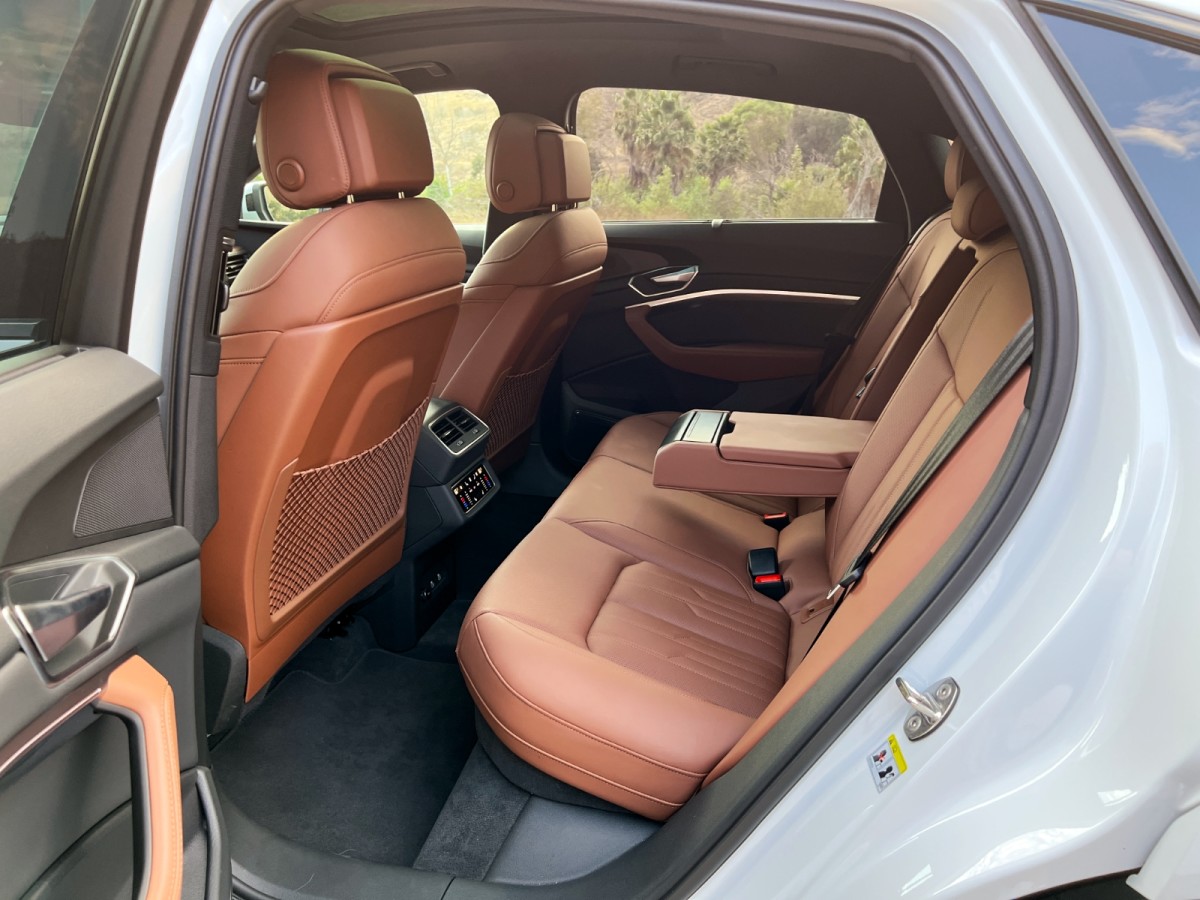
Our test vehicle’s Prestige trim level came fully loaded with ambient interior lighting, a power panoramic glass sunroof, a four-zone automatic climate control system, and a full Okapi Brown leather interior with a higher-quality grade of hides for the seats. Sumptuous is the best way to describe it.
In front, the driver and passenger enjoy 18-way power-adjustable seats with heating, ventilation, and massage. A power tilt-and-telescopic steering wheel further ensures comfort, and this combination of features – especially during a record-long heat wave in Southern California – went a long way toward making the e-tron a delightful place to spend time.
Furthermore, the four-zone climate control system proved exceptionally good at combatting the daily triple-digit temperatures and higher than normal humidity levels. You can precondition the cabin before driving the e-tron, cooling or heating the interior while the SUV is still plugged into the grid.
Coupe-style SUVs typically offer less rear-seat room than their conventional counterparts. That’s true of the e-tron Sportback, though the differences are negligible. Our test vehicle had heated outboard cushions, two sets of air conditioning vents, rear side window shades, and a separate climate control panel to allow passengers to customize their environment.
We found the e-tron Sportback to provide good rear-seat headroom and leg support, but the seat cushion is mounted a little low for an SUV. Also, Audi panels the front seatbacks in hard plastic with storage nets, materials that are unkind to knees and shins. However, there is enough legroom as long as front-seat occupants don’t recline much.
Practical storage space is a mixed bag. The center console storage bin under the sliding armrest is small, and Audi provides a narrow bin to the left of the cupholders. Tamboured covers slide over the bin and the cupholders, creating a tray of sorts, but you can’t put things on it because there are strange hand grips on either side of the console, which allows items to slide off into the nether regions between the console and front seats. However, the front door pockets are large and deep, and you get thoughtful coat hooks in the back. The rear center armrest contains a shallow storage tray and cupholders.
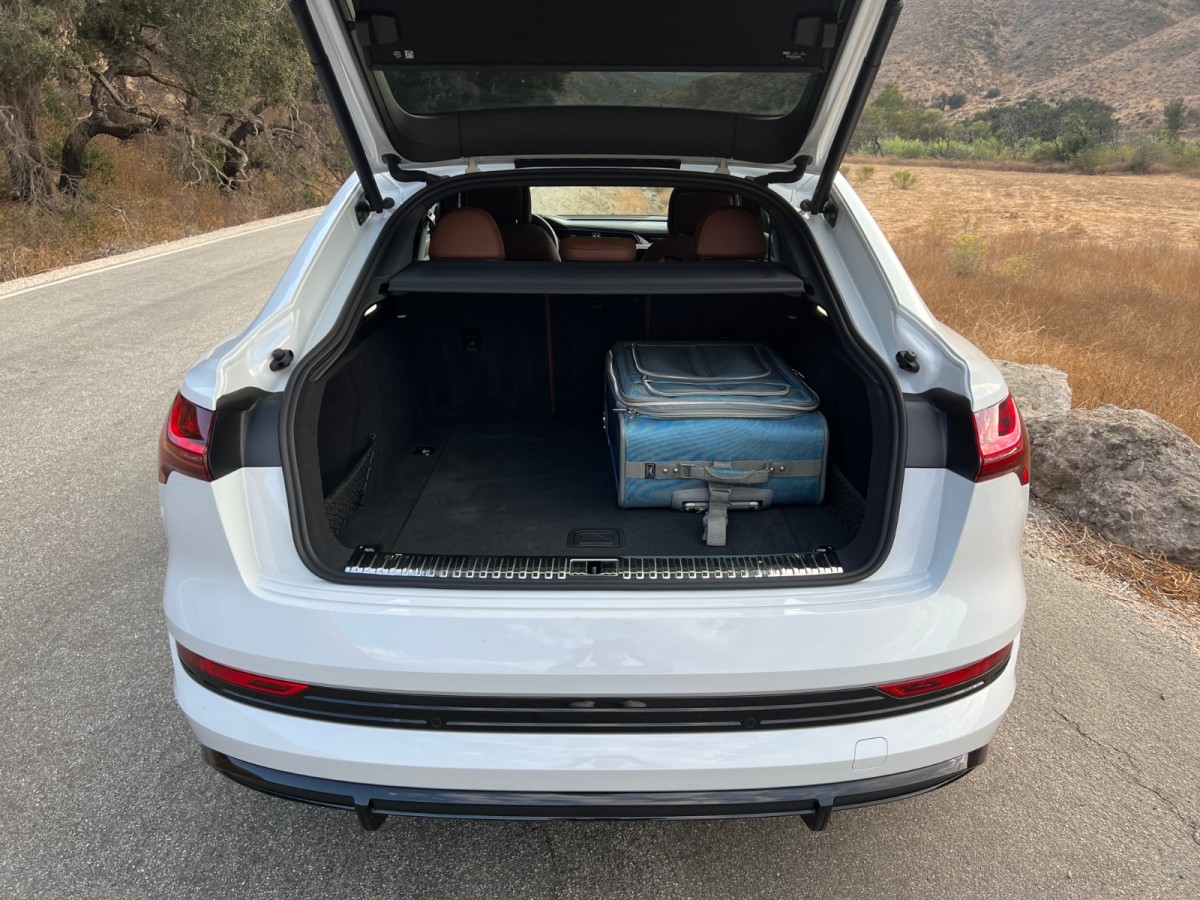
A power rear liftgate rises to reveal a 27.2 cubic-foot trunk with storage underneath the floor panel. The liftover is high and the two-piece cargo cover cuts into the available space, so you should plan to use about half the claimed volume unless you make every effort to maximize it. Fold the rear seats down, and up to 54.5 cu-ft of cargo space is at your disposal.
Technology
Justifiably or not, Audi has cultivated a technologically advanced brand image reflected in its purposeful no-nonsense design, innovative powertrain advancements, and breakthrough features. Unsurprisingly, then, the Audi e-tron is loaded with tech, but we find it approachable rather than daunting.
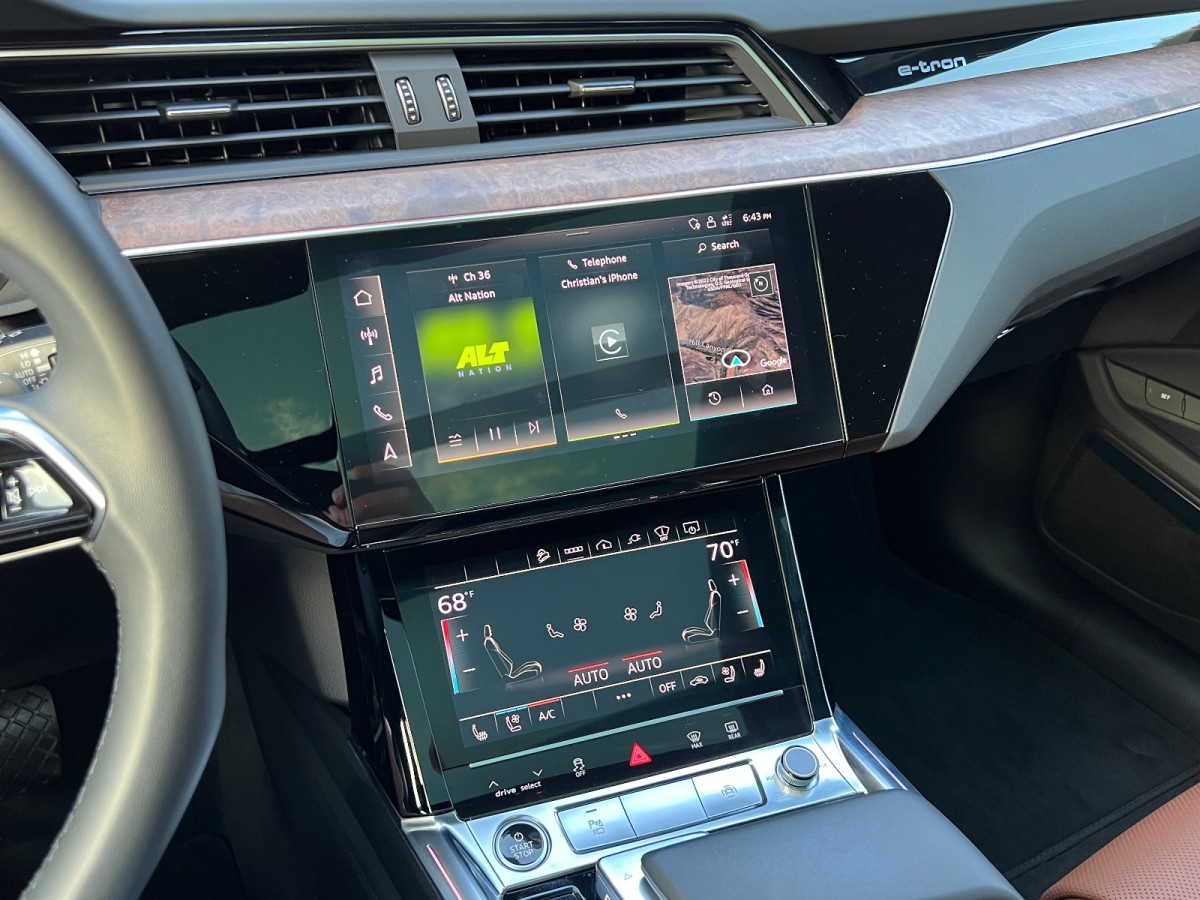
For example, changing the 12.3-inch Virtual Cockpit Plus digital instrumentation themes and adjusting the configurable display panels is relatively easy to figure out. Furthermore, the Audi Multi-Media Interface (MMI) touchscreen infotainment system is remarkably easy to set up and use thanks to a simple interface and haptic feedback that confirms on-screen selections.
Highlights of the MMI include wireless Apple CarPlay and Android Auto, SiriusXM satellite radio, Audi Connect connected services with complimentary trial subscriptions, a navigation system with Google-sourced satellite imagery, and a natural voice recognition system that serves as a digital assistant. Thoughtfully, when you have a destination programmed into the navigation system, the map shows you where the charging stations are as you’re driving.
Early in our week with the e-tron, the infotainment system suffered a glitch. When trying to use the voice recognition system, a notification appeared that the “speech dialog system” was unavailable because the “parking aid is active.” Also, all of our favorite pre-set radio stations disappeared. But this quickly resolved itself. The e-tron had been in the hands of two different valet parkers earlier in the day, so perhaps that had something to do with the problem.
When the voice recognition capabilities returned, the system accurately responded to every one of our standard commands and a couple of new ones, like “Where is the nearest charging station?” and “Where is the closest Korean restaurant?” If there is anything to criticize here, it’s that the system is somewhat slow to respond. But we’ll take accuracy over speed any time.
There is an MMI data panel that shows you how to increase your range by turning off power-robbing functions and features. For example, it told us we could increase the e-tron’s range by 14 miles by turning off the air conditioning and ventilated driver’s seat. But with the triple-digit temps, that wasn’t in the cards.
Beneath the MMI screen Audi provides a touch-sensing climate control panel. Like the MMI, it provides haptic feedback to confirm selections, but here you can use touch-sensing sliders to alter temperature. This panel can also show additional data, helping you to tailor the displays to provide the maximum amount of information at a glance.
The test vehicle had a 16-speaker Bang & Olufsen premium sound system. Normally, we look forward to enjoying this company’s speakers, but in this e-tron it seemed as though something went missing from the usual outstanding B&O recipe. It still sounded great, just not as immersive as we’ve come to expect.
Additional tech includes Audi Phone Box wireless charging and signal boosting, a head-up display, front and rear parking sensors, and a surround-view camera system. It’s worth noting here that the e-tron Sportback’s small rear quarter windows are helpful when reversing from slant parking while looking over your shoulder.
Safety
As you might expect, our e-tron Sportback Prestige came with every safety feature in the Audi arsenal. Unfortunately, most are named in a way that you have no idea what they do.
To summarize, our e-tron Sportback had collision preparation systems, collision avoidance systems, and active driving assistance systems related to speed and distance maintenance, lane-keeping, intersection monitoring, and emergency stopping due to an unresponsive driver. You can turn some of these features on and off, and you can adjust their sensitivity to Basic, Maximum, or Individual settings.
During testing with the advanced driving assistance systems in Maximum sensitivity mode, we found these systems to be effective and mostly accurate. The adaptive cruise control with lane-centering assist is impressive enough on freeways that we think Audi is almost ready to offer a hands-free driving assistance system. As is commonly the case, the steering assistance makes a nuisance of itself on twisty mountain roads and curving coastal highways, but you can easily shut it off using a button on the tip of the turn signal stalk.
During our week with the e-tron, we did experience an unsettling forward-collision warning and automatic braking event (Pre Sense Front, in Audi parlance).
When you’re driving east on Olympic Boulevard in West Los Angeles, the road kinks just prior to where it intersects Rimpau Blvd. As we approached at 40-45 mph, traveling in the left lane, the Audi’s ADAS spotted the line of motionless cars waiting to turn left from Olympic onto Rimpau. Since our lane had a green light, we did not slow down.
Suddenly, the collision warning system blared followed by a sharp, momentary activation of the automatic emergency braking system. This was so startling to all four occupants that we have no idea if the Pre Sense Basic technology also activated, but most likely it did. In any case, the tech quickly determined that a collision was not going to occur, the brakes released, and we continued around the slight bend in the road and through the intersection.
Fortunately, nobody was directly behind the e-tron when this sudden, unwarranted braking event occurred. But this is not our first rodeo with an Audi that suddenly brakes for no good reason. We’ve had this happen in an A6 and a Q7 in the past, but in completely different situations. So, maybe the company should dial it down a little.
Cost-effectiveness
Mostly, we enjoyed our time in the 2023 Audi e-tron Sportback Prestige. It is quick, comfortable, quiet, beautifully designed and outfitted, and equipped with largely intuitive and effective technology (except as noted above). However, the price tag is too high for an EV that is dramatically down on performance and range compared to the competition.
Increasingly, Audi faces more rivals than Tesla, and they often cost less while offering more range and performance. Prime examples include the Cadillac Lyriq and Genesis GV60, though neither can match the quality our e-tron Sportback Prestige oozed from its every pore. Even the aging and frequently overlooked Jaguar I-Pace makes a case for consideration here.
In reality, most people who buy an Audi e-tron will upgrade to a 240-volt home charging station that can fully recharge the battery overnight. And if you’re away from home, a 150-kW fast charger can provide plenty of juice in the time it takes to get a coffee, check your email, and scroll your socials. Nevertheless, people compare vehicles based on specs and stats, and the e-tron needs to improve in this regard.
Overall, we genuinely like the e-tron Sportback. It demonstrates that legacy automakers can build a compelling electric vehicle. But it would be much easier to recommend, especially at the as-tested price, if it had more competitive performance, range, and efficiency numbers.

What owners say
Carr has everything you could imagine for an $80,000 car. Felt like a tank, fast, quiet, luxury interior, and no detail overlooked.
March 30, 2026Trims & specs
Base MSRP N/A | Seating N/A |
Engine N/A | Cargo Capacity N/A |
Combined MPG N/A | Drivetrain N/A |
Base MSRP $77,800 | Seating 5 |
Engine 402 hp Electric | Cargo Capacity 28.5 cu ft |
Combined MPG 78 | Drivetrain AWD |
Base MSRP $86,400 | Seating 5 |
Engine 402 hp Electric | Cargo Capacity 28.5 cu ft |
Combined MPG 78 | Drivetrain AWD |
Base MSRP N/A | Seating N/A |
Engine N/A | Cargo Capacity N/A |
Combined MPG N/A | Drivetrain N/A |
Base MSRP N/A | Seating N/A |
Engine N/A | Cargo Capacity N/A |
Combined MPG N/A | Drivetrain N/A |
Base MSRP $70,800 | Seating 5 |
Engine 402 hp Electric | Cargo Capacity 28.5 cu ft |
Combined MPG 78 | Drivetrain AWD |
Base MSRP $81,000 | Seating 5 |
Engine 402 hp Electric | Cargo Capacity 27.2 cu ft |
Combined MPG 78 | Drivetrain AWD |
Base MSRP $74,000 | Seating 5 |
Engine 402 hp Electric | Cargo Capacity 27.2 cu ft |
Combined MPG 78 | Drivetrain AWD |
Base MSRP $89,300 | Seating 5 |
Engine 402 hp Electric | Cargo Capacity 27.2 cu ft |
Combined MPG 78 | Drivetrain AWD |


Pricing trends
MSRP range
$70,800 - $89,300
Current avg. market price
$31,728
Trending down by 3.1% this month
May 2026 - November 2026


