2021 Honda HR-V Reviews, Pricing & Specs


Pros & cons
What we like
Fun to drive
Comfortable
Standard advanced safety features
What to consider
Poor visibility
Outdated technology
The CarGurus verdict
Honda’s smallest SUV exceeds expectations in some areas, but fails to meet them in others.
The 2021 Honda HR-V is the automaker’s smallest crossover SUV, sitting below the Honda CR-V in size and price. While Honda hasn’t updated the HR-V in some time, it remains worthy of consideration thanks to agile handling and impressive practicality for its size.
Because while it’s billed as an SUV, the HR-V shares a platform with the discontinued Honda Fit hatchback. The HR-V is a bit bigger than that pint-sized wonder however, and adds features SUVs buyers want, such as a taller driving position and available all-wheel drive (AWD).
Honda launched the HR-V for the 2016 model year, and added more tech features for 2019. While Honda has been pushing these updates, the subcompact crossover category has exploded, adding new entrants from the likes of Hyundai, Kia, and Toyota.
The HR-V doesn’t receive any major updates for the 2021 model year, so we’re using our experience with past model years for this overview. The HR-V LX, Sport, EX, and EX-L trim levels carry over for 2021, but the HR-V Touring is no more. The only other changes are new wheel designs for the Sport, EX, and EX-L models, and added privacy glass for the HR-V Sport.
out of 10 expert review
Look & feel
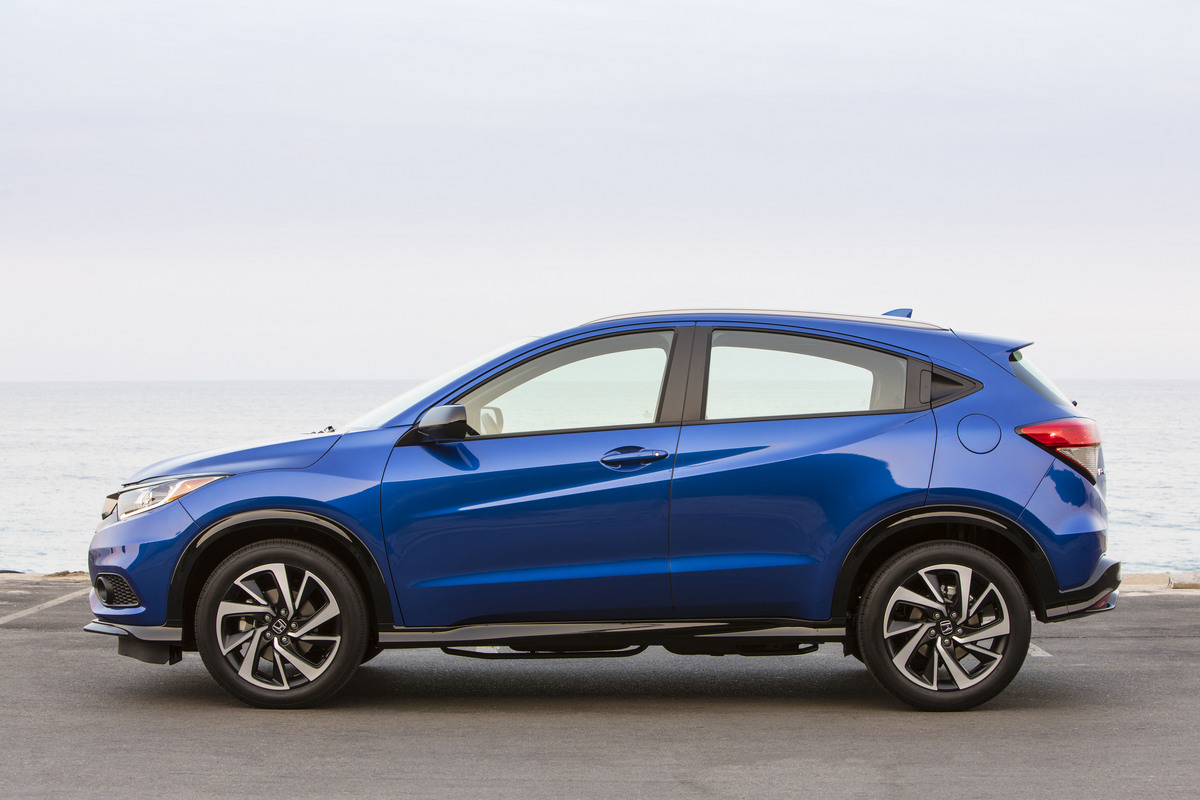
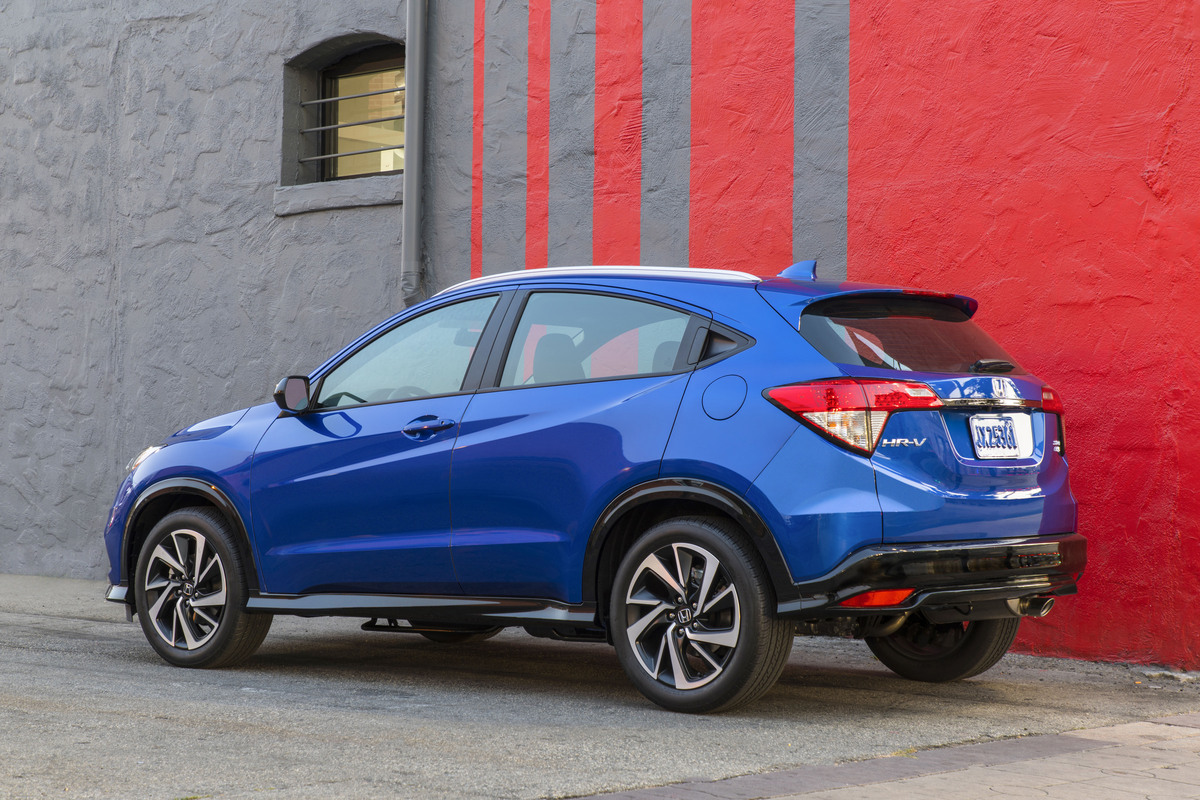
The HR-V’s styling sharply contrasts Honda’s larger SUVs. Where the CR-V, Passport, and Pilot go for the traditional SUV look, with upright roof lines and intimidating front ends, the HR-V has a softer, friendlier appearance. It’s also distinctive, thanks to details like upper and lower window lines that converge near the taillights in a triangular point that also houses the rear door handles.
Most trim levels get 17-inch alloy wheels, with a machined finish on the HR-V EX and EX-L. Sport models get matte-black 18-inch wheels, plus blacked-out trim. Fog lights are standard on all but the base LX trim level.
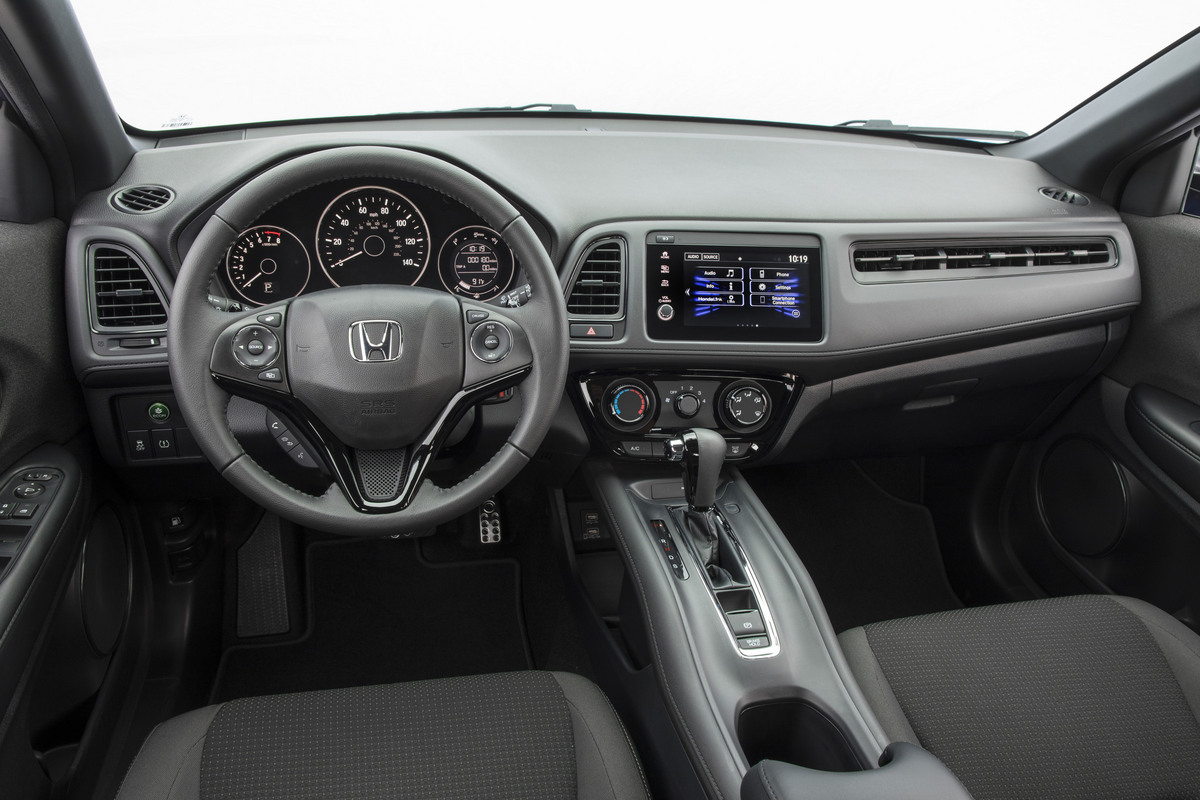
Interior styling is fairly plain but functional. We’ve also noticed good material quality and fit and finish in previous HR-V test vehicles, so while this little Honda will never be confused with a luxury car, it still looks and feels solid. EX and EX-L models get push-button start, automatic climate control, a moonroof, and heated front seats, and EX-L models get leather upholstery.
Performance
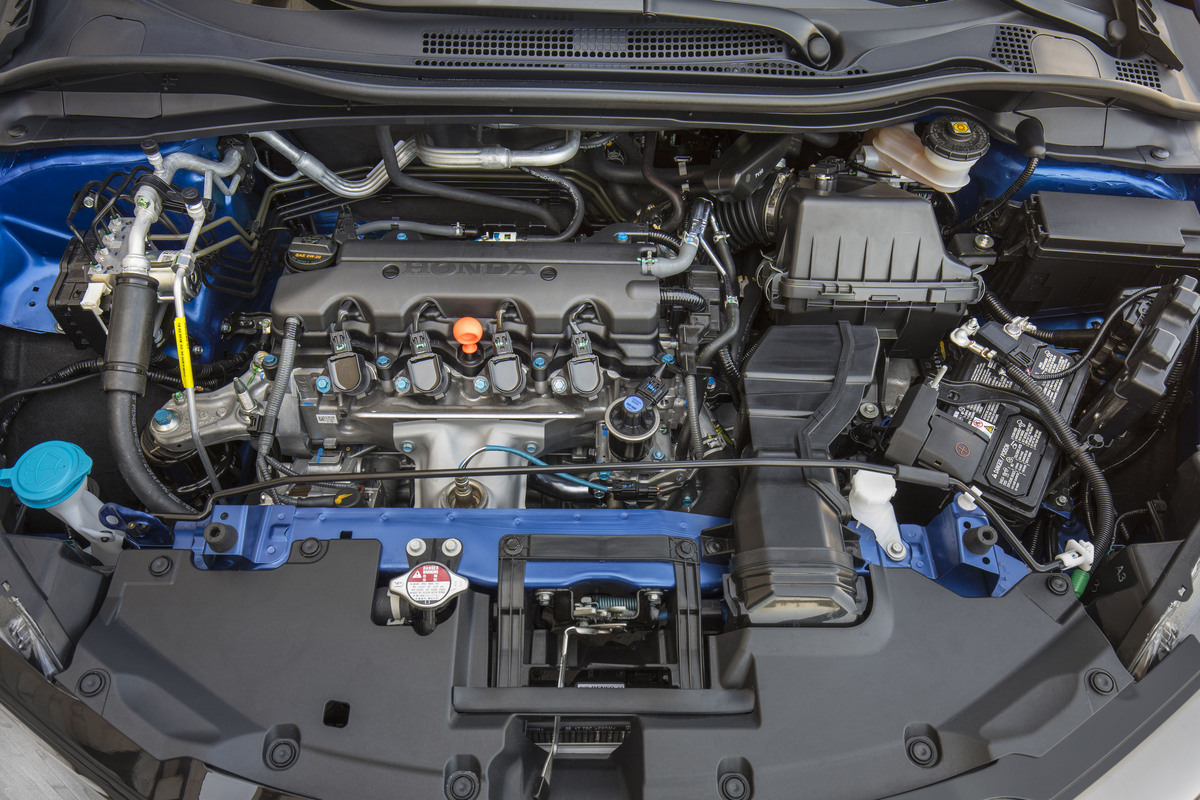
The sole HR-V powertrain is a 1.8-liter four-cylinder engine, which produces 141 horsepower and 127 pound-feet of torque, and is connected to a continuously variable transmission (CVT), with paddle shifters on higher trim levels. While AWD is available on all trim levels, front-wheel drive (FWD) is standard.
The powertrain hasn’t changed since the last time we drove an HR-V, which is not a good thing. We’ve found this crossover to be a bit underpowered for highway driving, a problem compounded by an ineffective CVT. Some competitors also offer more powerful engine options, such as the Kia Seltos’ 175-hp 1.6-liter turbo-four, or the 182-hp 2.5-liter boxer-four offered in higher-end versions of the Subaru Crosstrek.
However, we’ve found that the HR-V’s chassis makes up for its engine. It’s one of the only subcompact crossovers that’s genuinely rewarding to drive on twisty roads. It truly lives up to Honda’s reputation for fun cars, and provides decent ride quality, to boot. That’s the advantage of driving a small SUV that’s really just a lifted, enlarged subcompact hatchback.
One of the disadvantages of driving a glorified hatchback, though, is that the HR-V can’t do everything more traditional SUVs can. It’s AWD system isn’t designed for anything rougher than slippery roads, ground clearance is minimal, and the HR-V is not rated for towing.
Form & function
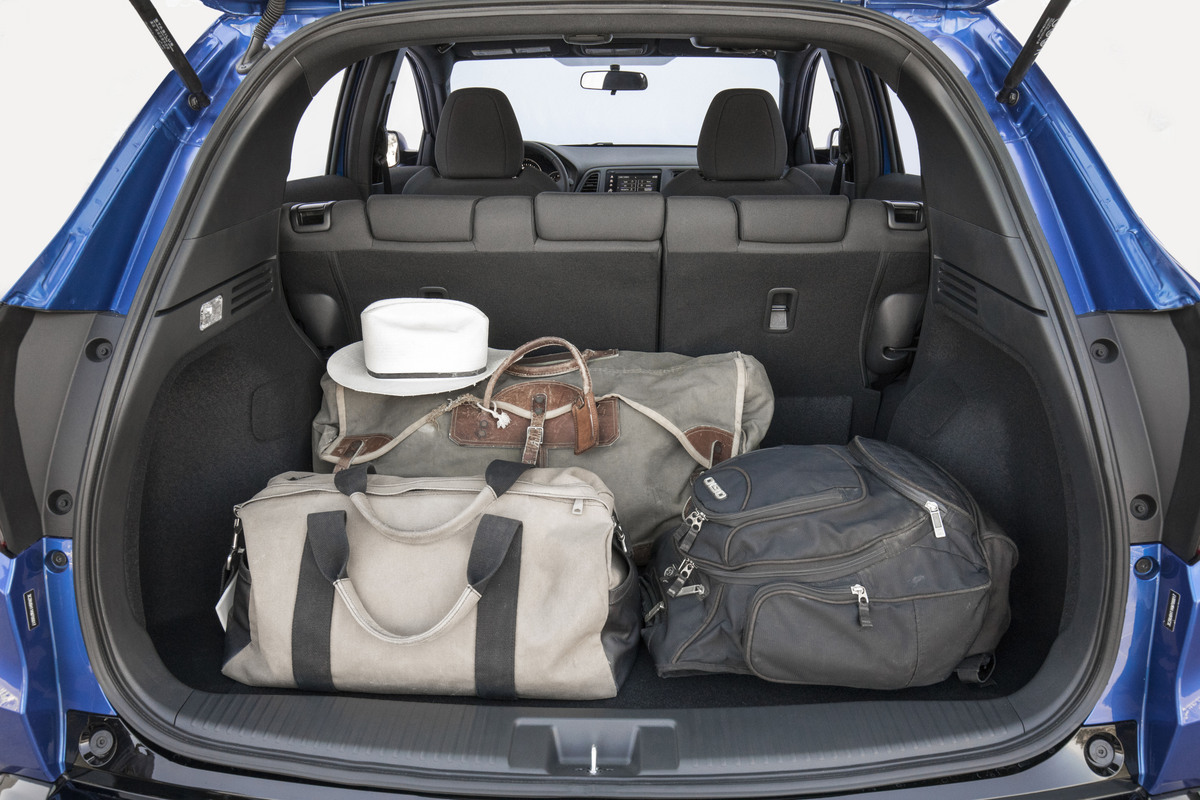
The HR-V has impressive cargo space for its size, thanks in part to the “Magic Seat” 60/40 split-folding rear bench seat, inherited from the Fit. Fold that seat down, and you get 58.8 cubic feet of cargo space (57.6 for AWD models). Leaving it up still retains 24.3 cubic feet (23.2 cubic feet with AWD). Both figures surpass competitors like the Chevrolet Trax, Hyundai Kona, and Subaru Crosstrek, but the Kia Seltos and upcoming 2022 Toyota Corolla Cross both offer more cargo space.
The HR-V is also second only to the Subaru Crosstrek in overall passenger space. Much of that space is devoted to rear-seat legroom, as the HR-V leads the segment in that category. In comparison, front-seat legroom, as well as front and rear headroom, are just average.
Honda doesn’t offer any clever interior storage solutions, but that’s also the case with most of the HR-V’s competitors. What you do get are sensibly-designed controls, including large knobs for climate control, and an audio volume knob. The narrow center console is dominated by a large shift lever but, while buttons or a rotary knob might have freed up more cupholder space, this is simpler and easier to use. A standard tilt-and-telescopic steering wheel also makes finding the perfect driving position easier.
Technology
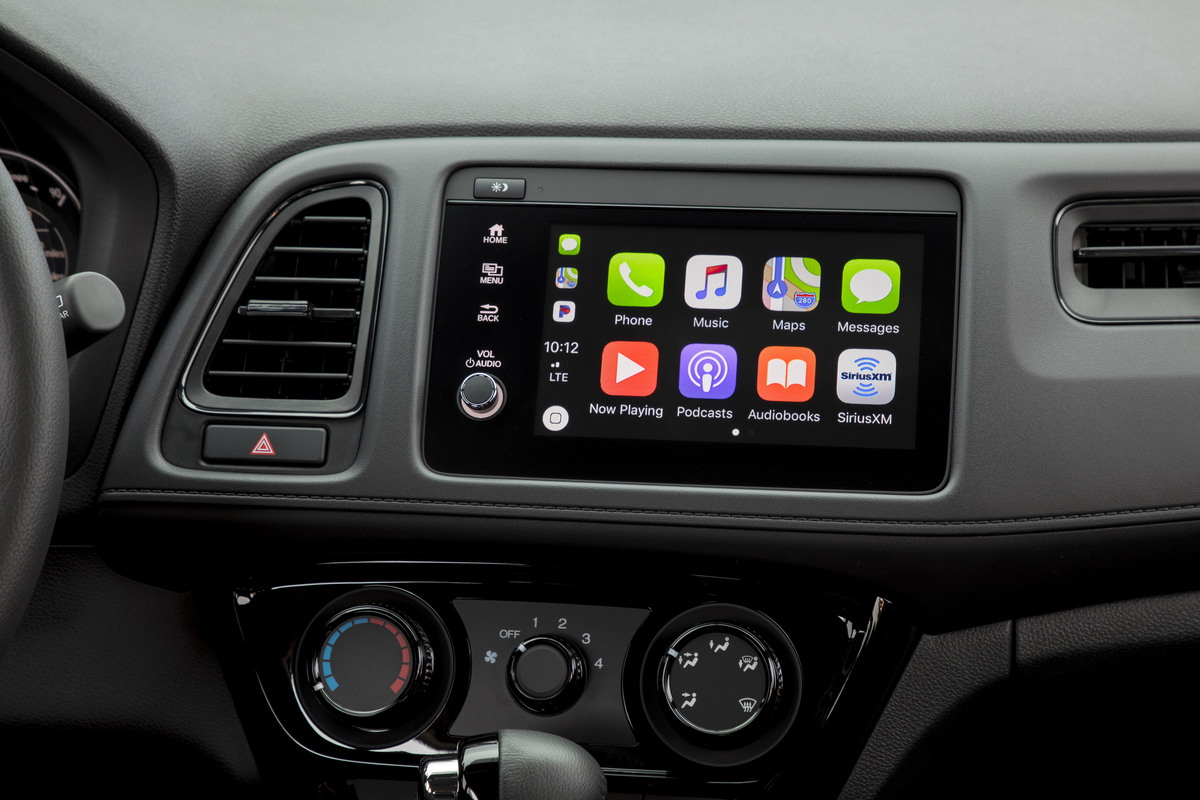
The base HR-V LX gets standard Bluetooth, a 5-inch display screen, and a four-speaker audio system, but you have to upgrade to the Sport trim level to get any real infotainment tech. The Sport and higher trim levels get a 7-inch touchscreen with Apple CarPlay and Android Auto connectivity, while EX and EX-L models add SiriusXM satellite radio (with a free trial).
Like the rest of the HR-V’s interior, the infotainment system is plain but functional. We’ve never had any issues navigating it in the past, and the two available USB ports (one for charging, one connectivity) are located in a cubbyhole ahead of the shifter, so you don’t have to stick your phone in a cupholder or storage bin that could be used for other things.
However, it’s worth noting that even the optional 7-inch touchscreen is somewhat small, and many competitors offer Apple CarPlay and Android Auto as standard equipment across the board. Honda loses points for making buyers upgrade from the base LX trim level to get these features.
Safety
The HR-V received top “Good” scores in all Insurance Institute for Highway Safety (IIHS) crash tests, and the top “Superior” rating for its optional front-crash prevention tech, but got “Marginal” and “Poor” headlight ratings (depending on trim level) and an “Acceptable” rating for LATCH child-seat anchor ease of use.
The National Highway Traffic Safety Administration (NHTSA) gave the HR-V a five-star overall safety rating and five stars in side crash testing, with four stars in frontal and rollover crash testing.
The HR-V does get Honda Sensing safety features, but only on the EX and EX-L trim levels. Honda Sensing includes forward-collision warning, lane-departure warning, automatic emergency braking, Road Departure Mitigation, lane-keep assist, automatic high beams, adaptive cruise control, and Honda’s LaneWatch. A step up from conventional blind-spot monitoring, it shows the view from a mirror-mounted camera when the turn signal is activated. The federally-mandated rearview camera also gets upgraded with dynamic gridlines on higher trim levels.
Cost-effectiveness
The 2021 HR-V is a more fuel-efficient alternatives to traditional SUVs. It gets EPA-rated fuel economy of 30 mpg combined (28 mpg city, 34 mpg highway) with FWD. With AWD, the HR-V is rated at 29 mpg combined (27 mpg city, 31 mpg highway) in LX trim and 28 mpg combined (26 mpg city, 31 mpg highway) in Sport, EX, and EX-L spec.
Honda offers a three-year, 36,000-mile basic warranty and five-year, 60,000-mile, powertrain warranty. That’s competitive with most other subcompact crossovers, but the Hyundai Kona and Kia Seltos offer longer warranty terms.
Pricing starts at $22,140 for a base LX FWD model, rising to $28,440 MSRP for the priciest EX-L AWD version (all prices include a mandatory $1,20 destination charge). AWD is a $1,500 option on all trim levels. You’ll pay similar prices for competitor subcompact SUVs.
The HR-V offers solid utility and a well-tuned chassis, but the competition is starting to catch up. The Kia Seltos and Subaru Crosstrek offer similar cargo space, and the Subaru also gets standard AWD. Honda is also stingy when it comes to standard driver-assistance and infotainment tech. The HR-V was among the best subcompact crossovers when it launched, but Honda won’t be able to coast along on that for much longer.
What owners say
"Overall, owners appreciate the 2021 Honda HR-V for its comfortable interior and decent size for a small SUV. Many drivers highlight the good value for the price and the reliability that Honda is known for. However, some feel it lacks power compared to newer models and noted a desire for more advanced technology features like CarPlay."
Love my HRV! Its a great car with plenty of room inside for such a small SUV. The features on the LX version are worth it.
October 13, 2026This car is great, however with the minimal keep up i feel asthough it could be of lesser value. Yet overall, nice experience!
August 24, 2025Honda is a car that lasts. The resale value is high. The features on the HR-V are everything I want.
August 28, 2025What owners say
Love my HRV! Its a great car with plenty of room inside for such a small SUV. The features on the LX version are worth it.
October 13, 2026This car is great, however with the minimal keep up i feel asthough it could be of lesser value. Yet overall, nice experience!
August 24, 2025Honda is a car that lasts. The resale value is high. The features on the HR-V are everything I want.
August 28, 2025It’s the perfect size and has the drive train options and it’s a very well made long lasting vehicle
September 20, 2024I would like to have car play in this car, but other than this, the car is great.
October 4, 2024The car is great for the price. smaller SUV with basic functions but thats what I needed.
October 9, 2023Test drove a 2021 and 2022. The new model is MUCH more comfortable. The 2021 is fine, but did not have the same power in the engine and not as comfortable of a ride as newer models
August 6, 2022Trims & specs
Base MSRP $25,920 | Seating 5 |
Engine 1.8L 141 hp I4 | Cargo Capacity 23.2 cu ft |
Combined MPG 29 | Drivetrain AWD |
Base MSRP $23,170 | Seating 5 |
Engine 1.8L 141 hp I4 | Cargo Capacity 24.3 cu ft |
Combined MPG 31 | Drivetrain FWD |
Base MSRP $24,670 | Seating 5 |
Engine 1.8L 141 hp I4 | Cargo Capacity 23.2 cu ft |
Combined MPG 29 | Drivetrain AWD |
Base MSRP $29,340 | Seating 5 |
Engine 1.8L 141 hp I4 | Cargo Capacity 23.2 cu ft |
Combined MPG 29 | Drivetrain AWD |
Base MSRP $26,020 | Seating 5 |
Engine 1.8L 141 hp I4 | Cargo Capacity 24.3 cu ft |
Combined MPG 31 | Drivetrain FWD |
Base MSRP $27,520 | Seating 5 |
Engine 1.8L 141 hp I4 | Cargo Capacity 23.2 cu ft |
Combined MPG 29 | Drivetrain AWD |
Base MSRP $21,220 | Seating 5 |
Engine 1.8L 141 hp I4 | Cargo Capacity 24.3 cu ft |
Combined MPG 31 | Drivetrain FWD |
Base MSRP $22,720 | Seating 5 |
Engine 1.8L 141 hp I4 | Cargo Capacity 23.2 cu ft |
Combined MPG 29 | Drivetrain AWD |
Base MSRP $24,420 | Seating 5 |
Engine 1.8L 141 hp I4 | Cargo Capacity 24.3 cu ft |
Combined MPG 31 | Drivetrain FWD |


Pricing trends
MSRP range
$21,220 - $29,340
Current avg. market price
$18,794
Trending down by 2.3% this month
May 2026 - November 2026


