2015 Ford Fiesta Reviews, Pricing & Specs
Write a review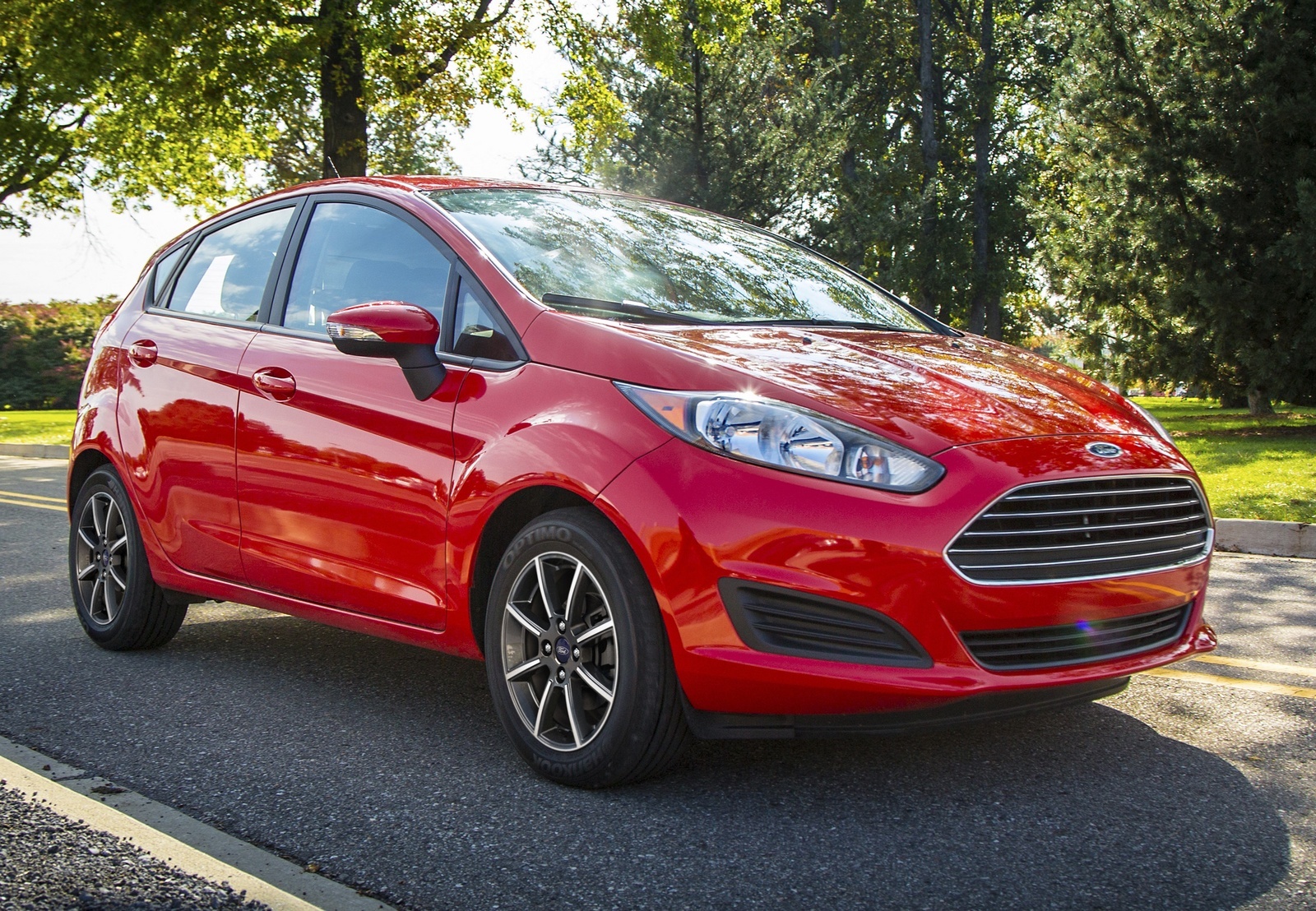
The 2015 Ford Fiesta can be optioned up for luxury or sportiness and has some tricks up its sleeve. The Fiesta manages to stand out by being different, but it’s not always the right combination.

In the Fiesta’s subcompact class, form follows function, though the hatchback I tried is both less awkward and more functional than its sedan sibling. Fitting 4 doors and a nose that measures up to worldwide pedestrian-impact standards to a tight wheelbase have largely shaped the Fiesta. Prices for the Fiesta range from an MSRP of $13,965 for a sedan to $20,945 for the fairly rowdy Fiesta ST that’s overtly sporty.
Fiesta trim levels start with the basic S and move up through the SE, Titanium, and the exciting ST, which is hatchback-only. Other trims are available in both sedan and 5-door configuration, though the hatch is consistently priced higher.

The Fiesta offers a pair of engines, a standard 1.6-liter Ti-VCT 4-cylinder with 120 hp and 112 lb-ft of torque, and the surprising 1.0-liter 3-cylinder EcoBoost that’s available in SE models with 123 hp and 125 lb-ft of torque. Transmission is a standard 5-speed manual or 6-speed PowerShift dual-clutch automatic. The EcoBoost models are manual-only, and the Fiesta ST powertrain is a turbocharged version of the 1.6-liter 4-cylinder that generates 197 hp and 202 lb-ft of torque and is paired with a 6-speed manual transmission.
The Fiesta I drove was an SE with the EcoBoost 3-cylinder. Even without being an ST trim, the handling is confident, with a direct feel and well-controlled ride. It’s often hard to tune a light, small car to soak up bumps with the grace of a heavier, less-efficient vehicle, but the Fiesta feels tremendously stout. In the past, a 3-cylinder engine was the domain of tractors and power equipment, and the few cars that dared run a triple weren’t always taken seriously. Boy, have times changed.
The Fiesta EcoBoost elevates the game of the 3-cylinder. It’s smooth and quiet to the point that you’d never guess there was anything unusual under the hood. In fact, this 1.0-liter EcoBoost engine has been honored with the International Engine of the Year award, and it’s the biggest surprise here.
The 1.0-liter EcoBoost is well-balanced, but it’s not because of a typical balance shaft that would rob both power and efficiency. Ford’s approach sounds improbable: The flywheel and crankshaft pulley are effectively counterweights, and engineers have managed the rest of the vibration with engine mounts that have been carefully tuned and placed. From an engine that’s more than a half-liter smaller than the 1.6-liter 4-cylinder other Fiesta models carry, you get 123 hp and 125 lb-ft of torque—that’s a 3-hp advantage over the 4-cylinder’s 120 hp, and noticeably more torque than the four's 112 lb-ft.
The numbers that look good on paper are even better in practice. Out on the street, the torque comes on early, peaking at just 2,500 rpm, and sticks around. The power delivery is reminiscent of a small turbodiesel, and if this is what we have to put up with for reduced emissions and EPA-estimated fuel economy of 31 mpg city/43 highway, the future looks bright. The power level is satisfying, no matter how big or small the engine actually is, and when the engine is on boost, which is often, the powertrain is responsive. There is some turbo lag, which will probably be noticeable, because the EcoBoost engine is available only with a 5-speed manual transmission.
At first, that sounds like a plus, especially for an enthusiast. Tiny turbo engine, the freedom to shift your own gears, and a solid little chassis—what could go wrong? The Fiesta’s shift linkage, for one. It’s a sloppy, vague shifter that feels cheap and reminded me of something 25 years old with a lot of miles on it. Once you get the hang of finding the gears, it’s better, and the clutch is light and fairly linear, but it felt like I was shifting a city bus at first. The transmission is loud, too. It’s been a long time since I have heard a manual gearbox “sing” like the one in the Fiesta. Every manual-transmission Fiesta does it, but it’s another aspect of the powertrain that chips away at an otherwise stellar small-car experience.
I didn’t expect the Fiesta to be Rolls-Royce quiet, but with the transmission and tire noise added to the normal racket of driving and the occasional snarl from the engine, there’s a lot of auditory stimulation.

It’s actually refreshing to get into a car with an cabin as honest and straightforward as the Fiesta's. There’s not a whole lot of room inside for giant screens or huge center consoles. In some ways, that’s great, such as the ventilation controls that are easy to figure out and use. In other areas, though, it hurts. There’s too much design going on with the array of buttons for the audio system and phone, and the tiny standard LCD screen perched atop the dashboard is less than elegant.
The seats are comfortable for someone of average height, but they’re economy-car grade, which means there’s only so much padding and support. The cloth material that covered the seats in my test car seemed durable enough, but the backrest adjustment could use about twice the detents. The ideal position inevitably winds up being in between two settings. My car had heated seats, a nice touch. The rest of the materials in the interior look good, with interesting graining patterns, and the clever design carves out as much space for people as possible. There are storage areas in the doors and a small one in front of the shifter, but it feels like you’re looking at an awful lot of dashboard; maybe that’s the price you pay for the rake of the windshield. The overall impression isn’t one of luxury, but of adequacy. The cabin will likely hold up well, except for the silvery fake-metal trim on the center console, but you see a lot of seams all over the place.
Sedan versions of the Fiesta will be a lot less useful than the hatchback. The area behind the rear seats is accessible with the 5-door in a way that’s terribly compromised by having a trunk. Folding down the rear seatbacks in the hatch gives you a surprising amount of cargo room, too.


The Fiesta is a small car, so you miss out on the big-car sensation of being inside a rolling safety bunker. On the other hand, front and side visibility are good, and the car is responsive thanks to its light weight and small size. The nimble chassis is its own safety feature, allowing you to confidently maneuver around trouble.
The Fiesta is as safe as Ford can make it, with 7 standard airbags, including a driver’s knee airbag. The body structure that feels so solid to drive also acts as a safety cage. The rigidity comes from high-strength boron steel. There’s also standard AdvanceTrac stability control and the Ford Personal Safety System, which activates the proper safety systems depending on the severity of the incident and the number and position of occupants.

There's enough choice to cover the bargain-basement buyer and the small-luxury shopper. With sedan and hatchback body types and features like leather seating and lots of available technology, the Fiesta covers a lot of bases. With the EcoBoost engine, this is a bit of an odd car among its brothers. The turbo engine carries a Fuel Economy Package, but it’s manual-only and being pitched as an enthusiasts’ delight. It is fun to drive, but the Fiesta ST is even more fun. That’s the one enthusiasts will go for, especially when it costs just about $3,000 more, which isn’t much more per month when financing.
Also, competition in the Fiesta’s segment has gotten surprisingly fierce. There’s the Honda Fit, which goes for about the same money and has an interior that can accommodate more cargo, more flexibly. Chevrolet's Spark and Sonic offer domestic competition, and even Ford’s own Focus could be more attractive because of the extra room it offers versus a Fiesta with some options.
User reviews for 2015 Ford Fiesta
Write a review2015 Ford Fiesta Pricing
Trims & specs
Air Conditioning
Single front air conditioning zones
Airbags
Dual front airbags · Driver knee airbags · Passenger airbag deactivation: occupant sensing deactivation · Front side airbags · Rear side curtain airbags
Audio System
Antenna Type: mast · Voice recognition audio system · Bluetooth auxiliary audio input · Single disc in-Dash CD · MP3 player: CD MP3 Playback · AM/FM radio · Total Number of Speakers: 6 · 80 watts
Brakes
ABS: 4-wheel · Braking assist: hill start assist · Front brake diameter: 10.2 · Front brake width: 0.9 · Front brakes: ventilated disc · Rear brake diameter: 7.9 · Rear brakes: drum
Comfort Features
Door trim: cloth · Floor Mat Material: carpet · Floor Material: carpet · Floor Mats: front · Shift knob trim: urethane · Steering wheel trim: urethane
Convenience Features
Center console: front console with storage · Cupholders: front · Multi-function remote: keyless entry · Power outlet(s): 12V front · Power steering: electric · Reading lights: front · Steering wheel: tilt and telescopic · Steering wheel mounted controls: audio · Storage: front seatback · Vanity mirrors: dual
Driver Seat
Manual adjustments: 6
Drivetrain
Axle ratio: 4.07
Exterior Features
Door handle color: body-color · Front bumper color: body-color · Grille color: black · Headlamp bezel color: black · Mirror color: body-color · Rear bumper color: body-color · Window trim: black
Headrests
Front headrests: adjustable · Number of front headrests: 2 · Number of rear headrests: 3
In Car Entertainment
Infotainment: SYNC · Infotainment screen size: 4 in.
Instrumentation
Warnings and reminders: low oil pressure
Lights
Headlights: Halogen
Mirrors
Exterior mirrors: manual folding · Inside rearview mirror: manual day/night
Passenger Seat
Manual Adjustments: 4
Rear Seats
Type: 60-40 split bench
Safety
Child seat anchors: LATCH system · Impact sensor: post-collision safety system
Seatbelts
Emergency locking retractors: front · Front seatbelts: 3-point · Seatbelt force limiters: front · Seatbelt pretensioners: front · Seatbelt warning sensor: driver and passenger · Second row seatbelts: 3-point
Seats
Driver seat manual adjustments: reclining · Front seat type: bucket · Passenger seat manual adjustments: reclining · Rear headrests: adjustable · Rear seat folding: split · Upholstery: cloth
Spare Tire
Mount Location: inside · Size: temporary
Spare Wheel
Rim Type: steel
Steering
Steering ratio: 14.3
Suspension
Front Arm Type: lower control arms · Front Shock Type: gas shock absorbers · Front Spring Type: coil springs · Front Stabilizer Bar: diameter 23 mm · Front Suspension Classification: independent · Front Suspension Type: MacPherson struts · Rear Shock Type: gas shock absorbers · Rear Spring Type: coil springs · Rear Suspension Classification: semi-independent · Rear Suspension Type: torsion bar
Telematics
Phone: voice activated · Phone wireless data link: Bluetooth
Tires
Type: all season
Tires and Rims
Wheels: steel
Wheels
Wheel covers: full
Windows
Front wipers: variable intermittent · Laminated glass: acoustic
Air Conditioning
Single front air conditioning zones
Airbags
Dual front airbags · Driver knee airbags · Passenger airbag deactivation: occupant sensing deactivation · Front side airbags · Rear side curtain airbags
Audio System
Antenna Type: mast · Voice recognition audio system · Auxiliary audio input: jack · Single disc in-Dash CD · MP3 player: CD MP3 Playback · AM/FM radio · Total Number of Speakers: 6 · 80 watts
Brakes
ABS: 4-wheel · Braking assist: hill start assist · Front brake diameter: 10.2 · Front brake width: 0.9 · Front brakes: ventilated disc · Rear brake diameter: 7.9 · Rear brakes: drum
Comfort Features
Door trim: cloth · Floor Mat Material: carpet · Floor Material: carpet · Floor Mats: front · Shift knob trim: urethane · Steering wheel trim: urethane
Convenience Features
Center console: front console with storage · Cupholders: front · Multi-function remote: keyless entry · Power outlet(s): 12V front · Power steering: electric · Reading lights: front · Steering wheel: tilt and telescopic · Steering wheel mounted controls: audio · Storage: door pockets · Vanity mirrors: dual
Driver Seat
Manual adjustments: 6
Drivetrain
Axle ratio: 4.07
Exterior Features
Door handle color: body-color · Front bumper color: body-color · Grille color: chrome surround · Headlamp bezel color: black · Mirror color: body-color · Rear bumper color: body-color · Rear spoiler: roofline spoiler · Rear spoiler color: body-color · Rear trunk/liftgate: liftgate · Window trim: black
Headrests
Front headrests: adjustable · Number of front headrests: 2 · Number of rear headrests: 3
In Car Entertainment
Infotainment: SYNC · Infotainment screen size: 4 in.
Instrumentation
Warnings and reminders: maintenance reminder
Lights
Headlights: quad headlights
Mirrors
Exterior mirrors: manual folding · Inside rearview mirror: manual day/night
Passenger Seat
Manual Adjustments: 4
Rear Seats
Type: 60-40 split bench
Safety
Child seat anchors: LATCH system · Impact sensor: post-collision safety system
Seatbelts
Emergency locking retractors: front · Front seatbelts: 3-point · Seatbelt force limiters: front · Seatbelt pretensioners: front · Seatbelt warning sensor: driver and passenger · Second row seatbelts: 3-point
Seats
Driver seat manual adjustments: height · Front seat type: bucket · Passenger seat manual adjustments: reclining · Rear headrests: adjustable · Rear seat folding: split · Upholstery: cloth
Spare Tire
Mount Location: inside · Size: temporary
Spare Wheel
Rim Type: steel
Steering
Steering ratio: 14.3
Suspension
Front Arm Type: lower control arms · Front Shock Type: gas shock absorbers · Front Spring Type: coil springs · Front Stabilizer Bar: diameter 23 mm · Front Suspension Classification: independent · Front Suspension Type: MacPherson struts · Rear Shock Type: gas shock absorbers · Rear Spring Type: coil springs · Rear Suspension Classification: semi-independent · Rear Suspension Type: torsion bar
Telematics
Phone: voice activated · Phone wireless data link: Bluetooth
Tires
Type: all season
Tires and Rims
Wheels: steel
Wheels
Wheel covers: partial
Windows
Front wipers: variable intermittent · Laminated glass: acoustic · Liftgate window: fixed · Rear wiper: intermittent
Air Conditioning
Single front air conditioning zones
Airbags
Dual front airbags · Driver knee airbags · Passenger airbag deactivation: occupant sensing deactivation · Front side airbags · Rear side curtain airbags
Audio System
Antenna Type: mast · Voice recognition audio system · USB auxiliary audio input · Single disc in-Dash CD · MP3 player: CD MP3 Playback · AM/FM radio · Total Number of Speakers: 6 · 80 watts
Brakes
ABS: 4-wheel · Braking assist: hill start assist · Front brake diameter: 10.2 · Front brake width: 0.9 · Front brakes: ventilated disc · Rear brake diameter: 7.9 · Rear brakes: drum
Comfort Features
Door trim: cloth · Floor Mat Material: carpet · Floor Material: carpet · Floor Mats: front · Shift knob trim: leather · Steering wheel trim: leather
Convenience Features
Ambient lighting: color-adjustable · Center console: front console with armrest · Cupholders: front · Multi-function remote: trunk release · One-touch windows: 1 · Power outlet(s): 12V front · Power windows: lockout button · Reading lights: rear · Steering wheel: tilt and telescopic · Steering wheel mounted controls: cruise controls · Storage: door pockets · Vanity mirrors: dual
Driver Seat
Manual adjustments: 6
Drivetrain
Axle ratio: 4.07
Exterior Features
Door handle color: body-color · Front bumper color: body-color · Grille color: black · Headlamp bezel color: black · Mirror color: body-color · Rear bumper color: body-color · Window trim: black
Headrests
Front headrests: adjustable · Number of front headrests: 2 · Number of rear headrests: 3
In Car Entertainment
Infotainment: SYNC · Infotainment screen size: 4 in.
Instrumentation
Warnings and reminders: maintenance reminder
Lights
Headlights: wiper activated
Mirrors
Exterior mirrors: power · Inside rearview mirror: manual day/night
Passenger Seat
Manual Adjustments: 4
Rear Seats
Type: 60-40 split bench
Safety
Child seat anchors: LATCH system · Impact sensor: post-collision safety system · Programmable safety key: MyKey
Seatbelts
Emergency locking retractors: front · Front seatbelts: 3-point · Seatbelt force limiters: front · Seatbelt pretensioners: front · Seatbelt warning sensor: driver and passenger · Second row seatbelts: 3-point
Seats
Driver seat manual adjustments: reclining · Front seat type: bucket · Passenger seat manual adjustments: reclining · Rear headrests: adjustable · Rear seat folding: split · Upholstery: cloth
Spare Tire
Mount Location: inside · Size: temporary
Spare Wheel
Rim Type: steel
Steering
Steering ratio: 14.3
Suspension
Front Arm Type: lower control arms · Front Shock Type: gas shock absorbers · Front Spring Type: coil springs · Front Stabilizer Bar: diameter 23 mm · Front Suspension Classification: independent · Front Suspension Type: MacPherson struts · Rear Shock Type: gas shock absorbers · Rear Spring Type: coil springs · Rear Suspension Classification: semi-independent · Rear Suspension Type: torsion bar
Telematics
Electronic messaging assistance: with read function · Phone: voice activated · Phone wireless data link: Bluetooth
Tires
Type: all season
Tires and Rims
Wheels: painted aluminum
Windows
Front wipers: variable intermittent · Laminated glass: acoustic
Air Conditioning
Single front air conditioning zones
Airbags
Dual front airbags · Driver knee airbags · Passenger airbag deactivation: occupant sensing deactivation · Front side airbags · Front side curtain airbags
Audio System
Antenna Type: mast · Voice recognition audio system · USB auxiliary audio input · Single disc in-Dash CD · MP3 player: CD MP3 Playback · AM/FM radio · Total Number of Speakers: 6 · 80 watts
Brakes
ABS: 4-wheel · Braking assist: hill start assist · Front brake diameter: 10.2 · Front brake width: 0.9 · Front brakes: ventilated disc · Rear brake diameter: 7.9 · Rear brakes: drum
Comfort Features
Door trim: cloth · Floor Mat Material: carpet · Floor Material: carpet · Floor Mats: front · Shift knob trim: leather · Steering wheel trim: leather
Convenience Features
Ambient lighting: color-adjustable · Center console: front console with armrest · Cupholders: rear · Multi-function remote: trunk release · One-touch windows: 1 · Power outlet(s): 12V front · Power windows: lockout button · Reading lights: rear · Steering wheel: tilt and telescopic · Steering wheel mounted controls: cruise controls · Storage: door pockets · Vanity mirrors: dual
Driver Seat
Manual adjustments: 6
Drivetrain
Axle ratio: 4.07
Exterior Features
Door handle color: body-color · Front bumper color: body-color · Grille color: black · Headlamp bezel color: black · Mirror color: body-color · Rear bumper color: body-color · Rear spoiler: roofline spoiler · Rear spoiler color: body-color · Rear trunk/liftgate: liftgate · Window trim: black
Headrests
Front headrests: adjustable · Number of front headrests: 2 · Number of rear headrests: 3
In Car Entertainment
Infotainment: SYNC · Infotainment screen size: 4 in.
Instrumentation
Warnings and reminders: low fuel level
Lights
Headlights: auto delay off
Mirrors
Exterior mirrors: power · Inside rearview mirror: manual day/night
Passenger Seat
Manual Adjustments: 4
Rear Seats
Type: 60-40 split bench
Safety
Child seat anchors: LATCH system · Impact sensor: post-collision safety system · Programmable safety key: MyKey
Seatbelts
Emergency locking retractors: front · Front seatbelts: 3-point · Seatbelt force limiters: front · Seatbelt pretensioners: front · Seatbelt warning sensor: driver and passenger · Second row seatbelts: 3-point
Seats
Driver seat manual adjustments: height · Front seat type: bucket · Passenger seat manual adjustments: reclining · Rear headrests: adjustable · Rear seat folding: split · Upholstery: cloth
Spare Tire
Mount Location: inside · Size: temporary
Spare Wheel
Rim Type: steel
Steering
Steering ratio: 14.3
Suspension
Front Arm Type: lower control arms · Front Shock Type: gas shock absorbers · Front Spring Type: coil springs · Front Stabilizer Bar: diameter 23 mm · Front Suspension Classification: independent · Front Suspension Type: MacPherson struts · Rear Shock Type: gas shock absorbers · Rear Spring Type: coil springs · Rear Suspension Classification: semi-independent · Rear Suspension Type: torsion bar
Telematics
Electronic messaging assistance: with read function · Phone: voice activated · Phone wireless data link: Bluetooth
Tires
Type: all season
Tires and Rims
Wheels: painted aluminum
Windows
Front wipers: variable intermittent · Laminated glass: acoustic · Liftgate window: fixed · Rear wiper: intermittent
Air Conditioning
Automatic climate control front air conditioning · Single front air conditioning zones
Airbags
Dual front airbags · Driver knee airbags · Passenger airbag deactivation: occupant sensing deactivation · Front side airbags · Rear side curtain airbags
Audio System
Antenna Type: diversity · Voice recognition audio system · Bluetooth auxiliary audio input · Single disc in-Dash CD · MP3 player: CD MP3 Playback · Premium Brand: Sony · Touch screen display radio · Satellite Radio: SiriusXM · Total Number of Speakers: 8 · 100 watts
Brakes
ABS: 4-wheel · Braking assist: hill start assist · Front brake diameter: 10.2 · Front brake width: 0.9 · Front brakes: ventilated disc · Rear brake diameter: 7.9 · Rear brakes: drum
Comfort Features
Door trim: cloth · Floor Mat Material: carpet · Floor Material: carpet · Floor Mats: front · Shift knob trim: leather · Steering wheel trim: leather
Convenience Features
Ambient lighting: color-adjustable · Center console: front console with armrest · Cupholders: rear · Dimming rearview mirror: auto-dimming · Multi-function remote: trunk release · One-touch windows: 1 · Power outlet(s): 12V front · Power steering: electric · Power windows: lockout button · Reading lights: front · Steering wheel: tilt and telescopic · Steering wheel mounted controls: audio · Storage: door pockets · Vanity mirrors: dual
Driver Seat
Adjustable lumbar support: manual · Manual adjustments: 6
Drivetrain
Axle ratio: 4.07
Exterior Features
Door handle color: body-color · Front bumper color: body-color · Grille color: chrome surround · Headlamp bezel color: black · Mirror color: body-color · Rear bumper color: body-color · Window trim: chrome
Headrests
Front headrests: adjustable · Number of front headrests: 2 · Number of rear headrests: 3
In Car Entertainment
Infotainment: SYNC · Infotainment screen size: 6.5 in.
Instrumentation
Warnings and reminders: maintenance reminder
Lights
Headlights: quad headlights
Mirrors
Exterior mirrors: heated
Passenger Seat
Manual Adjustments: 4
Rear Seats
Type: 60-40 split bench
Safety
Camera system: rearview · Child seat anchors: LATCH system · Impact sensor: post-collision safety system · Parking sensors: rear · Programmable safety key: MyKey · Rearview monitor: in dash
Seatbelts
Emergency locking retractors: front · Front seatbelts: 3-point · Seatbelt force limiters: front · Seatbelt pretensioners: front · Seatbelt warning sensor: driver and passenger · Second row seatbelts: 3-point
Seats
Driver seat manual adjustments: reclining · Front seat type: bucket · Passenger seat manual adjustments: reclining · Rear headrests: adjustable · Rear seat folding: split · Upholstery: leather
Spare Tire
Mount Location: inside · Size: temporary
Spare Wheel
Rim Type: steel
Steering
Steering ratio: 14.3
Suspension
Front Arm Type: lower control arms · Front Shock Type: gas shock absorbers · Front Spring Type: coil springs · Front Stabilizer Bar: diameter 23 mm · Front Suspension Classification: independent · Front Suspension Type: MacPherson struts · Rear Shock Type: gas shock absorbers · Rear Spring Type: coil springs · Rear Suspension Classification: semi-independent · Rear Suspension Type: torsion bar
Telematics
Electronic messaging assistance: with read function · Phone: voice activated · Phone wireless data link: Bluetooth
Tires
Type: all season
Tires and Rims
Wheels: painted aluminum
Windows
Front wipers: variable intermittent · Laminated glass: acoustic
Air Conditioning
Automatic climate control front air conditioning · Single front air conditioning zones
Airbags
Dual front airbags · Driver knee airbags · Passenger airbag deactivation: occupant sensing deactivation · Front side airbags · Front side curtain airbags
Audio System
Antenna Type: diversity · Voice recognition audio system · Bluetooth auxiliary audio input · Single disc in-Dash CD · MP3 player: CD MP3 Playback · Premium Brand: Sony · Touch screen display radio · Satellite Radio: SiriusXM · Total Number of Speakers: 8 · 100 watts
Brakes
ABS: 4-wheel · Braking assist: hill start assist · Front brake diameter: 10.2 · Front brake width: 0.9 · Front brakes: ventilated disc · Rear brake diameter: 7.9 · Rear brakes: drum
Comfort Features
Door trim: cloth · Floor Mat Material: carpet · Floor Material: carpet · Floor Mats: front · Shift knob trim: leather · Steering wheel trim: leather
Convenience Features
Ambient lighting: color-adjustable · Center console: front console with armrest · Cupholders: front · Dimming rearview mirror: auto-dimming · Multi-function remote: trunk release · One-touch windows: 1 · Power outlet(s): 12V front · Power steering: electric · Power windows: lockout button · Reading lights: rear · Steering wheel: tilt and telescopic · Steering wheel mounted controls: cruise controls · Storage: door pockets · Vanity mirrors: dual
Driver Seat
Adjustable lumbar support: manual · Manual adjustments: 6
Drivetrain
Axle ratio: 4.07
Exterior Features
Door handle color: body-color · Front bumper color: body-color · Grille color: chrome surround · Headlamp bezel color: black · Mirror color: body-color · Rear bumper color: body-color · Rear spoiler: roofline spoiler · Rear spoiler color: body-color · Rear trunk/liftgate: liftgate · Window trim: chrome
Headrests
Front headrests: adjustable · Number of front headrests: 2 · Number of rear headrests: 3
In Car Entertainment
Infotainment: SYNC · Infotainment screen size: 6.5 in.
Instrumentation
Warnings and reminders: low fuel level
Lights
Headlights: auto delay off
Mirrors
Exterior mirrors: manual folding
Passenger Seat
Manual Adjustments: 4
Rear Seats
Type: 60-40 split bench
Safety
Camera system: rearview · Child seat anchors: LATCH system · Impact sensor: post-collision safety system · Parking sensors: rear · Programmable safety key: MyKey · Rearview monitor: in dash
Seatbelts
Emergency locking retractors: front · Front seatbelts: 3-point · Seatbelt force limiters: front · Seatbelt pretensioners: front · Seatbelt warning sensor: driver and passenger · Second row seatbelts: 3-point
Seats
Driver seat manual adjustments: height · Front seat type: bucket · Passenger seat manual adjustments: reclining · Rear headrests: adjustable · Rear seat folding: split · Upholstery: leather
Spare Tire
Mount Location: inside · Size: temporary
Spare Wheel
Rim Type: steel
Steering
Steering ratio: 14.3
Suspension
Front Arm Type: lower control arms · Front Shock Type: gas shock absorbers · Front Spring Type: coil springs · Front Stabilizer Bar: diameter 23 mm · Front Suspension Classification: independent · Front Suspension Type: MacPherson struts · Rear Shock Type: gas shock absorbers · Rear Spring Type: coil springs · Rear Suspension Classification: semi-independent · Rear Suspension Type: torsion bar
Telematics
Electronic messaging assistance: with read function · Phone: voice activated · Phone wireless data link: Bluetooth
Tires
Type: all season
Tires and Rims
Wheels: painted aluminum
Windows
Front wipers: variable intermittent · Laminated glass: acoustic · Liftgate window: fixed · Rear wiper: intermittent
Air Conditioning
Automatic climate control front air conditioning · Single front air conditioning zones
Airbags
Dual front airbags · Driver knee airbags · Passenger airbag deactivation: occupant sensing deactivation · Front side airbags · Front side curtain airbags
Audio System
Antenna Type: mast · Voice recognition audio system · Memory card slot auxiliary audio input · Single disc in-Dash CD · MP3 player: CD MP3 Playback · Premium Brand: Sony · HD radio · Satellite Radio: SiriusXM · Total Number of Speakers: 6 · 80 watts
Brakes
ABS: 4-wheel · Braking assist: hill start assist · Front brake diameter: 10.9 · Front brake width: 0.9 · Front brakes: ventilated disc · Rear brake diameter: 9.9 · Rear brake width: 0.4 · Rear brakes: disc
Comfort Features
Door trim: cloth · Floor Mat Material: carpet · Floor Material: carpet · Floor Mats: front · Foot pedal trim: aluminum · Shift knob trim: leather · Steering wheel trim: leather
Convenience Features
Ambient lighting: color-adjustable · Center console: front console with armrest · Cupholders: rear · Dimming rearview mirror: auto-dimming · Multi-function remote: keyless entry · One-touch windows: 1 · Power outlet(s): 12V front · Power steering: electric · Power windows: lockout button · Reading lights: rear · Steering wheel: tilt and telescopic · Steering wheel mounted controls: audio · Storage: door pockets · Vanity mirrors: dual
Driver Seat
Adjustable lumbar support: manual · Manual adjustments: 6
Drivetrain
Axle ratio: 3.82
Exterior Features
Bumper detail: rear underguard · Door handle color: body-color · Exhaust: dual exhaust tips · Exhaust tip color: chrome · Front bumper color: body-color · Grille color: body-color · Headlamp bezel color: black · Mirror color: body-color · Rear bumper color: body-color · Rear spoiler: roofline spoiler · Rear spoiler color: body-color · Rear trunk/liftgate: liftgate · Rocker panel color: body-color · Window trim: black
Headrests
Front headrests: adjustable · Number of front headrests: 2 · Number of rear headrests: 3
In Car Entertainment
Infotainment: SYNC · Infotainment screen size: 6.5 in.
Instrumentation
Warnings and reminders: low fuel level
Lights
Headlights: wiper activated
Mirrors
Exterior mirrors: integrated turn signals
Passenger Seat
Manual Adjustments: 6
Rear Seats
Type: 60-40 split bench
Safety
Child seat anchors: LATCH system · Impact sensor: post-collision safety system · Programmable safety key: MyKey
Seatbelts
Emergency locking retractors: front · Front seatbelts: 3-point · Seatbelt force limiters: front · Seatbelt pretensioners: front · Seatbelt warning sensor: driver and passenger · Second row seatbelts: 3-point
Seats
Driver seat manual adjustments: height · Front seat type: bucket · Passenger seat manual adjustments: reclining · Rear headrests: adjustable · Rear seat folding: split · Upholstery: cloth
Spare Tire
Mount Location: inside · Size: full-size
Spare Wheel
Rim Type: steel
Steering
Steering ratio: 13.6
Suspension
Front Arm Type: lower control arms · Front Shock Type: gas shock absorbers · Front Spring Type: coil springs · Front Stabilizer Bar: diameter 23 mm · Front Suspension Classification: independent · Front Suspension Type: MacPherson struts · Rear Shock Type: gas shock absorbers · Rear Spring Type: coil springs · Rear Suspension Classification: semi-independent · Rear Suspension Type: torsion bar
Telematics
Electronic messaging assistance: with read function · Phone: voice activated · Phone wireless data link: Bluetooth
Tires
Type: summer performance
Tires and Rims
Wheels: painted aluminum
Windows
Front wipers: variable intermittent · Laminated glass: acoustic · Liftgate window: fixed · Rear wiper: with washer

