2014 BMW i3 Reviews, Pricing & Specs
Write a review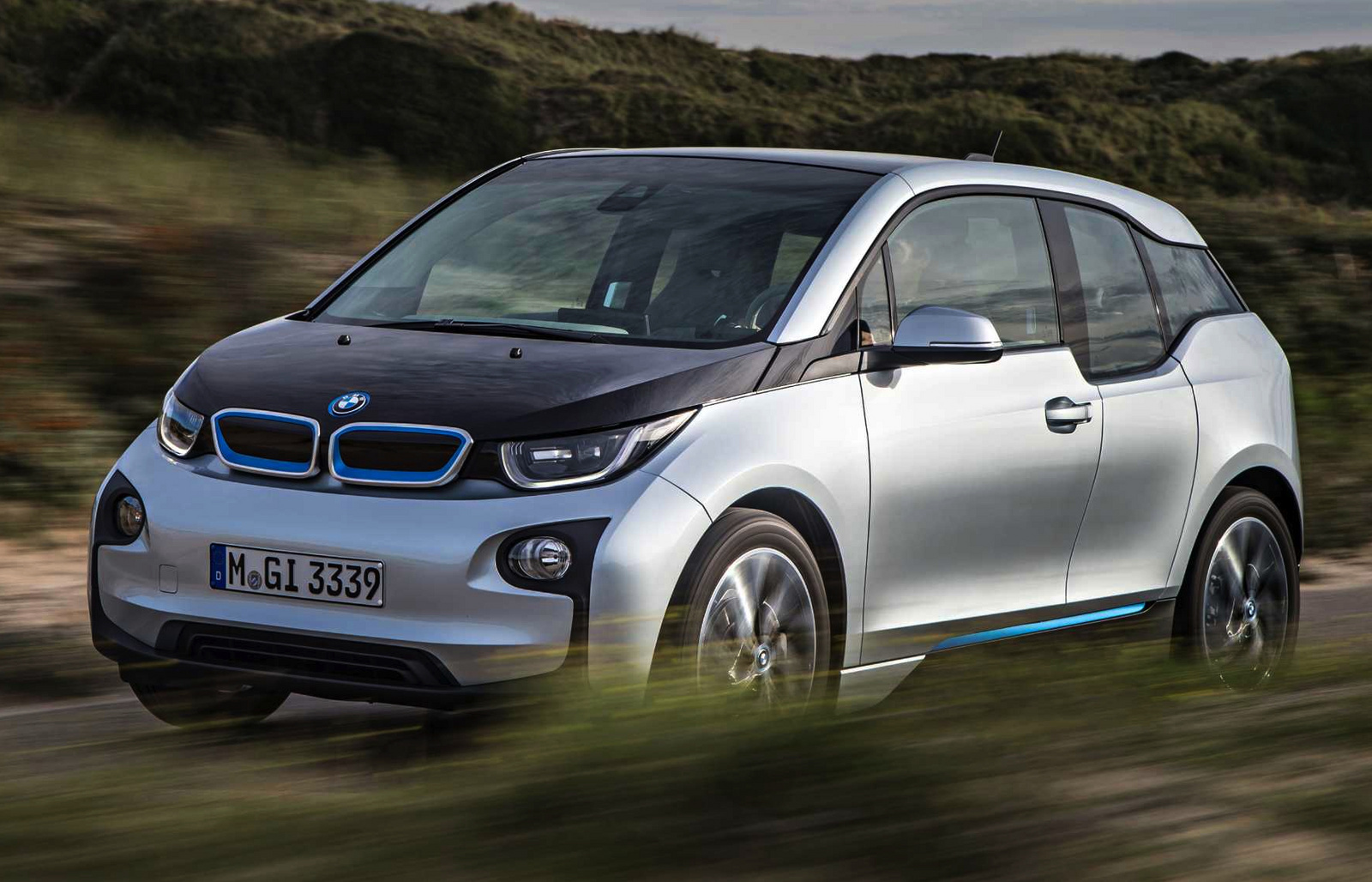
Dynamic driving, revolutionary design, and pricy efficiency are a complicated equation for BMW.

Electric versus gasoline power aside, BMW's i3 is fresh right down to its architecture. Because this is a ground-up electric rather than a conversion from an existing vehicle design, it was never intended to house an engine up front. Instead, the i3 was built utilizing BMW’s Life-Drive platform, separating passenger and drive architecture into two “modules” in a neo-retro update of the body-on-frame design of long ago. Here an aluminum chassis houses drive and suspension parts while a carbon-fiber body houses passengers. Batteries down low and drive components out back mean more room for passengers inside with a completely flat floor and plenty of legroom. And a wealth of lightweight materials throughout means a curb weight below 3,000 pounds—hundreds less than competitors like the Nissan Leaf and Chevy Volt.
But it’s not just the skeleton of the i3 that’s different. Small changes inside can be seen everywhere, proving that a small deviation from the norm can make a big impression. Hemp and kenaf fibers form the door panels, trim, and dash. Wood trim is open-pore eucalyptus, and any leather you add is naturally tanned. This means the i3 feels familiar yet strange as soon as you drop into the seat. In an industry where every car interior feels sickeningly similar, strange is a welcome feeling. Plant-fiber panels and wood are left naked, some might even say unfinished, but at least it’s not more hard-grained plastic. Textiles may be the high point here and add a touch of class that even the best leather seats would have a hard time matching. Quirky as it is, I love the interior of the i3.
For my time with the i3, I was given an example in the base Mega World trim with Range Extender ($3,850) in Andesite Silver ($550). Rather than traditional “trims,” the i3 is offered in different “worlds.” Moving up to the Giga World ($1,500) or the Tera World ($2,500) means you’ll get extra trim pieces like eucalyptus wood and leather seats, but not much else. The only options here were the heated seats ($350), which thankfully went largely unused in Northern California, but there are packages and options to be checked if the $46,250 base MSRP for the i3 with Range Extender isn’t lofty enough for you. Twenty-inch wheels ($1,300) or the Harman Kardon sound system ($800) are the only other standalones. As delivered ($950), this i3 stood at $47,050.

Let’s get this out of the way right now: The i3 is the fastest BMW ever from 0-30 mph. At 3.5 seconds, it’ll beat most anything on the road up to the typical city speed limit, and taking another 2.5 seconds to make it to 60, it’s not going to have any trouble hitting the highway, either. Stomp the accelerator, and the torque on tap is simply scary. Passengers yelped in shock as the little Bimmer leapt away from the line, quietly scooting its way to the posted speed limit.
Weighing just a couple hundred pounds more than your typical smart car, the i3 exhibits a nimbleness limited only by its tall, skinny tires. At a base size of 19 by 5 inches, they’re like nothing you’ve seen on a car this century. Hell, they're like nothing put on a car since before I was born. Pizza cutters come to mind here, and even with the larger 19-by-5.5-inch rears you can get with some of the more upscale trims and options, you’re going to look like you’re rolling along on beer coasters.
What this means is that at the limit you’re going to get some skittishness. Nanny systems engage to keep things composed, but you’ll still notice when you’re pushing too hard. This isn’t a complaint, though. Some drama is welcome here, as most cars today seem to keep the driver only peripherally involved in the act of driving. With the low center of gravity, rear-wheel drive (RWD), and balanced chassis of the i3, I had more fun behind the wheel of this little EV than most conventional cars can even offer.
That said, the i3's low weight means you’ll be pushed around a bit at highway speeds, by both wind and buffeting from passing tractor trailers. That will be alarming if you’re used to cruising around in a tank of an SUV, but nothing new if you’ve spent any time in compacts or riding motorcycles. My main concern would be how that light weight and those skinny tires would affect performance in the snow. I grew up in Western New York, driving all manner of vehicles through snowstorms that would make an Inuit wince. I’d love to see how the i3 would perform in those conditions, but I could see how some would find it uncomfortable.
The biggest difference in the way the i3 drives—beyond the gobs of torque just waiting to be abused—is in the way the power is delivered. Extreme engine braking means the i3 slows to a stop simply by releasing the accelerator. In order to “coast,” small amounts of pressure need to be maintained on the pedal, otherwise the i3 will come to a full stop. This is such a foreign concept to most drivers that BMW included a visual guide on the dash to help you understand what amount of pedal input was necessary to coast along, neither gaining nor losing speed. The system is so efficient that other than in emergency situations, I rarely used the brake pedal, as the i3 would come to a full stop even while pointing downward on many of the steep hills in the Bay Area. This is great for energy saving, but the engine braking can be so abrupt that I can see it surprising drivers following behind, who would suddenly see the i3 come rushing toward them without the added benefit of brake lights blazing. Be warned. The good news is that the i3 avoids the usual electric/hybrid bugaboo of grabby brakes thanks to fully hydraulic units.
And while you most likely won’t take the i3 on any cross-country trips, its 75-mile electric-only range is plenty for city use. Sadly, that range is just as optimistic here as it is for the rest of the electric crowd, even when in Eco Pro+ mode. Decide to have any fun with all that torque and you can watch that range drain like a bathtub. The range-extender option here adds a 2-cylinder, 647-cubic-centimeter engine stolen from BMW’s C600 scooter, used solely to provide additional power to the electric motor when the batteries deplete. To be clear, it never powers the rear wheels. As such it’ll add around 300 extra pounds to the i3 and another 75 miles to the range. If you have the BMW charging station ($1,080) installed at your home, you can get around 30 miles of range for every hour of charging, and if you’re lucky enough to find a DC fast-charge station in your city, BMW claims 80% charge in just 30 minutes. That sounds wonderful, but I had none of that in my home. The i3 was delivered to me with around 30% charge, and with a full-charge time of 20 hours from a conventional 120-volt socket, I spent a good portion of my 4 days with the i3 plugged in. Still, when the generator kicked on to keep the i3 scooting, it was barely noticeable. Step outside, however, and the coarse drone of that tiny twin was evident—kudos to BMW for proper sound insulation in the cabin.

The i3 offers a ton of room inside, even enough for rear passengers if you don’t put the front seats all the way back. The flat floor and expanse of legroom give the interior a cavernous feel, and not in a bad way. There’s plenty of storage, and the ultra-thin seats mean you’re not losing precious inches to excessive padding. They look sleek and elegant and reportedly weigh just half as much as those in other BMWs, even with the redesigned side airbags included. Electric controls were eliminated for weight considerations, which is to be applauded, but some higher-quality manual controls would be welcome. The same could be said of the door handles, which felt unacceptably flimsy.
Suicide doors can be comfortably operated only by front-seat occupants, meaning your rear passengers are stuck inside until you let them out, but otherwise entry and exit are easy here. There are no blind spots to contend with, either, something I forgot was possible in car design. And because the batteries are stored under the floor, the trunk is an actual trunk with 11.8 cubic feet of storage, expandable to 36.9 with the rear bench folded flat.
While the general interior design is a fresh approach without being disruptively revolutionary, there are places that need some attention. The awkward and clunky start/stop & transmission stalk/knob is poorly placed, ugly, and difficult to operate—some functions even require you to reach through the steering wheel. This isn’t something that can be tweaked—it simply needs a full redesign. It’s a fully electric vehicle—let’s just go with push-button operation.
Much has been written about the aesthetics of the i3, so I won’t waste too many words here. It’s a "love it or hate it" situation, and after my short time with the i3, I can definitely say I sleep in the “love it” camp. Its function as an around-town vehicle is nearly flawless, with only your particular charging situation getting in the way. That said, the home charger would be a necessity for daily use, so it’s disappointing that it’s a separate—and rather pricy—option, rather than an included feature.

Neither the National Highway Traffic Safety Administration (NHTSA) nor the Insurance Institute for Highway Safety (IIHS) have tested the i3, but with its aluminum chassis and carbon shell, BMW claims the passenger compartment will remain intact in crashes up to 40 mph.
Braking from 60 mph is said to be accomplished in less than 110 feet. This is an impressive figure, but with the low weight of the i3, I’d expect better. Perhaps some wider tires could cure this? Otherwise, the i3 comes with the usual outfit of 6 standard airbags as well as traction and stability control. We’ll wait for official word, but everything here points to safety.

User reviews for 2014 BMW i3
Write a review2014 BMW i3 Pricing
Trims & specs
Air Conditioning
Automatic climate control front air conditioning · Single front air conditioning zones
Airbags
Dual front airbags · Passenger airbag deactivation: occupant sensing deactivation · Front side airbags · Rear side curtain airbags
Audio System
Antenna Type: diversity · Bluetooth auxiliary audio input · Single disc in-Dash CD · AM/FM radio · Satellite Radio: SiriusXM · Total Number of Speakers: 4
Brakes
ABS: 4-wheel · Front brake diameter: 14.2 · Front brakes: ventilated disc · Rear brake diameter: 11.0 · Rear brakes: disc
Comfort Features
Armrests: front center · Floor Mat Material: carpet · Floor Material: carpet · Floor Mats: front
Convenience Features
Assist handle: front · Cupholders: rear · Dimming rearview mirror: auto-dimming · Memorized settings: audio system · Multi-function remote: keyless entry · One-touch windows: 4 · Power outlet(s): 12V front · Power steering: electric · Power windows: lockout button · Reading lights: front · Steering wheel: tilt and telescopic · Steering wheel mounted controls: audio · Storage: seatback · Vanity mirrors: dual illuminating
Engine
Electric Charge Cord: 240 volt · Electric Motor Battery Type: lithium ion · Electric Motor HP: 168 · Electric Motor Power Output (Kilowatts): 125 · Electric Motor Torque: 184 · Electric motor charger connector: SAE J1772 · Electric motor charging time: 4 hours · Electric motor miles per charge: 81
Exterior Features
Door handle color: body-color · Front bumper color: body-color · Grille color: black · Mirror color: black · Rear bumper color: body-color · Rear trunk/liftgate: liftgate · Window trim: black
Headrests
Front headrests: adjustable · Number of front headrests: 2
Hybrid
EV battery capacity: 22 kWh
In Car Entertainment
Infotainment screen size: 6.5 in.
Instrumentation
Fuel economy display: MPG · Warnings and reminders: low battery
Lights
Headlights: auto delay off · Tail and brake lights: LED
Mirrors
Exterior mirrors: power folding
Rear Seats
Type: 50-50 split bench
Safety
Child seat anchors: LATCH system · Crumple zones: front · Impact sensor: battery disconnect
Seatbelts
Front seatbelts: 3-point · Seatbelt force limiters: front · Seatbelt pretensioners: front · Seatbelt warning sensor: driver and passenger · Second row seatbelts: 3-point
Seats
Driver seat manual adjustments: height · Front seat type: bucket · Passenger seat manual adjustments: height · Rear headrests: adjustable · Upholstery: leatherette
Steering
Steering ratio: 14.2
Suspension
Front Arm Type: lower control arms · Front Shock Type: gas shock absorbers · Front Spring Type: coil springs · Front Suspension Classification: independent · Front Suspension Type: MacPherson struts · Rear Shock Type: gas shock absorbers · Rear Spring Type: coil springs · Rear Suspension Classification: independent · Rear Suspension Type: multi-link · Stabilizer bar(s): front
Telematics
Driver assistance app: roadside assistance · Navigation system: with voice recognition · Phone: hands free · Phone wireless data link: Bluetooth · Satellite communications: BMW Assist · Smart device app function: maintenance status
Tires
Type: all season
Tires and Rims
Wheel type: aluminum alloy
Windows
Front wipers: variable intermittent · Liftgate window: fixed · Rear wiper: variable intermittent
Air Conditioning
Automatic climate control front air conditioning · Single front air conditioning zones
Airbags
Dual front airbags · Passenger airbag deactivation: occupant sensing deactivation · Front side airbags · Rear side curtain airbags
Audio System
Antenna Type: diversity · Auxiliary audio input: jack · Single disc in-Dash CD · AM/FM radio · Satellite Radio: SiriusXM · Total Number of Speakers: 4
Brakes
ABS: 4-wheel · Front brake diameter: 14.2 · Front brakes: ventilated disc · Rear brake diameter: 11.0 · Rear brakes: disc
Comfort Features
Armrests: front center · Floor Mat Material: carpet · Floor Material: carpet · Floor Mats: front
Convenience Features
Assist handle: front · Cupholders: rear · Dimming rearview mirror: auto-dimming · Memorized settings: audio system · Multi-function remote: trunk release · One-touch windows: 4 · Power outlet(s): 12V front · Power steering: electric · Power windows: lockout button · Reading lights: rear · Steering wheel: tilt and telescopic · Steering wheel mounted controls: cruise controls · Storage: seatback · Vanity mirrors: dual illuminating
Engine
Electric Charge Cord: 240 volt · Electric Motor Battery Type: lithium ion · Electric Motor HP: 168 · Electric Motor Power Output (Kilowatts): 125 · Electric Motor Torque: 184 · Electric Vehicle Extended Range Generator Displacement: 0.7 · Electric Vehicle Extended Range Generator HP: 38 · Electric Vehicle Extended Range Generator Number of Cylinders: 2 · Electric motor charger connector: SAE J1772 · Electric motor charging time: 4 hours · Electric motor miles per charge: 72
Exterior Features
Door handle color: body-color · Front bumper color: body-color · Grille color: black · Mirror color: black · Rear bumper color: body-color · Rear trunk/liftgate: liftgate · Window trim: black
Headrests
Front headrests: adjustable · Number of front headrests: 2
Hybrid
EV battery capacity: 22 kWh
In Car Entertainment
Infotainment screen size: 6.5 in.
Instrumentation
Fuel economy display: MPG · Warnings and reminders: low battery
Lights
Headlights: LED · Tail and brake lights: LED
Mirrors
Exterior mirrors: power folding
Rear Seats
Type: 50-50 split bench
Safety
Child seat anchors: LATCH system · Crumple zones: front · Impact sensor: fuel cut-off
Seatbelts
Front seatbelts: 3-point · Seatbelt force limiters: front · Seatbelt pretensioners: front · Seatbelt warning sensor: driver and passenger · Second row seatbelts: 3-point
Seats
Driver seat manual adjustments: height · Front seat type: bucket · Passenger seat manual adjustments: height · Rear headrests: adjustable · Upholstery: leatherette
Steering
Steering ratio: 14.2
Suspension
Front Arm Type: lower control arms · Front Shock Type: gas shock absorbers · Front Spring Type: coil springs · Front Suspension Classification: independent · Front Suspension Type: MacPherson struts · Rear Shock Type: gas shock absorbers · Rear Spring Type: coil springs · Rear Suspension Classification: independent · Rear Suspension Type: multi-link · Stabilizer bar(s): front
Telematics
Driver assistance app: roadside assistance · Navigation system: hard drive navigation system · Phone: hands free · Phone wireless data link: Bluetooth · Satellite communications: BMW Assist · Smart device app function: maintenance status
Tires
Type: all season
Tires and Rims
Wheel type: aluminum alloy
Windows
Front wipers: rain sensing · Liftgate window: fixed · Rear wiper: variable intermittent

