2022 Genesis GV70 Reviews, Pricing & Specs



Pros & cons
What we like
Stylish design
Standard all-wheel drive
Impressive technology
What to consider
No hybrid option
Noisy
Poor handling
The CarGurus verdict
Genesis aims to stand out in a crowded market segment by emphasizing design.
Hyundai’s Genesis luxury brand has only been around for about five years, but it’s progressed so much in that time it seems like much longer than that. Genesis has quickly gone from selling two repurposed Hyundai sedans to fielding a full lineup of luxury cars and creating a distinct identity through bold design.
The 2022 Genesis GV70 is the brand’s latest effort. Not to be confused with the Genesis G70 sedan, the GV70 is a crossover SUV positioned below the recently-launched Genesis GV80 in size and price, meaning it competes with the Acura RDX, Audi Q5, BMW X3, Mercedes-Benz GLC-Class, Volvo XC60, and numerous other small luxury SUVs. As with the larger GV80 and the Genesis sedans, the challenge for the GV70 will be convincing new-car buyers to abandon familiar nameplates for something they might not have heard of.
The GV70 launches with a 2.5-liter turbocharged four-cylinder engine and optional 3.5-liter twin-turbocharged V6. The four-cylinder is available with Standard, Select, Advanced, and Sport Prestige trim levels, while the V6 engine is available with all trim levels except the Select. Our test car was a GV70 3.5T, a range-topping AWD Sport Prestige model with the 3.5-liter V6.
out of 10 expert review
Look & feel
The GV70 inherits some styling elements from other recent Genesis models, but it still has a unique appearance.
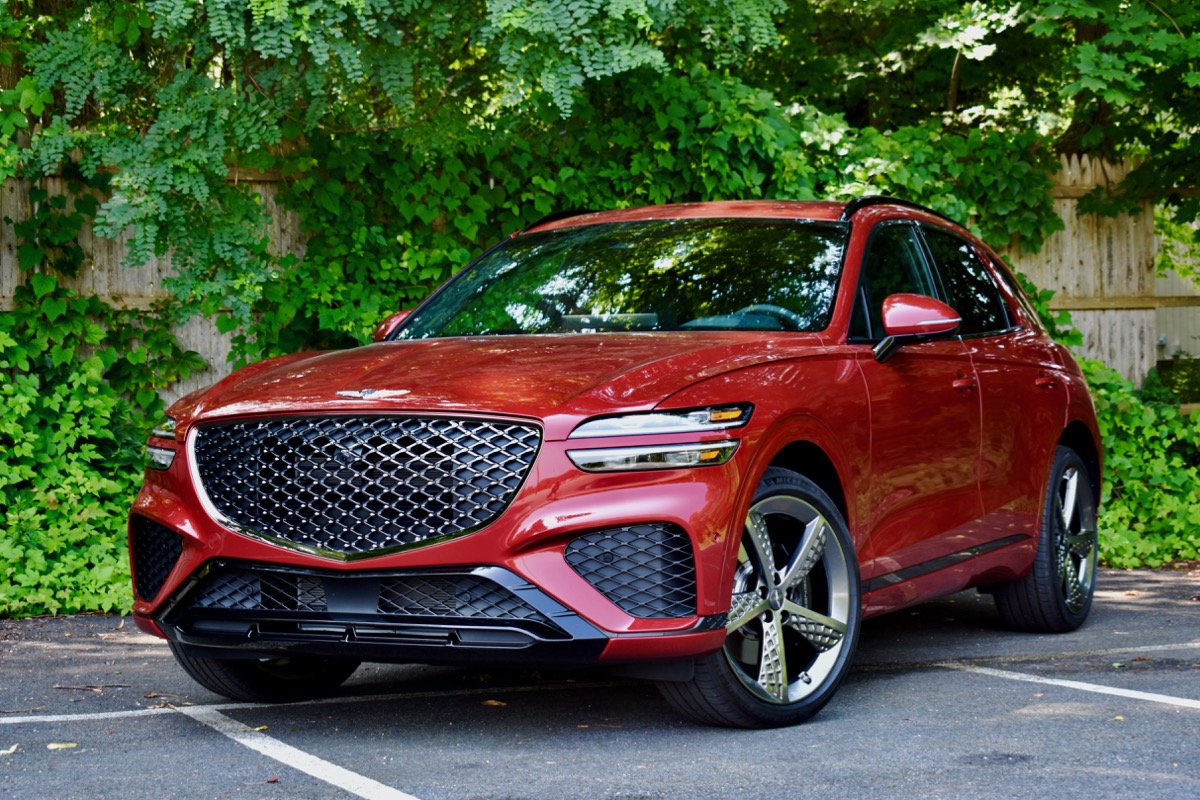
Like the other models in Genesis’s lineup, the GV70 has headlights and taillights defined by quad LED strips, and a large, shield-shaped grille. However, they’re combined with a sloping roofline that’s more fastback than SUV, and ribbed detailing that gives the GV70 a bit more muscle in profile view. The overall shape combines the SUV visual bulk buyers seem to want with some more athletic, car-like elements, making the GV70 appear both rugged and sleek.
Sport Prestige models get unique styling features that add even more character. Big fake vents look gaudy on most vehicles, but on the Sport Prestige’s model-specific front fascia, they at least frame the grille nicely. The 21-inch wheels (other models get 18-inch or 19-inch wheels) have a cool web pattern, and the chrome trim gets a dark finish. At the back, giant round exhaust outlets are sculpted into the rear bumper—no fake exhaust finishers here.
The interior has an elliptical theme that, Genesis says, is inspired by the cross-section of an airplane’s wing. Most controls are housed in a thin elliptical pod, matched by the shapes of the door handles and armrests. Genesis also kept the design wonderfully minimal, perching the touchscreen atop the dashboard and hiding the air vents in a slit that runs around the front of the cabin. A rotary gear selector and rotary infotainment controller make you feel like you’ve just sat down in a baroque spaceship, rather than a luxury SUV.
Genesis also offers a wide array of interior color options, including green and blue (with red seatbelts in our test car), so there’s no excuse to be boring. Material quality in our Sport Prestige test car seemed sufficiently luxurious, thanks to Nappa leather upholstery with suede seat inserts. However, base models get leatherette rather than real leather seats.

Performance
The base 2.5-liter turbo-four engine produces 300 horsepower and 311 pound-feet of torque, while the 3.5-liter twin-turbo V6 generates 375 horsepower and 391 lb-ft of torque. Both powertrains come with an eight-speed automatic transmission and standard all-wheel drive (AWD), something you don’t get with many competitors. Base versions of the German BMW X3 and Mercedes-Benz GLC-Class are rear-wheel drive (RWD), for example.
Genesis also throws in a rear electronic limited-slip differential and launch control. More appropriate for a sporty coupe than a compact SUV, launch control is designed to take the guesswork out of pulling away from a stop in a hurry. Since most luxury SUV owners don’t take their vehicles to the drag strip, it’s not exactly a relevant feature.
The inclusion of launch control suggests Genesis wanted the GV70 to be on the sportier side of the spectrum, as does the aggression of the Sport+ drive mode. Engage Sport+, and the transmission will hold impressively high revs to keep the engine in its power band, while throttle response sharpens up significantly. That’s great if you need to overtake someone in a hurry but seemed out of sync with the GV70’s overall character.
While the powertrain can be turned up to 11, the chassis never gets there. The GV70 never stops feeling big and heavy, and it lacks the sharpness of the Acura RDX, BMW X3, or Porsche Macan when pushed. Similarly, the steering felt fine at most speeds but just wasn’t precise enough for spirited driving. And as cool as the sport model’s giant exhaust outlets looked, the sound coming out of them wasn’t pleasant.
The GV70 felt more comfortable with itself when cruising down a highway, or trundling through quaint New York and Connecticut towns, but it’s not the gold standard for luxurious driving. Equipped with 21-inch wheels, our test car had a pretty firm ride (even in Comfort mode), and it lacked the feeling of solidity we expect from a true luxury vehicle.

Form & function
Interior space is mid-pack for this segment. Despite the car-like roof line, the GV70 does offer the same front-seat headroom as a Mercedes-Benz GLC-Class, and the same back-seat headroom as a BMW X3, but it doesn’t lead the segment in any measurements. Subjectively, legroom in both rows seemed adequate, and rear-seat visibility was good thanks to relatively thin rear pillars.
At 28.9 cubic feet with the rear seats in place, and 56.9 cubic feet with the rear seats folded, the amount of cargo space also won’t win the GV70 any awards. It places the Genesis in the substantial middle ground between the segment-leading Infiniti QX50 and bottom-of-the-pile Lexus NX and Porsche Macan.
Up front, the daringly-designed interior compromises storage space. The slim center console doesn’t leave much room to put small items or purses, nor do the thin door pockets. Genesis did included a covered storage cubby for phones, though, complete with USB ports, while rear-seat passengers get their own climate controls.
The front seats in our Sport Prestige test car were heavily bolstered, which was great for spirited driving but might feel too confining for some drivers. The driver's seat and front passenger's also featured heating/ventilation, massage, and posture-assist functions, which seemed designed on a scale of difficulty. Heating and ventilation controls were clearly displayed on the dashboard, but the massage controls were buried in touchscreen menus, and the posture assist seemed to activate itself whenever the driver shifted in the seat.

Technology
Like most vehicles in this segment, the GV70 offers a lot of tech. Unlike many competitors, though, you’ll actually want to use it.
The standard infotainment system includes a 14.5-inch touchscreen with Apple CarPlay and Android Auto connectivity. While the screen’s landscape orientation might not satisfy those aiming for Tesla-style flexing, we liked its tile-based layout and crisp typefaces and graphics. The infotainment system’s glass rotary controller was a high-quality item that also proved functional, thanks to integrated pinch-and-zoom functionality.
You can also get a 12.3-inch digital instrument cluster and 12-inch head-up display on higher trim levels. Digital instrument clusters are fairly common these days, but Genesis’ version has a 3D effect that makes the graphics stand out a bit more.
The GV70 also gets the digital-key feature already available in some models from Genesis parent Hyundai, as well as most Lincoln SUVs, letting drivers use a smartphone in place of a key fob. Alternatively, you can use the standard fingerprint scanner to start the car, as well as call up a cloud-based driver profile.
Genesis also offers a higher-tech version of the rear-seat monitors offered by many other automakers as a way to prevent drivers from leaving children or pets unattended. This version uses radar that’s sensitive enough to detect a baby’s breathing, according to Genesis. Similarly, while most competitors offer 360-degree camera systems, Genesis will let you activate the cameras remotely (through an app) to see what’s around the vehicle before getting in. The latter feature is part of Genesis Connected Services, which is included free for three years and also bundles driver profiles, last-mile guidance navigation, and a valet mode.

Safety
Because the GV70 is a new model, crash-test ratings from the Insurance Institute for Highway Safety (IIHS) and National Highway Traffic Safety Administration (NHTSA) aren’t available yet.
The GV70 comes standard with myriad safety features, including lane-keep assist, forward-collision warning, blind-spot and forward collision-avoidance assist, rear cross-traffic alert, a driver-attention monitor, and Highway Driving Assist, which adds automated lane centering to adaptive cruise control. The GV70 also gets eight standard airbags, including a front-center airbag that inflates between the front seats.
Optional driver-assist features include a Highway Driving Assist 2 system that adds lane-change functionality, blind-spot monitoring, and navigation navigation-based adaptive cruise control with auto-curve slowdown.
On New York City-area highways and parkways, we were impressed by Highway Driving Assist’s smooth control inputs but, as with other similar systems, the lane-centering function couldn’t handle every curve. That severely limits the utility of tech like this, unless you live in the Midwest or Florida.

Cost-effectiveness
EPA fuel-economy ratings for the four-cylinder GV70 are 24 mpg combined (22 mpg city, 28 mpg highway) with 18-inch or 19-inch wheels, but the available 21-inch wheels knock that down to 22 mpg combined (19 mpg city, 26 mpg highway). V6 models are rated at 21 mpg combined (19 mpg city, 25 mpg highway).
While the GV70 isn’t the only vehicle in its segment without a hybrid powertrain option, many competitors do offer one. The Lexus NX is available as a hybrid, while the Audi Q5, BMW X3, Lincoln Corsair, and Volvo XC60 are available as plug-in hybrids.
Genesis offers a 10-year, 100,000-mile powertrain warranty and five-year, 60,000-mile basic warranty, plus three years or 36,000 miles of complimentary scheduled maintenance.
Pricing for the 2022 Genesis GV70 starts at $42,045 for a base 2.5T AWD Standard model, and manufacturer's suggested retail price (MSRP) rises to $63,545 for the range-topping 3.5T Sport Prestige trim level. It may be an expensive vehicle, but the GV70 is a good value by luxury-car standards. Genesis offers an impressive number of standard features, including AWD, the 14.5-inch touchscreen, and a decent array of driver aids.
While driving dynamics fell short of a home run, everything else about the GV70 was great. It combines SUV practicality with distinctive looks, and features well-integrated tech, to boot. With many small luxury SUVs, you’re mostly paying for a badge. With the GV70, you’re getting a true luxury vehicle.

What owners say
"Owners are generally thrilled with the 2022 Genesis GV70, praising its comfort, luxury, and overall value for money. Many appreciate the spacious interior and high-quality materials, often comparing it favorably to competitors like Lexus and Acura. However, some drivers mention that certain tech features are lacking in the base model and express concerns about interior design choices, especially the infotainment system and space for taller drivers."
Great look and very nice interior, full of great features. Fun to drive.
August 19, 2025Great vehicle. Good value. Wish they had fixed the check engine light issue before selling
December 16, 2024Luxurious, practical, value for money and spacious SUV which packs a punch when needed.
February 23, 2023What owners say
Great look and very nice interior, full of great features. Fun to drive.
August 19, 2025Great vehicle. Good value. Wish they had fixed the check engine light issue before selling
December 16, 2024Luxurious, practical, value for money and spacious SUV which packs a punch when needed.
February 23, 2023Beautiful design. Smooth ride. High quality materials. Great electronics. Quiet. Roomy. Cant praise it enough. Ive owned Mercedes and Jaguar. No comparison. Genesis left everyone behind.
December 11, 2023Acceleration is awe inspiring. It feels like you are sucking the other cars headlights out when pulling away from a traffic light. Perfectly comfortable. Lots of cool features - including an auto park capability. Whats not to like?
December 19, 2023This car blows its competitors away! It’s drives like a 6cylinder, is well equipped, priced aggressively and well made with the best warranty to back it up.
January 9, 2023Good value for money and very reliable. Built well and finish is excellent. In my case with long legs there is not enough room to sit comfortably in the driving position and drive the vehicle safely.
October 18, 2022We love it. Excellent value; extremely comfortable. I cant think of anything that it is missing. We compared it to Lexus 350 and Acura MDX.
October 15, 2021I bought the base model of the GV70. It has all the comfort and quiet of more expensive fits, but no moon/sun roof and less technology. I miss the front parking warnings and the heated steering wheel but not much else. I traded a Subaru Forester Touring, which is not nearly what this car is, but I honestly have to say that the Subaru has a slightly better assisted cruise control and lane-centering capability.
March 5, 2022Its not a BMW X3 nor a Mercedes-Benz GLC 300. By any stretch of the imagination.
February 24, 2023Trims & specs
Base MSRP $45,150 | Seating 5 |
Engine 2.5L 300 hp I4 | Cargo Capacity 28.9 cu ft |
Combined MPG 25 | Drivetrain AWD |
Base MSRP N/A | Seating N/A |
Engine N/A | Cargo Capacity N/A |
Combined MPG N/A | Drivetrain N/A |
Base MSRP N/A | Seating N/A |
Engine N/A | Cargo Capacity N/A |
Combined MPG N/A | Drivetrain N/A |
Base MSRP $58,800 | Seating 5 |
Engine 3.5L 375 hp V6 | Cargo Capacity 28.9 cu ft |
Combined MPG 21 | Drivetrain AWD |
Base MSRP N/A | Seating N/A |
Engine N/A | Cargo Capacity N/A |
Combined MPG N/A | Drivetrain N/A |


Pricing trends
MSRP range
$41,500 - $53,100
Current avg. market price
$30,411
Trending down by 2.5% this month
May 2026 - November 2026


