2022 Cadillac Escalade Reviews, Pricing & Specs



Pros & cons
What we like
Multiple powertrain options
Impressive technology
Easy-to-use technology
What to consider
Poor ride quality
Poor fuel economy
Interior materials feel cheap
The CarGurus verdict
From the grille to the dashboard screen, everything is bigger in the Escalade.
Over roughly two decades in production, the Cadillac Escalade has become the General Motors luxury brand’s de facto flagship. It may share underpinnings with more pedestrian SUVs and pickup trucks from other GM brands, but the Escalade sits at the top of the Cadillac hierarchy in price, size, and—thanks to Cadillac’s constant reshuffling of its other nameplates—name recognition. It’s also an established player in a robust niche of big luxury SUVs.
The Escalade’s competitive set splits into two camps: other truck-like body-on-frame SUVs (Lincoln Navigator, Infiniti QX80, Jeep Grand Wagoneer, Lexus LX) and upscale unibody SUVs (BMW X7, Land Rover Range Rover, Mercedes-Benz GLS-Class). It’s a good time to be shopping for a full-size luxury SUV, in other words.
Cadillac has one of the freshest entries in this group. The Escalade was redesigned for the 2021 model year, adding a number of notable features like a 38-inch OLED display screen and GM’s Super Cruise hands-free driving system.
Changes for this generation’s sophomore model year are minor. A Buckle to Drive feature that forces the driver to buckle their seatbelt before setting off is now standard, lane-keep assist and lane-departure warning are now standard on the base Escalade Luxury trim level, and Premium Luxury Platinum and Sport Platinum models gets standard puddle lamps. Cadillac also added three extra-cost colors: Mahogany Metallic, Galactic Gray Metallic, and Wilder Metallic.
The Escalade is available in standard-wheelbase and long-wheelbase Escalade ESV body styles (the latter will be covered in a separate review), with the option of gasoline or diesel engines and five trim levels: Luxury, Premium Luxury, Sport, Premium Luxury Platinum, and Sport Platinum. We hoisted ourselves into a standard-length Premium Luxury diesel model for this review.
out of 10 expert review
Look & feel
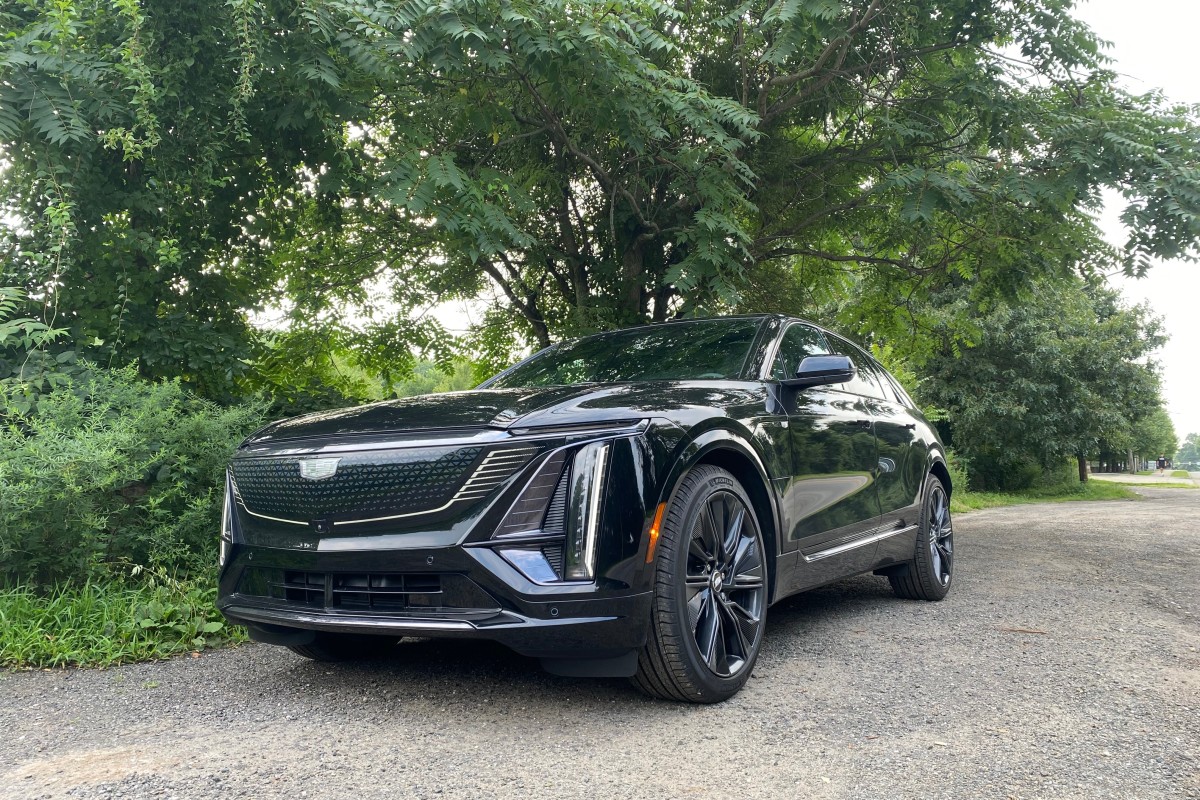
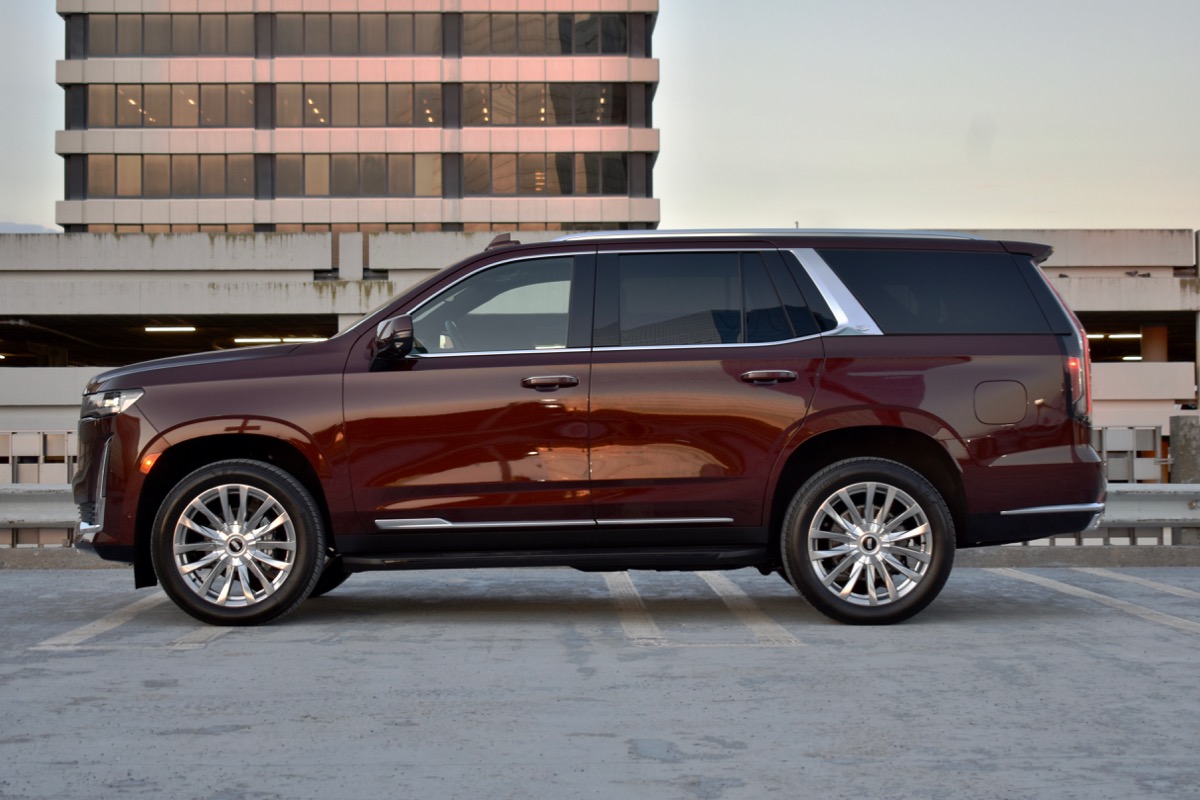
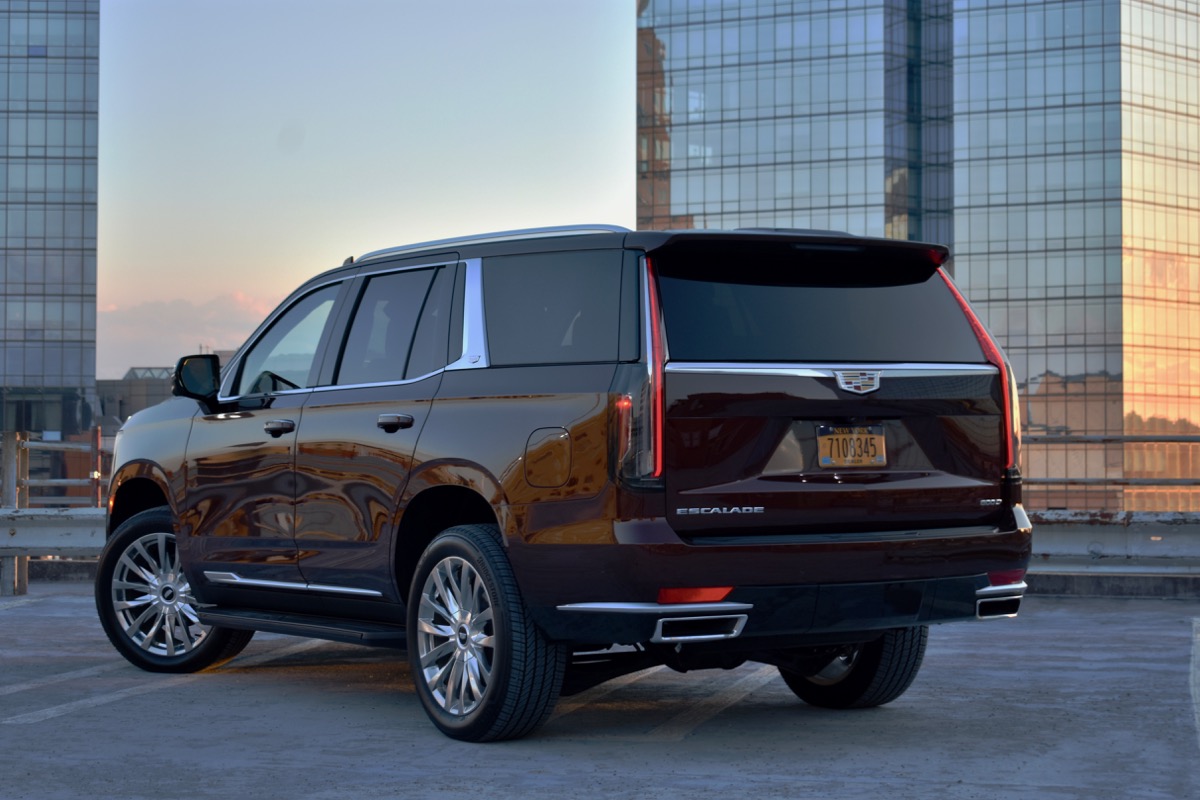
The Escalade makes a strong first impression. It’s not the only massive SUV out there, but few are so unapologetic about their size. The grille, LED daytime running lights, and taillights are scaled up to match the Escalade’s size, the taillights vaguely recalling the sky-high tailfins of classic Cadillacs.
With its tall hood, vertical running lights, and horizontal headlights, the front end looks like it came off a diesel locomotive, not a car. Overall, the various styling elements come together to make the Escalade look distinct from other GM full-size SUVs (which wasn’t always the case with past models) but they always emphasize the vehicle’s bulk. Our test car’s 22-inch wheels looked tiny in comparison to the vast expanse of sheetmetal they were situated in.
The Escalade also follows the pattern of other Cadillac SUVs in offering different trim pieces for “sport” and “luxury” models. The Escalade Luxury and Premium Luxury get bright exterior trim and wheels, while the Escalade Sport gets darkened trim, including a mesh grille.
The Escalade rides on the same body-on-frame architecture as other current-generation GM full-size SUVs, including the Chevrolet Tahoe and Suburban and GMC Yukon and Yukon XL, as well as the Chevy Silverado 1500 and GMC Sierra 1500 full-size pickup trucks. That may not seem like the best starting point for a luxury vehicle, but it hasn’t bothered customers over the years. It’s also the same approach used by the rival Lincoln Navigator, which shares underpinnings with the Ford Expedition and the F-150 pickup.
The interior checks all of the boxes for luxury without having a cohesive design theme. Leather upholstery, wood trim, and a massive panoramic sunroof are included, but the Escalade doesn’t have a distinctive interior design to match, for example, the Lincoln Navigator’s midcentury-modern-inspired look. And while most of the materials looked nice, Cadillac still included a lot of cheap-looking plastic bits.
Performance
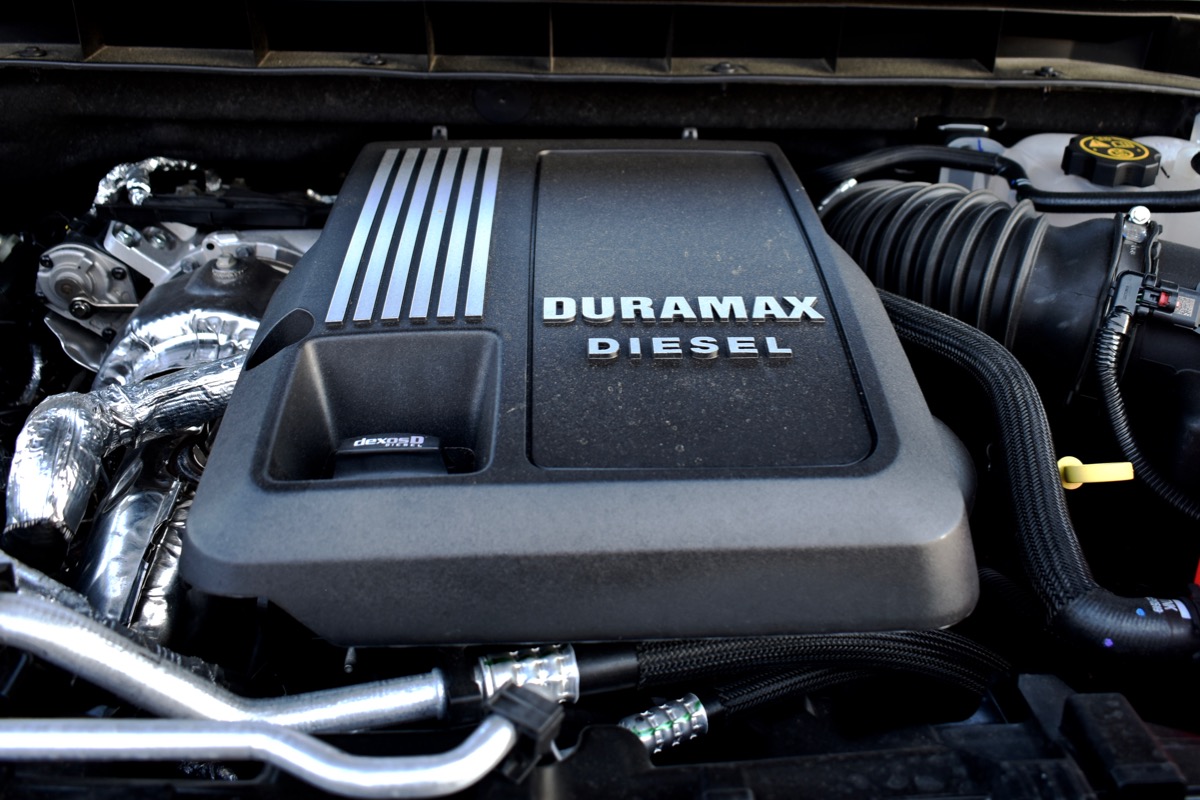
The Escalade gets two powertrain choices—both shared with other GM SUVs and trucks. The standard 6.2-liter gasoline V8 produces 420 horsepower and 460 pound-feet of torque. Also available as a $100 option is GM’s Duramax 3.0-liter turbocharged inline-six diesel engine, which produces 277 hp and 460 lb-ft of torque. Both engines are teamed with a 10-speed automatic transmission and standard rear-wheel-drive (RWD) or optional four-wheel-drive (4WD) drivetrains. A 2023 Cadillac Escalade-V performance model is available, with a 682-hp 6.2-liter supercharged V8.
We tested the Escalade diesel for this review, and while new-car buyers old enough to remember Cadillac’s dismal 1970s diesels might recoil at the prospect, we thoroughly enjoyed it. Despite its horsepower deficit to the V8 engine, the turbo-six had no trouble propelling the Escalade in all situations. Power delivery was smooth, and the diesel’s much lower torque peak of 1,500 rpm (versus 4,100 rpm for the gasoline engine) was a real asset when pulling away from a stop. When it came time to stop again, however, a very hard brake pedal didn’t inspire much confidence.
When it comes to towing, the gasoline engine has a slight advantage. It has a maximum towing capacity of 8,200 pounds—100 pounds more than the diesel. Note that this is achieved only with the standard-wheelbase body style, RWD, and an optional trailering package. That also falls short of the Lincoln Navigator, which can tow up to 8,700 pounds when properly equipped.
Most drivers probably won’t be using all of that towing capacity on a daily basis, but they will notice the Escalade’s unsettled ride. Cadillac did fit the Escalade with standard independent rear suspension (air suspension and Magnetic Ride Control dampers are available as well) but the Escalade still felt decidedly un-luxurious.
With its body-on-frame construction and 22-inch wheels, our test Escalade was always going to be at a disadvantage to unibody SUVs like the BMW X7, Mercedes-Benz GLS, and Range Rover in comfort and composure. But the big Cadillac also fell short of the equally truck-like Navigator and Grand Wagoneer on our test loop. The body never felt settled; it always seemed to be pitching or jiggling about. Any actual pavement imperfections sent vibrational waves through the cabin.
While it does have some truck DNA, the Escalade doesn’t offer the off-road capability of its GM cousins. There’s no Escalade equivalent to the Chevy Tahoe/Suburban Z71 or GMC Yukon/Yukon XL AT4. If you need something to reach your glamping site in style, the Range Rover, QX80, Grand Wagoneer, or LX are more appropriate choices.
Form & function
As with previous generations, the 2022 Escalade is essentially a high-end version of other GM full-size SUVs. The standard version shares its body shell and chassis with the Chevrolet Tahoe and GMC Yukon, while the extended Escalade ESV is a cousin of the Chevrolet Suburban and GMC Yukon XL. The standard Escalade measures 211.9 inches long, while the ESV is 15.1 inches longer, at 227 inches.
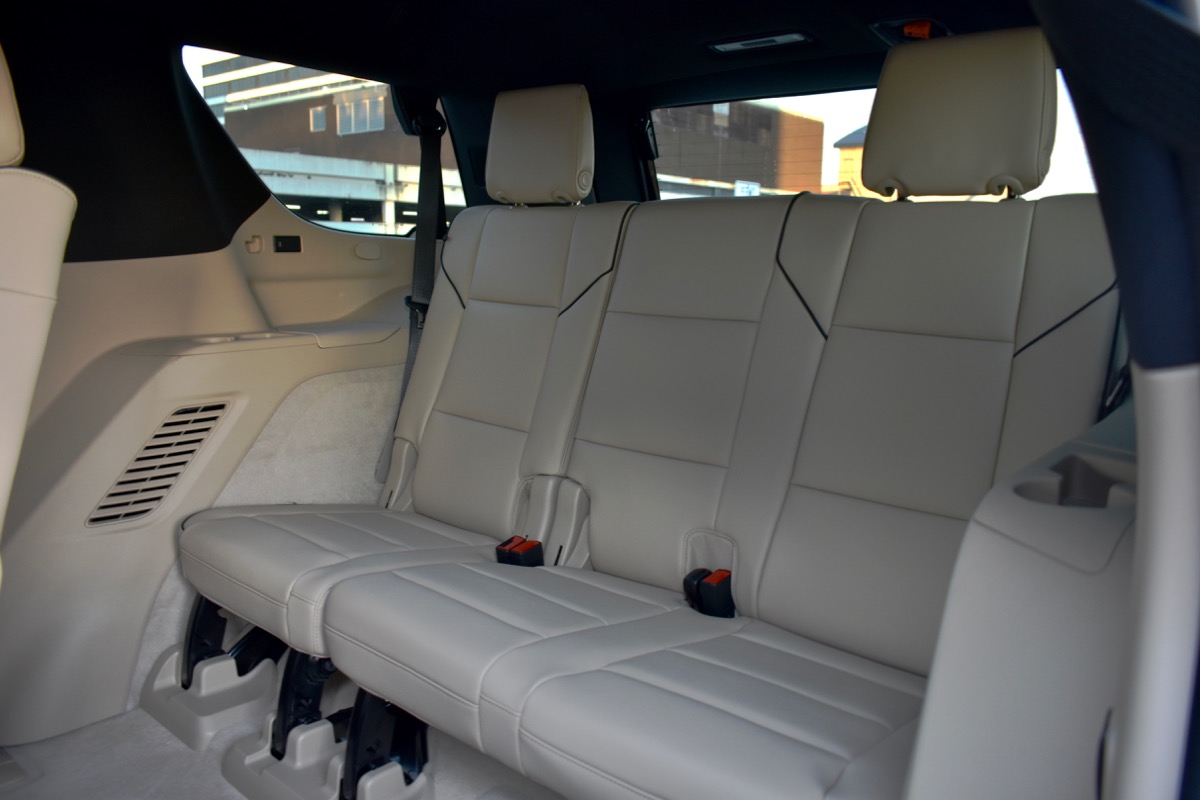
That platform sharing gives the Escalade a cavernous cabin. It offers the most first-row and third-row legroom among full-size luxury SUVs, although the Lincoln Navigator gives second-row passengers a bit more headroom. Second-row captain’s chairs and a 60/40 power split-folding third-row bench seat are standard, but the second row can also be equipped with a power-folding 60/40 bench seat as a no-cost option.
The Escalade is also a cargo-hauling champ. At 25.5 cubic feet with all seats in place, 63.0 cubic feet with the third-row seats folded, and 109.1 cubic feet with all rear seats folded, the Cadillac offers more cargo space than even the equally massive Navigator.
While the interior is spacious, there were some minor functionality issues. The raised center console doesn’t provide much room for storage space, leaving nowhere to easily toss loose items. And while the Escalade does get 12-way power adjustable front seats with massage and lumbar support (the latter is temporarily unavailable due to the chip shortage, however), the seats themselves felt they could have come out of one of the Escalade’s GM cousins.
Cadillac did get some important details right, though, including dedicated buttons for seat heating and ventilation, and large sun visors for the vast expanse of side-window glass.
Technology
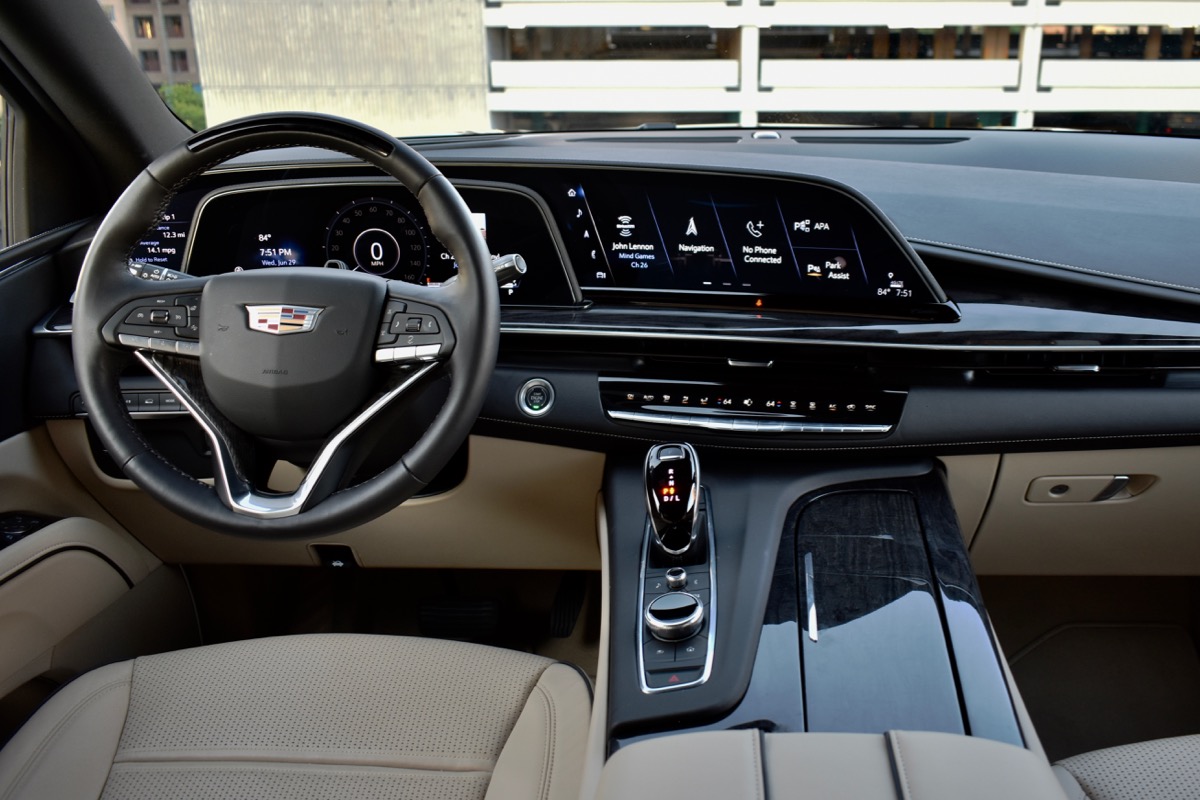
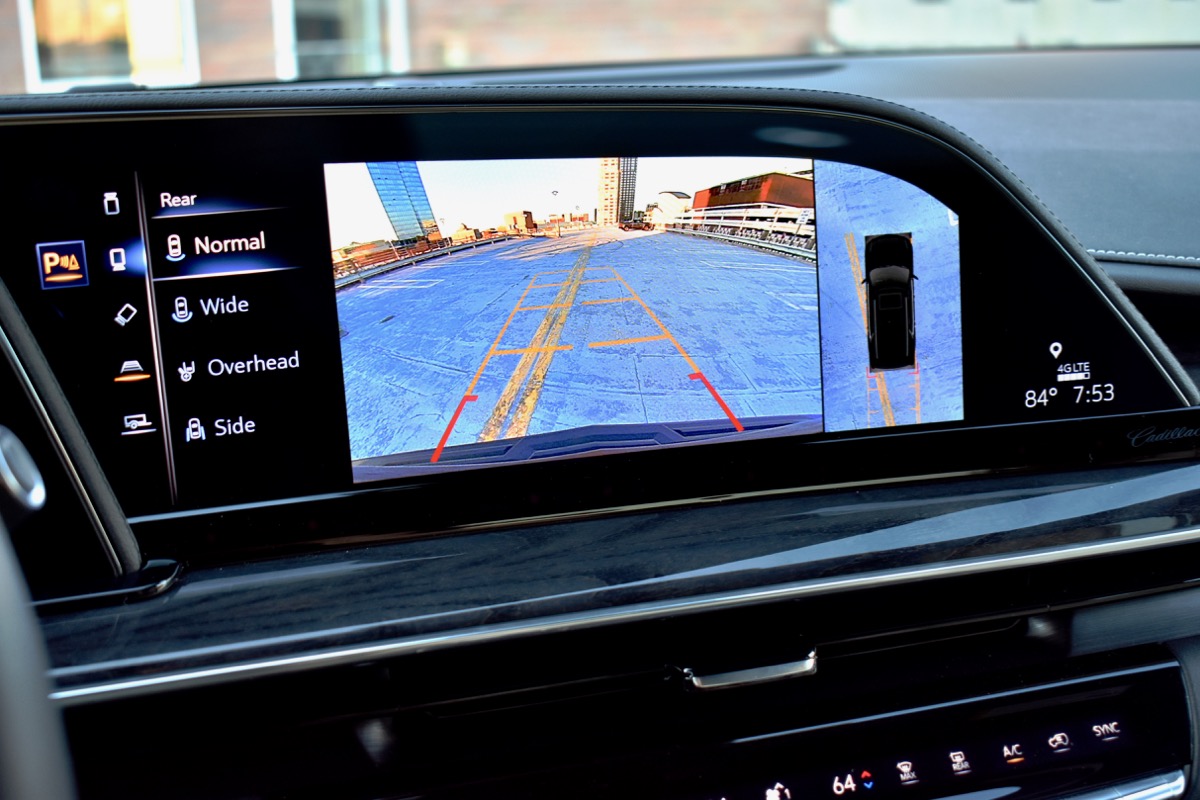
The Escalade boasts one of the most elaborate infotainment displays in any current production vehicle. The 38-inch curved OLED display is actually three screens nested together. A 14.2-inch digital instrument cluster is flanked by a 16.9-inch touchscreen on the right, and a 7.2-inch screen on the left that primarily serves trip-computer functions. Wireless Apple CarPlay and Android Auto, as well as Bluetooth connectivity, are standard.
Unlike some other automakers, Cadillac paid attention to how the display would fit into the dashboard, and how to make the best use of the screen space. This isn’t just a tablet sticking out of the dashboard; it blends in nicely with the rest of the interior. The touchscreen’s icons are also arranged to fit its shape, so you get a home row of diagonally arranged icons for music, phone connectivity, and navigation that’s both cool looking and functional. Cadillac also retained physical toggles for the climate control and other important functions.
We did have a few issues, though. The carousel format for changing radio stations, in which you continually swipe to bring up another station, was neat looking but awkward to use while driving. Cadillac’s rotary controller also seemed like an afterthought, and the brand’s infotainment systems still lack the natural language voice recognition you get in BMW and Mercedes SUVs these days.
However, the Escalade had one feature that’s crucial in a big SUV. Its OLED screens provided on unparalleled resolution when using the standard 360 degree camera system. And unlike many other cars, you can call up a camera view in the instrument cluster as well as the central touchscreen. The Escalade also has the rearview camera mirror that’s been appearing in GM vehicles for a few years now. Since you’re viewing the feed from an exterior camera, you don’t get blind spots from the rear seats or pillars.
The Escalade also offers an impressive breadth of tech features. In addition to expected features like a head-up display, it can be equipped with night vision and augmented-reality navigation, which uses prominent arrows to help ensure you don’t miss a turn. A 19-speaker AKG Studio sound system is standard as well, but we found it difficult to tune properly. Speakers mounted in the front headrests seemed to distort the sound for front-seat occupants as well.
Safety
Standard driver-assist tech includes adaptive cruise control, forward-collision warning, automatic emergency braking (front and rear), front and rear park assist, lane-keep assist, and lane-departure warning. Many of the warnings from these driver aids are dispatched through Cadillac’s vibrating Safety Alert Seat.
On top of those features, blind-spot monitoring and rear cross-traffic alert are standard on Escalade Premium Luxury and higher trim levels, with trailer blind-spot monitoring standard on Premium Luxury Platinum trims and above. Super Cruise is a $2,500 option on most trim levels but is unavailable on the base Luxury model.
Super Cruise is one of the most sophisticated driver-assist systems on the market today. It can steer, brake, and accelerate on highways, as well as execute automated lane changes, for truly hands-free driving. To ensure safety, Super Cruise only works on pre-mapped stretches of highway (over 200,000 miles in the United States and Canada are compatible, Cadillac claims) and uses a driver-facing camera to check for distraction. Because while Super Cruise allows for hands-free driving, the person behind the wheel is still responsible for monitoring the system, must be ready to take back full control at all times.
While we did find that the system didn’t seem to like a specific piece of road and would disengage for unknown reasons, we were impressed by Super Cruise in the Escalade. Its responses were much smoother and more natural than other driver-assist systems, and not having to hold the steering wheel means it’s less likely the system will get accidentally deactivated by tugging the wheel too hard. And it makes sense to fit this technology to a big SUV, which drivers might find harder to place on the road unassisted than a normal-sized vehicle.
While the Escalade might be able to avoid some crashes, we don’t know how well it can protect occupants compared to other full-size luxury SUVs should a crash occur. The Insurance Institute for Highway Safety (IIHS) and National Highway Traffic Safety Administration (NHTSA) didn’t publish safety ratings for this model year.
Cost-effectiveness
With the gasoline V8 engine, the Escalade gets the same 16 mpg combined (14 mpg city, 19 mpg highway) EPA fuel economy ratings whether you equip it with RWD or 4WD. The Escalade Duramax diesel is rated at 23 mpg combined (21 mpg city, 27 mpg highway) with RWD and 22 mpg combined (20 mpg city, 26 mpg highway) with 4WD. We achieved an observed 22.3 mpg average in our 4WD diesel test vehicle, so it appears the diesel’s fuel economy advantage holds up in the real world.
The Escalade has a four-year, 50,000-mile, bumper-to-bumper warranty and six-year, 70,000-mile, powertrain warranty.
Pricing starts at $77,990 for a base Luxury model with RWD, and runs up to $110,535 for a 4WD Escalade Sport Platinum (all prices include a $1,695 destination charge). Equipped with the diesel engine and 4WD, our mid-level Escalade Premium Luxury test vehicle had an $89,590 base price, and the addition of Super Cruise, Mahogany Metallic paint, and an engine block heater left the as-tested price at $92,715. While the Escalade isn’t cheap, Cadillac does deserve credit for making most safety features, as well as the 38-inch OLED display and 19-speaker AKG audio system standard equipment.
Overall, the Escalade gets points for those tech features, the available Super Cruise system, and the marvelous available Duramax diesel engine. However, the Caddy’s ride quality and interior materials aren’t on the same level as other full-size luxury SUVs. The Escalade isn’t particularly pleasant to drive on-road, and it lacks the off-road capability of competitors like the Range Rover, Infiniti QX80, Jeep Grand Wagoneer, and Lexus LX. This is still the best Escalade ever, though, and that will probably be enough for many buyers.
What owners say
"Owners are very impressed with the 2022 Cadillac Escalade, praising its smooth ride, advanced technology, and spacious interior. Many appreciate the new OLED screens and the larger cargo area compared to previous models. However, no negative points were mentioned in the reviews provided, indicating overall satisfaction with the vehicle."
This is an amazing vehicle. It has everything you could possibly imagine and rides so smoothly!! I purchased the sport platinum and could not be happier!!!
August 9, 2022I love super cruise and now it’s changes lanes automatically—love it
November 14, 2022This is the best car i have ever had , because the ideal car for families purpose even for daily driving is so confortable.
March 13, 2024What owners say
This is an amazing vehicle. It has everything you could possibly imagine and rides so smoothly!! I purchased the sport platinum and could not be happier!!!
August 9, 2022I love super cruise and now it’s changes lanes automatically—love it
November 14, 2022This is the best car i have ever had , because the ideal car for families purpose even for daily driving is so confortable.
March 13, 2024Great features, especially the technology.. more than what I expected.
November 17, 2023It’s new OLED screens are awesome. Wider front cabin area, adjustable second row seats, larger cargo area in back that our 2016. Very nice updates and upgrades.
March 16, 2023Trims & specs
Base MSRP $92,595 | Seating 8 |
Engine 6.2L 420 hp V8 | Cargo Capacity 25.5 cu ft |
Combined MPG 16 | Drivetrain 4X4 |
Base MSRP $107,095 | Seating 8 |
Engine 6.2L 420 hp V8 | Cargo Capacity 25.5 cu ft |
Combined MPG 16 | Drivetrain 4X4 |
Base MSRP $107,095 | Seating 8 |
Engine 6.2L 420 hp V8 | Cargo Capacity 25.5 cu ft |
Combined MPG 16 | Drivetrain 4X4 |
Base MSRP $89,595 | Seating 8 |
Engine 6.2L 420 hp V8 | Cargo Capacity 25.5 cu ft |
Combined MPG 16 | Drivetrain 4X4 |
Base MSRP $104,095 | Seating 8 |
Engine 6.2L 420 hp V8 | Cargo Capacity 25.5 cu ft |
Combined MPG 16 | Drivetrain RWD |
Base MSRP $104,095 | Seating 8 |
Engine 6.2L 420 hp V8 | Cargo Capacity 25.5 cu ft |
Combined MPG 16 | Drivetrain RWD |
Base MSRP $80,795 | Seating 8 |
Engine 6.2L 420 hp V8 | Cargo Capacity 25.5 cu ft |
Combined MPG 16 | Drivetrain 4X4 |
Base MSRP $77,795 | Seating 8 |
Engine 6.2L 420 hp V8 | Cargo Capacity 25.5 cu ft |
Combined MPG 16 | Drivetrain RWD |
Base MSRP $86,595 | Seating 8 |
Engine 6.2L 420 hp V8 | Cargo Capacity 25.5 cu ft |
Combined MPG 16 | Drivetrain RWD |
Base MSRP $89,595 | Seating 8 |
Engine 6.2L 420 hp V8 | Cargo Capacity 25.5 cu ft |
Combined MPG 16 | Drivetrain RWD |


Pricing trends
MSRP range
$77,795 - $107,095
Current avg. market price
$58,153
Trending down by 2.2% this month
May 2026 - November 2026